AIUEO JLPT Grammar
Meaning
「〜かねる」expresses that due to abilities or circumstances, it is difficult or impossible to perform a certain action. It is used as a polite refusal or expression of hesitation.
How to use it
Verb (ます-form) + かねる
In context 5 examples
あなたの意見には賛成しかねる。
I cannot agree with your opinion.
その提案は受け入れかねます。
I find it difficult to accept that proposal.
彼の行動は理解しかねるものです。
His actions are hard to understand.
申し訳ありませんが、こちらで両替はしかねます。
Sorry, but we cannot exchange money here.
この件について、うちの会社では対応しかねますよね?
Our company can't handle this matter, right?
Read the original source text
Meaning
「〜かねる」expresses that due to abilities or circumstances, it is difficult or impossible to perform a certain action. It is used as a polite refusal or expression of hesitation.
How to use it
動詞ます形+かねる
Explanation · 日本語
「〜かねる」は、能力的または状況的に、ある行動をするのが難しい、またはできないことを示します。断るときや遠慮を込めた表現として使われます。
文法
Meaning
“Cannot 〜”
Expresses impossibility and is a formal expression, so it is often used in business.
「かねる」 conveys the sense of “cannot do it even if one tries” or “it is difficult to do,” and is used to refuse indirectly.
How to use it
V (ます-stem) + かねる
Notes
Incorrect usage examples:
Since this cannot be used when something is impossible due to lack of ability, sentences like the following cannot be said.
❌ I cannot speak Chinese.
❌ People cannot fly in the sky.
In context 6 examples
私は責任者ではございませんので、その質問にはお答えしかねます。
I am not the person in charge, so I cannot answer that question.
B社の提案ですが、私個人としては賛成致しかねます。
Regarding Company B’s proposal, I personally cannot agree.
自分の希望する大学と親の希望する大学が違うので、どの大学を受験するか決めかねている。
The university I want to attend and the one my parents want me to attend are different, so I can’t decide which university to apply to.
あまりにも日本語ができないジョンさんに見かねた校長は彼をもう一度、初級から勉強させることにした。
Unable to bear seeing how little Japanese John knew, the principal decided to have him study again from the beginner level.
仕事の忙しさに耐えかねた彼は半年も経たないうちに会社を辞めてしまった。
Unable to endure how busy his job was, he quit the company in less than six months.
上司の提案に納得しかねる部分があったが、我々は受け入れざるを得なかった。
There were parts of my supervisor’s proposal that I found difficult to accept, but we had no choice but to accept it.
Read the original source text
Meaning
"〜できない"
不可能を表し、硬い表現なのでビジネスで使われる場合が多い。
「かねる」は「~しようとしてもできない」、「〜するのが難しくできない」という気持ちが含まれており、婉曲的に断るときに使われる。
How to use it
V(ます形)ます + かねる
Notes
誤用例:
能力的できない場合は使えないので、次のような文は言えません。
❌ 私は中国語を話かねます。
❌ 人は空を飛びかねます。
Bunpro Grammar Reference
Meaning
Cannot, Be unable to, Hard to, Hesitant to
How to use it
Verb[stem]+ かねる
Verb[stem]+ かねます
Nuance
A phrase showing that it will be hard to do (A), due to it causing efforts to be spread too thin, or causing actions or opinions to conflict.
Explanation
兼ねる, a る-Verb meaning 'to spread across' (usually 2 different activities or thought processes), often follows the ます-stem of other verbs in order to highlight that '(A) is not possible'. However, 兼ねる often indicates that the speaker would actually like to do (A), but cannot due to some external circumstances such as difficulty, already being busy, being hesitant, etc.
This particular grammar pattern will most frequently be seen in its non-kanji form, although both are possible.
こう言う場合でも返金はできかねます。
Even in situations like this we can't give you a refund.
それはお客様のプライバシーに関わる情報なのでお答えしかねます。
That is information regarding our client's privacy so we cannot answer that.
お電話での予約受付は受けかねます。
We cannot accept reservations by phone.
兼ねる is somewhat formal, and may be used in cases where a phrase like できない would be considered too strong, so the speaker wants to lightly imply that (A) cannot be done.
Fun-fact
As 兼ねる means 'to spread across', this expression can be thought of as similar to 'to be a stretch' in English. It just indicates that doing the action of (A) would be a stretch of the speaker's ability or capacity.
弊社は内装専門なので外装に関わるお仕事はお引き受けしかねます。
It would be a bit of a stretch for us to accept exterior work, as we specialize in interiors.
In context 16 examples
- 「役者になりたい」だなんて、賛成しかねる。
I cannot agree to (someone who says) 'I want to be an actor'. (hesitant)
- こう言う場合でも返金はできかねます。
Even in situations like this we can't give you a refund.
- それはお客様のプライバシーに関わる情報なのでお答えしかねます。
That is information regarding our client's privacy so we cannot answer that.
- お電話での予約受付は受けかねます。
We cannot accept reservations by phone.
- 専門的なプログラムには対応し兼ねる。
I cannot deal with a technical program. (hesitant)
- そんな乱暴なやり方は承服し兼ねる。
I cannot consent to such reckless behavior. (hesitant)
- そんな無茶な要望はお引受けし兼ねます。
I cannot accept such an absurd demand. (hesitant)
- そういう方針ということでしたら、応援し兼ねます。
If it is that kind of policy, I cannot support it. (hesitant)
- 個人的な理由での払い戻しは応じ兼ねます。
I cannot accept a refund based on personal reasons. (hesitant)
- 儲からないと分かっている事業には投資し兼ねる。
I am hesitant to invest in an enterprise that knows they will not be profitable. (cannot)
- 悪いけど、試験はこれ以上良い点数をつけ兼ねる。
I am sorry, but I cannot give you a better score on the exam than that. (hesitant)
- あなたは何回も約束を破っていますから、承諾し兼ねますね。
Time and time again you have broken promises, I cannot consent (to your request). (hesitant)
- 面接の練習でそういう態度を取るなら、推薦し兼ねる。
I am hesitant to give you a recommendation if you take that attitude when practicing for your interview. (cannot)
- 生徒:「時間旅行ができると思います。」
先生:「そのような意見には、とうてい同意し兼ねます。」Student: 'I think that time travel is possible.' Teacher: 'I just cannot agree with such an opinion.' (hesitant)
- 匿名の大臣さん:「将来の財政赤字に関する首相の言葉は信じ兼ねる。反対するわけにもいかないので、うなずくしかない。」
Anonymous cabinet minister: 'It is hard to believe the prime minister's words about the future budget deficit. However, because I can't oppose them, I just nod.' (hesitant)
- 弊社は内装専門なので外装に関わるお仕事はお引き受けしかねます。
It would be a bit of a stretch for us to accept exterior work, as we specialize in interiors.
DoJG 日本語文法辞典(全集)
Meaning
Cannot; be not in a position to; hardly possible; hard; hesitate to do
How to use it
Vます | かねる/かねない | |
| 飲みかねる | Someone cannot drink something |
| 飲みかねない | It is possible for someone to drink something/someone might drink something |
Explanation
An auxiliary expressing that someone cannot do something even if s/he wants to do it.
In context 13 examples
そのことは私には分かりかねますから、部長にお聞きになって下さい。
I am not in a position to figure out that matter, so please ask the departmental chief.
あの男はどんな馬鹿なことでもやりかねない。
He might (literally: can) do any stupid thing.
来週はロンドンへ出張しますので、誠に申し訳ございませんが、名古屋での会議には出席できかねます。
Next week I am making a business trip to London, so I cannot attend the meeting in Nagoya.
これだけの書類を一月では処理いたしかねますが。
I cannot handle this many documents in a month.
大変遺憾に存じますが、ご依頼には応じかねます。
It is a great regret, but we cannot comply with your request.
こんな高価な贈り物、頂きかねます。
I cannot accept such an expensive gift.
彼は私の気持ちを量りかねているようだ。
He appears to find it hard to understand my feelings.
非常に言いにくいことなので、さすがの部長も切り出しかねている。
It is such a delicate matter, so even the departmental chief finds it hard to break the ice.
みどりさん、ご主人がお待ちかねよ。
Midori, your husband is waiting for you with impatience (literally: cannot wait).
あいつはとんでもないことを言いかねないから、注意した方がいいよ。
He might say outrageous things, so watch out.
あの男はちょっとしたことで暴力を振るいかねない。
That man might use violence at the slightest provocation.
この事件は内閣総辞職にも発展しかねない。
It is possible for this incident to develop into resignation of the entire cabinet.
暴動すら起こりかねないような緊迫した情況だった。
It was such a tense situation that even a riot could have taken place.
絵でわかる日本語
Meaning
Cannot…
Cannot do something even if one wants to
How to use it
Verb [ます-form] + かねる
Explanation
“〜かねる” is a sentence pattern meaning “cannot” or “cannot do something even if one wants to.” It is used when, due to the situation or the speaker’s position, you want to say “it is impossible to do…” or “I cannot do…” Take care: it cannot be used to express ability 😨
[Examples]
⭕️ I can’t speak English.
⭕️ I am unable to speak English.
[For those with time to spare]
Remember “決めるに決めかねる” and “見るに見かねて〜” as idiomatic expressions 😉
決めるに決めかねる
→ Even though I want to decide, I just can’t make a decision.
見るに見かねて
→ It’s painful to watch someone in trouble, so (I help).
(Review: なかなか〜ない)
[Examples]
I can’t decide whether to study abroad or get a job.
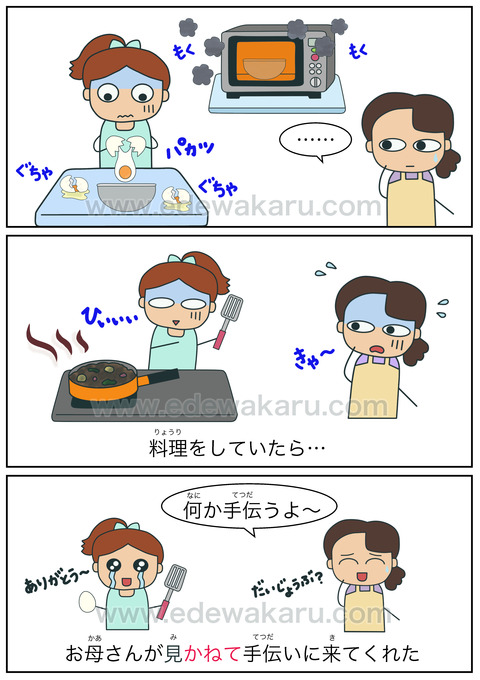
My mother couldn’t bear to watch and helped.
“〜かねる” is a formal expression used in [written language], and it is written in kanji as “〜兼ねる.” Also, the N2 sentence pattern “〜かねない” may look similar, but its meaning is completely different, so be sure to learn to distinguish them 😀
In context 5 examples
料理をしていたら、お母さんが見かねて手伝いに来てくれた
→お母さんは、見ていられなくなって手伝に来てくれた(復習:〜ている(進行中))While I was cooking, my mother couldn’t bear to watch and came to help. →My mother couldn’t keep watching, so she came to help. (Review: 〜ている (ongoing action))
卒業したら、留学するか就職するか決めかねている(復習:〜ている(結果の状態))
After I graduate, I can’t decide whether to study abroad or get a job. (Review: 〜ている (resulting state))
そのアイデアには賛成しかねます…
I’m afraid I can’t agree with that idea…
そちらはセール品ですので、返品はいたしかねます
Since that item is on sale, we are unable to accept returns.
すみませんが、その質問には答えかねます…
I’m sorry, but I’m unable to answer that question…
Read the original source text
Meaning
〜できない
〜したくても〜できない
How to use it
動詞[ます形]+かねる
Explanation
「〜かねる」は「〜できない」「〜したくても〜できない」という意味を表す文型です。状況や、話者の立場から
「〜することは不可能だ」「〜することできない」
と言いたい時に使われます。能力を表す場合には使うことができませんので気をつけましょう😨
[例]
⭕️私は英語が
話せない
⭕️私は英語を
話すことができない
【余裕のある人へ】
「決めるに決めかねる」「見るに見かねて〜」
は慣用表現(かんようひょうげん)として覚えておきましょう😉
決めるに決めかねる
→決めたくても、なかなか決められない
見るに見かねて
→困っている人を見ているのがつらいので(手伝う)
(復習:なかなか〜ない)
[例]
留学するか就職するか、
決めるに決めかねている
お母さんが、
見るに見かねて
手伝ってくれた
「〜かねる」は、かたい言い方で【書き言葉】として使われ、漢字では
「〜兼ねる」
と書きます。また、N2の文型「〜かねない」は似ている文型に見えますが、全く意味が違いますので区別をして覚えておきましょう😀
日本語文型辞典
Meaning
Basic information: R-かねる. Explanation. Attached to the continuative form of a verb, it means that doing something is difficult or impossible. It carries the nuance “even if one tries / makes an effort, it is impossible.” “決めるに決めかねる” and “見るに見かねて” are idiomatic. A formal written expression. Examples: ① I cannot agree with your opinion. ② Unfortunately, we are unable to accept your proposal. ③ The middle school student's death is believed to have been a suicide after being unable to endure bullying by classmates. ④ He scolds children in a way that shows he doesn't understand their psychology at all, so I couldn't just stand by and ended up speaking up.
Read the original source text
Meaning
基本情報R-かねる説明動詞の連用形に付いて、そうすることが困難・不可能だ、という意味を表す。「やろうとしても/努力しても、不可能だ」という意味あいがある。「決めるに決めかねる」「見るに見かねて」などは慣用的。あらたまった書きことば的表現。例文① そのご意見には賛成しかねます。② 残念ながら、そのご提案はお受けいたしかねます。③ その中学生の死は、同級生のいじめにたえかねての自殺と見られている。④ その人が、あまりにもこどもの心理を理解していないようなしかり方をするものだから、見かねて、つい口を出してしまったんだ。
日本語文型辞典 英語版
Meaning
【かねる】[R-かねる]
Attaches to a verb stem and means “it is difficult or impossible to do something, even if one tries to.” 決めるに決めかねる and 見るに見かねて are idiomatic expressions. A formal expression used in written language.
In context 4 examples
そのご意見には賛成しかねます。
I am afraid I cannot agree with that opinion.
残念ながら、そのご提案はお受けいたしかねます。
Regrettably, it is not possible for us to accept your proposal.
その中学生の死は、同級生のいじめにたえかねての自殺と見られている。
The death of that junior high school student appears to be a suicide triggered by the torments of his classmates, which he was no longer able to bear.
その人が、あまりにもこどもの心理を理解していないようなしかり方をするものだから、見かねて、つい口を出してしまったんだ。
I couldn’t bear to watch that person scold a child in a way that showed such a complete lack of understanding of children’s psyches, so I blurted out just how I felt.
くらべてわかる日本語表現文型辞典
Meaning
An understated expression for “cannot do.” It is an ambiguous expression used when saying “A cannot be done” would sound too direct and strong.
How to use it
A かねる
[verb ます-form] かねる
Notes
[Note 1]
・「A かねる」 is used when the speaker’s side has some reason it cannot be done; it cannot be used when something is impossible due to lack of ability.
×私、フランス語は話しかねるんです。 — I can’t speak French.
○ここでその話はちょっとしかねます。 — I’m afraid I can’t discuss that here.
・It is difficult to use with verbs of emotion such as 「愛す・笑う・悲しむ・憎む・喜ぶ」 (“love,” “laugh,” “grieve,” “hate,” and “rejoice”).
・It is sometimes used as a word in its own right through idiomatic derivation.
○見るに見かねて、救いの手を差し伸べた。(見ていられなくて) — Unable to bear watching, I reached out to help. (unable to keep watching)
○待ちかねていた便りが届いた。(待てないほど長い間待っていた) — The long-awaited letter arrived. (one had waited for so long that one could hardly wait any longer)
○たまりかねて、泣きだした。(我慢の限界をこえて) — Unable to hold back any longer, she began to cry. (past the limit of one’s endurance)
In context 4 examples
このような仕事はお引き受けしかねます。
I’m afraid we cannot accept this kind of work.
私ではちょっとわかりかねますので、担当の者を呼んでまいります。
I’m afraid I can’t quite answer that, so I’ll call the person in charge.
一度お買い求めになった商品はお取り替えしかねます。
We cannot exchange products once they have been purchased.
最近の父は、ますます頑固になり家族中、扱いかねている。
Recently my father has become increasingly stubborn, and the whole family is at a loss as to how to handle him.
Read the original source text
Meaning
「できない」ことを控えめに述べる表現。「Aできない」という表現が直接的で強すぎる場合に使うあいまいな表現。
How to use it
Aかねる
[動詞-ます形]かねる
Notes
【注意1】
・「Aかねる」は話し手側の事情でできない場合に使い、能力的にできない場合は使えない。
×私、フランス語は話しかねるんです。
○ここでその話はちょっとしかねます。
・「愛す・笑う・悲しむ・憎む・喜ぶ」などの感情動詞には使いにくい。
・慣用的に派生して一語のように使う場合もある。
○見るに見かねて、救いの手を差し伸べた。(見ていられなくて)
○待ちかねていた便りが届いた。(待てないほど長い間待っていた)
○たまりかねて、泣きだした。(我慢の限界をこえて)
日本語NET JLPT文法解説まとめ
Meaning
"Cannot ~"
Expresses impossibility. Because it is a formal expression, it is often used in business.
「かねる」 conveys the sense of being unable to do something despite trying, or finding it difficult to do, and is used to decline indirectly.
How to use it
V (ます-stem) + かねる
Explanation
cannot
It expresses impossibility and is often used in business contexts because of its formal tone.
"かねる" conveys the feeling of being unable to do something or finding it difficult to do so, and it is used when politely declining or expressing inability to do something.
In context 6 examples
私は責任者ではございませんので、その質問にはお答えしかねます。
I am not the person in charge, so I cannot answer that question.
B社の提案ですが、私個人としては賛成致しかねます。
Regarding Company B’s proposal, I personally cannot agree.
自分の希望する大学と親の希望する大学が違うので、どの大学を受験するか決めかねている。
The university I want to attend and the one my parents want me to attend are different, so I can’t decide which university to apply to.
あまりにも日本語ができないジョンさんに見かねた校長は彼をもう一度、初級から勉強させることにした。
Unable to bear seeing how little Japanese John knew, the principal decided to have him study again from the beginner level.
仕事の忙しさに耐えかねた彼は半年も経たないうちに会社を辞めてしまった。
Unable to endure how busy his job was, he quit the company in less than six months.
上司の提案に納得しかねる部分があったが、我々は受け入れざるを得なかった。
There were parts of my supervisor’s proposal that I found difficult to accept, but we had no choice but to accept it.
Read the original source text
Meaning
"〜できない"
不可能を表し、硬い表現なのでビジネスで使われる場合が多い。
「かねる」は「~しようとしてもできない」、「〜するのが難しくできない」という気持ちが含まれており、婉曲的に断るときに使われる。
How to use it
V(ます形)ます + かねる
Explanation
cannot
It expresses impossibility and is often used in business contexts because of its formal tone.
"かねる" conveys the feeling of being unable to do something or finding it difficult to do so, and it is used when politely declining or expressing inability to do something.
NINJAL 日本語文型データベース
Meaning
Expresses that you want to do something but cannot because of situational constraints. It is also used as a considerate way to decline so as not to be rude, by explaining that the reason for declining is not a personal circumstance. For this reason, it is often used in business settings or when declining a customer’s request at a shop.
「腹に据えかねる・たまりかねる・見るに見かねる」 are idiomatic expressions.
How to use it
Notes
It conjugates in the same way as a verb.
In context 7 examples
すみません。ただいまのご質問にはお答えしかねます。
I'm sorry, but I'm unable to answer your question at this time.
連休に海外旅行に行くかどうか、まだ決めかねています。
I still can't decide whether to travel abroad during the long holiday.
もう使わないが思い出があって、処分しかねていたものを思い切って捨てた。
I finally worked up the courage to throw away something I no longer used but couldn't bring myself to part with because of the memories.
春の訪れを待ちかねたように、木々が芽吹き始めた。
As if they had been unable to wait for spring to arrive, the trees began to bud.
この会の運営について、腹に据えかねたことを今日はみんな吐き出してみたい。
Today, I'd like to let out everything I've been unable to stomach about how this group is run.
私はあるミーティングで、一人の参加者の暴言にたまりかねて、その場を逃げ出した。
At a meeting, I couldn't take any more of one participant's abusive remarks and ran out of the room.
公園で男の子が火遊びをしていた。見るに見かねて「そんな遊びはしないほうがいいよ」と声をかけた。
A boy was playing with fire in the park. Unable to just stand by, I called out to him, “You shouldn't play like that.”
Read the original source text
Meaning
〜したい気持ちはあるが、状況的な制約があるので、できないということを表します。断る理由が個人的な事情ではないと説明することで、失礼にならないように配慮する言い方としても使います。そのため、ビジネスの場面や店などで客に対してできないことを断る場合にもよく使います。
「腹に据えかねる・たまりかねる・見るに見かねる」は慣用的な言い方です。
How to use it
Notes
動詞と同じ形に変化します。
IMABI
Potential IV
Read this IMABI lesson ↗Explanation
Potential IV: ~かねる・かねない VS ~きれる・きれない VS ~える/うる・~えない
Now that you have learned more Japanese, it is now time to delve into differences with phrases related to “can” or “can’t” that are more advanced and somewhat difficult to get straight. Be careful with the role of ~ない in this lesson.
Certainly, when a student realizes that 理解しきれない, 理解しえない, and 理解しかねる are possible on top of 理解できない, to the student, it seems at first glance that they must be interchangeable because they all translate as “can’t understand”. However, as with any similar phrases in Japanese, there will always be differences. Let’s get started at figuring out what these differences are.
Although there are clear nuance differences and writing style differences between them, as the example with 理解する demonstrates, ~きれない, ~えない, and ~かねる have the basic meaning of “can’t”. It’s now time to look at them individually and then compare.
~かねる・かねない
The 一段 verb かねる means “to serve/combine two or more functions or roles simultaneously”. Other verbs that could be used instead for this include 組み合わせる and 兼ね備える.
1. 彼は教師と教育理事長を兼ねています。
He is both a teacher and the education chair.
2. 彼はその二つの部の部長を兼ねています。
He is in charge of the two departments.
3. 総理が外相を兼ねた。
The Prime Minister concurrently held the Foreign Minister position.
4. 朝ごはんと昼ごはんをかねて遅めに食べることが多い。
I eat breakfast with lunch late a lot.
5. 応接間と書斎しょさいを兼ねた部屋です。
This is a room that serves as a parlor and a library.
6. 趣味を兼ねた仕事
Job combined with hobbies
7. 観光と取材をかねて旅行していた。
We were traveling to both sight-see and cover an event.
Meaning Note: News’ crews go places all the time not to just cover the story, but also to enjoy the place they’re at.
~かねる shows that something is impossible. This is more so impossibility of doing something in a certain situation. Say you really hate someone, and you are asked if you’re going to agree with him, you might say “I can’t agree with such a person”. So, it expresses the inability, reluctance, or refusal to do something. It can be translated as “cannot” or “(am) not able.”
8. 彼は、「表明には承服しょうふくしかねる」と怒りの面持おももちで言ったそうだ。
I hear that he said that he could not consent with the assertion with an angry face.
9. そんな悪徳あくとく業者には賛成しかねる。
I cannot agree with such an unscrupulous businessman.
10. そんな方法には賛成しかねる。
I can’t approve of such methods.
11. 動機を図りかねる。
To not be able to fathom the motive.
12. この場では決めかねますので、また別途べっと会議を設けましょう。
Since it is impossible to decide at this place, let’s set up a separate meeting again.
13. 彼女は彼氏が来るのを待ちかねていた。
She couldn’t wait for her boyfriend to come.
14. 申しかねますが。
I hesitate to say but…
~かねない is the negative form of -かねる. Since -かねる shows the impossibility, -かねない shows that something very well “can” happen. This ending is especially used when the situation is bad. So, it means that there is a danger/possibility that the bad thing might occur.
15. 彼は嘘をつきかねない男だ。
He is a man capable of telling a lie.
16. 彼なら嘘をつきかねないと思う。
I wouldn’t put it past him to lie.
17. このまま進めば、人間の絶滅をも引き起こしかねない。
If it continues at this rate, it may lead to human extinction.
18. このままでは、個人情報が漏洩ろうえいしかねない。
At this rate, personal information might be leaked.
19. このレフェリーは規則にうるさいので試合を台無しにしかねない。
This referee is fussy about the rules, so he could ruin the match.
20. 彼はせっかくのチャンスを棒ぼうに振ってしまいかねない。
He might end up making a complete waste of an opportune moment.
~きれる・きれない
This is the potential form of ~切る. It is used to show that you can completely do something, of which a lot is to be done. So, it’s negative form, ~きれない shows that you can’t do this.
So, as for 理解しきれない, you can still understand somewhat, but you can’t understand entirely. It is often used with expressions that show quantity and degree. It is often written in 漢字 as ~切れない.
21. 学校でいくら注意しても子供を守りきれないんだよ。
No matter how much we warn them at school, we cannot completely protect the kids.
22. 彼の行為こういは言葉で褒ほめ切れないほど立派ですよ。
His actions are beyond praise.
23. 言い切れます。
I can completely say (that…).
24. 1日で食べきれないほどのバナナを買いました。
I bought more bananas than can be eaten all in a day.
25. 待ちきれなかった。
We couldn’t wait (completely).
~える・うる/~えない
Though this has already been taught in Potential II, remember that this pattern is old-fashioned and used in the written language. It doesn’t show that something is literally impossible, but that since the conditions don’t match up, the possibility is slim to none. With non-volitional verbs the interpretation changes slightly to more of “it shouldn’t/can’t be that…”.
26. 期待しえないことだ。
It’s something that you can’t anticipate.
27. 忘れ得ぬ日
A day I can never forget
28. 過酷事故かこくじこは原理上げんりじょう起こりえない。
Severe accidents in theory can’t occur.
Compare and Contrast
All of these endings show impossibility in the forms ~かねる, ~きれない, and ~えない, but let’s see how well they can be used in a situation of stating one’s actual abilities.
29.
A: 韓国に来てどのくらいですか。
B: 半年です。
A: 韓国語はどの程度話せますか。
B: まだ十分話{〇 せません・△ しきれません・X しえません・X しかねます}。
A: How long has it been since you came to Korea?
B: It’s been half a year.
A: How much Korean can you speak?
B: I still can’t speak well enough.
From this data we can see that these endings cannot simply be used to show capacity.
The situation is not saying that you can’t speak a certain quantity of something completely. The situation is asking for your competency of the language itself. So, ~きれない is not correct.
Now, consider the following.
30. 田中が犯人だと断定できましたか。
Could you conclude that Tanaka is the criminal?
31.
Response 1: いえ、彼が犯人だとは断定できません。
Response 2: いえ、彼が犯人だとは断定しきれません。
Response 3: いえ、彼が犯人だとは断定しえません。
Response 4: いえ、彼が犯人だとは断定しかねます。
Translation: No, I cannot conclude that he is the criminal.
In this case, all four responses are correct, but they are all slightly different. In the first response, you are objective stating that it is impossible to decide. In the second situation, you state that you can’t 100% call him the criminal because there is still some doubt. In the third response, you can’t say that he is the criminal given the surrounding circumstances. It is also very uncommon to use this in 話し言葉. The fourth response implies that you refrain from stating definitively that he is the criminal.
With the last comment, you can see how ~かねる can be used in polite contexts in denying/rejecting things.
32. いろいろ考慮しましたが、お引き受けしかねます。
I’ve thought hard on this, but I cannot undertake it.
So, even in situations where all are possible, there will be differences as defined thus far. They are all used in showing that one can’t decide one way or another, as demonstrated by the criminal example.
33. 生徒が本当に分かっているのかどうか判断し{きれない・えない・かねる}。
I can’t determine whether or not the students really understand.
They can also be used in situations where because of a certain reason or cause, you can’t do something or it is extremely difficult to do something. The fine details, of course, are predicated on the pattern you choose.
34. 大きすぎて、把握はあくし{きれない・えない ・かねる}問題だ。
It’s a problem too big that I cannot fully grasp.
Remember that ~かねる implies that the speaker has a feeling of reluctance, which is part of the reason why they “can’t”. Again, as for ~えない, a consensus of the various circumstances can’t be made. So, in this example that means that the speaker can’t grasp certain parts due to conflicting issues.
Words Used
It is now time to examine what kinds of words these items are frequently used with to even further distinguish them.
X~きれない: Used with verbs concerning with degree, quantity. It is also used with volitional verbs in regards to recognition and decision. Ex. 数える, 押さえる, 対処する, 理解する, 等.
35. 彼のアリバイ説明で納得しきれないところがあります。
There are parts I’m not completely convinced in his alibi’s explanation.
X~えない: Used with volitional verbs in concern with recognition, progress, and remarking. It is not used with simple action verbs like 見る, 食べる, 飲む, 等. Verbs it is used with include 予期する, 期待する, 達成する, 等. It can also be used with non-volitional verbs such as ある, 存在する, 起こる, 等.
36. そんなことはありえないでしょう。
Isn’t something like that impossible?
37. 理解し得ない感情
Feelings that one cannot understand
38. 金にならないものは評価され得ない。
Something that won’t make money is cannot be assessed.
39. 客観的中立メディアなど存在し得ない。
An objective, neutral media cannot exist.
X~かねる: It too is used with volitional verbs of decision but also agreement, and it is also used in a lot of other expressions given its sense of reluctance. Ex. 理解する、決める, 耐える, 等.
40. すぐには決めかねます。
I can’t decide immediately.
41. 激痛げきつうに耐たえかねて呻うめく。
To not be able to bear the great pain and moan.
42. 先週、夫の虐待ぎゃくたいに耐えかねて、花子は実家に帰った。
Last week, unable to stand her husband’s abuse, Hanako returned to her parent’s house.
In context 40 examples
彼は教師と教育理事長を兼ねています。
He is both a teacher and the education chair.
彼はその二つの部の部長を兼ねています。
He is in charge of the two departments.
総理が外相を兼ねた。
The Prime Minister concurrently held the Foreign Minister position.
朝ごはんと昼ごはんをかねて遅めに食べることが多い。
I eat breakfast with lunch late a lot.
応接間と書斎しょさいを兼ねた部屋です。
This is a room that serves as a parlor and a library.
趣味を兼ねた仕事
Job combined with hobbies
観光と取材をかねて旅行していた。
We were traveling to both sight-see and cover an event.
彼は、「表明には承服しょうふくしかねる」と怒りの面持おももちで言ったそうだ。
I hear that he said that he could not consent with the assertion with an angry face.
そんな悪徳あくとく業者には賛成しかねる。
I cannot agree with such an unscrupulous businessman.
そんな方法には賛成しかねる。
I can’t approve of such methods.
動機を図りかねる。
To not be able to fathom the motive.
この場では決めかねますので、また別途べっと会議を設けましょう。
Since it is impossible to decide at this place, let’s set up a separate meeting again.
彼女は彼氏が来るのを待ちかねていた。
She couldn’t wait for her boyfriend to come.
申しかねますが。
I hesitate to say but…
彼は嘘をつきかねない男だ。
He is a man capable of telling a lie.
彼なら嘘をつきかねないと思う。
I wouldn’t put it past him to lie.
このまま進めば、人間の絶滅をも引き起こしかねない。
If it continues at this rate, it may lead to human extinction.
このままでは、個人情報が漏洩ろうえいしかねない。
At this rate, personal information might be leaked.
このレフェリーは規則にうるさいので試合を台無しにしかねない。
This referee is fussy about the rules, so he could ruin the match.
彼はせっかくのチャンスを棒ぼうに振ってしまいかねない。
He might end up making a complete waste of an opportune moment.
学校でいくら注意しても子供を守りきれないんだよ。
No matter how much we warn them at school, we cannot completely protect the kids.
彼の行為こういは言葉で褒ほめ切れないほど立派ですよ。
His actions are beyond praise.
言い切れます。
I can completely say (that…).
1日で食べきれないほどのバナナを買いました。
I bought more bananas than can be eaten all in a day.
待ちきれなかった。
We couldn’t wait (completely).
期待しえないことだ。
It’s something that you can’t anticipate.
忘れ得ぬ日
A day I can never forget
過酷事故かこくじこは原理上げんりじょう起こりえない。
Severe accidents in theory can’t occur.
田中が犯人だと断定できましたか。
Could you conclude that Tanaka is the criminal?
いろいろ考慮しましたが、お引き受けしかねます。
I’ve thought hard on this, but I cannot undertake it.
生徒が本当に分かっているのかどうか判断し{きれない・えない・かねる}。
I can’t determine whether or not the students really understand.
大きすぎて、把握はあくし{きれない・えない ・かねる}問題だ。
It’s a problem too big that I cannot fully grasp.
彼のアリバイ説明で納得しきれないところがあります。
There are parts I’m not completely convinced in his alibi’s explanation.
そんなことはありえないでしょう。
Isn’t something like that impossible?
理解し得ない感情
Feelings that one cannot understand
金にならないものは評価され得ない。
Something that won’t make money is cannot be assessed.
客観的中立メディアなど存在し得ない。
An objective, neutral media cannot exist.
すぐには決めかねます。
I can’t decide immediately.
激痛げきつうに耐たえかねて呻うめく。
To not be able to bear the great pain and moan.
先週、夫の虐待ぎゃくたいに耐えかねて、花子は実家に帰った。
Last week, unable to stand her husband’s abuse, Hanako returned to her parent’s house.
どんなときどう使う 日本語表現文型辞典
Meaning
cannot deal with
How to use it
Vます+かねる
Explanation
~できない
係:ここではわかりかねますので、あちらのカウンターでお聞きください。
1)「気持ちの上で抵抗があってそうすることはできない、難しい」という意味を表す。
2) ❹ は、サービス業などで客の希望に応じられないことを婉曲に言う例である。 ❺ は、ビジネスなどの改まった場面で使われる例である。
1)Something is difficult or impossible to do because of emotional resistance.
2)Sentence ❹ is used in service industry as soft way to say the company cannot meet customer's demands. Sentence ❺ is used in formal business situations.
In context 5 examples
親の希望を考えると、結婚のことを両親に言い出しかねています。
Thinking of my parents' wishes, I can't bring myself to tell them about the marriage.
わたしの経済的に困った状況を見かねたらしく山田さんが助けてくれた。
It seems Mr. Yamada couldn't bear to see how financially distressed I was, and helped me.
彼は留学生活の寂しさに耐えかねて、1年もたたないうちに帰国してしまった。
Unable to bear the loneliness of life abroad, he returned home in less than a year.
客:ホンコン行きの飛行機は何時に出ますか。
Customer: What time does the flight to Hong Kong depart?
ただ今のご説明では、私どもとしては納得しかねます。
We cannot accept your explanation as it stands.
Read the original source text
Meaning
cannot deal with
How to use it
Vます+かねる
Explanation
~できない
係:ここではわかりかねますので、あちらのカウンターでお聞きください。
1)「気持ちの上で抵抗があってそうすることはできない、難しい」という意味を表す。
2) ❹ は、サービス業などで客の希望に応じられないことを婉曲に言う例である。 ❺ は、ビジネスなどの改まった場面で使われる例である。
1)Something is difficult or impossible to do because of emotional resistance.
2)Sentence ❹ is used in service industry as soft way to say the company cannot meet customer's demands. Sentence ❺ is used in formal business situations.
毎日のんびり日本語教師
How to use it
Verb ます-stem + 兼ねる
Explanation
It is used to mean “want to do something but cannot” or “want to do something but find it difficult.” The reason it cannot be done is mainly psychological.
It can also be used as an indirect way to refuse someone’s request or command, in which case it gives a relatively polite impression.
It can be used when you want to avoid saying directly, “I can’t.”
「見るに見かねて」 is an idiomatic expression meaning that a situation is so pitiful that one can no longer bear to watch.
Notes
Related grammar: 「【N2 Grammar】~兼ねない(かねない)」
In context 16 examples
怪我した子猫を見るに見かねて、動物病院へ連れて行った。
Unable to bear the sight of the injured kitten, I took it to an animal hospital.
こちらとしては、それには賛成いたしかねます。
We are unable to agree with that.
確証が無いので判断しかねます。
Since there is no conclusive evidence, I can’t make a judgment.
自己責任で行ってください。こちらで責任は負いかねます。
Please proceed at your own risk. We cannot accept responsibility.
詳しい事情は分かりかねます。(详细情况难以理解。)
I can’t understand the details of the situation. (The details are difficult to understand.)
専門家ではないので適切なアドバイスはしかねます。
I’m not an expert, so I can’t give you appropriate advice.
ご意見は承りましたが、同意しかねます。
We have heard your opinion, but we cannot agree.
その質問には答えかねます。
I’m unable to answer that question.
仕事を辞めて無職になるか、それとも転職して働き続けるかを決めかねている。
I can’t decide whether to quit my job and become unemployed or change jobs and keep working.
アタックするべきだろうか、彼女との距離感やタイミングを掴みかねている。
I can’t figure out whether I should make a move, or what the right distance and timing with her would be.
意中の人に自分からどう連絡するのがベストなのか計りかねている。
I can’t figure out the best way to contact the person I’m interested in.
先日も殺人事件があった。先月にも似た手口の殺人事件があったが、2つの関連性は判断しかねる。
There was a murder the other day, too. There was a murder with a similar method last month, but I can’t determine whether the two are connected.
この作品は男女のドロドロ愛が描かれており、子供向けとは言いかねる。
This work depicts a messy romance between a man and a woman, so I can hardly call it suitable for children.
バスは交通事情、気象状況により遅延することがありますが、その場合でも運賃の払い戻しはいたしかねますのでご了承下さい。
Buses may be delayed due to traffic or weather conditions, but please understand that even in such cases we are unable to refund fares.
専門家ではないので正しいのかどうか断言はしかねます。
I’m not an expert, so I can’t say definitively whether it’s correct.
明日は休館日です。終日お電話でのお問い合わせ等もお受けしかねますので、お気を付けください。
Tomorrow is a day the facility is closed. Please be aware that we will be unable to take telephone inquiries or the like throughout the day.
Read the original source text
How to use it
動ます形+かねる
Explanation
「~したくてもできない」「~したくても難しい」という意味で使われます。できない理由は主に心理的なものが原因です。
他人のお願いや命令に対して婉曲的に断る表現としても使え、その場合は比較的丁寧な印象を与えます。
直接「できない」と言うことを避ける場面で使えます。
「見るに見かねて」は慣用的な表現で、見ることができないくらいかわいそうな状況であることを表します。
Notes
関連文法「【N2文法】~兼ねない(かねない)」