AIUEO JLPT Grammar
Meaning
This sentence pattern emphasizes contrasting results or situations when compared to a certain standard. It indicates that opposite conditions or states continue based on a particular reference.
How to use it
Verb の + に + ひきかえ(て); adjective dictionary form の + に + ひきかえ(て); な-adjective なの + に + ひきかえ(て); noun に + ひきかえ(て)
In context 5 examples
昨日の天気にひきかえて、今日はとても良い天気だ。
In contrast to yesterday’s weather, today is a beautiful day.
忙しい母にひきかえ、父は一日中テレビを見ている。
In contrast to my busy mother, my father spends all day watching TV.
彼女はいつも明るいが、それにひきかえ彼は内向的だ。
She’s always cheerful, but in contrast, he’s introverted.
安定した仕事にひきかえ、彼は常に新しい挑戦を求めている。
In contrast to his stable job, he is always seeking new challenges.
都会の生活にひきかえ、田舎の生活は静かで穏やかだ。
In contrast to city life, life in the countryside is quiet and peaceful.
Read the original source text
Meaning
This sentence pattern emphasizes contrasting results or situations when compared to a certain standard. It indicates that opposite conditions or states continue based on a particular reference.
How to use it
動詞の+に+ひきかえ (+て)形容詞辞書形の+に+ひきかえ (+て)形容動詞なの+に+ひきかえ (+て)名詞に+ひきかえ (+て)
Explanation · 日本語
この文型は、ある対象と比較して対照的な結果や状況を強調する表現です。ある事柄や状況を基準にして、それとは反対の内容や状態が続くことを示す場合に使われます。
文法
Meaning
Contrary to ~ / in contrast to ~
〜にひきかえ conveys a subjective feeling.
How to use it
V (plain form) + のにひきかえ
い-adjective + のにひきかえ
な-adjective + のにひきかえ
N + にひきかえ
Notes
〜に対して is used to make a contrast from a neutral standpoint.
In context 7 examples
兄にひきかえ、弟は全然勉強しないし、家の手伝いもしないし本当に困るよ。
In contrast to my older brother, my younger brother doesn't study at all or help around the house, and it's really a problem.
スポーツ万能で頭もいい弟にひきかえ、僕は何をやってもダメだ。
In contrast to my younger brother, who is good at every sport and smart, I'm no good at anything I do.
昔の子は外で体を動かすことが多かったのにひきかえ、今の子はスマホや携帯ゲームに夢中で全然外で遊ばなくなった。
In contrast to children in the past, who often got exercise outdoors, kids today are absorbed in smartphones and handheld games and no longer play outside at all.
去年にひきかえ、今年は台風や地震など自然災害が多いなあ。
Compared with last year, there have been so many natural disasters this year, like typhoons and earthquakes.
弟は背が高くてイケメンなのにひきかえ、何で俺はチビでブサイクなんだ。
My younger brother is tall and handsome, so why am I short and ugly by comparison?
去年のJLPTにひきかえ、今年のはとても難しかった。
In contrast to last year's JLPT, this year's was very difficult.
この頃、我が社は腰が低く気弱な男性社員にひきかえ、女性社員のほうがしっかりしているように見える。
These days, in contrast to the men in our company, who are meek and timid, the female employees seem more capable.
Read the original source text
Meaning
~とは反対に / ~に対して「~にひきかえ」は主観的な気持ちが含まれる。
How to use it
V(普通形)+ のにひきかえ
イAい + のにひきかえ
ナAな + のにひきかえ
N + にひきかえ
Notes
「~に対して」は中立的な立場で対比させる場合に使う。
Bunpro Grammar Reference
Meaning
In stark contrast, In comparison, On the other hand, While, In sharp contrast
How to use it
Noun+にひきかえ
[な]Adjective+な・である+の+にひきかえ
[い]Adjective+の+にひきかえ
Verb+の+にひきかえ
Phrase (A)。それにひきかえ、Noun は+Phrase (B)
Nuance
A strong expression, implying that (B) is in sharp contrast to (A). Pulling right back from (A) and changing views, (B).
Explanation
に引き換え is a grammar pattern that is used for making contrasts between things, and will be translated as ‘in comparison to (A), (B)’, or ‘in stark contrast to (A), (B)’. The literal translation is ‘pulling back and switching away from (A), (B)’. This ‘switching away from’ portion may be used as a reminder of the large size of the difference that this grammar pattern usually indicates.
に引き換え is a combination of the case-marking particle に, the conjunctive form of the う-Verb 引く ‘to pull’, 引き, and the conjunctive form of the る-Verb 換える ‘to switch between’, or ‘to interchange’, 換え.
に引き換え may follow almost any type of word, but will require a の to precede it before い-Adjectives or verbs, and なの to precede it before な-Adjectives.
周りの人たちはどんどん就職していっているのに引き換え、俺はまだ面接さえしていない。
In stark contrast to the people around me, who are getting jobs, I haven’t even gone to an interview.
うちの娘は頭がいいのに引き換え、うちの長男はゲームばかりして全然勉強をしようともしない。
In stark contrast to my daughter, who is smart, all my eldest son wants to do is play videogames and won’t even try to study.
親戚の全員が裕福なのに引き換え、なぜか私の家族だけが貧乏。
In stark contrast to all my relatives, who are wealthy, my family is poor for some reason.
去年の夏に引き換え、今年の夏はえげつなく暑い。
In stark contrast to summer last year, summer this year is extremely hot.
(A) and (B) will always be two opposite ends of some kind of spectrum, where one is considered to be good, while the other is regarded as bad based on the subjective opinion of the speaker.
Additionally, それにひきかえ may be used to begin sentences where the comparison is being made to a previous statement.
周りの子たちを見てみなさいよ!みんな来年から大学よ!それに引き換え、あんたったら。。。
Look at the kids around you! They are all going to college starting next year! In stark contrast to that you…
Caution
Both (A) and (B) will be facts that are plainly observable or measurable. Due to this, に引き換え will not be used in sentences that make assumptions or guesses.
今は寒いのに引き換え、昼になったら暖かくなるかもしれない。
In stark contrast to it being cold right now, it would probably get warmer at noon. (Unnatural Japanese)
In context 12 examples
- 母親の友達の息子さんは、弁護士として立派に働いているのにひきかえ、僕は・・・(まだフリーターだ)。
In stark contrast to my mother's friend's son, who is working prominently as a lawyer, I am… (still a permanent part-timer)
- 周りの子たちを見てみなさいよ!みんな来年から大学よ!それに引き換え、あんたったら。。。
Look at the kids around you! They are all going to college starting next year! In stark contrast to that you…
- 周りの人たちはどんどん就職していっているのに引き換え、俺はまだ面接さえしていない。
In stark contrast to the people around me, who are getting jobs, I haven’t even gone to an interview.
- 親戚の全員が裕福なのに引き換え、なぜか私の家族だけが貧乏。
In stark contrast to all my relatives, who are wealthy, my family is poor for some reason.
- 去年の夏に引き換え、今年の夏はえげつなく暑い。
In stark contrast to summer last year, summer this year is extremely hot.
- うちの娘は頭がいいのに引き換え、うちの長男はゲームばかりして全然勉強をしようともしない。
In stark contrast to my daughter, who is smart, all my eldest son wants to do is play videogames and won’t even try to study.
- 姉は積極的で活発な性格にひきかえ、弟の健太郎はとても無気力だ。
In stark contrast to the elder sister's lively personality, the younger brother, Kentaro, is very apathetic.
- 兄は優秀な成績をおさめている。それにひきかえ妹の方は遊んでばかりだ。
The elder brother has excellent grades. In stark contrast to that, the younger sister is just mucking around.
- 前回のテストにひきかえ今回のテストは難しい。
In stark contrast to the previous test, this one is hard.
- 隣の家の猫は痩せていて頭がいいのにひきかえうちの猫はぐうたらしてばかりだなあ。
In stark contrast to the neighbor's cat, which is skinny and smart, our cat is just loafing around.
- 彼の服はかっこいい。それにひきかえ私の彼氏の服は、なんてダサいのだ。
His clothes are cool. In stark contrast to that, how uncool my boyfriend's clothes are.
- 今は寒いのに引き換え、昼になったら暖かくなるかもしれない。
In stark contrast to it being cold right now, it would probably get warmer at noon. (Unnatural Japanese)
DoJG 日本語文法辞典(全集)
Meaning
In contrast to ~; while; whereas
How to use it
(i) {Noun/Demonstrative pronoun} | にひきかえ | |
| 健康な母にひきかえ | In contrast to my healthy mother |
| {これ/それ}にひきかえ | In contrast to this/that |
(ii) {V/Adjectiveい} informal | のにひきかえ | |
| 勉強がよくできるのにひきかえ | Someone is academically gifted, while ~ |
| 部屋が広いのにひきかえ | The room is spacious, while ~ |
(iii) {Adjectiveなstem/ Noun} | {な/だった}のにひきかえ | |
| 便利なのにひきかえ | Something is convenient, while ~ |
| 父は大学教授だったのにひきかえ | My father was a college professor, while ~ |
Explanation
A phrase that indicates a sharp contrast.
In context 11 examples
几帳面な父にひきかえ、息子はだらしなかった。
The son, in contrast to his meticulous father, was slovenly.
この大学は教育の質がとてもいいのにひきかえ、学内の設備が劣る。
While the quality of education at this college is excellent, the quality of the campus facilities is inferior.
昨日にひきかえ今朝は快晴です。
In contrast to yesterday, this morning is perfectly clear.
姉は何事にも堅実なタイプなのにひきかえ、妹は奔放なタイプだ。
My older sister is the type who's steady in any situation, while my younger sister is the free-wheeling type.
昨年が楽しい年だったのにひきかえ、今年は色々な意味で試練の年だった。
The last year was an enjoyable year, whereas this year has been a year of trials for all sorts of reasons.
16世紀のフランスでは、貴族の食事は贅沢だったのにひきかえ、市民の食事はとても貧しいものだった。
In France in the 16th century, the nobility ate extravagantly while the common people ate very poorly.
我々は「Aという国は、こんなにすばらしいことをしている。それにひきかえ日本は全く駄目だ」という話をずっと聞かされ続けたものだ。
"Country A is doing this really fabulous thing. In contrast, Japan is completely useless." We have been hearing this kind of statement (continuously) for a long time.
ハーバードやMITの名前は日本で広く知られているのにひきかえ、残念ながら私が教えているプリンストンの名前はほとんど知られていない。
Names such as Harvard and MIT are well-known in Japan while, regrettably, the name (of the school) where I am teaching, Princeton, is hardly known.
EUについては、経済問題はよく議論されてきたのにひきかえ、文化面の議論があまりなされてこなかった。
Although the EU's economic problems have been frequently debated, its cultural issues have hardly been discussed.
このアパートは駅にとても近くて便利なのにひきかえ、部屋は狭く、家賃も高い。
While this apartment is very close to the station and convenient, the room is small and the rent is high.
日本の大学は、入るのが難しいのにひきかえ、出るのは簡単だと言われている。
They say that while it is difficult to enter a Japanese university, it is easy to graduate.
絵でわかる日本語
Meaning
In contrast to...
Very different from...
How to use it
Noun [dictionary form] + にひきかえ
Verb or adjective [plain form] + のにひきかえ
Explanation
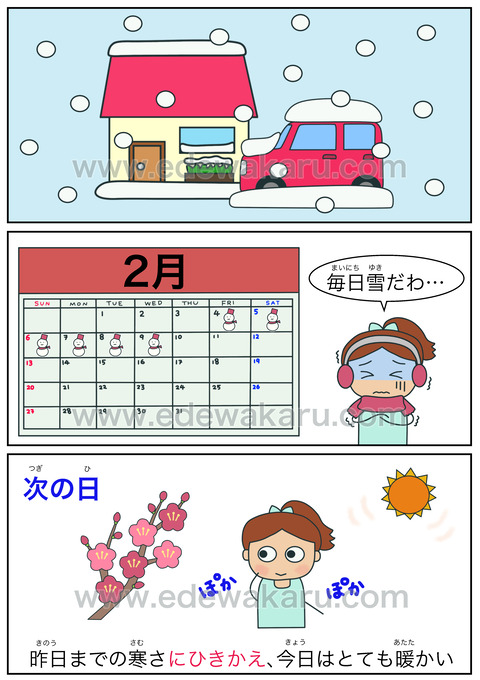
“AにひきかえB” is a sentence pattern meaning “B in contrast to A.” Contrasting things go in “A” and “B.” It carries the speaker’s feelings, as in “Unlike A, B is ... and very good” or “Unlike A, B is ... and very bad.” There is also the form “A is ... .それにひきかえB,” so learn that too. 😀
[Example]
It was really cold until yesterday. In contrast, it’s very warm today.
Remember that “〜にひきかえ,” though similar to other sentence patterns, conveys the speaker’s subjective feelings. 😊
[Related grammar patterns]
In context 5 examples
昨日までの寒さにひきかえ、今日はとても暖かい
→昨日の寒さとは反対に、今日はとても暖かいIn contrast to the cold weather up until yesterday, it’s very warm today. → In contrast to yesterday’s cold, it’s very warm today.
姉にひきかえ、妹は勉強もせず遊んでばかりいる
→姉とは反対に、妹は勉強もせず遊んでばかりいるIn contrast to her older sister, the younger sister does nothing but play without studying. → Unlike her older sister, the younger sister does nothing but play without studying.
お兄ちゃんにひきかえ、弟はすごくイケメンだね
→お兄ちゃんとは反対に、弟はすごくイケメンだねIn contrast to her big brother, the younger brother is really handsome. → Unlike her big brother, the younger brother is really handsome.
友達は結婚していくのにひきかえ、私は彼氏すらいない…
→友達とは反対に、私は彼氏すらいないWhile my friends are getting married, I don’t even have a boyfriend... → Unlike my friends, I don’t even have a boyfriend.
父は優しいのにひきかえ、母は何かにつけすぐ怒る
→父は優しいのとは反対に、母は何かにつけすぐ怒るUnlike my kind father, my mother gets angry right away over everything. → In contrast to my father being kind, my mother gets angry right away over everything.
Read the original source text
Meaning
〜とは反対に
〜とはすごく違って
How to use it
名詞[辞書形]+にひきかえ
動詞・形容詞[普通形]+のにひきかえ
Explanation
「AにひきかえB」は「Aとは反対にB」という意味の文型です。「A」と「B」には対照的(たいしょうてき)なことが入ります。「
Aとは反対にBは〜で、すごくいい」「Aとは反対にBは〜で、すごく悪い」
というように、話者の感情や気持ちが入ります。また
「Aは〜。それにひきかえB」
という形もありますので一緒に覚えておきましょう😀
[例]
昨日まではすごく寒かった。
それにひきかえ、今日はとても暖かいわ
「〜にひきかえ」は似ている文型がありますが、
話者の主観的な気持ち
が入ると覚えておきましょう😊
【関連文型】
日本語文型辞典 英語版
Meaning
【にひきかえ】[Nにひきかえ]
Comparing two contrastive items, expresses the meaning of “in contrast to the one, the other is/does....” In spoken Japanese, Nにくらべて is used instead.
In context 4 examples
兄にひきかえ弟はだれにでも好かれる好青年だ。
In contrast to his elder brother, he is a pleasant young man that everybody likes.
努力家の姉に引きかえ、弟は怠け者だ。
In contrast to his hardworking elder sister, he is a lazy oaf.
このごろは子供っぽい男子学生にひきかえ女子学生のほうが社会性があってしっかりしているようだ。
Recently, the female students are more sociable and stable than the childish male students.
市当局の柔軟な姿勢にひきかえ、窓口の高圧的な対応は市民の反発を招いている。
In contrast to the flexible attitude of the city authorities, the oppressive way they are treated at the window meets with strong opposition from citizens.
くらべてわかる日本語表現文型辞典
Meaning
Meaning 1: To emphasize or imply B, the opposite of B, A, is given as an example. Either A or B often has a positive or negative value judgment.
Meaning 2: In the form “A. それにひきかえ、B.” To emphasize or imply either A or B, something that can be evaluated is given as an example.
How to use it
AにひきかえB (それにひきかえB)
Connection 1:
[Verb] + の + にひきかえ
[i-adjective – plain form] + の + にひきかえ
[na-adjective – な / である / だった / ではない] + の + にひきかえ
[Noun – ∅] にひきかえ
[Noun – である / ではない / だった / な] + の + にひきかえ
Connection 2:
[Sentence]. それにひきかえ [Sentence].
Explanation
【Contrast 1】
“A ni kurabete B wa C” (Meaning 1, p. 226)
In “A ni hikikae B,” both A and B are known, but in “A ni kurabete B wa C,” A or B may be something unknown.
○今日に比べて明日は暖かくなるそうだ。 — It seems that tomorrow will be warmer compared with today.
×今日にひきかえ明日は暖かくなるそうだ。 — It seems that tomorrow will be warmer, in contrast to today.
With “A ni hikikae B wa C,” A and B are evaluated in completely opposite positive and negative terms, whereas “A ni kurabete B wa C” can be used whenever there is a difference between A and B.
○このサクラの木が満開なのに比べて、あの桜は八部咲きだ。 — In contrast to this cherry tree, which is in full bloom, that one is about 80 percent in bloom.
×このサクラの木が満開なのにひきかえ、あの桜は八部咲きだ。 — In contrast to this cherry tree, which is in full bloom, that one is about 80 percent in bloom.
○このサクラの木が満開なのにひきかえ、あの桜はまだ開いていない。 — In contrast to this cherry tree, which is in full bloom, that one has not opened yet.
“A ni taishite B” (Meaning 2, p. 244)
“A ni taishite B” describes two opposing or contrasting situations: “A is ~. On the other hand, B is ~.”
○成田空港が内陸部にあるのに対して、関西空港は海上にある。 — While Narita Airport is inland, Kansai Airport is offshore.
×成田空港が内陸部にあるのにひきかえ、関西空港は海上にある。(評価がない) — While Narita Airport is inland, Kansai Airport is offshore. (There is no evaluation.)
○成田空港が内陸部にあって騒音問題を抱えているのにひきかえ、関西空港は海上空港なのでその心配がない。(=対して) — In contrast to Narita Airport, which is inland and has noise problems, Kansai Airport is offshore, so there is no such concern. (= taishite)
【Contrast 2】
“A ni taishite B (sore ni taishite B)” (Meaning 2, p. 244)
“A ni kurabete B wa C (sore ni kurabete B wa C)” (Meaning 2, p. 227)
With “sore ni kurabete B wa C” and “sore ni hikikae B,” B may be omitted, but with “sore ni taishite B,” it may not.
○彼はよく努力している。それに比べて君は…。 — He works hard. Compared with that, you…
○彼はよく努力している。それにひきかえ君は…。 — He works hard. In contrast, you…
×彼はよく努力している。それに対して君は…。 — He works hard. In contrast to that, you…
Notes
【Note 1】
・Evaluations concerning a single theme are common; A and B do not become separate themes.
×あの店の店員が親切なのにひきかえ、この店は品数が少ない。 — In contrast to the staff at that shop being kind, this shop has few items.
【Note 2】
・“A. Sore ni hikikae B.” is a connective expression.
In context 8 examples
兄が短気で喧嘩っぱやいのにひきかえ、弟は落ち着いている。
In contrast to my short-tempered older brother, who is quick to get into fights, my younger brother is calm.
娘の結婚式で冷静な母親にひきかえ、父親は泣きっぱなしだった。
In contrast to the mother, who remained composed at her daughter’s wedding, the father cried the whole time.
都市部では野党支持が多かったのにひきかえ地方では与党寄りという結果が出た。
The result was that support for the opposition was high in urban areas, whereas people in rural areas leaned toward the ruling party.
他店が不景気で困っているのにひきかえ、ここだけは大入り満員だ。
While other shops are struggling in the recession, this place alone is packed to capacity.
兄は働き者だ。それにひきかえ、弟は遊んでばかりだ。
My older brother is a hard worker. In contrast, my younger brother does nothing but play.
お宅のお子さんまじめねえ。それにひきかえ、うちの子は…。
Your child is so earnest. In contrast, my child…
うちの娘は本当にだらしない。それにひきかえお隣は…うらやましい。
My daughter is really irresponsible. In contrast, the neighbors… I’m jealous.
新築の家は機密性が高く暖かい。それにひきかえうちの家は隙間風が入ってきて寒い。
Newly built houses are well insulated and warm. In contrast, cold drafts come in through gaps in our house.
Read the original source text
Meaning
意味1:Bを強調または暗示するために、Bと正反対のAを例示している。AかBどちらかに、良・悪の評価の対象がくることが多い。
意味2:「A。それにひきかえ、B。」の形で。AかBどちらかを強調・暗示するために、評価のできるものを例示する。
How to use it
AにひきかえB(それにひきかえB)
接続1:
[動詞]+の+にひきかえ
[イ形-普]+の+にひきかえ
[ナ形-な/である/だった/ではない]+の+にひきかえ
[名詞-∅]にひきかえ
[名詞-である/ではない/だった/な]+の+にひきかえ
接続2:
[文]。それにひきかえ[文]。
Explanation
【対比1】
「Aに比べてBはC」(意味1 P.226)
「AにひきかえB」はA,Bともに既知のことがくるが「Aに比べてBはC」は未知のものでもかまわない。
○今日に比べて明日は暖かくなるそうだ。
×今日にひきかえ明日は暖かくなるそうだ。
「AにひきかえBはC」のAとBは、プラス、マイナス正反対に評価されるものだが、「Aに比べてBはC」は、A,Bに差があれば使える。
○このサクラの木が満開なのに比べて、あの桜は八部咲きだ。
×このサクラの木が満開なのにひきかえ、あの桜は八部咲きだ。
○このサクラの木が満開なのにひきかえ、あの桜はまだ開いていない。
「Aに対してB」(意味2 P.244)
「Aに対してB」は「Aは~だ。一方、Bは~だ」という対立・対照的なふたつの事態を述べている。
○成田空港が内陸部にあるのに対して、関西空港は海上にある。
×成田空港が内陸部にあるのにひきかえ、関西空港は海上にある。(評価がない)
○成田空港が内陸部にあって騒音問題を抱えているのにひきかえ、関西空港は海上空港なのでその心配がない。(=対して)
【対比2】
「Aに対してB(それに対してB)」(意味2 P.244)
「Aに比べてBはC(それに比べてBはC)」(意味2 P.227)
「それに比べてBはC」「それにひきかえB」はBを省略できるが、「それに対してB」はできない。
○彼はよく努力している。それに比べて君は…。
○彼はよく努力している。それにひきかえ君は…。
×彼はよく努力している。それに対して君は…。
Notes
【注意1】
・一つのテーマについての評価が多く、AとBは別のテーマにならない。
×あの店の店員が親切なのにひきかえ、この店は品数が少ない。
【注意2】
・「A。それにひきかえB。」は接続表現である。
日本語NET JLPT文法解説まとめ
Meaning
~in contrast to / ~as opposed to
「~にひきかえ」 includes the speaker's subjective feelings.
How to use it
V (plain form) + のにひきかえ
いA + のにひきかえ
ナAな + のにひきかえ
N + にひきかえ
Explanation
“In contrast to ~”
Used to express a contrast or comparison between two different situations, qualities, or states.
「~に対して」 is used to make a contrast from a neutral standpoint.
Read the original source text
Meaning
~とは反対に / ~に対して
「~にひきかえ」は主観的な気持ちが含まれる。
How to use it
V(普通形)+ のにひきかえ
イAい + のにひきかえ
ナAな + のにひきかえ
N + にひきかえ
Explanation
"in contrast to 〜"
Used to express a contrast or comparison between two different situations, qualities, or states.
「~に対して」は中立的な立場で対比させる場合に使う。
毎日のんびり日本語教師
How to use it
Noun + にひきかえ
Noun + であるのにひきかえ
な-adjective stem + なの + にひきかえ
い-adjective plain form + の + にひきかえ
Verb plain form + の + にひきかえ
Explanation
This pattern is used to contrast two things that are very different. The preceding and following clauses describe contrasting results or states.
「それにひきかえ」 can be used as a conjunction.
The predicate or the entire following clause may be omitted.
Notes
Similar grammar: 「【N3 Grammar】~に比べて/に比べると/と比べて/と比べると」
In context 8 examples
昔は体力があったのに、それにひきかえ今は階段上っただけでも疲れる。
I used to have stamina, but by contrast, now I get tired just from climbing the stairs.
兄にひきかえ、弟はいつも無気力だ。
In contrast to his older brother, the younger brother is always listless.
暖冬だった去年にひきかえ、今年は厳冬になるらしい。
In contrast to last year, which had a mild winter, this year is apparently going to have a harsh winter.
私たちにひきかえ彼は遊び惚けていた。
Unlike us, he was busy having fun.
昔は良かった。それにひきかえ今は。
Things were good in the past. By contrast, now...
女性用の水着は毎年新商品が出るのに、それに引き換え男性用水着は毎年似たようなものばかりだ。
New women's swimsuits come out every year, whereas men's swimsuits are much the same every year.
長女は二重で目が大きいのにひきかえ、次女は一重で切れ目だ。
The older daughter has double eyelids and big eyes, whereas the younger daughter has single eyelids and narrow eyes.
多くの若い選手がオリンピックという大舞台で活躍している。それにひきかえ俺は…。
Many young athletes are excelling on the big stage of the Olympics. By contrast, there's me...
Read the original source text
How to use it
名詞+にひきかえ
名詞+であるのにひきかえ
ナ形語幹+なの+にひきかえ
イ形容詞普通形+の+にひきかえ
動詞普通形+の+にひきかえ
Explanation
対照的な2つの物事を対比させるときに用いる文型です。前件と後件は対照的な結果や状態が述べられます。
「それにひきかえ」は接続詞として使えます。
後件は述語や文そのものが省略されることがあります。
Notes
似ている文法「【N3文法】~に比べて/に比べると/と比べて/と比べると」
NINJAL 日本語文型データベース
Meaning
Used when subjectively contrasting one matter with another. It emphasizes the positive or negative evaluation of the matter in the clause following ~にひきかえ.
How to use it
V plain form+の+にひきかえ
i-A plain form+の+にひきかえ
na-A plain form+の+にひきかえ(however, 「na-Aだ」→「na-Aな+の+にひきかえ・na-Aである+の+にひきかえ」)
Nにひきかえ・N plain form+の+にひきかえ(however, 「Nだ」→「Nな+の+にひきかえ・Nである+の+にひきかえ」)
Notes
After 「〜にひきかえ」 comes a sentence expressing an evaluation opposite to that of 「〜」.
When 「〜」 is a sentence, use 「の」 to turn it into a noun phrase before connecting it.
In context 22 examples
弟がしっかり勉強しているのにひきかえ、兄のほうは遊んでばかりいる。
While my younger brother studies diligently, my older brother does nothing but play.
同僚が次から次へと偉くなっていくのにひきかえ、私はいまだに平社員のままだ。
While my colleagues keep getting promoted one after another, I’m still an ordinary employee.
私が一度も海外旅行の経験がないのにひきかえ、妹は数えきれないくらいの国を旅行している。あの行動力を見習いたい。
While I have never traveled abroad, my younger sister has visited more countries than I can count. I’d like to follow her example and be that proactive.
父の死後、姉が莫大な遺産を譲り受けたのにひきかえ、私はお金になりそうにもない田舎の土地しかもらえなかった。
After our father died, my older sister inherited a vast fortune, whereas I received only some rural land that didn’t seem likely to be worth any money.
去年の春は桜がすぐ散ってしまったのにひきかえ、今年は長く花見を楽しめている。
While the cherry blossoms fell quickly last spring, this year we’ve been able to enjoy them for a long time.
以前の社長は従来のやり方を変えようとしなかったのにひきかえ、現在の社長は次々に改革案を打ち出している。
While the previous president didn’t try to change the traditional way of doing things, the current president is putting forward reform proposals one after another.
正社員の給料が高いのにひきかえ、非正規社員である私の給料は低い。
While full-time employees earn high salaries, my salary as a non-regular employee is low.
山本さんの営業成績がよくないのにひきかえ、後輩の田中さんの営業成績はトップクラスだ。
While Mr. Yamamoto’s sales results are poor, his junior colleague, Mr. Tanaka, ranks among the best.
昨日の国会中継では、ある議員の質問が非常に鋭かったのにひきかえ、大臣の答弁は的確さに欠けていた。
During yesterday’s live broadcast of the Diet session, one legislator’s questions were very incisive, whereas the minister’s answers lacked precision.
内陸部ではこの地震の被害が少なかったのにひきかえ、沿岸部では甚大な被害が出ている。
While the earthquake caused little damage inland, it has caused enormous damage along the coast.
去年の冬は暖冬でさほど寒くなかったのにひきかえ、今年の冬は非常に寒さが厳しい。
While last winter was mild and not particularly cold, this winter has been extremely harsh.
僕が父に似て臆病なのにひきかえ、弟は何事にも大胆だ。
While I’m timid like my father, my younger brother is bold in everything he does.
我が社の業績が好調でないのにひきかえ、A電機は家電部門を中心に順調に業績を伸ばしている。
While our company’s performance is not strong, A Electric is steadily growing its business, particularly in its home appliance division.
スピーチ大会では緊張しすぎた。私の前の順番だった林君のスピーチが完璧だったのにひきかえ、私はまるでだめで、恥ずかしかった。
I was so nervous at the speech contest. While Hayashi, who spoke just before me, gave a perfect speech, mine was a complete failure, and I was embarrassed.
当時、貴族の暮らしは何もかもぜいたくであったのにひきかえ、庶民の暮らしは非常に貧しいものだった。
At the time, everything about the aristocracy’s lives was luxurious, whereas ordinary people lived in extreme poverty.
母が几帳面でなかったのにひきかえ、父は何事にもきっちりしていたので、家計は父が握っていた。
While my mother was not particularly meticulous, my father was precise about everything, so he handled the household finances.
しっかり者の祖母にひきかえ、祖父は何事にもだらしない人だった。
While my grandmother was dependable, my grandfather was careless about everything.
兄は勉強もスポーツもできる文武両道です。それにひきかえ、私はどちらもだめです。
My older brother excels at both academics and sports. By contrast, I’m no good at either.
市の図書館は近代的でスタイリッシュな建造物であるのにひきかえ、その隣にある公民館は老朽化した建物のままだ。
While the city library is a modern, stylish building, the community center next door remains an aging structure.
私が努力型でないのにひきかえ、恵美はコツコツ努力するタイプで、周りからも評価が高い。
While I’m not the type to work steadily toward my goals, Emi is, and people around her think highly of her.
あの頃は、皆がバラ色の未来を描ける時代だったのにひきかえ、今は、非常に失業率が高い暗黒の時代だ。
While that was an era when everyone could envision a rosy future, today is a dark age with an extremely high unemployment rate.
くじで私が引き当てた賞品が大した物ではなかったのにひきかえ、山根さんは一等の旅行券を引き当てた。
While the prize I won in the lottery was nothing special, Mr. Yamane won the first prize, a travel voucher.
Read the original source text
Meaning
ある事柄を〜と主観的に対比するときに使います。「〜にひきかえ」の後の文の事柄のプラス評価、またはマイナス評価を強調する言い方です。
How to use it
V普通形+の+にひきかえ
i-A普通形+の+にひきかえ
na-A普通形+の+にひきかえ(ただし、「na-Aだ」→「na-Aな+の+にひきかえ・na-Aである+の+にひきかえ」)
Nにひきかえ・N普通形+の+にひきかえ(ただし、「Nだ」→「Nな+の+にひきかえ・Nである+の+にひきかえ」)
Notes
「〜にひきかえ」の後には、「~」と反対の評価の事柄を表す文がきます。
「〜」が文の場合は、「の」を使って名詞にして接続します。
IMABI
Compare/Contrast
Read this IMABI lesson ↗Explanation
Compare & Contrast: ~に比べて, ~に引き換え, ~に反して,~にもまして, & ~ないまでも
The patterns in this lesson deal with compare and contrast. Although not near as similar to each other as topics in other lessons, you still need to pay attention to detail so that you don’t confuse them with each other.
~{に・と}比べて
The verb 比べる means “to compare,” and because it is the quintessential verb for establishing comparisons, it is heavily used with the standard marking function of both the case particle に and the case particle と, and the choice between the two rests in how they differ in directionality.
XをYと比べる compares X and Y on an even playing field regardless of whether the comparison is contrastive, resulting in a more formal tone. As for XをYに比べる, Y is viewed as the standard for which the contrast that follows is based. Imagine with と that X and Y are brought together and compared side by side (X→←Y), while with に, the direction of focus is pointed at Y (X→Y). Consequently, because the focus is pointed at Y with に, it carries an implication about the merits of the comparison, which is not had with と.
Instead of seeing this grammar point rendered in the て form, you may also see it without て in formal speech (連用形中止法), or you may even see 比べると or any other conditional provided that you account for the unique layer of nuancing provided by said conditional grammar pattern – with 比べると being neutral but to the point.
1. 外は暑いが、それに比べて中は寒い。
It’s hot outside, but, moreover, in contrast, it’s cold inside.
2. この本は昨日読んだのと比べると全くつまらない。
This book compared to the one I read yesterday is completely boring.
3. 彼は妹と比べて若く見えました。
He looked younger beside his younger sister.
4. 今年は去年に比べ、雪の量りょうが多い。
In contrast to last year, there has been a lot of snowfall this year.
5. 欧米諸国の薬剤費が全体の一〇~ニ〇%にとどまっているのに較べて異常な数値だ。
(That) is a bizarre figure in comparison to the pharmaceutical costs of Western countries being confined to 10~20% of their total (costs).
Orthography Note: In formal writing, you may also see the verb 比べる spelled as 較べる.
~に引き換え vs ~と引き換えに
The verb 引き換える has two definitions, each which produces two unique grammar structures which hinge on how に and と differ as standard markers.
The pattern ~に引き換え follows nouns or nominalized expressions to indicate a sharp contrast, one that is both subjective and pertaining to a good vs. bad judgment call by the speaker.
When following nominalized expressions, the nominalizer of choice is the particle の, as is to be expected due to the highly subjective nature of this pattern.
6. 健太の住んでいるマンションは新しくて、広い。それに引き換え、僕のところは古くて狭いし、駅からも遠いよ。
The apartment that Kenta is living at is new and wide. By contrast, my place is old, small, and also far from the train station.
7. 同じ年の人に引き換え、彼はとても頭がよくて、たくさんの素晴らしい偉業いぎょうを成し遂とげました。
In sharp contrast to people of his same age, he is very smart and has made a lot of wonderful achievements.
8. 惑星わくせいの大きさに引き換え、冥王星めいおうせいはとても小さい。
In sharp contrast to the size of a planet, Pluto is very small.
When a contrast is not subjectively charged and the contrast being made is neutral in nature, ~に引き換え will not be the natural word choice. Instead, something like ~に対して would need to be used to enforce neutrality.
9. 整備して明るくなった竹林にはタケノコが生えているのに{対して 〇・引き換え X}、まだ整備していないところは竹が密生して暗く、タケノコが生えていない。
In bamboo forest areas that have gotten brighter from (the light fixtures) we set up, bamboo shoots are growing, whereas in areas where we have not set up (light fixtures), with the bamboo so dense and it being so dark, bamboo shoots are not growing.
The pattern ~と引き換えに means “in exchange for,” and from this we can gather how there is always a difference in directionality between に and と. In Exs. 6-8, we can envision a shift from one expectation, which we will call X, to some other reality, which we will call Y. This X → Y directionality is a fundamental property of に. Meanwhile, the directionality of と is X→←Y, and in this context of “exchange,” factors X and Y merely swap places. Similarly to ~に引き換えに, though, ~と引き換えに often remains highly subjective and emotionally charged, especially when Y is a situation (not restricted to nouns) as opposed to a concrete noun.
10. あいつはわずかなお金と引き換えに、自分の友達を裏切った。
That guy betrayed his own friends in exchange for a measly amount of money.
11. 犯人は人質と引き換えに大金を要求してきた。
The criminal came demanding for a large sum of money in exchange for the hostage(s).
~に反して
The verb 反する may be defined as “to be contrary/go against/violate,” and it is often seen in the pattern Xに反してY to indicate that “Y is contrary to/against X.”
12. 予想よそうに反して成功するのはいつもいいことでしょう。
Succeeding against one’s expectations is always a good thing isn’t it?
13. 神の意に反して人間は互たがいに殺害している。
Against the will of God, humans are slaying each other.
14. 2006年に反して、2007年のステンレス鋼スクラップの貿易では、欧州が輸出を増し、東南アジアが輸入を増した。
Contrary to (the expectation set by) 2006, Europe increased its exports and Southeast Asia increased its imports in the 2007 stainless steel scrap market.
15. 大方の期待に反してサービスの展開が遅れている。
the extending of services is delayed contrary to most expectations.
Note that although this verb is often seen in the て form, it is not limited to it. You may see it as the main verb, modifying another noun in the 連体形, or even see て dropped via 連用形中止法.
16. 我々の期待に反していた。
It was contrast to our expectations.
17. これは直感に反しているが、正しい主張だ。
This may be contrary to intuition, but it is the correct assertion.
18. スポーツ精神に反する卑劣な行為であります。
(It) is a contemptible act contrary to sportsmanship.
19. アメリカの4月の耐久財受注は前の月から減少するとの市場予想に反し、0.7%増加しました。
Durable goods manufacture’s orders for America in April increase 0.7% contrary to market expectation which foresaw a decline from the previous month.
Some learners confuse the purpose of the 連用形 and 連体形 with this construction, but it is important to note how the components of the sentence in relation to ~に反する are not the same. In the case of the 連用形, Y is a verbal expression, whereas in the case of the 連体形, Y is another noun.
20. 国防長官こくぼうちょうかんは事実に反する報告をしました。
The Secretary of Defense made a report contradictory to the facts.
21. 予想に反した1結果が出ると「なぜだろう?」という探究心が生まれ、ますます学ぶ意欲が湧いてきます。
The inquisitive mind is borne from the question of “why?” from getting results contrary to one’s expectations, which brings about all the more ambition to study.
~にもまして
~にもまして, which attaches to nouns including interrogatives, indicates that a current extent builds on a previous/aforementioned one. If a comparison does not have it that both reference points share the same quality to start out with, the use of ~にもまして becomes unnatural and would need to be replaced with something else like the particle より.
22. 今年は去年にもまして暑さが厳しい。
The heat is far more severe than even last year.
23. 最近は以前にもまして物覚えが悪くなった。
Recently, my memory has gotten worse than it was even before.
24. テイラー君は病気がちなセス先生{にもまして X・より 〇}体力があります。
Taylor-kun has more stamina than Seth Sensei, who has a tendency of getting sick.
25. 遼平君は何にも増してマルガリータが好きだ。
Ryо̄hei-kun loves margaritas above all else.
26. 今日はいつにも増して暑い。
Today is hotter than it usually is.
As indicated by the Kanji spelling in Ex. 26, the 増して in this expression derives from the verb 増す meaning “to increase.”
~ないまでも
The pattern ~ないまでも indicates that V1, though not exactly reaching the extent the speaker would prefer, it still reaches the threshold with which V2 is carried out.
27. 毎週とはいわないまでも、せめて月に1回は映画館に行きたい。
Not that it’d have to be every week, but I’d like to at least go to the movies once a month.
28. 快晴かいせいとはいかないまでも、雨は降らないでほしい。
Not that I won’t go if it doesn’t turn out to be clear weather, but I’d like it to not rain.
The use of ~た emphasizes that the realization at hand (the results), which is contrary to the expectation that the speaker had, has occurred as such and remains the case. ↩︎
In context 28 examples
外は暑いが、それに比べて中は寒い。
It’s hot outside, but, moreover, in contrast, it’s cold inside.
この本は昨日読んだのと比べると全くつまらない。
This book compared to the one I read yesterday is completely boring.
彼は妹と比べて若く見えました。
He looked younger beside his younger sister.
今年は去年に比べ、雪の量りょうが多い。
In contrast to last year, there has been a lot of snowfall this year.
欧米諸国の薬剤費が全体の一〇~ニ〇%にとどまっているのに較べて異常な数値だ。
(That) is a bizarre figure in comparison to the pharmaceutical costs of Western countries being confined to 10~20% of their total (costs).
健太の住んでいるマンションは新しくて、広い。それに引き換え、僕のところは古くて狭いし、駅からも遠いよ。
The apartment that Kenta is living at is new and wide. By contrast, my place is old, small, and also far from the train station.
同じ年の人に引き換え、彼はとても頭がよくて、たくさんの素晴らしい偉業いぎょうを成し遂とげました。
In sharp contrast to people of his same age, he is very smart and has made a lot of wonderful achievements.
惑星わくせいの大きさに引き換え、冥王星めいおうせいはとても小さい。
In sharp contrast to the size of a planet, Pluto is very small.
整備して明るくなった竹林にはタケノコが生えているのに{対して 〇・引き換え X}、まだ整備していないところは竹が密生して暗く、タケノコが生えていない。
In bamboo forest areas that have gotten brighter from (the light fixtures) we set up, bamboo shoots are growing, whereas in areas where we have not set up (light fixtures), with the bamboo so dense and it being so dark, bamboo shoots are not growing.
あいつはわずかなお金と引き換えに、自分の友達を裏切った。
That guy betrayed his own friends in exchange for a measly amount of money.
犯人は人質と引き換えに大金を要求してきた。
The criminal came demanding for a large sum of money in exchange for the hostage(s).
予想よそうに反して成功するのはいつもいいことでしょう。
Succeeding against one’s expectations is always a good thing isn’t it?
神の意に反して人間は互たがいに殺害している。
Against the will of God, humans are slaying each other.
2006年に反して、2007年のステンレス鋼スクラップの貿易では、欧州が輸出を増し、東南アジアが輸入を増した。
Contrary to (the expectation set by) 2006, Europe increased its exports and Southeast Asia increased its imports in the 2007 stainless steel scrap market.
大方の期待に反してサービスの展開が遅れている。
the extending of services is delayed contrary to most expectations.
我々の期待に反していた。
It was contrast to our expectations.
これは直感に反しているが、正しい主張だ。
This may be contrary to intuition, but it is the correct assertion.
スポーツ精神に反する卑劣な行為であります。
(It) is a contemptible act contrary to sportsmanship.
アメリカの4月の耐久財受注は前の月から減少するとの市場予想に反し、0.7%増加しました。
Durable goods manufacture’s orders for America in April increase 0.7% contrary to market expectation which foresaw a decline from the previous month.
国防長官こくぼうちょうかんは事実に反する報告をしました。
The Secretary of Defense made a report contradictory to the facts.
予想に反した1結果が出ると「なぜだろう?」という探究心が生まれ、ますます学ぶ意欲が湧いてきます。
The inquisitive mind is borne from the question of “why?” from getting results contrary to one’s expectations, which brings about all the more ambition to study.
今年は去年にもまして暑さが厳しい。
The heat is far more severe than even last year.
最近は以前にもまして物覚えが悪くなった。
Recently, my memory has gotten worse than it was even before.
テイラー君は病気がちなセス先生{にもまして X・より 〇}体力があります。
Taylor-kun has more stamina than Seth Sensei, who has a tendency of getting sick.
遼平君は何にも増してマルガリータが好きだ。
Ryо̄hei-kun loves margaritas above all else.
今日はいつにも増して暑い。
Today is hotter than it usually is.
毎週とはいわないまでも、せめて月に1回は映画館に行きたい。
Not that it’d have to be every week, but I’d like to at least go to the movies once a month.
快晴かいせいとはいかないまでも、雨は降らないでほしい。
Not that I won’t go if it doesn’t turn out to be clear weather, but I’d like it to not rain.
どんなときどう使う 日本語表現文型辞典
Meaning
in contrast to
How to use it
N / [plain form] (な-adjective + な / な-adjective + である / N + な / N + である) + の + にひきかえ
Explanation
~とは反対に/~とは大きく変わって
「にひきかえ」の前に来る事柄とは「正反対に」とか「大きく違って」というような主観的な気持ちを込めて使う。「にたいして」は、前の事柄と後の事柄を中間的な立場で冷静に対比させる。
Subjective feelings about something directly opposite or vastly different from what comes before pattern. Form にたいして objectively contrasts what comes before and after pattern from an interim position.
In context 4 examples
ひどい米不足だった去年にひきかえ、今年は豊作のようです。
In contrast to last year, when there was a severe rice shortage, this year seems to have a bumper crop.
兄は節約家なのにひきかえ、弟は本当に浪費家だ。
Whereas the older brother is a frugal person, the younger brother is truly a spendthrift.
昔の若者がよく本を読んだのにひきかえ、今の若者は活字はどうも苦手のようだ。
Whereas young people in the past read a lot of books, young people today seem to have difficulty with printed material.
うちでは、父ががんこなのにひきかえ、母はとても考え方がやわらかい。
In our family, my father is stubborn, whereas my mother is very flexible in her way of thinking.
Read the original source text
Meaning
in contrast to
How to use it
N/〔普通形〕(ナAな・なAである/Nな・Nである)+の+にひきかえ
Explanation
~とは反対に/~とは大きく変わって
「にひきかえ」の前に来る事柄とは「正反対に」とか「大きく違って」というような主観的な気持ちを込めて使う。「にたいして」は、前の事柄と後の事柄を中間的な立場で冷静に対比させる。
Subjective feelings about something directly opposite or vastly different from what comes before pattern. Form にたいして objectively contrasts what comes before and after pattern from an interim position.
日本語文型辞典
Meaning
Basic information
Nにひきかえ
Compares two contrasting things and means “while one is one way, the other is the opposite.” In spoken language, 「Nにくらべて」 is used.
Examples
① Unlike his older brother, his younger brother is a fine young man whom everyone likes.
② In contrast to his hardworking older sister, the younger brother is lazy.
③ These days, unlike the childish male students, the female students seem to be more socially adept and levelheaded.
④ In contrast to the city authorities’ flexible stance, the high-handed treatment at the service counter has provoked a backlash from residents.
Read the original source text
Meaning
基本情報Nにひきかえ説明対照的な二つのものを比べ、「一方とは反対に他方は」という意味を表す。話しことばでは「Nにくらべて」を使う。例文① 兄にひきかえ弟はだれにでも好かれる好青年だ。② 努力家の姉に引きかえ、弟は怠け者だ。③ このごろは子供っぽい男子学生にひきかえ女子学生のほうが社会性があってしっかりしているようだ。④ 市当局の柔軟な姿勢にひきかえ、窓口の高圧的な対応は市民の反発を招いている。