くらべてわかる日本語表現文型辞典
Meaning
Meaning 1: Use A as a comparison or explanation for the degree of B.
Meaning 2: In the form 「AほどBない」, A is the most B.
Meaning 3: A that has the value or evaluation of B.
Meaning 4: In the form 「A(numeral)ほど」, indicates an approximate number.
How to use it
A ほど B (A ほどの B / A ほど B ない / A (numeral) ほど)
Connection 1:
[Verb—dictionary form] ほど
[Verb—negative form] ほど
[i-adjective—い] ほど
[na-adjective—な] ほど
[Noun—∅] ほど
Connection 2:
[Noun—∅] ほど
Connection 3:
[Noun—∅] ほど
Connection 4:
[Noun—∅] ほど
Explanation
【Contrast 1】
「Aくらい(ぐらい)B」 (Meaning 1, p. 79)
「AばかりのB」 (Meaning 2, p. 274)
【Contrast 2】
「Aくらい(ぐらい)B」 (Meaning 6, p. 81)
It can be used interchangeably with 「AほどB」.
【Contrast 4】
「Aくらい(ぐらい)B」 (Meaning 5, p. 81)
「Aぐらい」 can be used with 「~時」 (“o’clock”), but 「Aほど」 cannot. The two can be interchanged in other cases.
○10時ぐらいに東京に着きます。 — I’ll arrive in Tokyo at around 10 o’clock.
×10時ほどに東京に着きます。 — I’ll arrive in Tokyo at around 10 o’clock.
「A(numeral)ばかり」 (Meaning 1, p. 276)
「A(numeral)ばかり」 carries a nuance of “a small amount,” but 「ほど」 does not.
○40度ほど熱が出た。 — I had a fever of about 40 degrees.
×40度ばかり熱が出た。 — I had a fever of only about 40 degrees.
Notes
【Note 4】
・A is a numeral.
In context 16 examples
合格発表で自分の名前を見つけ、飛び上がりたいほどうれしかった。
When I found my name on the list of successful applicants, I was so happy I could jump for joy.
せっかくの夏休みなのに、山ほどの宿題を出された。
Even though it was summer vacation, I was given a mountain of homework.
この地域の大気汚染は深刻なほど進行している。
Air pollution in this area is progressing to a severe degree.
数え切れないほどの星が輝いていた。
Stars were shining in numbers too great to count.
相撲の世界ほど、時代がかった伝統を重んじているところはない。
There is no other world that values traditions as steeped in history as the world of sumo.
あの先生ほど学生のことを心配している人はいない。
No one worries about students as much as that teacher does.
お母さんの作った料理ほどおいしいものはない。
Nothing is as delicious as the food my mother makes.
サッカーほど多くの国で愛好されているスポーツはないだろう。
There probably isn’t another sport enjoyed in as many countries as soccer.
彼ほど立派な人物がそのようなことをするとは思えない。
I can’t imagine such a fine person as him doing something like that.
私の母ほど几帳面な人に手落ちはないと思います。
I don’t think anyone as meticulous as my mother would make a mistake.
あのマンションほど高い物件をいったいだれが購入するのだろう。
Who on earth would buy a property as expensive as that apartment building?
大阪ほどの大都市近郊でも、農作物は作られている。
Even in the suburbs of a major city like Osaka, crops are grown.
ちょっと10分ほど待ってください。
Please wait about ten minutes.
このお茶には15種類ほどの薬草が入っている。
This tea contains about 15 kinds of medicinal herbs.
ここにあるりんごは1個100円ほどだ。
The apples here are about 100 yen each.
コンサートには3000人ほどのファンが集まった。
About 3,000 fans gathered for the concert.
Read the original source text
Meaning
意味1:Bの程度をAでたとえたり、説明したりする。
意味2:「AほどBない」の形で。Aが一番Bだ。
意味3:Bという価値・評価を持つA。
意味4:「A(数詞)ほど」の形で。大体の数を表す。
How to use it
AほどB(AほどのB/AほどBない/A(数詞)ほど)
接続1:
[動詞-る形]ほど
[動詞-ない形]ほど
[イ形-い]ほど
[ナ形-な]ほど
[名詞-∅]ほど
接続2:
[名詞-∅]ほど
接続3:
[名詞-∅]ほど
接続4:
[名詞-∅]ほど
Explanation
【対比1】
「Aくらい(ぐらい)B」(意味1 P.79)
「AばかりのB」(意味2 P.274)
【対比2】
「Aくらい(ぐらい)B」(意味6 P.81)
「AほどB」との置き換えは可能。
【対比4】
「Aくらい(ぐらい)B」(意味5 P.81)
「~時」には「Aぐらい」は使えるが「Aほど」は使えない。ほかは置き換え可能。
○10時ぐらいに東京に着きます。
×10時ほどに東京に着きます。
「A(数詞)ばかり」(意味1 P.276)
「A(数詞)ばかり」には少ないというニュアンスが含まれるが、「ほど」にはない。
○40度ほど熱が出た。
×40度ばかり熱が出た。
Notes
【注意4】
・Aは数詞である。
DoJG 日本語文法辞典(全集)
Usage 1
Meaning
To the extent of; to the extent that ~; (not as) ~ as ~; about
How to use it
(i) Noun | ほど | |
| 君ほど | As you |
(ii) Demonstrative | ほど | |
| それほど | To that extent |
(iii) Sinformal | ほど | |
| 家が倒れるほど | To the extent that houses would fall down |
Explanation
A particle which indicates an extent or a degree to which someone/something does something or is in some state.
In context 6 examples
私はケンほど強くない・強くありません。
I'm not as strong as Ken.
この仕事は子共でも出来るほど易しい・易しいです。
This job is so easy that even a child can do it.
僕は君ほど速く歩けません。
I can't walk as fast as you can.
ジェニファーほどよく勉強する学生はいない。
There is no student who studies as hard as Jennifer.
私は西田さんがあれほどピアノが弾けるとは思わなかった。
I didn't think that Mr. Nishida could play the piano that well.
ルイスさんの日本語は太田先生も外国人だと気づかなかったほど上手です。
Mr. Lewis' Japanese is so good that even Professor Ota didn't notice he was a foreigner.
Usage 2
Meaning
The ~, the ~; as; to the extent
How to use it
(i) Noun | ほど | |
| 君ほど | As you |
(ii) Demonstrative | ほど | |
| それほど | To that extent |
(iii) Sinformal | ほど | |
| 家が倒れるほど | To the extent that houses would fall down |
Explanation
A particle which indicates the extent or the degree to which someone/something does something or is in some state.
In context 9 examples
この音楽は舞台に近いほど聞きやすい。
The closer (you sit) to the stage, the easier this music is to hear.
上空に行くほど酸素が薄くなる。
Oxygen is less dense at higher altitudes. (literally: Oxygen becomes thinner as you go higher / the extent to which you go higher in the air.)
私は難しい仕事ほどやる気が出てくる。
I get more motivated by a harder job.
子供は小言を言うほど反発するものだ。
The more you nag children, the more they disobey you.
私は静かなほど落ち着かない。
The quieter it is, the more uneasy I feel.
駅に近くなるほど家賃が高くなる。
The closer to the station, the higher the rent.
運動するほど体の調子が変になる。
The more I exercise, the worse I feel.
元気な人ほど無理をしがちだ。
Stronger people tend to strain themselves more.
あまり働かない者ほど不平が多い。
Lazier people complain more.
日本語文型辞典
Meaning
Attached to expressions of quantity, it indicates an approximate amount. It can also be used for approximate periods of time or numbers of days. However, it cannot be used with time expressions that have no duration, such as clock times or dates. In those cases, use 「ごろ」.
In ⑤, it is a kind of polite expression and means the same as 「五つください」. By indicating an approximate amount instead of saying clearly “five,” it leaves the listener some room to choose and sounds gentler. 「ほど」 meaning “approximately” can be replaced with 「くらい」 or 「ぐらい」.
a. …ほど…ない
In the form 「XはYほど…ない」, Y is used as the standard, and it means that X is no greater than Y. For example, 「XはYほど大きくない」 means “X is smaller than Y.” However, while 「XはYより…」 merely compares the two, the pattern 「XはYほど…ない」 can imply that “both X and Y are …, but comparing the two….” For example, in ①, it implies “This summer is hot too, but it’s better than last year.”
b. …ほど…Nはない
An expression stating that nothing else compares, and that the degree of the quality indicated by 「…ほど」 is the highest. ① means “There is nothing I dislike more than exams,” and ② means “You have been kinder to me than anyone else.”
a. …ほど
Used to express the degree of an action or state by means of a metaphor or a concrete example. When 「ほど」 is attached to 「これ/それ/あれ/どれ」, it means 「こんなに/そんなに/あんなに/どんなに」.
b. …ほどだ
Used to explain the degree of something mentioned earlier by giving a concrete example.
c. …ほどの…ではない
Means “it is less serious than ….” It implies that it is nothing major or not a serious problem.
d. …というほどではない
Expresses that the degree is not very high. It is used to add that the degree is not as high as one might generally expect from what was mentioned earlier.
a. …ほど
Used when, as the degree of the matter indicated by 「…ほど」 increases, the degree of another matter increases as well. ① means “As you get older, your body gradually gets weaker,” and ② means “Wine tastes better as it ages.” As in ①–④, it is often used in the form 「…ほど…Naに/A-く/V-ようになる」 to express general facts. 「…ほどに」 in ⑦ is a written expression. Similar expressions include 「…につれて」 and 「…ば…ほど」.
The same word is repeated to express that one thing progresses along with another. It means that the second thing changes in proportion to what is expressed by 「…ば」, but as in ④–⑦ it can also express a change opposite to what is generally expected.
How to use it
数量詞+ほど【approximate quantity】
…ほど…ない【comparison】
Nほど…ない
Vほど…ない
…ほど【degree】
Nほど
A-いほど
V-るほど
Naなほどだ
A/V ほどだ
…ほどのNではない
…ほどの こと/もの ではない
N/Na というほどではない
A/V というほどではない
…ほど【proportional change】
N/Na ほど
A-いほど
V-るほど
b…ば…ほど
N/Na であればあるほど
A-ければA-いほど
V-ばV-るほど
In context 53 examples
水を 10CC ほど入れてください。
Please add about 10 cc of water.
修理には一週間ほどかかります。
Repairs will take about a week.
完成するまでに3時間ほどかかります。
It will take about three hours to finish.
仕事はまだ半分ほど残っている。
About half the work is still left.
A:りんごください。
B:いくつですか。
A:五つほど。A: Apples, please. B: How many? A: About five.
(誤) 3時ほど来て下さい。
(Incorrect) Please come at about three o’clock.
(正) 3時ごろ来て下さい。
(Correct) Please come around three o’clock.
今年の夏は去年ほど暑くない。
This summer isn’t as hot as last summer.
試験は思っていたほど難しくなかった。
The exam wasn’t as difficult as I’d thought.
教師の仕事はそばでみているほど楽ではない。
A teacher’s job isn’t as easy as it looks from the outside.
佐藤は今井ほど勤勉な学生ではない。
Sato isn’t as diligent a student as Imai.
この地域は大都市近郊ほどは、宅地開発が進んでいない。
Housing development hasn’t progressed in this area as much as it has in the suburbs of major cities.
試験ほどいやなものはない。
There’s nothing I dislike more than exams.
いろんな方が親切にして下さいましたが、あなたほど親身になって下さった方は他にありません。
Many people were kind to me, but no one was as considerate as you.
東京ほど家賃の高いところはない。
There’s nowhere with higher rents than Tokyo.
これほどすばらしい作品は他にありません。
There’s no other work as wonderful as this.
川口さんほどよく勉強する学生はいない。
There’s no student who studies as hard as Mr. Kawaguchi.
子供に先立たれることほどつらいことはない。
Nothing is as painful as having your child die before you.
この商品はおもしろいほどよく売れる。
This product sells so well it’s almost amusing.
顔も見たくないほどきらいだ。
I hate them so much I don’t even want to see their face.
今日は死ぬほど疲れた。
I’m exhausted to death today.
そのニュースをきいて、彼は飛び上がるほど驚いた。
When he heard the news, he was so surprised he jumped up.
東京中を足が棒になるほど歩き回ったが、探していた本は見つからなかった。
I walked all over Tokyo until my legs felt like lead, but I couldn’t find the book I was looking for.
医者の話では、胃に親指の先ほどの腫瘍があるという。
According to the doctor, there is a tumor in my stomach about the size of the tip of my thumb.
それほど言うなら、好きなようにすればいい。
If you insist that much, do as you like.
なんの連結もしてこないから、どれほど心配したかわからない。
I was so worried because I hadn’t heard from you at all.
ずいぶん元気になって、昨日なんか外に散歩にでかけたほどです。
He’s recovered so much that yesterday, for example, he even went out for a walk.
彼は犬がたいへん嫌いだ。道に犬がいれば、わざわざ遠回りするほどだ。
He really hates dogs. If there’s a dog in the road, he’ll even go out of his way to take a detour.
コンサートはたいへんな人気で、立ち見がでるほどだった。
The concert was so popular that people had to stand.
このシャツは若やすいし値段も安いので、とても気に入っている。色違いで3枚も持っているほどだ。
This shirt is youthful-looking and inexpensive, so I really like it. I even have three in different colors.
事故後の彼の回復ぶりは、奇跡とも言えるほどだ。
His recovery after the accident is almost miraculous.
医者に行くはどのけがではない。
It’s not an injury serious enough to go to the doctor for.
そんなに深刻に悩むほどの間題ではない。
It’s not a problem serious enough to worry about so deeply.
そんなに怒るほどのことではない。
It’s nothing to get so angry about.
確かに便利そうな機械だが、20万円も出すほどのものではない。
It certainly looks like a convenient machine, but it’s not worth spending 200,000 yen on.
酒は好きだが、毎日飲まないではいられないというほどじゃない。
I like alcohol, but it’s not as if I can’t help drinking every day.
英語は少し勉強しましたが、通訳ができるというほどではありません。
I studied a little English, but not enough to work as an interpreter.
数年前から胃を悪くしているが、手術をしなければいけないというほどではない。
I’ve had stomach problems for several years, but it’s not serious enough to require surgery.
A:高級車買ったんだって?
B:いや、高級車というほどじゃないけれど。わりといい車なんだ。A: I heard you bought a luxury car. B: Well, it’s not exactly a luxury car, but it’s a pretty good one.
年をとるほど体が弱くなる。
The older you get, the weaker your body becomes.
上等のワインは、古くなるほどうまくなる。
Good wine gets better as it ages.
駅に近いほど家賃は高くなる。
The closer a place is to the station, the higher the rent.
北へ行くほど寒くなる。
The farther north you go, the colder it gets.
まじめな人ほどストレスがたまる。
The more serious a person is, the more stress they accumulate.
健康に自信がある人ほど、病気になかなか気づかないことが多い。
People who are more confident in their health often take longer to notice when they become ill.
酔うほどに、宴はにぎやかになっていった。
As the guests got drunker, the banquet grew livelier.
食べれば食べるほど太る。
The more you eat, the fatter you get.
A:どれぐらいのご予算ですか。
B:(安ければ)安いほどいいんですが。A: What’s your budget? B: The cheaper, the better.
活発で優秀な学生であればあるほど、知識を一方的に与えるような授業はつまらなく感じるのだろう。
The more active and capable the student, the more boring they probably find classes that simply feed them knowledge.
電気製品というのは、高くなればなるほど、使いにくくなる。
The more expensive electrical appliances get, the harder they become to use.
どうしたらいいのか、考えれば考えるほどわからなくなってしまった。
The more I thought about what to do, the less I understood.
眠ろうとすればするほど眠が冴えてくる。
The harder I try to fall asleep, the more alert I become.
この説明書は、読めば読むほどわからなくなる。
The more I read this manual, the less I understand it.
Read the original source text
Meaning
数量を表す表現に付いて、だいたいの量(概数)を表す。時間の長さ、日数などの概数を表すときにも使うことが出来る。しかし、時刻や日付など、長さを持たない時間表現には使えない。その場合は「ごろ」を使う。
⑤は、一種の丁寧表現で「五つください」と意味は変わらない。はっきり「五つ」と言わずに概数を示すことで聞き手に選択の余地を残した表現となり、やわらかな感じを与える。概数を表す「ほど」は「くらい」や「ぐらい」に言いかえることができる。
a. …ほど…ない
「XはYほど…ない」の形で、Yを基準として考えて、XはY以下であるという意味を表す。例えば「XはYほど大きくない」は「XはYより小さい」ということになる。ただし、「XはYより…」が単に両者を比較しているに過ぎないのに対して、「XはYほど…ない」の文型を使った場合には、「XもYも…であるが、その中で比較すると」という意味を含むことがある。例えば、①の例では「今年の夏も暑いが、去年よりましだ」という含みをもつ。
b. …ほど…Nはない
「他に並ぶものがない」ことを述べて、「…ほど」で示されたものの程度が一番高いことを表す表現。①は「試験は他の何よりもいやなものだ」、②は「あなたが一番親切にしてくれた」という意味になる。
a. …ほど
動作や状態がどれぐらいかという程度を、比喩や具体的な例を使って表すのに使う。「これ/それ/あれ/どれ」に「ほど」が付いたときは「こんなに/そんなに/あんなに/どんなに」の意味となる。
b. …ほどだ
先に述べられたことがらについて、具体的に例を挙げて、どの程度か説明するのに使う。
c. …ほどの…ではない
「…より程度の軽いものである」という意味を表す。たいしたことではない、重大な問題ではないという含みがある。
d. …というほどではない
程度がそれほど高くないことを表す。先に述べられたことから、一般に予想されることがらを取り上げて、そんなには程度が高くないことを補足説明するような場合に使う。
a. …ほど
「…ほど」で表されたことがらの程度が高くなるにつれて、もう一方も程度が高くなるという場合に使う。①は、「年をとるとだんだん体が弱くなる」、②は「ワインは古くなるともっとうまくなる」という意味。①~④のように、「…ほど…Naに/A-く/V-ようになる」の形で使われて、一般的なことがらを表すことが多い。⑦の「…ほどに」は、書きことば的な表現。よく似た表現に「…につれて」「…ば…ほど」がある。
同じ語をくり返して使い、ひとつのことがらの進行に伴って他のことがらも進行することを表す。「…ば」で表されることに比例してもうひとつのことがらも同じように変化するという意味だが、④~⑦のように、一般に予想されるのとは反対の変化を表す場合にも使われる。
How to use it
数量詞+ほど【概数】
…ほど…ない【比較】
Nほど…ない
Vほど…ない
…ほど【程度】
Nほど
A-いほど
V-るほど
Naなほどだ
A/V ほどだ
…ほどのNではない
…ほどの こと/もの ではない
N/Na というほどではない
A/V というほどではない
…ほど【比例変化】
N/Na ほど
A-いほど
V-るほど
b…ば…ほど
N/Na であればあるほど
A-ければA-いほど
V-ばV-るほど
絵でわかる日本語
Usage 1
Read this source entry ↗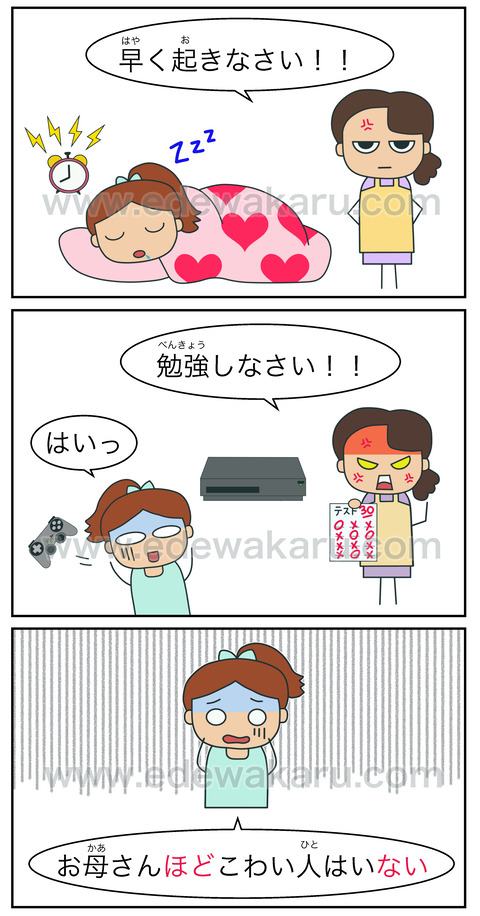
Meaning
~ is the most ~
~ is the very best ~
How to use it
Noun [dictionary form] + ほど〜はない
Explanation
“〜ほど〜はない” is a sentence pattern meaning “~ is the most ~” or “~ is the very best ~.” It is used to say “There is nothing better than ~.” 😊
This pattern is used when the speaker wants to express the feeling that “~ is the best,” so it is not used for general facts. 😮
❌ There is no mountain in Japan as high as Mt. Fuji. [Fact]
→ ⭕️ Mt. Fuji is the highest mountain in Japan.
⭕️ There is no mountain in Japan as beautiful as Mt. Fuji. [Speaker’s feeling]
This is a beginner-level pattern, but it is used very frequently, so be sure to learn it well 😉
In context 5 examples
お母さんほどこわい人はいない
→お母さんが一番こわいThere’s no one as scary as my mother. → My mother is the scariest.
プリンほど好きなものはない
→プリンが一番好きだThere’s nothing I like as much as pudding. → I like pudding best.
彼女ほどかわいい女の子はいない
→彼女が一番かわいい女の子だThere’s no girl as cute as my girlfriend. → She is the cutest girl.
家族ほど大切なものはない
→家族が一番大切だThere’s nothing as important as family. → Family is the most important.
英語ほど嫌いな教科はない
→英語が一番嫌いな教科だThere’s no subject I hate as much as English. → English is the subject I hate most.
Read the original source text
Meaning
〜が一番〜だ
〜が最高に〜だ
How to use it
名詞[辞書形]+ほど〜はない
Explanation
「〜ほど〜はない」は「〜が一番〜だ」「〜が最高に〜だ」という意味を表す文型です。「〜以上のものはな」と言いたい時に使われます😊
この文型は話し手が「〜が一番〜だ」という気持ちを表す場合に使われますので、一般的事実(いっぱんてきじじつ)には使われません
😮
❌日本には富士山
ほど
高い山は
ない
【事実】
→⭕️富士山は日本で一番高い山です
⭕️日本には富士山
ほど
きれいな山は
ない
【話し手の気持ち】
初級で勉強する文型ですが、とてもよく使いますので、しっかりと覚えておいてください😉
Usage 2
Read this source entry ↗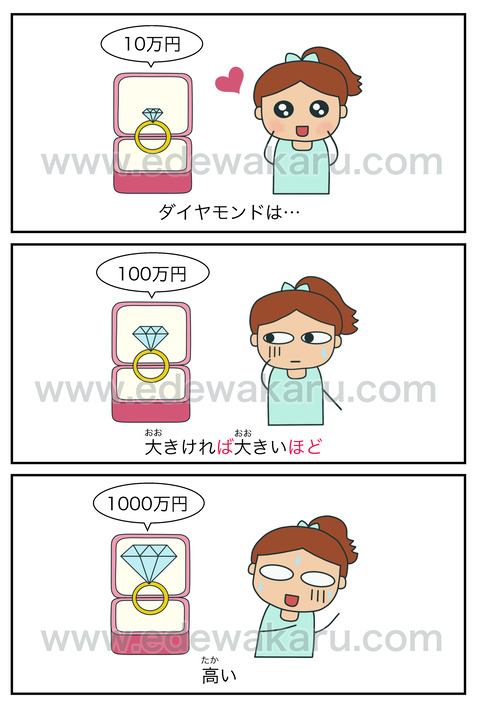
Meaning
In proportion to 〜, further 〜
If 〜, then further 〜
How to use it
Verb or い-adjective [ば-form] + verb or い-adjective [dictionary form] + ほど
な-adjective [であれば form] + な-adjective [〜な or 〜である] + ほど
Noun [であれば form] + noun [〜である] + ほど
Explanation
“AばBほど” is a sentence pattern expressing proportional change or a change in degree, as in “If A, then B also changes in proportion to it.”
[Example]
The bigger a diamond is, the more expensive it is.
In this example, the meaning is that when the size changes, the price also changes in proportion to it: “As a diamond gets bigger, its price also goes up.” 😀
[Additional explanation]
At the N2 level, “〜ば” in “〜ば〜ほど” may be omitted. 😨
[Examples]
① The bigger a diamond is, the more expensive it is.
② The more you study, the better your Japanese gets.
Also, with な-adjectives, forms such as “〜であれば〜なほど,” “〜であれば〜であるほど,” and “〜であればあるほど” can be used. 😮
[Examples]
The easier the test is, the better.
The easier the test is, the better.
The easier the test is, the better.
The easier the test is, the better.
The easier the test is, the better.
There are several forms for な-adjectives, but I think “〜であればあるほど” is used most often. 😀 If you have trouble with the ば-form, review it. 😉
In context 4 examples
ダイヤモンドは大きければ大きいほど高い
→ダイヤモンドは大きさに比例して、(大きくなると)更に高くなるThe bigger a diamond is, the more expensive it is. → In proportion to its size, a diamond becomes even more expensive as it gets bigger.
勉強すれば勉強するほど日本語が上手になる
→勉強するとそれに比例して、更に日本語が上手になるThe more you study, the better your Japanese gets. → As you study, your Japanese gets even better in proportion.
私は、食べれば食べるほど太っちゃうの…(復習:〜ちゃう・〜じゃう)
→私は、食べるとそれに比例して、更に太っちゃうのThe more I eat, the fatter I get... (Review: 〜ちゃう・〜じゃう) → As I eat, I get even fatter in proportion.
テストは簡単であれば、簡単であるほどいい
→テストは簡単だったら更にいいThe easier the test is, the better. → If the test were easy, that would be even better.
Read the original source text
Meaning
〜に比例して、更に〜
〜だったら、更に〜
How to use it
動詞・い形容詞[ば形]+動詞・い形容詞[辞書形]+ほど
な形容詞[であれば形]+な形容詞[ーな・ーである]+ほど
名詞[であれば形]+名詞[ーである]+ほど
Explanation
「AばBほど」は「Aだったら、それに比例してBも〜」というように、【比例変化】【程度の変化】を表す文型です。
[例]
ダイヤモンドは大きけれ
ば
大きい
ほど
高い
この例文では、
「ダイヤモンドは大きさが変わると、それに比例して値段も高くなる」
というように、【大きさ】が変化すると【値段】も比例して変わるという意味を表しています😀
【補足説明】
「〜ば〜ほど」はN2にレベルになると「〜ば」が省略されることがあります😨
[例]
①ダイヤモンドは(大きければ)大きい
ほど
高い
②(勉強すれば)勉強する
ほど
日本語が上手になる
また、「な形容詞」は
「〜であれば〜なほど」「〜であれば〜であるほど」「〜であればあるほど」
などを使うことができます😮
[例]
テストは簡単
であれば
簡単な
ほど
いい
テストは簡単
であれば
簡単
であるほど
いい
テストは(簡単であれば)簡単な
ほど
いい
テストは(簡単であれば)簡単
であるほど
いい
テストは簡単
であればあるほど
いい
「な形容詞」はいくつかの形がありますが、
「〜であればあるほど」が一番よく使われると思います
😀「ば形」が苦手な人は復習をしておいてくださいね😉
どんなときどう使う 日本語表現文型辞典
Usage 1
Meaning
not as…as
How to use it
N + ほど~ない
Explanation
ほど~ない
B:ええ、でも、前の社長ほどではありません。
1)二つのもの(N1とN2)の程度は大きくは違わないが、話題にしたもの(N1)はN2に及ばないと言いたいときに使う。程度がまったく違うものの比較には使わない。
◆ × かめはうさぎほど速く走れません。
2) ❺ ❻ のように、「ほど」が名詞以外につく形もある。
1)Two topics (N1 and N2)are not very different, but topic being taken up (N1)is not same degree as N2. Not used to compare completely different things.
In context 6 examples
今日も風が強いです。でも、今日はきのうほど寒くないです。
The wind is strong again today. But it isn’t as cold as yesterday.
わたしはテイさんほど速く走れません。
I can’t run as fast as Tei.
この町は今も人が多いですが、むかしほどにぎやかではありません。
There are still many people in this town, but it isn’t as lively as it used to be.
A:今度の社長はきびしいですか。
A: Is the new company president strict?
この番組は思っていたほどおもしろくなかったです。
This program wasn’t as interesting as I had expected.
このテスト問題はあなたが考えているほど易しくないです。
This test isn’t as easy as you think.
Read the original source text
Meaning
not as…as
How to use it
N+ほど~ない
Explanation
ほど~ない
B:ええ、でも、前の社長ほどではありません。
1)二つのもの(N1とN2)の程度は大きくは違わないが、話題にしたもの(N1)はN2に及ばないと言いたいときに使う。程度がまったく違うものの比較には使わない。
◆ × かめはうさぎほど速く走れません。
2) ❺ ❻ のように、「ほど」が名詞以外につく形もある。
1)Two topics (N1 and N2)are not very different, but topic being taken up (N1)is not same degree as N2. Not used to compare completely different things.
Usage 2
Meaning
to the extent that; so much that
How to use it
〔Plain form〕(mainly present-tense i-adjectives and verbs) + ほど
Explanation
ほど〈程度〉
~の程度に
B:うん、きのうまでは泣きたいほど痛かったけど、今日は大分よくなったよ。
1)ある状態がどのくらいそうなのか、その程度を強調して言いたいときに使う。
2)話者の意志を表さない動詞や、動詞の「たい」の形につくことが多い。
3)意味・用法は「くらい」とほとんど同じだが、「ほど」は程度が高い場合に使われることが多い。
◆ × 痛いけれど、がまんできるほどの痛さだ。→○痛いけれど、がまんできるくらいの痛さだ。
2)Often used with verbs not expressing speaker's volition, or ~たい form of verb.
3)Nearly same usage and meaning as くらい, but ほど is used when level is high.
1)Emphasizes degree.
In context 4 examples
きのうは山登りに行って、もう1歩も歩けないほど疲れました。
I went mountain climbing yesterday and was so tired I couldn’t walk another step.
A:足、けがしたんですか。
A: Did you injure your leg?
悩んでいたとき、友人が話を聞いてくれて、うれしくて涙が出るほどだった。
When I was worried, a friend listened to me, and I was so happy I could have cried.
いじめは子どもにとっては死にたいほどのつらい経験なのかもしれない。
Bullying may be such a painful experience for children that it makes them want to die.
Read the original source text
Meaning
to the extent that; so much that
How to use it
〔普通形〕(主にイAとVの現在形)+ほど
Explanation
ほど〈程度〉
~の程度に
B:うん、きのうまでは泣きたいほど痛かったけど、今日は大分よくなったよ。
1)ある状態がどのくらいそうなのか、その程度を強調して言いたいときに使う。
2)話者の意志を表さない動詞や、動詞の「たい」の形につくことが多い。
3)意味・用法は「くらい」とほとんど同じだが、「ほど」は程度が高い場合に使われることが多い。
◆ × 痛いけれど、がまんできるほどの痛さだ。→○痛いけれど、がまんできるくらいの痛さだ。
2)Often used with verbs not expressing speaker's volition, or ~たい form of verb.
3)Nearly same usage and meaning as くらい, but ほど is used when level is high.
1)Emphasizes degree.
Usage 3
Meaning
nothing is as supremely…as
How to use it
Vる / N + ほど~はない
Explanation
ほど~はない
~は最高に~だ
夫:まったく今年の夏ほど暑い夏はないね。
1)「Nほど~はない」の形で、話者が主観的に「Nは最高に~だ」と感じ、強調して言うときに使う。
2)「ほど」の代わりに「くらい~はない」の言い方もある。
3)客観的な事実については使わない。
◆ × 富士山ほど高い山
はない。
→◯富士山は日本で一番高い山だ。
2)Pattern くらい~はない can replace ほど.
1)Speaker subjectively feels and emphasizes that the N that comes before pattern is supreme.
3)Not used for objective facts.
In context 4 examples
妻:暑いわねえ。
Wife: It’s so hot, isn’t it?
困っているとき、思いやりのある友人の言葉ほどうれしいものはない。
When you’re having a hard time, nothing is as heartening as the words of a thoughtful friend.
旅行前に、あれこれ旅行案内の本を見るほど楽しいことはない。
There’s nothing as enjoyable as looking through various travel guidebooks before a trip.
志望の会社に就職できなかったときほど悔しかったことはない。
Nothing was as frustrating as when I couldn’t get a job at the company I wanted to work for.
Read the original source text
Meaning
nothing is as supremely…as
How to use it
Vる/N+ほど~はない
Explanation
ほど~はない
~は最高に~だ
夫:まったく今年の夏ほど暑い夏はないね。
1)「Nほど~はない」の形で、話者が主観的に「Nは最高に~だ」と感じ、強調して言うときに使う。
2)「ほど」の代わりに「くらい~はない」の言い方もある。
3)客観的な事実については使わない。
◆ × 富士山ほど高い山
はない。
→◯富士山は日本で一番高い山だ。
2)Pattern くらい~はない can replace ほど.
1)Speaker subjectively feels and emphasizes that the N that comes before pattern is supreme.
3)Not used for objective facts.
Usage 4
Meaning
if do…becomes…, the more…the more
How to use it
Vる / i-adjective い / na-adjective な / N + ほど
Explanation
ほど〈相関関係〉
~すれば…になり、もっと~すればもっと…になる
1)「ば~ほど・なら~ほど」の「ば・なら」を省略した文。
2)この使い方では「名詞+ほど」もある。
1)Sentence pattern in which ば and なら have been dropped from ば~ほど, and なら~ほど, respectively.
2)Also, noun +ほど.
In context 4 examples
外国語は勉強するほど難しくなる。
The more you study a foreign language, the more difficult it becomes.
アパートを探しています。駅に近いほどいいんですが、どこかありませんか。
I’m looking for an apartment. The closer it is to a station, the better. Do you know of anywhere?
わたしは何もしないでいるのが好きだから、休みの日は暇なほどいい。
I like doing nothing, so on my days off, the more free time I have, the better.
優れた営業マンほど客の声に耳を傾ける。
The better the salesperson, the more they listen to customers.
Read the original source text
Meaning
if do…becomes…, the more…the more
How to use it
Vる/イAい/ナAな/N+ほど
Explanation
ほど〈相関関係〉
~すれば…になり、もっと~すればもっと…になる
1)「ば~ほど・なら~ほど」の「ば・なら」を省略した文。
2)この使い方では「名詞+ほど」もある。
1)Sentence pattern in which ば and なら have been dropped from ば~ほど, and なら~ほど, respectively.
2)Also, noun +ほど.
Usage 5
Meaning
the more…the more; the less…the less
How to use it
Vば + Vる / i-adjective ければ + i-adjective い / na-adjective なら + na-adjective な + ほど
Explanation
ば~ほど
~すれば…になり、もっと~すればもっと…になる
1)「一方の程度が変われば、それとともに他方も変わる」と言いたいときの表現。ナ形容詞の場合は「~なら~なほど」となる。
2) ❺ のように、普通予想することと反対の結果となる場合にも使う。
1)As degree of one thing changes, so does another. ナ-adjectives become ~なら~なほど.
2)Also used for results contrary to what is usually expected, as in sentence ❺ .ば
In context 5 examples
山は登れば登るほど、気温が低くなる。
The higher you climb the mountain, the lower the temperature gets.
お礼の手紙を出すのは早ければ早いほどいい。
The sooner you send a thank-you letter, the better.
毎日使う道具の使い方は簡単なら簡単なほどいい。
The simpler the way to use a tool you use every day, the better.
このABC社で仕事をするには、外国語が上手なら上手なほどいい。
When working at ABC Company, the better you are at foreign languages, the better.
あの人の話は聞けば聞くほどわからなくなる。
The more I listen to that person’s story, the less I understand.
Read the original source text
Meaning
the more…the more; the less…the less
How to use it
Vば+Vる/イAければ+イAい/ナAなら+ナAな+ほど
Explanation
ば~ほど
~すれば…になり、もっと~すればもっと…になる
1)「一方の程度が変われば、それとともに他方も変わる」と言いたいときの表現。ナ形容詞の場合は「~なら~なほど」となる。
2) ❺ のように、普通予想することと反対の結果となる場合にも使う。
1)As degree of one thing changes, so does another. ナ-adjectives become ~なら~なほど.
2)Also used for results contrary to what is usually expected, as in sentence ❺ .ば
日本語NET JLPT文法解説まとめ
Usage 1
Read this source entry ↗Meaning
Expresses the degree of an action or state by giving an example.
How to use it
V (plain form / negative form) + ほど
イA (plain form) + ほど
N + ほど
Explanation
Shows the degree of an action or state.
・A casual way of saying it is 「~くらい」.
・When a noun follows, the form is 「〜ほどのN」.
In context 17 examples
送別会で持ち帰れないほどのプレゼントを頂きました。
I received so many farewell party gifts that I couldn't take them all home.
セールのせいで、歩けないほど人が多い。
Because of the sale, there are so many people you can hardly walk.
あぁ〜、死ぬほど疲れた〜。
Ahh, I'm tired to death.
好きな子に振られて、死ぬほど辛い。
I got rejected by the person I like, and it hurts so much I could die.
さっきの地震は立っていられないほど大きかった。
The earthquake just now was so strong I couldn't stay standing.
オークションでは、びっくりするほどの値段がつけられた。
At the auction, it fetched an astonishingly high price.
昨日はお腹いっぱいで、動けなくほど食べました。
Yesterday I was so full that I ate until I couldn't move.
今、家の近くで工事をしていて、集中できないほどうるさいです。
There's construction going on near my house right now, and it's so noisy I can't concentrate.
試験に受かった時は、涙が出るほど嬉しかった。
When I passed the exam, I was so happy I could cry.
その犬は震えるほど怯えていた。
That dog was so frightened it was trembling.
値段を見て、目が飛び出るほど驚いた。
When I saw the price, I was so surprised my eyes nearly popped out.
部長からは若いころの話をうんざりするほど聞かされた。
The department manager made me listen to stories about his youth so many times I was sick of them.
募金を呼びかけたところ、信じられないほどのお金が集まった。
When we called for donations, we collected an unbelievable amount of money.
彼の気持ちが痛いほどわかる。
I understand how he feels so well it hurts.
今日は昨日ほど寒くない。
It's not as cold today as it was yesterday.
あの人ほど日本語が上手に話せたらいいのになぁ。
I wish I could speak Japanese as well as that person.
言いたいことは山ほどあります。
I have a mountain of things I want to say.
Read the original source text
Meaning
動作や状態の程度を例を使って表す。
How to use it
V(普通形 / ナイ形) + ほど
イA(普通形) + ほど
N + ほど
Explanation
Shows the degree of an action or state.
・カジュアルな言い方は「~くらい」
・後ろに名詞が来る場合「〜ほどのN」となる。
Usage 2
Read this source entry ↗Meaning
“If you do ~, it becomes …; the more you do ~, the more …”
It expresses that as the degree of the preceding matter increases, the degree of the following matter also intensifies accordingly.
How to use it
V (ば-form) + V (dictionary form) + ほど
イAければ + イAい + ほど
ナAなら + ナAな + ほど / ナAであれば + ナAであるほど
Explanation
"if do〜becomes・・・, the more 〜the more・・・"
It expresses that as the degree of the preceding matter increases, the degree of the following matter also intensifies accordingly.
The conditional 「〜ば」 may be omitted.
In context 17 examples
外国語は勉強すればするほどむずかしくなる。
The more you study foreign languages, the harder they become.
日本語は話せば話すほど、早く上達します。
The more you speak Japanese, the faster you improve.
彼を好きになればなるほど私の気持ちを抑えられなくなるの。
The more I fall in love with him, the less I can control my feelings.
この問題は考えれば考えるほどわからなくなる。
The more I think about this problem, the less I understand it.
頑張れば頑張るほど給料がもらえる会社で働きたいです。
I want to work for a company where the harder you work, the more you get paid.
彼は酔えば酔うほど強くなるのよ。酔拳の使い手だからね。
The drunker he gets, the stronger he becomes. It's because he's a practitioner of drunken boxing.
駅に近ければ近いほど、家賃は高くなります。
The closer you are to the station, the higher the rent gets.
旅行に行く時は、荷物は軽ければ軽いほどいい。
When you travel, the lighter your luggage is, the better.
日本の料理を習いたいんだけど、どこか知らない。お金があまりないので、安ければ安いほど嬉しいんだけど。
I want to learn Japanese cooking. Do you know somewhere? I don't have much money, so the cheaper it is, the happier I'll be.
試験の問題は難しければ難しいほどやりがいがある。
The harder the exam questions are, the more rewarding they are.
私は辛いものが大好きなので、辛ければ辛いほど嬉しい。
I love spicy food, so the spicier it is, the happier I am.
ビジネスのメールの返信は早ければ早いほどいい。
The sooner you reply to a business email, the better.
ホテルは値段が高ければ高いほど、サービスや部屋の質もよくなるものだ。
The higher the price of a hotel, the better its service and room quality tend to be.
家で何もせず、ゴロゴロしているのが好きなので、休日は暇なら暇なほどいい。
I like doing nothing and lounging around at home, so the more free time I have on a day off, the better.
試験は簡単なら簡単なほど嬉しい。
The easier the exam is, the happier I am.
家は丈夫なら丈夫なほど安心です。
The sturdier a house is, the more reassured I feel.
仕事は、大変であれば大変であるほど、やる気がでます。
The tougher the job is, the more motivated I feel.
Read the original source text
Meaning
"〜すれば・・・になり、もっと〜すれば・・・になる"
前件の程度が強まると、それに影響して後件の程度もさらに強まることを表す。
How to use it
V(ば形) + V(辞書形) + ほど
イAければ + イAい + ほど
ナAなら + ナAな + ほど / ナAであれば + ナAであるほど
Explanation
"if do〜becomes・・・, the more 〜the more・・・"
It expresses that as the degree of the preceding matter increases, the degree of the following matter also intensifies accordingly.
条件を表す「〜ば」は省略されることもある。
Usage 3
Read this source entry ↗Meaning
~is the best.
Used when the speaker wants to subjectively emphasize that something is “the best” or “the most preferable.”
Therefore, it cannot be used for objective facts.
Incorrect example
× There is no mountain as high as Everest.
→ Everest is the highest mountain in the world.
How to use it
V (dictionary form) こと + ほど・・・はない
N + ほど・・・はない
Explanation
"the best"
When the speaker wants to subjectively emphasize that something is 'the best' or 'the most preferable,' this expression is used. Therefore, it cannot be used for objective facts."
① The latter clause is often used together with 「他に」 (e.g., 「〜他にない」, 「〜は他にいない」).
② 「ほど」 can be replaced with 「くらい/ぐらい」.
① The phrase is often used together with "他に" in the following pattern (e.g., "〜他にない"、"〜は他にいない").
② "ほど" can be replaced with "くらい/ぐらい".
In context 13 examples
ゲームをすることほど楽しいことは他にないね。
There's nothing more fun than playing games.
JLPTに合格できなかったことほど悔しかったことはない。
I've never been more frustrated than when I failed to pass the JLPT.
1日中寝ることほど幸せなことはない。
There's nothing happier than sleeping all day.
好きな子に告白することほど、緊張するものはない。
Nothing is more nerve-racking than confessing your feelings to someone you like.
ワンピースほど面白い漫画はない。
There's no manga as interesting as One Piece.
私ほどスマートな人はこの学校にはいないでしょう。
There's no one at this school as smart as me, I bet.
日本ほど治安のいい国はあまりありません。
There aren't many countries as safe as Japan.
私の彼氏ほどかっこいい男はいないよ。
There's no man as handsome as my boyfriend.
日本語の勉強で漢字ほど嫌なものはない。
There's nothing I dislike more than kanji in studying Japanese.
スマホほど便利なものはない。
There's nothing as convenient as a smartphone.
ファイナルファンタジーほどおもしろいRPGはない。
There's no RPG as interesting as Final Fantasy.
アラビア語ほど難しい言語は他にない。
There's no other language as difficult as Arabic.
トムさんほど元気な人はこの学校にはいない。
There's no one at this school as energetic as Tom.
Read the original source text
Meaning
〜が一番いい。
話し手が主観的に「最高だ」、「一番いい」と強調して言いたい時に使う。
そのため、客観的な事実については使えない。
誤用例
× エベレストほど高い山はない。
→ エベレストが世界で一番高い山だ。
How to use it
V(辞書形)こと + ほど・・・はない
N + ほど・・・はない
Explanation
"the best"
When the speaker wants to subjectively emphasize that something is 'the best' or 'the most preferable,' this expression is used. Therefore, it cannot be used for objective facts."
① 後件「他に」とセットで使うことも多い(〜他にない、〜は他にいない)。
②「ほど」は「くらい/ぐらい」で置き換え可能。
① The phrase is often used together with "他に" in the following pattern (e.g., "〜他にない"、"〜は他にいない").
② "ほど" can be replaced with "くらい/ぐらい".
Usage 4
Read this source entry ↗Meaning
In “XはYほど〜ない” (“X is not as … as Y”), X and Y are at roughly the same level, but when compared, X is lower in degree than Y.
How to use it
N + ほど〜ない
Explanation
X is not as ~ as Y.
In context 7 examples
トムさんはジョンさんほど背が高くないです。
Tom isn't as tall as John.
私がラーメンが好きだが、お好み焼きほど好きじゃありません。
I like ramen, but I don't like it as much as okonomiyaki.
今年は去年ほど寒くないですね。
This year isn't as cold as last year, is it?
中国はカナダほど大きくないです。
China isn't as large as Canada.
ジェシカさんは日本語が上手ですが、メアリーさんほどではありません。
Jessica is good at Japanese, but not as good as Mary.
私の部屋は普通の人の部屋より広いけど、ジェームスさんの部屋ほど広くはありません。
My room is bigger than an average person's room, but it isn't as big as James's.
トムさんはJLPT N1に合格したので、日本語を上手に話すが、スピーチコンテストで優勝したJLPT N2レベルのジェームスさんほど上手ではありません。
Tom passed JLPT N1, so he speaks Japanese well, but he isn't as good as James, who is at JLPT N2 level and won the speech contest.
Read the original source text
Meaning
"XはYほど〜ない"で、XもYも同じぐらい~であるが、比べるとXはYよりは程度が低いことを表す。
How to use it
N + ほど〜ない
Explanation
X is not as ~ as Y.
毎日のんびり日本語教師
Usage 1
Read this source entry ↗How to use it
Verb ば-form+verb dictionary form+ほど
Verb ば-form+verb dictionary form/verb た-form+だけ
い-adjective stem+ければ+い-adjective dictionary form+ほど/だけ
な-adjective stem+であれば+な-adjective stem+である/な+ほど/だけ
(な-adjective stem+であればあるほど/であればあるだけ)
Noun+であれば+Noun+であるほど/であるだけ
(Noun+であればあるほど/であればあるだけ)
Explanation
This grammar expresses two things changing simultaneously: as the first part changes, the second part changes along with it.
The same verb is used twice in different conjugated forms. However, with な-adjectives and nouns, the latter part can be omitted, giving 「であればあるほど」.
The 「~ば」 in the first clause may be omitted.
「~ば~だけ」 differs from 「~ば~ほど」 in that it can also attach to the past form of a verb.
The range of use of 「~ば~だけ」 is not very broad, and 「~ば~ほど」 is more commonly used.
Notes
The 「だけ」series
In context 5 examples
駅から近ければ近いほど家賃は高くなります。
The closer a house is to the station, the higher the rent.
周囲に反対されればされるほど恋は燃える。
The more people oppose them, the more their love burns.
目標は明確であればあるほどいい。(目标越明确越好。)
The clearer the goal, the better. (The clearer the goal, the better.)
何でも練習すればするほど上手になる。
The more you practice anything, the better you get at it.
今日は暑いので、飲み物は冷たければ冷たいほど良い。
It's hot today, so the colder the drink, the better.
Read the original source text
How to use it
動ば形+動辞形+ほど
動ば形+動辞形/動た形+だけ
い形容詞語幹+ければ+い形容詞辞書形+ほど/だけ
な形容詞語幹+であれば+な形容詞語幹+である/な+ほど/だけ
(な形容詞語幹+であればあるほど/であればあるだけ)
名詞+であれば+名詞+であるほど/であるだけ
(名詞+であればあるほど/であればあるだけ)
Explanation
ある2つの物事が同時に変化することを表す文法で、前項が変化していくにつれて、後項もそれと共に変化していくことを表します。
接続には同じ動詞を異なる活用で2度使います。ただし、な形容詞と名詞の場合は、後ろが省略されて「であればあるほど」と言うことができます。
前件の「~ば」は省略可能です。
「~ば~だけ」は動た形にも接続できる点で「~ば~ほど」と異なります。
「~ば~だけ」の使用範囲はあまり広くなく、「~ば~ほど」の方が一般的に用いられやすいです。
Notes
「だけ」シリーズ
Usage 2
Read this source entry ↗How to use it
Noun + ほど + noun + は~ない
Noun + くらい + noun + は~ない
Noun + ぐらい + noun + は~ない
Explanation
Expresses that something reaches the highest degree and that there is nothing beyond it.
It is followed by a negative form, using the pattern「~くらい~ない」.
The latter clause is followed by words such as「少ない」,「珍しい」,「他にない」,「いない」, and「存在しない」.
Notes
There is no difference between “くらい” and “ぐらい.” They mean the same thing whichever one you use.
The “くらい/ぐらい” series
In context 8 examples
囲碁ほどルールを聞いても分からない盤上競技は他にない。
There is no other board game where even after hearing the rules, you understand as little as you do with Go.
人生において、両親が死ぬくらいつらいことはないだろう。
In life, nothing is probably as painful as your parents dying.
バングラディシュのダッカくらい人口密度が高い都市は他にない。
There is no other city with a population density as high as Dhaka, Bangladesh.
人前に出ることほど嫌なことはない。
Nothing is as unpleasant as being in front of other people.
彼女ほど努力した人を他に見たことがない。
I have never seen anyone work as hard as she did.
結末を知りながら見る映画ほどつまらないものはない。
Nothing is as boring as watching a movie when you already know the ending.
エンターテイナーでは、マイケルジャクソンほど有名な人はいない。
Among entertainers, no one is as famous as Michael Jackson.
彼ほどこの分野に精通した人はいない。
No one is as knowledgeable about this field as he is.
Read the original source text
How to use it
名詞+ほど+名詞+は~ない
名詞+くらい+名詞+は~ない
名詞+ぐらい+名詞+は~ない
Explanation
物事が最高の程度に達して、それ以上ないことを表します。
後件に否定形を伴い、「~くらい~ない」の文型を取ります。
後件には「少ない」「珍しい」「他にない」「いない」「存在しない」などの語が続きます。
Notes
「くらい」と「ぐらい」に違いはありません。どちらを使っても意味は同じです。
「くらい/ぐらい」シリーズ
Usage 3
Read this source entry ↗How to use it
Quantity + ほど
Noun + ほど
Explanation
Expresses that an amount, size, duration, range, etc. is roughly close to the stated value, or almost the same.
It has the same meaning as 「約~」 or 「大体~」 (“about ~”).
In example (2), 「息子ほど」 is an abbreviated expression for 「息子と同じ年齢ほど」 (“about the same age as my son”).
It can be rephrased as 「くらい/ぐらい」. Using 「くらい」 makes the expression conversational. 「ほど」 is somewhat formal.
Notes
The 「ほど」 series
In context 8 examples
友だちと3時間ほど電話で喋ってた。
I was talking on the phone with a friend for about three hours.
今の職場では、自分の息子ほどの人と一緒に働いている。
At my current workplace, I work with people about my son's age.
昨日は12時間ほど寝た。
I slept for about 12 hours yesterday.
この世界には、異性は星の数ほどいる。
There are as many members of the opposite sex in this world as there are stars.
今の所持金は200円ほどしかない。(现在所带的钱只有200日元左右。)
I only have about 200 yen on me right now. (I only have about 200 yen with me.)
夏休みまであと1か月ほどだ。
There's about a month left until summer vacation.
私たちは3年ほど付き合っている。
We've been dating for about three years.
仕事が山ほどある。(工作堆积如山。)②程度
I have a mountain of work. (I have tons of work.) ② Degree
Read the original source text
How to use it
数量+ほど
名詞+ほど
Explanation
多さ、大きさ、時間、範囲等が大体その数値に近いこと、あるいはほとんど同じことを表します。
「約~」「大体~」と同じ意味です。
例文(2)の「息子ほど」は「息子と同じ年齢ほど」が省略された表現です。
「くらい/ぐらい」に言い換えられます。「くらい」を使うと口語的な表現になります。「ほど」はやや硬い表現です。
Notes
「ほど」シリーズ
Usage 4
Read this source entry ↗How to use it
Verb plain form + ほど~ない
Noun + ほど~ない
Explanation
Expresses comparison.
The word immediately before 「ほど」 serves as the standard, and the following clause states the comparison.
Notes
The 「ほど」 series
In context 8 examples
今年の冬は去年の冬ほど寒くはない。(今年冬天不如去年冬天冷。)
This winter isn't as cold as last winter. (This winter isn't as cold as last winter.)
子どもほど大切なものはない。
Nothing is as precious as children.
彼ほど仕事熱心な人はいない。
There is no one as devoted to work as he is.
A社の新商品は、我が社にとって多くの人が言うほど脅威にはならないだろう。
A Company's new product probably won't be as much of a threat to our company as many people say.
皆嫌々参加する会議ほど生産性の無いものはない。
Nothing is as unproductive as a meeting that everyone attends unwillingly.
完治するまでに思っていたほど時間はかからなかった。
It didn't take as long to recover completely as I had expected.
皆さんから参考にされるほど私は上手くないです。
I'm not good enough for people to look to me for advice.
お前の相手をしているほど暇ではない。
I'm not so free that I can spend time dealing with you.
Read the original source text
How to use it
動詞普通形+ほど~ない
名詞+ほど~ない
Explanation
比較を表します。
「ほど」の直前に接続された語が基準となり、後件では比較が述べられます。
Notes
「ほど」シリーズ
日本語文型辞典 英語版
Meaning
B:いくつですか。
How many would you like?
A:五つほど。
Five or so.
Indicates an approximate quantity when attached to a quantifier. Can be used with lengths of time, such as hours or days. However, it cannot be used with expressions that have no length such as the time of the day or date, where ごろ is used instead.
(×)3時ほど来て下さい。
Please come at about 3:00 p.m.
(○)3時ごろ来て下さい。
Please come around 3:00 p.m.
The meaning of 五つほど in example
(5)
is the same as五つください but it sounds politer to give the listener the option to choose “around five” apples.
ほど, when used with a numerical value to mean “approximately,” can be replaced by くらい or ぐらい.
Taking the form XはYほど...ない, it means X is less than Y. For example, in the expression XはYほど大きくない, X is smaller than Y.
While XはYより... indicates a simple comparison of X and Y, in the case of XはYほど...ない, there can be an additional meaning of “X and Y are both ..., but when comparing the two, ....” For example, in the case of
(1)
, it is understood that this summer is hot, but not as hot as last year.
b. ...ほど...Nはない
By stating that there is no comparison, N in Nほど has the highest degree within the comparison. Example
(1)
means that an examination is the most hateful thing of all. Example
(2)
means “You were the kindest.”
Used to explain the degree of the action or state by comparing it to an example N. When N is an indicative これ, それ, あれ or どれ, the meaning is the equivalent of こんなに, そんなに, あんなに or どんなに, respectively.
b. ...ほどだ[Na なほどだ][A/V ほどだ]
Used to describe the degree of the thing mentioned by giving concrete examples for comparison.
c. ...ほどの...ではない[...ほどのNではない][...ほどの こと/もの ではない]
Indicates that something is “less of a degree... than ....” Implies that this is not something serious or important.
d. ...というほどではない[N/Na というほどではない][A/V というほどではない]
B:いや、高級車というほどじゃないけれど。わりといい車なんだ。
I wouldn’t call it deluxe, but it’s a fairly good car.
Means that the degree of something is not close to what is described by N/Na/A/V. In this expression, a commonly-known example is used as a reference point. For example, as in the case of
(2)
, being able to interpret requires a high standard of English, so the speaker’s English is not as proficient as that of an interpreter. Similarly, in the case of
(3)
, having to have an operation is generally regarded as serious, but the speaker’s condition is not as serious as this.
As the level of something indicated by V in Vほど increases, something else related to the original V changes proportionately. For example, in the case of
(1)
, as someone grows older, his body gets weaker. In the case of
(2)
, wine that is kept longer improves.
The structure of ...ほど... Naに/A-く/V-ようになる is often used in stating general knowledge or observation, as in the cases of
(1)
-
(4)
. Example
(7)
uses ...ほどに that is formal and usually used in written language. There are similar expressions such as ...につれて and ...ば...ほど.
b. ...ば...ほど[N/Na であればあるほど][A-ければA-いほど][V-ばV-るほど]
B:(安ければ)安いほどいいんですが。
The cheaper the better.
Repeating the same word X (N, A or V), XばXほどY means “the more X, the more Y.” As state X changes over time, state Y changes proportionately to X. As in the cases of examples
(4)
-
(7)
, the changes in X and Y may be inversely proportionate.
How to use it
1. 数量詞+ほど〈approximation〉
2. ...ほど...ない〈comparison〉[Nほど...ない][Vほど...ない]a. ...ほど...ない
3. ...ほど〈degree〉a. ...ほど[Nほど][A-いほど][V-るほど]
4. ...ほど〈proportional change〉a. ...ほど[N/Na ほど][A-いほど][V-るほど]
In context 51 examples
水を 10 CCほど入れてください。
Please add about 10 ml of water.
修理には一週間ほどかかります。
It will take a week or so to repair.
完成するまでに3時間ほどかかります。
It will take approximately three hours to complete.
仕事はまだ半分ほど残っている。
There is still about half the work yet to be done.
A:りんごください。
I would like some apples, please.
今年の夏は去年ほど暑くない。
This summer hasn’t been as hot as last summer.
試験は思っていたほど難しくなかった。
The exam wasn’t as difficult as I’d thought it was going to be.
教師の仕事はそばでみているほど楽ではない。
The job of a teacher isn’t as easy as it may seem to a bystander.
佐藤は今井ほど勤勉な学生ではない。
Sato isn’t as conscientious a student as Imai.
この地域は大都市近郊ほどは、宅地開発が進んでいない。
Housing in this area has not been developed as much as in the suburbs of a big city.
試験ほどいやなものはない。
There is nothing as unpleasant as exams.
いろんな方が親切にして下さいましたが、あなたほど親身になって下さった方は他にありません。
Many different people have been kind to me, but no one has been as sincere as you.
東京ほど家賃の高いところはない。
There is no other place where the rent is as expensive as in Tokyo.
これほどすばらしい作品は他にありません。
There is no other work (of art) that is as splendid as this one.
川口さんほどよく勉強する学生はいない。
There is no other student who studies as hard as Kawaguchi-san.
子供に先立たれることほどつらいことはない。
There is nothing so heartbreaking as having your own child die before you do.
この商品はおもしろいほどよく売れる。
It’s almost funny how well this product is selling!
顔も見たくないほどきらいだ。
I hate her so much that I can’t even stand to look at her face.
今日は死ぬほど疲れた。
I was tired to death today!
そのニュースをきいて、彼は飛び上がるほど驚いた。
When he heard the news, he could have jumped up in astonishment.
東京中を足が棒になるほど歩き回ったが、探していた本は見つからなかった。
I walked around Tokyo until my legs were about to give out, but I didn’t find the book I was looking for.
医者の話では、胃に親指の先ほどの腫瘍があるという。
According to the doctor, I have a tumor the size of the tip of my thumb in my stomach.
それほど言うなら、好きなようにすればいい。
If you’re going to make such a fuss, do it your own way.
なんの連絡もしてこないから、どれほど心配したかわからない。
You can’t begin to imagine how much I worried about you when there was no contact whatsoever!
ずいぶん元気になって、昨日なんか外に散歩にでかけたほどです。
She’s feeling so much better that she even went out for a walk yesterday.
彼は犬がたいへん嫌いだ。道に犬がいれば、わざわざ遠回りするほどだ。
He cannot stand dogs. If there’s a dog on the street, he’ll take a detour to avoid it.
コンサートはたいへんな人気で、立ち見がでるほどだった。
The concert was so popular that it was finally a case of standing room only.
このシャツは着やすいし値段も安いので、とても気に入っている。色違いで3枚も持っているほどだ。
I really like this shirt because it is so comfortable and the price is right. So much so that I have it in three different colors!
事故後の彼の回復ぶりは、奇跡とも言えるほどだ。
The recovery he has made after the accident might well be called a miracle.
医者に行くほどのけがではない。
It is not an injury that requires medical attention.
そんなに深刻に悩むほどの問題ではない。
It is not such an issue that you should be so agonized over it.
そんなに怒るほどのことではない。
It is not something that’s worth getting so angry about.
確かに便利そうな機械だが、20 万円も出すほどのものではない。
This machine does seem to be useful, but it is not worth spending 200,000 yen on it.
酒は好きだが、毎日飲まないではいられないというほどじゃない。
I like alcohol, but not to the extent that I need to drink every day.
英語は少し勉強しましたが、通訳ができるというほどではありません。
I have studied English a little, but I am not good enough to become an interpreter.
数年前から胃を悪くしているが、手術をしなければいけないというほどではない。
I have been suffering from stomach problems for the past few years, but it is not bad enough to require an operation.
A:高級車買ったんだって?
Did I hear you have bought a deluxe car?
年をとるほど体が弱くなる。
The older one gets the weaker one’s body becomes.
上等のワインは、古くなるほどうまくなる。
Good wine becomes even better the older it gets.
駅に近いほど家賃は高くなる。
The closer the property is to the station, the higher the rent.
北へ行くほど寒くなる。
It gets colder the farther north you go.
まじめな人ほどストレスがたまる。
The more conscientious a person is, the more he or she suffers from stress.
健康に自信がある人ほど、病気になかなか気づかないことが多い。
People who believe in their own good health often fail to notice that they are ill.
酔うほどに、宴はにぎやかになっていった。
The drunker people became, the livelier the party got.
食べれば食べるほど太る。
The more you eat the fatter you get.
A:どれぐらいのご予算ですか。
How much is the budget?
活発で優秀な学生であればあるほど、知識を一方的に与えるような授業はつまらなく感じるのだろう。
The more active and brighter the student is, the more bored he or she is likely to feel in a class where the teacher simply teaches facts (without soliciting any response).
電気製品というのは、高くなればなるほど、使いにくくなる。
For electronic goods, the more expensive they are, the more difficult they are to use.
どうしたらいいのか、考えれば考えるほどわからなくなってしまった。
The more I thought about what I should do, the more confused I became.
眠ろうとすればするほど眼が冴えてくる。
The harder I try to get to sleep the wider awake I become.
この説明書は、読めば読むほどわからなくなる。
The more I read this instruction manual, the more confused I get.
AIUEO JLPT Grammar
Usage 1
Meaning
「ほど」is used to express the degree or comparison of a certain state or extent, or to compare it with something else.
How to use it
Verb + ほど; adjective + ほど; な-adjective + な + ほど; noun + ほど
In context 5 examples
驚くほどの美しさだった。
It was so beautiful that it was astonishing.
彼の話は信じられないほど面白かった。
His story was unbelievably interesting.
今日は昨日ほど寒くない。
Today is not as cold as yesterday.
彼の冗談にはお腹が痛くなるほど笑った。
I laughed so hard at his joke that my stomach hurt.
このカレーは涙が出るほど辛い。
This curry is so spicy that it makes me cry.
Read the original source text
Meaning
「ほど」is used to express the degree or comparison of a certain state or extent, or to compare it with something else.
How to use it
動詞+ほど形容詞+ほど形容動詞な+ほど名詞+ほど
Explanation · 日本語
「ほど」は、程度や比較を表す表現で、特定の状態や程度がどれくらいであるか、または他のものと比べてどのくらいかを示すために用いられる助詞です。
Usage 2
Meaning
This sentence pattern indicates that something is less than another thing in terms of degree.
How to use it
Noun + ほど + negative sentence; verb + ほど + negative sentence
In context 5 examples
彼女は私ほど数学が得意ではない。
She is not as good at math as I am.
この店は他の店ほど安くない。
This store is not as cheap as other stores.
この映画は前作ほど人気がない。
This movie is not as popular as the previous one.
この町は東京ほど賑やかではない。
This town is not as lively as Tokyo.
彼女は彼ほど友達が多くない。
She doesn’t have as many friends as he does.
Read the original source text
Meaning
This sentence pattern indicates that something is less than another thing in terms of degree.
How to use it
名詞ほど+否定文動詞ほど+否定文
Explanation · 日本語
この文型は、あるものが他のものと比べて程度が低いことを表す表現です。
Usage 3
Meaning
This sentence pattern is used to compare and express “〜 is the best at〜.” The pattern「AほどBが〜ない」emphasizes that A is the highest in a particular attribute of B.
How to use it
Noun ほど + negative sentence
In context 5 examples
彼女ほど美しい人はいない。
There is no one as beautiful as she is.
この問題ほど難しいものはないです。
There is no problem as difficult as this one.
それまで彼女ほど優しい人には会ったことがなかった。
I’ve never met anyone as kind as she is.
彼ほど努力している人を見たことがありません。
I had never met anyone as kind as her before.
この画家ほど芸術に情熱を持つ人はいないんです。
There is no artist as passionate about art as this painter.
Read the original source text
Meaning
This sentence pattern is used to compare and express “〜 is the best at〜.” The pattern「AほどBが〜ない」emphasizes that A is the highest in a particular attribute of B.
How to use it
名詞ほど+否定文
Explanation · 日本語
この文型は、比較を行うときに、「〜が一番〜」の意味で使われます。「AほどBが〜ない」という形で、AがBの特定の属性において最も高い程度にあることを強調します。
Usage 4
Meaning
This sentence pattern is used to show that as something progresses, another thing also progresses. It often connects with verbs, adjectives, and adjectival verbs in forms like “〜すればするほど,” “〜ければ〜ほど,” and “〜であればあるほど,” or simply with just “〜ほど” in a shortened form.
How to use it
Verb ば-form + verb dictionary form + ほど; adjective ば-form + adjective dictionary form + ほど; な-adjective なら + な-adjective + ほど; な-adjective で + あれば + あるほど
In context 5 examples
商品は、安いほど売れます。
The cheaper the product, the better it sells.
簡単であればあるほど、いいと思います。
I think the simpler it is, the better.
静かなら静かなほど、勉強に集中できる。
The quieter it is, the better you can concentrate on studying.
お金は多いほど安心です。
The more money you have, the more secure you feel.
練習すればするほど、上達する。
The more you practice, the more you improve.
Read the original source text
Meaning
This sentence pattern is used to show that as something progresses, another thing also progresses. It often connects with verbs, adjectives, and adjectival verbs in forms like “〜すればするほど,” “〜ければ〜ほど,” and “〜であればあるほど,” or simply with just “〜ほど” in a shortened form.
How to use it
動詞ば形+動詞辞書形ほど形容詞ば形+形容詞辞書形ほど形容動詞なら+形容動詞な+ほど形容動詞で+あれば+あるほど
Explanation · 日本語
この文型は、何かが進行するにつれて、他のことも同時に進行することを表す表現です。この表現は、「〜すればするほど」「〜ければ~ほど」「〜であればあるほど」といった形で、動詞、形容詞、形容動詞に接続します。また、省略形として、「〜ば」の部分を省略し、「〜ほど」のみで使われることもあります。
Bunpro Grammar Reference
Usage 1
Meaning
The more, About, To the extent that, So much… that
How to use it
Verb + ほど
[い]Adjective + ほど
[な]Adjective + な + ほど
Noun + ほど
Nuance
A phrase that somewhat confidently highlights the rough degree, amount, or span of something.
Explanation
ほど, coming from the kanji 程 'an extent', is used for describing rough estimates about the 'amount' of something. However, unlike expressions such as くらい (which focuses more on the speaker's uncertainty about the exact number), ほど puts emphasis on the upper (or lower) limit of something as having been 'reached'. Due to this, it is usually translated as 'so much that (A)', or 'to the extent that (A)'.
ほど can be added on to the end of the attributive form of any word. The attributive form being the form that is able to be partnered directly with nouns.
死ぬほど練習したけれど、試合に出られなかった。
I practiced myself to death, but I was not able to participate in the match.
その気持ちは痛いほど分かるけど、だからってそういう事言ってもいいと言う訳では無いよ。
I understand how you feel to the point that it hurts, but that doesn't mean that you can say stuff like that.
それは嫌なほど聞かされたから、分かってる。
I have been told that so much that I don't want to hear it anymore, I get it.
あと10分ほどで着きます。
I will be there in about 10 minutes.
Caution
Although くらい may be used to describe something that is 'around' a certain extent (regardless of whether it is above or below that extent), 程 refers specifically to the 'limit' of something, and therefore cannot be used to describe something that exceeds the stated limit. Due to this, it is regularly used to express some sort of exaggerated limit of (A), when the real extent is far below that.
今日はもう二度と走りたくないと思うほど走った。
Today, I ran so much that I feel like I never want to run again.
In context 17 examples
- 遅れてごめんなさい。あと10分程で着きます。
I'm sorry that I'm late. I will be there in about 10 minutes. (degree・bounds・limit)
- 死ぬほど練習したけれど、試合に出られなかった。
I practiced myself to death, but I was not able to participate in the match.
- それは嫌なほど聞かされたから、分かってる。
I have been told that so much that I don't want to hear it anymore, I get it.
- あと10分ほどで着きます。
I will be there in about 10 minutes.
- その気持ちは痛いほど分かるけど、だからってそういう事言ってもいいと言う訳では無いよ。
I understand how you feel to the point that it hurts, but that doesn't mean that you can say stuff like that.
- ピンが落ちた音が聞こえる程、静かだった。
It was quiet to the extent that you could hear a pin drop. (degree・bounds・limit)
- もう二度と食べたくないと思う程、ピザを食べた。
I ate pizza to the extent that I don't think that I ever want to eat it again. (degree・bounds・limit)
- 他の人がわがままだと言う程甘やかしている。
I am spoiling them to the extent that people would say they're selfish. (degree・bounds・limit)
- 今回は一週間程旅行するつもりだ。
This time, I plan to go on a trip for about one week. (degree・bounds・limit)
- あの二人は他人なのに、驚く程よく似ている。
Those two are complete strangers, but they look surprisingly similar. (so much so) (They look similar to the extent that I am surprised) (degree・bounds・limit)
- 今年の夏も暑いけど、去年程ではない。
This summer is also hot, but not to the extent of last summer. (degree・bounds・limit)
- あの人程よく働く人に今まで会ったことがない。
Until now, I have never met anyone that has worked to the extent that he has. (degree・bounds・limit)
- この絵は一時間見ても飽きない程素晴らしい。
This painting is amazing to the extent that I could stare at it for an hour and not get tired of it. (degree・bounds・limit)
- 調子がいい時程、慎重に行動すべきだ。
When things are at the extent of progressing well, you should move cautiously. (the more) (degree・bounds・limit)
- 死ぬ程勉強しなければ、あの試験には受からない。
You will not pass that test unless you study to the extent that you will die. (so much so) (degree・bounds・limit)
- こんなプレゼントを本当にもらえていいの!? 涙が出る程嬉しいよ。
Can I really have this present? I am happy to the extent that I could cry! (degree・bounds・limit)
- 今日はもう二度と走りたくないと思うほど走った。
Today, I ran so much that I feel like I never want to run again.
Usage 2
Meaning
The more…the more
How to use it
(Verb[ば])+ Verb [る](*) + ほど
([い]Adjective[ば])+ [い]Adjective(*) + ほど
([な]Adjective + なら(ば))+ [な]Adjective(*) + な + ほど
([な]Adjective + であれば)+ [な]Adjective(*) + である + ほど
(Noun + なら(ば))+ Noun(*) + ほど
(Noun + であれば)+ Noun(*) + である + ほど
(*) The same Adjective, Verb or Noun has to be repeated
Nuance
A phrase that highlights a hypothetical (A), and how something will increase or decrease as much as (A) does.
Explanation
ば~ほど is a combination of the conjunction particle ば, and the noun ほど. It is used in a similar way to 'the more ~ the more' in English. Literally, it just highlights that 'if it is (A), then the limit of (A) will be controlled only by its extent'.
To use ば~ほど, ば will be paired with the hypothetical form of any verb/い-Adjective (or noun/な-Adjective with なら on the end), before the same word will be repeated in its attributive form. After this, a (B) part of the sentence will highlight what the expected result of (A) is.
いい肉は噛めば噛むほど味が出る。
The more you chew good meat, the more flavorful it gets.
公園は広ければ広いほどいい。
The bigger the park is, the better it is.
ビルは丈夫ならば丈夫なほど安心できる。
The stronger a building is, the safer you feel.
プロならばプロほど速く泳げる。
The more of a pro you are, the faster you can swim.
As である (the formal version of だ) may replace な with な-Adjectives (or なら with nouns), sometimes である will be used instead of な/なら, in regard to both nouns and な-Adjectives.
アプリが便利であれば便利であるほどユーザーが増える。
The more useful an app is, the more users will increase.
職人であれば職人であるほど凄いものが作れる。
The more of a craftsman a person is, the more likely that they will be able to make something amazing.
Caution
When this expression is used with する verbs, the noun that する is linked to in the ば part of the sentence does not need to be repeated in the ほど part.
漢字の勉強をすればするほど色んな本が読めるようになる。
The more you study kanji, the more various books you will be able to read.
掃除をすればするほど、部屋が綺麗になっていく。
The more you clean, the cleaner your room will get.
Fun Fact
Sometimes, the ば 'hypothetical' part of the sentence will be omitted altogether, leaving ほど to perform a similar function by itself.
身体を鍛えるほど、身体が強くなる。
The more you workout, the stronger your body gets.
In context 21 examples
- この豆を食べれば食べるほど痩せるらしい。
I hear that the more of these beans you eat, the thinner you will become.
- 職人であれば職人であるほど凄いものが作れる。
The more of a craftsman a person is, the more likely that they will be able to make something amazing.
- ビルは丈夫ならば丈夫なほど安心できる。
The stronger a building is, the safer you feel.
- プロならばプロほど速く泳げる。
The more of a pro you are, the faster you can swim.
- 公園は広ければ広いほどいい。
The bigger the park is, the better it is.
- アプリが便利であれば便利であるほどユーザーが増える。
The more useful an app is, the more users will increase.
- いい肉は噛めば噛むほど味が出る。
The more you chew good meat, the more flavorful it gets.
- 早ければ早い程いい。
The sooner the better.
- 綺麗ならば綺麗なほど見続けたくなる。
The more beautiful it is, the more I want to continue looking at it.
- 勝てば勝つほど、またやりたくなる。
The more you win, the more you want to play again.
- 勉強すればする程、日本語が上手くなる。
The more you study, the better you will be at Japanese.
- 聞けば聞くほど怪しい話だ。
The more I hear that story, the more suspicious it becomes.
- 会えば会う程、あの人のことが好きになっていく。
The more we meet, the more I grow fond of that person.
- 書けば書くほど書きやすくなるペンだな。
The more I write with this pen, the easier it becomes to write with.
- 鍛えれば鍛える程、筋肉がつくからやめられない。
The more I workout, the more muscle I gain, so I can't stop.
- スーパーは近ければ近い程買い物に行きやすい。
The closer the supermarket, the easier it is to go shopping.
- 進めば進むほど、引き返すのが難しくなる。
The further you go, the harder it will become to turn back.
- 言えば言う程、あの人との関係は悪くなる。
The more I say, the worse my relationship with that person becomes.
- 漢字の勉強をすればするほど色んな本が読めるようになる。
The more you study kanji, the more various books you will be able to read.
- 掃除をすればするほど、部屋が綺麗になっていく。
The more you clean, the cleaner your room will get.
- 身体を鍛えるほど、身体が強くなる。
The more you workout, the stronger your body gets.
Usage 3
Meaning
Is not as…as, Isn't... like..., Not to the extent of...
How to use it
Verb + ほど + Verb[ない](1)
Noun + ほど + Verb[ない](1)
(1) [い]Adjective[ない]、[な]Adjective + ではない、[な]Adjective + じゃない
Nuance
A grammar point that highlights the extent of (A) as insufficient to cause (B).
Explanation
Another expression that uses the noun ほど 'an extent' in Japanese, is ほど~ない. In the (A) part of a sentence, an extent will be highlighted, before the (B) part of the sentence will use ない to negate that extent, saying that it has not been reached. This phrase can be translated as 'it isn't like (A)', 'it's not to the point of (A)'. Literally it means 'if (A) is the extent, then (B) is not true'.
ほど will regularly be used after a verb or noun, while ない is more likely to be used after a verb, い-Adjective, or な-Adjective (as it is describing something about ほど).
今日は思ったほど暑くなかった。
Today wasn't as hot as I expected.
悩むほどの事じゃない。
It is nothing to worry about so much. (This is not as serious as you think it is)
自転車は車程速くないけど、健康にいいから自転車で会社に行っています。
Bicycles aren't as fast as cars, but it is good for my health, so I ride my bike to work.
この世にこのカレーほど辛い食べ物はない。
There is no food as spicy as this curry in the world.
While this grammar point may be used for expressing that an extent has not been reached, it is also frequently used for making comparisons between two things. In these cases, it states that 'the example/limit of (A) is something that cannot be reached/repeated by (B)'. This is similar to '(B) is not as ~ as (A)' in English.
お母さんほどケーキ作りが上手な人はどこにもいない。
There is no one in this world that is as good as my mom at baking cakes.
In context 17 examples
- 君の母程優しい人はいない。
There isn't anyone as nice as your mom.
- この世にこのカレーほど辛い食べ物はない。
There is no food as spicy as this curry in the world.
- 今日は思ったほど暑くなかった。
Today wasn't as hot as I expected.
- 悩むほどの事じゃない。
It is nothing to worry about so much. (This is not as serious as you think it is)
- お母さんほどケーキ作りが上手な人はどこにもいない。
There is no one in this world that is as good as my mom at baking cakes.
- 自転車は車程速くないけど、健康にいいから自転車で会社に行っています。
Bicycles aren't as fast as cars, but it is good for my health, so I ride my bike to work.
- 待って!あなたほど速く走れないんだ!
Wait! I can't run as fast as you!
- タイタニック程感動する映画はないわ。
There is no movie as touching as 'Titanic'.
- 思っていた程大変な仕事ではなかった。
The job was not as rough as I thought it would be.
- 宇宙では誰もがフリゾ程強くなかった。
There was no-one as strong as Frizo in the universe.
- 他の人を手伝うこと程いいことはないと思う。
I think that there is nothing as good as helping others.
- 人に褒めてもらえるかどうかはそれ程重要ではない。
It is not that important whether or not you can be praised by others.
- 東京程人口が多い都会はないと思う。
I think that there isn't another city with a large population like Tokyo's.
- 魔王さんは言われている程悪くないです。職場でクライアントに優しいし従業員たちの役に立つからです。
The Demon King is not as bad as they say. Because, at work, he is nice to clients and helpful to employees.
- トム・ソーヤくんほど元気な男の子を(私は)知らない。
I do not know a boy as lively as Tom Sawyer.
- 電車は飛行機程速くないけど、電車程安い乗り物はない。
Trains are not as fast as planes, but there isn't anything like a train when it comes to cheap transportation.
- 地図形式が持つ歪みから、ロシアは世界地図上に描かれている程大きくない。
Geographical features are distorted on maps so, Russia is not as large as it is depicted to be.
文法
Usage 1
Meaning
Expresses the degree of an action or state by giving an example.
How to use it
V (plain form / negative form) + ほど
イA (plain form) + ほど
N + ほど
Notes
・The casual way to say this is 「~くらい」.
・When a noun follows, the form is 「〜ほどのN」.
In context 15 examples
送別会で持ち帰れないほどのプレゼントを頂きました。
I received so many farewell party gifts that I couldn't take them all home.
セールのせいで、歩けないほど人が多い。
Because of the sale, there are so many people you can hardly walk.
あぁ〜、死ぬほど疲れた〜。
Ahh, I'm tired to death.
好きな子に振られて、死ぬほど辛い。
I got rejected by the person I like, and it hurts so much I could die.
さっきの地震は立っていられないほど大きかった。
The earthquake just now was so strong I couldn't stay standing.
オークションでは、びっくりするほどの値段がつけられた。
At the auction, it fetched an astonishingly high price.
昨日はお腹いっぱいで、動けなくなるほど食べました。
Yesterday I ate so much that I was full and could hardly move.
今、家の近くで工事をしていて、集中できないほどうるさいです。
There's construction going on near my house right now, and it's so noisy I can't concentrate.
試験に受かった時は、涙が出るほど嬉しかった。
When I passed the exam, I was so happy I could cry.
その犬は震えるほど怯えていた。
That dog was so frightened it was trembling.
値段を見て、目が飛び出るほど驚いた。
When I saw the price, I was so surprised my eyes nearly popped out.
彼の気持ちが痛いほどわかる。
I understand how he feels so well it hurts.
今日は昨日ほど寒くない。
It's not as cold today as it was yesterday.
あの人ほど日本語が上手に話せたらいいのになぁ。
I wish I could speak Japanese as well as that person.
言いたいことは山ほどあります。
I have a mountain of things I want to say.
Read the original source text
Meaning
動作や状態の程度を例を使って表す。
How to use it
V(普通形 / ナイ形) + ほど
イA(普通形) + ほど
N + ほど
Notes
・カジュアルな言い方は「~くらい」
・後ろに名詞が来る場合「〜ほどのN」となる。
Usage 2
Meaning
In “XはYほど〜ない” (“X is not as … as Y”), X and Y are at roughly the same level, but when compared, X is lower in degree than Y.
How to use it
N + ほど〜ない
In context 7 examples
トムさんはジョンさんほど背が高くないです。
( = どちらも背が高いが、ジョンさんの方が高い。)Tom isn't as tall as John. (= Both are tall, but John is taller.)
私がラーメンが好きだが、お好み焼きほど好きじゃありません。
( = どちらも好きだが、お好み焼きの方が好きです。)I like ramen, but I don't like it as much as okonomiyaki. (= I like both, but I like okonomiyaki more.)
今年は去年ほど寒くないですね。
( = どちらの年も寒いが、去年の方が寒い。)This year isn't as cold as last year. (= Both years are cold, but last year was colder.)
中国はカナダほど大きくないです。
( = どちらも大きいが、カナダの方が大きい。)China isn't as big as Canada. (= Both are large, but Canada is larger.)
ジェシカさんは日本語が上手ですが、メアリーさんほどではありません。
( =どちらも日本語が上手だが、メアリーさんの方が上手です。)Jessica is good at Japanese, but not as good as Mary. (= Both are good at Japanese, but Mary is better.)
私の部屋は普通の人の部屋より広いけど、ジェームスさんの部屋ほど広くはありません。
( = 私の部屋もジェームさんの部屋も広いが、ジェームさんの部屋の方が広い。)My room is larger than an average person's room, but it isn't as large as James's room. (= Both my room and James's room are large, but James's room is larger.)
トムさんはJLPT N1に合格したので、日本語を上手に話すが、スピーチコンテストで優勝したJLPT N2レベルのジェームスさんほど上手ではありません。
( =トムさんもジェースムさんも日本語が上手だが、ジェームスさんの方が上手だ。)Tom passed JLPT N1, so he speaks Japanese well, but not as well as James, who won a speech contest at JLPT N2 level. (= Both Tom and James speak Japanese well, but James speaks it better.)
Read the original source text
Meaning
"XはYほど〜ない"で、XもYも同じぐらい~であるが、比べるとXはYよりは程度が低いことを表す。
How to use it
N + ほど〜ない
Usage 3
Meaning
The stronger the degree of the preceding clause becomes, the more the degree of the following clause is affected and increases; it expresses that if 〜, it becomes 〜, and if 〜 even more, it becomes 〜.
How to use it
V (ば-form) + V (dictionary form) + ほど
イAければ + イAい + ほど
ナAなら + ナAな + ほど / ナAであれば + ナAであるほど
Notes
The conditional 「〜ば」 may sometimes be omitted.
In context 15 examples
外国語は勉強すればするほどむずかしくなる。
The more you study foreign languages, the harder they become.
日本語は話せば話すほど、早く上達します。
The more you speak Japanese, the faster you improve.
山頂に近づけば近づくほど空気が薄くなる。
The closer you get to the mountain summit, the thinner the air becomes.
彼を好きになればなるほど私の気持ちを抑えられなくなるの。
The more I fall in love with him, the less I can control my feelings.
この問題は考えれば考えるほどわからなくなる。
The more I think about this problem, the less I understand it.
駅に近ければ近いほど、家賃は高くなります。
The closer you are to the station, the higher the rent gets.
旅行に行く時は、荷物は軽ければ軽いほどいい。
When you travel, the lighter your luggage is, the better.
日本の料理を習いたいんだけど、どこか知らない。お金があまりないので、安ければ安いほど嬉しいんだけど。
I want to learn Japanese cooking. Do you know somewhere? I don't have much money, so the cheaper it is, the happier I'll be.
試験の問題は難しければ難しいほどやりがいがある。
The harder the exam questions are, the more rewarding they are.
私は辛いものが大好きなので、辛ければ辛いほど嬉しい。
I love spicy food, so the spicier it is, the happier I am.
家で何もせず、ゴロゴロしているのが好きなので、休日は暇なら暇なほどいい。
I like doing nothing and lounging around at home, so the more free time I have on a day off, the better.
試験は簡単なら簡単なほど嬉しい。
The easier the exam is, the happier I am.
家は丈夫なら丈夫なほど安心です。
The sturdier a house is, the more reassured I feel.
仕事は、大変であれば大変であるほど、やる気がでます。
The tougher the job is, the more motivated I feel.
ビジネスのメールの返信は早ければ早いほどいい。
The sooner you reply to a business email, the better.
Read the original source text
Meaning
〜すれば・・・になり、もっと〜すれば・・・になる前件の程度が強まると、それに影響して後件の程度もさらに強まることを表す。
How to use it
V(ば形) + V(辞書形) + ほど
イAければ + イAい + ほど
ナAなら + ナAな + ほど / ナAであれば + ナAであるほど
Notes
条件を表す「〜ば」は省略されることもある。
Usage 4
Meaning
〜 is the best.
Used when the speaker wants to emphasize subjectively that something is 「the greatest」 or 「the best」.
Therefore, it cannot be used for objective facts.
Incorrect example
× There is no mountain as high as Everest.
→ Everest is the highest mountain in the world.
How to use it
V (dictionary form) こと + ほど・・・はない
N + ほど・・・はない
Notes
・The latter part is often used together with 「他に」 (〜他にない, 〜は他にいない).
・「ほど」 can be replaced with 「くらい/ぐらい」.
In context 13 examples
ゲームをすることほど楽しいことは他にないね。
There's nothing more fun than playing games.
JLPTに合格できなかったことほど悔しかったことはない。
I've never been more frustrated than when I failed to pass the JLPT.
1日中寝ることほど幸せなことはない。
There's nothing happier than sleeping all day.
好きな子に告白することほど、緊張するものはない。
Nothing is more nerve-racking than confessing your feelings to someone you like.
ワンピースほど面白い漫画はない。
There's no manga as interesting as One Piece.
私ほどスマートな人はこの学校にはいないでしょう。
There's no one at this school as smart as me, I bet.
日本ほど治安のいい国はあまりありません。
There aren't many countries as safe as Japan.
私の彼氏ほどかっこいい男はいないよ。
There's no man as handsome as my boyfriend.
日本語の勉強で漢字ほど嫌なものはない。
There's nothing I dislike more than kanji in studying Japanese.
スマホほど便利なものはない。
There's nothing as convenient as a smartphone.
ファイナルファンタジーほどおもしろいRPGはない。
There's no RPG as interesting as Final Fantasy.
アラビア語ほど難しい言語は他にない。
There's no other language as difficult as Arabic.
トムさんほど元気な人はこの学校にはいない。
There's no one at this school as energetic as Tom.
Read the original source text
Meaning
〜が一番いい。
話し手が主観的に「最高だ」、「一番いい」と強調して言いたい時に使う。
そのため、客観的な事実については使えない。
誤用例
× エベレストほど高い山はない。
→ エベレストが世界で一番高い山だ。
How to use it
V(辞書形)こと + ほど・・・はない
N + ほど・・・はない
Notes
・後件「他に」とセットで使うことも多い(〜他にない、〜は他にいない)。
・「ほど」は「くらい/ぐらい」で置き換え可能。
Yokubi — The Common Grammar Guide (https://yoku.bi)
Explanation
ころ is a noun that roughly means "approximate time". You run into Xのころに a lot. This can either be a conjunction "around the time of X", or a noun like "the general time when X" with the に particle attached. In some situations ころ can attach directly to nouns as the suffix ごろ.
くらい takes a measure or amount (including time) and makes it approximate. It is completely interchangeable with ぐらい and it is entirely up to speaker's preference.
It can also be used to mean "to the point where" or "to the level where" and not an inch beyond that.
When paired with the は particle it gives a nuance of "at least".
まで essentially means "up to" or "until". The limit or boundary marked by まで is included in the set.
まで is often paired with から as 〜から〜まで (from 〜 until 〜).
までに changes the meaning of まで to mean "by" (as in "do something by next Friday")
ほど essentially means "as" in terms of a comparison. Deep down the core meaning of ほど is "to the extent of".
In positive statements where ほど attaches to an "amount", it's an approximation.
すぎる is a verb and means "to exceed" or "to surpass". As an auxiliary verb, it means "too much" or indicates an excess of activity. It attaches to the ます stem.
In context 2 examples
私は彼らほど強くない。
I am not as strong as them.
中身はまだ半分ほど残っている。
About half of the contents were still left.
IMABI
The Particles ほど & くらい
Read this IMABI lesson ↗Explanation
The Particles ほど & くらい
Although very similar, ほど and くらい―also ぐらい―are not always the same.
The Adverbial Particle ほど
The first thing that you should know about the particle ほど is how it is attached to various parts of speech and what sort of particle combinations are allowed.
Class Pattern Example
名詞 N+ほど 日本ほど
形容詞 連体形+ほど できないほど
形容動詞 連体形+ほど 楽なほど
動詞 連体形+ほど 考えるほど
As far as particles are concerned, the typical order is noun + case particle + ほど. However, が・を are deleted. If they are to be used, they are used right after ほど. However, the particles such as に, で, and から are always after it.
Approximation
After a quantity, ほど shows an approximation. This usage is interchangeable with くらい・ぐらい.
1. 9年間ほど
About nine years
2. 旅は10時間ほどかかるでしょう。
The trip will probably take about ten hours.
3. そのロープは長さが六メートルほどあります。
The rope is about six meters long.
4. することが山ほどあるよ。
I have a pile of work to do.
Literally: I have a mountain of stuff to do.
5. あと1ヶ月ほどで夏休みになる。
I’ll be on summer vacation in about a month.
6. この仕事はあと2週間ほどあれば出来上がりますか。
Will this job get done in around two weeks?
7. {細石・小石}ほどの大きさの石
A stone the size of a pebble
Reading & Meaning Note: 細石 = さざれいし. This is smaller than a 小石. However, in English you use the same word.
8a. あの橋はどれ{ほど・くらい}長いんですか。(More natural)
8b. あの橋の長さはどれくらいですか。
How long is that bridge over there?
9. お(お)よそ50人(ほど)の人
Around fifty people
Word Note: お(お)よそ = Approximately
Extreme Example
It may also show an extreme example. It takes a specific situation and evaluates its extent. So, it is often translated as “to the extent that”. It may be seen after nominal or verbal expressions. Of course, idiomatic translation may very well blur this literal definition.
10. 言葉にできないほど素晴らしい。
It’s too wonderful for words.
11. 彼は歩けないほど弱ってはいなかった。
He wasn’t weak enough to not walk.
12. 彼を見てるのが気の毒なほど悄気しょげてる。(Casual)
Just seeing him makes me feel bad.
13. 彼はそれを試みるほど勇敢ゆうかんな兵士ではありません。
He isn’t a brave enough soldier to attempt that.
14. 全国民は戦争に優勝して、涙なみだが出るほど嬉しかったです。
The entire nation was happy to the point of tears from winning the war.
15. 振り解ほどけないほど彼女を確しっかりと抱き締しめた。 (叙述的な表現)
I hugged her so tightly that she couldn’t break away.
漢字 Note: しっかり(と) is usually written in ひらがな. Using the 漢字 is more old-fashioned.
When ほど is used to make a negative comparison such as in the following sentences, it cannot be replaced with くらい・ぐらい.
16. クリスマスほど待ち遠どおしいものはない。
There’s nothing I look forward to more than Christmas.
17a. 鈴木さんは外見ほど年をとっていませんね。 (Potentially rude)
17b. 鈴木さんは見た目より若く見えますね。 (More natural)
Mr. Suzuki’s not as old as he looks.18. 高橋氏は外見ほどの年齢ねんれいじゃないよ。 (失礼な言い方)
Mr. Takahashi is not as old as he looks.
19. 日本に住むほど幸せなことはありません。
There is nothing more happy than living in Japan.
20. 足はこの程度なら医者に行くほどのこともない。
If your foot is only this bad, there’s no need to go to the doctor.
21. 怒おこるほどのことではありません。
It’s not something we need to get angry about.
22. 心配するほどの怪我けがではありません。
It’s not an injury to worry about.
23. 病状は手術が必要なほどではない。
The condition of her illness is not to the point of surgery.
24. あいつは俺ほどうまく運転しねー。(Vulgar)
He doesn’t drive as good as me.
25. 私の知識ちしきなど先生のそれとは比較ひかくにならないほどお粗末そまつなものでございます。 (Humble)
My knowledge is not even comparable to that of the teacher’s.
26. 散歩ほどいいものはないね。
There’s nothing like a walk, right?
27. 今日の微分積分学びぶんせきぶんがくの試験は思ったほど難しくなかった。
Today’s calculus exam was less difficult than I thought.
28. 結果は後程ご一報ください。(Formal)
Please inform us the results later.
敬語 Note: 後程(のちほど) = あとで.
AすればAするほど
This pattern means “the more…the more…”. Without the conditional, you’d just show that there is a link between the extent of the pattern and the phrase that follows. The overall sentence can either be positive or negative depending on whether you are showing an increase or decrease in the degree of something respectively. You cannot replace ほど with くらい・ぐらい for this usage!
Verbs 泳ぐ → 泳げ → 泳げ +ば = 泳げば + 泳ぐほど = 泳げば泳ぐほど
形容詞 新しい → 新しけれ + ば = 新しければ + 新しいほど = 新しければ新しいほど
形容動詞 簡単だ → 簡単な (+ば) = 簡単なら(ば) + 簡単なほど = 簡単なら(ば)簡単なほど
Politeness Note: Using であれば instead of なら is more formal/polite.
29. 多ければ多いほどよい。
The more, the better it is.
30. 複雑ふくざつなら複雑なほど壊れやすいです。
The more complicated something is, the easier it is to break.
31. 何でも、練習すればするほど上手になります。
With anything, the more you practice, the better you become.
32. 価格かかくが高ければ高いほど、需要じゅようは減少げんしょうする。
The higher the price, the smaller the demand is.
33. 骨董品こっとうひんは古ければ古いほど価値があがる。
The older antiques are the more value it has.
34. 早ければ早いほどいいです。
The sooner, the better it is.
35. 高く登れば登るほど寒くなってくる。
The higher you climb, the colder it gets.
36. パソコンは操作が簡単であれば簡単であるほどいいです。
The easier the operation of a PC is, the better it is.
37. 田舎いなかに住むほど幸せなことはないと思う。
I think that nothing is happier than living in the country.
38. 人が多ければ多いほど楽しい。
The more the merrier.
39. 深ければ深いほど暗くなる。
The deeper you get, the darker it gets.
The Adverbial Particle くらい・ぐらい
The way くらい・ぐらい are attached to things is the same as with ほど, but its combination with other particles is slightly different.
Class Pattern Example
名詞 N+くらい・ぐらい 一円{くらい・ぐらい}
形容詞 連体形+くらい・ぐらい 見えない{くらい・ぐらい}
形容動詞 連体形+くらい・ぐらい 不思議な{くらい・ぐらい}
動詞 連体形+くらい・ぐらい 捨てる{くらい・ぐらい}
The particles が and を if used with it are after it. The particles に, へ, で, と, から can all be seen before or after it.
Approximation
Introduces something and then shows the degree or quantity almost equivalent to that. When you are saying that something is the same degree, you must use くらい・ぐらい.
40. ニューメキシコ州も同じ{〇 くらい・〇 ぐらい・X ほど}暑いですよ。
New Mexico is just as hot.
41. 8時くらいです。
It’s about eight o’clock.
42. リーチは立原の方が極端なぐらい長い。
As for reach, Tachihara’s is longer to an extreme.
From 擬態 by 北方謙三.
43. 彼は36歳ぐらいだ。
He is around thirty six years old.
44. 30分ぐらいしてから、もう一度電話をかけてみました。
I tried calling again after about thirty minutes.
45. 私の捕った魚はこれくらいの大きさでした。
The fish I caught was about this big.
46. 昼くらいに雨が止んだ。
It stopped raining around noon.
47. それくらいのことでめげるな。
Don’t be discouraged at such a thing.
48. 眉まゆが隠れるくらいに切ってください。
Please cut it so that my eyebrows are covered.
49. そして仲田が、その女を自分の妹あつかいし、馬鹿にしているのを勿体もったいないことをする奴やつだ位に感じた。
Furthermore, he felt that Nakata was this guy treating that (perfect woman for him) as his own sister, making her out to be stupid, having her do things unfit for her class.
From 友情 by 武者小路実篤むしゃのこうじさねあつ.
Grammar Note: An entire clause is modifying 位, the 漢字 spelling of くらい, and if this were written in a more modern fashion, quotations would have probably been used to reinforce a short spoken pause that aids in the grammaticality of this sentence.
Orthography Note: This sentence comes from a book originally published in 1920, which is why くらい is written in 漢字. It would be somewhat old-fashioned to do likewise today.
Belittling
Introduces something of light degree and limits it to a certain level. This can be seen in the pattern XのはYくらいだ (Y is about the only X). Thus, again, this usage creates a minimal phrase. This belittling usage is not interchangeable with ほど.
50. せめてタバコくらいやめてくださいよ。
The least you can do is stop smoking.
51. 簡単な料理ぐらい私だってできるよ。
Even I can cook a simple meal (to that extent)!
52. 子供でもそんなことくらい分かる。
Even a child would understand (to the extent of) something like that.
53. 「韓国料理は、何でも好きですか」 「いいえ、私が好きなのはキムチくらいです」
“Do you like any Korean food?”. “No, kimchi is about the only thing I like”.
54. 「このごろの子供は、本をあんまり読まんと聞いたが」「ええ、ほんとに。よく読むのマンガぐらいなんだよね」「そりゃ困ったな~」 (すごく砕けた言い方)
“I heard that kids these days don’t read books much”. “Yeah, that’s true. Manga is just about the only thing they often read”. “That’s no good”.
55. 「あの、君はスポーツは何でもできるんでしょ」「いや、実は、僕ができるのは{サッカー・卓球・野球・バドミントン・テニス}くらいだよ」
“Uh, you can play any sport, right?”. “No, actually, [soccer; table tennis; baseball; badminton; tennis] is about the only thing I can”.
56. 空一面真っ赤かになるくらいの見事みごとな夕焼けでした。
The splendid sunset was to the extent that the whole sky turned completely red.
57. 恥はずかしくて穴があったら入りたいくらいだった。
I was so embarrassed to the extent that if a hole opened up I would want to enter it.
2. Shows an extreme matter. ~くらいなら~ほうがましだ = “rather…than…”. However, it should be understood that both actions are unfavorable. It’s just you say that you’d rather do the latter.
58. 降参するぐらいなら死んだ方がましだ。
I’d rather die than surrender.
59. 君を捨てるぐらいなら死んだ方がましだ。
I would rather die than abandon you.
60. 期日きじつに遅れるくらいなら、徹夜てつやをして完成かんせいさせた方がましだ。
I would rather have it completed overnight than be late to the deadline.
Phrase Note: ましになる is used to show that something is improving, but it’s not fully good. As such, it’s not really appropriate to a lot of people to use such a phrase to refer to someone feeling better. However, there are areas like the Kansai Region where it is rather common.
61. 痛みがましになる。
The pain improved.
62. 通りから広場に出たところで、少し混雑がましになった。
As I entered into the plaza from the street, the traffic got a little better.
From 野生の風 by 村山由佳.
3. ~くらい~はない shows something being the most….
63. 彼くらい努力する人はいません。
There is no person putting effort into it than him.
64. 地震{ほど・くらい}怖いものはない。
There’s nothing as scary as an earthquake.
4. ~くらいで gives that the feeling that something is at a small amount or significance. It is often used in suggesting or belittling something.
65. テストが悪かったぐらいで、泣かないで。(Casual)
Don’t cry over a doing bad on a test.
66. スペイン語習ったことはあるけど、ちょっとしゃべれるようになったぐらいでやめてちゃったんで、本を読めるようにはならんかった。 (すごく砕けた言い方)
I’ve studied Spanish, but I quit when I became able to speak it, so I didn’t end up becoming able to read a book.
67. このレッスンはやさしいから、ちょっと練習するくらいで、終わりましょう。
Since this lesson is easy, let’s end with a little practice.
In context 71 examples
9年間ほど
About nine years
旅は10時間ほどかかるでしょう。
The trip will probably take about ten hours.
そのロープは長さが六メートルほどあります。
The rope is about six meters long.
することが山ほどあるよ。
I have a pile of work to do.
あと1ヶ月ほどで夏休みになる。
I’ll be on summer vacation in about a month.
この仕事はあと2週間ほどあれば出来上がりますか。
Will this job get done in around two weeks?
{細石・小石}ほどの大きさの石
A stone the size of a pebble
あの橋はどれ{ほど・くらい}長いんですか。(More natural)
How long is that bridge over there?
あの橋の長さはどれくらいですか。
How long is that bridge over there?
お(お)よそ50人(ほど)の人
Around fifty people
言葉にできないほど素晴らしい。
It’s too wonderful for words.
彼は歩けないほど弱ってはいなかった。
He wasn’t weak enough to not walk.
彼を見てるのが気の毒なほど悄気しょげてる。(Casual)
Just seeing him makes me feel bad.
彼はそれを試みるほど勇敢ゆうかんな兵士ではありません。
He isn’t a brave enough soldier to attempt that.
全国民は戦争に優勝して、涙なみだが出るほど嬉しかったです。
The entire nation was happy to the point of tears from winning the war.
振り解ほどけないほど彼女を確しっかりと抱き締しめた。 (叙述的な表現)
I hugged her so tightly that she couldn’t break away.
クリスマスほど待ち遠どおしいものはない。
There’s nothing I look forward to more than Christmas.
鈴木さんは外見ほど年をとっていませんね。 (Potentially rude)
Mr. Suzuki, you haven’t aged as much as your appearance suggests, have you? (Potentially rude)
鈴木さんは見た目より若く見えますね。 (More natural)
Mr. Suzuki, you look younger than you look. (More natural)
日本に住むほど幸せなことはありません。
There is nothing more happy than living in Japan.
足はこの程度なら医者に行くほどのこともない。
If your foot is only this bad, there’s no need to go to the doctor.
怒おこるほどのことではありません。
It’s not something we need to get angry about.
心配するほどの怪我けがではありません。
It’s not an injury to worry about.
病状は手術が必要なほどではない。
The condition of her illness is not to the point of surgery.
あいつは俺ほどうまく運転しねー。(Vulgar)
He doesn’t drive as good as me.
私の知識ちしきなど先生のそれとは比較ひかくにならないほどお粗末そまつなものでございます。 (Humble)
My knowledge is not even comparable to that of the teacher’s.
散歩ほどいいものはないね。
There’s nothing like a walk, right?
今日の微分積分学びぶんせきぶんがくの試験は思ったほど難しくなかった。
Today’s calculus exam was less difficult than I thought.
結果は後程ご一報ください。(Formal)
Please inform us the results later.
多ければ多いほどよい。
The more, the better it is.
複雑ふくざつなら複雑なほど壊れやすいです。
The more complicated something is, the easier it is to break.
何でも、練習すればするほど上手になります。
With anything, the more you practice, the better you become.
価格かかくが高ければ高いほど、需要じゅようは減少げんしょうする。
The higher the price, the smaller the demand is.
骨董品こっとうひんは古ければ古いほど価値があがる。
The older antiques are the more value it has.
早ければ早いほどいいです。
The sooner, the better it is.
高く登れば登るほど寒くなってくる。
The higher you climb, the colder it gets.
パソコンは操作が簡単であれば簡単であるほどいいです。
The easier the operation of a PC is, the better it is.
田舎いなかに住むほど幸せなことはないと思う。
I think that nothing is happier than living in the country.
人が多ければ多いほど楽しい。
The more the merrier.
深ければ深いほど暗くなる。
The deeper you get, the darker it gets.
ニューメキシコ州も同じ{〇 くらい・〇 ぐらい・X ほど}暑いですよ。
New Mexico is just as hot.
8時くらいです。
It’s about eight o’clock.
リーチは立原の方が極端なぐらい長い。
As for reach, Tachihara’s is longer to an extreme.
彼は36歳ぐらいだ。
He is around thirty six years old.
30分ぐらいしてから、もう一度電話をかけてみました。
I tried calling again after about thirty minutes.
私の捕った魚はこれくらいの大きさでした。
The fish I caught was about this big.
昼くらいに雨が止んだ。
It stopped raining around noon.
それくらいのことでめげるな。
Don’t be discouraged at such a thing.
眉まゆが隠れるくらいに切ってください。
Please cut it so that my eyebrows are covered.
そして仲田が、その女を自分の妹あつかいし、馬鹿にしているのを勿体もったいないことをする奴やつだ位に感じた。
Furthermore, he felt that Nakata was this guy treating that (perfect woman for him) as his own sister, making her out to be stupid, having her do things unfit for her class.
せめてタバコくらいやめてくださいよ。
The least you can do is stop smoking.
簡単な料理ぐらい私だってできるよ。
Even I can cook a simple meal (to that extent)!
子供でもそんなことくらい分かる。
Even a child would understand (to the extent of) something like that.
「韓国料理は、何でも好きですか」 「いいえ、私が好きなのはキムチくらいです」
“Do you like any Korean food?”. “No, kimchi is about the only thing I like”.
「このごろの子供は、本をあんまり読まんと聞いたが」「ええ、ほんとに。よく読むのマンガぐらいなんだよね」「そりゃ困ったな~」 (すごく砕けた言い方)
“I heard that kids these days don’t read books much”. “Yeah, that’s true. Manga is just about the only thing they often read”. “That’s no good”.
「あの、君はスポーツは何でもできるんでしょ」「いや、実は、僕ができるのは{サッカー・卓球・野球・バドミントン・テニス}くらいだよ」
“Uh, you can play any sport, right?”. “No, actually, [soccer; table tennis; baseball; badminton; tennis] is about the only thing I can”.
空一面真っ赤かになるくらいの見事みごとな夕焼けでした。
The splendid sunset was to the extent that the whole sky turned completely red.
恥はずかしくて穴があったら入りたいくらいだった。
I was so embarrassed to the extent that if a hole opened up I would want to enter it.
Shows an extreme matter. ~くらいなら~ほうがましだ = “rather…than…”. However, it should be understood that both actions are unfavorable. It’s just you say that you’d rather do the latter.
I’d rather die than surrender.
降参するぐらいなら死んだ方がましだ。
I’d rather die than surrender.
君を捨てるぐらいなら死んだ方がましだ。
I would rather die than abandon you.
期日きじつに遅れるくらいなら、徹夜てつやをして完成かんせいさせた方がましだ。
I would rather have it completed overnight than be late to the deadline.
痛みがましになる。
The pain improved.
通りから広場に出たところで、少し混雑がましになった。
As I entered into the plaza from the street, the traffic got a little better.
~くらい~はない shows something being the most….
There is no person putting effort into it than him.
彼くらい努力する人はいません。
There is no person putting effort into it than him.
地震{ほど・くらい}怖いものはない。
There’s nothing as scary as an earthquake.
~くらいで gives that the feeling that something is at a small amount or significance. It is often used in suggesting or belittling something.
Don’t cry over a doing bad on a test.
テストが悪かったぐらいで、泣かないで。(Casual)
Don’t cry over a doing bad on a test.
スペイン語習ったことはあるけど、ちょっとしゃべれるようになったぐらいでやめてちゃったんで、本を読めるようにはならんかった。 (すごく砕けた言い方)
I’ve studied Spanish, but I quit when I became able to speak it, so I didn’t end up becoming able to read a book.
このレッスンはやさしいから、ちょっと練習するくらいで、終わりましょう。
Since this lesson is easy, let’s end with a little practice.
Read the original source text
Explanation
The Particles ほど & くらい
Although very similar, ほど and くらい―also ぐらい―are not always the same.
The Adverbial Particle ほど
The first thing that you should know about the particle ほど is how it is attached to various parts of speech and what sort of particle combinations are allowed.
Class Pattern Example
名詞 N+ほど 日本ほど
形容詞 連体形+ほど できないほど
形容動詞 連体形+ほど 楽なほど
動詞 連体形+ほど 考えるほど
As far as particles are concerned, the typical order is noun + case particle + ほど. However, が・を are deleted. If they are to be used, they are used right after ほど. However, the particles such as に, で, and から are always after it.
Approximation
After a quantity, ほど shows an approximation. This usage is interchangeable with くらい・ぐらい.
1. 9年間ほど
About nine years
2. 旅は10時間ほどかかるでしょう。
The trip will probably take about ten hours.
3. そのロープは長さが六メートルほどあります。
The rope is about six meters long.
4. することが山ほどあるよ。
I have a pile of work to do.
Literally: I have a mountain of stuff to do.
5. あと1ヶ月ほどで夏休みになる。
I’ll be on summer vacation in about a month.
6. この仕事はあと2週間ほどあれば出来上がりますか。
Will this job get done in around two weeks?
7. {細石・小石}ほどの大きさの石
A stone the size of a pebble
Reading & Meaning Note: 細石 = さざれいし. This is smaller than a 小石. However, in English you use the same word.
8a. あの橋はどれ{ほど・くらい}長いんですか。(More natural)
8b. あの橋の長さはどれくらいですか。
How long is that bridge over there?
9. お(お)よそ50人(ほど)の人
Around fifty people
Word Note: お(お)よそ = Approximately
Extreme Example
It may also show an extreme example. It takes a specific situation and evaluates its extent. So, it is often translated as “to the extent that”. It may be seen after nominal or verbal expressions. Of course, idiomatic translation may very well blur this literal definition.
10. 言葉にできないほど素晴らしい。
It’s too wonderful for words.
11. 彼は歩けないほど弱ってはいなかった。
He wasn’t weak enough to not walk.
12. 彼を見てるのが気の毒なほど悄気しょげてる。(Casual)
Just seeing him makes me feel bad.
13. 彼はそれを試みるほど勇敢ゆうかんな兵士ではありません。
He isn’t a brave enough soldier to attempt that.
14. 全国民は戦争に優勝して、涙なみだが出るほど嬉しかったです。
The entire nation was happy to the point of tears from winning the war.
15. 振り解ほどけないほど彼女を確しっかりと抱き締しめた。 (叙述的な表現)
I hugged her so tightly that she couldn’t break away.
漢字 Note: しっかり(と) is usually written in ひらがな. Using the 漢字 is more old-fashioned.
When ほど is used to make a negative comparison such as in the following sentences, it cannot be replaced with くらい・ぐらい.
16. クリスマスほど待ち遠どおしいものはない。
There’s nothing I look forward to more than Christmas.
17a. 鈴木さんは外見ほど年をとっていませんね。 (Potentially rude)
17b. 鈴木さんは見た目より若く見えますね。 (More natural)
Mr. Suzuki’s not as old as he looks.18. 高橋氏は外見ほどの年齢ねんれいじゃないよ。 (失礼な言い方)
Mr. Takahashi is not as old as he looks.
19. 日本に住むほど幸せなことはありません。
There is nothing more happy than living in Japan.
20. 足はこの程度なら医者に行くほどのこともない。
If your foot is only this bad, there’s no need to go to the doctor.
21. 怒おこるほどのことではありません。
It’s not something we need to get angry about.
22. 心配するほどの怪我けがではありません。
It’s not an injury to worry about.
23. 病状は手術が必要なほどではない。
The condition of her illness is not to the point of surgery.
24. あいつは俺ほどうまく運転しねー。(Vulgar)
He doesn’t drive as good as me.
25. 私の知識ちしきなど先生のそれとは比較ひかくにならないほどお粗末そまつなものでございます。 (Humble)
My knowledge is not even comparable to that of the teacher’s.
26. 散歩ほどいいものはないね。
There’s nothing like a walk, right?
27. 今日の微分積分学びぶんせきぶんがくの試験は思ったほど難しくなかった。
Today’s calculus exam was less difficult than I thought.
28. 結果は後程ご一報ください。(Formal)
Please inform us the results later.
敬語 Note: 後程(のちほど) = あとで.
AすればAするほど
This pattern means “the more…the more…”. Without the conditional, you’d just show that there is a link between the extent of the pattern and the phrase that follows. The overall sentence can either be positive or negative depending on whether you are showing an increase or decrease in the degree of something respectively. You cannot replace ほど with くらい・ぐらい for this usage!
Verbs 泳ぐ → 泳げ → 泳げ +ば = 泳げば + 泳ぐほど = 泳げば泳ぐほど
形容詞 新しい → 新しけれ + ば = 新しければ + 新しいほど = 新しければ新しいほど
形容動詞 簡単だ → 簡単な (+ば) = 簡単なら(ば) + 簡単なほど = 簡単なら(ば)簡単なほど
Politeness Note: Using であれば instead of なら is more formal/polite.
29. 多ければ多いほどよい。
The more, the better it is.
30. 複雑ふくざつなら複雑なほど壊れやすいです。
The more complicated something is, the easier it is to break.
31. 何でも、練習すればするほど上手になります。
With anything, the more you practice, the better you become.
32. 価格かかくが高ければ高いほど、需要じゅようは減少げんしょうする。
The higher the price, the smaller the demand is.
33. 骨董品こっとうひんは古ければ古いほど価値があがる。
The older antiques are the more value it has.
34. 早ければ早いほどいいです。
The sooner, the better it is.
35. 高く登れば登るほど寒くなってくる。
The higher you climb, the colder it gets.
36. パソコンは操作が簡単であれば簡単であるほどいいです。
The easier the operation of a PC is, the better it is.
37. 田舎いなかに住むほど幸せなことはないと思う。
I think that nothing is happier than living in the country.
38. 人が多ければ多いほど楽しい。
The more the merrier.
39. 深ければ深いほど暗くなる。
The deeper you get, the darker it gets.
The Adverbial Particle くらい・ぐらい
The way くらい・ぐらい are attached to things is the same as with ほど, but its combination with other particles is slightly different.
Class Pattern Example
名詞 N+くらい・ぐらい 一円{くらい・ぐらい}
形容詞 連体形+くらい・ぐらい 見えない{くらい・ぐらい}
形容動詞 連体形+くらい・ぐらい 不思議な{くらい・ぐらい}
動詞 連体形+くらい・ぐらい 捨てる{くらい・ぐらい}
The particles が and を if used with it are after it. The particles に, へ, で, と, から can all be seen before or after it.
Approximation
Introduces something and then shows the degree or quantity almost equivalent to that. When you are saying that something is the same degree, you must use くらい・ぐらい.
40. ニューメキシコ州も同じ{〇 くらい・〇 ぐらい・X ほど}暑いですよ。
New Mexico is just as hot.
41. 8時くらいです。
It’s about eight o’clock.
42. リーチは立原の方が極端なぐらい長い。
As for reach, Tachihara’s is longer to an extreme.
From 擬態 by 北方謙三.
43. 彼は36歳ぐらいだ。
He is around thirty six years old.
44. 30分ぐらいしてから、もう一度電話をかけてみました。
I tried calling again after about thirty minutes.
45. 私の捕った魚はこれくらいの大きさでした。
The fish I caught was about this big.
46. 昼くらいに雨が止んだ。
It stopped raining around noon.
47. それくらいのことでめげるな。
Don’t be discouraged at such a thing.
48. 眉まゆが隠れるくらいに切ってください。
Please cut it so that my eyebrows are covered.
49. そして仲田が、その女を自分の妹あつかいし、馬鹿にしているのを勿体もったいないことをする奴やつだ位に感じた。
Furthermore, he felt that Nakata was this guy treating that (perfect woman for him) as his own sister, making her out to be stupid, having her do things unfit for her class.
From 友情 by 武者小路実篤むしゃのこうじさねあつ.
Grammar Note: An entire clause is modifying 位, the 漢字 spelling of くらい, and if this were written in a more modern fashion, quotations would have probably been used to reinforce a short spoken pause that aids in the grammaticality of this sentence.
Orthography Note: This sentence comes from a book originally published in 1920, which is why くらい is written in 漢字. It would be somewhat old-fashioned to do likewise today.
Belittling
Introduces something of light degree and limits it to a certain level. This can be seen in the pattern XのはYくらいだ (Y is about the only X). Thus, again, this usage creates a minimal phrase. This belittling usage is not interchangeable with ほど.
50. せめてタバコくらいやめてくださいよ。
The least you can do is stop smoking.
51. 簡単な料理ぐらい私だってできるよ。
Even I can cook a simple meal (to that extent)!
52. 子供でもそんなことくらい分かる。
Even a child would understand (to the extent of) something like that.
53. 「韓国料理は、何でも好きですか」 「いいえ、私が好きなのはキムチくらいです」
“Do you like any Korean food?”. “No, kimchi is about the only thing I like”.
54. 「このごろの子供は、本をあんまり読まんと聞いたが」「ええ、ほんとに。よく読むのマンガぐらいなんだよね」「そりゃ困ったな~」 (すごく砕けた言い方)
“I heard that kids these days don’t read books much”. “Yeah, that’s true. Manga is just about the only thing they often read”. “That’s no good”.
55. 「あの、君はスポーツは何でもできるんでしょ」「いや、実は、僕ができるのは{サッカー・卓球・野球・バドミントン・テニス}くらいだよ」
“Uh, you can play any sport, right?”. “No, actually, [soccer; table tennis; baseball; badminton; tennis] is about the only thing I can”.
56. 空一面真っ赤かになるくらいの見事みごとな夕焼けでした。
The splendid sunset was to the extent that the whole sky turned completely red.
57. 恥はずかしくて穴があったら入りたいくらいだった。
I was so embarrassed to the extent that if a hole opened up I would want to enter it.
2. Shows an extreme matter. ~くらいなら~ほうがましだ = “rather…than…”. However, it should be understood that both actions are unfavorable. It’s just you say that you’d rather do the latter.
58. 降参するぐらいなら死んだ方がましだ。
I’d rather die than surrender.
59. 君を捨てるぐらいなら死んだ方がましだ。
I would rather die than abandon you.
60. 期日きじつに遅れるくらいなら、徹夜てつやをして完成かんせいさせた方がましだ。
I would rather have it completed overnight than be late to the deadline.
Phrase Note: ましになる is used to show that something is improving, but it’s not fully good. As such, it’s not really appropriate to a lot of people to use such a phrase to refer to someone feeling better. However, there are areas like the Kansai Region where it is rather common.
61. 痛みがましになる。
The pain improved.
62. 通りから広場に出たところで、少し混雑がましになった。
As I entered into the plaza from the street, the traffic got a little better.
From 野生の風 by 村山由佳.
3. ~くらい~はない shows something being the most….
63. 彼くらい努力する人はいません。
There is no person putting effort into it than him.
64. 地震{ほど・くらい}怖いものはない。
There’s nothing as scary as an earthquake.
4. ~くらいで gives that the feeling that something is at a small amount or significance. It is often used in suggesting or belittling something.
65. テストが悪かったぐらいで、泣かないで。(Casual)
Don’t cry over a doing bad on a test.
66. スペイン語習ったことはあるけど、ちょっとしゃべれるようになったぐらいでやめてちゃったんで、本を読めるようにはならんかった。 (すごく砕けた言い方)
I’ve studied Spanish, but I quit when I became able to speak it, so I didn’t end up becoming able to read a book.
67. このレッスンはやさしいから、ちょっと練習するくらいで、終わりましょう。
Since this lesson is easy, let’s end with a little practice.
NINJAL 日本語文型データベース
Usage 1
Meaning
Used to say that as the degree of one thing increases, the degree of another increases in proportion.
This is the form used with na-adjectives in “〜ば〜ほど.”
How to use it
na-Aならna-Aなほど
Notes
The same na-adjective goes in both instances of 「~」.
After 「〜なら〜ほど」 comes a sentence expressing something that occurs in proportion to a change in the degree of 「~」.
In context 5 examples
観光地は有名なら有名なほど人が集まる。
The more famous a tourist destination is, the more people gather there.
自由というのは確かに気楽な感じがするが、自由なら自由なほど自己責任も大きくなる。
Freedom certainly feels carefree, but the more freedom you have, the greater your personal responsibility becomes.
祭りはやはりにぎやかなほうがいい。にぎやかならにぎやかなほど心が躍る。
Festivals are better when they are lively, after all. The livelier they are, the more my heart leaps.
山田さんは、仕事が大変なら大変なほどやりがいを感じるタイプのようだ。
Mr. Yamada seems to be the type who finds his work more rewarding the harder it is.
調理器具は使い方が簡単なら簡単なほど、私にはありがたい。
The simpler cooking utensils are to use, the better it is for me.
Read the original source text
Meaning
~の程度が進めば、それに比例して他方も程度が進むと言いたいときに使います。
「〜ば〜ほど」のナ形容詞の場合の形です。
How to use it
na-Aならna-Aなほど
Notes
2つの「~」には同じナ形容詞がきます。
「〜なら〜ほど」の後には、「~」の程度の変化に比例して生じることを表す文がきます。
Usage 2
Meaning
This is used to say that as the degree of one thing increases, the degree of another increases in proportion.
How to use it
Notes
The two instances of “~” are the same word, expressing a degree that can vary.
After “〜ば〜ほど” comes a sentence expressing something that occurs in proportion to a change in the degree of “~.”
In context 16 examples
人間の心理は、考えれば考えるほどわからなくなる。
The more you think about human psychology, the less you understand it.
会社では昇進すればするほど責任も重くなるはずだ。
At a company, the higher you rise, the heavier your responsibilities should become.
ナイチンゲールのことを調べている。知れば知るほど彼女への尊敬の念が高まっていく。
I’m researching Florence Nightingale. The more I learn, the more my respect for her grows.
欲張れば欲張るほど不足感が増す。
The more greedy you are, the greater your sense of lack becomes.
「これ、見れば見るほど不思議な感じがする絵だねえ」
“The more I look at this, the more mysterious it feels.”
引っ越しの荷物が多ければ多いほど運搬費がかかる。
The more luggage there is to move, the more the transportation costs.
新しいアパートに住みたいと思って探しているが、新しければ新しいほど家賃が高い。
I’m looking for a new apartment to live in, but the newer it is, the higher the rent.
どんなことにも言えるかもしれませんが、練習時間が長ければ長いほど上手になるわけではありません。
This may be true of anything, but the longer you practice, it doesn’t necessarily mean you’ll get better.
広い庭が欲しいが、広すぎても困る。広ければ広いほど手入れも大変になるからだ。
I want a large garden, but one that’s too large would be a problem. The larger it is, the harder it is to maintain.
私は忙しいのが好きだ。忙しければ忙しいほどやる気が出てくる。
I like being busy. The busier I am, the more motivated I feel.
人は誠実であれば誠実であるほど、信用されるものだ。
The more sincere people are, the more they are trusted.
自己紹介は簡潔な方がいいと思う。簡潔であればあるほど相手に強い印象を残せるだろう。
I think self-introductions should be concise. The more concise they are, the stronger an impression they are likely to leave.
物事を進めるのに、慎重であればあるほどいいとは言えない。時には、思い切った行動が必要なこともある。
When moving things forward, you can’t say that the more cautious you are, the better. Sometimes bold action is necessary.
有名人であれば有名人であるほど、マスコミ報道の対象になりやすい。
The more famous someone is, the more likely they are to be the subject of media reports.
珍しい品物であればあるほど、値打ちが増す。
The rarer an item is, the more valuable it becomes.
どんな分野でも、上級者であればあるほど、基本的な訓練を大切にする。
In any field, the more advanced people are, the more they value basic training.
Read the original source text
Meaning
~の程度が進めば、それに比例して他方も程度が進むと言いたいときに使います。
How to use it
Notes
2つの「~」には、程度の幅がある意味の同じ言葉がきます。
「〜ば〜ほど」の後には、「~」の程度の変化に比例して生じることを表す文がきます。
Usage 3
Meaning
This is used when you want to say that, compared with 〜, the degree of something being discussed is not as high. It acknowledges to some extent that the thing being discussed has a high degree, while meaning that there is something else, 〜, that has an even higher degree.
How to use it
V plain form + ほど~ない
N ほど~ない
Notes
A negative sentence that includes an adjective or adverb expressing degree often follows 「〜ほど」.
In context 10 examples
忙しいときも、缶詰などを使えば、1から作るほど調理に手間がかからない。
Even when you’re busy, if you use canned food and the like, cooking doesn’t take as much effort as making something from scratch.
専門用語を使って説明するのは、誰にでもわかる言葉で説明するほど難しくはない。
Explaining something using technical terms isn’t as difficult as explaining it in words that anyone can understand.
町の開発計画について調査したところ、我々が考えているほど容易ではないことがわかった。
When we investigated the town’s development plan, we found that it wasn’t as easy as we had thought.
今度のアルバイトは思っていたほど大変ではありませんでした。
This part-time job wasn’t as hard as I had expected.
この映画は評判がいいので見に行ったが、期待していたほど面白くなかった。
I went to see this movie because it had good reviews, but it wasn’t as interesting as I had expected.
この町は首都圏ほど物価が高くない。
Prices in this town aren’t as high as in the capital region.
この店はさっきの店ほど込んでいないから、こちらで食べることにしよう。
This restaurant isn’t as crowded as the one we just passed, so let’s eat here.
来週は今週ほど気温が下がらないと予想されています。
The temperature is forecast not to drop as much next week as it does this week.
「今度の部長もかなり厳しい方だそうですね」「ええ、でも前の部長ほど厳しくはないですよ」
“I hear the new department head is pretty strict too.” “Yes, but not as strict as the previous one.”
僕も確かにわがままだけど、兄貴ほどじゃない。
I’m definitely selfish too, but not as much as my big brother.
Read the original source text
Meaning
〜と比べて、話題となっている物事の程度が高くないと言いたいときに使います。話題として取り上げたものの程度の高さもある程度認めるが、より程度の高い〜があるという意味になります。
How to use it
V普通形+ほど~ない
Nほど~ない
Notes
「〜ほど」の後には、程度を表す形容詞や副詞などを含む否定文がくることが多いです。
Usage 4
Meaning
Expresses the speaker’s subjective evaluation that 〜 has the highest degree.
How to use it
N1 ほど N2 はない・N1 ほど N2 はいない
Notes
When talking about people, the form 「〜ほど〜はいない」 is used.
When 「〜」 is a sentence, use 「こと」 to nominalize it before connecting.
In context 7 examples
私にとってゴルフほど楽しいスポーツはない。
For me, there is no sport as enjoyable as golf.
ギャンブルほど人生を狂わせるものはないと思う。
I think nothing throws a life off course as much as gambling.
子どものころ風邪で寝込んでいたときに母が作ってくれたうどんほどおいしいものはなかったと思っています。
I think nothing ever tasted as good as the udon my mother made for me when I was bedridden with a cold as a child.
竹田選手ほど日本チームの優勝に貢献した選手はいない。
No player has contributed as much to the Japanese team’s victory as Takeda.
信用している友達に裏切られることほど悲しいことはありません。
Nothing is as sad as being betrayed by a friend you trust.
社長として、会社の売り上げが上がらないことほど、いら立つことはなかった。
As company president, nothing frustrated me more than the company’s sales failing to rise.
毎日食事がおいしいことほど幸せなことはない。
Nothing is as wonderful as having delicious meals every day.
Read the original source text
Meaning
〜がいちばん程度が高いという話し手の主観的な評価を表します。
How to use it
N1ほどN2はない・N1ほどN2はいない
Notes
人について言うときは「〜ほど〜はいない」の形になります。
「〜」が文のときは、「こと」を使って名詞にして接続します。