日本語文型辞典
Usage 1
Meaning
Basic information: Unlike 「なら2」, these forms do not take the form 「のなら」. They are used as 「なら」 or 「ならば」. They correspond to the ba-form of 「N/Naだ」, but also follow verbs and i-adjectives, taking their dictionary or ta-forms. When following a verb or i-adjective, they can be rephrased with 「ば」 or 「たら」 without a major difference in meaning. The form 「たなら」 is a somewhat old-fashioned way of emphasizing 「たら」.
As the ba-form of 「N/Naだ」, it expresses a hypothetical condition meaning “if it were…,” “in the event that it were…,” or a counterfactual condition meaning “if circumstances were the opposite.” In formal writing, 「であれば」, the ba-form of 「である」, is also used. It can be rephrased as 「だったら」. The difference from 「なら1」 marking the topic is that 「なら1」 attaches only to nouns and means “if N is the topic,” whereas this use means “if we assume something whose truth is undetermined or which is contrary to fact to be true.” However, it is often difficult to determine which use applies.
A way of speaking used to describe contrasting people or things by setting them against each other. It is used when likening each to a different expression, and means “if we were to describe X as …, then Y could be described as …”
Used when nouns denoting people, institutions, or organizations in a paired relationship, such as “wife” and “husband,” occur before and after the form, and their ways or attitudes are negatively evaluated as “both equally terrible” or “what a bunch of exasperating people.” It is used for pairs with undesirable qualities or attitudes such as unreasonable behavior, laziness, brazenness, or rudeness. The form 「N1もN1ならN2もN2だ」 is also used, as in ④.
Takes the dictionary or ta-form of an i-adjective or verb and means “if such a situation were to arise.” It is a hypothetical conditional used to assume a situation expected to arise in the future and predict what would follow if it did. There is no major difference in meaning between 「するなら」 and 「したなら」. It is a literary expression used in argumentative prose and similar writing. It can be rephrased with 「ば」 or 「たら」, which are more common in colloquial speech.
A somewhat old-fashioned form that emphasizes 「たら」 and is used to express hypothetical or counterfactual conditions. It is often used in song lyrics and the like, while 「たら」 is normally used in everyday spoken language.
A set expression in which 「なら」 follows the dictionary form of verbs such as 「見る」「言う」 and 「比べる」, indicating the standpoint from which the following judgment or opinion is made. Somewhat literary. 「たら/と/ば」 have similar uses and can usually be substituted. Other expressions include 「…によるなら/を別にするなら」 and the like.
How to use it
N/Na なら(ば)
NがNならNはNだ
NがNならNもNだ
…なら(ば)
A/V なら(ば)
…たなら
N/Na だったなら
A-かったなら
V-たなら
V-るなら【viewpoint】
In context 30 examples
10人一緒なら団体の割り引き料金になる。
If there are ten of us together, we get the group discount.
まわりがもう少し静かならば落ち着いて勉強できるのですが。
If it were a little quieter around here, I could study in peace.
東京ならこんなに安い家賃で家は借りられません。
If this were Tokyo, you couldn't rent a house at such a low rent.
その話が本当なら大変なことになりますよ。
If that story is true, it will be a serious matter.
私があなたならそんなふうには考えなかったと思う。
If I were you, I don't think I would have thought about it that way.
日曜日、お天気ならハイキングに行きましょう。
If the weather is good on Sunday, let's go hiking.
銀座が東京の中心なら心斎橋は大阪の中心だ。
If Ginza is the center of Tokyo, then Shinsaibashi is the center of Osaka.
パリが芸術の都なら、ロンドンは金融の都だ。
If Paris is the city of art, London is the city of finance.
兄が努力型の秀才なら弟は天才型の秀才だ。
If the older brother is a hard-working prodigy, the younger brother is a natural genius.
親が親なら子も子だ。
Like parents, like children; they're both as bad as each other.
先生が先生なら学生も学生だ。
The teacher is one thing, but the students are just as bad.
亭主が亭主なら女房も女房だ。
Like husband, like wife; they're both just as bad.
アメリカもアメリカなら日本も日本だ。
America is one thing, but Japan is just as bad.
今年も真夏の日照時間が短い/短かったならば米不足の問題は深刻だ。
If the midsummer sunshine hours are short again this year, the rice shortage will be a serious problem.
この機会を逃す/逃したならばもう2度と彼には会えないだろう。
If we miss this opportunity, we probably won't ever see him again.
このまま不況が続く/続いたなら失業問題は深刻になる。
If the recession continues like this, the unemployment problem will become serious.
今後1週間雨が降らない/降らなかったならば水不足になる。
If it doesn't rain for the next week, there will be a water shortage.
今年も真夏の日照時間が{短ければ/短かったら}米不足の問題は深刻だ。
If the midsummer sunshine hours are short again this year, the rice shortage will be a serious problem.
この機会を{逃せば/逃したら}もう2度と彼には会えないだろう。
If we miss this opportunity, we probably won't ever see him again.
このまま不況が{続けば/続いたら}失業問題は深刻になる。
If the recession continues like this, the unemployment problem will become serious.
今後1週間雨が{降らなければ/降らなかったら}水不足になる。
If it doesn't rain for the next week, there will be a water shortage.
私が全能の神様だったなら、あなたを助けてあげられるのに。
If I were an omnipotent god, I could help you.
もう少し発見が早かったなら助かったのに。
If they had discovered it a little sooner, you would have been saved.
困ることがあったならいつでも相談に来い。
If you run into trouble, come and talk to me anytime.
もしも私に翼があったなら大空を自由にかけまわりたい。
If I had wings, I would want to fly freely through the wide-open sky.
≪歌詞≫あの坂を越えたなら幸せが待っている。
〈Lyrics〉If you cross that hill, happiness will be waiting.
事情を知らない人の目から見るなら、少しおおげさな感じがするかもしれない。
From the perspective of someone who doesn't know the circumstances, it might seem a little exaggerated.
私に言わせるなら、この作品はあまり面白いとは思えない。
If you ask me, I don't think this work is very interesting.
戦前と比べるなら生活レベルはずいぶん向上したといえるだろう。
Compared with before the war, living standards have improved considerably.
一部を除くなら、彼の意見は正しいと思う。
Except for a few points, I think his opinion is right.
Read the original source text
Meaning
基本情報N/Na(だった)ならA-い/A-かった ならV-る/V-た なら説明 「なら2」と異なり、「のなら」の形にならないもの。「なら」または「ならば」の形で使われる。「N/Naだ」のバ形に当たるが、動詞やイ形容詞にも続き、それぞれの辞書形とタ形を受ける。動詞・イ形容詞に続く場合は、「ば」「たら」で言いかえても大きな意味の違いはない。「たなら」の形は「たら」を強調したやや古めかしい言い方。
「N/Naだ」のバ形で、「もし…であれば」「かりに…である場合は」といった意味の仮定条件や「事情が反対なら」という反事実条件を表す。改まった書きことばでは「である」のバ形「であれば」も使われる。「だったら」で言いかえが可能。主題を表す「なら1」との違いは、「なら1」は名詞のみに付いて「Nが話題であれば」という意味を表すのに対し、この用法は事実であるかどうかが未定のことがらや、事実に反することがらを仮にそうだと仮定すればという意味を表す。だが、どちらの用法か判定がむずかしい場合も多い。
対比的な性質をもつ人物や事物について、それぞれを対比させて述べる時の言い方。それぞれを別のことばにたとえて言う場合に用いるもので「ーを…と表現するとすれば-は…と表現できる」という意味。
前後に「妻」「夫」のように対をなす関係の人物や機関・組織を表す名詞が続き、その人物や組織のやり方や態度が「どちらも同様にひどい」「まったくあきれた連中だ」といったマイナス評価を表す場合に用いる。非常識・怠惰・無遠慮・失礼といった好ましくない性質・態度をもつペアに対して用いる。④のように「N1もN1ならN2もN2だ」の形も使われる。
イ形容詞、動詞の辞書形またはタ形を受け「もしそのような状況が成立した場合は」という意味を表す。未来に成立が予想される状況を仮定して、それが実現した場合に成立することがらを予測して述べる仮定条件の表現。「するなら」「したなら」のどちらを使っても大きな意味の違いはない。文語的な言い方で、論説調の文章などで用いられる。「ば」「たら」で言いかえが可能で、口語的な言い方では、こちらを使うことのほうが多い。
「たら」を強調した、やや古風な言い方で、仮定条件や、反事実条件を表す場合に用いられる。歌話曲の歌詞などでよく使われるが、日常の話しことばでは普通「たら」を使う。
「見る」や「言う」「比べる」などの動詞の辞書形に「なら」が続く慣用的な表現で、後に続く判断や意見がどのような観点から述べられているかを表す。やや書きことば的。「たら/と/ば」にも同様の用法があり、たいていこれらで言いかえが可能。この他「…によるなら/を別にするなら」などがある。
How to use it
N/Na なら(ば)
NがNならNはNだ
NがNならNもNだ
…なら(ば)
A/V なら(ば)
…たなら
N/Na だったなら
A-かったなら
V-たなら
V-るなら【観点】
Usage 2
Meaning
Basic information: A noun is followed directly by 「なら」 to mark the topic. It is also sometimes used in the form 「ならば」.
Used to take as the topic something the other person has said, something that has been discussed so far, or something predictable from the situation, and then continue talking about it. It is often used when taking up a matter raised by the other person. It can often be rephrased with 「は」 marking the topic, but 「なら」 originally has a hypothetical sense such as “if N is the topic,” whereas 「は」 does not. Therefore, the meaning changes when it is rephrased. It is similar in meaning to 「Nだったら」 marking the topic, and can be substituted for it.
After 「Nなら」, expressions such as 「Nだ」「Nに限る」「Nが一番だ」 and 「Nがいい」 are used. It limits the topic to N and is used to state what is most highly regarded within that range. In this case, rephrasing it as 「Nは」 does not significantly change the meaning.
Follows a noun, adverb, or noun + particle and means “other cases are different, but for X / in the case of X, Y holds.” Y is usually followed by something desirable, and this is used when actively choosing X as a way to make it happen. It resembles 「は」 marking contrast, but unlike 「は」, 「なら」 can follow an interrogative word.
How to use it
Nなら
NならNだ
…(particle)なら
In context 16 examples
A:めがねはどこかな。
B:めがねなら、タンスの上に置いてありましたよ。A: Where are my glasses? B: If you mean your glasses, I saw them on top of the chest of drawers.
A:アルバイトを雇うには金がかかりますよ。
B:お金のことなら、心配しなくていいですよ。何とかなりますから。A: It costs money to hire part-time workers. B: If it's the money you're worried about, don't worry. We'll manage somehow.
A:佐藤さん見ませんでしたか。
B:佐藤さんなら、図書館にいましたよ。A: Have you seen Mr. Sato? B: If you mean Mr. Sato, he was in the library.
時間ならば十分ありますから、ご心配なく。
We have plenty of time, so don't worry.
例のことなら、もう社長に伝えてあります。
I've already told the president about that matter.
山ならやっぱり富士山だ。
When it comes to mountains, Mount Fuji is the one.
ストレス解消法ならゴルフに限る。
Golf is the best way to relieve stress.
酒なら、なんといってもここの地酒が一番だ。
When it comes to sake, this local sake is definitely the best.
カキ料理なら広島が本場だ。
Hiroshima is the home of oyster dishes.
あの人となら結婚してもいい。
I wouldn't mind marrying him.
フランス語はだめですが、英語でなら会話ができます。
I'm no good at French, but I can converse in English.
あと一人だけなら入場できます。
If it's only one more person, they can come in.
A:足の具合はいかがですか。
B:ゆっくりとなら歩けるようになりました。A: How is your leg? B: I've gotten to the point where I can walk slowly.
仕事の後なら時間があります。
I have time after work.
(正) 何時なら都合がいいですか。誰となら結婚してもいいですか。
(Correct) What time would be convenient? Who would you be willing to marry?
(誤) 何時は都合がいいですか。誰とは結婚してもいいですか。
(Incorrect) What time is convenient? Who would you be willing to marry?
Read the original source text
Meaning
基本情報説明名詞を直接「なら」が受け、主題を表す。「ならば」の形で使われることもある。
相手の言ったことやこれまでの話題にあがっていたこと、あるいはその場の状況から予測できることを話題として取り立てて、それに関して話を進める場合に用いる。相手から持ち出されたことがらを話題として取り上げる場合によく使われる。主題を表す「は」に言いかえられることが多いが、「なら」には本来「Nが話題ということならば」といった仮定的な意味があるのに対し、「は」にはこのような意味がない。そのため、言いかえた場合は意味が変わる。主題を表す「Nだったら」と類義的で、言いかえが可能。
「Nなら」の後には「Nだ」の他「Nに限る」「Nが一番だ」「Nがいい」などが用いられる。「Nなら」で話題の範囲を限定し、その範囲内で最も評価の高いものを述べるのに用いる。この場合は「Nは」で言いかえても大きな意味の違いはない。
名詞、副詞、あるいは名詞+助詞などを受けて、「他の場合はそうでないが、Xについてなら/の場合ならYが成立する」という意味を表す。Yにはたいてい望ましいことがらが続き、それを成立させることが可能なXを積極的に選ぶような場合に用いる。対比を表す「は」と似ているが、「なら」は疑問詞を受けることができるのに対し、「は」ではそれが不可能である。
How to use it
Nなら
NならNだ
…(助詞)なら
Usage 3
Meaning
Basic information: N/Naなら N/Naだった(の)なら A-い/A-かった(の)なら V-る/V-た(の)なら
Takes the dictionary or ta-form of a predicate and means “if the actual circumstances or situation are as such.” The forms 「のならば」「のなら」 and 「ならば」 are also used. In spoken language, 「の」 often becomes 「ん」. In many cases, there is no clearly discernible difference in meaning depending on whether 「の」 is present, but when 「の」 is present it tends to mean “if you say so,” “if that is the fact,” or “if the actual circumstances are as such,” taking the listener's statement or a specific situation as its basis. Without 「の」, it tends to mean “in general, in such a case” or “if one does that.” 「の」 is often not used when the form directly follows a noun or na-adjective. When it follows a verb or i-adjective, 「(の)なら」 and 「のだったら」 are similar and can replace each other, but the 「の」 in 「のだったら」 cannot be omitted. Example (incorrect): 知っているだったら教えてほしい. Examples (correct): 知っている(の)なら教えてほしい. 知っているのだったら教えてほしい.
Takes the dictionary or ta-form of a predicate and expresses a hypothetical condition meaning “if the actual circumstances were as such” or “if that were the fact.” It is used to state one's opinion or intention, or to make a request or give advice to the other person, based on what they have said or on the situation. 「なら」 cannot be used for something that is bound to happen or that will happen naturally as time passes; instead, forms such as 「たら」「ば」 or 「と」 must be used. Nor can an expression that simply states a fact be used at the end of the sentence; an expression of the speaker's subjective stance, such as a judgment, intention, command, request, suggestion, or evaluation, must be used.
Whereas 「たら」「ば」 and 「と」 are used when the preceding condition happens first in time and the matter stated afterward holds as a result, 「なら」 can also be used when the latter matter holds first and the matter in the condition clause follows it.
A use in which Y in 「X(の)ならY」, or both X and Y, express something contrary to fact. In the former case, when one has just learned fact X, the expression means “if I had known X, I would have done Y, but I didn't know it, so I didn't do it”; X is factual, while Y is contrary to fact. In the latter case, the expression means “if I did X, I would do Y, but in reality I don't do X, so I don't do Y either”; both X and Y are contrary to fact. Examples ①–③ are of the former kind, and ④ is of the latter. For example, in ②, having learned that the other person had been in Kobe, the speaker says “Then you should have called,” conveying reproach or regret that the other person did not call; X is factual and Y counterfactual. In ④, the expression means “If I were attending the wedding, I would buy a black suit, but in reality I am not attending the wedding, so I will not buy a black suit”; both X and Y are contrary to fact. Examples ①–④ express meanings different from counterfactual conditional sentences using 「たら」 or 「ば」 and cannot be rephrased with them. Counterfactual conditionals using 「たら」 or 「ば」 express circumstances contrary to fact in both X and Y, and X must also occur before Y. By contrast, in ①–③ only Y is contrary to fact, and in ④ both X and Y are contrary to fact, but the order of actions if they were to occur is “buy a black suit, then attend the wedding,” where X follows Y. This relationship can only be expressed with 「なら」 and cannot be rephrased with 「たら」 or 「ば」.
Used when followed by expressions such as 「がいい」 or 「をすすめる」 to recommend the best means or method for doing something. It is often used in advertising slogans and commercials. When referring to general action rather than the action of a specific person, 「の」 is usually omitted, and the meaning is close to expressions using 「なら」 or 「は」 to mark the topic, such as 「Nなら…がいい」 or 「Nは…がいい」.
Used when the same verb occurs before and after 「なら」 to indicate how an action should be performed. It is followed not only by commands or prohibitions but also by suggestions such as 「すればいい」. ④ and ⑤ mean “If you want to do that, do it however you like.” When it means “in general, if one does…,” 「の」 is often not used before 「なら」. However, when responding to a specific person's statement or intention and meaning “if that's what you intend” or “if that's what you want to do,” the form 「のなら」 is also used, as in ⑤.
The same word is repeated before and after 「なら」. It acknowledges that if the situation is as stated, that is acceptable, then says what action should be taken in that case, or conveys reproach or regret that it was not taken.
The same word is repeated, followed by an expression of speech such as 「言う」 or 「連絡する」, to convey the speaker's stance that the other person or a third party should state their position clearly about their actions. It is normally used to criticize someone for not making their position clear or to advise them that they should have done so. It is also used to express regret at one's own failure to state one's position clearly, as in ④.
Used to envision two different situations, preface the point that something would not apply in one of them, and state the speaker's opinion regarding the other. It is often followed by an expression that acts upon the other person, such as reproach, warning, or advice. It is also used in the form 「…なら話は別だが」, as in ④ and ⑤.
Used to show the speaker's judgment about what has been said so far. It is followed by expressions of permission, advice, or suggestions to the other person, or by an expression of the speaker's judgment. Also said as 「ということなら」.
Used to express how the speaker will respond based on a third party's statement. Its use is mostly the same as 「というのなら」, but 「というのなら」 can be used both in response to the person directly in front of the speaker and in response to a third party, meaning either “if you say so” or “if he says so.” 「ということなら」 is normally used in the latter sense.
⇾どうせ2
⇾ものなら1
⇾ものなら2
How to use it
…(の)なら【hypothetical condition】
…(の)なら【counterfactual】
V-る(の)なら…がいい
V-る(の)なら…しろ/…するな
…(の)なら…で
NaならNaで
A(の)ならAで
V(の)ならVで
…(の)なら…と
NならN(だ)と
NaならNa(だ)と
A(の)ならAと
V(の)ならVと
…(の)ならべつだが
N/Na ならべつだが
A/V(の)ならべつだが
…というのなら
…ということなら
どうせ…(の)なら
…ものなら
V-ようものなら
In context 52 examples
A:風邪をひいてしまいまして。
B:風邪なら早く帰って休んだほうがいいよ。A: I've caught a cold. B: If it's a cold, you should go home early and rest.
彼女のことがそんなに嫌いなら別れたらいい。
If you dislike her that much, you should break up.
A:頭がずきずき痛むんです。
B:そんなに痛い(の)なら早く帰ったほうがいいですよ。A: My head is throbbing. B: If it hurts that much, you should go home early.
行きたくない(の)ならやめておいたらどうですか。
If you don't want to go, why don't you just leave it?
真相を知っている(の)なら私に教えてほしい。
If you know the truth, I want you to tell me.
郵便局に行く(の)なら、この手紙を出してきてくれますか。
If you're going to the post office, could you mail this letter?
あなたがそんなに反対する(の)ならあきらめます。
If you're so opposed, I'll give up.
A:ちょっと買い物に行ってくる。
B:買い物に行く(の)ならついでにおしょうゆを買ってきてちょうだい。A: I'm going out to do a little shopping. B: If you're going shopping, pick up some soy sauce while you're at it.
A:沖縄ではもう梅雨に入ったそうですよ。
B:沖縄で梅雨に入ったのなら、九州の梅雨入りも間近ですね。A: I hear the rainy season has already started in Okinawa. B: If it's started in Okinawa, then the rainy season will start in Kyushu soon too.
二人が昼からこの店で会っていたのなら、二人には午前中のアリバイはないことになる。
If the two of them met at this shop from noon onward, then they have no alibi for the morning.
(誤) 春が来るなら花が咲きます。雨が降るなら道がぬかります。
(Incorrect) If spring comes, flowers bloom. If it rains, the road gets muddy.
(正) 春が{来たら/来れば/来ると}花が咲きます。雨が{降ったら/降ると/降れば}道がぬかります。
≪午後から雨が降ると聞いて≫雨が降る(の)なら、傘を持って行こう。(意志)(Correct) When spring comes, flowers bloom. When it rains, the road gets muddy. 〈Having heard that it will rain this afternoon〉If it's going to rain, I'll take an umbrella. (intention)
(例) イタリアに行ったらイタリア語を習いなさい。(イタリアに行ってからイタリアで習う)
イタリアに行くならイタリア語を習いなさい。(イタリアヘ行く前に自分の国で習う)(Example) If you go to Italy, learn Italian. (Go to Italy and learn it there.) If you're going to Italy, learn Italian. (Learn it in your own country before going to Italy.)
電話をくれるのなら、もう少し早い時間に電話してほしかった。
If you were going to call me, I wish you had called a little earlier.
神戸に来ていたのなら、電話してくれればよかったのに。
If you were in Kobe, you should have called me.
あいつが来るのならこのパーティーには来なかったんだが。
If that guy is coming, I wouldn't have come to this party.
結婚式に出席する(の)なら黒いスーツを買うのだが。
If I were attending the wedding, I would buy a black suit.
(例) 先週、神戸に来ていたのなら案内してあげたのに。(「先週、神戸に来ていたという事実を知らなかったので案内してあげられなかった」という意味。Xが事実でYが反事実)
先週、神戸に来て{いれば/いたら}案内してあげたのに。(「先週、神戸に来ていなかったので案内してあげられなかった」という意味。XもYも反事実。)
結婚式に出るなら黒いスーツを買ったのだけど。(「結婚式に出ないので黒いスーツを買わなかった」という意味。XもYも反事実。成立した場合の行動の順序はYの後にX)
黒いスーツを買って{いれば/いたら}結婚式に出たのだが。(「黒いスーツを買っていなかったので、結婚式に出なかった」という意味。XもYも反事実。成立した場合の行動の順序はⅩの後にY)(Example) If you had been in Kobe last week, I would have shown you around. (Means “I couldn't show you around because I didn't know the fact that you had been in Kobe last week.” X is factual and Y is counterfactual.) If you had been in Kobe last week, I would have shown you around. (Means “I couldn't show you around because you weren't in Kobe last week.” Both X and Y are counterfactual.) If I were going to the wedding, I would have bought a black suit. (Means “I didn't buy a black suit because I wasn't going to the wedding.” Both X and Y are counterfactual. If the actions had occurred, their order would be Y followed by X.) If I had bought a black suit, I would have gone to the wedding. (Means “I didn't go to the wedding because I hadn't bought a black suit.” Both X and Y are counterfactual. If the actions had occurred, their order would be X followed by Y.)
靴を買うならイタリア製がいい。
If you're buying shoes, Italian-made ones are best.
食事をするなら、このレストランがいいよ。
If you're going out to eat, this restaurant is good.
英語を習うならアメリカかカナダに留学することをすすめたい。
If you're going to study English, I recommend studying abroad in the United States or Canada.
A:大学を卒業したら留学したいと思っているんだ。
B:留学するのならオーストラリアがいいよ。A: I'm thinking of studying abroad after I graduate from university. B: If you're going to study abroad, Australia is a good choice.
(例) 靴を買うならイタリア製がいい。
靴ならイタリア製がいい。
靴はイタリア製がいい。(Example) If you're buying shoes, Italian-made ones are best. As for shoes, Italian-made ones are best. Shoes are best when they're Italian-made.
何事もやるなら最後まで徹底的にやれ。
If you're going to do anything, do it thoroughly to the end.
女性と付き合うなら真剣に付き合いなさい。
If you're going to date a woman, take the relationship seriously.
留学するならいい加減な気持ちではするな。
If you're going to study abroad, don't do it half-heartedly.
私のことを笑うなら勝手に笑えばいい。
If you want to laugh at me, go ahead and laugh.
泣きたいのなら好きなだけ泣けばいい。
If you want to cry, cry as much as you like.
嫌なら嫌で、そう言ってくれたらよかったのに。今となっては遅すぎるよ。
If you didn't like it, you should have said so. It's too late now.
金がないならないで、人生何とかなるものさ。
Even if you have no money, somehow life goes on.
会社を辞める(の)なら辞めるで、それからあとの身の振り方ぐらい考えておくべきだった。
If you were going to quit the company, you should at least have thought about what you would do afterward.
遅くなる(の)なら遅くなるで、ちゃんと連絡ぐらいしてくれればいいのに。
If you were going to be late, you should at least have let me know properly.
行かない(の)なら行かないで、ちゃんと断わりの連絡だけはしておいたほうがいい。
If you're not going, you should at least make sure to contact them and decline.
欠席なら欠席と前もって知らせておいてください。
If you're going to be absent, please let us know ahead of time that you'll be absent.
そうならそうと言ってほしかった。
I wish you had said so if that was the case.
嫌なら嫌だとはっきり言ってくれればいいのに。
If you don't like it, you should just say so clearly.
好きなら好きとはっきり言っておけばよかった。
I should have made it clear that I liked you.
都合が悪い(の)なら悪いと言ってくれればよかったのに。
You should have told me if it wasn't convenient.
これからは来ない(の)なら来ないとちゃんと事前に連絡して下さいね。
From now on, if you aren't coming, be sure to let me know in advance.
行く(の)なら行く、行かない(の)なら行かないとちゃんと言ってくれなければ困るじゃないですか。
You need to tell me clearly whether you're going or not, don't you?
そんなに勉強がつまらない(の)なら別だが、自分の心構えについても反省してみてはどうだろうか。
If studying is really that boring, that's one thing, but why don't you also reflect on your own attitude?
やめたい(の)なら別だが、もし続けたい(の)ならもう少し基礎的なところから勉強し直した方がいい。
If you want to quit, that's one thing, but if you want to continue, you should start studying again from more basic material.
本気で頑張る気があるのなら別だがいい加減な気持ちでやっているならやめたほうがいい。
If you're genuinely prepared to work hard, that's one thing, but if you're doing it half-heartedly, you'd better quit.
自分のことなら話は別だが、人のことにそんなに気を柔んでも仕方がないだろう。
If it concerns you, that's one thing, but there's no point worrying so much about other people's affairs.
どうしても嫌なら話は別だが、我慢して今の会社にとどまるのも一つの考えだ。
If you really can't stand it, that's one thing, but staying at your current company and putting up with it is also an option.
A:明日はほかに用事があってお邪魔できないのですが。
B:来たくないと言うのなら来てもらわなくてもいい。A: I have something else to do tomorrow, so I can't come by. B: If you're saying you don't want to come, you don't have to.
責任をもつと言うのなら、信頼して任せてみてはどうですか。
If you say you'll take responsibility, why not trust them and let them try?
子供が大事だと言うのなら、もっと家庭を大切にしなくてはだめだ。
If you say your children are important to you, you have to put more care into your family.
経営に行き詰まっているというのならあんな派手な商売はできないはずだ。
If they are really stuck in their business, they shouldn't be able to run such a flashy business.
癌だということなら退院させてくれるはずがない。
If it means he has cancer, there's no way they would let him leave the hospital.
自分たちでやるということなら、やらせてみてはどうか。
If they say they want to do it themselves, why not let them try?
期限内にできないということなら、ほかの業者に頼むことにしよう。
If they mean it can't be done by the deadline, let's ask another contractor.
Read the original source text
Meaning
基本情報N/NaならN/Naだった(の)ならA-い/A-かった(の)ならV-る/V-た(の)なら説明述語の辞書形・タ形を受け、「実情・状況がそのようであれば」という意味を表す。「のならば」「のなら」「ならば」の形も使われる。話しことばでは「の」は「ん」となることが多い。「の」の有無による意味の違いは、はっきりとは認められない場合が多いが、「の」がある場合は、聞き手の発言や具体的な状況を受けて「あなたがそう言うなら」「それが事実ならば」「実情がそのようであれば」という意味を表すのに対し、「の」がない場合は、「一般的にそのような場合は」「そうする場合は」という意味を表す傾向がある。名詞、ナ形容詞を直接受ける場合は「の」は使われないことが多い。動詞、イ形容詞に続く場合、「(の)なら」と「のだったら」は類義的で、互いに言いかえが可能だが、「のだったら」の「の」は省略できない。例文(誤) 知っているだったら教えてほしい。例文(正) 知っている(の)なら教えてほしい。知っているのだったら教えてほしい。
述語の辞書形・タ形を受け、「実情がそのようであれば」「それが事実であれば」という意味の仮定条件を表す。相手の言ったことやその場の状況を踏まえて、自分の意見や意向を述べたり、相手に依頼・忠告などをしたりする場合に用いる。起こるのが当然のことがらや、時間が経てば自然に起こることがらについて述べるような場合には「なら」は使えず、かわりに「たら」「ば」「と」などを使わなければならない。また、文末に単なる事実を述べる表現は使えず、判断、意志、命令、要求、提案、評価など、話し手の主観的態度を表す表現を使わなければならない。
「たら」「ば」「と」では、前の条件が時間的に先行して起こり、その結果として後ろに述べることがらが成立するという場合に使われるのに対して、「なら」は、後半のことがらの方がまず成り立って、そのあとに条件部のことがらが続くことを表す場合にも使うことができる。
「X(の)ならY」のY、あるいはXとYが事実に反することがらを表す場合の用法。前者は、新たに事実Xを知ったような場合に、「Xを知っていればYを行ったはずだが、それを知らなかったので行わなかった」という意味の表現で、Xが事実、Yが事実に反することがらを表す。後者は、「Xを行う場合はYを行うのだが、実際にはXを行わないのでYも行わない」という表現で、XもYも事実に反することがらを表す。①~③が前者、④が後者の例である。例えば②は、相手が神戸に来ていたという事実を知って、「それなら電話をしてくれればよかったのに」と、相手が電話しなかったことを非難したり後悔したりする気持ちを表すもので、Xが事実、Yが反事実を表す。④は、「結婚式に出席する場合であれば黒いスーツを買うのだが、実際には結婚式には出席しないので黒いスーツは買わない」という意味の表現で、XもYも事実に反することがらを表す。①~④は、「たら」「ば」を使った反事実条件文とは異なる意味を表し、言いかえは不可能である。「たら」「ば」を用いた反事実条件文は、XもYも共に事実に反することがらを表し、しかも、ⅩはYより先に起こるものでなければならない。これに対し、①~③はYのみが事実に反することがらを表し、④は、XYとも事実に反することがらを表すが、仮にそれが成立した場合の順序は、「黒いスーツを買ってから結婚式に出席する」という、Yの後にXが起こるような関係を表している。このような関係は「なら」でしか表すことができず、「たら」「ば」で言いかえることはできない。
「がいい」「をすすめる」などの表現が続き、あることを行う場合に一番よい手段・方法を勧めるような場合に用いる。広告・コマーシャルのキャッチフレーズでよく使われる。特定の相手の行為ではなく一般的な行動について述べる場合には「の」は付かないのが普通で、「Nなら…がいい」「Nは…がいい」のような主題を表す「なら」「は」を用いた表現に近い意味になる。
「なら」の前後に同じ動詞が続き、ある行動をとる場合に、それをどのように行うべきかを指示する場合に用いる。後ろには命令・禁止の表現のほか「すればいい」など提案や勧めの表現が続く。④⑤は、「そうしたければ好きなようにすればいい」という意味の表現。「一般的に…する場合」という意味では「なら」の前に「の」がつかないことが多いが、特定の相手の発言や意向を受けて、「そういうつもりなら」「そうしたいのなら」という意味の場合は、⑤のように「のなら」の形も使われる。
「なら」の前後に同じ語を繰り返し、そのような状況ならそれでも構わないと認めた上で、その際どういう行動をすべきであるかを述べたり、それをしなかったことを非難したり後悔したりする意味を表す。
同じ語を繰り返し、後ろに「言う」「連絡する」など発言を表す表現を続けて、相手や第三者が自分の行動に対してはっきり態度表明をすべきであるという話し手の態度を表す。普通、明確な態度表明をしなかったことを非難したり、態度表明すべきであったと忠告する場合に使う。④のように自分自身が明確な態度表明をしなかったことを悔やむ気持ちを表す場合にも用いられる。
異なった二つの状況を想定して、一方の状況の場合は当てはまらないことだがと前置きし、もう一方の場合に対しての話し手の意見を言う場合に用いる。非難や警告・忠告など相手に対する働き掛けを表す表現が続くことが多い。④⑤のように、「…なら話は別だが」の形で用いられることもある。
これまでの話の内容を踏まえてそれに対する話し手の判断を示す場合に用いる。相手に対する許可や忠告、提案の表現や、話し手の判断を表す表現が続く。「ということなら」とも言う。
第三者の発言を踏まえてそれに対する話し手の対応を表す。用法は「というのなら」とだいたい同じだが、「というのなら」は直接の目の前の相手あるいは第三者の発言を受けて「あなたがそう言うのなら」「彼がそう言うのなら」の両方の意味で使うことができるが、「ということなら」は普通、後者の意味で使われる。
⇾どうせ2
⇾ものなら1
⇾ものなら2
How to use it
…(の)なら【仮定条件】
…(の)なら【反事実】
Vーる(の)なら…がいい
V-る(の)なら…しろ/…するな
…(の)なら…で
NaならNaで
A(の)ならAで
V(の)ならVで
…(の)なら…と
NならN(だ)と
NaならNa(だ)と
A(の)ならAと
V(の)ならVと
…(の)ならべつだが
N/Na ならべつだが
A/V(の)ならべつだが
…というのなら
…ということなら
どうせ…(の)なら
…ものなら
V-ようものなら
IMABI
The Conditionals
Read this IMABI lesson ↗Explanation
Conditionals I: The Particles と, なら(ば), たら, & ば
Creating an “if” statement in Japanese is not easy. This lesson will showcase to you three of the most common grammar points in Japanese to make conditional phrases. By no means, though, does this mean you will be able to master them completely by reading this lesson. The differences between these patterns are highly contextual, and it will still take a lot of practice to get the hang of them. So, by all means, please take your time as you read through this lesson.
The Conjunctive Particle と
The conjunctive と can be described as being in the part of the construction of the following constructs. For all of these constructs, the particle follows the non-past tense of a verb.
When X happens, Y will happen. For example, “when you turn, there will be a bank.”
When X happens, Y happens. For example, “when I opened the door, snow came in.”
When/if…, then… (Certain)
So, “when X happens, Y happens.” Y is predictable or an unavoidable fact. This is not an “if” statement. Even when it is translated with the word “if”, Y is still something that is certain. So, this means that this pattern is not correct for requests, judgments, etc. These sorts of things don’t have a 100% degree of certainty, and they can be easily refuted.
1. 四月になると、桜さくらが咲さく。
When it becomes April, cherry blossoms will blossom.
2. 先生だと、きっと年上としうえなんじゃないですか。
If he’s a teacher, surely he has to be older, right?
3.病院びょういんに行くと藤原さんがいました。
When I went to the hospital, Mr. Fujiwara was there.
4. 今出かけないと遅おくれるよ。
If you don’t depart now, you’ll be late.
5. 窓まどを開あけると、牛が見えます。
When you open the window, you can see cows.
6. 日が昇のぼると、明るくなります。
When the sun rises, it becomes bright.
7. 日が沈しずむと、暗くなります。
When the sun sets, it becomes dark.
8. 昆布こんぶや何かで出汁だしを取るといい。
It would be good to gather soup stock withkombu or something.
9. 3に2を足たすと、5になります。
When we add 2 to 3, we get 5.
10. 雪が降ふり始めると、動物どうぶつたちは冬眠とうみんを始める。
When it begins to snow, the animals begin hibernation.
11. ワカメやヒジキを食べると髪が生える。
Your hair grows when you eat wakame and hijiki.
12. ♪さかなさかなさかな~魚を食べると~♪あたまあたまあたま~頭がよくなる~♪
Fish, fish, fish, when you eat fish, your brain gets smart, your brain gets smart, your brain gets smart.
Practice (1): Translate the following. You may use a dictionary.
1. If you warm ice, it melts.
2. 部屋に入るとカーテンを開けた。
3. ボーイフレンドと京都に行きました。
4. ドアを開けると、犬がいた。窓まどを開けると、鳥がいた。そして、ゴミ箱ばこを開けると、ねずみがいた。
Practice (8): Translate the following. You may use a dictionary.
1. If you warm ice, it melts.
2. 部屋へやに入るとカーテンを開あけた。
3. ボーイフレンドと京都に行きました。
4. ドアを開けると、犬がいた。窓まどを開けると、鳥がいた。そして、ゴミ箱ばこを開けると、ねずみがいた。
The Conjunctive Particle なら(ば)
なら may show advice. It can show things that would be realistic if something were to ever be the case. なら is called the contextual conditional because it is equivalent to “if you are talking about…, then…“. Overall, なら(ば) is used to give suggestions, speculation, or requests.
13. 中国に行くなら、万里ばんりの長城ちょうじょうを見みてください。
If you are going to China, please see the Great Wall.
14. カメラを買いたいなら、秋葉原に行った方がいいです。
If you want to buy a camera, it’s best to go to Akihabara.
15. 郵便局ゆうびんきょくに行くなら、60円の切手きってを5枚買ってきてください。
If you are going to the post office, please buy five 60 yen stamps.
16. いいえ、売り切れましたが、自由席じゆうせきならあります。
No, they are sold out, but we have unreserved seats.
17. どうしてもというなら仕方しかたがない。
If you must, you have no choice.
18. それなら話は早い。
That makes it easy.
19. 仕事を終えたのなら、帰かえっていいよ。
You may leave provided/providing that you finished your work.
20. 知っているんなら、教えてください。
Providing that you know, please tell me.
Grammar Note: なら expresses the speaker’s supposition or defines the basis of the statement. There is no required temporal ordering of the two situations presented. So, it can’t be used to show a consequence in the past or condition for the future.
Nuance Note: のなら is stronger and enforces a confirmation of the content of the condition.
Usage Note: なら can also be used as a conjunction at the front of a sentence in broken down speech for それなら.
Practice (2): Translate the following.
1. 韓国かんこくに行くなら(ば)、飛行機ひこうきの方がよいです。
2. みなが行くなら、私も行きます。
3. 電車がないなら、歩くまでだ。
4. 大阪おおさかに行くなら、新幹線しんかんせんがいいですよ。
5. その話なら何度なんども聞いているよ。
The Conjunctive Particle たら
1. Shows an unrealized event being hypothesized, not completely certain. It’s often preceded by もし. In a temporal condition, the next action is to happen after the action with たら. So, something happens once certain conditions are met.
21. 会議かいぎが終わったら、電話でんわしますね。
I’ll call you once the meeting ends, OK?
22. 金持かねもちになったら、城しろを買う!
If I were rich, I’d so buy a castle!
23. もし雨が降らなかったら、行きましょう。
If it doesn’t rain, let’s go.
24. 雨が(降り)やんだら、どこかに行くと決めた。
After it finished raining, we decided to go somewhere.
25. 日本に行けたらいいなあ。
It would be nice if I could go to Japan.
26. もし地球ちきゅうに引力いんりょくがなかったら、空中くうちゅうに浮ういているでしょう。
If there wasn’t gravity on earth, you would probably be floating in the air.
27. 地震じしんが収おさまったら、正しい情報じょうほうを聞いてください。
Once an earthquake subsides, get accurate information.
2. When you do X, Y happens. The latter part is typically unexpected.
28. ドアを開けたら、加藤かとうさんが立っていました。
When I opened the door, Mr. Kato was standing there.
29. 本を読んであげたら、弟が喜よろこびました。
When I read the book for my younger brother, he was very happy.
30. 休んだら、元気になった。
When I rested, I got better.
31. 銀行に行ったら、友人ゆうじんに会いました。
When I went to the bank, I saw a friend.
3. Shows an obvious conditional. This is a generic condition. This means that something is almost always followed by some situation. This “almost always” diction suggests that it is not as certain as と.
32. この会社かいしゃの社員しゃいんだったら、あの大学だいがくで割引わりびきがもらえる。
If you are an employee of this company, you can get a discount at that college.
33. 人を殺ころしたら、死刑しけいになります。
If you kill a person, you’ll get the death penalty.
34. 風邪かぜを引いたら、くしゃみが出でます。
If we catch a cold, we sneeze.
4. (の)だったら emphasizes a topic because of the condition of someone else.
35. やりたくないんだったらやめてくれ。(Vulgar)
If you don’t want to do it, stop!
36. お父さんだったら部屋にいるよ。
If you’re talking about dad, he’s in the room.
たら may be たらば in formal situations. In hypothetical situations, もし(も) is almost always added. Unlike と or なら, たら may be in a hypothetical yet unrealistic gesture. It’s also the most common conditional because of its wide usage. However, it’s often avoided in formal writing.
The Adverb もし
We saw that in the first usage of たら, もし was always present. もし is related to hypothetical events. If you looked in a Japanese dictionary, you would find a definition similar to the following.
37. ある事態じたいを仮定かていして述のべることを表あらわす。
It shows an event of hypothesizing and stating a certain condition.
When a clause with たら is used to show a hypothetical condition–where it may or may not happen–it is usually used with もし. もし is also used with counter-factual hypothetical statements where the event is extremely unrealistic. Even here, もし simply adds more uncertainty.
38. 毎日すしが食べられたら、私は幸せでしょう。
If I could eat sushi every day, I would be very happy.
39. もし雨が降れば私は家にいます。
If it rains tomorrow, I will stay at home.
40. もし私があなただったらすこし待つでしょう。
If I were you, I’d wait a while.
41. もし君が僕の立場たちばだったら、どうしますか?
Suppose you were in my place, what would you do?
The Conjunctive Particle ば
ば creates the provisional conditional form with the 仮定形. Never confuse this with the potential form (可能形) .
Part of SpeechExample仮定形+~ば
一段動詞食べるtabere–食べれば
五段動詞歌うutae–歌えば
サ変するsure–すれば
カ変来るkure–来れば
形容詞新しいatarashikere–新しければ
形容動詞簡単kantan.nara–
kantan.deare–簡単なら (ば)
簡単であれば
であるであるdeare–であれば
だだnara–なら(ば)
Conjugation Note: Do not confuse the potential form (可能形) with the 仮定形. All potential forms conjugate as 一段 verbs – e.g. 買えば (if… buys) vs. 買えれば (if.. can buy).
ば indicates that the previous stated condition’s establishment is the condition for the latter stated condition to occur. The subjects of both clauses should not show volition. So, although the subject may be the same in both clauses, the resultant outcome should be natural in such instance.
This particle is perfect for showing desired result, so it would sound unnatural if the latter clause had some negative/undesired result specifically stated. This, then, does not mean “negative words” used in making suggestions/commands are then ungrammatical because you are soliciting a desired outcome.
ば may also show the cue for a latter stated recognition or judgment.
42. ほかに意見がなければ、これで終わりましょう。
If you don’t have any other opinions, let’s end here.
43. まあ、無理むり{なら・であれば}、月曜日までに出してください。
Well, if it’s impossibility, turn it in by Monday.
Like たら, it can show generic, temporal, and hypothetical conditions, but it is more forceful and places emphasis on the future aspect. The main clause should not suggest with an action in the following manner.
44a. 京都へ来たら、ぜひ連絡してください。〇
44b. 京都へ来れば、ぜひ連絡してください。X
Once you come to Kyoto, please contact me.
The suggestion is to do something once the condition of reaching Kyoto is met. Both conditionals can be followed by expressions reflecting the will of the speaker, but phrases with ば tend to be stronger and directed more specifically on something.
45. 押おせば、開ひらきます。
It will open once you push it.
46. 冬になれば、雪が降る。
When it becomes winter, snow will fall.
Grammar Note: たら has a sequence requirement, but this “once” nuance of ば focuses on the conditional as the instigator for the latter to occur.
47. 都合がよければ、一緒いっしょに大阪に行きませんか。
How about going to Osaka together if it’s convenient with you?
48. 自信じしんがあれば半なかば成功せいこうしたも同然どうぜんだ。(Proverb)
Confidence is half the battle.
49. 見上げれば、星ほしが宙ちゅうをうねり、闇やみが覆おおっている。
If you look up, the stars are projected in the air, and the dark is spreading.
50. あれだけ勉強すれば、合格ごうかくするのも当然とうぜんです。
If you’ll study to that extent, passing is only natural.
51. 酒も飲めば、タバコも吸う。
If you drink sake, you also smoke.
52. 歌手かしゅになりたいのであれば、楽器がっきの弾ひき方かたも習ならった方ほうがよいのです。
If it is the case that you wish to become a singer, it is best that you also learn how to play an instrument.
Pronunciation Note: Do not pronounce 楽器 as がき because 餓鬼 = brat. So, be careful.
Practice (3): Translate the following.
1. 高ければ、買わない方がいいですよ。
2. 僕の家に来ればどう?
3. 犬と話せれば、楽しいでしょう。
4. 勉強すれば、Aがもらえますよ。
5. 安ければ、買った方がいいと思います。
Proverb Note: 一犬虚いっけんきょに吠ほゆれば万犬実ばんけんじつを云いう。This proverb means that “if a single dog barks a lie, ten thousand dogs will then speak it as the truth”. This is meant to show that once a rumor spreads, it will eventually be taken as the truth. 吠ゆれば is the Classical Japanese form 吠えれば, and in proverbs such as this, old forms of grammar are common.
Slang Note: ~ば may be turned into ~や in slang. Generally, this is seen when れ precedes ば, and then the combination becomes りゃ. For instance, どうすりゃいいの? However, you can still say things like どう言いやいいんだよ. Of course, this would be very casual and slang and is rather 乱暴.
Keys
Practice (1):
1. 氷を温あたためると、溶とける。
2. When I entered the room, I opened the curtains.
3. I went to Kyoto with my boyfriend.
4. When I opened the door, there was a dog. When I opened the window, there was a bird. And, when I opened the trash can, there was a rat.
Practice (2):
1. If you are going to Korea, it is best to go by plane.
2. If everyone’s going, I’ll go too.
3. If there’s not a train, you just got to walk.
4. If you are going to Osaka, the bullet train is good.
5. If it’s that you’re talking about, I’ve heard it numerous times.
Practice (3):
1. It’s best not to buy it if it’s expensive.
2. How about coming to my house?
3. It would probably be fun if you could talk to dogs.
4. You’ll be able to receive an A if you study.
5. If it’s cheap, I think that it’s best to buy it.
In context 71 examples
四月になると、桜さくらが咲さく。
When it becomes April, cherry blossoms will blossom.
先生だと、きっと年上としうえなんじゃないですか。
If he’s a teacher, surely he has to be older, right?
病院びょういんに行くと藤原さんがいました。
When I went to the hospital, Mr. Fujiwara was there.
今出かけないと遅おくれるよ。
If you don’t depart now, you’ll be late.
窓まどを開あけると、牛が見えます。
When you open the window, you can see cows.
日が昇のぼると、明るくなります。
When the sun rises, it becomes bright.
日が沈しずむと、暗くなります。
When the sun sets, it becomes dark.
昆布こんぶや何かで出汁だしを取るといい。
It would be good to gather soup stock withkombu or something.
3に2を足たすと、5になります。
When we add 2 to 3, we get 5.
雪が降ふり始めると、動物どうぶつたちは冬眠とうみんを始める。
When it begins to snow, the animals begin hibernation.
ワカメやヒジキを食べると髪が生える。
Your hair grows when you eat wakame and hijiki.
♪さかなさかなさかな~魚を食べると~♪あたまあたまあたま~頭がよくなる~♪
Fish, fish, fish, when you eat fish, your brain gets smart, your brain gets smart, your brain gets smart.
部屋に入るとカーテンを開けた。
Practice (8): Translate the following. You may use a dictionary.
ボーイフレンドと京都に行きました。
Practice (8): Translate the following. You may use a dictionary.
ドアを開けると、犬がいた。窓まどを開けると、鳥がいた。そして、ゴミ箱ばこを開けると、ねずみがいた。
Practice (8): Translate the following. You may use a dictionary.
部屋へやに入るとカーテンを開あけた。
When I entered the room, I opened the curtains.
中国に行くなら、万里ばんりの長城ちょうじょうを見みてください。
If you are going to China, please see the Great Wall.
カメラを買いたいなら、秋葉原に行った方がいいです。
If you want to buy a camera, it’s best to go to Akihabara.
郵便局ゆうびんきょくに行くなら、60円の切手きってを5枚買ってきてください。
If you are going to the post office, please buy five 60 yen stamps.
いいえ、売り切れましたが、自由席じゆうせきならあります。
No, they are sold out, but we have unreserved seats.
どうしてもというなら仕方しかたがない。
If you must, you have no choice.
それなら話は早い。
That makes it easy.
仕事を終えたのなら、帰かえっていいよ。
You may leave provided/providing that you finished your work.
知っているんなら、教えてください。
Providing that you know, please tell me.
韓国かんこくに行くなら(ば)、飛行機ひこうきの方がよいです。
If you go to Korea, it would be better to go by plane.
みなが行くなら、私も行きます。
If everyone goes, I’ll go too.
電車がないなら、歩くまでだ。
If there’s no train, I’ll just walk.
大阪おおさかに行くなら、新幹線しんかんせんがいいですよ。
If you’re going to Osaka, the Shinkansen is a good choice.
その話なら何度なんども聞いているよ。
I’ve heard that story many times.
Shows an unrealized event being hypothesized, not completely certain. It’s often preceded by もし. In a temporal condition, the next action is to happen after the action with たら. So, something happens once certain conditions are met.
I’ll call you once the meeting ends, OK?
会議かいぎが終わったら、電話でんわしますね。
I’ll call you once the meeting ends, OK?
金持かねもちになったら、城しろを買う!
If I were rich, I’d so buy a castle!
もし雨が降らなかったら、行きましょう。
If it doesn’t rain, let’s go.
雨が(降り)やんだら、どこかに行くと決めた。
After it finished raining, we decided to go somewhere.
日本に行けたらいいなあ。
It would be nice if I could go to Japan.
もし地球ちきゅうに引力いんりょくがなかったら、空中くうちゅうに浮ういているでしょう。
If there wasn’t gravity on earth, you would probably be floating in the air.
地震じしんが収おさまったら、正しい情報じょうほうを聞いてください。
Once an earthquake subsides, get accurate information.
ドアを開けたら、加藤かとうさんが立っていました。
When I opened the door, Mr. Kato was standing there.
本を読んであげたら、弟が喜よろこびました。
When I read the book for my younger brother, he was very happy.
休んだら、元気になった。
When I rested, I got better.
銀行に行ったら、友人ゆうじんに会いました。
When I went to the bank, I saw a friend.
Shows an obvious conditional. This is a generic condition. This means that something is almost always followed by some situation. This “almost always” diction suggests that it is not as certain as と.
If you are an employee of this company, you can get a discount at that college.
この会社かいしゃの社員しゃいんだったら、あの大学だいがくで割引わりびきがもらえる。
If you are an employee of this company, you can get a discount at that college.
人を殺ころしたら、死刑しけいになります。
If you kill a person, you’ll get the death penalty.
風邪かぜを引いたら、くしゃみが出でます。
If we catch a cold, we sneeze.
(の)だったら emphasizes a topic because of the condition of someone else.
If you don’t want to do it, stop!
やりたくないんだったらやめてくれ。(Vulgar)
If you don’t want to do it, stop!
お父さんだったら部屋にいるよ。
If you’re talking about dad, he’s in the room.
ある事態じたいを仮定かていして述のべることを表あらわす。
It shows an event of hypothesizing and stating a certain condition.
毎日すしが食べられたら、私は幸せでしょう。
If I could eat sushi every day, I would be very happy.
もし雨が降れば私は家にいます。
If it rains tomorrow, I will stay at home.
もし私があなただったらすこし待つでしょう。
If I were you, I’d wait a while.
もし君が僕の立場たちばだったら、どうしますか?
Suppose you were in my place, what would you do?
ほかに意見がなければ、これで終わりましょう。
If you don’t have any other opinions, let’s end here.
まあ、無理むり{なら・であれば}、月曜日までに出してください。
Well, if it’s impossibility, turn it in by Monday.
京都へ来たら、ぜひ連絡してください。〇
Once you come to Kyoto, please contact me.
京都へ来れば、ぜひ連絡してください。X
Once you come to Kyoto, please contact me.
押おせば、開ひらきます。
It will open once you push it.
冬になれば、雪が降る。
When it becomes winter, snow will fall.
都合がよければ、一緒いっしょに大阪に行きませんか。
How about going to Osaka together if it’s convenient with you?
自信じしんがあれば半なかば成功せいこうしたも同然どうぜんだ。(Proverb)
Confidence is half the battle.
見上げれば、星ほしが宙ちゅうをうねり、闇やみが覆おおっている。
If you look up, the stars are projected in the air, and the dark is spreading.
あれだけ勉強すれば、合格ごうかくするのも当然とうぜんです。
If you’ll study to that extent, passing is only natural.
酒も飲めば、タバコも吸う。
If you drink sake, you also smoke.
歌手かしゅになりたいのであれば、楽器がっきの弾ひき方かたも習ならった方ほうがよいのです。
If it is the case that you wish to become a singer, it is best that you also learn how to play an instrument.
高ければ、買わない方がいいですよ。
If it’s expensive, you’d better not buy it.
僕の家に来ればどう?
Why don’t you come to my house?
犬と話せれば、楽しいでしょう。
If we could talk with dogs, it would be fun.
勉強すれば、Aがもらえますよ。
If you study, you’ll get an A.
安ければ、買った方がいいと思います。
If it’s cheap, I think you should buy it.
氷を温あたためると、溶とける。
2. When I entered the room, I opened the curtains.
Read the original source text
Explanation
Conditionals I: The Particles と, なら(ば), たら, & ば
Creating an “if” statement in Japanese is not easy. This lesson will showcase to you three of the most common grammar points in Japanese to make conditional phrases. By no means, though, does this mean you will be able to master them completely by reading this lesson. The differences between these patterns are highly contextual, and it will still take a lot of practice to get the hang of them. So, by all means, please take your time as you read through this lesson.
The Conjunctive Particle と
The conjunctive と can be described as being in the part of the construction of the following constructs. For all of these constructs, the particle follows the non-past tense of a verb.
When X happens, Y will happen. For example, “when you turn, there will be a bank.”
When X happens, Y happens. For example, “when I opened the door, snow came in.”
When/if…, then… (Certain)
So, “when X happens, Y happens.” Y is predictable or an unavoidable fact. This is not an “if” statement. Even when it is translated with the word “if”, Y is still something that is certain. So, this means that this pattern is not correct for requests, judgments, etc. These sorts of things don’t have a 100% degree of certainty, and they can be easily refuted.
1. 四月になると、桜さくらが咲さく。
When it becomes April, cherry blossoms will blossom.
2. 先生だと、きっと年上としうえなんじゃないですか。
If he’s a teacher, surely he has to be older, right?
3.病院びょういんに行くと藤原さんがいました。
When I went to the hospital, Mr. Fujiwara was there.
4. 今出かけないと遅おくれるよ。
If you don’t depart now, you’ll be late.
5. 窓まどを開あけると、牛が見えます。
When you open the window, you can see cows.
6. 日が昇のぼると、明るくなります。
When the sun rises, it becomes bright.
7. 日が沈しずむと、暗くなります。
When the sun sets, it becomes dark.
8. 昆布こんぶや何かで出汁だしを取るといい。
It would be good to gather soup stock withkombu or something.
9. 3に2を足たすと、5になります。
When we add 2 to 3, we get 5.
10. 雪が降ふり始めると、動物どうぶつたちは冬眠とうみんを始める。
When it begins to snow, the animals begin hibernation.
11. ワカメやヒジキを食べると髪が生える。
Your hair grows when you eat wakame and hijiki.
12. ♪さかなさかなさかな~魚を食べると~♪あたまあたまあたま~頭がよくなる~♪
Fish, fish, fish, when you eat fish, your brain gets smart, your brain gets smart, your brain gets smart.
Practice (1): Translate the following. You may use a dictionary.
1. If you warm ice, it melts.
2. 部屋に入るとカーテンを開けた。
3. ボーイフレンドと京都に行きました。
4. ドアを開けると、犬がいた。窓まどを開けると、鳥がいた。そして、ゴミ箱ばこを開けると、ねずみがいた。
Practice (8): Translate the following. You may use a dictionary.
1. If you warm ice, it melts.
2. 部屋へやに入るとカーテンを開あけた。
3. ボーイフレンドと京都に行きました。
4. ドアを開けると、犬がいた。窓まどを開けると、鳥がいた。そして、ゴミ箱ばこを開けると、ねずみがいた。
The Conjunctive Particle なら(ば)
なら may show advice. It can show things that would be realistic if something were to ever be the case. なら is called the contextual conditional because it is equivalent to “if you are talking about…, then…“. Overall, なら(ば) is used to give suggestions, speculation, or requests.
13. 中国に行くなら、万里ばんりの長城ちょうじょうを見みてください。
If you are going to China, please see the Great Wall.
14. カメラを買いたいなら、秋葉原に行った方がいいです。
If you want to buy a camera, it’s best to go to Akihabara.
15. 郵便局ゆうびんきょくに行くなら、60円の切手きってを5枚買ってきてください。
If you are going to the post office, please buy five 60 yen stamps.
16. いいえ、売り切れましたが、自由席じゆうせきならあります。
No, they are sold out, but we have unreserved seats.
17. どうしてもというなら仕方しかたがない。
If you must, you have no choice.
18. それなら話は早い。
That makes it easy.
19. 仕事を終えたのなら、帰かえっていいよ。
You may leave provided/providing that you finished your work.
20. 知っているんなら、教えてください。
Providing that you know, please tell me.
Grammar Note: なら expresses the speaker’s supposition or defines the basis of the statement. There is no required temporal ordering of the two situations presented. So, it can’t be used to show a consequence in the past or condition for the future.
Nuance Note: のなら is stronger and enforces a confirmation of the content of the condition.
Usage Note: なら can also be used as a conjunction at the front of a sentence in broken down speech for それなら.
Practice (2): Translate the following.
1. 韓国かんこくに行くなら(ば)、飛行機ひこうきの方がよいです。
2. みなが行くなら、私も行きます。
3. 電車がないなら、歩くまでだ。
4. 大阪おおさかに行くなら、新幹線しんかんせんがいいですよ。
5. その話なら何度なんども聞いているよ。
The Conjunctive Particle たら
1. Shows an unrealized event being hypothesized, not completely certain. It’s often preceded by もし. In a temporal condition, the next action is to happen after the action with たら. So, something happens once certain conditions are met.
21. 会議かいぎが終わったら、電話でんわしますね。
I’ll call you once the meeting ends, OK?
22. 金持かねもちになったら、城しろを買う!
If I were rich, I’d so buy a castle!
23. もし雨が降らなかったら、行きましょう。
If it doesn’t rain, let’s go.
24. 雨が(降り)やんだら、どこかに行くと決めた。
After it finished raining, we decided to go somewhere.
25. 日本に行けたらいいなあ。
It would be nice if I could go to Japan.
26. もし地球ちきゅうに引力いんりょくがなかったら、空中くうちゅうに浮ういているでしょう。
If there wasn’t gravity on earth, you would probably be floating in the air.
27. 地震じしんが収おさまったら、正しい情報じょうほうを聞いてください。
Once an earthquake subsides, get accurate information.
2. When you do X, Y happens. The latter part is typically unexpected.
28. ドアを開けたら、加藤かとうさんが立っていました。
When I opened the door, Mr. Kato was standing there.
29. 本を読んであげたら、弟が喜よろこびました。
When I read the book for my younger brother, he was very happy.
30. 休んだら、元気になった。
When I rested, I got better.
31. 銀行に行ったら、友人ゆうじんに会いました。
When I went to the bank, I saw a friend.
3. Shows an obvious conditional. This is a generic condition. This means that something is almost always followed by some situation. This “almost always” diction suggests that it is not as certain as と.
32. この会社かいしゃの社員しゃいんだったら、あの大学だいがくで割引わりびきがもらえる。
If you are an employee of this company, you can get a discount at that college.
33. 人を殺ころしたら、死刑しけいになります。
If you kill a person, you’ll get the death penalty.
34. 風邪かぜを引いたら、くしゃみが出でます。
If we catch a cold, we sneeze.
4. (の)だったら emphasizes a topic because of the condition of someone else.
35. やりたくないんだったらやめてくれ。(Vulgar)
If you don’t want to do it, stop!
36. お父さんだったら部屋にいるよ。
If you’re talking about dad, he’s in the room.
たら may be たらば in formal situations. In hypothetical situations, もし(も) is almost always added. Unlike と or なら, たら may be in a hypothetical yet unrealistic gesture. It’s also the most common conditional because of its wide usage. However, it’s often avoided in formal writing.
The Adverb もし
We saw that in the first usage of たら, もし was always present. もし is related to hypothetical events. If you looked in a Japanese dictionary, you would find a definition similar to the following.
37. ある事態じたいを仮定かていして述のべることを表あらわす。
It shows an event of hypothesizing and stating a certain condition.
When a clause with たら is used to show a hypothetical condition–where it may or may not happen–it is usually used with もし. もし is also used with counter-factual hypothetical statements where the event is extremely unrealistic. Even here, もし simply adds more uncertainty.
38. 毎日すしが食べられたら、私は幸せでしょう。
If I could eat sushi every day, I would be very happy.
39. もし雨が降れば私は家にいます。
If it rains tomorrow, I will stay at home.
40. もし私があなただったらすこし待つでしょう。
If I were you, I’d wait a while.
41. もし君が僕の立場たちばだったら、どうしますか?
Suppose you were in my place, what would you do?
The Conjunctive Particle ば
ば creates the provisional conditional form with the 仮定形. Never confuse this with the potential form (可能形) .
Part of SpeechExample仮定形+~ば
一段動詞食べるtabere–食べれば
五段動詞歌うutae–歌えば
サ変するsure–すれば
カ変来るkure–来れば
形容詞新しいatarashikere–新しければ
形容動詞簡単kantan.nara–
kantan.deare–簡単なら (ば)
簡単であれば
であるであるdeare–であれば
だだnara–なら(ば)
Conjugation Note: Do not confuse the potential form (可能形) with the 仮定形. All potential forms conjugate as 一段 verbs – e.g. 買えば (if… buys) vs. 買えれば (if.. can buy).
ば indicates that the previous stated condition’s establishment is the condition for the latter stated condition to occur. The subjects of both clauses should not show volition. So, although the subject may be the same in both clauses, the resultant outcome should be natural in such instance.
This particle is perfect for showing desired result, so it would sound unnatural if the latter clause had some negative/undesired result specifically stated. This, then, does not mean “negative words” used in making suggestions/commands are then ungrammatical because you are soliciting a desired outcome.
ば may also show the cue for a latter stated recognition or judgment.
42. ほかに意見がなければ、これで終わりましょう。
If you don’t have any other opinions, let’s end here.
43. まあ、無理むり{なら・であれば}、月曜日までに出してください。
Well, if it’s impossibility, turn it in by Monday.
Like たら, it can show generic, temporal, and hypothetical conditions, but it is more forceful and places emphasis on the future aspect. The main clause should not suggest with an action in the following manner.
44a. 京都へ来たら、ぜひ連絡してください。〇
44b. 京都へ来れば、ぜひ連絡してください。X
Once you come to Kyoto, please contact me.
The suggestion is to do something once the condition of reaching Kyoto is met. Both conditionals can be followed by expressions reflecting the will of the speaker, but phrases with ば tend to be stronger and directed more specifically on something.
45. 押おせば、開ひらきます。
It will open once you push it.
46. 冬になれば、雪が降る。
When it becomes winter, snow will fall.
Grammar Note: たら has a sequence requirement, but this “once” nuance of ば focuses on the conditional as the instigator for the latter to occur.
47. 都合がよければ、一緒いっしょに大阪に行きませんか。
How about going to Osaka together if it’s convenient with you?
48. 自信じしんがあれば半なかば成功せいこうしたも同然どうぜんだ。(Proverb)
Confidence is half the battle.
49. 見上げれば、星ほしが宙ちゅうをうねり、闇やみが覆おおっている。
If you look up, the stars are projected in the air, and the dark is spreading.
50. あれだけ勉強すれば、合格ごうかくするのも当然とうぜんです。
If you’ll study to that extent, passing is only natural.
51. 酒も飲めば、タバコも吸う。
If you drink sake, you also smoke.
52. 歌手かしゅになりたいのであれば、楽器がっきの弾ひき方かたも習ならった方ほうがよいのです。
If it is the case that you wish to become a singer, it is best that you also learn how to play an instrument.
Pronunciation Note: Do not pronounce 楽器 as がき because 餓鬼 = brat. So, be careful.
Practice (3): Translate the following.
1. 高ければ、買わない方がいいですよ。
2. 僕の家に来ればどう?
3. 犬と話せれば、楽しいでしょう。
4. 勉強すれば、Aがもらえますよ。
5. 安ければ、買った方がいいと思います。
Proverb Note: 一犬虚いっけんきょに吠ほゆれば万犬実ばんけんじつを云いう。This proverb means that “if a single dog barks a lie, ten thousand dogs will then speak it as the truth”. This is meant to show that once a rumor spreads, it will eventually be taken as the truth. 吠ゆれば is the Classical Japanese form 吠えれば, and in proverbs such as this, old forms of grammar are common.
Slang Note: ~ば may be turned into ~や in slang. Generally, this is seen when れ precedes ば, and then the combination becomes りゃ. For instance, どうすりゃいいの? However, you can still say things like どう言いやいいんだよ. Of course, this would be very casual and slang and is rather 乱暴.
Keys
Practice (1):
1. 氷を温あたためると、溶とける。
2. When I entered the room, I opened the curtains.
3. I went to Kyoto with my boyfriend.
4. When I opened the door, there was a dog. When I opened the window, there was a bird. And, when I opened the trash can, there was a rat.
Practice (2):
1. If you are going to Korea, it is best to go by plane.
2. If everyone’s going, I’ll go too.
3. If there’s not a train, you just got to walk.
4. If you are going to Osaka, the bullet train is good.
5. If it’s that you’re talking about, I’ve heard it numerous times.
Practice (3):
1. It’s best not to buy it if it’s expensive.
2. How about coming to my house?
3. It would probably be fun if you could talk to dogs.
4. You’ll be able to receive an A if you study.
5. If it’s cheap, I think that it’s best to buy it.
AIUEO JLPT Grammar
Usage 1
Meaning
This sentence pattern is used when expressing hopes, expectations, or regrets that differ from reality, implying an ideal outcome or situation that would happen if a condition were met, but does not in reality.
How to use it
Verb ば-form + ordinary sentence + のに; adjective ば-form + ordinary sentence + のに; な-adjective なら + ordinary sentence + のに; noun なら + ordinary sentence + のに
In context 5 examples
もっと早く出発すればよかったのに。
I wish we had left earlier.
お金があれば、旅行に行けるのに。
If I had money, I could go on a trip.
雨が降らなければ、ピクニックに行けたのに。
If it hadn’t rained, we could have gone on a picnic.
彼女がもっと優しければ、付き合っていたのに。
If she were kinder, we could have been together.
彼がリーダーなら、もっといい結果が出たのに。
If he were the leader, we would have had better results.
Read the original source text
Meaning
This sentence pattern is used when expressing hopes, expectations, or regrets that differ from reality, implying an ideal outcome or situation that would happen if a condition were met, but does not in reality.
How to use it
動詞ば形+普通文のに形容詞ば形+普通文のに形容動詞なら+普通文のに名詞なら+普通文のに
Explanation · 日本語
この文型は、現実とは異なる希望や期待、または後悔を表すときに使われる仮定形の表現です。仮定の条件が満たされていれば、理想的な結果や状況が実現するという意味を持ちますが、現実にはそうなっていないことを示します。
Usage 2
Meaning
This sentence pattern addresses two matters, pointing out the issues or characteristics of each. It is often used with a critical nuance, emphasizing the speaker’s feelings by paralleling the content.
How to use it
Noun + も + noun + なら + noun + も + noun + だ
In context 5 examples
親も親なら、子供も子供だ。
Like parent, like child; both are problematic.
上司も上司なら、部下も部下ですね。
The boss is bad, and so are the subordinates.
商品も商品なら、店員も店員だ。
The products are bad, and so are the clerks.
学校も学校なら、生徒も生徒だ。
The school is bad, and so are the students.
先生も先生なら、生徒も生徒だった。
The teacher is one thing, but the students are no better.
Read the original source text
Meaning
This sentence pattern addresses two matters, pointing out the issues or characteristics of each. It is often used with a critical nuance, emphasizing the speaker’s feelings by paralleling the content.
How to use it
名詞も+名詞なら+名詞も+名詞だ
Explanation · 日本語
この文型は、二つの事柄について、それぞれ問題があることや、特徴を指摘する表現です。批判的なニュアンスで使われることが多く、前後の内容を並列して述べることで、話者の感情を強調します。
Usage 3
Meaning
「なら」is a conjunction used to express hypothetical or conditional situations, stating that if a particular condition or premise is established, the speaker will express their opinion, intention, or advice. It is also often used in response to another person’s statement or situation.
How to use it
Verb + の or ん + なら; adjective + の or ん + なら; adjectival noun + なら; noun + なら
In context 5 examples
宿題が終わるなら、遊んでもいいです。
If you finish your homework, you can play.
時間があるんなら、友達に会いたいです。
If I have time, I want to meet my friends.
緊急の場合なら、すぐに避難してください。
If it is an emergency, please evacuate immediately.
大阪に行くなら、たこ焼きがおすすめです。
If you go to Osaka, I recommend takoyaki.
好きなら、たくさん食べてください。
If you like it, eat lots of it.
Read the original source text
Meaning
「なら」is a conjunction used to express hypothetical or conditional situations, stating that if a particular condition or premise is established, the speaker will express their opinion, intention, or advice. It is also often used in response to another person’s statement or situation.
How to use it
動詞のor動詞ん+なら形容詞のor形容詞ん+なら形容動詞+なら名詞+なら
Explanation · 日本語
「なら」は、仮定条件や前提条件を表す接続助詞で、特定の状況や前提条件が成立している場合に、話者の意見や意志、助言を述べるときに使われます。また、相手の発言や状況に対する反応として使われることも多いです。
文法
Usage 1
Meaning
If only 〜 had happened, the result would have been different...
An expression of regret or remorse about something one did not do or something that was not the case.
How to use it
V (conditional form) + 〜のに
いAければ + 〜のに
なAなら + 〜のに
Nなら + 〜のに
In addition to 「〜ば」, conditional forms such as 「たら」 and 「なら」 can also be used.
In context 12 examples
あの時、頑張って彼女に好きって言えばよかったのに。
You should have tried harder and told her you liked her back then.
あと5分あれば、全部の問題を解くことができたのに。
If only I had five more minutes, I could have solved all the problems.
もっと早く寝れば、朝起きられたのに、昨日は夜中ゲームしてしまった。
If I had gone to bed earlier, I could have gotten up in the morning, but I ended up playing games late into the night yesterday.
タクシーで行けば、間に合ったのに、バスに乗ってしまったので遅れてしまった。
If I’d taken a taxi, I would have made it on time, but I took the bus and ended up being late.
犬アレルギーさえなければ、家で犬が飼えるのに。
If only I weren’t allergic to dogs, I could have one at home.
日本語がもっと上手なら、雇ってもらえそうなのになあ。
If only my Japanese were better, it seems like they might hire me.
隣のクラスの先生、すごく美人だよな。俺らのクラスの先生ならいいのになあ。
The teacher in the next class is really beautiful. I wish she were our class’s teacher.
ジェシカさん、もっと静かにすれば、男性からモテそうなのに。いつもギャーギャーうるさいから・・・。
Jessica, if only you were a little quieter, guys might be attracted to you. You're always yelling so loudly...
アパートがもう少し学校から近ければ、便利なのになあ。
If only the apartment were a little closer to school, it would be convenient.
もう少し安くしてくれれば、買うのになあ。
If only you'd lower the price a little more, I'd buy it.
もうちょっと早く連絡してくれれば、迎えに行ったのに。
If only you had contacted me a little earlier, I would have come to pick you up.
もう少し優しく接してくれれば、いい先生なのに。いつも怒ってばかりで、ストレスだ。
If only you treated me a little more kindly, you'd be a good teacher. You always do nothing but get angry, and it's stressful.
Read the original source text
Meaning
~すれば違う結果になっていたのに・・・。
~しなかったこと、〜でないことを残念に思ったり後悔する言い方。
How to use it
V(条件形) + 〜のに
イAければ + 〜のに
ナAなら + 〜のに
Nなら + 〜のに
「~ば」の他に「たら」や「なら」などの条件形も使うことができる。
Usage 2
Meaning
① An expression used to pick up on something the other person has mentioned and offer advice or make a request about it.
② An expression used to take what the other person said as the topic and comment on it.
③ Expresses limitation or contrast. It means, “Other things are not ~, but when it comes to one particular thing or matter, it is ~.”
How to use it
① Plain form + なら
② N + なら
③ N + なら
In context 15 examples
A:今度、韓国へ旅行に行くんですが、お土産に何を買えばいいですか。
B:韓国ならやっぱり海苔かな。A: I'm going on a trip to Korea. What should I buy as a souvenir? B: If it's Korea, I guess seaweed, as you'd expect.
A:来週、シンガポールに行くんですが、何を食べればいいですか?
B:シンガポールなら「チリクラブ」がオススメですよ。A: I'm going to Singapore next week. What should I eat? B: If you're going to Singapore, I recommend chili crab.
A:今度、大阪に旅行に行くんだけど、何かオススメある?
B:初めての大阪なら、大阪城とか、通天閣とかかなあ。それと、大阪のたこ焼きは絶対に食べたほうがいいよ。A: I'm going on a trip to Osaka soon. Do you have any recommendations? B: If it's your first time in Osaka, maybe Osaka Castle or Tsutenkaku. Also, you should definitely try Osaka's takoyaki.
A:将来、日本で働きたいと思っています。
B:日本で働きたいなら、基本的な日本語はもちろん、きちんと敬語を勉強しておいたほうがいいよ。A: I want to work in Japan in the future. B: If you want to work in Japan, you should study proper honorific language as well as basic Japanese.
A:ちょっとコンビニへ行ってくる。
B:コンビニへ行くなら、ついでに牛乳買ってきて。A: I'm going to the convenience store for a bit. B: If you're going to the convenience store, pick up some milk while you're there.
A:先輩、リスニングの試験でいい点が取れないんです。
B:リスニングが苦手なら、シャドーイングの練習をしてみたらどうかな。A: Senpai, I can't get a good score on the listening test. B: If listening is hard for you, why don't you try practicing shadowing?
A:トムさんはどこ?
B:トムさんなら、さっきトイレに行ったよ。A: Where's Tom? B: As for Tom, he went to the bathroom a little while ago.
A:すみません。浅草寺はどこですか。
B:浅草寺なら、この道をまっすぐいったところにありますよ。A: Excuse me. Where is Sensoji Temple? B: If you're looking for Sensoji Temple, it's straight down this road.
A:何か楽器ができますか。
B:ギターならできますよ。A: Can you play any musical instruments? B: I can play the guitar.
A:日本語が話せますか。
B:少しなら話せます。A: Can you speak Japanese? B: I can speak a little.
A:Bさんはサッカーをしますか。
B:しないですね。でも、野球ならしますよ。A: Does B play soccer? B: No, I don't. But I do play baseball.
:料理ができますか。
B:いいえ、できません。でも、味噌汁ぐらいなら作れますよ。A: Can you cook? B: No, I can't. But I can make miso soup, at least.
A:アルバイトをしたことがありますか。
B:いいえ、ありません。でも、ボランティアならしたことがあります。A: Have you ever had a part-time job? B: No, I haven't. But I have done volunteer work.
A:ペットを飼ったことがありますか。
B:猫なら飼ったことがありますよ。A: Have you ever had a pet? B: I've had a cat.
A:海外に行ったことがありますか。
B:中国なら行ったことがありますよ。A: Have you ever been abroad? B: I've been to China.
Read the original source text
Meaning
① 相手が話題にしたことを取り上げて、それに関してアドバイスしたり、リクエストしたりする時に使われる表現
② 相手の言ったことを話題に取り上げて述べる表現
③ 限定や対照を表す。「他は〜ではないが、ある1つのものや事柄に関して言うと〜だ」という意味。
How to use it
① 普通形 + なら
② N + なら
③ N + なら
Bunpro Grammar Reference
Usage 1
Meaning
If ~ should, Before ~ should
How to use it
Verb[る]+ なら(1) + Verb[る]+ で
[い]Adjective + なら(1) + [い]Adjective + で
[な]Adjective + なら + [な]Adjective + で
Noun + なら + Noun + で
(1) のなら
Nuance
A hypothetical expression, implying that if doing (A), do (A) with (B). Often when instructing others about unmet expectations.
Explanation
なら〜で is a structure which appears in situations where the same word will repeat twice, followed by some sort of opinion in regard to it. It can be translated as 'if (A), you should (B)', or 'before (A), you should (B)'. In many cases it will be used to exhibit the speaker's dissatisfaction about something.
なら〜で may follow verbs in their standard forms, い-Adjectives, な-Adjectives or nouns. Both なら and で are functioning as conjunction particles in this grammar pattern.
仕事するならするでちゃんとしろ!
If you are going to work, you should do it properly.
欲しいなら欲しいで始めっから言ってくれればよかったのに!
If you wanted it, you should have told me so!
嫌なら嫌でやめればいい。嫌々やっていても誰のためにもならないでしょ。
If you don't like it, you should quit. Continuing something you don't want to do does not benefit anyone.
休むなら休むでちゃんと休んでください。仕事のことはわたしたちに任せてもらって全然いいんで。
If you are going to take a break, please take a break. You can leave work to us, so no need to worry about that.
Caution
This nuance is different to ば~で, なら〜で, and たら~たで, which are used when conveying that something either is or is not an issue in relation to (A). With this pattern, なら〜で will only appear following な-Adjectives.
In context 16 examples
- 上司:「塗るなら塗るでもっと丁寧に仕上げなさい。」
Boss: 'If you are going to paint, then (you should) be more careful.'
- 仕事するならするでちゃんとしろ!
If you are going to work, you should do it properly.
- 欲しいなら欲しいで始めっから言ってくれればよかったのに!
If you wanted it, you should have told me so!
- 休むなら休むでちゃんと休んでください。仕事のことはわたしたちに任せてもらって全然いいんで。
If you are going to take a break, please take a break. You can leave work to us, so no need to worry about that.
- 嫌なら嫌でやめればいい。嫌々やっていても誰のためにもならないでしょ。
If you don't like it, you should quit. Continuing something you don't want to do does not benefit anyone.
- イライラした妻、ダラダラ食べる夫に:「食べるなら食べるで、きちんと食べなさい。」
Irritated wife to her husband who is sluggishly eating: 'If you are going to eat, you should do it properly!'
- 娘:「もう空港で1時間も待ってるよ。」
母:「もう待っているなら待っているでもっと早くケータイを鳴らしてくれたらよかったのに・・・」Daughter: 'I have already been waiting at the airport for an hour!' Mother: 'If you were already waiting, then you should have called me sooner…'
- 彼女:「実はお腹が痛いの...」
彼氏:「お腹が痛いなら痛いで、ベッドで寝た方がいいよ。あとは俺に任せてね。」Girlfriend: 'To be honest, my stomach hurts...' Boyfriend: 'If your stomach hurts then you should lie in bed. Leave the rest to me, ok?'
- 「勝手にジュースを飲むなら飲むで、正直に言ってたらそんなに怒られなかったのに。」
'If you drink juice without asking, you should be honest about it. I would not have gotten so angry (if you told the truth).'
- 部活に入りたくないなら入りたくないで別にいいと思う。入りたい生徒だけが入ればいい。
If you don't want to enter a club, then it's probably fine I think. Only students that want to enter should do it.
- 僕は、結婚したくないならしたくないで、子供が欲しくないなら欲しくないで、個人の自由だと思っている。
If I don't want to get married or have kids, then I think that should be my personal freedom.
- 働きたくないなら働きたくないでいいけど、どうやって生きていくのか考えないと飢え死にしてしまうよ?
Although it's okay if you don't want to work, if you don't consider just how you're going to survive, you'll end up starving to death, right?
- 母が娘に:「海外に移住したいならしたいですればいいよ。でも、その代わりに自分で生計を立ててね。」
A mother to her daughter: 'If you want to relocate overseas that's alright. However, in exchange for that, you should make a living by yourself.'
- チョコを食べたいなら食べたいで食べればいいけど、ダイエット中なら食後の運動を忘れないでね!
If you want to eat chocolate then feel free, but if you're in the middle of a diet, then you should not forget to exercise after eating!
- バイトを辞めるなら辞めるでいいけど、早く辞めたいなら雇い主になるべく早く言った方がいいんじゃない?
If you want to quit your job that's ok, but if you want to quit soon, shouldn't you tell your employer as soon as possible?
- 夜11時、子供:「あした、学校で水彩絵の具が要る。」
母:「必要なら必要で早く言っとくべきだったでしょ。もうお店が閉まっちゃったよ。」11 p.m., child: 'I need watercolors for school tomorrow.' Mother: 'If you needed it, you should have told me sooner. The shops are already closed.'
Usage 2
Meaning
Were it, If, If it's the case, As for (Conditional)
How to use it
Verb+(の)+なら(ば)
[い]Adjective+(の)+なら(ば)
[な]Adjective+なら(ば)
Noun+なら(ば)
Nuance
A phrase that expresses something hypothetical, but is often used in same way as は.
Explanation
As mentioned in our lesson about ば, なら is often used by itself to mean 'if'. This is considered to be an abbreviation of ならば, the hypothetical form of なり, a classical auxiliary verb that is not used much in modern Japanese.
Because なり originally meant 'to be', it functions in a similar way to the auxiliary verb だ. This means that it regularly pairs with nouns, or phrases that have been nominalized (become noun-like), through the use of の.
田舎に住むのならば、車を買ったほうがいい。
If you are going to live in the countryside, it would be better to buy a car.
寒いのならば、ジャケットを着るといいだろう。
If it is cold, you should wear a jacket.
無理ならいいよ。
If it is not possible, it's okay.
デザートなら何でも食べられます。
If it is a dessert, I can eat anything. (If it is dessert, I like anything)
However, unlike だ (or です), なら is also regularly used without the extra help of の for nominalization, and can be attached directly to verbs or い-Adjectives.
私の車を使うなら、いつ使うか教えてください。
If you are going to use my car, please let me know when.
暑いなら、その上着を脱いでください。
If you are hot, please take off that jacket.
Caution
Because なら is an abbreviation of ならば, it is strictly used when making guesses about what 'may', or what 'could' happen in certain situations. This means that it will not be used as 'if' in statements about results that are produced through some sort of effort/training.
練習をするなら、漢字を書くのが上手になる。
If you are going to practice, you will get good at writing kanji. (Unnatural Japanese, as becoming 'good' is a natural result of practicing)
Fun Fact
Although なら comes from the classical auxiliary verb なり, it should not be confused with the particle なり, which often has the meaning of 'as soon as', or 'just after'. Thankfully, the particle なり is also quite uncommon in modern Japanese.
In context 19 examples
- 君なら、できる。
If it's you, you can do it. (if it is the case)
- 無理ならいいよ。
If it is not possible, it's okay.
- 寒いのならば、ジャケットを着るといいだろう。
If it is cold, you should wear a jacket.
- デザートなら何でも食べられます。
If it is a dessert, I can eat anything. (If it is dessert, I like anything)
- 私の車を使うなら、いつ使うか教えてください。
If you are going to use my car, please let me know when.
- 暑いなら、その上着を脱いでください。
If you are hot, please take off that jacket.
- 田舎に住むのならば、車を買ったほうがいい。
If you are going to live in the countryside, it would be better to buy a car.
- そういうことなら、聞かなくていい。
If it's something like that, you don't have to ask. (in the case of)
- 宿題が難しいなら、一緒にしよう。
If the homework is hard, let's do it together. (if it is the case)
- また行くなら、帰って来ないでください。
If you are going to go again, please don't come back. (in the case of)
- 暑いなら、扇風機を点けてください。
If it's the case that it is hot, please turn on the fan.
- 何か言いたい事があるなら、言えば?
If you have something that you want to say, then how about you say it?
- 切手を買いたいなら、郵便局に行ってきて。
If you want to buy stamps, go to the post office. (in the case of)
- スポーツをしているなら、鍛えているでしょう。
If it's the case that you are playing sports, you are training, right?
- 旅行に行くなら、おみやげを買ってきてください。
If you are going on a trip, please buy me some gifts. (if it is the case)
- 明日から日本語の勉強を始めるなら、教科書を買ってください。
If you are going to start studying Japanese tomorrow, please buy a textbook. (in the case of)
- 日本語のことなら、先生に聞いた方がいい。
As for Japanese, it would be better if you asked the teacher. (in the case of)
- 新しいおもちゃが欲しいなら、自分のお金で買ってね。
If you want a new toy, buy it with your own money. (in the case of)
- 練習をするなら、漢字を書くのが上手になる。
If you are going to practice, you will get good at writing kanji. (Unnatural Japanese, as becoming 'good' is a natural result of practicing)
くらべてわかる日本語表現文型辞典
Usage 1
Meaning
For situation A, there is a corresponding way of dealing with it or way of thinking.
How to use it
AならAでB (AないならAないでB)
[Verb] なら [Verb] で
[い-adjective—plain form] なら [い-adjective—plain form] で
[な-adjective—だ / である / だった / ではない] なら [~] で
[Noun—∅ / である / ではない / だ / だった] なら [~] で
Explanation
【Contrast 1】
“AたらAたでB” (Meaning 2, p. 128)
In context 4 examples
いつ来てもいいが、来るなら来るで連絡するべきだ。
You can come whenever you like, but if you’re going to come, you should let me know.
反対するならするで、理由を言ってほしい。
If you’re going to oppose it, then give me your reasons.
この道が危険なら危険できちんと標示をしておいてほしい。
If this road is dangerous, then I want proper signs put up to indicate that.
友だちなら友だちで、もっと誠意を見せなさい。
If you’re a friend, then show a little more sincerity.
Read the original source text
Meaning
Aの場合はBという対処法、考え方がある。
How to use it
AならAでB(AないならAないでB)
[動詞]なら[動詞]で
[イ形-普]なら[イ形-普]で
[ナ形-だ/である/だった/ではない]なら[~]で
[名詞-∅/である/ではない/だ/だった]なら[~]で
Explanation
【対比1】
「AたらAたでB」(意味2 P.128)
Usage 2
Meaning
Meaning 1: Both A and B are equally bad. Expresses the speaker’s exasperation or low opinion of A and B.
Meaning 2: With regard to X, A has aspect B, and C has aspect D. An expression describing a certain tendency or quality of X.
How to use it
(As for X,) AもAならBもB (AもBならCもD / AもBばCもD)
Connection 1:
[Noun—∅] も [Noun—∅] なら [Noun—∅] も [Noun—∅]
Connection 2:
[Noun—∅] も [Verb—ば form]
[Noun—∅] も [Verb—dictionary form] なら
[Noun—∅] も [い-adjective—けれ] ば
[Noun—∅] も [な-adjective—なら] (ば)
Explanation
【Contrast 1】
“AがAだからB” (Meaning 1, p. 49)
Notes
【Note 2】
・The tendencies or qualities of B and D must be in the same direction.
○あの兄弟は兄が190cmなら、弟も185cmだ。 — Those brothers: if the older one is 190 cm tall, the younger one is 185 cm too.
×あの兄弟は兄が190cmなら、弟も150cmだ。 — Those brothers: if the older one is 190 cm tall, the younger one is 150 cm too.
In context 8 examples
こんな事件を起こすなんて、親も親なら子も子だ。
To cause an incident like this—the parents are as bad as the child.
夫婦喧嘩で警察が来る騒ぎになるなんて夫も夫なら妻も妻だ。
For a marital argument to turn into a commotion that brings the police—the husband is as bad as the wife.
兄は受験生だというのに一日中寝ているし、弟はゲームばかりしている。ほんとうに兄も兄なら弟も弟だ。
My older brother is supposed to be studying for entrance exams, yet he sleeps all day, and my younger brother does nothing but play games. Honestly, the older brother is as bad as the younger one.
汚職で3回も捕まった人が、また立候補している。出るほうも出るほうなら選ぶほうも選ぶほうだと思う。
Someone who has been arrested for corruption three times is running for office again. I think the candidate is as bad as the people who vote for him.
彼は小学生なのに、母を助けて家事も手伝えば学校の勉強も怠らない。
Although he is an elementary school student, he helps his mother with the housework and doesn’t neglect his schoolwork either.
日本の夏は温度も高ければ、湿度も高く、本当に過ごしにくい。
Japanese summers are hard to get through because both the temperature and the humidity are high.
あの兄弟は兄がスポーツ万能なら、弟も成績がよくて羨ましい。
Those brothers are enviable: if the older one is good at every sport, the younger one also gets good grades.
砂漠には木もなければ草も生えていない。
There are neither trees nor grass growing in the desert.
Read the original source text
Meaning
意味1:AもBも両方とも同じように悪い。話し手の呆れた気持ちや、AやBを低く捉えた気持ちを表す。
意味2:Xに関して言えばAもBという面があるしCもDという面がある。Xのある傾向や性質を表している表現。
How to use it
(Xは)AもAならBもB(AもBならCもD/AもBばCもD)
接続1:
[名詞-∅]も[名詞-∅]なら[名詞-∅]も[名詞-∅]
接続2:
[名詞-∅]も[動詞-ば形]
[名詞-∅]も[動詞-る形]なら
[名詞-∅]も[イ形-けれ]ば
[名詞-∅]も[ナ形-なら](ば)
Explanation
【対比1】
「AがAだからB」(意味1 P.49)
Notes
【注意2】
・BやDの傾向や性質の方向は同じでなければならない。
○あの兄弟は兄が190cmなら、弟も185cmだ。
×あの兄弟は兄が190cmなら、弟も150cmだ。
日本語NET JLPT文法解説まとめ
Usage 1
Read this source entry ↗Meaning
If only ~ had happened, the result would have been different…
An expression of regret or remorse about something that was not done or was not the case.
How to use it
V (conditional form) + 〜のに
イAければ + 〜のに
ナAなら + 〜のに
Nなら + 〜のに
In addition to 「~ば」, other conditional forms such as 「たら」 and 「なら」 can also be used.
Explanation
"would have"
A way of saying you regret what you did not or could not do.
In context 9 examples
あの時、頑張って彼女に好きって言えばよかったのに。
You should have tried harder and told her you liked her back then.
あと5分あれば、全部の問題を解くことができたのに。
If only I had five more minutes, I could have solved all the problems.
もっと早く寝れば、朝起きられたのに、昨日は夜中ゲームしてしまった。
If I had gone to bed earlier, I could have gotten up in the morning, but I ended up playing games late into the night yesterday.
日本語がもっと上手なら、雇ってもらえそうなのになあ。
If only my Japanese were better, it seems like they might hire me.
ジェシカさん、もっと静かにすれば、男性からモテそうなのに。いつもギャーギャーうるさいから・・・。
Jessica, if only you were a little quieter, guys might be attracted to you. You're always yelling so loudly...
アパートがもう少し学校から近ければ、便利なのになあ。
If only the apartment were a little closer to school, it would be convenient.
もう少し安くしてくれれば、買うのになあ。
If only you'd lower the price a little more, I'd buy it.
もうちょっと早く連絡してくれれば、迎えに行ったのに。
If only you had contacted me a little earlier, I would have come to pick you up.
もう少し優しく接してくれれば、いい先生なのに。いつも怒ってばかりで、ストレスだ。
If only you treated me a little more kindly, you'd be a good teacher. You always do nothing but get angry, and it's stressful.
Read the original source text
Meaning
~すれば違う結果になっていたのに・・・。
~しなかったこと、〜でないことを残念に思ったり後悔する言い方。
How to use it
V(条件形) + 〜のに
イAければ + 〜のに
ナAなら + 〜のに
Nなら + 〜のに
「~ば」の他に「たら」や「なら」などの条件形も使うことができる。
Explanation
"would have"
A way of saying you regret what you did not or could not do.
Usage 2
Read this source entry ↗Meaning
① An expression used to pick up on something the other person has mentioned and offer advice or make a request about it.
② An expression used to take what the other person said as the topic and comment on it.
③ Expresses limitation or contrast. It means, “Other things are not ~, but when it comes to one particular thing or matter, it is ~.”
How to use it
① Plain form + なら
② N + なら
③ N + なら
Explanation
① Expression used when addressing the topic brought up by the other party, offering advice or making requests regarding it.
② Expression used to address what the other party has said and elaborate on it.
③ Expression indicating limitation or contrast. It means "While it's not the case for others, regarding one specific thing or matter, it is this way."
In context 17 examples
A:今度、韓国へ旅行に行くんですが、お土産に何を買えばいいですか。
A: I'm going on a trip to Korea next time. What should I buy as a souvenir?
A:来週、シンガポールに行くんですが、何を食べればいいですか?
A: I'm going to Singapore next week. What should I eat?
A:今度、大阪に旅行に行くんだけど、何かオススメある?
A: I'm going on a trip to Osaka next time. Do you have any recommendations?
A:将来、日本で働きたいと思っています。
A: I want to work in Japan in the future.
A:ちょっとコンビニへ行ってくる。
A: I'm going to the convenience store for a bit.
A:先輩、リスニングの試験でいい点が取れないんです。
A: Senpai, I can't get a good score on the listening test.
A:トムさんはどこ?
A: Where is Tom?
A:すみません。浅草寺はどこですか。
A: Excuse me. Where is Sensoji Temple?
A:何か楽器ができますか。
A: Can you play any musical instruments?
A:日本語が話せますか。
A: Can you speak Japanese?
A:Bさんはサッカーをしますか。
A: B, do you play soccer?
A:料理ができますか。
A: Can you cook?
A:アルバイトをしたことがありますか。
A: Have you ever had a part-time job?
A:ペットを飼ったことがありますか。
A: Have you ever owned a pet?
A:海外に行ったことがありますか。
A: Have you ever been abroad?
A:Bさんは本を読みますか?
A: B, do you read books?
A:明日は時間がありますか。
A: Do you have time tomorrow?
Read the original source text
Meaning
① 相手が話題にしたことを取り上げて、それに関してアドバイスしたり、リクエストしたりする時に使われる表現
② 相手の言ったことを話題に取り上げて述べる表現
③ 限定や対照を表す。「他は〜ではないが、ある1つのものや事柄に関して言うと〜だ」という意味。
How to use it
① 普通形 + なら
② N + なら
③ N + なら
Explanation
① Expression used when addressing the topic brought up by the other party, offering advice or making requests regarding it.
② Expression used to address what the other party has said and elaborate on it.
③ Expression indicating limitation or contrast. It means "While it's not the case for others, regarding one specific thing or matter, it is this way."
NINJAL 日本語文型データベース
Usage 1
Meaning
Used to express the bare minimum condition necessary for a certain situation to come about.
This is the form used with nouns and na-adjectives for “〜さえ〜ば.”
How to use it
Nさえna-Aなら
N1さえN2なら
Notes
The two “〜” parts express the conditions necessary for a certain situation to come about. After “〜さえ〜なら,” a clause describing the situation that comes about follows.
In context 8 examples
何歳になっても足さえ丈夫なら、山登りを楽しむことができる。
No matter how old you get, as long as your legs are strong, you can enjoy mountain climbing.
町の発展には交通の便が欠かせない。交通さえ便利なら人が集まってくる。
Convenient transportation is essential for a town’s development. As long as transportation is convenient, people will come.
食料さえ十分なら、遭難しても数日は持ちこたえられるだろう。
As long as there is enough food, you could probably endure for several days even if you become stranded.
困難にぶつかったときでも、気持ちさえ冷静なら乗り越えていける。
Even when you face difficulties, as long as you remain calm, you can overcome them.
旅行の日さえ晴れなら、次の日からは毎日雨でもいい。
As long as it’s sunny on the day of the trip, I don’t mind if it rains every day after that.
答えさえ正解なら、スマートな解き方でなくてもいいと思う。
I think it’s fine as long as the answer is correct, even if the method isn’t elegant.
母親さえ私の味方なら、私はこの人との結婚をみんなに反対されても平気だ。
As long as my mother is on my side, I don’t mind if everyone opposes my marrying this person.
災害などが起こったとき、自分さえ安全圏内なら、被害を受けた人のことはあまり気にしない人もいるのではないだろうか。
When a disaster or something similar occurs, there may be people who don’t really care about those affected, as long as they themselves are in a safe area.
Read the original source text
Meaning
ある状況が成立するための必要最低限の条件を表すときに使います。
「~さえ~ば」の名詞とナ形容詞の場合の形です。
How to use it
Nさえna-Aなら
N1さえN2なら
Notes
2つの「〜」で、ある状況の成立に必要な条件を表します。「〜さえ〜なら」の後には、成立する状況を表す文がきます。
Usage 2
Meaning
Used to say that as the degree of one thing increases, the degree of another increases in proportion.
This is the form used with na-adjectives in “〜ば〜ほど.”
How to use it
na-Aならna-Aなほど
Notes
The same na-adjective goes in both instances of 「~」.
After 「〜なら〜ほど」 comes a sentence expressing something that occurs in proportion to a change in the degree of 「~」.
In context 5 examples
観光地は有名なら有名なほど人が集まる。
The more famous a tourist destination is, the more people gather there.
自由というのは確かに気楽な感じがするが、自由なら自由なほど自己責任も大きくなる。
Freedom certainly feels carefree, but the more freedom you have, the greater your personal responsibility becomes.
祭りはやはりにぎやかなほうがいい。にぎやかならにぎやかなほど心が躍る。
Festivals are better when they are lively, after all. The livelier they are, the more my heart leaps.
山田さんは、仕事が大変なら大変なほどやりがいを感じるタイプのようだ。
Mr. Yamada seems to be the type who finds his work more rewarding the harder it is.
調理器具は使い方が簡単なら簡単なほど、私にはありがたい。
The simpler cooking utensils are to use, the better it is for me.
Read the original source text
Meaning
~の程度が進めば、それに比例して他方も程度が進むと言いたいときに使います。
「〜ば〜ほど」のナ形容詞の場合の形です。
How to use it
na-Aならna-Aなほど
Notes
2つの「~」には同じナ形容詞がきます。
「〜なら〜ほど」の後には、「~」の程度の変化に比例して生じることを表す文がきます。
Usage 3
Meaning
This expression pairs two similar or contrasting things to emphasize that both are true.
This is the form that 「~も~なら~も」 takes with nouns and na-adjectives.
How to use it
N1 (+particle) も na-A なら + N2 (+particle) も
N1 (+particle) も N なら + N2 (+particle) も
In context 12 examples
このマンションは値段も手ごろなら設備もすばらしいです。ここに決めたいです。
This apartment building is reasonably priced, and its facilities are excellent too. I’d like to choose this one.
今日は天気も穏やかなら体調も良かったので、久しぶりにハイキングに出かけた。
The weather was mild and I was feeling well today, so I went hiking for the first time in a while.
まりは本当に話題も豊富なら話し方も上手だなあ。
Mari really has an impressive range of topics, and she speaks so well too.
田中さんは、外国語も堪能なら、金融問題にも精通している。ぜひ我が社で採用したい。
Mr. Tanaka is fluent in foreign languages and well-versed in financial issues too. We should definitely hire him.
あの人は身振りも派手なら、言うことも大げさだ。
That person’s gestures are flamboyant, and what they say is exaggerated too.
Aさんは俳優としても素敵なら、ミュージシャンとしても魅力的だ。私は大ファンだ。
A is wonderful as an actor and captivating as a musician too. I’m a huge fan.
旅行は楽しかった。景色も最高なら食事も毎回おいしかった。
The trip was fun. The scenery was superb, and the food was delicious every time.
リーさんのお宅はお父さんも声楽家ならお母さんもピアニストという音楽一家だ。
The Lees are a musical family: Mr. Lee is a vocalist, and Mrs. Lee is a pianist.
田中さんはすべての出来事をポジティブに捉えてきた。彼にとっては、幸運な出来事もチャンスなら、トラブルもチャンスだ。
Mr. Tanaka has always viewed everything positively. For him, good fortune is an opportunity, and so are problems.
10年ぶりに会った由美は、髪も金髪なら服装も奇抜だった。昔の地味なイメージとのギャップに私には驚いてしまった。
When I met Yumi for the first time in ten years, her hair was blonde and her clothes were equally eccentric. I was startled by the contrast with her formerly plain image.
先日、京都の有名な旅館に泊まった。飾られている絵画も名品なら、置かれている調度品も素晴らしかった。
The other day, I stayed at a famous inn in Kyoto. The paintings on display were masterpieces, and the furnishings were wonderful too.
ボランティア活動をしている高橋さんは、高齢者施設でも人気者なら、保育園でも子どもに好かれている。
Mr. Takahashi, who volunteers, is popular at the senior care facility, and children at the nursery school like him too.
Read the original source text
Meaning
類似した事柄や対立する事柄を2つ並べて、そのどちらでもあることを強調するときの言い方です。
「~も~ば~も」の名詞とナ形容詞につく形です。
How to use it
N1(+助詞)もna-Aなら+N2(+助詞)も
N1(+助詞)もNなら+N2(+助詞)も
Usage 4
Meaning
[1] Used to say that if the condition ~ holds, a certain matter also holds.
[2] Used to take something that came up in the conversation or something inferred from the other person's attitude as the topic, and then state something related to it.
[3] Used to say that something will not (or did not) come to pass because it is not (or was not) actually a fact.
How to use it
V plain form (mainly present tense) + なら
i-A plain form (mainly present tense) + なら
na-A plain form (mainly present tense) + なら(however, 「na-Aだ」→「na-A+なら」)
N plain form (mainly present tense) + なら(however, 「Nだ」→「Nなら」)
V plain form + なら
i-A plain form + なら
na-A plain form + なら(however, 「na-Aだ」→「na-A+なら」)
N plain form + なら(however, 「Nだ」→「N+なら」)
V plain form + なら
i-A plain form + なら
na-A plain form + なら(however, 「na-Aだ」→「na-A+なら」)
N plain form + なら(however, 「Nだ」→「N+なら」)
Notes
[2] “~” is information obtained from the other person's words or attitude, or from the situation at hand. After “〜なら” comes a sentence that provides information about the topic, expresses the speaker's judgment or intention, or prompts the other person to do something.
[3] “~” is something that is not a fact. After “〜なら” comes a sentence expressing something that will not or did not come to pass.
Even when talking about the present, “~” may be put in the past tense.
Adding “~のに・~のだが” at the end of the sentence makes the feeling of regret that it did not come to pass explicit.
In context 72 examples
このホテルの部屋は1人1泊13,000円で、朝食をつけるなら15,000円です。
A room at this hotel costs 13,000 yen per person per night, or 15,000 yen with breakfast.
もし時間に余裕があるなら、駅から10分ほど歩いたところにある神社に行ってみてください。とてもいいところですよ。
If you have some time to spare, please visit the shrine about a 10-minute walk from the station. It's a really nice place.
卒業後はどうしようかな。もし留学するなら、今から準備を始めないといけないけど。
I wonder what I should do after graduation. If I study abroad, I have to start preparing now, though.
レジ袋は有料なので、もし買った物を入れる袋を持っていないなら、買わなければならない。
Since plastic shopping bags cost money, if you don't have a bag to put your purchases in, you have to buy one.
試験は60分間だが、もし早めに終わったなら、それより早く提出することもできる。
The exam is 60 minutes long, but if you finish early, you can hand it in before time is up.
今日の会議でこの問題の結論が出るかどうかわからない。どうしても結論が出なかったなら、次回の会議に持ち越されることになる。
I don't know whether this issue will be resolved at today's meeting. If they absolutely can't reach a conclusion, it will be carried over to the next meeting.
もしこの問題が難しいなら、あなたの日本語のレベルは日本語能力試験のN4ぐらいです。
If this problem is difficult, your Japanese level is about JLPT N4.
「もし窓側のほうがいいなら、席を代わりますよ」
“If you'd prefer a window seat, I'll switch seats with you.”
もし美術館が駅からそれほど遠くないなら、歩いて行けます。
If the art museum isn't that far from the station, we can walk there.
この英会話スクールのレッスンを試しに一度受けてみて、よかったなら入会したい。
I'll try a lesson at this English conversation school once, and if I like it, I want to enroll.
このペースで走るのがそれほどつらくなかったなら、もう少しペースをあげてみよう。
If running at this pace wasn't that hard, let's try increasing the pace a little.
自分が幸せなら、心に余裕ができて他人にも優しくなれる。
If you are happy, you'll have peace of mind and be able to be kind to others, too.
もし皿洗いが面倒なら、食器洗い機に入れてしまえばいい。
If washing the dishes is a hassle, you can just put them in the dishwasher.
もう一度オーディションに挑戦してみて、それでだめなら俳優になるのはもう諦めよう。
I'll try out for the audition one more time, and if that doesn't work, I'll give up on becoming an actor.
もしこの分野の知識が十分ではないなら、入門書を紹介しましょう。
If you don't have enough knowledge in this field, I'll recommend an introductory book.
林さんは昔漫画家だったらしい。ある程度有名だったなら、インターネットで探せば情報が見つかるかもしれない。
Apparently Hayashi used to be a manga artist. If he was famous to some extent, we might be able to find information by searching the internet.
食品の保存方法が適切でなかったなら、食中毒の危険性が高まる。
If food was not stored properly, the risk of food poisoning increases.
手術を受けるのが大学病院なら、症例も豊富だし、安心して任せられます。
If your surgery is at a university hospital, they have plenty of case experience, so you can entrust yourself to them with peace of mind.
街中ならすぐにタクシーがつかまえられます。
If you're downtown, you can catch a taxi right away.
毎日運動している人なら、生活習慣病になるリスクは少ないです。
People who exercise every day have a low risk of lifestyle-related diseases.
「藤田さん、ちょっと資料の整理を手伝ってほしいんだけど……」「すみませんが、急ぎの仕事があって。30分後ならお手伝いできそうですが……」
“Fujita, could you help me organize these documents for a bit...?” “I'm sorry, but I have urgent work. I think I could help in 30 minutes...”
参加者がそれほど大人数ではないなら、打ち合わせはこの部屋でできます。
If there aren't that many participants, we can hold the meeting in this room.
かつて仲の良かった友達でも、その後長い間音信不通だったなら、話が合わない場合もある。
Even if you were once good friends, if you were out of touch for a long time afterward, you may find you have nothing to talk about.
大学の専門は慎重に選んだほうがいい。勉強する内容が自分の興味のあることでなかったなら、やる気は持続しないだろう。
You should choose your university major carefully. If the subject matter isn't something you're interested in, you probably won't be able to stay motivated.
「ちょっと駅前の本屋さんに行ってくる」「駅前に行くなら、スーパーに寄って卵買ってきて」
“I'm going to the bookstore in front of the station for a bit.” “If you're going there, stop by the supermarket and buy some eggs.”
「健康のために、この頃、毎朝散歩してるんですよ」「そうですか。散歩するなら、さくら公園がいいですよ。広いし、緑も多いから気持ちいいですよ」
“For my health, I've been going for a walk every morning lately.” “I see. If you're going for a walk, Sakura Park is nice. It's spacious and has lots of greenery, so it's pleasant.”
「あれ? 今日、山田君、来られないのか。来られないなら、もっと早く連絡してくれればいいのに」
“Huh? Yamada isn't coming today? If he can't come, he should have let us know sooner.”
「来年は就職活動だから、今やってる家庭教師のアルバイトはもうしないつもりなんだ」「君がしないなら、僕がその家庭教師引き受けようか」
“I'm job hunting next year, so I don't plan to keep doing my current tutoring part-time job.” “If you're not going to do it, maybe I'll take over that tutoring job.”
「なんだかだるそうだね。疲れたなら早く寝たほうがいいと思うよ」
“You look kind of sluggish. If you're tired, I think you should go to bed early.”
「すみませんが、明日は用事ができて、飲み会に行けなくなったんです」「わかりました。行けなくなったなら、しかたないですね」
“I'm sorry, but something came up tomorrow, and I can't go to the drinking party.” “I understand. If you can't make it, it can't be helped.”
「暑いの? 暑いならすぐエアコン入れるね」
“Are you hot? If you are, I'll turn on the air conditioner right away.”
「今日は忙しくて晩ご飯作れないかも」「そんなに忙しいなら、僕が作るよ」
“I'm busy today, so I might not be able to make dinner.” “If you're that busy, I'll make it.”
子「ねえ、新しく出たゲームソフト買いたいから、お小遣いくれる?」親「お小遣いが欲しいなら、もっと家のお手伝いしなさいよ」
Child: “Hey, can you give me some allowance? I want to buy the new video game.” Parent: “If you want allowance, you should help out more around the house.”
「食欲ないの? 食べたくないなら、無理に食べなくてもいいよ」
“You don't have an appetite? If you don't want to eat, you don't have to force yourself.”
「パパ、今日動物園、楽しかったね」「そうか。楽しかったなら、また行こうな」
“Dad, the zoo was fun today, wasn't it?” “Oh, was it? If you had fun, let's go again.”
「お金がなかったから行けなかったけど、僕もみんなとスキーに行きたかったな」「そんなに行きたかったなら、お金をためてまた今度みんなと行けばいいじゃない」
“I couldn't go because I didn't have any money, but I wanted to go skiing with everyone too.” “If you wanted to go that much, why don't you save up and go with everyone next time?”
「新商品の売れ行き、今月もいまひとつですね」「今月もよくなかったなら、プロモーションを改善しないといけないかもしれませんね」
“Sales of the new product are still a little sluggish this month.” “If they weren't good this month either, we may have to improve the promotion.”
「なんか暇そうだね。暇なら掃除手伝ってよ」
“You look kind of bored. If you're free, help me clean.”
「友達からお金を貸してほしいって言われているんだ。ほんとは嫌なんだけど、なかなか断れなくて……」「だめだよ。嫌ならきっぱりと断らなきゃ」
“A friend asked me to lend them money. I really don't want to, but I can't seem to refuse...” “You can't do that. If you don't want to, you have to firmly say no.”
「今度のアルバイト、あまり大変じゃないみたいだ」「大変じゃないなら私にも紹介してよ」
“It seems this new part-time job isn't very demanding.” “If it's not demanding, introduce me to it too.”
「直子おばさん、元気だったよ」「あ、そう。元気だったなら安心、安心」
“Aunt Naoko was doing well.” “Oh, good. If she was well, that's a relief, that's a relief.”
「この前勧めてくれた漫画は、あんまり好きじゃなかった」「あ、そう。あれが好きじゃなかったならこれはどう?」
“I didn't really like the manga you recommended the other day.” “Oh, I see. If you didn't like that one, how about this one?”
「おいしいラーメンが食べたいな」「ラーメンなら、このすぐ先にあるところが安くておいしいよ。行ってみる?」
“I want to eat some delicious ramen.” “If it's ramen you're after, there's a place just up ahead that's cheap and delicious. Want to try it?”
「あれ、車の鍵、どこにおいたかな」「鍵ならリビングのテーブルの上にあったよ」
“Huh, where did I put the car keys?” “The keys were on the living room table.”
「マラソンのオリンピック代表は小林選手でしょうかね。このところ調子が上がっているから」「あの調子なら、期待に応えてくれそうですね」
“Do you think Kobayashi will be the Olympic marathon representative? He's been doing well lately.” “At this rate, he seems likely to live up to expectations.”
「さっき2人で見たの、幽霊じゃないよね」「幽霊じゃないなら、何だったの?」
“What the two of us saw earlier wasn't a ghost, was it?” “If it wasn't a ghost, what was it?”
「昼は焼肉食べた」「昼が肉だったなら、晩ご飯は魚がいいかもね」
“I had yakiniku for lunch.” “If you had meat for lunch, maybe fish would be good for dinner.”
「旅行先はどこもいい天気じゃなかったよ」「いい天気じゃなかったなら、あまり楽しめなかったでしょう」
“The weather wasn't good anywhere we went on our trip.” “If the weather wasn't good, you probably didn't enjoy it very much.”
「明日は雨らしいよ」「それならキャンプは中止かな」
“Apparently it's going to rain tomorrow.” “In that case, I guess the camping trip is off.”
ああ、1日が30時間あるなら、もっといろいろなことができるのに。
Ah, if only there were 30 hours in a day, I could do so many more things.
もしも生まれ変われるなら、何になりたいですか。
If you could be reincarnated, what would you want to become?
世の中に競争というものが全くないなら、もっと気楽に暮らせるのだが。
If there were no such thing as competition in the world at all, we could live more carefree lives.
もしあの時別の道を選んだなら、きっと後悔していただろう。
If I had chosen a different path back then, I would surely have regretted it.
もし母が生きていたなら、私が今まで頑張ってきたことをきっと褒めてくれるだろう。
If my mother were alive, she would surely praise me for all the hard work I've done up to now.
海でおぼれそうになったあの時、彼が助けてくれなかったなら、私の命はなかったと思う。
If he hadn't saved me when I was about to drown in the sea back then, I think I would have died.
すいか、高いなあ。もっと安いなら買うんだけど。
Watermelons are so expensive. If they were cheaper, I'd buy one.
日本の夏は猛暑だ。こんなに暑くないなら夏休みにもっと旅行できるんだけどなあ。
Japanese summers are scorching. If it weren't this hot, I could travel more during summer vacation.
ああ、明日またテストか。テストがいつもあんなに難しくないならいいんだけど、そうじゃないからなあ。
Oh, another test tomorrow. I wish tests weren't always so difficult, but that's not how it is.
この家がもっと広かったなら、友達みんなを招待できるのに。
If only this house were bigger, I could invite all my friends over.
マラソン大会のとき、途中から少し足が痛くなってしまったんです。足が痛くなかったなら、もっといい記録が出せたと思うんですが。
During the marathon, my leg started hurting a little partway through. If it hadn't hurt, I think I could have made a better time.
アルバイトがもっと楽ならいいのに。でも、時給が高いんだからしかたがないか。
I wish my part-time job were easier. But I guess it can't be helped since the hourly wage is high.
あの人、あんなにせっかちでないなら、変なミスをしないですむのに。
If that person weren't so impatient, they could avoid making silly mistakes.
私はどうも料理が下手だ。料理が好きで得意だったなら、毎日の食事作りが楽しいだろうけど。
I'm really bad at cooking. If I liked cooking and were good at it, making meals every day would be fun.
私はすぐに感情的になってしまう。あのときもう少し冷静だったなら、妹と大げんかにはならなかったはずなのに。
I get emotional so easily. If only I'd been a little calmer then, I wouldn't have had a huge fight with my younger sister.
このタレント、特に才能があるとは思えない。親が有名人でなかったなら、有名にはなれなかっただろう。
I don't think this entertainer has any particular talent. If their parent hadn't been famous, they probably wouldn't have become famous.
姉は私にいつも命令口調だ。私の方が年上ならあんな言い方は許さないんだけど、年下だからしかたがない。
My older sister is always bossing me around. If I were older than her, I wouldn't tolerate her talking to me like that, but since I'm younger, it can't be helped.
この靴、1万円以下なら買えるんだけど……。やっぱり諦めるしかないな。
I could buy these shoes if they were under 10,000 yen... I guess I'll just have to give up.
マンションじゃなくて一戸建てで庭がある家なら、もっとガーデニングが楽しめるのに。
If I had a house with a garden, rather than an apartment, I could enjoy gardening more.
このイベント、面白そうだなあ。この日が仕事の日でないなら、絶対行くんだけど。残念。
This event looks interesting. If I didn't have to work that day, I'd definitely go. What a shame.
もし私が社長だったなら、あんないいかげんな社員は絶対に首にする。
If I were the company president, I would definitely fire such an irresponsible employee.
すごい大雨だ。昨日が今日みたいな天気だったなら、運動会はできなかっただろう。
It's pouring rain. If yesterday's weather had been like today's, we wouldn't have been able to hold the sports day.
オーディションはだめだった。志願者があんなに大勢でなかったなら、私も合格できたかもしれないのにな。
I didn't pass the audition. If there hadn't been so many applicants, I might have passed too.
Read the original source text
Meaning
[1] 〜の条件が成り立つ場合、ある事柄が成り立つと言いたいときに使います。
[2] 話の現場で出てきたこと、または相手の態度などから推測されることを話題として取り上げ、それに関連した事柄を述べるときに使います。
[3] 実際には事実でない(事実でなかった)ために、実現しない(実現しなかった)と言いたいときに使います。
How to use it
V普通形(主に現在形)+なら
i-A普通形(主に現在形)+なら
na-A普通形(主に現在形)+なら(ただし、「na-Aだ」→「na-A+なら」)
N普通形(主に現在形)+なら(ただし、「Nだ」→「Nなら」)
V普通形+なら
i-A普通形+なら
na-A普通形+なら(ただし、「na-Aだ」→「na-A+なら」)
N普通形+なら(ただし、「Nだ」→「N+なら」)
V普通形+なら
i-A普通形+なら
na-A普通形+なら(ただし、「na-Aだ」→「na-A+なら」)
Ǹ普通形+なら(ただし、「Nだ」→「N+なら」)
Notes
[2] 「~」には、相手の発言や態度、またはその場の状況から得られた情報がきます。「〜なら」の後には、その話題に対する情報提供・話し手の判断・意向を表す文や相手への働きかけの文などがきます。
[3] 「~」には事実ではないことがきます。「〜なら」の後には、実現しないことや実現しなかったことを表す文がきます。
現在のことについて言っていても、「〜」を過去形にすることがあります。
文末に「~のに・~のだが」を加えると、実現しなくて残念だという気持ちがはっきりします。
DoJG 日本語文法辞典(全集)
Meaning
If it is true that; if it is the case that; if; would; could
How to use it
(i) {V/Adjective い} informal | (の)なら | |
| {話す /話した} (の)なら | If it is true that someone talks/talked |
| {高い /高かった} (の)なら | If it is true that something is/was expensive |
(ii) {Adjective な stem/ N} | {の/だった(の)}なら | |
| {静かの/静かだった(の)}なら | If it is true that something is/as quiet |
| {先生の/先生だった(の)}なら | If it is true that someone is/was a teacher |
Explanation
A conjunction which indicates that the preceding sentence is the speaker’s supposition about the truth of a present or past fact or the actualisation of something in the future.
In context 6 examples
松田が来る(の)なら僕は行かない・行きません。
If it is true that Matsuda will come, I won't go.
シカゴへ行くのならバスで行きなさい。
If you go to Chicago, go by bus.
杉田が来たのなら僕は帰る。
If Sugita has come, I'll go home.
そんなに高いのなら買えません。
If it is that expensive, I can't buy it.
山田先生が好きなら手紙を書いたらどうですか。
If you like Mr. Yamada, why don't you write a letter to him?
高橋先生ならそのことを知っているでしょう。
If it is Professor Takahashi, he probably knows about it.
絵でわかる日本語
Usage 1
Read this source entry ↗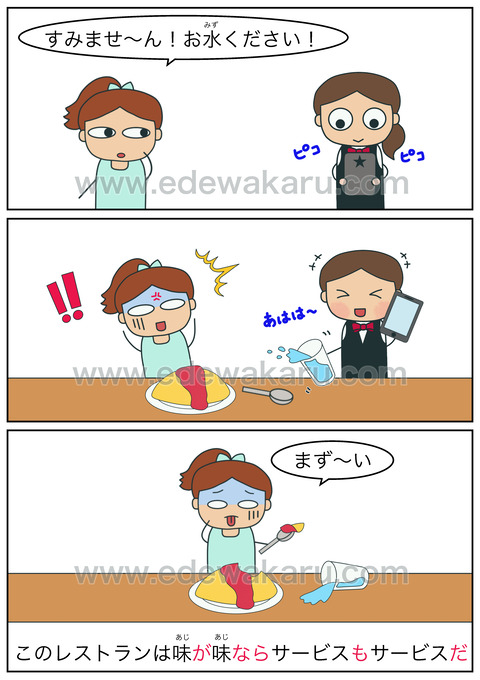
Meaning
Both ~ and ~ are bad
How to use it
Noun [dictionary form] + が + Noun [dictionary form] + なら + Noun [dictionary form] + も + Noun [dictionary form] + だ
Explanation
「AがAならBもBだ」 is a sentence pattern meaning “Both A and B are bad.”
A and B refer to people or things with a close relationship, such as a parent and child or a husband and wife. It is often used to criticize both A and B. 「AがAならBもBだ」 can also be changed to 「AもAならBもBだ」.
[Example]
If the food is bad,
then the service is bad, too.
→
The food is bad,
and the service is bad, too.
「〜が〜なら〜も〜だ」 is a commonly used pattern, so advanced learners should learn it 😉
In context 4 examples
このレストランは味が味ならサービスもサービスだ
→味もサービスも、どちらも最悪だAt this restaurant, the food is bad, and the service is bad, too. → Both the food and the service are terrible.
A:毎日遅刻して、先生に怒られないの?B:怒られないよ〜。先生も毎日遅れてくるしA:…。学生が学生なら、先生も先生ね…
→学生も先生も、どちらもよくないね…A: You’re late every day. Doesn’t the teacher get mad at you? B: No. The teacher is late every day, too. A: ... If the students are like that, and the teacher is like that, too... → Both the students and the teacher are bad...
A:お隣の奥さんは、何かにつけ文句を言ってくるの…B:聞いたところによると、旦那さんもそうらしいわよA:…。妻が妻なら、夫も夫だね
→妻も夫もどちらもよくないねA: The woman next door complains about everything... B: From what I hear, her husband is like that, too. A: ... If the wife is like that, and the husband is like that, too. → Both the wife and the husband are bad.
A:あの家の子は、すごく乱暴よね…B:うん。でも注意すると、母親がキレるんだってA:そうなんだ…親が親なら、子も子だね
→親も子供も、どちらもよくないんだねA: That family’s child is so rough... B: Yeah. But apparently, when someone tells them off, the mother loses her temper. A: I see... Like parent, like child. → Both the parent and the child are bad.
Read the original source text
Meaning
〜も〜も、どちらもよくない
How to use it
名詞[辞書形]+が+名詞[辞書形]なら+名詞[辞書形]+も+名詞[辞書形]だ
Explanation
「AがAならBもBだ」は「AもBもどちらもよくない」という意味の文型です。
「A」と「B」には、[親・子][夫・妻]など、関係が深い人やものが入ります。「A」と「B」の両方を批判する場合によく使われます。「AがAならBもBだ」は「AもAならBもBだ」にチェンジすることもできます。
[例]
味
が
味
なら
サービス
も
サービス
だ
→味
も
味
なら
サービス
も
サービス
だ
「〜が〜なら〜も〜だ」はよく使われる文型ですので、上級レベルの人は覚えておきましょう😉
Usage 2
Read this source entry ↗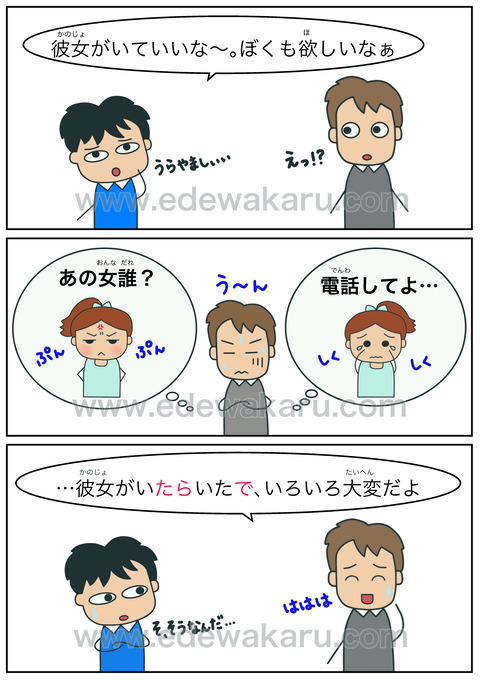
Meaning
If..., there is the problem that...
Even if..., there is no problem.
How to use it
Verb, adjective, or noun [た-form] + たら〜で
Verb, adjective, or noun [なかった-form] + たら〜で
Explanation
“AたらAで” is a sentence pattern meaning “If A happens, there is the problem that...” or “Even if A happens, there is no problem.” The same word goes in both places for “A.”
“If A happens, there is the problem that...” is used when you want to say, “Whether it’s this or that, there is a problem in either case.” “Even if A happens, there is no problem” is used when you want to say, “It is not such a big problem. It’ll be all right.”
[Examples]
① A: You’re lucky to have a girlfriend. I want one too.
B: Even if you have one, it’s a lot of work...
→ Even if you have a girlfriend, it’s a lot of work...
“It’s sad not to have a girlfriend, but even if you have one, it’s a lot of work.”
② If you don’t pass N1, just try again next time.
→ If you don’t pass, you can just try again next time.
“Not passing is not such a big problem.”
③ If we fail, we’ll think about it then.
→ If we fail, we’ll think about it then.
“Even if we fail, it’s not such a big problem.”
④ Even if I pass the university entrance exam, I’ll need money for all sorts of things.
→ Even if I pass, I’ll need money for all sorts of things.
“It would be a problem not to pass, but even if I do pass, there are still financial issues.”
⑤ A: It’s so hot I could die... I really do prefer winter.
B: When winter comes, you’ll say, “It’s so cold I could die,” right?
→ When winter comes, you’ll say, “It’s so cold I could die,” right?
“You’ll complain either way, whether it’s summer or winter, right?”
With な-adjectives and nouns, “〜なら〜で” is more commonly used.
[Examples]
If you didn’t like it, you should have said so!
= If you didn’t like it, you should have said so!
If you’re opposed, explain your reasons properly.
= If you’re opposed, explain your reasons properly.
“〜たら〜で” is one of the difficult sentence patterns to remember. Those taking the N1 exam should review it carefully. 😊
In context 5 examples
A:彼女がいていいな〜。ぼくも彼女が欲しいなぁB:いたらいたで、いろいろ大変だよ…
A: You’re lucky to have a girlfriend. I want one too. B: Even if you have one, it’s a lot of work...
N1に合格できなかったらできなかったで、また次がんばればいいよ
If you don’t pass N1, just try again next time.
失敗したら失敗したで、その時考えよう
If we fail, we’ll think about it then.
大学に合格したら合格したで、なにかとお金が必要になる
Even if I pass the university entrance exam, I’ll need money for all sorts of things.
A:暑くて死にそう…やっぱり私は冬の方が好きだわB:冬になったらなったで「寒くて死にそう」っていうんだろ?
A: It’s so hot I could die... I really do prefer winter. B: When winter comes, you’ll say, “It’s so cold I could die,” right?
Read the original source text
Meaning
〜た場合は、〜という問題がある
〜た場合でも、問題はない
How to use it
動詞・形容詞・名詞[た形]+たら〜で
動詞・形容詞・名詞[なかった形]+たら〜で
Explanation
「AたらAで」は「Aた場合は、〜という問題がある」「Aた場合でも、問題はない」という意味の文型です。「A」には同じ単語が入ります。
「Aた場合は、〜という問題がある」は「〜でも〜でも、どちらの場合でも問題がある」
と言いたい時に使われます。また
「Aた場合でも、問題ない」は「そんなに大きな問題ではない。大丈夫だ」
と言いたい時に使います。
[例]
①A:彼女がいていいな〜。ぼくも彼女が欲しいなぁ
B:い
たら
いた
で、いろいろ大変だよ…
→彼女がいても、いろいろ大変だよ…
「彼女がいないと悲しいが、いる場合でもいろいろ大変だ」
②N1に合格できなかっ
たら
できなかった
で、また次がんばればいいよ
→合格できなかったら、また次がんばればいいよ
「合格できないことは、そんなに大きな問題ではない」
③失敗し
たら
失敗した
で、その時考えよう
→失敗した場合は、その時考えよう
「失敗しても、そんなに大きな問題ではない」
④大学に合格し
たら
合格した
で、なにかとお金が必要になる
→合格した場合でも、なにかとお金が必要になる
「不合格では困るが、合格してもお金の問題はある」
⑤A:暑くて死にそう…やっぱり私は冬の方が好きだわ
B:冬になっ
たら
なった
で
「寒くて死にそう」っていうんだろ?
→冬になったら、「寒くて死にそう」っていうんだろ?
「夏でも冬でも、どちらの場合でも文句を言うんだろ?」
「な形容詞・名詞」の場合は「〜なら〜で」の方がよく使われます。
[例]
嫌だっ
たら
嫌だった
で、そう言えばよかったじゃない!
=嫌
なら
嫌
で、そう言えばよかったじゃない!
反対だっ
たら
反対
で、ちゃんと理由を説明しなさい
=反対
なら
反対
で、ちゃんと理由を説明しなさい
「〜たら〜で」は、覚えにくい文型の1つです。N1を受ける人はしっかりと復習をしておきましょう😊
どんなときどう使う 日本語表現文型辞典
Meaning
if
How to use it
〔Plain form〕(ナA/N)+ なら
Explanation
B:あ、図書館に行くなら、わたしも返したい本があるんですが。
B:そう、まだ仕事があるなら、お弁当と熱いお茶を買ってきましょうか。
B:えっ、かぎがかかっているんなら、かぎを借りてきましょう。
B:田中さんなら、さっき出かけましたよ。
1)「~ なら、… 」 の形で、「~なら」で相手の言ったことや様子を受けて、「…」で話す人のそれに対する助言・意志・意見などを言う。
2) ❺ のように、何かを取り立てて言う言い方もある。
3)くだけた話し言葉では、 ❸ のように「なら」の前に「ん」を入れて「んなら」となることが多い。
3)In informal spoken form, の or ん are often added before なら to become んなら, as in sentence ❸ .
1)Takes up other party's utterance or appearance and gives speaker's advice, volition, or opinion.
2)Sometimes emphasizes subject, as in sentence ❺ .
In context 5 examples
A:今から図書館へ行きます。
A: I’m going to the library now.
A:あれ、林さん、もう帰るんですか。ぼくはまだ仕事があるんです。
A: Oh, Mr. Hayashi, are you going home already? I still have work to do.
A:ドアが開かない。かぎがかかっています。
A: The door won’t open. It’s locked.
(友だちが納豆を食べないのを見て)ジムさん、納豆がきらいなら、食べなくてもいいんですよ。
(Seeing a friend not eat natto) Jim, if you don’t like natto, you don’t have to eat it.
A:田中さん、いませんか。
A: Is Mr. Tanaka here?
Read the original source text
Meaning
if
How to use it
〔普通形〕(ナA/N)+なら
Explanation
B:あ、図書館に行くなら、わたしも返したい本があるんですが。
B:そう、まだ仕事があるなら、お弁当と熱いお茶を買ってきましょうか。
B:えっ、かぎがかかっているんなら、かぎを借りてきましょう。
B:田中さんなら、さっき出かけましたよ。
1)「~ なら、… 」 の形で、「~なら」で相手の言ったことや様子を受けて、「…」で話す人のそれに対する助言・意志・意見などを言う。
2) ❺ のように、何かを取り立てて言う言い方もある。
3)くだけた話し言葉では、 ❸ のように「なら」の前に「ん」を入れて「んなら」となることが多い。
3)In informal spoken form, の or ん are often added before なら to become んなら, as in sentence ❸ .
1)Takes up other party's utterance or appearance and gives speaker's advice, volition, or opinion.
2)Sometimes emphasizes subject, as in sentence ❺ .
毎日のんびり日本語教師
Usage 1
Read this source entry ↗Meaning
If it had been a different [noun]
How to use it
Noun A + が + Noun A + なら
Explanation
This grammar repeats the same noun twice. There are very few commonly used expressions, such as 「世が世なら(時代が時代なら)」 and 「相手が相手なら」.
世が世なら(時代が時代なら) → if it were a different era
相手が相手なら → if it were a different person
Notes
I couldn't find any generally usable expressions other than 「時代」 and 「相手」, so please leave a comment if you know of any.
In context 1 examples
この子は世が世なら王になっていただろう。
If times were different, this child would probably have become a king.
Read the original source text
Meaning
もし他の[名詞]だったなら
How to use it
名詞A+が+名詞A+なら
Explanation
同じ名詞を2回繰り返して使う文法です。一般的に使われる表現はとても少なく、「世が世なら(時代が時代なら)」「相手が相手なら」等です。
世が世なら(時代が時代なら) → もし別の時代だったなら
相手が相手なら → もし別の相手だったなら
Notes
「時代」や「相手」以外、一般的に使える表現が見つかりませんでしたので、もしありましたらコメントください。
Usage 2
Read this source entry ↗How to use it
Noun + なら + noun + で
Na-adjective stem + なら + na-adjective stem + で
I-adjective plain form + (の)なら + i-adjective plain form + で
Verb plain form + (の)なら + verb plain form + で
Explanation
This sentence pattern expresses the speaker’s judgment that “if things are going to be that way, you should take some kind of action.”
The latter clause contains advice, a command, or some kind of judgment. It often conveys dissatisfaction.
It is generally used in situations where it would be better to take that action and where the person has some responsibility to do so.
The same verb is used before and after “なら.”
Notes
Nothing in particular.
In context 8 examples
仕事辞めるなら辞めるでいいけど、次のこともちゃんと考えてるか?
If you’re going to quit your job, then quit, but have you properly thought about what you’ll do next?
規則正しい生活のためには、朝ご飯は抜くなら抜く、食べるなら食べるで固定した方が良い。
For a regular lifestyle, it’s better to make a fixed choice: either skip breakfast or eat it.
嫌なら嫌で別れればいい。
If you don’t like it, then just break up.
結婚する気がないならないで相手に早めにちゃんと話したほうが良い。
If you’re not going to get married, you should tell your partner properly sooner rather than later.
遅れるなら遅れるで先に知らせてよ。
If you’re going to be late, let me know beforehand.
子どもが学校に行きたくないのなら行きたくないで別に良いと思う。
If a child doesn’t want to go to school, I think that’s fine.
チョコが欲しいなら欲しいで言ってくれれば一個くらいはあげるよ。
If you want chocolate, just say so and I’ll give you at least one piece.
恋愛する気がないのも自由だし、恋愛したいならしたいでそれも良い。
It’s your choice not to be interested in romance, and if you want to be in a relationship, that’s fine too.
Read the original source text
How to use it
名詞+なら+名詞+で
ナ形語幹+なら+ナ形語幹+で
イ形普通形+(の)なら+イ形普通形+で
動詞普通形+(の)なら+動詞普通形+で
Explanation
「その状況になるなら何らかの行動をするべきだ」という話者の判断を表す文型です。
後件にはアドバイス、命令、何らかの判断が来ます。不満が現れることが多いです。
一般的にはその行動をしたほうがよく、その責任があるような場面で用います。
「なら」の前後は同じ動詞を用います。
Notes
特になし
Usage 3
Read this source entry ↗Meaning
Neither A nor B is any good
How to use it
Noun A + が + Noun A + なら, Noun B + も + Noun B + だ
Noun A + も + Noun A + なら, Noun B + も + Noun B + だ
Explanation
It compares two people or things that are closely related and indicates that neither is any good.
Since this is a subjective expression, it often carries a critical nuance.
Notes
Nothing in particular.
In context 5 examples
親が親なら子も子だ。(父母和孩子都有相同的错误。)
Like parent, like child.
先生が先生なら学生も学生だ。(老师和学生也都有相同的错误。)
If the teacher is no good, the students are no good either.
妻も妻なら、夫も夫だ。
The wife is no good, and the husband is no good either.
アメリカがアメリカなら、ロシアもロシアだ。
America is as bad as Russia, and Russia is as bad as America.
犯人も犯人なら、警察も警察だ。
The culprit is no good, and the police are no good either.
Read the original source text
Meaning
AもBも良くない
How to use it
名詞A+が+名詞A+なら、名詞B+も+名詞B+だ
名詞A+も+名詞A+なら、名詞B+も+名詞B+だ
Explanation
それぞれ関係の深い二つの人や物を比較して、そのいずれも良くないことを表します。
主観的な表現なので、しばしば批判的なニュアンスを含みます。
Notes
特になし
日本語文型辞典 英語版
Meaning
【なら1】 When なら is attached directly to a noun, it expresses the topic of a sentence. The form ならば may also be used.
B:めがねならタンスの上に置いてありましたよ。
Your glasses? They were on top of the dresser.
B:お金のことなら心配しなくていいですよ。何とかなりますから。
If it’s a matter of money, you don’t have to worry. We can manage.
B:佐藤さんなら、図書館にいましたよ。
Sato-san? He was in the library.
なら is used when the speaker takes something that the addressee has said, something mentioned during discussion of the previous topic, or something that can be predicted from the current situation, makes it a new topic, and then continues talking about it. Often used when the speaker adopts as a topic something that was previously brought up by the addressee.
なら can often be replaced by the topic marker は. However, なら essentially has the hypothetical meaning “if N were the topic,” while は does not have such meaning. Therefore, when なら is replaced by は, the meaning of the sentence changes slightly. なら is synonymous with Nだったら, and these two expressions are interchangeable.
Nなら can be followed by Nだ, or by expressions such as Nに限る (there’s nothing better than N), Nが一番だ (N is the best), and Nがいい (N is good). Nなら is used to define the range of the topic and then describe the most highly evaluated item within that range. In this usage, Nなら can be replaced by Nは without any great change in meaning.
B:ゆっくりとなら歩けるようになりました。
If I go slowly, I can walk now.
When なら follows a noun, adverb, or noun/particle combination, it expresses the meaning that “Y doesn’t hold in other cases, but in the case of X, Y can be realized.” The Y clause that follows なら usually represents something desirable, and this pattern is used when the speaker actively selects an X that makes Y possible. This usage of なら is similar to the contrastive use of は. However, なら can be combined with interrogative words, while は cannot.
(○)何時なら都合がいいですか。
What time would be convenient for you?
(○)誰となら結婚してもいいですか。
Who would it have to be, in order for you to consider getting married?
(×)何時は都合がいいですか。
What is the time convenient for you?
(×)誰とは結婚してもいいですか。
I wouldn’t mind marrying who.
【なら2】[N/Na なら][N/Na だった(の)なら][A-い/A-かった (の)なら][V-る/V-た (の)なら]When combined with the dictionary form or the ta-form of a predicate, なら expresses the meaning “if the actual situation or circumstances were like that.” The forms のならば, のなら, and ならば are also used. In spoken Japanese, の often becomes ん.
Although there is often no clear difference in meaning related to the presence or absence of の, のなら tends to be used in response to a statement on the part of the addressee, or a concrete situation, and conveys the meaning “if you say so,” “if that is true,” or “if that is the actual situation.” On the other hand, when の is not used, なら tends to convey the meaning of “generally, in such cases” or “if/when someone does so.” When (の)なら is combined with a noun or a na-adjective, の is often omitted. When (の)なら is combined with a verb or an i-adjective, it is synonymous with のだったら, and these two are interchangeable. However, の in のだったら cannot be omitted.
(×)知っているだったら教えてほしい。
If you happen know, I want you to tell me.
(○)知っている(の)なら教えてほしい。
If you happen to know, I want you to tell me.
知っているのだったら教えてほしい。
If you happen to know, I want you to tell me.
B:風邪なら早く帰って休んだほうがいいよ。
If you’ve got a cold, you should go home early and rest.
B:そんなに痛い(の)なら早く帰ったほうがいいですよ。
If it hurts that much, you should go home early.
B:買い物に行く(の)ならついでにおしょうゆを買ってきてちょうだい。
If you’re going shopping, please pick up some soy sauce while you’re out.
B:沖縄で梅雨に入ったのなら、九州の梅雨入りも間近ですね。
If the rainy season has started in Okinawa, it’ll start soon in Kyushu, too.
When combined with the dictionary form or the ta-form of a predicate, (の)なら expresses a hypothetical condition and means “if that is the actual situation” or “if that is true.” A speaker uses (の)なら to state his/her own opinion or view, to make a request, or to give advice to the addressee, in light of something the addressee has just said or the situation at hand.
なら cannot be used to refer to things that occur as a matter of course or events that arise naturally with the passage of time. In such cases, expressions like たら, ば, and/or と must be used instead. Also, expressions that merely state a fact cannot be used at the end of a sentence with なら. Expressions indicating a judgment, intention, command, request/demand, suggestion, evaluation, or some other subjective attitude on the part of the speaker must be used.
(×)春が来るなら花が咲きます。
If spring comes, flowers bloom.
(×)雨が降るなら道がぬかります。
If rain falls, the road gets muddy.
(○)春が{来たら/来れば/来ると}花が咲きます。
When spring comes, flowers bloom.
(○)雨が{降ったら/降ると/降れば}道がぬかります。
When it rains, the road gets muddy.
(○)《午後から雨が降ると聞いて》雨が降る(の)なら、傘を持って行こう。(意志)
《having heard that it will rain in the afternoon》If it’s going to rain, I’ll take an umbrella. (intention)
たら, ば and と are used when the condition expressed in the first clause happens prior to the second clause and the situation or event in the second clause is realized as a result. On the other hand, なら can be used even when the situation in the second clause is realized first and the situation in the conditional clause follows.
(例)イタリアに行ったらイタリア語を習いなさい。(イタリアに行ってからイタリアで習う)
When you go to Italy, study Italian. (= study the language in Italy, after arriving there)
(例)イタリアに行くならイタリア語を習いなさい。(イタリアへ行く前に自分の国で習う)
If you’re going to Italy, study Italian. (= study the language in your own country, before going to Italy)
When (の)なら is used in the pattern X(の)ならY, either Y alone or both X and Y may contradict the given facts. In the first case, (の)なら is used when the speaker learns a new fact, X, and the pattern means “if I had known X (= factual), I could have done Y (= counter-factual), but since I didn’t know X, I didn’t do Y.” In the second case, (の)なら means “if X is done (= counter-factual), Y should be done (= counter-factual), but since X is actually not done, Y is not done either.”
(1)
-
(3)
illustrate the first case, and
(4)
illustrates the second case. For instance,
(2)
, in which X is factual but Y is not, conveys the sense that when the speaker found out that the addressee had come to Kobe, s/he felt critical or regretful of the fact that the addressee hadn’t called him/her (you should have called me...).
(4)
, in which both X and Y are counter-factual, means “if I were going to attend a wedding, I would buy a black suit, but since I’m not actually going to a wedding, I’m not going to buy one.”
(の)なら cannot be replaced by たら or ば in
(1)
-
(4)
, because the meanings of these sentences are not the same as those of counter-factual conditional sentences with たら or ば. In counter-factual conditionals with たら or ば, X and Y are both counter-factual and X must occur prior to Y. On the other hand, in
(1)
-
(3)
only Y is counter-factual, and although both X and Y are counter-factual in
(4)
, if X and Y were both realized in these sentences, the sequential relationship between them would be that X occurs after Y: “buy a black suit and then attend a wedding.” Such a relation can only be expressed by なら. Neither たら nor ば can be used instead.
(例)先週、神戸に来ていたのなら案内してあげたのに。
If you were in Kobe last week, I could have shown you around. (Means “I didn’t know you were in Kobe last week, so I couldn’t show you around.” X (you were in Kobe last week) is factual, while Y (I could have shown you around) is counter-factual.)
(例)先週、神戸に来て{いれば/いたら}案内してあげたのに。
If you had come to Kobe last week, I would have shown you around. (Means “you didn’t come to Kobe last week, so I couldn’t show you around.” Both X and Y are counter-factual.)
(例)結婚式に出るなら黒いスーツを買ったのだけど。
If I were going to a wedding, I would have bought a black suit. (Means “I’m not planning to attend a wedding, so I didn’t buy a black suit.” Both X and Y are counter-factual, and if both were realized, X would follow Y.)
(例)黒いスーツを買って{いれば/いたら}結婚式に出たのだが。
If I had bought a black suit, I would have attended the wedding. (Means “I hadn’t bought a black suit, so I didn’t attend the wedding.” Both X and Y are counter-factual, and if both were realized, Y would follow X.)
B:留学するのならオーストラリアがいいよ。
If you’re going to study abroad, I’d recommend Australia.
When (の)なら is followed by expressions such as がいい and をすすめる, its function is to recommend the best way or method of doing something. This pattern is often used in advertising slogans and/or commercials.
When talking about an action in general, rather than a particular person’s action, の is usually omitted. The meaning of V-るなら...がいい is similar to the meaning of expressions in which なら and は are used as topic markers, such as Nなら...がいい and Nは...がいい.
(例)靴を買うならイタリア製がいい。
If you’re buying shoes, Italian-made ones are the best.
(例)靴ならイタリア製がいい。
When it comes to shoes, Italian-made ones are the best.
(例)靴はイタリア製がいい。
As for shoes, Italian-made ones are the best.
When (の)なら is preceded and followed by the same verb, its function is to give instructions about how something should be done. (の)なら may be followed by expressions of command or prohibition, as well as expressions of suggestion or recommendation such as すればいい.
(4)
and
(5)
convey the meaning “if you want to do so, go ahead and do as you please.”
When this pattern is used to mean “when something is done in general,” なら is usually not preceded by の. However, when it is used in response to an utterance or intention of a particular person, with the meaning “if you have such an intention” or “if you want to do so,” it may take the form のなら, as shown in
(5)
.
When the same word is repeated before and after (の)なら, the speaker is acknowledging a certain situation to be as it is. S/he then states what kind of action should be taken under such circumstances, or expresses criticism or regret that such an action has not been taken.
The same word is repeated before and after (の)なら, and ...とis followed by expressions of utterance such as 言う and 連絡する. This pattern expresses the speaker’s attitude that the listener or a third person should clearly indicate his/her intentions regarding his/her own actions.
This pattern is usually used to criticize someone else for not expressing his/her intentions clearly, or to advise him/her that s/he should have indicated them clearly. However, it can also be used by the speaker to express his/her regret that s/he didn’t make his/her own intentions clear, as shown in
(4)
.
(の)ならべつだが assumes two distinct situations. It is used to introduce one situation as being inapplicable and to state the speaker’s opinion concerning the other possible situation. It is often followed by expressions intended to influence the listener, such as criticism, warning, or advice. As shown in
(4)
and
(5)
, (の)ならべつだが may also take the form ...なら話は別だが.
B:来たくないと言うのなら来てもらわなくてもいい。
If you’re saying you don’t want to come, that’s fine with me.
というのなら is used to indicate a judgment on the part of the speaker regarding the content of the preceding conversation. It is followed by an expression of permission, advice, or suggestion directed toward the listener, or an inference made by the speaker. ということなら can also be used.
Expresses the speaker’s response to something a third party has said. Used in more or less the same way as というのなら. However, というのなら can be used to respond to something said by either a direct addressee or a third person who is not present, in which cases it means “if you say so” or “if s/he says so,” respectively. ということなら usually means the latter only.
1
2
1
1
1
【ものなら】2
【なら3】[N/Na (だった)なら][A-い/A-かった なら][V-る/V-た なら]In contrast with Usage 2 of なら, Usage 3 does not take the pattern のなら. Usage 3 is used in the form なら or ならば and is equivalent to the ba-form of N/Naだ. However, it can also be used after the dictionary form or the ta-form of a verb or i-adjective. When Usage 3 of なら is preceded by a verb or an i-adjective, it can be replaced by ば or たら with very little change in meaning. たなら is an emphatic form of たら and sounds a little old-fashioned.
N/Naなら(ば) is the ba-form of N/Naだ. It expresses a hypothetical condition, such as “if such-and-such was the case” or “supposing that...,” or a counter-factual condition, such as “if the circumstances were the other way around.” In formal written Japanese, であれば, which is the ba-form of である, can also be used. N/Naなら(ば) can be replaced by だったら.
The difference between Usage 3 of なら and Usage 1 is that Usage 1 attaches to nouns only and means “if N were the topic,” while Usage 3 expresses a supposition (if it were the case that...) regarding something that is either not known to be true, or is contrary to fact. However, in many cases it is difficult to decide which usage of なら actually applies.
NがNならNはNだ is used to compare people or things that have contrasting characteristics. Each person or thing is likened to something different (using different terms), and the pattern itself means “if ...can be expressed as ..., then ...can be expressed as ....”
The N slots in the pattern NがNならNもNだ are filled by pairs of nouns that represent people in a relationship, such as “husband” and “wife,” or institutions, organizations, etc. This pattern expresses a negative evaluation of the behavior or attitude of the people or organizations in question and means “both of them are equally terrible” or “they’re a totally outrageous bunch of people.” It is used to describe two parties with undesirable characteristics or attitudes, such as being thoughtless, lazy, impertinent, or rude. This pattern also takes the form N1もN1ならN2もN2だ, as in
(4)
.
Used with the dictionary form or the ta-form of an i-adjective or verb, なら(ば) means “in the event that such a situation is realized.” It is a hypothetical conditional used to state an assumption about a situation that may be realized in the future, as well as a prediction about something that will happen if that situation is realized. なら(ば) is similar in meaning to するなら and したなら. It is a literary expression that often appears in editorial or academic texts. It can be replaced by ば and たら, and in spoken Japanese the latter are more commonly used.
...たなら, an emphatic form of たら that sounds a little old-fashioned, is used to express hypothetical or counter-factual conditions. It is often used in the lyrics of popular songs, but in daily conversation たら is more common.
When the dictionary form of verbs such as 見る, 言う, and 比べる is followed by なら, the result is an idiomatic expression that indicates the viewpoint from which a judgment or opinion (given in the subsequent clause) is stated. This pattern tends to be used in written Japanese. たら/と/ば can also be used with these verbs, and the resulting forms are, for the most part, interchangeable with V-るなら. Similar expressions include ...によるなら and ...を別にするなら.
How to use it
1. Nなら
2. NならNだ
3. ...(助詞)なら
1. ...(の)なら〈hypothetical condition〉
2. ...(の)なら〈counter-factual〉
3. V-る(の)なら...がいい
4. V-る(の)なら ...しろ/...するな
5. ...(の)なら...で[Na ならNa で][A(の)ならAで][V(の)ならVで]
6. ...(の)なら...と[NならN(だ)と][Na ならNa(だ)と][A(の)ならAと][V(の)ならVと]
7. ...(の)ならべつだが[N/Na ならべつだが][A/V (の)ならべつだが]
8. ...というのなら
9. ...ということなら
0. どうせ...(の)なら→
1. ...ものなら→
2. V-ようものなら→
1. N/Na なら(ば)
2. NがNならNはNだ
3. NがNならNもNだ
4. ...なら(ば)[A/V なら(ば)]
5. ...たなら[N/Na だったなら][A-かったなら][V-たなら]
6. V-るなら〈viewpoint〉
In context 91 examples
A:めがねはどこかな。
I wonder where my glasses are.
A:アルバイトを雇うには金がかかりますよ。
Hiring a part-time worker will be expensive.
A:佐藤さん見ませんでしたか。
Have you seen Sato-san?
時間ならば十分ありますから、ご心配なく。
As for time, we have plenty of it, so don’t worry.
例のことならもう社長に伝えてあります。
If you mean that thing we talked about, I’ve already informed the company president.
山ならやっぱり富士山だ。
When it comes to mountains, naturally it has to be Fuji-san (Mt. Fuji).
ストレス解消法ならゴルフに限る。
If you’re looking for a way to get rid of stress, nothing beats golf.
酒ならなんといってもここの地酒が一番だ。
When it comes to sake, the locally brewed sake here is unquestionably the best.
カキ料理なら広島が本場だ。
If you want good oyster cuisine, Hiroshima is the place to go.
あの人となら結婚してもいい。
I wouldn’t mind getting married, if it were to him.
フランス語はだめですが、英語でなら会話ができます。
I’m no good at French, but in English, I can carry on a conversation.
あと一人だけなら入場できます。
Only one more person can get in.
A:足の具合はいかがですか。
How is your leg?
仕事の後なら時間があります。
If it’s after work, I’ll have time.
A:風邪をひいてしまいまして。
Unfortunately, I’ve caught a cold....
彼女のことがそんなに嫌いなら別れたらいい。
If you dislike her so much, you should break up with her.
A:頭がずきずき痛むんです。
I have a splitting headache.
行きたくない(の)ならやめておいたらどうですか。
If you don’t want to go, why don’t you just say no?
真相を知っている(の)なら私に教えてほしい。
If you know the truth, I’d like you to tell me.
郵便局に行く(の)なら、この手紙を出してきてくれますか。
If you’re going to the post office, could you mail this letter for me?
あなたがそんなに反対する(の)ならあきらめます。
If you’re so against it, I’ll give up on it.
A:ちょっと買い物に行ってくる。
I’m off to do a little shopping.
A:沖縄ではもう梅雨に入ったそうですよ。
I hear the rainy season in Okinawa has already started.
二人が昼からこの店で会っていたのなら、二人には午前中のアリバイはないことになる。
If the two of them were with each other for (part of) the afternoon in this shop, that means they don’t have an alibi for the morning.
電話をくれるのなら、もう少し早い時間に電話してほしかった。
If you were going to call me, I wish you had called a little earlier.
神戸に来ていたのなら、電話してくれればよかったのに。
If you were in Kobe, you should have phoned me.
あいつが来るのならこのパーティには来なかったんだが。
If I’d known he was coming, I wouldn’t have come to this party.
結婚式に出席する(の)なら黒いスーツを買うのだが。
If I were going to a wedding, I would buy myself a black suit.
靴を買うならイタリア製がいい。
If you’re buying shoes, Italian-made ones are the best.
食事をするなら、このレストランがいいよ。
If you’re going to eat out, I’d recommend this restaurant.
英語を習うならアメリカかカナダに留学することをすすめたい。
If you want to learn English, I’d suggest studying in the United States or Canada.
A:大学を卒業したら留学したいと思っているんだ。
I’m thinking of going abroad to study after I graduate from college.
何事もやるなら最後まで徹底的にやれ。
Whatever you do, follow it through to the very end.
女性と付き合うなら真剣に付き合いなさい。
If you’re going out with a girl, be serious about it.
留学するならいい加減な気持ちではするな。
If you’re going to study abroad, don’t do it halfway.
私のことを笑うなら勝手に笑えばいい。
If you want to laugh at me, feel free to do so.
泣きたいのなら好きなだけ泣けばいい。
If you feel like crying, go ahead and cry your heart out.
嫌なら嫌で、そう言ってくれたらよかったのに。今となっては遅すぎるよ。
If you didn’t like it, you should have told me so. It’s too late now.
金がないならないで、人生何とかなるものさ。
So what if there’s no money—life will still turn out all right.
会社を辞める(の)なら辞めるで、それからあとの身の振り方ぐらい考えておくべきだった。
Before I up and left the company, I should have at least considered what I would do next.
遅くなる(の)なら遅くなるで、ちゃんと連絡ぐらいしてくれればいいのに。
If you knew you’d be late, you could have at least let me know.
行かない(の)なら行かないで、ちゃんと断わりの連絡だけはしておいたほうがいい。
If you’re not going, that’s fine, but you should at least make sure to send your regrets.
欠席なら欠席と前もって知らせておいてください。
If you’re going to be absent, please let me know in advance.
そうならそうと言ってほしかった。
I just wanted you to tell me the truth.
嫌なら嫌だとはっきり言ってくれればいいのに。
If you don’t like it, you should come straight out and tell me so.
好きなら好きとはっきり言っておけばよかった。
If I knew I liked him, I should have told him directly.
都合が悪い(の)なら悪いと言ってくれればよかったのに。
If it wasn’t convenient for you, you should have said so.
これからは来ない(の)なら来ないとちゃんと事前に連絡して下さいね。
From now on, please be sure to contact me in advance when you’re not coming.
行く(の)なら行く、行かない(の)なら行かないとちゃんと言ってくれなければ困るじゃないですか。
Can’t you see what trouble you cause for me if you don’t tell me whether or not you’re coming?
そんなに勉強がつまらない(の)なら別だが、自分の心構えについても反省してみてはどうだろうか。
It would be a different matter if your studies were really that boring, but how about reflecting on your own attitude for a change?
やめたい(の)なら別だが、もし続けたい(の)ならもう少し基礎的なところから勉強し直した方がいい。
If you want to quit, that’s fine, but if you intend to continue, you ought to go back to the basics and start studying all over again.
本気で頑張る気があるのなら別だがいい加減な気持ちでやっているならやめたほうがいい。
It’s all right if you’re serious about doing this, but if you’re just fooling around, then you’d better quit.
自分のことなら話は別だが、人のことにそんなに気を揉んでも仕方がないだろう。
If it were your own problem, it’d be a different matter, but there’s no use worrying so much about other people.
どうしても嫌なら話は別だが、我慢して今の会社にとどまるのも一つの考えだ。
If you really can’t stand it, that’d be different, but one idea to consider is hanging in there and staying with the company.
A:明日はほかに用事があってお邪魔できないのですが。
I have something else to do tomorrow, so I can’t come to visit you.
責任をもつと言うのなら、信頼して任せてみてはどうですか。
If she says she’ll take responsibility, why don’t you trust her and let her handle it?
子供が大事だと言うのなら、もっと家庭を大切にしなくてはだめだ。
If you say your child is important, then you have to take better care of your family.
経営に行き詰まっているというのならあんな派手な商売はできないはずだ。
If it’s true that their business is at a standstill, then they shouldn’t be able to put on such a flashy sales campaign.
癌だということなら退院させてくれるはずがない。
If it really is cancer, there’s no way that they’ll release you from the hospital.
自分たちでやるということなら、やらせてみてはどうか。
If they say they’ll do it by themselves, how about letting them go ahead and do it?
期限内にできないということなら、ほかの業者に頼むことにしよう。
If he says they can’t finish it by the deadline, then we’ll ask another dealer.
10 人一緒なら団体の割り引き料金になる。
Groups of ten get a reduced rate.
まわりがもう少し静かならば落ち着いて勉強できるのですが。
If it were a little quieter around here, I could settle down and study.
東京ならこんなに安い家賃で家は借りられません。
If this were Tokyo, you would never be able to rent a house for such a low price.
その話が本当なら大変なことになりますよ。
If that story is true, you’re going to be in big trouble.
私があなたならそんなふうには考えなかったと思う。
If I were you, I wouldn’t have thought like that.
日曜日、お天気ならハイキングに行きましょう。
If the weather’s nice on Sunday, let’s go hiking.
銀座が東京の中心なら心斎橋は大阪の中心だ。
If Ginza is the center of Tokyo, Shinsaibashi is the center of Osaka.
パリが芸術の都なら、ロンドンは金融の都だ。
If Paris is the city of art, London is the city of finance.
兄が努力型の秀才なら弟は天才型の秀才だ。
If the older brother is the hard-working prodigy type, the younger brother is the genius type.
親が親なら子も子だ。
What can you expect from a child with parents like that? (lit. Like parent, like child.)
先生が先生なら学生も学生だ。
What can you expect from students with a teacher like that?
亭主が亭主なら女房も女房だ。
Both the husband and wife are hopeless.
アメリカもアメリカなら日本も日本だ。
Both America and Japan are equally to blame.
今年も真夏の日照時間が短い/短かったならば米不足の問題は深刻だ。
If there are too few hours of mid-summer sunlight again this year, the shortage of rice will be a serious problem.
この機会を逃す/逃したならばもう2度と彼には会えないだろう。
If I miss this opportunity, I’m afraid I’ll never be able to see him again.
このまま不況が続く/続いたなら失業問題は深刻になる。
If the recession continues like this, the unemployment problem will become critical.
今後1週間雨が降らない/降らなかったならば水不足になる。
If it doesn’t rain in the next week, there will be a shortage of water.
今年も真夏の日照時間が{短ければ/短かったら}米不足の問題は深刻だ。
If there are too few hours of mid-summer sunlight again this year, the shortage of rice will be a serious problem.
この機会を{逃せば/逃したら}もう2度と彼には会えないだろう。
If I miss this opportunity, I’m afraid I’ll never be able to see him again.
このまま不況が{続けば/続いたら}失業問題は深刻になる。
If the recession continues like this, the unemployment problem will become critical.
今後1週間雨が{降らなければ/降らなかったら}水不足になる。
If it doesn’t rain in the next week, there will be a shortage of water.
私が全能の神様だったなら、あなたを助けてあげられるのに。
If I were the Almighty God, I could help you.
もう少し発見が早かったなら助かったのに。
If only she had been found a little earlier, she would have been saved.
困ることがあったならいつでも相談に来い。
Come and talk to me anytime you have a problem.
もしも私に翼があったなら大空を自由にかけまわりたい。
If I had wings, I would like to fly freely all over the open sky.
《歌詞》あの坂を越えたなら幸せが待っている。
《song》Happiness awaits over that hill.
事情を知らない人の目から見るなら、少しおおげさな感じがするかもしれない。
In the eyes of someone who doesn’t know the actual situation, it may seem a bit blown out of proportion.
私に言わせるなら、この作品はあまり面白いとは思えない。
If you ask me, I don’t think this piece is all that interesting.
戦前と比べるなら生活レベルはずいぶん向上したといえるだろう。
We can say that the standard of living has improved considerably, compared with before the war.
一部を除くなら、彼の意見は正しいと思う。
Except for some parts, I think his opinion is correct.