絵でわかる日本語
Usage 1
Read this source entry ↗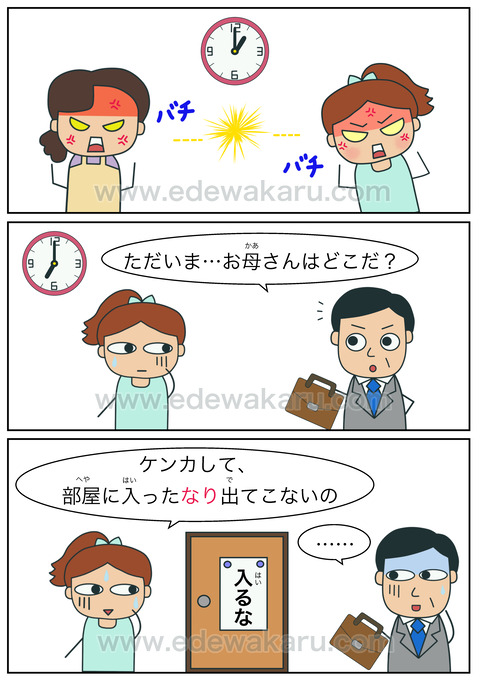
Meaning
In the state of having done ~
Having done ~, and remaining that way
How to use it
Verb [た-form] + なり
Explanation
When “〜なり” is used with a verb in the [た-form], it means “with ~ done” or “in the state of having done ~.” It is used to say that a state continues. In the form “Aなり,” it can also mean that after doing A, something expected to happen does not happen, and the state of A continues.
[Example]
Dad went out in the morning and still hasn’t come back.
[What was expected to happen] He comes back
→We thought he would come back, but he still hasn’t, and that state continues.
“Vた+なり” is formal and a little old-fashioned, so you may not hear it often… 😯 If you’re taking the N1, remember it for the test and distinguish it from “V dictionary form + なり” 😊
[Examples]
She kept crying with her head bowed.
→She kept crying with her head bowed.
She started crying as soon as she lowered her head.
→She started crying as soon as she lowered her head.
In context 4 examples
父:ただいま…お母さんはどこだ?娘:ケンカして、部屋に入ったなり出てこないの…
→部屋に入ったままで、まだ出てこないの…Father: I’m home… Where’s Mom? Daughter: She had a fight and went into her room, and she still hasn’t come out… →She went into her room and still hasn’t come out…
母:お父さんは朝出かけたなり、まだ帰ってこないの娘:残業なんじゃない?
→朝出かけたままで、まだ帰ってこないのMother: Dad went out this morning and still hasn’t come back. Daughter: Maybe he’s working overtime? →He went out this morning and still hasn’t come back.
彼女は下を向いたなり、泣き続けた
→下を向いたまま、泣き続けたShe kept crying with her head bowed. →She kept crying with her head bowed.
彼は座ったなり何も言わなくなってしまった
→座ったまま、何も言わなくなってしまったHe sat down and then fell silent. →He stayed seated and stopped saying anything.
Read the original source text
Meaning
〜たまま
〜た状態で
How to use it
動詞[た形]+なり
Explanation
「〜なり」は動詞の[た形]と一緒に使うと、「〜たまま」「〜た状態で」という意味になります。ある状態が続いていると言いたい時に使われます。 「Aなり」の形で、「Aした後、起こると思ったことが起こらないで、Aの状態が続いている」という意味で使用することもあります。
[例]
お父さんは、朝出かけ
たなり
まだ帰ってこない
【起こると思ったこと】帰ってくる
→帰ってくると思ったのに、まだ帰ってこない状態が続いている
「Vた+なり」はかたくて、少し古い言い方ですので、聞く機会は少ないかもしれません…😯N1を受ける人はテストのために「V辞+なり」 と区別をして覚えておきましょう😊
[例]
彼女は下を
向いたなり、泣き続けた
→下を向い
たまま
泣き続けた
彼女は下を
向く
なり、泣き出した
→下を向く
とすぐに
泣き出した
Usage 2
Read this source entry ↗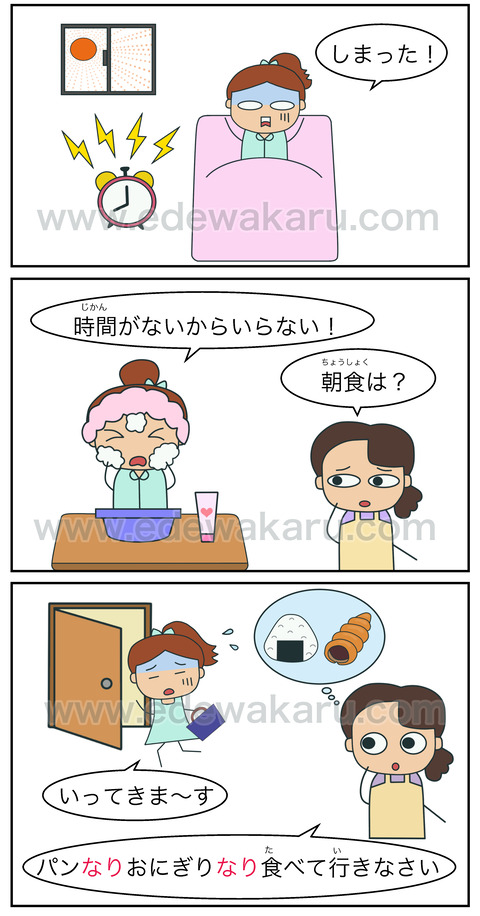
Meaning
choose, for example, either ~ or ~
How to use it
Verb・adjective [dictionary form] +なり+Verb・adjective [dictionary form] +なり
Explanation
「AなりBなり」 is a sentence pattern meaning “choose either A or B, for example, and ~.” It is used when giving examples of the same kind and saying to choose one of them 😊 Although the pattern gives two examples, it implies that there are other options too 😮
[Examples]
① Eat some bread or a rice ball before you go!
→Eat “bread” or a “rice ball” (or a “hamburger,” “salad,” etc.) before you go!
*This indicates that there are examples other than “bread” and “a rice ball.”
② Help me with the cleaning or the laundry.
→Help me with the “cleaning” or the “laundry” (or the “cooking,” “shopping,” etc.).
*This indicates that there are examples other than “cleaning” and “laundry.”
③ Have whatever you like to drink, coffee or juice.
→Choose either “coffee” or “juice” (or “tea,” “water,” etc.) and have whatever you like.
*This indicates that there are examples other than “coffee” and “juice.”
【Additional explanation】
A 「〜なり〜なり」 can also be used by giving just one example, as in 「〜なり」 😀 (Review: 〜ことがある) As with 「〜なり〜なり」, the meaning implies that there are other examples too 😊
[Examples]
① Have some bread or something before you go (Review: 「食パン」 and 「トースト」).
② Help me with the cleaning or something.
B There is also the expression 「〜なり何なり」 😃 It means “~ or something.”
[Examples]
① Have some bread or something before you go.
→Have some bread or something before you go.
② Help me with the cleaning or something.
→Help me with the cleaning or something.
C There is also the form 「question word+なり」. It is used to mean “any ~.” 😊 It is used with a fairly fixed set of words, so learn some of them.
[Examples]
「何」+なり→「何なり」→“anything” (same as “B”)
「いつ」+なり→「いつなり」→“any time” (example: 今日なりいつなり)
「どこ」+なり→「どこなり」→“anywhere” (example: 東京なりどこなり)
「どれ」+なり→「どれなり」→“any one” (example: 赤色のなりどれなり)
「〜なり〜なり」 sounds more polite than simply naming the options directly, so you will probably have many chances to use it. Try using it in everyday conversation too 😉
In context 4 examples
パンなりおにぎりなり食べて行きなさい!
→パンかおにぎりなどを食べて行きなさい!(復習:〜など・〜なんか・〜なんて)Eat some bread or a rice ball before you go! →Eat some bread or a rice ball, or something like that, before you go! (Review: 〜など・〜なんか・〜なんて)
掃除なり洗濯なり手伝ってちょうだい
→掃除か洗濯など手伝ってちょうだい(復習:〜てちょうだい)Help me with the cleaning or the laundry. →Help me with cleaning or laundry, or something like that (Review: 〜てちょうだい)
コーヒーなりジュースなり、好きなものを飲んでください
→コーヒーかジュースかを選んで、好きなものを飲んでくださいHave whatever you like, coffee or juice. →Choose either coffee or juice and have whatever you like.
留学のことはお母さんなりお父さんなりに相談したほうがいいよ
→留学のことはお母さんかお父さんなどに相談したほうがいいよ(復習:「相談する」「相談にのる」)You should talk to your mother or father, or someone like that, about studying abroad. →You should talk to your mother or father, or someone like that, about studying abroad (Review: 「相談する」「相談にのる」)
Read the original source text
Meaning
例えば〜か〜かを選んで
How to use it
動詞・形容詞[辞書形]+なり+動詞・形容詞[辞書形]+なり
Explanation
「AなりBなり」は「例えばAかBかを選んで〜」という意味で使われる文型です。
同じ種類の例をあげて、そのどちらかを選ぶと言いたい時に使用します😊
この文型は2つの例をあげていますが、その他にも選択肢があるという意味が入っているのが特徴です
😮
[例]
①パン
なり
おにぎり
なり
食べて行きなさい!
→
「パン」
か
「おにぎり」
か(
「ハンバーガー」
か
「サラダ」
など)を食べて行きなさい!
*「パン」「おにぎり」以外にも例があることを表している
②掃除
なり
洗濯
なり
手伝ってちょうだい
→
「掃除」
か
「洗濯」
か(
「料理」
か
「買い物」
など)を手伝ってちょうだい
*「掃除」「洗濯」以外にも例があることを表している
③コーヒー
なり
ジュース
なり
好きなものを飲んでください
→
「コーヒー」
か
「ジュース」
か(
「お茶」
か
「水」
など)好きなものを飲んでください
*「コーヒー」「ジュース」以外にも例があることを表している
【補足説明】
A 「〜なり〜なり」は「〜なり」というように、例を1つだけあげて使用することもあります😀(復習:〜ことがある)意味は「〜なり〜なり」と同じように、他にも例があるということを暗示しています😊
[例]
①パン
なり
食べて行きなさい(復習:「食パン」と「トースト」)
②掃除
なり
手伝ってちょうだい
B
「〜なり何なり」という言い方もあります😃
意味は「〜か何か」となります。
[例]
①パン
なり何なり
食べて行きなさい
→パンか何か食べて行きなさい
②掃除
なり何なり
手伝ってちょうだい
→掃除か何か手伝ってちょうだい
C 「疑問詞+なり」の形もあります。「疑問詞+でも」という意味で使われます😊ほとんど決まったものに使いますので、いくつか覚えておきましょう。
[例]
「何」+なり→「
何なり」→「何でも」(「B」と同じ)
「いつ」+なり→「
いつなり」→「いつでも」(例:今日
なりいつなり)
「どこ」+なり→「
どこなり」→「どこでも」(例:東京
なりどこなり)
「どれ」+なり→「
どれなり」→「どれでも」(例:赤色の
なりどれなり)
「〜なり〜なり」ははっきりと例をあげて言うより、丁寧に聞こえますので、使う機会も多いと思います。みなさんも日常会話(にちじょうかいわ)で使ってみてくださいね😉
Usage 3
Read this source entry ↗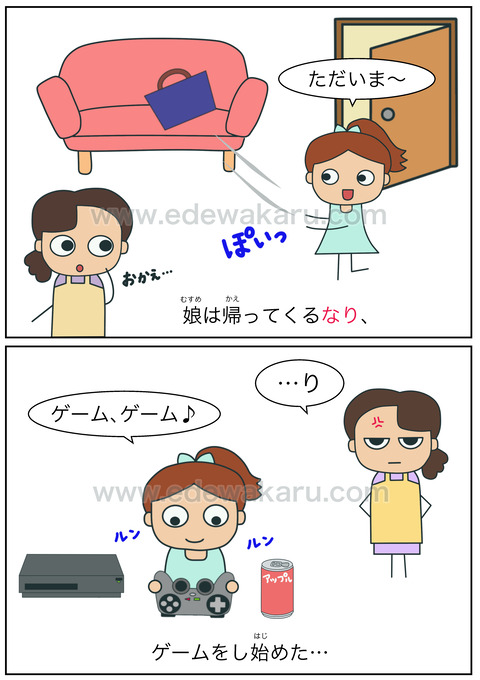
Meaning
As soon as ~, ~
How to use it
Verb [dictionary form] + なり
Explanation
When “〜なり” is used with a verb in the [dictionary form], it means “as soon as ~, ~.” It is used when you want to say, “Someone did something unexpected as soon as they did something.” This pattern is used with third person, and cannot be used with first person (I) or second person 😬
[Examples]
⭕️ My daughter got home and immediately played a game (“my daughter” is third person).
❌ I got home and immediately played a game (“I” is first person).
❌ You got home and immediately played a game (“you” is second person).
Also, the subject before and after is often the same (other dictionaries also give examples with different subjects) 😨
[Examples]
⭕️ My daughter got home and immediately started making dinner.
❌ My daughter got home, and her mother started making dinner.
“〜なり” also has the form “Vた+なり,” so remember it as well. There are also several similar patterns, so if you’re taking the N1, review them.
[Similar patterns to “〜なり (V dictionary form + なり)”]
In context 4 examples
娘は帰ってくるなりゲームをし始めた
→娘は、帰ってくるとすぐにゲームをし始めたMy daughter started playing a game as soon as she got home. →My daughter started playing a game as soon as she got home.
彼女は手紙を読むなり笑い出した
→彼女は手紙を読むとすぐに笑い出したShe burst out laughing as soon as she read the letter. →She burst out laughing as soon as she read the letter.
お母さんは部屋に入ってくるなり怒り始めた
→お母さんは部屋に入ってくると、すぐに怒り始めたMy mother started getting angry as soon as she came into the room. →My mother started getting angry as soon as she came into the room.
彼女は下を向くなり泣き出した
→彼女は下を向くとすぐに泣き出したShe started crying as soon as she lowered her head. →She started crying as soon as she lowered her head.
Read the original source text
Meaning
〜すると、すぐに〜
How to use it
動詞[辞書形]+なり
Explanation
「〜なり」は、動詞の[辞書形]と一緒に使うと「〜すると、すぐに〜」という意味になります。「〜は、〜すると、すぐに意外なことをした」と言いたい時に使います。この文型は三人称(さんにんしょう)に使うもので、一人称(私)・二人称に使うことができません😬
[例]
⭕️娘は家に帰る
なり
ゲームをした(「娘」は三人称)
❌私は家に帰る
なり
ゲームをした(「私」は一人称)
❌あなたは家に帰る
なり
ゲームをした(「あなた」は二人称)
また、前と後ろの主語は同じであることが多いです(他の辞書は主語が異なる例も挙げています)😨
[例]
⭕️娘は家に帰る
なり、(娘は)夕食を作り始めた
❌
娘
は家に帰る
なり、お母さんは夕食を作り始めた
「〜なり」には「Vた+なり」の形もありますので、一緒に覚えておきましょう。また、類似文型もいくつかありますので、N1を受ける人は復習をしておきましょう。
【「〜なり(V辞+なり)」類似文型】
日本語文型辞典
Usage 1
Meaning
Attaches to verbs of action and means “immediately after that action”; “as soon as…,” “no sooner…than….” Used when an unexpected event occurs immediately after the action.
a. V-たなり(で)
Indicates that a state continues as it is and the situation does not progress. It can be rephrased as 「…したまま」 (“remaining as one has done”). Somewhat old-fashioned.
b. V-たなり
Indicates that after a situation occurs, nothing further happens, when normally one would expect something to follow. It can be rephrased as 「…したまま」 (“remaining as one has done”). Somewhat old-fashioned.
How to use it
V-るなり
V-たなり
In context 9 examples
家に帰るなり自分の部屋に閉じ込もって出てこない。
As soon as he gets home, he shuts himself in his room and doesn't come out.
立ち上がるなり目まいがして倒れそうになった。
As soon as I stood up, I felt dizzy and nearly fell over.
会うなり金を貸してくれなどと言うので驚いた。
I was surprised because as soon as we met, he said something like, “Lend me some money.”
座ったなり動こうともしない。
He sat down and hasn't even tried to move.
うつむいたなり黙りこんでいる。
He is keeping his head bowed and remaining silent.
立ったなりでじっとこちらの様子を伺っている。
He is standing there, quietly watching how we are doing.
家を出たなり一ケ月も帰ってこなかった。
He left home and did not come back for a whole month.
お辞儀をしたなり何も言わずに部屋を出て行った。
He bowed, then left the room without saying a word.
住民の反対にあって、工事は中断されたなり解決のめどもついていない。け月帰辞儀何言部屋出行住民反対工事中断解決
The construction was suspended after the residents opposed it, and there is still no prospect of a resolution.
Read the original source text
Meaning
動作を表す動詞に付いて、「その動作の直後に」という意味を表す。「…したとたんに」「…するやいなや」。その動作の直後に予期しない出来事が起こる場合に用いられる。
a. V-たなり(で)
ある状態がそのまま持続して事態が進展しないことを表す。「…したまま」に言いかえられる。多少古めかしい言い方。
b. V-たなり
ある事態が起こった後、普通ならそれに引き続いて起こると思われる事態にならないでそのまま何も起こらない状態が続くことを表す。「…したまま」に言いかえられる。多少古めかしい言い方。
How to use it
V-るなり
V-たなり
Usage 2
Meaning
Attaches to various elements such as nouns and verbs and is used to indicate one example from among several possibilities.
A verb's affirmative form is followed by its negative form to mean choosing between the two actions. It is followed by an expression indicating that one should make clear which one they will choose, asking them to do so, or suggesting that they do so. Because it carries a sense of pressing someone to choose, using it incorrectly may be rude.
Two items belonging to the same group are given, meaning that one of the two is to be chosen. It implies that there may be other possibilities besides those two.
Means “anything that is relevant to it.” When referring to a place, the expression 「…なりどこなり」 is used.
How to use it
…なり
Nなり
V-るなり
V-るなりV-ないなり
…なり…なり
NなりNなり
V-るなりV-るなり
…なりなんなり
N/V なりなんなり
In context 17 examples
何かお飲物なりお持ちしましょうか。
Shall I bring you something to drink, or something of the sort?
そんなに忙しいんだったら友達になり手伝ってもらったらいいのに。
If you’re that busy, you could ask a friend to help you or something.
そんなに心配なら先生に相談するなりしてみてはどうですか。
If you’re that worried, why don’t you try talking to your teacher or doing something like that?
壁に絵を飾るなりしたらもっと落ちつくと思いますよ。
I think it would feel more relaxing if you put up a picture on the wall or something.
行くなり行かないなりはっきり決めてほしい。
I want you to make up your mind clearly whether you’re going or not.
やるなりやらないなり、はっきりした態度をとらなければならない。
You have to take a clear position, either doing it or not doing it.
来るなり来ないなりをきちんと連絡してもらわなければ困ります。
It will be a problem if you don’t let me know clearly whether you’re coming or not.
(誤) 参加なさるなりなさらないなりをお知らせください。
(Incorrect) Please let us know whether you will participate or not.
(正) 参加なさるかどうかをお知らせください。
(Correct) Please let us know whether you will participate.
彼の父親なり母親なりに相談しなければならないだろう。
I suppose I’ll have to consult either his father or his mother.
東京なり大阪なり、好きなところで生活すればいい。
You can live wherever you like, Tokyo or Osaka.
叱るなり誉めるなり、はっきりとした態度をとらなければだめだ。
You have to take a clear position, either scolding or praising them.
チューリップなりなんなり、少し目立つ花を買ってきて下さい。
Please buy some flowers that stand out a little, tulips or something.
ここは私が支払いますからコーヒーなりなんなり好きなものを注文して下さい。
I’ll pay here, so please order whatever you like, coffee or anything else.
転地療養するなり何なりして少し体を休めたほうがいい。
You should rest your body a little, by going somewhere for recuperation or doing something of the sort.
この部屋は寒そうだから、カーペットを入れるなり何なりしなければいけないね。
This room looks cold, so we’ll have to put in a carpet or do something like that.
(例) 外国なりどこなり、好きなところへ行ってしまえ。
(Example) Go wherever you like, abroad or wherever.
Read the original source text
Meaning
名詞や動詞などのいろいろな成分に付いて、いくつかある可能性の中から一つのものを例として指し示すのに用いる。
動詞の肯定形の後に否定形を続けて、どちらかの行為を選ぶという意味を表す。後ろにはどちらを選択するか態度を明確にすべきである、してほしい、したらどうかなどの表現が続く。選択を迫る気持ちが含まれるので使い方をあやまると失礼になる。
同じグループに属するものを二つ挙げ、そのどちらかを選ぶという意味を表す。そのふたつのものだけでなく可能性はほかにもあるという含みがある。
それに頚するものやことがらなら何でもという意を表す。場所を表す場合は「…なりどこなり」という表現がある。
How to use it
…なり
Nなり
V-るなり
V-るなりV-ないなり
…なり…なり
NなりNなり
V-るなりV-るなり
…なりなんなり
N/V なりなんなり
Usage 3
Meaning
a. …なり
Expresses that something is in a state appropriate to it. It is used when making some positive evaluation while acknowledging that the thing in question has limitations or shortcomings.
b. …なり
Expresses the sense of “following along without resisting it.” It is used only in fixed expressions such as 「言うなり」 and 「道なり」. 「言いなり」 is also used with the same meaning as 「言うなり」.
Repeating the same word expresses meanings such as “suited to what is being described there” or “appropriate to it.” It implies that the thing in question has characteristic limitations, shortcomings, or strengths, and conveys “appropriate to it, acknowledging that.” It is often followed by expressions such as “should do so,” “must do so,” or “want someone to do so.” It can also take the form 「…ば…なり」.
Repeats the same noun, verb, or similar word. It implies that the thing in question has characteristic limitations, shortcomings, or strengths, and means “suited to that thing, appropriate to it, while acknowledging it.”
Repeats the same noun. It implies that the person or thing has limitations or shortcomings, and means “corresponding to it, appropriate to it, while acknowledging that.”
Implies that it has limitations or shortcomings, and means “appropriate to it, acknowledging that.”
How to use it
…なり
Nなり
A-いなり
Nなり
V-るなり
…なら…なり
NならNなり
NaならNaなり
A-いならA-いなり
V-るならV-るなり
には…なり
NにはNなり
V-るにはV-るなり
NはNなり
それなり
In context 27 examples
私なりに努力はしてみましたが、力が及びませんでした。
I did try to make an effort in my own way, but I wasn’t up to it.
この事態は役人だけに任せておくのではなく、私たち住人なりの対応策を考えなければならない。
We must think of a response of our own as residents, rather than leaving this situation entirely to the officials.
彼らは経験が浅いなりによく頑張ってやってくれる。
Though they lack experience, they work hard and do a good job.
母親が留守の間は、子供たちなりに一生懸命考えて、食事を作っていたようです。
While their mother was away, the children seem to have thought hard in their own way and made a meal.
この結論は私なりに悩んだ末のものです。
This conclusion is the result of much agonizing on my part.
彼は妻の言うなりになっている。
He does whatever his wife tells him.
その店なら、道なりにまっすぐ行くと右側にあります。
If you go straight along the road, the shop is on your right.
嫌なら嫌なりの理由があるはずだ。
If you don’t like it, there must be a reason that suits you.
若いなら若いなりにやってみればいい。
If you’re young, you can just give it a try in your own way.
貧乏なら貧乏なりに楽しく生きられる方法がある。
Even if you’re poor, there are ways to live happily in your own way.
我々の要求を受け入れられないなら、受け入れられないなりにもっと誠意を持って対応すべきだ。
If you can’t accept our demands, you should respond with greater sincerity in your own way.
金があるならあるなりに心配ごともつきまとう。
If you have money, you have worries to go along with it.
新しいビジネスを始めるなら始めるなりの準備というものが必要だ。
If you’re going to start a new business, you need the kind of preparation appropriate to it.
(例) 金があればあるなりに気を使わなければならない。
(Example) The more money you have, the more careful you have to be.
若い人には若い人なりの考えがあるだろう。
Young people probably have ideas of their own.
学生には学生なりの努力が求められている。
Students are expected to make efforts appropriate to students.
金持ちには金持ちなりの心配事がある。
Rich people have worries of their own.
この商売にはこの商売なりに、いろいろな苦労や面白さがある。
This business has its own various hardships and pleasures.
断わるには断わるなりの手順というものがある。
There is a proper procedure for refusing.
彼らは彼らなりにいろいろ努力しているのだから、それは認めてやってほしい。
They are making various efforts in their own way, so I want you to give them credit for that.
私は私なりのやりかたでやってみたい。
I want to try doing it in my own way.
私は私なりに考えて子供をしつけてきたつもりです。
I believe I have raised my children thoughtfully, in my own way.
古い機械は古い機械なりに、年代を経た趣と手慣れた使いやすさがある。
Old machines have the charm that comes with age and the ease of use that comes from familiarity, each in its own way.
小さな会社だがそれなりの利益は上げている。
It’s a small company, but it does make a profit commensurate with its size.
嫌だというならそれなりの理由があるのだろう。
If they say they don’t like it, I suppose they have their reasons.
子供たちもそれなりに力を合わせて頑張っている。
The children are doing their best and cooperating in their own way.
努力をすればそれなりの成果はあがるはずだ。
If you make an effort, you should get results to match.
Read the original source text
Meaning
a. …なり
それ相応の状態であることを表す。そのものごとに限界や欠点があることは認めた上で何かプラスの評価をするときに用いる。
b. …なり
「それに逆らわないで従って行く」という意を表す。「言うなり」「道なり」などの固定化した表現でしか用いない。「言うなり」と同じ意味で「言いなり」という表現もある。
同じ語を繰り返して、「そこで述べられているものごとに相応した」「それにふさわしい」といった意を表す。そのものごとに特有の限界や欠点あるいは長所などの特徴があるという含みがあり、「それは認めた上でそれ相応の」という意味を表す。後ろには、そうするはずだ、そうしなければならない、そうしてほしいなどの表現が続くことが多い。「…ば…なり」となることもある。
同じ名詞や動詞などを繰り返す。そのものごとに特有の限界や欠点あるいは長所などの特徴があるという含みがあり、「それを認めた上でそのものごとに相応の、それにふさわしい」という意味を表す。
同じ名詞を繰り返す。その人やものに限界や欠点があるという含みがあり、「それを認めた上でそれに相当した、それにふさわしい」という意味を表す。
それに限界や欠点があると言う含みがあり、「それは認めた上でそれ相応の」という意味を表す。
How to use it
…なり
Nなり
A-いなり
Nなり
V-るなり
…なら…なり
NならNなり
NaならNaなり
A-いならA-いなり
V-るならV-るなり
には…なり
NにはNなり
V-るにはV-るなり
NはNなり
それなり
IMABI
As soon as
Read this IMABI lesson ↗Explanation
As soon as: ~や(いなや), ~なり, ~途端(に), ~かと思うと, & ~次第
Though “as” itself is hard enough in Japanese, Japanese also has a lot of expressions that mean “as soon as”. This lesson will investigate how to use these expressions. Take close attention to what defines them as there are differences!
~や否や & ~や
Placed after the 終止形しゅうしけい of a verb in ~や or ~や否いなや, it means “as soon as”. With 否や, it is like the second action takes place before the first action can even be confirmed or done. The most used is や否や. In fact, や否や will be used 90% of the time.
1. 地震じしんが発生はっせいするやいなや、気象庁きしょうちょうは直ただちに津波警報つなみけいほうを出しました。
As soon as the earthquake happened, the Meteorological Agency issued a tsunami warning.
2. 姉の顔を見るやいなや、泣き出した。
I began weeping as soon as I saw my sister’s face.
3a. その選手はチャンスと見るや、一気に{攻め込んだ・攻撃をしかけた}。
3b. その選手はチャンスと見るやいなや、一気に{攻め込んだ・攻撃をしかけた}。 (あまり使わない言い方)
The player felt a chance open and attacked in one burst.
4. 出発しゅっぱつするやいなや雨が降ふり出した。
It started to rain as soon as I departed.
~やいなや cannot be used to show the speaker’s wants or intentions. Also, don’t use the past tense before ~やいなや. The action can be something that you can expect. It’s important to understand that the events of the second clause are actions/movements.
5. うちの猫は魚が大好きで、あげるやいなや、一気に全部食べてしまう。
My cat loves fish, and the instant you give it to it, it’s gone in an instant.
The Conjunctive Particle なり
After the 連体形 of a verb, ~なり shows that something is done as soon as something else is done. So right when someone does something, they do something next in sequence to the first action. The subject is normally third person, and the subject is the same in both clauses.
6a. 宿題を済ませるなり、彼らはインターネットを使った。
6b. 宿題を済ませるとすぐに、彼らはインターネットを使った。(More natural)
They used the Internet as soon as they finished their homework.
7. 彼は帰るなり、トイレに行った。
He went to the bathroom as soon as he got home.
8. 社長は入ってくるなり、大声で怒鳴りました。
As soon as the company president came in, he shouted in a big voice.
The word comes from the なり in words like 身なり (appearance). The event in the second clause is often one that describes an action/condition not wanted. Although it is used some in the spoken language, it is usually reserved to writing.
After the past tense, it shows a situation that is still in play as another action begins. It is unnatural when you move in any way to a different action.
9. 彼は靴を履いたなり、畳に上がってしまった。 △
彼は靴を履いたまま、畳に上がってしまった。 〇
He accidentally stepped onto the tatami mat with his shoes still.
10. 彼女は公園でベンチに座り込んだ{なり・まま}、眠ってしまった。
She fell asleep while sitting on a park bench.
~途端(に)
When students learn of 途端に, they immediately think of ~ときに, especially when they learn that this phrase is used after the past tense. Understandable, ~たとき(に)and ~たとたん(に) vaguely resemble each other, especially when not written in 漢字.
~た途端とたん(に) is, again, only used with the past tense. It marks the instant after one does something. This “something” that happens afterward is something that is unexpected and much of a surprise.
11. 彼がドアを開けた途端、車が爆発した。
The car exploded just as he opened the door.
12. 窓まどを開けた途端に、犬が飛び出していった。
As soon as I opened the window, the dog jumped out.
13. 立ち去さった途端に、その建物たてものが爆発ばくはつしたよ!
As soon as he left, the building exploded!
14. 動画どうがを観みた途端に、眠ねむくなってしまった。
I accidentally fell asleep as soon as I saw the video.
15. 余所見をした途端、転んだ。
I fell down as soon as I turned away.
16. 酒を飲むと、(その)途端に人が変わる。
Once a person drinks, that person changes instantly.
Grammar Note: 途端 may also be used in the sense of instantly and can be seen with such statements.
As seen in the example sentences, though, ~た途端(に)can’t be used when something volitional occurs. So, although a situation may be unexpected, you would need to use a phrase like ~たら、すぐに if you are using a verb of volition.
17. ベルが鳴ったら、すぐに外に出てください。
When the bell rings, immediately go outside.
~かと思うと
Perhaps because it is rarely treated separately in grammar discussions, students have a hard time knowing how to use this phrase. This describes something happening that causes a sense of surprise, similar to ~た途端(に), which follows after an event described in the first clause. Transitivity, though, is clearly different as ~た途端(に)is used with transitive expressions, but this phrase does not have that requirement.
You cannot use this phrase for yourself. At times it may be best to use ~かと思ったら instead. Sentences of command, negation, or will appear afterwards. For some people, when the event is not of the future or going back and forth in a way that means the first action may happen again in the “future”, then the use of ~かと思うと is somewhat unnatural and should be replaced with ~かと思ったら. So, for the sentences below regarding weather, you can paraphrase with the latter and have no problem.
Examples
18. 雨が降ってきたかと{思うと ?/〇・思ったら 〇}、もう止んだ。
Just when I thought it had started to rain, it stopped.
19. 空が曇ってきたと{思うと ?/〇・思ったら 〇}、突然大雨になった。
Just when I thought it got cloudy, it started to rain heavily.
20. 彼女はA君のことを好きだと言っていたかと思うと、次はB君が好きだと言い出し、何を考えているのかよく分からない。
Just as I had thought she said she liked A-kun, she then stated that she liked B-kun, and so I don’t know what she’s thinking.
22. うちの子供は帰ってきたかと{思うと ?/〇・思ったら 〇}、もう外に遊びに行った。
The kids had already gone to play outside just when I thought they had come home.
~次第
As a regular noun, 次第 means “course of events”. It is seen after nouns a lot, especially Sino-Japanese words, but also after the 連用形 of verbs.
When it attaches to other nouns, it often means “depending on”. As such, when after the 連用形 of a verb, it may show that something is dependent on an action in question.
23. 請求せいきゅうがあり次第だ。
It’s on demand.
24. 物事は状況次第。
Circumstances alter cases.
25. こういう次第だ。
This is how it stands.
26. 万事は君の(この)取り扱い方次第だ。
It depends on the way you handle it.
27. 天気の様子次第で行くかどうか決めるんだ。
I’m going to decide on whether to go or not depending on the weather condition.
28. 大統領が決心するかどうかはそれ次第だ。
The president’s resolution depends on this.
29. 豊作になるかどうかは天気次第です。
An abundant harvest is dependent on the weather.
30. 結果は君次第だ。
The results depend on you.
31. 昇進できるかどうかは能力次第だ。
Promotion is dependent on one’s ability.
連用形 + 次第
It may also be used with the 連用形 of a verb to show what happens “as soon as…”. This is in the sense that right after something realizes, one does the next action. Thus, the second clause following must be a verb of volition in regards to the speaker. This separates it quite well from the other “as soon as” phrases in this lesson.
32. 着き次第、被災地に援助します。
As soon as we arrive, we will aid in the disaster area.
33. 手当たり次第に食べ物を買い占しめる。
To buy up food as it is made available.
34. 満員になり次第締め切ろう。
Let’s close up as soon as we become a full house.
35. 我々は雪がやみ次第、作業を再び始めるつもりです。
We plan to resume operations as soon as it stops snowing.
Adverbial 次第に
Lastly, 次第に is an adverb meaning “gradually”, “finally”, or “in order”.
36. 機械は{次第にだんだんと}廃すたれていくだろう。
Machines will gradually go out of date.
37. 騒音そうおんが次第に消えてゆく。
Noise will gradually fade away.
In context 38 examples
地震じしんが発生はっせいするやいなや、気象庁きしょうちょうは直ただちに津波警報つなみけいほうを出しました。
As soon as the earthquake happened, the Meteorological Agency issued a tsunami warning.
姉の顔を見るやいなや、泣き出した。
I began weeping as soon as I saw my sister’s face.
その選手はチャンスと見るや、一気に{攻め込んだ・攻撃をしかけた}。
The player felt a chance open and attacked in one burst.
その選手はチャンスと見るやいなや、一気に{攻め込んだ・攻撃をしかけた}。 (あまり使わない言い方)
The player felt a chance open and attacked in one burst.
出発しゅっぱつするやいなや雨が降ふり出した。
It started to rain as soon as I departed.
うちの猫は魚が大好きで、あげるやいなや、一気に全部食べてしまう。
My cat loves fish, and the instant you give it to it, it’s gone in an instant.
宿題を済ませるなり、彼らはインターネットを使った。
They used the Internet as soon as they finished their homework.
宿題を済ませるとすぐに、彼らはインターネットを使った。(More natural)
They used the Internet as soon as they finished their homework.
彼は帰るなり、トイレに行った。
He went to the bathroom as soon as he got home.
社長は入ってくるなり、大声で怒鳴りました。
As soon as the company president came in, he shouted in a big voice.
彼は靴を履いたなり、畳に上がってしまった。 △
He went up onto the tatami with his shoes still on. △
彼女は公園でベンチに座り込んだ{なり・まま}、眠ってしまった。
She fell asleep while sitting on a park bench.
彼がドアを開けた途端、車が爆発した。
The car exploded just as he opened the door.
窓まどを開けた途端に、犬が飛び出していった。
As soon as I opened the window, the dog jumped out.
立ち去さった途端に、その建物たてものが爆発ばくはつしたよ!
As soon as he left, the building exploded!
動画どうがを観みた途端に、眠ねむくなってしまった。
I accidentally fell asleep as soon as I saw the video.
余所見をした途端、転んだ。
I fell down as soon as I turned away.
酒を飲むと、(その)途端に人が変わる。
Once a person drinks, that person changes instantly.
ベルが鳴ったら、すぐに外に出てください。
When the bell rings, immediately go outside.
雨が降ってきたかと{思うと ?/〇・思ったら 〇}、もう止んだ。
Just when I thought it had started to rain, it stopped.
空が曇ってきたと{思うと ?/〇・思ったら 〇}、突然大雨になった。
Just when I thought it got cloudy, it started to rain heavily.
彼女はA君のことを好きだと言っていたかと思うと、次はB君が好きだと言い出し、何を考えているのかよく分からない。
Just as I had thought she said she liked A-kun, she then stated that she liked B-kun, and so I don’t know what she’s thinking.
うちの子供は帰ってきたかと{思うと ?/〇・思ったら 〇}、もう外に遊びに行った。
The kids had already gone to play outside just when I thought they had come home.
請求せいきゅうがあり次第だ。
It’s on demand.
物事は状況次第。
Circumstances alter cases.
こういう次第だ。
This is how it stands.
万事は君の(この)取り扱い方次第だ。
It depends on the way you handle it.
天気の様子次第で行くかどうか決めるんだ。
I’m going to decide on whether to go or not depending on the weather condition.
大統領が決心するかどうかはそれ次第だ。
The president’s resolution depends on this.
豊作になるかどうかは天気次第です。
An abundant harvest is dependent on the weather.
結果は君次第だ。
The results depend on you.
昇進できるかどうかは能力次第だ。
Promotion is dependent on one’s ability.
着き次第、被災地に援助します。
As soon as we arrive, we will aid in the disaster area.
手当たり次第に食べ物を買い占しめる。
To buy up food as it is made available.
満員になり次第締め切ろう。
Let’s close up as soon as we become a full house.
我々は雪がやみ次第、作業を再び始めるつもりです。
We plan to resume operations as soon as it stops snowing.
機械は{次第にだんだんと}廃すたれていくだろう。
Machines will gradually go out of date.
騒音そうおんが次第に消えてゆく。
Noise will gradually fade away.
Read the original source text
Explanation
As soon as: ~や(いなや), ~なり, ~途端(に), ~かと思うと, & ~次第
Though “as” itself is hard enough in Japanese, Japanese also has a lot of expressions that mean “as soon as”. This lesson will investigate how to use these expressions. Take close attention to what defines them as there are differences!
~や否や & ~や
Placed after the 終止形しゅうしけい of a verb in ~や or ~や否いなや, it means “as soon as”. With 否や, it is like the second action takes place before the first action can even be confirmed or done. The most used is や否や. In fact, や否や will be used 90% of the time.
1. 地震じしんが発生はっせいするやいなや、気象庁きしょうちょうは直ただちに津波警報つなみけいほうを出しました。
As soon as the earthquake happened, the Meteorological Agency issued a tsunami warning.
2. 姉の顔を見るやいなや、泣き出した。
I began weeping as soon as I saw my sister’s face.
3a. その選手はチャンスと見るや、一気に{攻め込んだ・攻撃をしかけた}。
3b. その選手はチャンスと見るやいなや、一気に{攻め込んだ・攻撃をしかけた}。 (あまり使わない言い方)
The player felt a chance open and attacked in one burst.
4. 出発しゅっぱつするやいなや雨が降ふり出した。
It started to rain as soon as I departed.
~やいなや cannot be used to show the speaker’s wants or intentions. Also, don’t use the past tense before ~やいなや. The action can be something that you can expect. It’s important to understand that the events of the second clause are actions/movements.
5. うちの猫は魚が大好きで、あげるやいなや、一気に全部食べてしまう。
My cat loves fish, and the instant you give it to it, it’s gone in an instant.
The Conjunctive Particle なり
After the 連体形 of a verb, ~なり shows that something is done as soon as something else is done. So right when someone does something, they do something next in sequence to the first action. The subject is normally third person, and the subject is the same in both clauses.
6a. 宿題を済ませるなり、彼らはインターネットを使った。
6b. 宿題を済ませるとすぐに、彼らはインターネットを使った。(More natural)
They used the Internet as soon as they finished their homework.
7. 彼は帰るなり、トイレに行った。
He went to the bathroom as soon as he got home.
8. 社長は入ってくるなり、大声で怒鳴りました。
As soon as the company president came in, he shouted in a big voice.
The word comes from the なり in words like 身なり (appearance). The event in the second clause is often one that describes an action/condition not wanted. Although it is used some in the spoken language, it is usually reserved to writing.
After the past tense, it shows a situation that is still in play as another action begins. It is unnatural when you move in any way to a different action.
9. 彼は靴を履いたなり、畳に上がってしまった。 △
彼は靴を履いたまま、畳に上がってしまった。 〇
He accidentally stepped onto the tatami mat with his shoes still.
10. 彼女は公園でベンチに座り込んだ{なり・まま}、眠ってしまった。
She fell asleep while sitting on a park bench.
~途端(に)
When students learn of 途端に, they immediately think of ~ときに, especially when they learn that this phrase is used after the past tense. Understandable, ~たとき(に)and ~たとたん(に) vaguely resemble each other, especially when not written in 漢字.
~た途端とたん(に) is, again, only used with the past tense. It marks the instant after one does something. This “something” that happens afterward is something that is unexpected and much of a surprise.
11. 彼がドアを開けた途端、車が爆発した。
The car exploded just as he opened the door.
12. 窓まどを開けた途端に、犬が飛び出していった。
As soon as I opened the window, the dog jumped out.
13. 立ち去さった途端に、その建物たてものが爆発ばくはつしたよ!
As soon as he left, the building exploded!
14. 動画どうがを観みた途端に、眠ねむくなってしまった。
I accidentally fell asleep as soon as I saw the video.
15. 余所見をした途端、転んだ。
I fell down as soon as I turned away.
16. 酒を飲むと、(その)途端に人が変わる。
Once a person drinks, that person changes instantly.
Grammar Note: 途端 may also be used in the sense of instantly and can be seen with such statements.
As seen in the example sentences, though, ~た途端(に)can’t be used when something volitional occurs. So, although a situation may be unexpected, you would need to use a phrase like ~たら、すぐに if you are using a verb of volition.
17. ベルが鳴ったら、すぐに外に出てください。
When the bell rings, immediately go outside.
~かと思うと
Perhaps because it is rarely treated separately in grammar discussions, students have a hard time knowing how to use this phrase. This describes something happening that causes a sense of surprise, similar to ~た途端(に), which follows after an event described in the first clause. Transitivity, though, is clearly different as ~た途端(に)is used with transitive expressions, but this phrase does not have that requirement.
You cannot use this phrase for yourself. At times it may be best to use ~かと思ったら instead. Sentences of command, negation, or will appear afterwards. For some people, when the event is not of the future or going back and forth in a way that means the first action may happen again in the “future”, then the use of ~かと思うと is somewhat unnatural and should be replaced with ~かと思ったら. So, for the sentences below regarding weather, you can paraphrase with the latter and have no problem.
Examples
18. 雨が降ってきたかと{思うと ?/〇・思ったら 〇}、もう止んだ。
Just when I thought it had started to rain, it stopped.
19. 空が曇ってきたと{思うと ?/〇・思ったら 〇}、突然大雨になった。
Just when I thought it got cloudy, it started to rain heavily.
20. 彼女はA君のことを好きだと言っていたかと思うと、次はB君が好きだと言い出し、何を考えているのかよく分からない。
Just as I had thought she said she liked A-kun, she then stated that she liked B-kun, and so I don’t know what she’s thinking.
22. うちの子供は帰ってきたかと{思うと ?/〇・思ったら 〇}、もう外に遊びに行った。
The kids had already gone to play outside just when I thought they had come home.
~次第
As a regular noun, 次第 means “course of events”. It is seen after nouns a lot, especially Sino-Japanese words, but also after the 連用形 of verbs.
When it attaches to other nouns, it often means “depending on”. As such, when after the 連用形 of a verb, it may show that something is dependent on an action in question.
23. 請求せいきゅうがあり次第だ。
It’s on demand.
24. 物事は状況次第。
Circumstances alter cases.
25. こういう次第だ。
This is how it stands.
26. 万事は君の(この)取り扱い方次第だ。
It depends on the way you handle it.
27. 天気の様子次第で行くかどうか決めるんだ。
I’m going to decide on whether to go or not depending on the weather condition.
28. 大統領が決心するかどうかはそれ次第だ。
The president’s resolution depends on this.
29. 豊作になるかどうかは天気次第です。
An abundant harvest is dependent on the weather.
30. 結果は君次第だ。
The results depend on you.
31. 昇進できるかどうかは能力次第だ。
Promotion is dependent on one’s ability.
連用形 + 次第
It may also be used with the 連用形 of a verb to show what happens “as soon as…”. This is in the sense that right after something realizes, one does the next action. Thus, the second clause following must be a verb of volition in regards to the speaker. This separates it quite well from the other “as soon as” phrases in this lesson.
32. 着き次第、被災地に援助します。
As soon as we arrive, we will aid in the disaster area.
33. 手当たり次第に食べ物を買い占しめる。
To buy up food as it is made available.
34. 満員になり次第締め切ろう。
Let’s close up as soon as we become a full house.
35. 我々は雪がやみ次第、作業を再び始めるつもりです。
We plan to resume operations as soon as it stops snowing.
Adverbial 次第に
Lastly, 次第に is an adverb meaning “gradually”, “finally”, or “in order”.
36. 機械は{次第にだんだんと}廃すたれていくだろう。
Machines will gradually go out of date.
37. 騒音そうおんが次第に消えてゆく。
Noise will gradually fade away.
The Particles やら, なり, & きり
Read this IMABI lesson ↗Explanation
The Particles やら, なり, & きり
In this lesson we will learn about the adverbial particles やら, なり, and きり. Some of them have usages that have different classifications. So, always be careful.
The Particle やら
The Adverbial Particle やら
This particle is rather interesting. Some phrases such as どうやら shown below in sentences are used all of the time. However, when used to list things vaguely (usage 2), it is not so common and generally mainly found in books. Despite this, it is not impossible to hear someone say it every now and then because it is more emphatic than typical means of expression.
Shows uncertainty
やら lists things very vaguely and emphatically. May be rude as it should not be used in reference to someone above you.
とやら shows obscurity without any particularity.
Examples
1a. 雨が降るのやら降らないのやらよく分からない。
1b. 雨が降るのか降らないのかよく分からない。(もっと一般的な言い方)
I don’t know whether it’s going to rain or not rain.
2. どうやら留守るすのようです。
It looks like they’re somehow not at home.
3. えっと、英之とやらだったかな。(ちょっと失礼な言い方)
Uh, it was a person called Hideyuki.
4. どうやら一荒れ来そうだ。
It looks like we’re going to have a storm.
5. モウリさんはどうやら置いてきたものが多いらしかった。わたしは、一つか二つしか、置いてきたものはない。その一つ二つでさえ持て余しているのだから、モウリさんの疲れかたをや、だろう。
Mouri somehow seemed to have come with a lot of things. As for me, I’ve only came with one or two things. Since even those one or two things are hard to deal with, I guess you could say that’s her way of fatigue.
From 溺レる by 川上弘美.
Particle Note: をや is a combination of the case particle を and the adverbial particle や. It is more common in things like 漢文訓読. It is often seen with いわんや (Let alone)、~において~をや. The phrase itself is a rhetorical device used to add a sense of lament. So, with the example, the author chose it to give the impression that the speaker might get fatigued thinking about his partner’s things.
The Final Particle やら
Questions oneself with a sense of uncertainty. This is rarely used nowadays. The variant patterns in the first example apply for the second as well, but they are meant to show you how this has been absorbed by other speech patterns.
6a. 彼は勝った(の)やら。 (May sound old to some)
6b. 彼は勝った(の)かな(あ) (一般的な言い方)
6c. 彼は勝ったのかしら。 (Feminine)
6d. 彼は勝ったんだろうか。 (Somewhat masculine)
I wonder if he won.
7. 行ったやら。 (古風)
I wonder if he went.
8. 私もどれほど安堵あんどしましたことやら。 (Literary)
Oh how I was relieved too.
From 光の雨 by 立松和平.
The Particle なり
The Adverbial Particle なり
1. In “AなりBなり” meaning “either…or…”. B may be a question word hinting at other options. This is normally replaced by other things. In this case, though, it’s not necessarily old-fashioned.
9a. 俺なりあんたやりが行かなきゃ。(Masculine)
9b. 俺かあんたが行かなきゃ。(Masculine)
Either I or you have to go.
10. 大だいなり小しょうなり欠点はある。
There is either a fault in being big or in being small.
Sentence Note: Ex. 10 is more common as it is a common expression.
11a. フランスなりどこなりへ引っ越したらいい。
11b. フランスかどこかに引っ越したらいい。(Better choice)
It would be nice to move to France or somewhere.
2. A more literary variant of ~なければ~ほど.
12. 「なんで君はある金全部を使ってしまうの」とユキヲは言うのだが、どうやって金の始末をうまくすればいいのか、私には見当もつかないのだ。少なければ少ないなりに、多ければ多いなりに、私はいつでもぴたりと使いきってしまう。体が、あり金にあわせて伸のびたり縮ちぢんだりするような感じだった。
Yukio asks “why do you end up using all the money?”, but I can’t guess on how to dispose of the money well. Whether it be less or more, I always completely use it up. I felt as if my body stretched and contracted with [how much] money I had.
From 溺レる by 川上弘美.
3. Shows an example with the implication of the possibility of other options.
13.
Aくん「どこか海外に行きたいかな。」
Bくん「なんか西洋の空気を感じたいな。」
Aくん「じゃ、ヨーロッパへなり行きましょう。」
A: I kind of want to go overseas.
B: I’d like to feel the West and what not.
A: Let’s go to somewhere like Europe.
14. 運動するなりしてみてはどうか。
How about trying to drive or something?
なりと
This is a very interesting combination particle that has several usages. In its first usage, it sets up something as a bare minimal condition, making it essentially a humble でも. This usage, though, has become quite old-fashioned. Some exceptions to this include 何なりと which is used frequently.
15. 何なりとお申し付けを
Whatever I instruct…
16. よろしかったらお茶なりと召めし上がってください。
If it’s all right, please have something like tea.
17. どうなりと好きにせよ! (Rude , old-style command)
Do what you’d like!
Speech Note: Using something humble like this in a command results in a rather rude command.
~なりと may also be seldom seen abbreviated as ~なと. However, this is out of use in mainstream Japanese and is viewed to be dialectical.
18. 「まことに申し訳ございません。お腹が減ったでしょうから、どうぞ、これなと召し上がって下さい。いずれあとから主人がご挨拶に参ります」
“I sincerely apologize. I’m sure you are hungry, so please have this. The owner will come by to greet you sometime later.”
From 翳った旋舞 by 松本清張.
In other contexts, it can show that one may choose voluntarily, but this doesn’t always have to be in nice contexts. It can also be used in the pattern AなりとBなりと and function just like なり above. It may be seen as なと, which is somewhat dialectical and very old-fashioned, and なりとも.
19. 死ぬなり(と)生きるなり(と)勝手にしろ。
Whether you die or live, do whatever you want.
20. 願わくは一言なりとも知らせてほしゅうございます。(すごく古い言い方)
I wish to be informed at least one word.
The Conjunctive Particle なり
After the 連体形 of a verb, it shows that something is done as soon as something else is done. So right when someone does something, they do something next in sequence to the first action. The subject is normally third person, and the subject is the same in both clauses. The second part has a little sense of unexpected strong will.
21a. 宿題を済ませるなり、すぐに彼らはインターネットを使った。
21b. 宿題を済ませるとすぐに彼らはインターネットを使った。(More natural)
They used the Internet as soon as they finished their homework.
22. 彼は帰るなり、トイレに行った。
He went to the bathroom as soon as he got home.
23. 社長は入ってくるなり、大声で怒鳴どなりました。
As soon as the company president came in, he shouted in a big voice.
After the past tense, it shows a situation that is still in play as another action begins. There shouldn’t be any movement involved by the individual.
24. 机の椅子に座ったなり、眠ってしまった。
I feel sleep in my desk chair.
The Suffix ~なり
~なり may attach to nouns to give a meaning of “like”. It may attach itself to nominal phrases or the 連体形 of adjectives to show the means by which something is done like. It may also be after the 連用形 of verbs to be like the phrase ~まま (as is).
25. 彼は親の言いなりになった。
He did as his parents told (and never changed).
26. 道なりに行く。
To go along the road.
27. 私なりに努力します。
I will put effort into it a way that suits me.
28. 体を弓なりに反そらす。
To lean one’s body back in an arch-like shape.
The Adverbial Particle きり
きり is generally used to limit things. In this sense, it is just like だけ. The sense of limitation is stronger. Consider this. だけ comes from 丈. But, きり comes from 切り. With this alone, you can see how they would have slightly different nuances.
きり may also follow ~た followed by a negative expression to refer to something that has not surpassed a limit meaning “after doing…”. It may also be in 丸まるっきり which means “at all” in a negative potential expression.
Variant Notes:
1. きり may be seen as っきり a lot in the spoken language.
2. ぎり is an old-fashioned variant.
Etymology Note: This particle comes from the noun 切り, which means “limit” in this instance.
Examples
29. 二人きりで話しましょう。
Let’s talk just the two of us.
30. たった二人きりで国を征服せいふくした。
The two of them conquered the country.
31. 寝たきりになる。
To become confined to continuously lying down.
32. {座りっきりで・座ったまま(で)・座りっぱなしで}仕事を続ける母はいつも肩が凝こっている。
My mother, who continuously sits while working, is stiff in the shoulders.
33. 中国に行ったきり、彼の行方ゆくえが分からない。
After going to China, we don’t know his whereabouts.
34. まるっきり飲めない。
I can’t drink at all.
35. もうこれ(っ)きりだよ。
Make this the last time.
36. 俺の手元にあるのは1円これきりだぞ。(男性語)
This is my very last yen.
Literally: The last thing in my hands is just this yen.
37. 二階の彼女の―そして彼のともなる部屋は、通りに向いた窓際に、安い塗ぬり薬ぐすりの匂においがする粗末そまつな机があるきりで、その外は灰色の壁かべと押入れの襖ふすまだけだった。
Near the window in her room on the second floor–the room he and she had together–facing the street, there was just a crude desk with the smell of cheap ointment, and aside from that there was only a gray wall and the closet fusuma.
From 死体紹介人 by 川端康成.
37. 「父や母は忙しいからたまにきり来ないだろうがね。よかったら君も泊りがけに来たまえ」 (ちょっと古風)
“But my mom and dad don’t come but occasionally because they’re busy. If it’s alright, come stay over”.
From 友情 by 武者小路実篤.
Grammar Notes:
1. たまにきり is an instance where this particle can be seen with an adverb, but in today’s speech, the phrase would be replaced with たまにしか.
2. ~たまえ is now old-fashioned and normally used by middle aged men and older in various situations, of which none are polite to say. However, given that the book in which this sentence is from was published in 1920, the users would be of the same generation. This is a clear instance of a generational shift.
In context 50 examples
雨が降るのやら降らないのやらよく分からない。
I don’t know whether it’s going to rain or not rain.
雨が降るのか降らないのかよく分からない。(もっと一般的な言い方)
I don’t know whether it’s going to rain or not rain.
どうやら留守るすのようです。
It looks like they’re somehow not at home.
えっと、英之とやらだったかな。(ちょっと失礼な言い方)
Uh, it was a person called Hideyuki.
どうやら一荒れ来そうだ。
It looks like we’re going to have a storm.
モウリさんはどうやら置いてきたものが多いらしかった。わたしは、一つか二つしか、置いてきたものはない。その一つ二つでさえ持て余しているのだから、モウリさんの疲れかたをや、だろう。
Mouri somehow seemed to have come with a lot of things. As for me, I’ve only came with one or two things. Since even those one or two things are hard to deal with, I guess you could say that’s her way of fatigue.
彼は勝った(の)やら。 (May sound old to some)
I wonder if he won.
彼は勝った(の)かな(あ) (一般的な言い方)
I wonder if he won.
彼は勝ったのかしら。 (Feminine)
I wonder if he won.
彼は勝ったんだろうか。 (Somewhat masculine)
I wonder if he won.
行ったやら。 (古風)
I wonder if he went.
私もどれほど安堵あんどしましたことやら。 (Literary)
Oh how I was relieved too.
In “AなりBなり” meaning “either…or…”. B may be a question word hinting at other options. This is normally replaced by other things. In this case, though, it’s not necessarily old-fashioned.
Either I or you have to go.
俺なりあんたやりが行かなきゃ。(Masculine)
Either I or you have to go.
俺かあんたが行かなきゃ。(Masculine)
Either I or you have to go.
大だいなり小しょうなり欠点はある。
There is either a fault in being big or in being small.
フランスなりどこなりへ引っ越したらいい。
It would be nice to move to France or somewhere.
フランスかどこかに引っ越したらいい。(Better choice)
It would be nice to move to France or somewhere.
A more literary variant of ~なければ~ほど.
Yukio asks “why do you end up using all the money?”, but I can’t guess on how to dispose of the money well. Whether it be less or more, I always completely use it up. I felt as if my body stretched and contracted with [how much] money I had.
「なんで君はある金全部を使ってしまうの」とユキヲは言うのだが、どうやって金の始末をうまくすればいいのか、私には見当もつかないのだ。少なければ少ないなりに、多ければ多いなりに、私はいつでもぴたりと使いきってしまう。体が、あり金にあわせて伸のびたり縮ちぢんだりするような感じだった。
Yukio asks “why do you end up using all the money?”, but I can’t guess on how to dispose of the money well. Whether it be less or more, I always completely use it up. I felt as if my body stretched and contracted with [how much] money I had.
運動するなりしてみてはどうか。
How about trying to drive or something?
何なりとお申し付けを
Whatever I instruct…
よろしかったらお茶なりと召めし上がってください。
If it’s all right, please have something like tea.
どうなりと好きにせよ! (Rude , old-style command)
Do what you’d like!
「まことに申し訳ございません。お腹が減ったでしょうから、どうぞ、これなと召し上がって下さい。いずれあとから主人がご挨拶に参ります」
“I sincerely apologize. I’m sure you are hungry, so please have this. The owner will come by to greet you sometime later.”
死ぬなり(と)生きるなり(と)勝手にしろ。
Whether you die or live, do whatever you want.
願わくは一言なりとも知らせてほしゅうございます。(すごく古い言い方)
I wish to be informed at least one word.
宿題を済ませるなり、すぐに彼らはインターネットを使った。
They used the Internet as soon as they finished their homework.
宿題を済ませるとすぐに彼らはインターネットを使った。(More natural)
They used the Internet as soon as they finished their homework.
彼は帰るなり、トイレに行った。
He went to the bathroom as soon as he got home.
社長は入ってくるなり、大声で怒鳴どなりました。
As soon as the company president came in, he shouted in a big voice.
机の椅子に座ったなり、眠ってしまった。
I feel sleep in my desk chair.
彼は親の言いなりになった。
He did as his parents told (and never changed).
道なりに行く。
To go along the road.
私なりに努力します。
I will put effort into it a way that suits me.
体を弓なりに反そらす。
To lean one’s body back in an arch-like shape.
きり may be seen as っきり a lot in the spoken language.
きり is often seen as っきり in spoken language.
ぎり is an old-fashioned variant.
ぎり is an old-fashioned variant.
二人きりで話しましょう。
Let’s talk just the two of us.
たった二人きりで国を征服せいふくした。
The two of them conquered the country.
寝たきりになる。
To become confined to continuously lying down.
{座りっきりで・座ったまま(で)・座りっぱなしで}仕事を続ける母はいつも肩が凝こっている。
My mother, who continuously sits while working, is stiff in the shoulders.
中国に行ったきり、彼の行方ゆくえが分からない。
After going to China, we don’t know his whereabouts.
まるっきり飲めない。
I can’t drink at all.
もうこれ(っ)きりだよ。
Make this the last time.
俺の手元にあるのは1円これきりだぞ。(男性語)
This is my very last yen.
二階の彼女の―そして彼のともなる部屋は、通りに向いた窓際に、安い塗ぬり薬ぐすりの匂においがする粗末そまつな机があるきりで、その外は灰色の壁かべと押入れの襖ふすまだけだった。
Near the window in her room on the second floor–the room he and she had together–facing the street, there was just a crude desk with the smell of cheap ointment, and aside from that there was only a gray wall and the closet fusuma.
「父や母は忙しいからたまにきり来ないだろうがね。よかったら君も泊りがけに来たまえ」 (ちょっと古風)
“But my mom and dad don’t come but occasionally because they’re busy. If it’s alright, come stay over”.
たまにきり is an instance where this particle can be seen with an adverb, but in today’s speech, the phrase would be replaced with たまにしか.
たまにきり is an instance in which this particle can be used with an adverb, but in today’s speech the phrase would be replaced with たまにしか.
~たまえ is now old-fashioned and normally used by middle aged men and older in various situations, of which none are polite to say. However, given that the book in which this sentence is from was published in 1920, the users would be of the same generation. This is a clear instance of a generational shift.
~たまえ is now old-fashioned and normally used by middle-aged men and older in various situations, none of which are polite. However, given that the book from which this sentence comes was published in 1920, its users would have been of the same generation. This is a clear instance of a generational shift.
Read the original source text
Explanation
The Particles やら, なり, & きり
In this lesson we will learn about the adverbial particles やら, なり, and きり. Some of them have usages that have different classifications. So, always be careful.
The Particle やら
The Adverbial Particle やら
This particle is rather interesting. Some phrases such as どうやら shown below in sentences are used all of the time. However, when used to list things vaguely (usage 2), it is not so common and generally mainly found in books. Despite this, it is not impossible to hear someone say it every now and then because it is more emphatic than typical means of expression.
Shows uncertainty
やら lists things very vaguely and emphatically. May be rude as it should not be used in reference to someone above you.
とやら shows obscurity without any particularity.
Examples
1a. 雨が降るのやら降らないのやらよく分からない。
1b. 雨が降るのか降らないのかよく分からない。(もっと一般的な言い方)
I don’t know whether it’s going to rain or not rain.
2. どうやら留守るすのようです。
It looks like they’re somehow not at home.
3. えっと、英之とやらだったかな。(ちょっと失礼な言い方)
Uh, it was a person called Hideyuki.
4. どうやら一荒れ来そうだ。
It looks like we’re going to have a storm.
5. モウリさんはどうやら置いてきたものが多いらしかった。わたしは、一つか二つしか、置いてきたものはない。その一つ二つでさえ持て余しているのだから、モウリさんの疲れかたをや、だろう。
Mouri somehow seemed to have come with a lot of things. As for me, I’ve only came with one or two things. Since even those one or two things are hard to deal with, I guess you could say that’s her way of fatigue.
From 溺レる by 川上弘美.
Particle Note: をや is a combination of the case particle を and the adverbial particle や. It is more common in things like 漢文訓読. It is often seen with いわんや (Let alone)、~において~をや. The phrase itself is a rhetorical device used to add a sense of lament. So, with the example, the author chose it to give the impression that the speaker might get fatigued thinking about his partner’s things.
The Final Particle やら
Questions oneself with a sense of uncertainty. This is rarely used nowadays. The variant patterns in the first example apply for the second as well, but they are meant to show you how this has been absorbed by other speech patterns.
6a. 彼は勝った(の)やら。 (May sound old to some)
6b. 彼は勝った(の)かな(あ) (一般的な言い方)
6c. 彼は勝ったのかしら。 (Feminine)
6d. 彼は勝ったんだろうか。 (Somewhat masculine)
I wonder if he won.
7. 行ったやら。 (古風)
I wonder if he went.
8. 私もどれほど安堵あんどしましたことやら。 (Literary)
Oh how I was relieved too.
From 光の雨 by 立松和平.
The Particle なり
The Adverbial Particle なり
1. In “AなりBなり” meaning “either…or…”. B may be a question word hinting at other options. This is normally replaced by other things. In this case, though, it’s not necessarily old-fashioned.
9a. 俺なりあんたやりが行かなきゃ。(Masculine)
9b. 俺かあんたが行かなきゃ。(Masculine)
Either I or you have to go.
10. 大だいなり小しょうなり欠点はある。
There is either a fault in being big or in being small.
Sentence Note: Ex. 10 is more common as it is a common expression.
11a. フランスなりどこなりへ引っ越したらいい。
11b. フランスかどこかに引っ越したらいい。(Better choice)
It would be nice to move to France or somewhere.
2. A more literary variant of ~なければ~ほど.
12. 「なんで君はある金全部を使ってしまうの」とユキヲは言うのだが、どうやって金の始末をうまくすればいいのか、私には見当もつかないのだ。少なければ少ないなりに、多ければ多いなりに、私はいつでもぴたりと使いきってしまう。体が、あり金にあわせて伸のびたり縮ちぢんだりするような感じだった。
Yukio asks “why do you end up using all the money?”, but I can’t guess on how to dispose of the money well. Whether it be less or more, I always completely use it up. I felt as if my body stretched and contracted with [how much] money I had.
From 溺レる by 川上弘美.
3. Shows an example with the implication of the possibility of other options.
13.
Aくん「どこか海外に行きたいかな。」
Bくん「なんか西洋の空気を感じたいな。」
Aくん「じゃ、ヨーロッパへなり行きましょう。」
A: I kind of want to go overseas.
B: I’d like to feel the West and what not.
A: Let’s go to somewhere like Europe.
14. 運動するなりしてみてはどうか。
How about trying to drive or something?
なりと
This is a very interesting combination particle that has several usages. In its first usage, it sets up something as a bare minimal condition, making it essentially a humble でも. This usage, though, has become quite old-fashioned. Some exceptions to this include 何なりと which is used frequently.
15. 何なりとお申し付けを
Whatever I instruct…
16. よろしかったらお茶なりと召めし上がってください。
If it’s all right, please have something like tea.
17. どうなりと好きにせよ! (Rude , old-style command)
Do what you’d like!
Speech Note: Using something humble like this in a command results in a rather rude command.
~なりと may also be seldom seen abbreviated as ~なと. However, this is out of use in mainstream Japanese and is viewed to be dialectical.
18. 「まことに申し訳ございません。お腹が減ったでしょうから、どうぞ、これなと召し上がって下さい。いずれあとから主人がご挨拶に参ります」
“I sincerely apologize. I’m sure you are hungry, so please have this. The owner will come by to greet you sometime later.”
From 翳った旋舞 by 松本清張.
In other contexts, it can show that one may choose voluntarily, but this doesn’t always have to be in nice contexts. It can also be used in the pattern AなりとBなりと and function just like なり above. It may be seen as なと, which is somewhat dialectical and very old-fashioned, and なりとも.
19. 死ぬなり(と)生きるなり(と)勝手にしろ。
Whether you die or live, do whatever you want.
20. 願わくは一言なりとも知らせてほしゅうございます。(すごく古い言い方)
I wish to be informed at least one word.
The Conjunctive Particle なり
After the 連体形 of a verb, it shows that something is done as soon as something else is done. So right when someone does something, they do something next in sequence to the first action. The subject is normally third person, and the subject is the same in both clauses. The second part has a little sense of unexpected strong will.
21a. 宿題を済ませるなり、すぐに彼らはインターネットを使った。
21b. 宿題を済ませるとすぐに彼らはインターネットを使った。(More natural)
They used the Internet as soon as they finished their homework.
22. 彼は帰るなり、トイレに行った。
He went to the bathroom as soon as he got home.
23. 社長は入ってくるなり、大声で怒鳴どなりました。
As soon as the company president came in, he shouted in a big voice.
After the past tense, it shows a situation that is still in play as another action begins. There shouldn’t be any movement involved by the individual.
24. 机の椅子に座ったなり、眠ってしまった。
I feel sleep in my desk chair.
The Suffix ~なり
~なり may attach to nouns to give a meaning of “like”. It may attach itself to nominal phrases or the 連体形 of adjectives to show the means by which something is done like. It may also be after the 連用形 of verbs to be like the phrase ~まま (as is).
25. 彼は親の言いなりになった。
He did as his parents told (and never changed).
26. 道なりに行く。
To go along the road.
27. 私なりに努力します。
I will put effort into it a way that suits me.
28. 体を弓なりに反そらす。
To lean one’s body back in an arch-like shape.
The Adverbial Particle きり
きり is generally used to limit things. In this sense, it is just like だけ. The sense of limitation is stronger. Consider this. だけ comes from 丈. But, きり comes from 切り. With this alone, you can see how they would have slightly different nuances.
きり may also follow ~た followed by a negative expression to refer to something that has not surpassed a limit meaning “after doing…”. It may also be in 丸まるっきり which means “at all” in a negative potential expression.
Variant Notes:
1. きり may be seen as っきり a lot in the spoken language.
2. ぎり is an old-fashioned variant.
Etymology Note: This particle comes from the noun 切り, which means “limit” in this instance.
Examples
29. 二人きりで話しましょう。
Let’s talk just the two of us.
30. たった二人きりで国を征服せいふくした。
The two of them conquered the country.
31. 寝たきりになる。
To become confined to continuously lying down.
32. {座りっきりで・座ったまま(で)・座りっぱなしで}仕事を続ける母はいつも肩が凝こっている。
My mother, who continuously sits while working, is stiff in the shoulders.
33. 中国に行ったきり、彼の行方ゆくえが分からない。
After going to China, we don’t know his whereabouts.
34. まるっきり飲めない。
I can’t drink at all.
35. もうこれ(っ)きりだよ。
Make this the last time.
36. 俺の手元にあるのは1円これきりだぞ。(男性語)
This is my very last yen.
Literally: The last thing in my hands is just this yen.
37. 二階の彼女の―そして彼のともなる部屋は、通りに向いた窓際に、安い塗ぬり薬ぐすりの匂においがする粗末そまつな机があるきりで、その外は灰色の壁かべと押入れの襖ふすまだけだった。
Near the window in her room on the second floor–the room he and she had together–facing the street, there was just a crude desk with the smell of cheap ointment, and aside from that there was only a gray wall and the closet fusuma.
From 死体紹介人 by 川端康成.
37. 「父や母は忙しいからたまにきり来ないだろうがね。よかったら君も泊りがけに来たまえ」 (ちょっと古風)
“But my mom and dad don’t come but occasionally because they’re busy. If it’s alright, come stay over”.
From 友情 by 武者小路実篤.
Grammar Notes:
1. たまにきり is an instance where this particle can be seen with an adverb, but in today’s speech, the phrase would be replaced with たまにしか.
2. ~たまえ is now old-fashioned and normally used by middle aged men and older in various situations, of which none are polite to say. However, given that the book in which this sentence is from was published in 1920, the users would be of the same generation. This is a clear instance of a generational shift.
Copula Verbs
Read this IMABI lesson ↗Explanation
第04課: The Copula Verbs にあり(なり) & とあり(たり)
The copula なり may be archaic, but this has not stopped anyone from using it from time to time. You will also see another copula verb, たり, that was used to follow nominals. Also, unlike the modern である, all of the bases are used for the copula verbs in Classical Japanese.
にあり(なり)
The copula verb なり comes from the fusion of the case particle に and the ラ-変 irregular verb あり “to be.” The bases of the copula verb as as follows.
未然形 連用形 終止形 連体形 已然形 命令形
なら- なり・に- なり なる なれ- なれ
Before we learn about the differences between the two 連用形 bases, we will take a look at the six bases of conjugation.
未然形: The 未然形 is the “irrealis form” and is associated with endings that indicate actions that have not yet taken place: negation, desire, and hypothesis.
連用形: The 連用形 is the “continuative form” and is used with endings that indicate actions that are in the process of being carried out and the verb is either taken or taking place. This is why the 連用形 is used with conjunctive particles such as て and auxiliary verbs that express tense and politeness.
終止形: The 終止形 is the “terminal form” and is used to mark the end of a complete sentence. Actions are in the present if and only if there is not a temporal noun that tells otherwise. The 終止形 may still be followed by final and interjectory particles.
連体形: The 連体形 is the “attributive form” used when you want to use something as a participial when modifying a nominal phrase with an inflectional part of speech. So, as all endings have a 連体形, any state of time and purpose is possible. It is also used as the nominalized form of a verb.
已然形: The 已然形 is the “hypothetical form” but is viewed as the “perfective form” in Classical Japanese because it is with conjunctive particles such as ば to show reason. Thus, unlike now the 已然形 typically describes actions that have already occurred.
命令形: The 命令形 is the “imperative/command form“: this is pretty much explanatory.
Using なり
なり’s main usage is making declarative sentences. In the なる-連体形 it either shows location or name. When showing location, it indicates the place or direction that something is “located” at. This is equivalent to にある. When showing name, it is equivalent to the Modern という. This last usage appeared in the 漢文訓読 style of writing during the 江戸時代.
1.
吉野尓有 夏實之河乃 川余杼尓 鴨曾鳴成 山影尓之弖
吉野にある夏実の河かはの川淀かはよどに鴨そ鳴くなる山影にして
In the river pool of the Natsumi River in Yoshino, you can hear ducks cry in the shadowy mountains.
From the 『万葉集』.
Orthography Note: Notice in the 万葉仮名 that basic words such as 山影, 鴨, and 川 are written semantically whereas almost everything else is written phonetically.
2. この西なる家いへには何人なにびとの住むぞ。
What kind of person lives there as for this house located in the west?
From the 『源氏物語』.
The なり-連用形 is typically used, but there are two major instances where it isn’t. With the particle て, に is used.
3. 誰たれもいまだ都なれぬほどにてえ見つけず。
It was a time when no one was still used to the capital and none could find it.
From the 『更級日記』.
Grammar Notes:
1. なれぬ is the verb なれる “to get used to” with ~ず in the ぬ-連体形.
2. なり is in the に-連用形 with て to show parallelism and is then followed by the pattern for negative potential in Classical Japanese, え…-ず.
4. 父はなほ人にて 母なん藤原ふぢはらなりける。
The father was a normal person, and the mother was a Fujiwara.
From the 『伊勢物語』.
Grammar Notes:
1. In this sentence, にて is the に-連用形 of なり with て, and なりける is the なり-連用形 of なり with the recollection auxiliary verb けり in the ける-連体形.
2. Although sentences should end in the 終止形, there has always been a trend to end with the 連体形 for special emphasis which eventually lead to the fusion of the two bases.
Unlike Modern Japanese, conjugation is not as straightforward, and there are more auxiliary verbs. The primary thing that you should notice in the example sentences in this lesson is how the copula verbs are used in terms of meaning and bases and what they are used with. With that in mind, consider the following additional examples.
5. 天地之 分時従 神左備手 高貴寸 駿河有 布士能高嶺乎 天原 振放見者 度日之 陰毛隠比 照月乃 光毛不見 天地あめのつちの別れし時ゆ 神かみさびて 高く貴たふとき駿河するがなる富士ふじの高嶺たかねを 天あまの原振り放さけ見れば 渡る日の影も隠らひ照る月の光も見えず
Looking afar into the wide sky at Mount Fuji of Suruga, which has been a highly exalted and divine peak since the division of heaven and earth, you cannot even see the shining moon light for even the shadow of the passing sun is hidden.
From the 『万葉集』.
Word Notes:
1. There is notably not a single Sino-Japanese morpheme in this poem. A
2. The particle ゆ is an old case particle meaning “from”.
3. 天の原 is a 雅語.
4. 振りさく is a somewhat archaic verb equivalent to 遥かに仰ぐ.
5. The verb 隠らふ, 未然形 of 隠る (the Classical form of 隠れる) + the auxiliary verb -ふ, shows that the place is repetitively covered by clouds.
6. 我が敵は我にあり。
My enemy is myself.
7. たましきの都みやこのうちに棟むねを並ならべ 甍いらかを爭あらそへる高き賤いやしき人のすまひは 世々よよを經へて盡つきせぬものなれど これをまことかと尋たづぬれば 昔ありし家いへは稀なり。
In the jewel-strewn capital the houses lined up with the abodes of the noble and base competing with their roof tiles pass the generations everlastingly; however, when you ask if this is true, houses (that appear) from long ago are (actually) rare.
From the 『方丈記』.
Word Note: たましき is an epithet word that embellishes 都 which is used here to refer to 京都.
Particle Note: なれど is the 已然形 of なり with the conjunctive particle ど.
Historical Note: なり became だ as such. にて gave rise to で by first dropping the vowel “i”, which led to voicing of で. As voiced sounds were believed to have had pre-nasalization, it would have been treated as a single mora. Thus, で was born. Once あり changed to ある, である was formed. Then, である contracted to だ in the East and じゃ in the West. When 東京 became the capital, 東京弁 became standard and so did だ.
As for です, etymology is a little unclear. It’s clear that the で must have derived from にて, but the latter element has been interpreted in two primary ways. One theory of thought suggests that the predecessor of です was でございます, which is easy for Modern Japanese speakers and learners alike to understand. If one knew that でござんす was used a lot in the Edo Period in East Japan and that dialects in this region of Japan are known for truncating long phrases drastically, this relation is quite logical.
Another theory proposes that the predecessor is actually で候. 候, which is rendered as そうろう in Modern Orthography and さうらふ in Old Orthography, was a formal auxiliary used primarily in texts now understandably called 候文. There are truncated forms of 候 such as そろう. However, there needs to be a reason for why it is further truncated and why a vowel change happened after the truncation. Vowel changes on the individual word level are not uncommon in Japanese dialects. So, this is not impossible. However, the fact that です has always been associated with the “spoken language” makes the connection implausible from a social linguistic standpoint.
The Copula Verb たり
The copula たり, from the particle と + あり, appeared in the 平安時代 and was often used to emphasize the qualities of someone. It originally appeared in 漢文 and eventually become more influential in 軍記物 (warrior narratives), 説話 (anecdotes), and 和漢混淆 (Japanese-Chinese mixed style). The bases of たり are:
未然形 連用形 終止形 連体形 已然形 命令形
たら- たり・と- たり たる たれ- たれ
The 連用形 to is seen when used to make adverbial phrases. This is still this case in Modern Japanese with words such as 堂々と (magnificently).
Like なり, たり may be used for showing declaration. There are also four important patterns that involve たり when it is used in the 連体形.
…たると…たるとを問(と)はず No matter which regardless of Like どちらであっても関係(かんけい)なく in Modern Japanese.
….たるや Speaking of… Strongly emphasizes something
….たる者(もの) those who are (in the capacity of) Describes someone with the exquisite qualities of something regardless of how long he or she was as such.
何(なん)たる What Either used in astonishment or just as 何である.
Examples
8. 教師けうしたる者が賄賂わいろを要求えうきうするとは!
A person in the capacity of a teacher seeking a bribe!
9. 団体、または、公人たると私人たるとを問わず遵守じゆんしゆすべき。
(This) body, again, regardless of whether you are an officeholder or a private citizen, you should comply.
Modern Application Note: This example is an example how Classical Japanese grammar can still be applied today. So, the second line for かな shows it in 歴史仮名遣い simply for exposure.
10. その姿たるや、実に悲惨なものだった。
Speaking of the appearance (of it), it truly was a pitiful thing.
11. 君たれども臣おみたれども、だかひにこころざし深く隔へだつる思ひのなきは
Whether you are the lord or the vassal, if it were not feelings that mutually one’s motives are deeply distant
From the 『十訓抄』 (The Miscellany of Ten Maxims)
Nuance Change Note: 君 in Classical Japanese means “lord” and not the informal you as it does today. The opposite of 君 is 臣which is an old term that is equivalent to the modern 家臣かしん, which is less degrading.
12. しかるを忠盛ただもり備前守びぜんかみたりし時
Well, when Tadamori was the Governor of Bizen
From the 『平家物語』.
Name Note: 備前 was a former province of Japan and is now a part of Okayama Prefecture.
13. その故ゆゑはいにしへ清盛公 未だ安芸守たりしとき
The reason is that long ago when Lord Kiyomori was still the Governor of Aki
From the 『平家物語』.
Name Note: 安芸 is the former name of the 広島県.
14. かの隆海律師りうかいりつしの魚いをつりの童わらはとありけるとき
When the Buddhist Priest Ryuukai was a child working in fishery
From the 『今昔物語』.
15. 五日いつかのあかつきに せうとたる人 ほかより来て
On the dawn of the fifth day people that were brothers came from other places
From the 『蜻蛉日記』.
16. 清盛 嫡男ちやくなんたるによって其跡そのあとをつぐ
Since Kiyomori was the first son, he inherited that position.
From the 『平家物語』.
HISTORICAL NOTE: Once the copula だ became the main copula verb, both なり and たり fell out of use. たり, as mentioned earlier, is sometimes used in modern contexts as the auxiliary verb -たる in some lasting patterns.
Archaism Note: There are still instances where the auxiliary copula verb たり is still used in Modern Japanese. As it is more emphatic, it often serves a role in formal yet serious situations. One instance is 日本よ国家たれ! (Japan, be a nation!) and its derivations.
Exercises
1. Make a chart of the bases of the copula なり.
2. Make a chart of the bases of the copula たり.
3. Create a sentence with たるや.
4. In the following example sentence, find the copula verb and tell what base it is in.
はやても龍の吹かするなり
はやてもりうのふかするなり
Note: The copula verb is used like the Modern Japanese “no da” in the sentence above.
5. When did たり first appear and in what kind of writing?
6. How is 何たる used?
In context 28 examples
この西なる家いへには何人なにびとの住むぞ。
What kind of person lives there as for this house located in the west?
誰たれもいまだ都なれぬほどにてえ見つけず。
It was a time when no one was still used to the capital and none could find it.
なれぬ is the verb なれる “to get used to” with ~ず in the ぬ-連体形.
The father was a normal person, and the mother was a Fujiwara.
なり is in the に-連用形 with て to show parallelism and is then followed by the pattern for negative potential in Classical Japanese, え…-ず.
The father was a normal person, and the mother was a Fujiwara.
父はなほ人にて 母なん藤原ふぢはらなりける。
The father was a normal person, and the mother was a Fujiwara.
In this sentence, にて is the に-連用形 of なり with て, and なりける is the なり-連用形 of なり with the recollection auxiliary verb けり in the ける-連体形.
Unlike Modern Japanese, conjugation is not as straightforward, and there are more auxiliary verbs. The primary thing that you should notice in the example sentences in this lesson is how the copula verbs are used in terms of meaning and bases and what they are used with. With that in mind, consider the following additional examples.
Although sentences should end in the 終止形, there has always been a trend to end with the 連体形 for special emphasis which eventually lead to the fusion of the two bases.
Unlike Modern Japanese, conjugation is not as straightforward, and there are more auxiliary verbs. The primary thing that you should notice in the example sentences in this lesson is how the copula verbs are used in terms of meaning and bases and what they are used with. With that in mind, consider the following additional examples.
天地之 分時従 神左備手 高貴寸 駿河有 布士能高嶺乎 天原 振放見者 度日之 陰毛隠比 照月乃 光毛不見 天地あめのつちの別れし時ゆ 神かみさびて 高く貴たふとき駿河するがなる富士ふじの高嶺たかねを 天あまの原振り放さけ見れば 渡る日の影も隠らひ照る月の光も見えず
Looking afar into the wide sky at Mount Fuji of Suruga, which has been a highly exalted and divine peak since the division of heaven and earth, you cannot even see the shining moon light for even the shadow of the passing sun is hidden.
The particle ゆ is an old case particle meaning “from”.
My enemy is myself.
天の原 is a 雅語.
My enemy is myself.
振りさく is a somewhat archaic verb equivalent to 遥かに仰ぐ.
My enemy is myself.
The verb 隠らふ, 未然形 of 隠る (the Classical form of 隠れる) + the auxiliary verb -ふ, shows that the place is repetitively covered by clouds.
My enemy is myself.
我が敵は我にあり。
My enemy is myself.
たましきの都みやこのうちに棟むねを並ならべ 甍いらかを爭あらそへる高き賤いやしき人のすまひは 世々よよを經へて盡つきせぬものなれど これをまことかと尋たづぬれば 昔ありし家いへは稀なり。
In the jewel-strewn capital the houses lined up with the abodes of the noble and base competing with their roof tiles pass the generations everlastingly; however, when you ask if this is true, houses (that appear) from long ago are (actually) rare.
教師けうしたる者が賄賂わいろを要求えうきうするとは!
A person in the capacity of a teacher seeking a bribe!
団体、または、公人たると私人たるとを問わず遵守じゆんしゆすべき。
(This) body, again, regardless of whether you are an officeholder or a private citizen, you should comply.
その姿たるや、実に悲惨なものだった。
Speaking of the appearance (of it), it truly was a pitiful thing.
君たれども臣おみたれども、だかひにこころざし深く隔へだつる思ひのなきは
Whether you are the lord or the vassal, if it were not feelings that mutually one’s motives are deeply distant
しかるを忠盛ただもり備前守びぜんかみたりし時
Well, when Tadamori was the Governor of Bizen
その故ゆゑはいにしへ清盛公 未だ安芸守たりしとき
The reason is that long ago when Lord Kiyomori was still the Governor of Aki
かの隆海律師りうかいりつしの魚いをつりの童わらはとありけるとき
When the Buddhist Priest Ryuukai was a child working in fishery
五日いつかのあかつきに せうとたる人 ほかより来て
On the dawn of the fifth day people that were brothers came from other places
清盛 嫡男ちやくなんたるによって其跡そのあとをつぐ
Since Kiyomori was the first son, he inherited that position.
Make a chart of the bases of the copula なり.
4. In the following example sentence, find the copula verb and tell what base it is in.
Make a chart of the bases of the copula たり.
4. In the following example sentence, find the copula verb and tell what base it is in.
Create a sentence with たるや.
4. In the following example sentence, find the copula verb and tell what base it is in.
When did たり first appear and in what kind of writing?
When did たり first appear and in what kind of writing?
How is 何たる used?
How is 何たる used?
Read the original source text
Explanation
第04課: The Copula Verbs にあり(なり) & とあり(たり)
The copula なり may be archaic, but this has not stopped anyone from using it from time to time. You will also see another copula verb, たり, that was used to follow nominals. Also, unlike the modern である, all of the bases are used for the copula verbs in Classical Japanese.
にあり(なり)
The copula verb なり comes from the fusion of the case particle に and the ラ-変 irregular verb あり “to be.” The bases of the copula verb as as follows.
未然形 連用形 終止形 連体形 已然形 命令形
なら- なり・に- なり なる なれ- なれ
Before we learn about the differences between the two 連用形 bases, we will take a look at the six bases of conjugation.
未然形: The 未然形 is the “irrealis form” and is associated with endings that indicate actions that have not yet taken place: negation, desire, and hypothesis.
連用形: The 連用形 is the “continuative form” and is used with endings that indicate actions that are in the process of being carried out and the verb is either taken or taking place. This is why the 連用形 is used with conjunctive particles such as て and auxiliary verbs that express tense and politeness.
終止形: The 終止形 is the “terminal form” and is used to mark the end of a complete sentence. Actions are in the present if and only if there is not a temporal noun that tells otherwise. The 終止形 may still be followed by final and interjectory particles.
連体形: The 連体形 is the “attributive form” used when you want to use something as a participial when modifying a nominal phrase with an inflectional part of speech. So, as all endings have a 連体形, any state of time and purpose is possible. It is also used as the nominalized form of a verb.
已然形: The 已然形 is the “hypothetical form” but is viewed as the “perfective form” in Classical Japanese because it is with conjunctive particles such as ば to show reason. Thus, unlike now the 已然形 typically describes actions that have already occurred.
命令形: The 命令形 is the “imperative/command form“: this is pretty much explanatory.
Using なり
なり’s main usage is making declarative sentences. In the なる-連体形 it either shows location or name. When showing location, it indicates the place or direction that something is “located” at. This is equivalent to にある. When showing name, it is equivalent to the Modern という. This last usage appeared in the 漢文訓読 style of writing during the 江戸時代.
1.
吉野尓有 夏實之河乃 川余杼尓 鴨曾鳴成 山影尓之弖
吉野にある夏実の河かはの川淀かはよどに鴨そ鳴くなる山影にして
In the river pool of the Natsumi River in Yoshino, you can hear ducks cry in the shadowy mountains.
From the 『万葉集』.
Orthography Note: Notice in the 万葉仮名 that basic words such as 山影, 鴨, and 川 are written semantically whereas almost everything else is written phonetically.
2. この西なる家いへには何人なにびとの住むぞ。
What kind of person lives there as for this house located in the west?
From the 『源氏物語』.
The なり-連用形 is typically used, but there are two major instances where it isn’t. With the particle て, に is used.
3. 誰たれもいまだ都なれぬほどにてえ見つけず。
It was a time when no one was still used to the capital and none could find it.
From the 『更級日記』.
Grammar Notes:
1. なれぬ is the verb なれる “to get used to” with ~ず in the ぬ-連体形.
2. なり is in the に-連用形 with て to show parallelism and is then followed by the pattern for negative potential in Classical Japanese, え…-ず.
4. 父はなほ人にて 母なん藤原ふぢはらなりける。
The father was a normal person, and the mother was a Fujiwara.
From the 『伊勢物語』.
Grammar Notes:
1. In this sentence, にて is the に-連用形 of なり with て, and なりける is the なり-連用形 of なり with the recollection auxiliary verb けり in the ける-連体形.
2. Although sentences should end in the 終止形, there has always been a trend to end with the 連体形 for special emphasis which eventually lead to the fusion of the two bases.
Unlike Modern Japanese, conjugation is not as straightforward, and there are more auxiliary verbs. The primary thing that you should notice in the example sentences in this lesson is how the copula verbs are used in terms of meaning and bases and what they are used with. With that in mind, consider the following additional examples.
5. 天地之 分時従 神左備手 高貴寸 駿河有 布士能高嶺乎 天原 振放見者 度日之 陰毛隠比 照月乃 光毛不見 天地あめのつちの別れし時ゆ 神かみさびて 高く貴たふとき駿河するがなる富士ふじの高嶺たかねを 天あまの原振り放さけ見れば 渡る日の影も隠らひ照る月の光も見えず
Looking afar into the wide sky at Mount Fuji of Suruga, which has been a highly exalted and divine peak since the division of heaven and earth, you cannot even see the shining moon light for even the shadow of the passing sun is hidden.
From the 『万葉集』.
Word Notes:
1. There is notably not a single Sino-Japanese morpheme in this poem. A
2. The particle ゆ is an old case particle meaning “from”.
3. 天の原 is a 雅語.
4. 振りさく is a somewhat archaic verb equivalent to 遥かに仰ぐ.
5. The verb 隠らふ, 未然形 of 隠る (the Classical form of 隠れる) + the auxiliary verb -ふ, shows that the place is repetitively covered by clouds.
6. 我が敵は我にあり。
My enemy is myself.
7. たましきの都みやこのうちに棟むねを並ならべ 甍いらかを爭あらそへる高き賤いやしき人のすまひは 世々よよを經へて盡つきせぬものなれど これをまことかと尋たづぬれば 昔ありし家いへは稀なり。
In the jewel-strewn capital the houses lined up with the abodes of the noble and base competing with their roof tiles pass the generations everlastingly; however, when you ask if this is true, houses (that appear) from long ago are (actually) rare.
From the 『方丈記』.
Word Note: たましき is an epithet word that embellishes 都 which is used here to refer to 京都.
Particle Note: なれど is the 已然形 of なり with the conjunctive particle ど.
Historical Note: なり became だ as such. にて gave rise to で by first dropping the vowel “i”, which led to voicing of で. As voiced sounds were believed to have had pre-nasalization, it would have been treated as a single mora. Thus, で was born. Once あり changed to ある, である was formed. Then, である contracted to だ in the East and じゃ in the West. When 東京 became the capital, 東京弁 became standard and so did だ.
As for です, etymology is a little unclear. It’s clear that the で must have derived from にて, but the latter element has been interpreted in two primary ways. One theory of thought suggests that the predecessor of です was でございます, which is easy for Modern Japanese speakers and learners alike to understand. If one knew that でござんす was used a lot in the Edo Period in East Japan and that dialects in this region of Japan are known for truncating long phrases drastically, this relation is quite logical.
Another theory proposes that the predecessor is actually で候. 候, which is rendered as そうろう in Modern Orthography and さうらふ in Old Orthography, was a formal auxiliary used primarily in texts now understandably called 候文. There are truncated forms of 候 such as そろう. However, there needs to be a reason for why it is further truncated and why a vowel change happened after the truncation. Vowel changes on the individual word level are not uncommon in Japanese dialects. So, this is not impossible. However, the fact that です has always been associated with the “spoken language” makes the connection implausible from a social linguistic standpoint.
The Copula Verb たり
The copula たり, from the particle と + あり, appeared in the 平安時代 and was often used to emphasize the qualities of someone. It originally appeared in 漢文 and eventually become more influential in 軍記物 (warrior narratives), 説話 (anecdotes), and 和漢混淆 (Japanese-Chinese mixed style). The bases of たり are:
未然形 連用形 終止形 連体形 已然形 命令形
たら- たり・と- たり たる たれ- たれ
The 連用形 to is seen when used to make adverbial phrases. This is still this case in Modern Japanese with words such as 堂々と (magnificently).
Like なり, たり may be used for showing declaration. There are also four important patterns that involve たり when it is used in the 連体形.
…たると…たるとを問(と)はず No matter which regardless of Like どちらであっても関係(かんけい)なく in Modern Japanese.
….たるや Speaking of… Strongly emphasizes something
….たる者(もの) those who are (in the capacity of) Describes someone with the exquisite qualities of something regardless of how long he or she was as such.
何(なん)たる What Either used in astonishment or just as 何である.
Examples
8. 教師けうしたる者が賄賂わいろを要求えうきうするとは!
A person in the capacity of a teacher seeking a bribe!
9. 団体、または、公人たると私人たるとを問わず遵守じゆんしゆすべき。
(This) body, again, regardless of whether you are an officeholder or a private citizen, you should comply.
Modern Application Note: This example is an example how Classical Japanese grammar can still be applied today. So, the second line for かな shows it in 歴史仮名遣い simply for exposure.
10. その姿たるや、実に悲惨なものだった。
Speaking of the appearance (of it), it truly was a pitiful thing.
11. 君たれども臣おみたれども、だかひにこころざし深く隔へだつる思ひのなきは
Whether you are the lord or the vassal, if it were not feelings that mutually one’s motives are deeply distant
From the 『十訓抄』 (The Miscellany of Ten Maxims)
Nuance Change Note: 君 in Classical Japanese means “lord” and not the informal you as it does today. The opposite of 君 is 臣which is an old term that is equivalent to the modern 家臣かしん, which is less degrading.
12. しかるを忠盛ただもり備前守びぜんかみたりし時
Well, when Tadamori was the Governor of Bizen
From the 『平家物語』.
Name Note: 備前 was a former province of Japan and is now a part of Okayama Prefecture.
13. その故ゆゑはいにしへ清盛公 未だ安芸守たりしとき
The reason is that long ago when Lord Kiyomori was still the Governor of Aki
From the 『平家物語』.
Name Note: 安芸 is the former name of the 広島県.
14. かの隆海律師りうかいりつしの魚いをつりの童わらはとありけるとき
When the Buddhist Priest Ryuukai was a child working in fishery
From the 『今昔物語』.
15. 五日いつかのあかつきに せうとたる人 ほかより来て
On the dawn of the fifth day people that were brothers came from other places
From the 『蜻蛉日記』.
16. 清盛 嫡男ちやくなんたるによって其跡そのあとをつぐ
Since Kiyomori was the first son, he inherited that position.
From the 『平家物語』.
HISTORICAL NOTE: Once the copula だ became the main copula verb, both なり and たり fell out of use. たり, as mentioned earlier, is sometimes used in modern contexts as the auxiliary verb -たる in some lasting patterns.
Archaism Note: There are still instances where the auxiliary copula verb たり is still used in Modern Japanese. As it is more emphatic, it often serves a role in formal yet serious situations. One instance is 日本よ国家たれ! (Japan, be a nation!) and its derivations.
Exercises
1. Make a chart of the bases of the copula なり.
2. Make a chart of the bases of the copula たり.
3. Create a sentence with たるや.
4. In the following example sentence, find the copula verb and tell what base it is in.
はやても龍の吹かするなり
はやてもりうのふかするなり
Note: The copula verb is used like the Modern Japanese “no da” in the sentence above.
5. When did たり first appear and in what kind of writing?
6. How is 何たる used?
AIUEO JLPT Grammar
Usage 1
Meaning
This sentence pattern is used to present multiple options, expressing a desire or proposal for someone to choose one and act. It generally presents two or more alternatives, implying that any of them is acceptable.
How to use it
Verb dictionary form なり + verb dictionary form なり; noun なり + noun なり
In context 5 examples
電話なりメールなり、連絡をください。
Please contact me, whether by phone or email.
本を読むなり、映画を見るなり、好きなように過ごしてください。
Spend your time as you like, whether by reading a book or watching a movie.
水なりお茶なり、好きな飲み物を選んでください。
Please choose whatever you like to drink, whether it’s water or tea.
本なり雑誌なり、暇つぶしに読むものを持ってきてください。
Bring something to read to pass the time, whether it’s a book or a magazine.
映画なり音楽なり、好きなもので気分転換をしてください。
Refresh yourself with something you like, whether it’s a movie or music.
Read the original source text
Meaning
This sentence pattern is used to present multiple options, expressing a desire or proposal for someone to choose one and act. It generally presents two or more alternatives, implying that any of them is acceptable.
How to use it
動詞辞書形なり+動詞辞書形なり名詞なり+名詞なり
Explanation · 日本語
この文型は、複数の選択肢を提示して、どれかを選んで行動してほしいという希望や提案を表現するときに使います。基本的に、二つ以上の選択肢を並列して提示し、どちらか一つでも良いという意味を持ちます。
Usage 2
Meaning
This sentence pattern emphasizes that an action or event occurs immediately or almost simultaneously after another. It highlights the continuity or rapidity of actions, often used for unexpected or surprising events.
How to use it
Verb dictionary form + なり
In context 5 examples
娘は家に帰ってくるなり、泣き出した。
As soon as my daughter came home, she started crying.
彼は部屋に入るなり、ソファーに倒れ込んだ。
As soon as he entered the room, he collapsed onto the sofa.
電話が鳴るなり、彼は慌てて出て行った。
As soon as the phone rang, he rushed out in a hurry.
彼女は席につくなり、すぐに食べ始めた。
As soon as she sat down, she started eating immediately.
彼女は私の顔を見るなり、笑い出した。
As soon as she saw my face, she burst into laughter.
Read the original source text
Meaning
This sentence pattern emphasizes that an action or event occurs immediately or almost simultaneously after another. It highlights the continuity or rapidity of actions, often used for unexpected or surprising events.
How to use it
動詞辞書形+なり
Explanation · 日本語
この文型は、ある動作が行われた直後に、ほぼ同時に次の動作や出来事が発生することを強調する表現です。動作の連続性や迅速さを表し、少し驚きや予想外の出来事に使われることが多いです。
文法
Usage 1
Meaning
Either ... or ...; just do something ...
Either ... or ...; do as you like ...
How to use it
V1 (dictionary form) + なり + V2 (dictionary form) + なり
N1 + なり + N2 + なり
Notes
① It can also be used with just one 「なり」.
② It cannot be used with someone of higher status.
In context 5 examples
冷蔵庫に色々入っているから、料理するなり、冷凍食品をチンするなりして食べてね。
There's all sorts of food in the fridge, so cook something or heat up some frozen food in the microwave and eat.
煮るなり焼くなり、好きなように調理してください。
Boil it or grill it—cook it however you like.
わからないことがあったら、先生に聞くなり、辞書で調べるなりしてください。
If there's something you don't understand, ask the teacher or look it up in a dictionary.
休みで仕事がないなら、掃除するなり洗濯するなり、家事を手伝ったらどう?
If you have the day off and no work, why don't you help with the housework by cleaning or doing laundry?
もったいないのもわかるけど、売るなり捨てるなりしないと物がたまっていく一方よ。
I know it's a waste, but unless you sell some things or throw them away, they'll just keep piling up.
Read the original source text
Meaning
〜でもいいし、〜でもいいし、とにかく何か・・・
〜でもいいし、〜でもいいし、好きなように・・・
How to use it
V1(辞書形)+ なり + V2(辞書形)+ なり
N1 + なり + N2 + なり
Notes
①「なり」1つだけでも使うことができる
②目上の人には使えない。
Usage 2
Meaning
at the same time as ...
How to use it
V (dictionary form) + なり
Notes
The following clause cannot be an intentional sentence, an imperative sentence, or a negative sentence.
In context 10 examples
キムさんを電話を切るなり、大きなため息をついた。
As soon as Kim hung up the phone, he let out a long sigh.
トムさんはJLPTの結果を見るなり、大きな声を出して喜んだ。
As soon as Tom saw his JLPT results, he shouted with joy.
赤ん坊は、私の顔を見るなり、大声で泣き出した。
As soon as the baby saw my face, it began to cry loudly.
うちの子は、家に帰って来るなり、テレビゲームを始めた。
As soon as my child got home, they started playing video games.
家を出るなり、雨が降りだした。
As soon as I left the house, it started raining.
アランさんは私の顔を見るなり、部屋を出て行った。
As soon as Alan saw my face, he left the room.
娘は家に帰ってくるなり、泣き出した。
As soon as my daughter got home, she started crying.
部長は会議室に入ってくるなり、新製品のアイデアについて話し始めた。
As soon as the department head entered the conference room, he began talking about ideas for new products.
同僚の山下さんは出勤するなり、いきなり「今日でこの会社辞めます」と言った。
As soon as my colleague Yamashita arrived at work, he abruptly said, “I'm quitting this company today.”
二人のボクサーは顔を見合わせるなり、睨み合った。
As soon as the two boxers looked at each other, they glared at one another.
Read the original source text
Meaning
〜すると同時に
How to use it
V(辞書形)+ なり
Notes
後件に、意志文・命令文・否定文は来ない。
Bunpro Grammar Reference
Usage 1
Meaning
Or, Either or
How to use it
Verb[る](A) + なり + Verb[る](B) + なり + する
Noun (A) + (Particle(1))+ なり + Noun (B) + (Particle(1))+ なり
Noun (A) + なり + Noun (B) + なり + (Particle(1))
Verb[る]+ なり + WH-Word + (Particle)+ なり + する
Noun + (Particle(1))+ なり + WH-Word + (Particle(1))+ なり
(1) Particles を and が cannot be used in this case
Nuance
A polite construction, indicating non-exhaustive lists of actions or things. Whether it takes the shape of (A) or (B), (C).
Explanation
When the classical adverbial particle なり is used in lists, it expresses that each item within that list is a possibility, but that one particular thing will be or needs to be chosen. This use of なり will indicate that either (A) or (B) is fine, but anything else that falls within that same category is probably fine too. Due to this, it is non-exhaustive.
なり is a fairly polite construction and will appear after either verbs in their dictionary forms, or nouns that may or may not be followed by another particle. This is in cases where that particle is giving important information involved in the 'choice'. An example of this would be に for marking a location.
もうちょっと待機しないといけなさそうだから、タバコを吸うなり弁当食べるなりして待ってな。準備ができたら呼ぶからゆっくりしてな。
It seems like we have to wait a little longer, so why don't you go smoke some cigarettes or eat your lunch and wait. Once everything is ready, I'll let you know so take your time.
どうぞ受け取ってください。いらないなら売るなり捨てるなりしてもらっても結構ですので。
Please take this. If you don't want it you can sell it or throw it away.
遅れるなら電話なりメールなりするのが社会人としての常識じゃないのか?!
Isn't it common sense as a member of society to call or text if you are going to be late?!
なんでお前はいつもそう一人でなんでも解決しようとするんだ?俺になり高橋になり相談してくれればいいのに!
Why do you always try to solve everything on your own? You should come talk to me or Takahashi!
As with all adverbial particles, なり cannot follow either が or を.
Caution
This emphasis on (A) なり (B) なり presenting lists from which something will be chosen is what differentiates it from similar structures such as など and や. Due to this, なり will not be used to mean 'such as', but only for 'either, or' statements.
In context 16 examples
- ヨーロッパなら、フランスなりイタリアなり、料理が美味しいところに行きたい。
If it’s Europe, whether it’s France or Italy, I want to go to a place with delicious food.
- どうぞ受け取ってください。いらないなら売るなり捨てるなりしてもらっても結構ですので。
Please take this. If you don't want it you can sell it or throw it away.
- もうちょっと待機しないといけなさそうだから、タバコを吸うなり弁当食べるなりして待ってな。準備ができたら呼ぶからゆっくりしてな。
It seems like we have to wait a little longer, so why don't you go smoke some cigarettes or eat your lunch and wait. Once everything is ready, I'll let you know so take your time.
- 遅れるなら電話なりメールなりするのが社会人としての常識じゃないのか?!
Isn't it common sense as a member of society to call or text if you are going to be late?!
- なんでお前はいつもそう一人でなんでも解決しようとするんだ?俺になり高橋になり相談してくれればいいのに!
Why do you always try to solve everything on your own? You should come talk to me or Takahashi!
- 完璧な人はいない。大なり小なり欠点はあるものだ。
Nobody is perfect. To either a greater or lesser extent, we all have faults.
- ご飯にするなり運動するなり好きにすればいいけど、早く寝なさいよ。
Do whatever you want whether it is eating or doing exercise, but please go to sleep early.
- 彼女が彼氏に:「電話なり何なりで、早く連絡しなさいよ。」
Girlfriend to boyfriend: 'Contact me as soon as possible, by phone or something.'
- お母さん:「私じゃなくて、お姉ちゃんなりお兄ちゃんなりに質問して!」
Mother: ‘Rather than me, ask your sister or brother!’
- 上司:「具合が悪いなら、時短勤務にするなり欠席するなりしなさい。」
Boss: ‘If you’re in bad shape, please either shorten your hours or take a leave of absence.’
- あなたには、両親なり友達なり、心から信頼できる人はいますか?
Whether it is your parents or your friends, is there anyone that you can completely trust?
- 友達にアドバイスする:「黙ってばかりいないでよ。喧嘩するなり文句を言うなりしてみたら?」
Giving advice to a friend: 'Don't be quiet all the time! Why don't you try to argue or complain?'
- 父親は娘に:「孤独を感じていたのなら、俺になり母さんになり電話くれればよかったのに。」
Father to daughter: 'If you were feeling lonely, you should have called me or mom…'
- 怪我をしている友達にアドバイスする:「ケガをしてるよ!絆創膏を貼るなり包帯を巻くなりした方がいいんじゃないかな!」
Giving advice to an injured friend: 'You are injured! I think you'd better put a band-aid on or bandage it.'
- 怒った親が子供に:「部屋を漫画本だらけにしないで!読まないものは売るなり捨てるなりして片づけなさい!」
Angry parent to a child: 'Don't scatter the manga all over the room! Either sell or throw away the things you don't read!
- 小説、勇者が魔王に:「仲間にだけは手を出さないでください。俺を煮るなり焼くなり好きにしていい!」
A novel, Hero to Demon King: 'Please don't lay a hand on my friends! Instead, you can do whatever you like to me!' (Literally - Boil me or grill me)
Usage 2
Meaning
As soon as, The moment, When
How to use it
Verb[る]+ なり
Nuance
An expression showing that (B) happened as soon as (A) changed. While (A) was still in its just completed state, (B) became, or arose.
Explanation
なり is an old-fashioned particle in Japanese that has several different uses. One of those uses is to convey the meaning of 'as soon as (A), (B)', or 'the moment of (A), (B)'. This structure will follow the dictionary form of verbs and is classified as a conjunction particle.
(B) is usually something that is surprising, and brought about by a strong sense of will or emotion. Additionally, なり is almost always used in relation to other people, rather than oneself.
息子が家に上がるなりトイレへと駆け込んだ。
My son ran to the toilet as soon as he entered the house.
ママ友が私の家に入るなり、冷蔵庫の中を物色し始めた。
As soon as my mom-friend came into my house, she started to go through my refrigerator.
彼は机に座るなりすぐスマホをいじり始めたから注意した。
I warned him because he started playing on his phone as soon as he sat down.
Fun Fact
Despite appearing to be a conjugation of the う-Verb なる 'to become' at first glance, なり is actually one of the readings of 形, meaning 'shape', and refers to the overall situation of (A) in a similar way to ところ.
In context 15 examples
- 父が出張から帰るなり母は泣きだした。
The moment father returned home from a business trip, mother started crying.
- 息子が家に上がるなりトイレへと駆け込んだ。
My son ran to the toilet as soon as he entered the house.
- ママ友が私の家に入るなり、冷蔵庫の中を物色し始めた。
As soon as my mom-friend came into my house, she started to go through my refrigerator.
- 彼は机に座るなりすぐスマホをいじり始めたから注意した。
I warned him because he started playing on his phone as soon as he sat down.
- 彼女はジョークを聞くなり笑い出してしまった。
As soon as she heard the joke, she bursted out laughing.
- うちの奥さんは毎日起きるなりスマホで電子メールを見ている。
As soon as my wife wakes up, she checks mail on her smartphone.
- 踊りを止めるなり、彼女が急にキスしてくれたんだ。気持ちいい。
As soon as I stopped dancing, she suddenly kissed me. I feel great.
- 実家のお母さんからの電報が来るなり、山田さんは青ざめた。
As soon as the telegram from his mother came, Yamada became pale.
- 故郷に帰るなり灰燼に帰した家を見て、驚き、悲しんだ。
The moment I returned to my home town, I saw my house reduced to ashes. I was shocked and saddened.
- 自宅に訪問してきた男性が指名手配犯だと気づくなり、妻は警察へ通報した。
As soon as my wife realized that the man who came to visit our house was a wanted criminal, she reported it to the police.
- 教授は授業開始を告げるチャイムが鳴るなり直ぐに授業の本題へ入りました。
As for the professor, the moment the chime that signifies the beginning of class rang, he immediately went straight into the main topic of the lesson.
- 以前会った時に彼に失礼な事を言ったのは確かだが、彼に会うなり罵られるとは…。
When I met him previously, it is indeed true that I said something rude, but to think that he would hurl abuse at me the moment he saw me…
- 普段は深夜にお風呂に入る夫が家に着くなり急いでお風呂に入ったのを見て妻は首を傾げた。
When seeing her husband, who usually has a shower in the middle of the night, enter the shower hurriedly upon arriving home, the wife became quite puzzled.
- 夕食を食べ終わるなり自室へ篭ってしまった息子を見て、息子がストレスを抱えている事に気づきました。
When they saw their son shut himself in his room the moment he finished eating dinner, they realized that he was harboring some stress.
- 自他ともに認める雨女である私と旅行へ行くと、どんな場所へ旅行に行っても宿から出るなり雨に降られる事になりますよ。
If you're going on a trip with me, who is generally accepted as a woman that takes the rain with her everywhere, no matter where we go, from when we settle in, til as soon as we depart, we'll get rained on.
Read the original source text
Meaning
As soon as, The moment, When
How to use it
Verb[る]+ なり
Nuance
An expression showing that (B) happened as soon as (A) changed. While (A) was still in its just completed state, (B) became, or arose.
Explanation
なり is an old-fashioned particle in Japanese that has several different uses. One of those uses is to convey the meaning of 'as soon as (A), (B)', or 'the moment of (A), (B)'. This structure will follow the dictionary form of verbs and is classified as a conjunction particle.
(B) is usually something that is surprising, and brought about by a strong sense of will or emotion. Additionally, なり is almost always used in relation to other people, rather than oneself.
息子が家に上がるなりトイレへと駆け込んだ。
My son ran to the toilet as soon as he entered the house.
ママ友が私の家に入るなり、冷蔵庫の中を物色し始めた。
As soon as my mom-friend came into my house, she started to go through my refrigerator.
彼は机に座るなりすぐスマホをいじり始めたから注意した。
I warned him because he started playing on his phone as soon as he sat down.
Fun Fact
Despite appearing to be a conjugation of the う-Verb なる 'to become' at first glance, なり is actually one of the readings of 形, meaning 'shape', and refers to the overall situation of (A) in a similar way to ところ.
Nuance · 日本語
(A)が変わったらすぐに(B)が起こったということを表す表現。(A)が完成したての状態で(B)が起こった。
Explanation · 日本語
「なり」は、日本語の古風な接続助詞です。「なり」にはいくつかの意味がありますが、そのうちの一つは「(A) するとすぐに (B)」や「(A) の瞬間に、(B)」というものです。この文型は、動詞の辞書形の後に置かれます。
(B) に入る内容は、通常、強い意思や感情によって引き起こされる、思いがけない行動です。ほとんどの場合、「なり」は自分自身ではなく他人について話すときに使われます。
息子が家に上がるなりトイレへと駆け込んだ。
My son ran to the toilet as soon as he entered the house.
ママ友が私の家に入るなり、冷蔵庫の中を物色し始めた。
As soon as my mom-friend came into my house, she started to go through my refrigerator.
彼は机に座るなりすぐスマホをいじり始めたから注意した。
I warned him because he started playing on his phone as soon as he sat down.
豆知識
「なり」は一見、五段動詞「なる」の活用形のように見えるかもしれません。しかし、実はこの「なり」は「形」という漢字の読み方から来ており、「ところ」と同じように (A) の状況全体を表します。
日本語NET JLPT文法解説まとめ
Usage 1
Read this source entry ↗Meaning
Either ... or ...; just do something ...
Either ... or ...; do as you like ...
How to use it
V1 (dictionary form) + なり + V2 (dictionary form) + なり
N1 + なり + N2 + なり
Explanation
It can be ~ or ~, just do something...
It can be ~ or ~, do as you like...
① You can use just one “なり.”
② You cannot use it with superiors.
① You can use just one “なり.”
② You cannot use it with superiors.
In context 5 examples
冷蔵庫に色々入っているから、料理するなり、冷凍食品をチンするなりして食べてね。
There's all sorts of food in the fridge, so cook something or heat up some frozen food in the microwave and eat.
煮るなり焼くなり、好きなように調理してください。
Boil it or grill it—cook it however you like.
わからないことがあったら、先生に聞くなり、辞書で調べるなりしてください。
If there's something you don't understand, ask the teacher or look it up in a dictionary.
休みで仕事がないなら、掃除するなり洗濯するなり、家事を手伝ったらどう?
If you have the day off and no work, why don't you help with the housework by cleaning or doing laundry?
もったいないのもわかるけど、売るなり捨てるなりしないと物がたまっていく一方よ。
I know it's a waste, but unless you sell some things or throw them away, they'll just keep piling up.
Read the original source text
Meaning
〜でもいいし、〜でもいいし、とにかく何か・・・
〜でもいいし、〜でもいいし、好きなように・・・
How to use it
V1(辞書形)+ なり + V2(辞書形)+ なり
N1 + なり + N2 + なり
Explanation
It can be ~ or ~, just do something...
It can be ~ or ~, do as you like...
①「なり」1つだけでも使うことができる
②目上の人には使えない。
① You can use just one "なり."
② You cannot use it with superiors.
Usage 2
Read this source entry ↗Meaning
at the same time as ...
How to use it
V (dictionary form) + なり
Explanation
as soon as
The following clause is not an intentional, imperative, or negative sentence.
In context 10 examples
キムさんを電話を切るなり、大きなため息をついた。
As soon as Kim hung up the phone, he let out a long sigh.
トムさんはJLPTの結果を見るなり、大きな声を出して喜んだ。
As soon as Tom saw his JLPT results, he shouted with joy.
赤ん坊は、私の顔を見るなり、大声で泣き出した。
As soon as the baby saw my face, it began to cry loudly.
うちの子は、家に帰って来るなり、テレビゲームを始めた。
As soon as my child got home, they started playing video games.
家を出るなり、雨が降りだした。
As soon as I left the house, it started raining.
アランさんは私の顔を見るなり、部屋を出て行った。
As soon as Alan saw my face, he left the room.
娘は家に帰ってくるなり、泣き出した。
As soon as my daughter got home, she started crying.
部長は会議室に入ってくるなり、新製品のアイデアについて話し始めた。
As soon as the department head entered the conference room, he began talking about ideas for new products.
同僚の山下さんは出勤するなり、いきなり「今日でこの会社辞めます」と言った。
As soon as my colleague Yamashita arrived at work, he abruptly said, “I'm quitting this company today.”
二人のボクサーは顔を見合わせるなり、睨み合った。
As soon as the two boxers looked at each other, they glared at one another.
Read the original source text
Meaning
〜すると同時に
How to use it
V(辞書形)+ なり
Explanation
as soon as
後件に、意志文・命令文・否定文は来ない。
NINJAL 日本語文型データベース
Usage 1
Meaning
Used to give two examples with 「〜」 when suggesting that someone do something, or when stating the speaker's wish or intention.
When giving examples of actions, use the form 「〜なり〜なりする」.
It is also used in the form 「〜なり何なり」 to mean that anything similar will do.
How to use it
V1るなりV2るなり
N1なりN2なり
Other
Notes
「〜」 is filled by a specific method or option among several possibilities. After 「~なり~なり」 comes a sentence expressing the speaker's wish or intention, or a sentence prompting the other person to do something.
In context 11 examples
分からない言葉があれば、インターネットで調べるなり先生に尋ねるなりしてください。
If there's a word you don't understand, look it up on the internet or ask your teacher.
勉強中に眠くなったら、顔を洗うなりコーヒーを飲むなりしたほうがいい。
If you get sleepy while studying, you should wash your face or drink coffee.
「もう社会人なんだから、いつまでも実家で親に甘えてばかりいないで、家にお金を入れるなり一人暮らしするなりしなさいよ」
“You're an adult now, so stop relying on your parents at home all the time and either contribute money to the household or live on your own!”
道に迷ったら、人に聞くなりスマホで調べるなりするつもりだ。
If I get lost, I plan to ask someone or look it up on my smartphone.
「体調が悪いなら、薬を飲むなり病院に行くなりしたらどう?」
“If you're not feeling well, why don't you take some medicine or go to the hospital?”
待ち合わせに遅れそうな時には、早めに電話なりメールなりしてください。
If you're going to be late for a meeting, please call or email ahead of time.
母「ちょっと美容院に行ってくるから、お昼はテーブルの上のカップラーメンなりパンなり食べなさいね」
Mother: “I'm going to the hair salon for a bit, so eat some cup noodles or bread from the table for lunch.”
困ったことがあったら、親なり友達なりに相談したほうがいい。
If you have a problem, you should talk to your parents or a friend.
「暇なら、ごろごろしないで掃除なり何なりしたらどう?」
“If you're free, why don't you do some cleaning or something instead of lazing around?”
残業で終電に間に合わないときは、会社になりビジネスホテルになり泊まったほうがいいです。
If you'll miss the last train because of overtime, you should stay at the office or a business hotel.
退会のことは今日の会議の後になり先になり、とにかく皆さんに報告していただけませんか。
Could you report the matter of withdrawal to everyone, either after today's meeting or beforehand—in any case?
Read the original source text
Meaning
〜で2つの例を挙げて、相手に何かをするように提案するときや話し手の希望・意向を言うときに使います。
行為の例を挙げるときは「〜なり〜なりする」の形を使います。
「〜なり何なり」の形でも使い、同じようなものなら何でもいいことを表します。
How to use it
V1るなりV2るなり
N1なりN2なり
その他
Notes
「〜」には、いろいろある中の具体的な方法や選択肢がきます。「~なり~なり」の後には、話し手の希望・意向を表す文や相手への働きかけの文がきます。
Usage 2
Meaning
Expresses that one action was performed immediately after 「〜」.
How to use it
Vるなり
Notes
It is usually used to describe a single event in the past.
「~」 is filled by a verb expressing an instantaneous action. After 「〜なり」 comes a sentence expressing an unexpected action.
The subject of the 「〜」 clause and that of the clause following 「〜なり」 are the same, and are usually someone other than the speaker.
In context 5 examples
海に到着するなり、子どもはすぐにじゃぶじゃぶと海の中に入っていった。
As soon as they arrived at the sea, the children splashed straight into the water.
息子は寝坊したらしく、朝、飛び起きるなり、あっという間に出かけていった。
It seems my son overslept; as soon as he jumped out of bed in the morning, he was off in no time.
私の帰りが遅くなった日、父は私の顔を見るなり、いきなり怒鳴りつけた。
The day I got home late, my father suddenly yelled at me as soon as he saw my face.
弟はよほど疲れていたのか、家に帰ってくるなり、ベッドに潜り込んで眠ってしまった。
Perhaps my younger brother was exhausted; as soon as he got home, he crawled into bed and fell asleep.
彼はジョギングコースの途中にあるベンチに座って休んでいたが、立ち上がるなり、すぐまた走り出した。
He had been sitting and resting on a bench along the jogging route, but as soon as he stood up, he immediately started running again.
Read the original source text
Meaning
〜の動作のすぐ後に、次の動作をしたことを表します。
How to use it
Vるなり
Notes
ふつう過去の1回だけの出来事について説明するときに使います。
「~」には瞬間的な行為を表す動詞がきます。「〜なり」の後には意外性のある行為を表す文がきます。
「〜」の文と「〜なり」の後の文の主語は同じで、ふつう話し手以外です。
くらべてわかる日本語表現文型辞典
Usage 1
Meaning
Meaning 1: A becoming a certain state triggers what follows, B.
Meaning 2: B immediately after A. Expresses that there is almost no time gap between A and B.
Meaning 3: B while A remains in the state it was in after A. Something that ought to be done has not been done.
How to use it
AなりB
Connections 1 and 2:
[Verb—dictionary form] なり
Connection 3:
[Verb—た form] なり
Explanation
【Contrasts 1 and 2】
“AたとたんにB” (Meanings 1 and 2, pp. 121–122)
With “AたとたんにB,” the speaker only subjectively feels that there is no time gap between A and B, so it can also be used when there actually is a time gap. In addition, the focus is on the change in B, with a nuance of surprise at the unexpected change B.
○彼は結婚したとたんに、家事を手伝ってくれなくなった。 — As soon as he got married, he stopped helping with the housework.
×彼は結婚するなり、家事を手伝ってくれなくなった。 — As soon as he got married, he stopped helping with the housework.
“Aや否やB” (Meaning 1, p. 313)
【Contrast 3】
“Aたきりだ (AたきりBない)” (Meaning 1, p. 112)
“AなりB” is used to mean that the cleanup or follow-up after A has not been done as part of B, whereas “AたきりBない” focuses on the fact that the action or state of A stopped rather than continuing.
○もう冬だというのに、忙しくてまだ夏服を出したなりだ。 — Although it’s already winter, I’ve been so busy that the summer clothes are still out, just as I left them.
×もう冬だというのに、忙しくてまだ夏服を出したきりだ。 — Although it’s already winter, I’ve been so busy that I still haven’t taken out the summer clothes.
“AままB” (Meaning 3, p. 296)
Interchangeable, but “AなりB” is a somewhat older expression.
Notes
【Notes 1 and 2】
・A command or statement of intention cannot follow B.
×家へ帰るなり、電話してください。 — As soon as you get home, please call.
・A naturally expected result cannot follow B.
×自動販売機のボタンを押すなり、ジュースが出てきた。 — As soon as you press the vending machine button, juice comes out.
In context 12 examples
二人は顔を合わせるなり、喧嘩をはじめた。
The two started arguing as soon as they came face to face.
私が話しはじめるなり、やじが飛んできた。
As soon as I started speaking, heckling came flying at me.
立ち上がるなりめまいを感じ、その場に座り込んだ。
As soon as I stood up, I felt dizzy and sank down where I was.
押し入れを開けるなり、布団が落ちてきた。
As soon as I opened the closet, the futon fell out.
彼は座席に座るなり、いびきをかいて寝てしまった。
As soon as he sat down in his seat, he fell asleep snoring.
先生は教室に入ってくるなり、試験問題を配りはじめた。
As soon as the teacher came into the classroom, they began handing out the exam papers.
うちの子は学校から帰ってくるなり、「おやつ、おやつ」とうるさい。
As soon as my child gets home from school, they start pestering me: “Snack, snack!”
駅を出るなり、雨が降りだした。
As soon as I left the station, it started raining.
朝、パンをかじったなり、何も食べていない。
I haven’t eaten anything since I had a bite of bread this morning.
彼から手紙をもらったなりで、まだ返事を書いていない。
I received a letter from him and have left it at that; I still haven’t written a reply.
あの子はおもちゃを出したら、出したなりで、片付けもしない。
That child takes out toys and leaves them out without even tidying up.
出かけるのに、お金をテーブルの上に置いたなりで行ってしまった。
They went out, leaving the money on the table.
Read the original source text
Meaning
意味1:Aという状態になったことがきっかけで、続いてB。
意味2:Aのすぐ後にB。AB間の時間差がほとんどないことを述べたい。
意味3:Aの後ずっとAの状態のままB。本来されるべきことがされていない。
How to use it
AなりB
接続1,2:
[動詞-る形]なり
接続3:
[動詞-た形]なり
Explanation
【対比1,2】
「AたとたんにB」(意味1,2 P.121,122)
「AたとたんにB」はAとBとの間に時間差がないと話し手が主観的に感じているだけなので実際には時間差がある場合にも使える。さらにBの変化に視点があり、意外な変化Bに驚くというニュアンスがある。
○彼は結婚したとたんに、家事を手伝ってくれなくなった。
×彼は結婚するなり、家事を手伝ってくれなくなった。
「Aや否やB」(意味1 P.313)
【対比3】
「Aたきりだ(AたきりBない)」(意味1 P.112)
「AなりB」はAの後始末・処理がBでなされていないという意味で使うが、「AたきりBない」はAの行為・状態が続かず途切れてしまうことに視点がある。
○もう冬だというのに、忙しくてまだ夏服を出したなりだ。
×もう冬だというのに、忙しくてまだ夏服を出したきりだ。
「AままB」(意味3 P.296)
置き換え可能。ただし「AなりB」のほうがやや古い表現。
Notes
【注意1,2】
・Bに命令・意向文は来ない。
×家へ帰るなり、電話してください。
・Bに当然の結果は来ない。
×自動販売機のボタンを押すなり、ジュースが出てきた。
Usage 2
Meaning
An expression listing choices, such as A or B, as examples (any choice will do).
How to use it
AなりBなり
[Verb—dictionary form] なり [Verb—dictionary form] なり
[Noun—∅] なり [Noun—∅] なり
Explanation
【Contrast 1】
“AとかB (AとかBとか)” (Meaning 4, p. 165)
Both expressions list A and B as choices. “AなりBなり” conveys that anything will do, whether A, B, or something else. If used about oneself, it can sound somewhat resigned; if used about someone else, it can convey a somewhat dismissive or critical attitude. “AなりBなり” cannot be used when A and B are given as specific examples.
○今年の夏は、京都とか奈良とかいろんなところへ行ったんだ。 — This summer, I went to various places, like Kyoto and Nara.
×今年の夏は、京都なり奈良なりいろんなところへ行ったんだ。 — This summer, I went to various places, like Kyoto or Nara.
“AようがBようがC” (Meaning 1, p. 317)
“AようがBようがC” means that whether one does A or B, the result is C. “AなりBなり” is an expression listing choices.
○こんなに込んでいたら、バスに乗ろうがタクシーに乗ろうが一緒だ。 — With it this crowded, it’s all the same whether we take the bus or a taxi.
×こんなに込んでいたら、バスに乗るなりタクシーに乗るなりしても一緒だ。 — With it this crowded, it’s all the same whether we take the bus or a taxi.
In context 4 examples
夕食は惣菜を買うなり、外食するなり、適当にすますからいいよ。
I’ll just sort out dinner somehow, by buying prepared dishes or eating out, so don’t worry.
初日は観光に付き合うけど、二日目はショッピングなり、観光なり、自由にしたらどう?
I’ll join you for sightseeing on the first day, but how about doing whatever you like on the second day, shopping or sightseeing?
出発まで映画を見るなり、お茶を飲むなりして、時間をつぶそう。
Let’s kill time until departure by watching a movie or having tea.
忙しいんだから、突っ立っていないで、手伝うなりなんなりしてよ。
You’re busy, so don’t just stand there—help out somehow!
Read the original source text
Meaning
(何でもよいのだが)たとえばAやBなどと、選択肢を挙げる表現。
How to use it
AなりBなり
[動詞-る形]なり[動詞-る形]なり
[名詞-∅]なり[名詞-∅]なり
Explanation
【対比1】
「AとかB(AとかBとか)」(意味4 P.165)
どちらもA,Bと選択肢を挙げる表現。「AなりBなり」はAでもBでもその他何でもいいという気持ちがあるため、自分のことに使えば、どこか投げやりなニュアンスになり、相手のことに使えば、やや突き放したり、非難したりしている感じが含まれることがある。A,Bを具体的に表すときには「AなりBなり」は使えない。
○今年の夏は、京都とか奈良とかいろんなところへ行ったんだ。
×今年の夏は、京都なり奈良なりいろんなところへ行ったんだ。
「AようがBようがC」(意味1 P.317)
「AようがBようがC」はAをしてもBをしても結局はCだという意味。「AなりBなり」は選択肢をあげる表現。
○こんなに込んでいたら、バスに乗ろうがタクシーに乗ろうが一緒だ。
×こんなに込んでいたら、バスに乗るなりタクシーに乗るなりしても一緒だ。
DoJG 日本語文法辞典(全集)
Meaning
The moment; when; as soon as; soon after; no sooner ~ than
How to use it
Vinformal nonpast | なり | |
| 知らせを聞くなり | As soon as someone heard the news |
Explanation
A conjunction meaning "soon after".
In context 8 examples
妻は私の顔を見るなり泣き出した。
My wife began to cry the moment she saw me (literally: my face).
首相は会議場を出るなり記者団の質問攻めにあった。
The prime minister was bombarded with questions by a group of reporters soon after he left the conference hall.
部屋に入るなりルームサービスの人がお茶とお菓子を持ってきてくれた。
No sooner had we entered our room than room service brought tea and sweets.
編集長は私と顔を合わせるなり私をにらみつけ、「話がある」と言った。
The chief editor glared at me when she saw me, and told me that we needed to talk.
家に帰るまで何とかもつかと思ったが、バスを降りるなり激しい雨が降り出した。
I thought the weather would hold somehow until I got home, but as soon as I stepped off the bus, it started pouring.
会議中タバコが吸えなくて禁断症状だった伊藤さんは、部屋を出るなりタバコに火をつけた。
Mr. Ito, who had shown withdrawal symptoms during the meeting because he was not allowed to smoke, lit a cigarette as soon as he got out of the room.
そのニュースが報道されるなり、放送局に問い合わせの電話が殺到した。
Soon after the news was reported, phone queries flooded the broadcast centre.
所属レコード会社が宣伝に力を入れたため、そのアルバムは発売されるなりヒットチャート1位になった。
Because the recording company made an effort to promote the album, it became No. 1 in the hit charts soon after it was released.
どんなときどう使う 日本語表現文型辞典
Usage 1
Meaning
as soon as
How to use it
Vる + なり
Explanation
~すると、同時に
1)「~なり…」の形で、「~」をすると同時に、「…」という普通ではない行為をしたと言いたいときに使う。
2)「なり」は現実のできごとを描写するのであるから、意志的な行為を表す文や「よう・つもり」などの意志の文、命令文、否定文などが後に来ることはない。
◆ × 会社に着くなり、社長室に行ってください。
3)同様の意味・用法を持つ表現には次のものがある。
2)Since なり describes actual fact, clauses expressing volitional action, volition using よう, or つもり, com-mands, or negatives cannot follow.
◆ × 会社に着くなり、社長室に行ってください。
1)Some unusual action occurs just after another action.
3)The following patterns have similar meaning and usage:
In context 3 examples
子どもは母親の顔を見るなり、ワッと泣き出しました。
As soon as the child saw their mother’s face, they burst into tears.
彼はしばらく電話で話していたが、とつぜん受話器を置くなり部屋を出ていった。
He had been talking on the phone for a while, but suddenly hung up and left the room.
彼は合格者のリストに自分の名前を発見するなり、跳び上がって大声をあげた。
As soon as he spotted his name on the list of successful applicants, he jumped up and shouted.
Read the original source text
Meaning
as soon as
How to use it
Vる+なり
Explanation
~すると、同時に
1)「~なり…」の形で、「~」をすると同時に、「…」という普通ではない行為をしたと言いたいときに使う。
2)「なり」は現実のできごとを描写するのであるから、意志的な行為を表す文や「よう・つもり」などの意志の文、命令文、否定文などが後に来ることはない。
◆ × 会社に着くなり、社長室に行ってください。
3)同様の意味・用法を持つ表現には次のものがある。
2)Since なり describes actual fact, clauses expressing volitional action, volition using よう, or つもり, com-mands, or negatives cannot follow.
◆ × 会社に着くなり、社長室に行ってください。
1)Some unusual action occurs just after another action.
3)The following patterns have similar meaning and usage:
Usage 2
Meaning
either…or
How to use it
Vる/N(+ particle)+ なり + Vる/N(+ particle)+ なり
Explanation
なり~なり
~でもいい~でもいい
B:今週なり来週なり、時間があるときに来てください。
1)「~でもいい~でもいい、何か」と考えられる例を挙げる言い方。
2)過去のことには使えない。また、「何でもいいけど」という意味合いを含むときがあるので、目上の人に対してはあまり使われない。
1)Several courses of action are permissible.
2)Can't use in past tense. Sometimes has nuance that anything is all right, so not often used toward superiors.
In context 4 examples
だまっていないで、反対するなり賛成するなり意見を言ってください。
Don’t just keep quiet; please give your opinion, whether in opposition or in agreement.
となりの部屋の人がうるさいので、朝早く起きて勉強するなり図書館で勉強するなり、勉強の方法を考えなければならない。
The person in the next room is noisy, so I have to think of a way to study, whether by getting up early and studying or by studying at the library.
奨学金のことは先生になり学生課の人になり相談してみたらどうですか。
Why don’t you consult either a teacher or someone in the student affairs office about the scholarship?
A:いつ伺いましょうか。
A: When should I come by?
Read the original source text
Meaning
either…or
How to use it
Vる/N(+助詞)+なり+Vる/N(+助詞)+なり
Explanation
なり~なり
~でもいい~でもいい
B:今週なり来週なり、時間があるときに来てください。
1)「~でもいい~でもいい、何か」と考えられる例を挙げる言い方。
2)過去のことには使えない。また、「何でもいいけど」という意味合いを含むときがあるので、目上の人に対してはあまり使われない。
1)Several courses of action are permissible.
2)Can't use in past tense. Sometimes has nuance that anything is all right, so not often used toward superiors.
毎日のんびり日本語教師
Usage 1
Read this source entry ↗How to use it
Noun + なり + noun + なり
Noun (+ particle) + なり + noun (+ particle) + なり
Noun + なりとも
Noun + なり何なり(と)
Verb dictionary form + なり + verb dictionary form + なり
Verb dictionary form + 何なり(と)
Explanation
This sentence pattern presents several choices or possibilities by listing one or two things of the same kind.
It also implies that options other than those listed exist.
The latter clause is likely to contain an expression of command, request, invitation, caution, advice, or warning.
“煮るなり焼くなり(好きにしろ)” (“Boil it or roast it—do as you like”) is an idiom.
Notes
The “なり” series
In context 10 examples
おにぎりなりパンなり、何か食べてから行きなさい。
Eat something, like a rice ball or bread, before you go.
分からないときは、私に聞くなり、辞書で調べるなりしてください。
If you don’t understand, ask me or look it up in a dictionary.
疲れたら軽く運動するなり背伸びするなり自由にしてください。
If you get tired, feel free to do some light exercise or stretch.
熱があるなら病院に行くなりなんなりすればよかったのに。
If you had a fever, you should’ve gone to the hospital or done something.
負けるのには理由がある。対策なりなんなりしないなら一生そのままだ。
There’s a reason you keep losing. If you don’t take countermeasures or do something, things will stay this way forever.
時間があったら電話なりともしてください。
If you have time, at least give me a call.
お困りの際はお近くの店員へ何なりとお申しつけください。
If you need assistance, please ask any of our nearby staff for whatever you need.
世界では常にどこかで内戦なり何なり起きている。
Somewhere in the world, a civil war or something is always going on.
文句があるなら直接言うなりしてください。
If you have a complaint, say it to me directly or something.
まずは冷静に話し合うなり何なりしましょう。
Let’s start by discussing things calmly or doing something along those lines.
Read the original source text
How to use it
名詞+なり+名詞+なり
名詞(+助詞)+なり+名詞(+助詞)+なり
名詞+なりとも
名詞+なり何なり(と)
動辞形+なり+動辞形+なり
動辞形+何なり(と)
Explanation
同類のものを1つ2つ挙げていくつかの選択肢や可能性を提示する文型です。
挙げられた例以外の存在も暗示します。
後件では命令、お願い、誘い、注意、アドバイス、忠告などの表現が来やすいです。
「煮るなり焼くなり(好きにしろ)」は慣用句です。
Notes
「なり」シリーズ
Usage 2
Read this source entry ↗How to use it
Verb dictionary form + なり
Explanation
As a rule, this expresses that the latter clause occurred immediately after the action in the first clause.
The latter clause describes something unexpected for the speaker.
The first and latter clauses must have the same subject. Also, the subject cannot be first person.
This sentence pattern conveys the speaker’s surprise.
Notes
The “なり” series
In context 8 examples
その男は私と目が合うなり、追いかけてきた。
The moment that man and I made eye contact, he chased after me.
ドアを開けるなり、土足で入り込んできた。
The moment he opened the door, he barged in with his shoes on.
会うなりビンタされるとは思わなかった。
I didn’t expect to get slapped as soon as we met.
バッグに商品を入れるなり、店から立ち去って行った。
The moment he put the merchandise in his bag, he left the store.
彼女はその教会に足を踏み入れるなり涙が止まらなくなったそうだ。
Apparently, the moment she set foot in that church, she couldn’t stop crying.
彼は家を出るなり、母親に呼び止められた。
The moment he left the house, his mother called him back.
席に座るなりすぐ本題に入った。
The moment he sat down, he got straight to the point.
水着に着替えるなり海に飛び込んでいった。
The moment he changed into his swimsuit, he jumped into the sea.
Read the original source text
How to use it
動辞形+なり
Explanation
前件の動作後すぐに後件が発生したことを表します。原則
後件では話者にとって予想外なことが述べられます。
前件と後件は同一主語でなければいけません。また一人称の主語は取れません。
話者の驚きが表れる文型です。
Notes
「なり」シリーズ
日本語文型辞典 英語版
Meaning
With an action verb, V-るなり expresses the meaning of “right after that action.” This expression is similar to ...したとたんに or ...するやいなや. V-るなり is used when something unexpected happens right after the action.
Expresses a state which continues as it is and does not get anything/circumstances moving. Can be rephrased as ...したまま. V-たなり sounds a little archaic.
b. V-たなり
Expresses a state which continues to be as it is without changing even though it is normally expected to trigger the following state after something happens. Can be rephrased as ...したまま. Sounds a little archaic.
Attaches to a variety of elements such as nouns and verbs and is used to refer to one possibility among several others as an example.
With an affirmative form of a verb followed by a negative form of the same verb, expresses the meaning of choosing one over the other. Followed by expressions indicating that choosing one over the other is required, desired, or suggested. Since V-るなりV-ないなり involves the speaker’s feeling to force the other party to choose one over the other, this expression could be considered rude if used inappropriately.
(×)参加なさるなりなさらないなりをお知らせください。
Please let me know whether you will attend or not.
(○)参加なさるかどうかをお知らせください。
Kindly let me know whether you will be attending or not.
NなりNなり and V-るなりV-るなり express the meaning of choosing between two things in the same group. It implies that there are some other possibilities in addition to the two.
N/Vなりなんなり expresses the meaning that anything would be fine if it is similar to what the speaker mentions. When it refers to a place, ...なりどこなり is used.
(例)外国なりどこなり、好きなところへ行ってしまえ。
Whether it’s a foreign country or somewhere else, go anywhere you like.
Expresses the meaning that a certain thing/state/event is in accordance with what is anticipated in normal circumstances. Used when the speaker evaluates something positively even though s/he recognizes its limit or defect.
b. ...なり[Nなり][V-るなり]
Expresses the meaning that something/someone follows another without going against it/the person. Used only in fixed phrases such as 言うなり and 道なり. 言うなり can be rephrased as 言いなり.
Repeating the same word, expresses the meaning that something is in accordance with the thing mentioned or something is suitable to the thing mentioned. Implies that there is typically a limit, defect, or strength of its own, and means that even such a limit, defect, or strength is in accordance with the thing mentioned. ...なら...なり clauses are often followed by expressions such as そうするはずだ ((I am) certain that (they) will do so), そうしなければならない (must do so), or そうしてほしい ((I hope they) will do so). This expression can be rephrased as ...ば...なり.
(例)金があればあるなりに気を使わなければならない。
The more money you have, the more care you have to take.
The same noun or verb is used in the expression ...には...なり. Implies that there is typically a limit, defect, or strength of its own, and expresses the meaning that even with such a characteristic, this is in accordance with something or this is suitable to something.
Repeating the same noun, implies that a person or a thing has his/her/its own limit or defect. It means that even with such a characteristic, this is in accordance with something or this is suitable for something.
Implies that there is a limit or defect and means that even with such a characteristic, this is in accordance with something.
How to use it
1. V-るなり
2. V-たなりa. V-たなり(で)
1. ...なり[Nなり][V-るなり]
2. V-るなりV-ないなり
3. ...なり...なり[NなりNなり][V-るなりV-るなり]
4. ...なりなんなり[N/V なりなんなり]
1. ...なりa. ...なり[Nなり][A-いなり]
2. ...なら...なり[NならNなり][Na ならNa なり][A-いならA-いなり][V-るならV-るなり]
3. には...なり[NにはNなり][V-るにはV-るなり]
4. NはNなり
5. それなり
In context 49 examples
家に帰るなり自分の部屋に閉じ込もって出てこない。
As soon as he came home, he locked himself up in his room.
立ち上がるなり目まいがして倒れそうになった。
When I stood up, I suddenly felt dizzy and was about to collapse.
会うなり金を貸してくれなどと言うので驚いた。
I was very surprised because as soon as she saw me, she asked me to lend her money and more.
座ったなり動こうともしない。
Since he sat down, he has not moved at all.
うつむいたなり黙りこんでいる。
She has been silent since she bowed her head.
立ったなりでじっとこちらの様子を伺っている。
He’s been standing there and watching our every action.
家を出たなり一カ月も帰ってこなかった。
Since he left home, a month has passed.
お辞儀をしたなり何も言わずに部屋を出て行った。
As soon as she bowed, she left the room without saying a word.
住民の反対にあって、工事は中断されたなり解決のめどもついていない。
Because of the objection of the residents, the construction was interrupted and there is no sign of any solution when the problem will be solved.
何かお飲物なりお持ちしましょうか。
Shall I bring you a drink or something?
そんなに忙しいんだったら友達になり手伝ってもらったらいいのに。
If you are so busy, you should ask a friend or somebody to help you.
そんなに心配なら先生に相談するなりしてみてはどうですか。
If you are worrying that much, why don’t you do something like consult your teacher?
壁に絵を飾るなりしたらもっと落ちつくと思いますよ。
I think doing something like putting pictures on the wall would calm the mood more.
行くなり行かないなりはっきり決めてほしい。
I want you to decide whether you are going to go or not.
やるなりやらないなり、はっきりした態度をとらなければならない。
Whether you do it or not, you must make up your mind.
来るなり来ないなりをきちんと連絡してもらわなければ困ります。
If you won’t give me a definite answer as to whether or not you’re coming, I’ll have trouble.
彼の父親なり母親なりに相談しなければならないだろう。
I should probably consult an appropriate person like his father or mother, for instance.
東京なり大阪なり、好きなところで生活すればいい。
I don’t care whether it will be in Tokyo or in Osaka or wherever—live someplace you like.
叱るなり誉めるなり、はっきりとした態度をとらなければだめだ。
Whether you scold or praise him, you need to have a clear idea of your own stance.
チューリップなりなんなり、少し目立つ花を買ってきて下さい。
Please go buy some flowers—like tulips—that are a little showy.
ここは私が支払いますからコーヒーなりなんなり好きなものを注文して下さい。
I’ll pay for you here, so please order coffee or anything you like.
転地療養するなり何なりして少し体を休めたほうがいい。
You should go somewhere for a change or do something to take at least a little rest.
この部屋は寒そうだから、カーペットを入れるなり何なりしなければいけないね。
We need to carpet this room or do something because it seems cold.
私なりに努力はしてみましたが、力が及びませんでした。
I tried my best, but it was beyond my ability.
この事態は役人だけに任せておくのではなく、私たち住人なりの対応策を考えなければならない。
We shouldn’t leave this matter to the officials, but as residents we should consider our own countermeasures.
彼らは経験が浅いなりによく頑張ってやってくれる。
For all their lack of experience, they are still doing what they can.
母親が留守の間は、子供たちなりに一生懸命考えて、食事を作っていたようです。
While their mother was away, it seems the children planned as best they could and did the cooking.
この結論は私なりに悩んだ末のものです。
This is my conclusion I arrived at after much worrying.
彼は妻の言うなりになっている。
He does everything his wife says.
その店なら、道なりにまっすぐ行くと右側にあります。
If that’s the shop, just follow this street straight on and it’ll be on the right.
嫌なら嫌なりの理由があるはずだ。
There has to be a reason why she so dislikes it.
若いなら若いなりにやってみればいい。
Young people should make their own way.
貧乏なら貧乏なりに楽しく生きられる方法がある。
Even poor people can find their own way to live happy lives.
我々の要求を受け入れられないなら、受け入れられないなりにもっと誠意を持って対応すべきだ。
If you cannot meet our demand(s), you should at least show that you take your responsibilities seriously for what you have done to us.
金があるならあるなりに心配ごともつきまとう。
More money is accompanied by more worries.
新しいビジネスを始めるなら始めるなりの準備というものが必要だ。
If you are to start a new business, you need to prepare for that.
若い人には若い人なりの考えがあるだろう。
Young people probably have their own way of thinking.
学生には学生なりの努力が求められている。
Students are expected to make efforts on their own.
金持ちには金持ちなりの心配事がある。
Even the rich have their own concerns.
この商売にはこの商売なりに、いろいろな苦労や面白さがある。
This business has its own problems and interesting parts in various respects.
断わるには断わるなりの手順というものがある。
There is a certain procedure to follow when you decline an offer.
彼らは彼らなりにいろいろ努力しているのだから、それは認めてやってほしい。
They are trying their best in various ways, so I would like you to acknowledge that.
私は私なりのやりかたでやってみたい。
I’d like to try my own way.
私は私なりに考えて子供をしつけてきたつもりです。
I believe that I have done what I felt best in bringing up my children.
古い機械は古い機械なりに、年代を経た趣と手慣れた使いやすさがある。
Old machines have their own merits, as they have the true character of past times and are easy to handle.
小さな会社だがそれなりの利益は上げている。
This is a small company, but as such, they are making a profit.
嫌だというならそれなりの理由があるのだろう。
If he says he doesn’t like it, there should be a reason as such.
子供たちもそれなりに力を合わせて頑張っている。
Children are working together and trying their best.
努力をすればそれなりの成果はあがるはずだ。
If you work hard, you can expect that much more.
Read the original source text
Meaning
With an action verb, V-るなり expresses the meaning of “right after that action.” This expression is similar to ...したとたんに or ...するやいなや. V-るなり is used when something unexpected happens right after the action.
Expresses a state which continues as it is and does not get anything/circumstances moving. Can be rephrased as ...したまま. V-たなり sounds a little archaic.
b. V-たなり
Expresses a state which continues to be as it is without changing even though it is normally expected to trigger the following state after something happens. Can be rephrased as ...したまま. Sounds a little archaic.
Attaches to a variety of elements such as nouns and verbs and is used to refer to one possibility among several others as an example.
With an affirmative form of a verb followed by a negative form of the same verb, expresses the meaning of choosing one over the other. Followed by expressions indicating that choosing one over the other is required, desired, or suggested. Since V-るなりV-ないなり involves the speaker’s feeling to force the other party to choose one over the other, this expression could be considered rude if used inappropriately.
(×)参加なさるなりなさらないなりをお知らせください。
Please let me know whether you will attend or not.
(○)参加なさるかどうかをお知らせください。
Kindly let me know whether you will be attending or not.
NなりNなり and V-るなりV-るなり express the meaning of choosing between two things in the same group. It implies that there are some other possibilities in addition to the two.
N/Vなりなんなり expresses the meaning that anything would be fine if it is similar to what the speaker mentions. When it refers to a place, ...なりどこなり is used.
(例)外国なりどこなり、好きなところへ行ってしまえ。
Whether it’s a foreign country or somewhere else, go anywhere you like.
Expresses the meaning that a certain thing/state/event is in accordance with what is anticipated in normal circumstances. Used when the speaker evaluates something positively even though s/he recognizes its limit or defect.
b. ...なり[Nなり][V-るなり]
Expresses the meaning that something/someone follows another without going against it/the person. Used only in fixed phrases such as 言うなり and 道なり. 言うなり can be rephrased as 言いなり.
Repeating the same word, expresses the meaning that something is in accordance with the thing mentioned or something is suitable to the thing mentioned. Implies that there is typically a limit, defect, or strength of its own, and means that even such a limit, defect, or strength is in accordance with the thing mentioned. ...なら...なり clauses are often followed by expressions such as そうするはずだ ((I am) certain that (they) will do so), そうしなければならない (must do so), or そうしてほしい ((I hope they) will do so). This expression can be rephrased as ...ば...なり.
(例)金があればあるなりに気を使わなければならない。
The more money you have, the more care you have to take.
The same noun or verb is used in the expression ...には...なり. Implies that there is typically a limit, defect, or strength of its own, and expresses the meaning that even with such a characteristic, this is in accordance with something or this is suitable to something.
Repeating the same noun, implies that a person or a thing has his/her/its own limit or defect. It means that even with such a characteristic, this is in accordance with something or this is suitable for something.
Implies that there is a limit or defect and means that even with such a characteristic, this is in accordance with something.
How to use it
1. V-るなり
2. V-たなりa. V-たなり(で)
1. ...なり[Nなり][V-るなり]
2. V-るなりV-ないなり
3. ...なり...なり[NなりNなり][V-るなりV-るなり]
4. ...なりなんなり[N/V なりなんなり]
1. ...なりa. ...なり[Nなり][A-いなり]
2. ...なら...なり[NならNなり][Na ならNa なり][A-いならA-いなり][V-るならV-るなり]
3. には...なり[NにはNなり][V-るにはV-るなり]
4. NはNなり
5. それなり