AIUEO JLPT Grammar
Meaning
“〜がたい” is a sentence pattern used with the masu-stem of verbs to indicate that an action or act is difficult or nearly impossible. It emphasizes the psychological difficulty or moral impossibility of performing the action.
How to use it
Verb in ます-form + がたい
In context 5 examples
彼の話は信じがたいです。
His story is hard to believe.
その結果は受け入れがたかった。
The result was hard to accept.
彼の行動は理解しがたいです。
His behavior is hard to understand.
この問題は解決しがたいです。
This problem is hard to solve.
そのデータは信じがたかった。
The data was hard to believe.
Read the original source text
Meaning
“〜がたい” is a sentence pattern used with the masu-stem of verbs to indicate that an action or act is difficult or nearly impossible. It emphasizes the psychological difficulty or moral impossibility of performing the action.
How to use it
動詞ます形+がたい
Explanation · 日本語
「〜がたい」は、動詞ます形に接続して、ある動作や行為が難しい、あるいはほとんど不可能であることを表す形容詞です。この表現は、主に心理的な困難さや道徳的な観点から、その動作や行為が実現しにくいことを強調するときに使われます。
文法
Meaning
It is difficult to 〜.
It is not used to mean “being unable to do something due to lack of ability.”
[Verbs commonly used with this]
believe, forgive, understand, accept, imagine, etc.
How to use it
V (ます-stem) + がたい
Notes
Incorrect usage example:
This software has too many functions, so it is difficult for me to use.
→ Use “使いにくい” (difficult to use).
In context 5 examples
彼はいつも嘘ばかりつくので、今回の話も本当かどうか信じがたい。
He always lies, so it’s hard to believe whether what he’s saying this time is true.
まさか、彼女があの事故から奇跡的に生き延びた何て信じがたい話だ。
It’s hard to believe that she miraculously survived that accident.
20代の男性がナイフで女性を刺したそうです。本当に許しがたい行為だ。
Apparently, a man in his twenties stabbed a woman with a knife. It’s truly an unforgivable act.
彼はいつも怖い顔をしているし、静かだし、近寄りがたいよ。
He always looks scary and is quiet, so he’s hard to approach.
大勢の人の前で馬鹿にされて、耐えがたい屈辱を味わった。
I was ridiculed in front of a large crowd and suffered unbearable humiliation.
Read the original source text
Meaning
〜するのが難しい。
「能力的にできない」ということには使わない。
[一緒に使われる動詞]
信じる、許す、理解する、受け入れる、想像するなど
How to use it
Vます+ がたい
Notes
誤用例:
このソフトは機能が多すぎで、私には使いがたい。
→「使いにくい」を使う。
Bunpro Grammar Reference
Meaning
Hard to, Difficult to
How to use it
Verb[stem]+ がたい
Verb[stem]+ がたいです
Nuance
A phrase that focuses on the difficulty of (A), in relation to the task itself being hard.
Explanation
Coming from the same kanji as 難しい 'difficult', 難い is a suffix that also means 'difficult'. However, in the case of がたい, it will be attached to the conjunctive form of verbs, and conveys that '(A) is difficult to do'. がたい is almost always written without kanji in this meaning.
あいつが言う事は信じがたいが、今は信じるしかない。
It is hard to believe what he says, but we have no choice but to trust him.
景気が悪化しているため、今期の売上は期待しがたい。
Since the market has worsened, it will be hard to expect good sales in this period.
Compared to にくい, which can simply imply that something is 'uncomfortable' to do, がたい refers almost exclusively to 困難であること 'things that involve a high degree of difficulty, distress, or infeasibility'. Due to this, がたい will come across as far stronger than にくい, and may imply that a certain task is almost impossible.
彼の声は聞こえにくい。
His voice is a bit tricky to hear. (It is kind of hard to hear his voice, based on my ability/feeling)
この話が信じがたいのは分かるが、信じてくれ!
I understand that this story is impossible to believe, but please believe me! (Believing something like this is not easy)
Summed up, these nuances basically translate as the following:
にくい - Something is difficult based on someone's opinion, experience, or general feeling.
がたい - Something is difficult based on the task itself having a high level of difficulty.
In context 16 examples
- あの罪は許しがたい。
That crime is unforgivable. (Nearly impossible to forgive)
- 彼の声は聞こえにくい。
His voice is a bit tricky to hear. (It is kind of hard to hear his voice, based on my ability/feeling)
- あいつが言う事は信じがたいが、今は信じるしかない。
It is hard to believe what he says, but we have no choice but to trust him.
- 景気が悪化しているため、今期の売上は期待しがたい。
Since the market has worsened, it will be hard to expect good sales in this period.
- この話が信じがたいのは分かるが、信じてくれ!
I understand that this story is impossible to believe, but please believe me! (Believing something like this is not easy)
- もう一つのアイデアも捨てがたい。
The other idea is also hard to give up.
- あの人の言っていることは信じがたいですね。
It's hard to believe what that person is saying.
- 忘れがたい出来事に遭遇した。
I encountered an event that is nearly impossible to forget.
- 皆から近寄りがたいってよく言われます。
I am often told that I am hard to approach.
- 僕には理解しがたい考え方だ。
That approach is nearly impossible for me to understand.
- その人は信じがたいほど勇敢だった。
That person was brave to the point that was nearly impossible to believe.
- もう会えないと思うと、去りがたい。
Knowing that I will never see you again, it is nearly impossible for me to leave.
- 毎日耐えがたい痛みに直面しているんです。
I face pain that is nearly impossible to bear every day.
- あの言葉は僕にとっては、何物にも代えがたい贈り物だ。
I wouldn't exchange anything in the world for what was said (to me).
- 耐えがたいことを耐え、忍びがたいことを忍び、天に向かう!
Enduring the unendurable and suffering the insufferable, reach to the heavens!
- 皆はその映画が面白いって言っているけど、僕はその映画が成功するとは言いがたい。
Everyone is saying that that movie is interesting, but I find it hard to say that it will succeed. (Casual)
DoJG 日本語文法辞典(全集)
Meaning
Cannot; un—able; can hardly; difficult to; impossible
How to use it
Vます | がたい | |
| 信じがたい | Hard to believe; unbelievable |
Explanation
An auxiliary adjective which expresses the idea that for someone to do something is virtually impossible or impossible.
In context 9 examples
彼のしたことは許しがたい。
What he did is unforgivable.
この旅行は私にとって忘れがたい思い出になるだろう。
This trip will be an unforgettable one (literally: memory) for me.
彼の行為は理解しがたい。
His behaviour is hard to understand.
あの先生は偉すぎて私には近寄りがたい。
That professor is so respected that I can hardly approach him.
この二つの作品は甲乙付けがたい。
Between these two works, it is hard to say that one is better than the other.
このプロジェクトは成功したとは言いがたい。
It is hard to say that this project was a success.
ジョーンズ氏は得がたい人物だ。
Mr. Jones is an irreplaceable person (literally: a person hard to get).
我々は彼の犯行に関する動かしがたい証拠をつかんだ。
We obtained an indisputable piece of evidence concerning his crime.
私は過去に彼から耐えがたい屈辱を受けた。
I was intolerably humiliated by him in the past. (literally: received an intolerable humiliation from him.)
絵でわかる日本語
Meaning
It is difficult to …
Even if one tries to do …, one cannot
How to use it
Verb [ます-form] + がたい
Explanation
「〜がたい」means “it is difficult to do …,” but when Japanese people use this pattern, in most cases it expresses impossibility: “even if one tries to do …, one cannot” 😮 It is a stiff, written expression. The verbs commonly used with it are limited. It is written with the kanji 「〜難い」, so advanced learners should remember that 😉
[Commonly used forms]
信じがたい
想像しがたい
理解しがたい
認めがたい
言いがたい
表しがたい
耐えがたい
許しがたい
得がたい
【For advanced learners】
There is the idiomatic expression 「動かしがたい」. It means “undeniable” and is used in forms such as 「動かしがたい真実」(an undeniable truth), so memorize it 😀
【Supplementary explanation】
Most reference books explain both「〜にくい」and「〜がたい」as “it is difficult to do …,” but as explained above, when「〜がたい」is used, it generally expresses impossibility 😊
〜にくい → It is difficult to do …, but it can be done if one tries.
〜がたい → Even if one tries to do …, one cannot.
It’s useful to remember them this way 😄
In context 4 examples
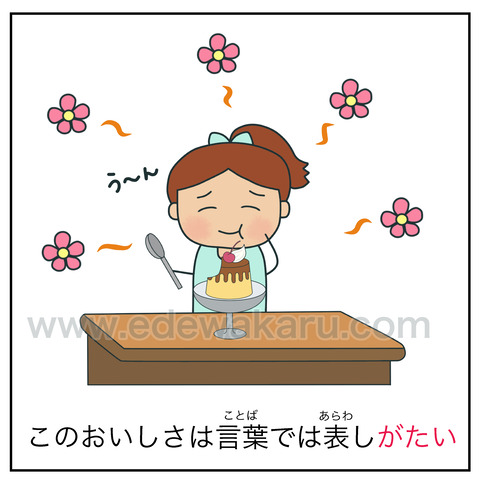
このおいしさは言葉では表しがたい
→このおいしさは言葉では表せないThis deliciousness is hard to express in words. →This deliciousness cannot be expressed in words.
彼女が不合格だったなんて信じがたい
→彼女が不合格だったなんて信じられないIt’s hard to believe that she failed. →I can’t believe that she failed.
山田くんの言っていることは理解しがたい
→山田くんの言っていることは理解できないIt’s hard to understand what Yamada is saying. →I can’t understand what Yamada is saying.
社長:彼は許しがたいミスをしたので首にした(復習:首にする・首になる)
→社長:彼は許せないミスをしたので首にしたPresident: I fired him because he made an unforgivable mistake (review: 首にする・首になる). →President: I fired him because he made an unforgivable mistake.
Read the original source text
Meaning
〜するのが難しい
〜しようとしてもできない
How to use it
動詞[ます形]+がたい
Explanation
「〜がたい」は「〜するのが難しい」という意味ですが、
日本人がこの文型を使用する場合はほとんどの場合「〜しようとしても〜できない」という不可能を表す意味になります
😮かたい言い方で、書き言葉的です。よく使われる動詞が決まっています。また漢字で書くと「〜難い」と書きますので、上級レベルの人は覚えておきましょう😉
[よく使われるもの]
信じがたい
想像しがたい
理解しがたい
認めがたい
言いがたい
表しがたい
耐えがたい
許しがたい
得がたい
【上級レベルの人へ】
慣用表現として「
動かしがたい」というのがあります。これは「
間違いのない」という意味で「動かしがたい真実(間違いのない真実)」などの形で使われますので暗記しておきましょう😀
【補足説明】
「〜にくい」と「〜がたい」はどちらも「〜するのが難しい」と説明している参考書がほとんどですが、上でも説明したように「〜がたい」が使われる場合は不可能を表すのが一般的です😊
〜にくい→〜するのが難しいが、しようと思えばできる
〜がたい→〜しようとしてもできない
このように覚えておくといいですね😄
日本語文型辞典
Meaning
Basic information: R-がたい. Explanation. Attached to the continuative form of a verb, it means that doing the action is difficult or impossible. Verbs related to perception and judgment are used, such as “想像しがたい・認めがたい・(考えを)受け入れがたい・賛成しがたい,” as well as verbs related to expression, such as “言いがたい・表しがたい.” “動かしがたい事実” in ③ is an idiomatic expression meaning “a complete fact that cannot be dismissed as a lie.” This is a written style. Examples: ① It's hard to believe, but it's true. ② What that guy says has no basis and is outrageous; it's utterly incomprehensible. ③ It is an undeniable fact that during the war Japan's military killed nameless people in Asian countries without reason. ④ Although he has been accused of sexually harassing a female subordinate, he shows no sign of remorse; on top of that, he is spreading rumors that the woman is incompetent. That is simply unforgivable.
Read the original source text
Meaning
基本情報R-がたい説明動詞の連用形に付いて、その行為を行うことがむずかしい・不可能であるという意味を表す。「想像しがたい・認めがたい・(考えを)受け入れがたい・賛成しがたい」など、認識に関わる動詞が使われるほか、「言いがたい・表しがたい」など発言に関わる動詞も使われる。③の「動かしがたい事実」は慣用句的な表現で、「嘘だとすることのできない、まったくの事実」の意味。書きことば的。例文① 信じがたいことだが本当なのだ。② あいつの言うことは何の根拠もないし常識はずれで、とうてい理解しがたい。③ 日本が戦時中にアジア諸国で名もない人たちを理由もなく殺したことは、動かしがたい事実である。④ 彼は部下の女性に対するセクシャル・ハラスメントで告発されたにもかかわらず、まるで反省の色が見えないばかりか、あの女は無能だなどと言いふらしており、まったく許しがたい。
日本語文型辞典 英語版
Meaning
【がたい】[R-がたい]
Attaches to a verb stem and means that an action is difficult or impossible to do. Combines with verbs of perception and awareness, as in 想像しがたい (hard to imagine), 認めがたい (hard to admit/accept), (考えを) 受け入れがたい (hard to accept other people’s (opinions/ideas)), 賛成しがたい (difficult to agree with). Also used with verbs of utterance, as in 言いがたい (hard to say) and 表しがたい (difficult to express). 動かしがたい事実 in
(3)
is an idiomatic expression that means something is undeniably true. Often used in written language.
In context 4 examples
信じがたいことだが本当なのだ。
It’s hard to believe, but it’s true.
あいつの言うことは何の根拠もないし常識はずれで、とうてい理解しがたい。
What he says is groundless, absurd, and hardly comprehensible.
日本が戦時中にアジア諸国で名もない人たちを理由もなく殺したことは、動かしがたい事実である。
It is an indisputable fact that, during the war, the Japanese Army killed ordinary people in Asian countries for no reason.
彼は部下の女性に対するセクシャル・ハラスメントで告発されたにもかかわらず、まるで反省の色が見えないばかりか、あの女は無能だなどと言いふらしており、まったく許しがたい。
Though he was prosecuted by a female subordinate for sexual harassment, he not only shows no sign of remorse, he’s also spreading reports that she’s incompetent. That’s really unpardonable!
くらべてわかる日本語表現文型辞典
Meaning
Even if one wants to do A, one cannot do it.
How to use it
A がたい
[verb ます-form] がたい
Explanation
[Contrast 1]
「A にくい」 (Meaning 1, p. 225)
Notes
[Note 1]
・This form cannot be used when something is impossible due to ability or circumstances.
×私はフランス語が話しがたい。 — I find it hard to speak French.
×怪我をしているので、歩きがたい。 — I can’t walk because I’m injured.
・There are also set expressions such as 「甲乙つけがたい」 (“hard to choose between the two”), 「筆舌に尽くしがたい」 (“indescribable”), 「いかんともしがたい」 (“impossible to do anything about”), and 「何物にも代えがたい」 (“invaluable; beyond compare”).
In context 4 examples
あの真面目な彼が犯人だなんて、信じがたいことだ。
It is hard to believe that he, of all people, so serious, is the culprit.
これは正解ではないが、まちがっているとも言いがたい。
This is not the correct answer, but it is also hard to say that it is wrong.
この小説を読んで、言葉では形容しがたい感動を受けた。
Reading this novel moved me in a way that words cannot describe.
日本にきて、色々と得がたい経験をした。
Since coming to Japan, I have had many invaluable experiences.
Read the original source text
Meaning
Aをしようと思っても、することができない。
How to use it
Aがたい
[動詞-ます形]がたい
Explanation
【対比1】
「Aにくい」(意味1 P.225)
Notes
【注意1】
・能力や事情によってできない場合は、この形では使えない。
×私はフランス語が話しがたい。
×怪我をしているので、歩きがたい。
・「甲乙つけがたい」「筆舌に尽くしがたい」「いかんともしがたい」「何物にも代えがたい」などの慣用的な表現もある。
日本語NET JLPT文法解説まとめ
Meaning
Difficult to ~.
It is not used to mean that something is impossible due to a lack of ability.
How to use it
V (ます-stem) + がたい
Explanation
"difficult to do"
*Not used to mean something can't be done because of lack of ability.
In context 5 examples
彼はいつも嘘ばかりつくので、今回の話も本当かどうか信じがたい。
He always lies, so it’s hard to believe whether what he’s saying this time is true.
まさか、彼女があの事故から奇跡的に生き延びた何て信じがたい話だ。
It’s hard to believe that she miraculously survived that accident.
20代の男性がナイフで女性を刺したそうです。本当に許しがたい行為だ。
Apparently, a man in his twenties stabbed a woman with a knife. It’s truly an unforgivable act.
彼はいつも怖い顔をしているし、静かだし、近寄りがたいよ。
He always looks scary and is quiet, so he’s hard to approach.
大勢の人の前で馬鹿にされて、耐えがたい屈辱を味わった。
I was ridiculed in front of a large crowd and suffered unbearable humiliation.
Read the original source text
Meaning
〜するのが難しい。
「能力的にできない」ということには使わない。
How to use it
Vます+ がたい
Explanation
"difficult to do"
*Not used to mean something can't be done because of lack of ability.
毎日のんびり日本語教師
Meaning
Difficult to do (~ cannot be done)
How to use it
Verb ます-form + がたい
Explanation
Attaches to the verb ます-form and expresses that carrying out the action is difficult. It describes a situation where you cannot do something despite trying hard, or where you want to do it but cannot. 「~がたい」 cannot be used when the reason is emotional.
The kanji 「難い(がたい)」 is also sometimes used.
Common expressions include 「理解しがたい」 (hard to understand), 「信じがたい」 (hard to believe), 「近寄りがたい」 (hard to approach), 「捨てがたい」 (hard to give up), 「許しがたい」 (hard to forgive), 「想像しがたい」 (hard to imagine), and 「耐えがたい」 (hard to endure). 「にわかに」 sometimes collocates with 「信じがたい」.
There are four points to keep in mind about 「~がたい」.
① You genuinely want to do it.
② You cannot do it even if you try hard. It is almost impossible.
③ It cannot be used when the reason is emotional.
④ It can only be used in the first person.
Notes
It cannot be used when the reason is emotional.
✕
I find it hard to believe what she says because I dislike her.
〇
I can't believe what she says because I dislike her.
It cannot be used for anyone other than the first person.
✕
That person surely finds it hard to forgive you now.
〇
That person surely won't forgive you now.
It cannot be used for something you can do if you try hard.
✕
The text in this book is too small, so it's hard to read.
〇
The text in this book is too small, so I can't read it / it's hard to read / it's difficult to read.
In context 6 examples
彼はずっと勉強していて、近寄りがたい雰囲気がある。
He is always studying and has an unapproachable air about him.
信じがたいことに、いくつかの企業は月や火星への移住を視野に宇宙開発を行っている。
Unbelievably, some companies are developing space technology with migration to the Moon and Mars in mind.
人の彼女に手を出すなんて、本当に許しがたい。
It's truly unforgivable to make a move on someone else's girlfriend.
独りは孤独だが、自由とは何ものにも代えがたいものだ。
Being alone is lonely, but freedom is something nothing can replace.
被告の行為は本当に許しがたいものだ。(被告的行为实在无法原谅。)
The defendant's actions are truly unforgivable. (The defendant's actions are truly impossible to forgive.)
A国の要求は、政府にとっては受け入れがたいものである。
Country A's demands are unacceptable to the government.
Read the original source text
Meaning
~することが難しい(~できない)
How to use it
動ます形+がたい
Explanation
動ます形に接続してその動作が実現困難であることを表します。頑張ってもできない、本当はしたいけどできないという状態です。心情的な理由の場合は「~がたい」を使うことができません。
漢字「難い(がたい)」が使われることもあります。
理解しがたい、信じがたい、近寄りがたい、捨てがたい、許しがたい、想像しがたい、耐えがたい…等はよく使われます。そのうち「信じがたい」に対しては「にわかに」が呼応することがあります。
「~がたい」で注意すべき点は4つです。
①本当はしたい気持ちがある。
②頑張ってもできない。ほぼ不可能。
③心情的な理由の場合使えない。
④一人称にしか使えない。
Notes
心情的な理由では使えません。
✕
彼女の事は嫌いだから信じがたい。
〇
彼女の事は嫌いだから信じられない。
一人称以外でも使えません。
✕
あの人はもう君のことをきっと許しがたいよ
〇
あの人はもう君のことをきっと許さないよ
頑張ればできる事には使えません。
✕
この本、文字が小さすぎて読みがたい。
〇
この本、文字が小さすぎて読めない/読みにくい/読みづらい。
NINJAL 日本語文型データベース
Meaning
Expresses having a desire to do 〜 but being in a situation where it is almost impossible. It conveys feelings of surprise, criticism, or bewilderment about the matter.
“いかんともしがたい” (impossible to do anything about), “筆舌に尽くしがたい” (indescribable), and “何ものにも代えがたい” (irreplaceable) are idiomatic expressions.
How to use it
Notes
It is often used with specific verbs, such as verbs expressing cognition like “understand,” “believe,” and “forgive,” or verbs expressing speech like “say” and “express.”
It conjugates like an i-adjective, in forms such as “〜がたく(は)ない・〜がたかった・〜がたく(は)なかった・〜がたくて.”
In context 8 examples
お世話になった人にうそをつくとは許しがたい。
It is unforgivable to lie to someone who has helped you.
今の政府が国民の不安に応えてくれるとは言いがたいのではないか。
Isn’t it hard to say that the current government will respond to the concerns of the people?
あの頃、私はよくいじめられて、耐えがたい苦痛を味わった。
Back then, I was often bullied and endured unbearable suffering.
すばらしい景色だったので、しばらくその場を去りがたかった。
The scenery was magnificent, so I found it hard to leave for a while.
田中部長は、みんなが言うほど近寄りがたくはない。
Department Head Tanaka isn’t as unapproachable as everyone says.
父の頑固さはいかんともしがたいです。
There’s no doing anything about my father’s stubbornness.
優勝したときの感動は筆舌に尽くしがたい。戦い抜いた者だけが味わえる感情だろう。
The emotion I felt when I won is indescribable. It must be a feeling only those who have fought to the end can experience.
先生のお言葉、何ものにも代え難いご忠告として受けとめています。
I accept your words, teacher, as advice that is beyond compare.
Read the original source text
Meaning
〜したい気持ちはあるが、ほとんど不可能な状況であることを表します。そのことに対する驚き・非難・困惑の気持ちが込められます。
「いかんともしがたい・筆舌に尽くしがたい・何ものにも代えがたい」は慣用的な言い方です。
How to use it
Notes
「理解する・信じる・許す」などの認識を表す動詞や「言う・表す」などの発言を表す動詞など、決まった動詞を使う場合が多いです。
「~がたく(は)ない・~がたかった・~がたく(は)なかった、~がたくて」などのように、イ形容詞と同じ形に変化します。
IMABI
Difficult II: ~がたい & ~づらい
Read this IMABI lesson ↗Explanation
Difficult II: ~がたい & ~づらい
In this second installation on how to express difficulty, we will be looking at two additional supplementary adjectival endings which attach to the 連用形 of verbs. These endings are ~がたい and ~づらい. Both are synonymous with ~にくい but have their own specialized nuances. Despite their role of expressing difficulty, neither of these endings are particularly hard to grasp.
~がたい
The ending ~がたい attaches to the 連用形 to a semantically restricted set of verbs to indicate an action that is difficult not because of lack of ability but out of some sort of strong emotional hindrance. It is most frequently used with verbs related to acceptance belief, thought, and understanding.
~がたい is most appropriate in 書き言葉, or in a tone that is similar in nature. It is also used more so in set phrases, which was hinted by how it’s semantically restricted to only some verbs.
When written in kanji, it shares the same kanji as ~にくい. However, because ~にくい is overwhelmingly written in kana, whenever you do see ~難い, it is usually read as がたい unless the use of ~にくい would be more natural.
Verb Class +がたい
一段 Verbs 避けがたい
五段 Verbs 許しがたい
する しがたい
Etymology Note: This ending derives from the Classical Japanese adjective 難(かた)し. This ending is also responsible for the creation of ありがとう. In fact, ありがたい literally means “difficult to have,” and from that meaning the sense of “to be welcome” came about.
1. 今回の話すらも本当かどうか信じがたい。
It’s even hard to believe whether or not this current talk (of his) is true or not.
2. オレオレ詐欺は息子に成り済まして老人からお金を奪う許しがたい犯罪だ。
Phone scams involving making someone believe that they’re that person’s son is an inexcusable crime which steals money from the elderly.
3. 自分がOLであるという現状は耐え難い屈辱だ。
My current state as an OL is an unbearable disgrace.
4. 意見が分かれることは民主的な話し合いをしていれば避けがたいことだ。
When having a democratic discussion, having opinions become divided is unavoidable.
5. その光景は筆舌に尽くしがたいほど凄惨なものだった。
The scene was gruesome beyond description.
6. 2011年3月11日に東日本大震災という想像しがたい災害が起こりました。
On March 11, 2011, the Great East Japan Earthquake, a disaster hard to even believe, occurred.
7. 自衛隊のイラクへの派遣の違憲性を認めた判決は、改憲を目論む自民党にとっては認めがたい判決であろうが、 現「平和憲法」があればこその判決であると、思います。
The verdict that recognized the unconstitutionality of the Defense Force’s deployment to Iraq may very well be a verdict that’s hard to accept from the Liberal Democratic Party, whose aim is to revise the constitution, but I believe that such a verdict is all thanks to the current “constitution of peace” that we have today.
8. これは誰がどう考えても納得しがたい解釈じゃないか。
This interpretation is something that no one would ever accept no matter how you look at it.
9. 銭湯には捨てがたい魅力がある。
Public baths have a charm that’s hard to get rid of.
10. 彼は、叱れば実際に自分の言動を反省するという得がたい人材だ。
He’s the kind of hard-to-come-by human resource who actually reflects on his behavior when you reprimand him.
~づらい
Seldom written in kanji as ~辛い, ~づらい indicates an action that is emotionally straining to go about doing. The degree of “emotional strain” can vary from agony to just being burdensome. Although it can be used to express personal physical difficulty, it always places emphasis on the emotional burden that comes along with said struggle.
For comparison, 言いにくい, 言いがたい, 言いづらい are each possible, but the ‘difficult’ situation they describe are not the same. In the case of 言いにくい, the speaker is most likely referring to a situation that’s hard to pinpoint. 言いがたい, on the other hand, is a situation that the speaker has a strong urge not to discuss. 言いづらい, is similar to 言いがたい, but implies that the topic is rather painful for them to mention.
Unlike ~がたい, so long as the act being described can be conceptualized in a way that it is ‘difficult’ to the speaker or agent in an emotional way, using ~づらい can still be grammatical. However, if the verb purely describes physical difficulty, it is just as ungrammatical to use ~づらい as it would be to use ~がたい. For instance, 滑りづらい is not correct. To say, “hard to slide on,” you would need to say 滑りにくい.
In recent years, however, a decent percentage of speakers have been using ~づらい in a broader sense that makes it sound like a more refined alternative to ~にくい. As to whether the grammatical limitations of past generations will hold as an effect of this speech register restructuring, only time will tell.
Orthography Note: It is generally accepted that ~ずらい is an improper spelling of this ending and should be avoided in formal writing.
Verb Class 連用形+づらい
一段 Verbs 見づらい
五段 Verbs死にづらい
する しづらい
来る 来(き)づらい
Etymology Note: The reason for why ~づらい describes mental woe is because it derives from the adjective 辛(つら)い, which itself describes situations that are emotionally trying.
11. お前が葬儀に来なかったのは多分来づらかったからだろうと思っていた。
I had thought that the reason why you didn’t come to the funeral was probably because coming was too hard for you to handle.
12. なんか好きなんだけどちょっと話しづらくて…
I sort of like (him), but it’s a little tough to talk about it……
13. 相手に悪気はないのはわかるんだけど、感情の起伏が激しすぎて、一緒に仕事がやりづらい。
I know that the person doesn’t mean anything negative about it, but their emotional ups-and-downs are too extreme, and it’s hard to work together with them.
14. 相続のたびにお金とられるんじゃ、死にづらくてたまんねーよな。
You just can’t help being anxious about dying when your money is gonna be taken during inheritance.
15. 昨日買った長靴だけど、ちょっと歩きづらいよ。
So, about these high boots that I bought yesterday, they’re a bit tough to walk in.
16. ここのハンバーガーだが、本当においしいんだけど、大きすぎるし、形が崩れやすいし、食べづらいよね。
The burgers here are really delicious, but they’re too big and fall apart easily, and are hard to eat, huh.
17. また緊急事態宣言が出て、生活しづらくなるもんね。
It’ll be hard to make a livelihood now that another state of emergency is being declared.
18. 「いまび」はUIがスマホに対応しておらず、使いづらい。
“IMABI” is difficult to use because its UI is not optimized for smart phones.
19. いつから日本はこんなに生きづらくなったのか。
Since when did Japan become so difficult to live in like this?
20. あまり一般的でない言い回しなので、伝わりづらいかもしれません。
Since it’s not a common expression, it might be hard for its meaning to get across properly.
Sentence Note: Although Ex. 20 does not describe mental woes, the speaker is trying to explain how the text they’re proofreading may cause readers to rack their brains too much to understand. This, though, in a way, is a form of strain.
In context 20 examples
今回の話すらも本当かどうか信じがたい。
It’s even hard to believe whether or not this current talk (of his) is true or not.
オレオレ詐欺は息子に成り済まして老人からお金を奪う許しがたい犯罪だ。
Phone scams involving making someone believe that they’re that person’s son is an inexcusable crime which steals money from the elderly.
自分がOLであるという現状は耐え難い屈辱だ。
My current state as an OL is an unbearable disgrace.
意見が分かれることは民主的な話し合いをしていれば避けがたいことだ。
When having a democratic discussion, having opinions become divided is unavoidable.
その光景は筆舌に尽くしがたいほど凄惨なものだった。
The scene was gruesome beyond description.
2011年3月11日に東日本大震災という想像しがたい災害が起こりました。
On March 11, 2011, the Great East Japan Earthquake, a disaster hard to even believe, occurred.
自衛隊のイラクへの派遣の違憲性を認めた判決は、改憲を目論む自民党にとっては認めがたい判決であろうが、 現「平和憲法」があればこその判決であると、思います。
The verdict that recognized the unconstitutionality of the Defense Force’s deployment to Iraq may very well be a verdict that’s hard to accept from the Liberal Democratic Party, whose aim is to revise the constitution, but I believe that such a verdict is all thanks to the current “constitution of peace” that we have today.
これは誰がどう考えても納得しがたい解釈じゃないか。
This interpretation is something that no one would ever accept no matter how you look at it.
銭湯には捨てがたい魅力がある。
Public baths have a charm that’s hard to get rid of.
彼は、叱れば実際に自分の言動を反省するという得がたい人材だ。
He’s the kind of hard-to-come-by human resource who actually reflects on his behavior when you reprimand him.
お前が葬儀に来なかったのは多分来づらかったからだろうと思っていた。
I had thought that the reason why you didn’t come to the funeral was probably because coming was too hard for you to handle.
なんか好きなんだけどちょっと話しづらくて…
I sort of like (him), but it’s a little tough to talk about it……
相手に悪気はないのはわかるんだけど、感情の起伏が激しすぎて、一緒に仕事がやりづらい。
I know that the person doesn’t mean anything negative about it, but their emotional ups-and-downs are too extreme, and it’s hard to work together with them.
相続のたびにお金とられるんじゃ、死にづらくてたまんねーよな。
You just can’t help being anxious about dying when your money is gonna be taken during inheritance.
昨日買った長靴だけど、ちょっと歩きづらいよ。
So, about these high boots that I bought yesterday, they’re a bit tough to walk in.
ここのハンバーガーだが、本当においしいんだけど、大きすぎるし、形が崩れやすいし、食べづらいよね。
The burgers here are really delicious, but they’re too big and fall apart easily, and are hard to eat, huh.
また緊急事態宣言が出て、生活しづらくなるもんね。
It’ll be hard to make a livelihood now that another state of emergency is being declared.
「いまび」はUIがスマホに対応しておらず、使いづらい。
“IMABI” is difficult to use because its UI is not optimized for smart phones.
いつから日本はこんなに生きづらくなったのか。
Since when did Japan become so difficult to live in like this?
あまり一般的でない言い回しなので、伝わりづらいかもしれません。
Since it’s not a common expression, it might be hard for its meaning to get across properly.
どんなときどう使う 日本語表現文型辞典
Meaning
difficult to
How to use it
Vます+がたい
Explanation
~するのは難しい
1)「そうすることは難しい、不可能だ」という意味。
2)「信じる・許す・理解する・想像する・受け入れる」などの動詞とともによく使われる。やや古い言い方。慣用的に使われる例が多い。
3)「能力的にできない」という意味では使わない。
◆ × わたしにはコンピューターは難しくて、使いがたいです。/
× けががまだ治っていないので、長い時間は歩きがたい。
2)Often used with verbs 信じる (believe), 許す (forgive), 理解する (understand), 想像する (imagine),and 受け入れる (accept). Often used as idiom.
1)Slightly old-fashioned expression meaning that doing something would be difficult or impossible.
3)Not used to mean something can't be done because of lack of ability.
In context 3 examples
あの元気なひろしが病気になるなんて信じがたいことです。
It's hard to believe that energetic Hiroshi has fallen ill.
弱い者をいじめるとは許しがたい行為だ。
Bullying the weak is an unforgivable act.
幼い子どもと離れて暮らすことは彼には耐えがたかったのだろう。
Living apart from his young child must have been unbearable for him.
Read the original source text
Meaning
difficult to
How to use it
Vます+がたい
Explanation
~するのは難しい
1)「そうすることは難しい、不可能だ」という意味。
2)「信じる・許す・理解する・想像する・受け入れる」などの動詞とともによく使われる。やや古い言い方。慣用的に使われる例が多い。
3)「能力的にできない」という意味では使わない。
◆ × わたしにはコンピューターは難しくて、使いがたいです。/
× けががまだ治っていないので、長い時間は歩きがたい。
2)Often used with verbs 信じる (believe), 許す (forgive), 理解する (understand), 想像する (imagine),and 受け入れる (accept). Often used as idiom.
1)Slightly old-fashioned expression meaning that doing something would be difficult or impossible.
3)Not used to mean something can't be done because of lack of ability.