くらべてわかる日本語表現文型辞典
Meaning
Meaning 1: The speaker conveys information A received from someone else, while indicating that they are not sure whether it is correct.
Meaning 2: Looking at the situation at hand, one checks a fact with the person involved. It is also used to confirm hearsay with that person.
Meaning 3: An expression that implies there are things besides A (or B).
Meaning 4: In the form 「A とか B とか」. While giving A and B as examples, the speaker conveys the whole category including A and B. It is often used mainly for advice, requests, and commands.
How to use it
Explanation
【Contrast 1】
「A ということだ」(Meaning 1, p. 153)
「A そうだ」, 「A とか B」, 「A ということだ」, and 「A そうだ」are all hearsay expressions, but 「A とか B」includes the speaker’s feeling that they are “not sure.”
【Contrast 4】
「A なり B なり」(Meaning 1, p. 204)
「A やら B やら」(Meaning 1, p. 314)
Notes
【Note 3】
・Recently, an expression like the one in example ④ tends to be used as a kind of euphemism meaning “A alone,” rather than “including things besides A.”
In context 16 examples
彼は大学には行かないとか言っていました。
He said something about not going to university.
また、九州地方で地震があったとか。心配しています。
Apparently there was another earthquake in the Kyushu region. I’m worried.
田中さんは林さんと結婚するとか聞きましたが、本当ですか。
I heard that Ms. Tanaka is marrying Mr. Hayashi. Is it true?
あの人のお父さんは有名な作家だとか。本当でしょうか。
Apparently that person’s father is a famous writer. I wonder if it’s true.
どうした?元気ないな。もしかして二日酔いとか…?
What’s wrong? You look down. Maybe you’re hungover or something…?
うれしそうな顔をして。ひょっとして、合格したとか…?
You look so happy. Did you perhaps pass or something…?
「きのう、財布を落とされたとか…。」
「ええ、そうなんですよ。」“I heard you lost your wallet yesterday…” “Yes, that’s right.”
「ご結婚なさったとか…。おめでとうございます。」
「ありがとう。」“I heard you got married…. Congratulations.” “Thank you.”
「カバンの中に何が入ってたんですか?」
「財布とかメモ帳とか…。」“What was in your bag?” “My wallet, a notepad, and things like that….”
インスタント食品ばかりじゃなく、たまには肉じゃがとか食べたいな。
I’m tired of eating nothing but instant food; I’d like to have something like nikujaga once in a while.
友達の結婚式とか転勤とかで、今月は出費が多かった。
I had a lot of expenses this month because of things like a friend’s wedding and a transfer.
ねえ、お茶とか飲みにいかない?
Hey, want to go get some tea or something?
黙っていないで「うん」とか「すん」とか言ったらどうなんだ?(発言しろ)
Instead of sitting there silently, why don’t you say something like “yeah” or even “mm”? (Say something.)
きれいだとか汚いとか言ってる場合じゃない。早く掃除してしまえ。(文句を言うな)
This is no time to go on about whether it’s clean or dirty. Hurry up and clean it. (Stop complaining.)
わからない言葉があったら、先生に聞くとか、辞書を調べるとかしなきゃだめだ。(とにかく勉強しろ)
If there’s a word you don’t understand, you have to ask the teacher or look it up in a dictionary or something. (Just study.)
ボーッとしていないで、皿を並べるとか机を拭くとかしろよ。(手伝え)
Stop spacing out and do something like set out the plates or wipe the table. (Help out.)
Read the original source text
Meaning
意味1:ほかから得たAという情報をはっきりわからないという気持ちで相手に伝える。
意味2:その場の様子を見て本人に対し、事実の確認をする。また、伝聞情報を本人に確認するときにも使う。
意味3:A(やB)以外のものが他にもあることを含んだ表現。
意味4:「AとかBとか」の形で。AやBを例示しながら、話し手はAやBを含んだ全体を相手に伝える表現。主に「忠告・要求・命令」に使われることが多い。
How to use it
Explanation
【対比1】
「Aということだ」(意味1 P.153)
「Aそうだ」「AとかB」「Aということだ」「Aそうだ」は、いずれも伝聞の表現であるが、「AとかB」には「はっきりわからない」という話し手の気持ちが含まれる。
【対比4】
「AなりBなり」(意味1 P.204)
「AやらBやら」(意味1 P.314)
Notes
【注意3】
・例文④のような表現は、「A以外のものも含んだ」というより「Aだけ」を指す婉曲表現の一種として最近、使われる傾向にある。
DoJG 日本語文法辞典(全集)
Meaning
And; or
How to use it
(i) Noun | とか Noun とか… | |
| 学生とか先生とか… | Students and teachers… (among others) |
(ii) Sinformal | とか Sinformal とかする | |
| テレビを見るとか本を読むとかする | Do such things as watching TV or reading books |
Explanation
A conjunction that lists two or more items, actions or states as inexhaustive examples.
In context 5 examples
私はバッハとかモーツアルトとかベートーベンが好きだ・好きです。
I like Bach, Mozart and Beethoven, among others.
疲れた時はお風呂に入るとか早く寝るとかしなさい。
When you are tired, do things like taking a bath or going to sleep early.
日本の茶道とか生け花とかいうものをよく知らない。
I don't know much about things like the Japanese tea ceremony and flower arranging.
A:どんな日本の映画を見ましたか。 B:黒沢の「七人の侍」とか「生きる」とか「影武者」を見ました。
A: What kind of Japanese movie did you see? B: I saw Kurosawa's Seven Samurai, Ikiru and Kagemusha.
A:日曜日にはどんなことをしていますか。 B:音楽を聞くとか、本を読むとかしています。
A: What sorts of things do you do on Sundays? B: I do things like listening to music or reading books.
日本語文型辞典
Usage 1
Meaning
Used after a person or thing when giving several examples of similar cases. Colloquial.
Follows a verb expressing an action when giving several examples of similar actions or behaviors.
How to use it
N とか(N とか)
V-るとか(V-るとか)
In context 7 examples
病気のお見舞いには果物とかお花が好まれる。
Fruit and flowers, for example, are popular gifts for people in the hospital.
私は、ケーキとか和菓子とかの甘いものは、あまり好きではありません。
I don't particularly like sweet things such as cakes and Japanese sweets.
最近の大学院では、一度就職した人とか、子育てを終わった主婦とかが、再び勉強するために入学するケースが目立つようになった。
Recently, graduate schools have seen more cases of people returning to study, such as those who have worked before and housewives whose children have grown up.
日本から外国へのお土産としては、カメラとか電気製品がいいでしょう。
Cameras and electrical appliances, for example, would make good gifts to take from Japan to other countries.
休日はテレビを見るとか、買い物するとかして過ごすことが多い。
I often spend my days off watching TV, shopping, or doing things like that.
教師の不足は、教師が教える時間数を増やすとか、一つの教室で複式の授業をするとかの方法で何とか乗り切ることにしたい。
We hope to get through the teacher shortage somehow by using methods such as increasing the number of hours teachers teach or holding combined-grade classes in one classroom.
奨学金をもらっていない留学生には授業料を免除するとか、部屋代の安い宿舎を捏供するとかして、経済面での援助をする必要がある。
It is necessary to provide financial support to international students who do not receive scholarships, for example by waiving tuition or providing housing with low rent.
Read the original source text
Meaning
人や物に付いて、同じような例をいくつか挙げる場合に用いる。話しことば的。
動作を表す動詞を受け、同じような動作・行動の例をいくつか挙げる場合に用いる。
How to use it
Nとか(Nとか)
V-るとか(V-るとか)
Usage 2
Meaning
Attached to a noun or quoted clause, used to convey something heard to another person. It implies that the speaker is not entirely sure of the accuracy of the information. As in ②, 「言っている/言った」 at the end of a sentence may be omitted.
Used after opposite things or statements that vary in different ways when it is unclear which is actually the case. As in ②, 「言う」 may be omitted.
Follows reported information and means “I've heard something like …, though not clearly.”
Means “I've heard that … is the cause/reason”; indicates that the cause or reason is something heard from another person. Colloquial.
How to use it
…とか(いう)
…とか…とか(いう)
…とかいうことだ
N/Na だとかいうことだ
A/V とかいうことだ
…とかで
N/Na だとかで
A/V とかで
In context 12 examples
山田さんとかいう人が訪ねてきていますよ。
Someone called Yamada or something has come to see you.
田中さんは今日は風邪で休むとか。
I hear Mr. Tanaka is taking the day off today with a cold.
A:田中さんは?
B:なんか今日はかぜで休むとか言っていました。A: What about Mr. Tanaka? B: They said something about taking the day off today with a cold.
天気予報によると台風が近づいているとかいう話です。
According to the weather forecast, I hear a typhoon is approaching.
彼女は買い物に行くとこれがいいとかあれがいいとか言って、決まるまでに本当に時間がかかる。
When she goes shopping, she says this one is good, that one is good, and it really takes a long time before she decides.
あの二人は結婚するとかしないとか、いつまでたっても態度がはっきりしない。
Those two keep saying they might get married or they might not; they never make their position clear.
もう仕事はやめるとかやっぱり続けるとか、会うたびに言うことが変わる人だ。
He's the kind of person who changes what he says every time we meet: one time he'll say he's quitting work, and the next that he'll keep going after all.
隣の娘さんは来月結婚式を挙げるとかいうことだ。
I hear the girl next door is getting married next month.
ニュースによると大雨で新幹線がストップしているとかいうことだ。
According to the news, heavy rain has stopped the Shinkansen.
途中で事故があったとかで、彼は1時間ほど遅刻してきた。
He arrived about an hour late, saying there had been an accident on the way or something.
来週引っ越すとかで、鈴木さんから二日間の休暇願いが出ています。
Suzuki has put in a request for two days off, saying something about moving next week.
結婚式に出るとかで、彼女は着物姿で現れた。
She showed up wearing a kimono, saying something about attending a wedding.
Read the original source text
Meaning
名詞や引用節の後に付いて、聞いた内容を他の人に伝える場合に用いる。内容の正確さに十分な確信がないという含みがある。②のように文末の「言っている/言った」が省略されることもある。
正反対のことがらや、いろいろに変わる発言内容を受け、本当はどちらなのかはっきりしない場合に用いる。②のように「言う」の部分が省略されることもある。
伝聞内容を受けて、「はっきりとではないが…のようなことを聞いている」という意味を表す。
「聞くところによると…のような原因・理由で」という意味で、原因・理由の部分が他の人から伝え聞いたものであることを表す。話しことば的。
How to use it
…とか(いう)
…とか…とか(いう)
…とかいうことだ
N/Na だとかいうことだ
A/V とかいうことだ
…とかで
N/Na だとかで
A/V とかで
絵でわかる日本語
Usage 1
Read this source entry ↗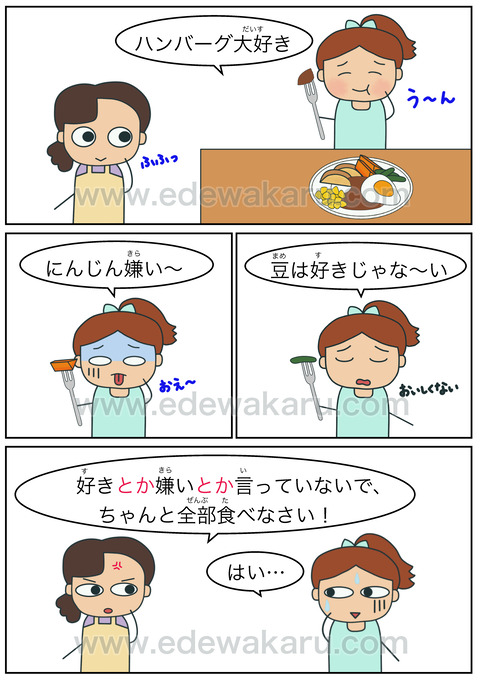
Meaning
It is unclear whether it is 〜 or 〜
The statement keeps changing, saying 〜 and then 〜
How to use it
Verb/adjective/noun [plain form] + とか
Verb [dictionary form] + とか + verb [ない-form] + とか
Explanation
“AとかBとか” is a sentence pattern meaning “it’s unclear whether A or B” or “the person keeps changing what they say, saying A and then B.” It is originally the pattern “say A or B” or “say 〜 such as A or B,” but the “say” or “saying” part is often omitted. “A” and “B” are opposite things or things that are completely different. It is used when you want to say that what the other person says “keeps changing” or “is unclear.” In many cases, it expresses reproach.
[Example]
My younger sister is always changing what she says, saying she wants to study abroad and then that she doesn’t.
= She says she wants to study abroad and then that she doesn’t, and she’s always changing what she says.
There are several sentence patterns that use “とか,” so be sure to review them 😊
[Patterns that use “とか”]
In context 5 examples
好きとか嫌いとか言っていないで、ちゃんと全部食べなさい!
→好きと言ったり嫌いと言ったりしていないで、ちゃんと全部食べなさい!Stop saying you like it and then that you hate it, and eat all of it properly!
妹は留学したいとかしたくないとか、いつも言うことが変わる
→留学したいのかしたくないのか、どちらかはっきりしないMy younger sister is always changing what she says, saying she wants to study abroad and then that she doesn’t. → It’s unclear whether she wants to study abroad or not.
あの子は彼氏と別れるとか別れないとか、どうしたいのかよくわからない
→別れるのか別れないのか、どちらかはっきりしないThat girl says she might break up with her boyfriend or might not; I can’t really tell what she wants to do. → It’s unclear whether she’ll break up with him or not.
彼は私の意見に賛成とか反対とか、聞くたびに意見が変わる
→賛成と言ったり反対と言ったり、聞くたびに言うことが変わるHe says he agrees with my opinion and then that he disagrees; his opinion changes every time I ask him.
彼女と結婚するとかしないとか言っていないで、早くどうするか決めたら?
→結婚するのかしないのかはっきりしないStop going back and forth about whether you’ll marry her, and decide what you’re going to do already. → It’s unclear whether you’ll marry her or not.
Read the original source text
Meaning
〜か〜か、はっきりしない
〜と言ったり〜と言ったり、言うことがいろいろに変わる
How to use it
動詞・形容詞・名詞[普通形]+とか
動詞[辞書形]+とか+動詞[ない形]+とか
Explanation
「AとかBとか」は「AかBか、どちらかはっきりしない」「Aと言ったりBと言ったり、言うことがいろいろに変わる」という意味の文型です。これは、もともと「AとかBとか言う」「AとかBとか言って〜」という文型ですが、よく「言う・言って」の部分を省略して使われます。「A」と「B」には正反対のことや、全然違うことが入ります。相手の言ったことが「いろいろ変わる」「はっきりしない」と言いたい時に使われます。多くの場合は、非難する気持ちを表します。
[例]
妹は留学したい
とか
したくない
とか、いつも言うことが変わる
=留学したい
とか
したくない
とか言って、いつも言うことが変わる
「とか」がつく文型は、いくつかありますので復習しておきましょう😊
【「とか」がつく文型】
Usage 2
Read this source entry ↗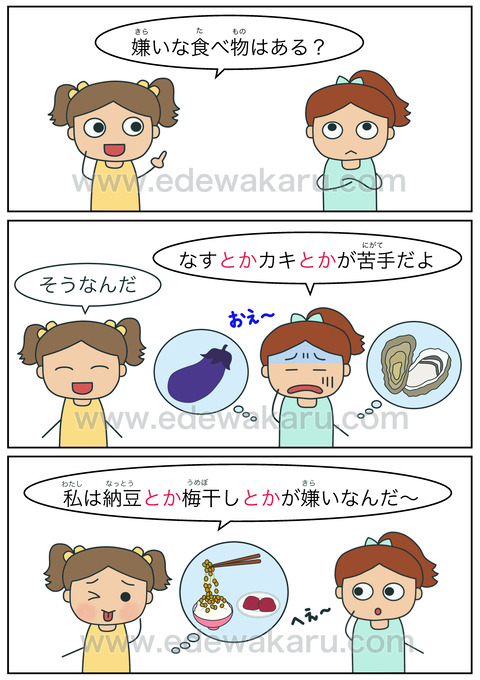
Meaning
〜 and, 〜 and so on
How to use it
Verb/adjective/noun [plain form] + とか
Explanation
“〜とか〜とか” is a sentence pattern meaning “〜 and so on,” and it is used to give examples of things of the same kind. It can be used to give three examples, as in “〜とか〜とか〜とか,” or just one example, as in “〜とか.”
[Examples]
I’m not good with things like eggplant, oysters, and natto. [three examples]
I’m not good with things like eggplant and oysters. [two examples]
I’m not good with things like eggplant. [one example]
“〜とか” also has a hearsay use. Also, “〜とか〜とか” can mean “it’s unclear whether 〜 or 〜,” so be sure to review these uses 😊
In context 5 examples
A:嫌いな食べ物はある?B:う〜ん…なすとかカキとかが苦手だよ
→なすやカキなどが苦手だよA: Are there any foods you dislike? B: Hmm… I’m not good with things like eggplant and oysters. → I’m not good with things like eggplant and oysters.
A:なかなかやせないなぁ…B:ケーキとかプリンとか、甘いものばかり食べているからやせないんだよ
→ケーキやプリンなど、甘いものばかり食べているからやせないんだよA: I just can’t seem to lose weight… B: You’re not losing weight because you keep eating sweets like cake and pudding. → You’re not losing weight because you keep eating sweets like cake and pudding.
日本に行くなら、お寿司とか天ぷらとかが食べたいな
→お寿司や天ぷらなどが食べたいなIf I go to Japan, I’d like to eat things like sushi and tempura. → I’d like to eat things like sushi and tempura.
母:デパートに何を買いに行くの?娘:服とかバッグとかを買おうと思ってるの
→服やバックなどを買おうと思ってるのMother: What are you going to the department store to buy? Daughter: I’m thinking of buying things like clothes and bags. → I’m thinking of buying things like clothes and bags.
A:ここのところ、ずっと体調が悪いんだよね…B:病院へ行くとかネットで症状を調べるとかしたほうがいいんじゃない?
→病院へ行くことやネットで調べることをしたほうがいいんじゃない?A: I’ve been feeling unwell for a while now… B: Don’t you think you should do something like go to the hospital or look up your symptoms online? → Don’t you think you should do things like go to the hospital or look them up online?
Read the original source text
Meaning
〜や、〜など
How to use it
動詞・形容詞・名詞[普通形]+とか
Explanation
「〜とか〜とか」は「〜や、〜など」という意味の文型で、同じ種類のものを例をあげていう場合に使われます。「〜とか〜とか〜とか」というように3つ例をあげて使う場合や、「〜とか」というように1つだけ例をあげる場合にも使用することができます。
[例]
なす
とか
カキ
とか
納豆
とか
が苦手だ【3つの例】
なす
とか
カキ
とか
が苦手だ【2つの例】
なす
とか
が苦手だ【1つの例】
「〜とか」には伝聞を表す用法もあります。また「〜とか〜とか」には「〜か〜か、はっきりしない」という意味もありますので、復習しておきましょう😊
Usage 3
Read this source entry ↗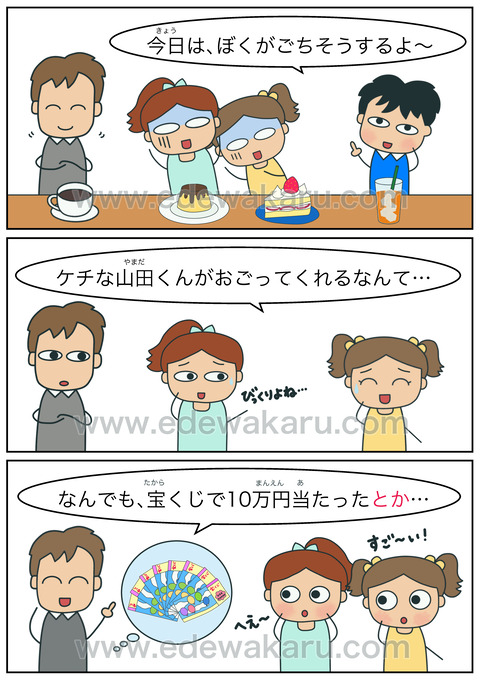
Meaning
I don’t know for sure, but apparently 〜
How to use it
Verb/adjective/noun [plain form] + とか
Explanation
“〜とか” is a sentence pattern meaning “I don’t know for sure, but apparently 〜.” It is a hearsay expression used when the speaker is not very certain, and is used when you want to say “I don’t know for sure whether it’s true, but apparently 〜.” Learn the patterns that are often used together with it.
[Patterns often used together]
・
〜によると
+ 〜とか
・
なんでも
+ 〜とか
・
〜ところによると
+ 〜とか
There are several sentence patterns that express [hearsay], so be sure to review them 😉
[Hearsay expressions]
In context 6 examples
A:山田くんがおごってくれるなんて、びっくりだねB:うん、彼はすごくケチなのにねC:なんでも、宝くじで10万円当たったとかA:なるほど、だからおごってくれたんだ〜!
→本当かどうかはわからないけど、宝くじで10万円あたったそうだよA: I’m surprised Yamada is treating us! B: Yeah, even though he’s really stingy. C: Apparently, he won 100,000 yen in the lottery. A: I see, that’s why he treated us~! → I don’t know if it’s true, but apparently he won 100,000 yen in the lottery.
A:彼は、満点でN1に合格したとかB:へえ〜、すごいね!!
→本当かどうかわからないけど、彼は満点でN1に合格したそうだA: Apparently, he passed N1 with a perfect score. B: Wow~ that’s amazing!! → I don’t know if it’s true, but apparently he passed N1 with a perfect score.
娘:来週からずっと雨だとか…母:そうなんだ…洗濯物が乾かないから困るわ
→はっきりとわからないけど、来週からずっと雨だそうよDaughter: I hear it’s going to rain continuously starting next week… Mother: Is that so… That’ll be a problem because the laundry won’t dry. → I don’t know for sure, but apparently it’s going to rain continuously starting next week.
彼女はテニスの試合で優勝したとか
→はっきりとは知らないが、彼女はテニスの試合で優勝したそうだApparently, she won the tennis match. → I don’t know for sure, but apparently she won the tennis match.
部長によると、田中さんは来年結婚するとか
→本当かどうかわからないが、田中さんは来年結婚するそうだAccording to the department manager, Tanaka is apparently getting married next year. → I don’t know if it’s true, but apparently Tanaka is getting married next year.
A:なんでも、この本はおもしろいとかB:じゃあ、買ってみようかしら
→本当かどうかわからないけど、この本はおもしろいそうよA: Apparently, this book is interesting. B: Then maybe I’ll buy it. → I don’t know if it’s true, but apparently this book is interesting.
Read the original source text
Meaning
はっきりとわからないが、〜そうだ
How to use it
動詞・形容詞・名詞[普通形]+とか
Explanation
「〜とか」は「はっきりとわからないが、〜そうだ」という意味の文型です。確信性が低い時に使われる伝聞表現(でんぶんひょうげん)で、「本当かどうかはっきりわからないが、〜そうだ」と言いたい時に使われます。よく一緒に使われる文型を覚えておきましょう。
[よく一緒に使われる文型]
・
〜によると
+〜とか
・
なんでも
+〜とか
・
〜ところによると
+〜とか
[伝聞]を表す文型は、いくつかありますので復習しておきましょう😉
【伝聞表現】
どんなときどう使う 日本語表現文型辞典
Usage 1
Meaning
and such
How to use it
N/Vる/〔plain form〕+とか+N/Vる/〔plain form〕+とか
Explanation
とか~とか
~や~など
1)あるものごとや方法の同類の具体例をいくつか示したいときの言い方。「NとかNとかの…」は「NとかNとかいった…」の言い方もある。
2) ❸ のように方法の具体例の場合は「~とか~とかして」の形になる。
3) ❺ ❻ は、対立する言葉を並べて、言うことや態度がいつも変わってはっきりしないことを非難する文。
1)Gives several concrete examples of similar things or methods. Variant of N とか N とかの is N とか N とかいった.
2)For concrete examples of methods, ~とか~とかして is used, as in sentences ❸ .
3)In sentences ❺ and ❻ , contrasting pairs of words are listed to express criticism of shifting attitudes or discourse.
In context 6 examples
科目の中ではわたしは数学とか物理とかの理科系の科目が好きです。
Among the subjects, I like science subjects such as mathematics and physics.
学校とか図書館とかでは静かに勉強するのが礼儀だ。
It’s good manners to study quietly in places like schools and libraries.
親と話し合うとか先輩に相談するとかして早く進路を決めてください。
Please decide on your future course soon, by discussing it with your parents, consulting a senior, or doing something like that.
わからないところは、詳しい人に聞くとか、ネットで調べるとかしてください。
For things you don’t understand, ask someone knowledgeable, look them up online, or do something like that.
好きだとかきらいだとか言わないで、ちゃんと食べなさい。
Don’t say things like you like it or hate it; eat properly.
いつも仕事をやめるとか続けるとか言っているけど、どうするつもりですか。
You’re always saying things like you’ll quit your job or keep it. What are you planning to do?
Read the original source text
Meaning
and such
How to use it
N/Vる/〔普通形〕+とか+N/Vる/〔普通形〕+とか
Explanation
とか~とか
~や~など
1)あるものごとや方法の同類の具体例をいくつか示したいときの言い方。「NとかNとかの…」は「NとかNとかいった…」の言い方もある。
2) ❸ のように方法の具体例の場合は「~とか~とかして」の形になる。
3) ❺ ❻ は、対立する言葉を並べて、言うことや態度がいつも変わってはっきりしないことを非難する文。
1)Gives several concrete examples of similar things or methods. Variant of N とか N とかの is N とか N とかいった.
2)For concrete examples of methods, ~とか~とかして is used, as in sentences ❸ .
3)In sentences ❺ and ❻ , contrasting pairs of words are listed to express criticism of shifting attitudes or discourse.
Usage 2
Meaning
I heard something to the effect that
How to use it
See 2).
Explanation
~そうだが/~と聞いたが
B:そうですか。いよいよ冬ですねえ。
1)伝聞の言い方。同じく伝聞の「そうだ」や「ということだ」より不確かな気持ちがあったり、はっきり言うことを避けたりするときに使う。
2)接続は基本的には普通形につくが、その他の形につくこともある。
3)ややくだけた言い方。
1)Hearsay. Not as definitive as そうだ or ということだ of hearsay or avoids being definite.
2)Usually appends to plain form, but can also append to other forms.
3)Somewhat informal.
In context 3 examples
A:テレビで見たんだけど北海道はきのう大雪だったとか。
A: I saw it on TV—apparently there was heavy snow in Hokkaido yesterday.
課長の話では、打ち合わせの資料を2時前には用意しておかなければならないとか。間に合うかなあ。
According to the section chief, we’re supposed to have the meeting materials ready before two. I wonder if we’ll make it in time.
来年は妹さんが日本へ留学のご予定だとか。楽しみに待っています。
I hear your younger sister is planning to study in Japan next year. I’m looking forward to it.
Read the original source text
Meaning
I heard something to the effect that
How to use it
2)参照
Explanation
~そうだが/~と聞いたが
B:そうですか。いよいよ冬ですねえ。
1)伝聞の言い方。同じく伝聞の「そうだ」や「ということだ」より不確かな気持ちがあったり、はっきり言うことを避けたりするときに使う。
2)接続は基本的には普通形につくが、その他の形につくこともある。
3)ややくだけた言い方。
1)Hearsay. Not as definitive as そうだ or ということだ of hearsay or avoids being definite.
2)Usually appends to plain form, but can also append to other forms.
3)Somewhat informal.
日本語NET JLPT文法解説まとめ
Usage 1
Read this source entry ↗Meaning
“I hear that ~”
A hearsay expression. Also used when one wants to avoid stating something definitively.
How to use it
V(plain form)+とか
イA +とか
ナAだ + とか
Nだ + とか
Explanation
"I heard something to the effect that"
A hearsay expression. It is also used when you want to avoid making a definitive statement.
Read the original source text
Meaning
"〜そうで"
伝聞表現。断定した言い方を避けたい時にも使う。
How to use it
V(普通形)+とか
イA +とか
ナAだ + とか
Nだ + とか
Explanation
"I heard something to the effect that"
A hearsay expression. It is also used when you want to avoid making a definitive statement.
Usage 2
Read this source entry ↗Meaning
“〜and 〜, among other things”
Used when listing several examples.
How to use it
V (plain form) + とか
い-adjective (plain form) + とか
な-adjective (plain form) + とか
N (plain form) + とか
Explanation
Used when saying several nouns as an example of something.
① Compared to “〜や〜など,” it is slightly more casual and colloquial.
② For the reason mentioned in ①, it is better not to use it with superiors.
③ When followed by a noun, the form becomes “〜とかのN,” “〜とかいったN,” or “〜とかいうN.”
① Compared to "〜や〜など," it is slightly more casual and colloquial.
② For the reason mentioned in ①, it is better not to use it with superiors.
③ When followed by a noun, the form becomes "〜とかのN," "〜とかいったN," or "〜とかいうN."
In context 13 examples
このイベントでは、バーベキューとかゲームとかをします。
At this event, we'll do things like have a barbecue and play games.
日本語がもっと上手に話せるようになりたいなら、日本人の友達を作るとか、交流会に参加するとかしたらどう?
If you want to get better at speaking Japanese, how about making Japanese friends or joining a language exchange meetup?
僕は電車とかバスとかに長時間乗ると、気持ち悪くなる。
I feel sick when I ride trains or buses for a long time.
私の国ではワンピースとかナルトとかのアニメが人気がある。
Anime like One Piece and Naruto are popular in my country.
ギターとかベースとかの弦楽器が弾けるようになりたい。
I want to learn to play string instruments like the guitar and bass.
京都とか大阪とか関西のことなら、田中先生が詳しいと思うよ。
If it's about the Kansai region, such as Kyoto or Osaka, I think Professor Tanaka knows a lot.
ピザとかフライドチキンとか、カロリーの高いものばかり食べているから太るんだよ。
You get fat because you eat nothing but high-calorie foods like pizza and fried chicken.
あの二人はもう別れるとか、やっぱり別れないとか言い続けて3年になる。
Those two have spent three years going back and forth, saying things like they're going to break up and then that they won't after all.
次のセールではコートとかジャケットとかを買うつもりだ。
I plan to buy things like a coat and a jacket at the next sale.
アラビア語とか、中国語とか、アルファベットが使われていない言語を勉強するのは難しい。
It's difficult to study languages that don't use the alphabet, such as Arabic and Chinese.
科目の中では、数学とか化学とか理系と呼ばれる科目が好きです。
Among school subjects, I like science subjects such as mathematics and chemistry.
人に頼ってばかりいないで、辞書を使うとか、ネットで調べるとかしたら。
Instead of always relying on other people, why don't you try using a dictionary or looking it up online?
田中さんが悪いとか、鈴木さんがやったとか、そんなことは正直どうでもいい。
Honestly, I don't care whether Mr. Tanaka is at fault or Mr. Suzuki did it.
Read the original source text
Meaning
〜や〜など
例を複数挙げて言う時に使う。
How to use it
V(普通形) + とか
イA(普通形) + とか
ナA(普通形)+ とか
N(普通形)+ とか
Explanation
Used when saying several nouns as an example of something.
①「〜や〜など」に比べると少しカジュアルで話し言葉的。
② ①の理由から目上の人にはあまり使わない方がいい。
③ 後ろに名詞が続く場合は形が「~とかのN」、「〜とかいったN」、「~とかいうN」になる。
① Compared to "〜や〜など," it is slightly more casual and colloquial.
② For the reason mentioned in ①, it is better not to use it with superiors.
③ When followed by a noun, the form becomes "〜とかのN," "〜とかいったN," or "〜とかいうN."
毎日のんびり日本語教師
Usage 1
Read this source entry ↗How to use it
Noun + とか (+ noun + とか)
Verb dictionary form + とか (+ verb dictionary form + とか)
Explanation
There are two usages.
① Listing
Lists two items of the same kind. You don’t necessarily have to list two; just one is also fine.
② Unclear state or action
Connects to two completely opposite states or actions and indicates that it is unclear which of the two will occur. Examples (7) and (8).
“とか” is mainly used in conversation.
Notes
The 「とか」 series
In context 8 examples
皮肉とか嫌味とか、そういうつもりで言ったんじゃないです。
I didn’t mean it as sarcasm or a snide remark or anything like that.
休みの日に遊ぶ友達とかいない。
I don’t have any friends to hang out with on my days off.
将来は漫画家とか作家とかになりたい。
I want to become a manga artist or a writer someday.
新生活が始まるし、家具とか買わないといけない。
I’m starting a new life, so I have to buy things like furniture.
すぐ自慢する奴とか嫌い。
I hate people who brag all the time.
男とか女とか、そういう考えにとらわれず色んな服着たい。
I want to wear all kinds of clothes without being bound by ideas like “men’s clothes” or “women’s clothes.”
やりたいとか、やっぱりやりたくないとか、彼女は本当にわがままだ。
She’s really selfish, saying she wants to do it and then that she doesn’t after all.
恋人と結婚するとかしないとか、彼女は会う度に言うことが変わる。
Every time I see her, she changes what she says about whether she’ll marry her boyfriend.
Read the original source text
How to use it
名詞+とか(+名詞+とか)
動辞形+とか(+動辞形+とか)
Explanation
用法は2つあります。
①列挙
同種のものを2つ挙げる列挙を表します。必ずしも2つ挙げる必要はなく、1つだけでも良いです。
②はっきりしない状態、行動
完全に相反する2つの状態や動作に接続し、その2つのうち、どちらになるのかはっきりしないことを表します。例文(7)(8)。
「とか」は主に口語で用いられます。
Notes
「とか」シリーズ
Usage 2
Read this source entry ↗How to use it
Noun + とか
Sentence plain form + とか
Explanation
Expresses hearsay.
A characteristic of this expression is that the speaker has relatively little certainty about what they have heard. It implies that they either do not know the matter in question or did not know about it before.
At the end of a sentence, it may also take the form “~とかいう話だ.”
“~するとかしないとか” is also used as a set expression.
“とか” is mainly used in conversation.
Notes
The 「とか」 series
In context 8 examples
山口さんとかいう人から電話が来てますよ。
There’s a call from someone called Yamaguchi or something.
Aさん来月結婚するとか。
I hear A is getting married next month.
コロナウイルスは体内で変異するとかいう話だ。
Apparently, the coronavirus mutates inside the body.
Aさんは昨晩食中毒で病院行ったとかいう話だ。
Apparently, A went to the hospital last night with food poisoning.
太鼓の達人とかいうゲームが面白い。(鼓手达人之类的游戏很有趣。)
A game called Taiko no Tatsujin is fun.
福島県では、喜多方ラーメンとかいうラーメンが有名らしい。
Apparently, a ramen called Kitakata ramen is famous in Fukushima Prefecture.
ニュースによると、隣町で竜巻が発生したとかしないとか。
According to the news, there may or may not have been a tornado in the neighboring town.
今日午後は雨が降るとか。
I hear it’s going to rain this afternoon.
Read the original source text
How to use it
名詞+とか
文普通形+とか
Explanation
伝聞を表します。
話者の伝聞の内容に対する確証が低めなところが特徴です。前件についてそもそも知らないか、元々知らなかったニュアンスを含んでいます。
文末では「~とかいう話だ」となることもあります。
「~するとかしないとか」も定型的に用いられます。
「とか」は主に口語で用いられます。
Notes
「とか」シリーズ
日本語文型辞典 英語版
Meaning
Attaches to nouns referring to people or things and is used to give several similar examples. Has the tone of spoken language.
Used after action verbs to give several examples of similar actions or activities.
B:なんか今日はかぜで休むとか言っていました。
Umm, she said something like she’s caught a cold and is taking the day off.
Attaches to a noun or a quoted statement and is used by the speaker to tell someone something s/he has heard. Implies that the speaker is not completely sure of the accuracy of content. 言っている or 言った at the end of the sentence is sometimes dropped, as shown in
(2)
.
Used in cases of indecision, when it really isn’t clear which option will be taken. Placed after expressions that refer to opposing situations or something that changes in several ways. As in
(2)
, 言う is sometimes omitted.
Used when reporting indirect information. Means “I can’t be sure, but I heard something like....”
Means “according to what I heard, the cause or reason is such-and-such.” Expresses that the cause or reason is something that was heard or learned from another person. Has the tone of spoken language.
How to use it
1. Nとか(Nとか)
2. V-るとか(V-るとか)
1. ...とか(いう)
2. ...とか...とか(いう)
3. ...とかいうことだ[N/Na だとかいうことだ][A/V とかいうことだ]
4. ...とかで[N/Na だとかで][A/V とかで]
In context 19 examples
病気のお見舞いには果物とかお花が好まれる。
When you visit someone in the hospital, it’s good to take something like fruit or flowers.
私はケーキとか和菓子とかの甘いものはあまり好きではありません。
I don't really like sweet things, like cake or Japanese-style confectioneries.
最近の大学院では、一度就職した人とか、子育てを終わった主婦とかが、再び勉強するために入学するケースが目立つようになった。
Graduate schools are recently seeing a marked increase in students who are returning to pursue further studies, including people with job experience and homemakers who have finished raising their children.
日本から外国へのお土産としては、カメラとか電気製品がいいでしょう。
For gifts to take from Japan to other countries, a camera or an electric appliance of some kind might be a good idea.
休日はテレビを見るとか、買い物するとかして過ごすことが多い。
I usually spend my days off doing things like watching TV or going shopping.
教師の不足は、教師が教える時間数を増やすとか、一つの教室で複式の授業をするとかの方法で何とか乗り切ることにしたい。
I want to find a way to cope with the teacher shortage, such as increasing teaching hours or conducting combined classes in the same classroom.
奨学金をもらっていない留学生には授業料を免除するとか、部屋代の安い宿舎を提供するとかして、経済面での援助をする必要がある。
We need to provide financial support to international students who don’t have scholarships, by waiving their tuition fees, or offering them inexpensive housing, or other things like that.
山田さんとかいう人が訪ねてきていますよ。
Someone—I think it’s a Yamada-san—is here to see you.
田中さんは今日は風邪で休むとか。
I hear Tanaka-san might be off because of a cold.
A:田中さんは?
Where’s Tanaka-san?
天気予報によると台風が近づいているとかいう話です。
According to the weather report, a typhoon is approaching or something.
彼女は買い物に行くとこれがいいとかあれがいいとか言って、決まるまでに本当に時間がかかる。
When she goes shopping, it takes her forever to decide whether she wants this, that, or the other thing.
あの二人は結婚するとかしないとか、いつまでたっても態度がはっきりしない。
Those two are never going to make up their minds about whether or not they’ll get married.
もう仕事はやめるとかやっぱり続けるとか、会うたびに言うことが変わる人だ。
Every time I meet him, he’s changed his mind about whether he’s going to quit his job or continue with it after all.
隣の娘さんは来月結婚式を挙げるとかいうことだ。
It sounds like the girl next door is getting married next month.
ニュースによると大雨で新幹線がストップしているとかいうことだ。
The news is saying something about the shinkansen (bullet train) being stopped because of the heavy rain.
途中で事故があったとかで、彼は1時間ほど遅刻してきた。
He arrived about an hour late, apparently because there had been an accident on the way.
来週引っ越すとかで、鈴木さんから二日間の休暇願いが出ています。
Suzuki-san has asked for two days off because next week she'll be moving or something.
結婚式に出るとかで、彼女は着物姿で現れた。
She came dressed up in a kimono, apparently because she was on her way to a wedding.
Read the original source text
Meaning
Attaches to nouns referring to people or things and is used to give several similar examples. Has the tone of spoken language.
Used after action verbs to give several examples of similar actions or activities.
B:なんか今日はかぜで休むとか言っていました。
Umm, she said something like she’s caught a cold and is taking the day off.
Attaches to a noun or a quoted statement and is used by the speaker to tell someone something s/he has heard. Implies that the speaker is not completely sure of the accuracy of content. 言っている or 言った at the end of the sentence is sometimes dropped, as shown in
(2)
.
Used in cases of indecision, when it really isn’t clear which option will be taken. Placed after expressions that refer to opposing situations or something that changes in several ways. As in
(2)
, 言う is sometimes omitted.
Used when reporting indirect information. Means “I can’t be sure, but I heard something like....”
Means “according to what I heard, the cause or reason is such-and-such.” Expresses that the cause or reason is something that was heard or learned from another person. Has the tone of spoken language.
How to use it
1. Nとか(Nとか)
2. V-るとか(V-るとか)
1. ...とか(いう)
2. ...とか...とか(いう)
3. ...とかいうことだ[N/Na だとかいうことだ][A/V とかいうことだ]
4. ...とかで[N/Na だとかで][A/V とかで]
AIUEO JLPT Grammar
Usage 1
Meaning
「とか」is a particle used to give examples or convey uncertain information. It is used when giving vague or non-definitive information and is commonly used in casual situations.
How to use it
Verb dictionary form + とか; noun + とか
In context 5 examples
携帯とかパソコンとか、全然分かりません。
I don't know anything about cell phones or computers.
例えば図書館とか行きたいです。
For example, I want to go to the library.
趣味はゲームとか漫画かなぁ。
My hobbies include games and comics.
今度の学級委員長、彼とかはどう?
What do you think of the next class representative, him?
趣味として写真を撮るとかが好きです。
I like taking photos or something as a hobby.
Read the original source text
Meaning
「とか」is a particle used to give examples or convey uncertain information. It is used when giving vague or non-definitive information and is commonly used in casual situations.
How to use it
動詞辞書形+とか名詞+とか
Explanation · 日本語
「とか」は、例示や不確かな情報を挙げるために使われる助詞で、断定できない曖昧な情報を伝えるときに使われます。カジュアルな場面でよく使われます。
Usage 2
Meaning
This sentence pattern expresses vague information, rumors, or examples. Particularly, “〜とかいう” is used when the information is uncertain or when the speaker is talking about hearsay.
How to use it
Ordinary sentence + とか; noun + とか; ordinary sentence + とか + いう; noun + とか + いう
In context 5 examples
彼は会社を辞めるとか言っていたけど、真相は分からない。
I heard he was quitting his job, but I don’t know the truth.
来週、会議があるとかいう話を聞いたけど、詳細はまだ知らない。
I heard there’s supposed to be a meeting next week, but I don’t know the details yet.
来月、旅行に行くとか言ってたけど、結局どうなったの?
You mentioned going on a trip next month, but what ended up happening?
彼が引っ越すとかいう話を聞いたけど、本当かどうかは分からない。
I heard a rumor that he’s moving, but I don’t know if it’s true.
会社が倒産するとかいう噂って、本当?
Is it true that the company is going bankrupt?
Read the original source text
Meaning
This sentence pattern expresses vague information, rumors, or examples. Particularly, “〜とかいう” is used when the information is uncertain or when the speaker is talking about hearsay.
How to use it
普通文+とか名詞+とか普通文+とか+いう名詞+とか+いう
Explanation · 日本語
この文型は、曖昧な情報や噂、または例示を表す表現です。特に「〜とかいう」は、特定の情報が確実ではない場合や伝聞的な内容を話すときによく使われます。
文法
Usage 1
Meaning
“I hear that ~”
A hearsay expression. Also used when one wants to avoid stating something definitively.
How to use it
V(plain form)+とか
イA +とか
ナAだ + とか
Nだ + とか
In context 5 examples
田中さんは熱があるとかで、今日は休むそうです。
Apparently Mr. Tanaka has a fever, so I hear he’s taking the day off.
さっき聞いたんだけど、黒田さんは来年、会社を辞めるとか。噂になっていたよ。本当なのかなぁ。
I heard earlier that Mr. Kuroda is apparently leaving the company next year. It had become a rumor. I wonder if it’s true.
人身事故があったとかで、今、電車が止まっています。
Apparently there was a fatal accident, so the trains have stopped.
トムさんのお父さんはIT企業の社長だとか。羨ましいね。
Apparently Mr. Tom’s father is the president of an IT company. I’m jealous.
さっき、私の国で地震があったとか。家族が心配です。
Apparently there was an earthquake in my country earlier. I’m worried about my family.
Read the original source text
Meaning
"〜そうで"
伝聞表現。断定した言い方を避けたい時にも使う。
How to use it
V(普通形)+とか
イA +とか
ナAだ + とか
Nだ + とか
Usage 2
Meaning
Used when giving several examples, like 〜 and 〜, among others.
How to use it
V (plain form) + とか
い-adjective (plain form) + とか
な-adjective (plain form) + とか
N (plain form) + とか
Notes
① Compared with “〜や〜など,” this is a little more casual and conversational.
② For that reason, it is better not to use it much with people senior to you.
③ When a noun follows, the forms are “~とかのN,” “〜とかいったN,” or “~とかいうN.”
In context 13 examples
このイベントでは、バーベキューとかゲームとかをします。
At this event, we'll do things like have a barbecue and play games.
日本語がもっと上手に話せるようになりたいなら、日本人の友達を作るとか、交流会に参加するとかしたらどう?
If you want to get better at speaking Japanese, how about making Japanese friends or joining a language exchange meetup?
僕は電車とかバスとかに長時間乗ると、気持ち悪くなる。
I feel sick when I ride trains or buses for a long time.
私の国ではワンピースとかナルトとかのアニメが人気がある。
Anime like One Piece and Naruto are popular in my country.
ギターとかベースとかの弦楽器が弾けるようになりたい。
I want to learn to play string instruments like the guitar and bass.
京都とか大阪とか関西のことなら、田中先生が詳しいと思うよ。
If it's about the Kansai region, such as Kyoto or Osaka, I think Professor Tanaka knows a lot.
ピザとかフライドチキンとか、カロリーの高いものばかり食べているから太るんだよ。
You get fat because you eat nothing but high-calorie foods like pizza and fried chicken.
あの二人はもう別れるとか、やっぱり別れないとか言い続けて3年になる。
Those two have spent three years going back and forth, saying things like they're going to break up and then that they won't after all.
次のセールではコートとかジャケットとかを買うつもりだ。
I plan to buy things like a coat and a jacket at the next sale.
アラビア語とか、中国語とか、アルファベットが使われていない言語を勉強するのは難しい。
It's difficult to study languages that don't use the alphabet, such as Arabic and Chinese.
科目の中では、数学とか化学とか理系と呼ばれる科目が好きです。
Among school subjects, I like science subjects such as mathematics and chemistry.
人に頼ってばかりいないで、辞書を使うとか、ネットで調べるとかしたら。
Instead of always relying on other people, why don't you try using a dictionary or looking it up online?
田中さんが悪いとか、鈴木さんがやったとか、そんなことは正直どうでもいい。
Honestly, I don't care whether Mr. Tanaka is at fault or Mr. Suzuki did it.
Read the original source text
Meaning
〜や〜など例を複数挙げて言う時に使う。
How to use it
V(普通形) + とか
イA(普通形) + とか
ナA(普通形)+ とか
N(普通形)+ とか
Notes
①「〜や〜など」に比べると少しカジュアルで話し言葉的。
② ①の理由から目上の人にはあまり使わない方がいい。
③ 後ろに名詞が続く場合は形が「~とかのN」、「〜とかいったN」、「~とかいうN」になる。
Bunpro Grammar Reference
Usage 1
Meaning
I heard that… something like, They said ... or something
How to use it
Verb + とか
[い]Adjective + とか
[な]Adjective + とか
Noun + とか
Nuance
A phrase which expresses uncertainty about something heard, by questioning a quote.
Explanation
Being a combination of the particles と and か, とか 'quotes' the previous statement as being something that has been heard, but is unconfirmed or uncertain. In English, this translates as 'I heard something like (A)', or '(A) or something was said'.
とか may appear after verbs, い-Adjectives, な-Adjectives, or nouns.
遠藤さんと近藤さんが結婚するとか。意外じゃない?
I heard that Endo-san and Kondo-san are getting married or something. Isn't that surprising?
あの大手家電メーカーが開発した最新のスマホはたくさんのブロートウェアがインストールされているせいで動作がものすごく重いとか。
I heard that the latest smartphone developed by that major appliance manufacturer performs extremely slow because of all the bloatware that comes installed, or something like that.
高橋くんの彼女が美人だとか。あんなやつに美人な彼女ができたとは信じられないけどな。
I heard that Takahashi's girlfriend is beautiful or something. I can't believe that a guy like that could have a beautiful girlfriend, though.
あの人は実はお金持ちだとか。
I heard that person is actually rich or something.
This meaning of 'or something' when using とか is fairly casual and will often be heard in everyday conversation.
Caution
This combination of と and か may appear the same as the とか used to indicate lists, but the former is simply a combination of the case-marking particle と, and the adverbial particle か, while the latter is a single listing particle. Despite this, both structures are originally combinations of と and か, and may be thought to have some overlap in meaning.
In context 16 examples
- 納豆は体にいいんだとか。
I heard that Natto is good for your body or something like that.
- 遠藤さんと近藤さんが結婚するとか。意外じゃない?
I heard that Endo-san and Kondo-san are getting married or something. Isn't that surprising?
- あの大手家電メーカーが開発した最新のスマホはたくさんのブロートウェアがインストールされているせいで動作がものすごく重いとか。
I heard that the latest smartphone developed by that major appliance manufacturer performs extremely slow because of all the bloatware that comes installed, or something like that.
- 高橋くんの彼女が美人だとか。あんなやつに美人な彼女ができたとは信じられないけどな。
I heard that Takahashi's girlfriend is beautiful or something. I can't believe that a guy like that could have a beautiful girlfriend, though.
- あの人は実はお金持ちだとか。
I heard that person is actually rich or something.
- このワンピースは体型をカバーするとか。
I heard that this dress conceals your physique or something like that.
- AKB(えーけーびー)48(ふぉーてぃーえいと)という音楽グループは解散するとか。
I heard that the music group called AKB48 is going to break up or something like that.
- 最近はカラーサングラスが流行っているとか。
I heard that color sunglasses are popular recently or something like that.
- お母さんが朝ごはんを食べるのは大事だとか言っていた。
Mom was saying that eating breakfast is important or something like that.
- 先生がテストの問題は難しくないとか言ってたけど本当かな?
The teacher was saying that the test questions weren't hard or something like that, but I wonder if it's true.
- 鉄分が不足すると無駄に落ち込みやすくなったりするんだとか…。
It's said that if you have an iron deficiency, it's easy for you to get pointlessly depressed or something like that.
- 社長は年末年始に温泉旅行に行ってらっしゃるとか。
I heard that the company president is going on a hot springs trip over New Years or something like that.
- この計画は絶対成功するとか言ってたけどさ、そんな甘くないよね。
You were saying that this plan will definitely succeed or something like that, right? You're not really that naive are you?
- 今日は雨が降るんだとか。だったら、傘を持って行かないわけにはいかない。
It's going to rain today or something like that. If that's the case, then there's no way I can go without an umbrella.
- 地球温暖化に関する問題は解決しうるとか…。でも、現状は悪くなる一方である。
It's said that we're able to solve the problems in relation to global warming or something like that... But the real situation is that it just keeps getting worse.
- めがねちゃん:「彼が昨日、何て言ったか覚えてる?」
ヤンキー君:「明日、11時ごろに学校の前で会おうとか言っていたようだけど、定かではない。」Megane-chan: 'Do you remember what he said yesterday?' Yankee-kun: 'He said, 'lets meet in front of school around 11' or something like that, but I am not really sure.'
Usage 2
Meaning
Among other things, For example, Such as
How to use it
Verb (A) + とか + Verb (B) + (とか)
Adjective (A) + (だ) + とか + Adjective (B) + (だ) +(とか)
Noun (A) + とか + Noun (B) + (とか)
Nuance
A word which may be used with either verbs or nouns, to express a variety of non-specific actions or things.
Explanation
とか is a word that belongs to a unique family of particles in Japanese called listing particles. As the name suggests, these particles are used for listing groups of items that share similarities. とか can be used after verbs, or nouns, to express 'among other things, (A)'.
健康のために野菜を食べるとか水を飲むとかをしています。
For my health, I do things like eat vegetables and drink water.
亀とかすっぽんとかは美味しいんですか。
Are things like turtles and softshell turtles delicious?
When multiple things are listed, the last item in the list can (and often does) have とか omitted.
かぼちゃとかサツマイモとか白菜とかシイタケが入っている鍋が好き。
I like hot pots that include things like pumpkin, sweet potato, cabbage, and shiitake.
Caution
とか is used to list items in a non-exhaustive way. What this means is that the listener will assume that there are other items in the list, apart from what is stated directly. The speaker is just providing a few examples of a (potentially much larger) category.
Fun Fact
As we have seen, とか may be used with verb phrases. This is in contrast to や, a similar grammar point that can only be used for listing nouns.
冷蔵庫の中にあるものを食べるとかしてください。
Eat what's in the refrigerator or something. (Natural Japanese)
冷蔵庫の中にあるものを食べるやしてください。
Eat things in the refrigerator or something. (Unnatural Japanese, as や cannot be used with verbs)
In context 17 examples
- 青とか水色が好き。
I like colors such as blue and light blue. (among others)
- かぼちゃとかサツマイモとか白菜とかシイタケが入っている鍋が好き。
I like hot pots that include things like pumpkin, sweet potato, cabbage, and shiitake.
- 健康のために野菜を食べるとか水を飲むとかをしています。
For my health, I do things like eat vegetables and drink water.
- 亀とかすっぽんとかは美味しいんですか。
Are things like turtles and softshell turtles delicious?
- 明日とか今週末とか、暇なら、映画を見に行こう。
If you are free tomorrow or, for example this weekend, let's go watch a movie. (among others)
- トム・クルーズとかブラッド・ピットとかがかっこいいと思う。
I think people like Tom Cruise for example, or Brad Pitt are cool. (among others)
- 日本とか、韓国とかに行ってみたいですね。
I want to go to places such as Japan and Korea. (among others)
- 日本語で「th」の音とかはないです。
Japanese doesn't have a 'th' sound (among other things).
- 私は色々なフルーツが好きだけど、苺とか、りんごとかは嫌いです。
I like a variety of fruits, but I don't like (fruits) such as strawberries and apples.
- お客さんが来るのに、掃除とか、料理とか、何もしていない!
Even though we are having guests, I haven't done things such as cleaning or cooking! (among others)
- ラーメンの中ではとんこつラーメンとか、味噌ラーメンが好きですね。
Among (types of) ramen, I like Tonkotsu and Miso (among others). (such as)
- テストを受ける人は、鉛筆とか、消しゴムとかが必要でしょう。
People who are going to take a test will need things such as a pencil and an eraser, right? (among others)
- まだ家事とかしなくてはいけないから今日は遊べない。
I still have to do things such as cleaning, so I can't hang out. (among others)
- 日本語はひらがなとか、カタカナとか、漢字もあるから、勉強をするのが大変です。
In Japanese, there are things such as hiragana, katakana and kanji that make studying the language tough. (among others)
- あの人凄いね。人の顔を見るだけで性格とか分かるって。
That person is amazing. I heard that she can determine someone's personality (among other things) just by looking at their face.
- 冷蔵庫の中にあるものを食べるとかしてください。
Eat what's in the refrigerator or something. (Natural Japanese)
- 冷蔵庫の中にあるものを食べるやしてください。
Eat things in the refrigerator or something. (Unnatural Japanese, as や cannot be used with verbs)
Yokubi — The Common Grammar Guide (https://yoku.bi)
Explanation
List of items in Japanese are made by tagging each item with a specific "listing" particle that defines the nature of the list. There can be both exhaustive and non-exhaustive lists. An exhaustive list is just a list that states explicitly every element it is comprised of. A non-exhaustive list is a list that provides a few examples or a description of the nature of its elements, while leaving space for ambiguity and indirectness.
"I went to the mall with Paul and Frank" is an exhaustive list, while "I went to the mall with Paul, Frank, and the rest of the crew" on the other hand is a non-exhaustive list.
Depending on the nature of the list, the final element often has its listing particle dropped and replaced with the case particle that applies to the entire list.
や makes a **non-exhaustive** list providing a few examples of elements that correlate to a general common idea of them.
と was covered as a side-note before, but here we'll cover it explicitly and compare it to や. と makes a "generic" **exhaustive** list. It counts every element in the list.
As already mentioned, the last と is optional and usually dropped.
か can be used to provide alternatives. It is closer to "or" than "and" although the distinction is sometimes blurry.
とか makes a "vague" list. It's vague, and therefore **non-exhaustive**, but each item is its own. The items aren't necessarily considered to share a common property.
It can also be used to make things vague with just one element:
To the surprise of no one, とか is basically like と + か. It can also be used to list verbs, often to provide alternative choices. This is a distinctive feature that doesn't exist for the other listing particles in this lesson.
If the list is too long (more than 2-3 elements), it's common to use commas to separate the elements in the middle without using particles.
など is not technically a listing particle, but rather some filler particle that sounds like using "etc" or "and such" in English. It implies the notion of a list of elements open to more similar stuff. Its meaning is similar to using a single や or とか to state that more examples are implied but not directly stated.
These listing particles are also commonly used together, especially with など. The pattern Xや、Y、Zなど is incredibly common, like in the following sentence:
There is another listing particle that is sometimes overlooked: に. This particle is used to list things that come together in a set, or that the speaker is listing one-by-one as some form of chain of thought or active recollection.
In context 4 examples
スプーンとかフォークで食べること
To eat with a spoon or fork (or something).
例えばデスクトップパソコンとか。
For example, (something like a) desktop PC...
戦えるとか戦えないとか、そういう問題じゃないんだ。
The problem isn't whether you can fight or not.
もしかして、付き合ってるとか?
Are you perhaps dating? (or something like that)
IMABI
The Particle とか
Read this IMABI lesson ↗Explanation
The Particle とか
The parallel particle とか is the combination of the quotative particle と and the adverbial particle か1. Its core definition is to list things out (列挙), but from this basic meaning, examples given can be implied as hearsay or even an attempt to avoid making a concrete statement (断定回避).
The individual nuances of the parallel particle と are interrelated and can be viewed as offshoots (派生) of each other. As such, as we discover more about the particle, it is important to take any information pertaining to syntax—such as its relationship to other words, particles, etc.—applying the syntactical knowledge you know for one nuance can be applied to the others.
The Parallel Particle とか
基礎用法: 物事の列挙
At a basic understanding, the parallel particle とか is equivalent to “such as” in English, but given its colloquial tone2, it can be more accurately interpreted as “something like.” Compare this to the parallel と, which lists things rigidly as strictly whatever it enumerates.
i. ビールとおつまみ
Beer and snacks
ii. ビールとかおつまみとか
Beer, snacks, the like
The connection とか creates is also notably looser than those made with the parallel particle や, allowing speakers to create pairs within pairs, with the relationships between the nouns enumerated differing based on how they are paired together.
iii. 居酒屋タクシー3の場合は、ビールやおつまみの提供とか、あるいはジュースとか栄養ドリンク(とか)、中には飴玉あるいはお絞りというようなものもございます。
In the case of izakaya taxis, they provide beer and snacks (and what not), or soft drinks or even nutritional supplement drinks and the like, and sometimes even candy or wet towels.
This example, as complicated as it might seem at first, is a great case of multiple connecting elements—や, とか, and even あるいは—which all give considerable insight into how the speaker is grouping these things in a logical manner. In this sentence, the speaker is listing things that izakaya taxis offer which can be viewed as free services (things on the house). We see how the particle や combines ビール and おつまみ as things that go together with providing alcohol but in a way that does not restrict おつまみ that might accompany beer, or conversely, restrict the alcohol to just ビール . Then, we see the particle とか extend the logic to other plausible things in a fairly open book tone. As for あるいは, it adds an extra layer of nuance that, on occasion, 飴玉 or お絞り may even be offered.
When the parallel particle とか lists nouns, we see that [N1 とか N2 とか(Nn + とか)] may be followed by any case particle. As for が and を, these particles are usually ellipsed. The particles に・へ for marking direction may also be seen ellipsed in highly casual speech.
Translation Note: While the parallel particle とか is not the exact same as “and,” both “and” and “or” in addition to “etc.” may serve as natural translations depending on the context.
1. スペイン語のことなら、ラファエル君とかザイダさんとかが詳しいですよ。
When it comes to Spanish, Rafael-kun and Zaida-san know it very well.
2. ザルとかナベとかを山ほど洗ってきました。
I went and washed tons of colanders and pots.
3. 試験とか仕事とかで好きなことをやめることが多い。
I often stop what I like doing because of exams or work.
4. セスさんは日本語だけじゃなくて、韓国語とかカタルーニャ語とかも話せるんですよ。
Not only can Seth-san speak Japanese, but he can also speak Korean, Catalan, etc.
5. せっかくの休みだから、洗濯とか掃除とかしなくてもいいじゃない?
It’s your rare day off, so surely it’d be alright for you to not do the dishes, laundry, and what not, yeah?
6. 電車とかバスとかには、たまにしか乗らないのに、そんな日に限って雨なのね。
I only seldom take the train or bus, but it just has to rain on the days that I do, of course.
7. 1日置きや2日置きとかでも、LINEが長く続く人たちについて、男女間で、お互いどういう印象を持っていると思いますか?
What kind of impression do you think men and women have of each other on people they have long LINE chats with, even with 1-2 day gaps?
8. 飲食店で無料の水の代わりに、ジャスミン茶とかルイボス茶とかが出る店があるんだけど、あれが苦手。普通の水の方が嬉しい。
Some restaurants give out jasmine tea or rooibos tea in place of free water, but I’m not a fan of that. I’d rather have regular water.
Additionally, the final とか may be ellipsed4, as we also saw in iii.
9. 民主主義は食料とか飲料(とか)のように輸出できるものではない。
Democracy is not exportable like food or drink.
Starkly different from the parallel particle と, the parallel particle とか may also juxtapose predicates due to its quotative functionality.
10. 精神科に行く前に、アンガーマネジメントの講座を受けるとか本を読むとかしてはどうですか?
Before going to a psychiatrist, why not take a class or read a book on anger management?
11. あの二人は、もう別れるとかやっぱり別れないとか言い続けて5年になるよ。
Those two have been saying for five years now that they’re going to break up or that they’re not going to after all.
12. この場合のカンニングは、辞書を使うとか、友達と一緒に試験を受けて答えを教え合うとか、そんな感じでしょうか。
In this case, cheating would mean using a dictionary, taking a test with a friend and telling each other answers, or something like that.
13. 新人さんが悪いとか、先方がやったとか、そんなことは正直どうでもいい。
Honestly, I don’t care if it’s “the new person’s fault” or if it’s “the client that did it.”
14.『いろいろ我慢したもんね』というのを口実にして、前からほしかったものを買うとか、美味しいものを食べるとかをします。
I often say “I’ve had to put up with a lot” as a pretext to buy things I’ve wanted for a while or eat tasty food.
15. 中一の孫ですが、母親の作った食事に文句を言い、まずくて食べられるかとか、作り直せとか、ノロウィールスになるとか、文句ばかりつけて食べ、それで全く気に入らないときは、食べなかったりしています。
My grandson is in his first year of junior high school, and he complains about the food his mother makes for him, saying it takes bad and that he can’t eat it, or demanding she should remake it for him, or that it might give him norovirus, all the while still eating it, but then if he doesn’t like it at all, he just doesn’t eat.
16. 町民はね、まあ当然な話かもしれませんけど、ここ八丈島のほうが安全だとか静かだとか言っていました。
The townspeople of Hachijojima here, perhaps understandably so, so that it is safer and quieter (than aforementioned place).
As part of the quotative function built into とか, you may also see chains listed by とか directly modify one noun when said list is a description of that noun. In doing so, you may see ~の or no intervening structure to combine these elements.
17. 美由紀さんはギターとか、ドラムとか、ピアノとかたくさんお稽古けいこに行ってるのよ。(女性言葉)
Miyuki is taking many lessons such as guitar, drum, and piano.
18. お寿司とかラーメンとか「日本料理」が一番好きな料理だ。
“Japanese cuisine,” sushi, ramen, and the like, is my favorite kind of food.
19. テニスとかサッカーとかアメフトとかの球技が大好きだからね。
Because I love ball sports like tennis, soccer, and (American) football.
なんとか
One important phrase made with the particle とか is 何とか, which may translate as “somehow” or “something or another.” In the sense of “somehow,” it can be viewed as a combination of 何と = どのように (how) and か5 meaning “thing” when paired with an interrogative. In the sense of “”something or another,” it is an example of the parallel particle とか. Because 何 is indefinite in number, it grammatically functions as if more than one noun is being mentioned.
20. なんとかなるよ。
Things will work out somehow.
21. なんとかしろよ。
Figure it out somehow.
22. 編集委員たちがなんとかかんとか言って載せてくれない。
The editorial committee members complain about this and that and won’t publish (what I write).
Quotative/Adverbial Particle とか
~とかいう and ~とかいった are also possible ways to connect an embedded quote=predicate to a following noun. By using the base verb いう, the speaker inherently admits the uncertainty of the information, which as we will also see next, may indicate that said information is hearsay.
Typically, ~とかいうN is indicative of the speaker relaying one event, albeit while describing said event with little certainty. Meanwhile, ~とかいったN is most often used with multiple things modifying the final noun, or if only one thing is mentioned, the use of いった over いう shows some mutual recognition of the situation at hand, but the reluctance to outright limit the discussion to whatever is mentioned is still felt.
23. 先生って海外の方と同性婚してるとかいう噂って本当?
Is it true that Sensei is in a same-sex marriage with someone from overseas?
24. 字が小さいとか声が聞こえないとかいった問題がある人も多い。
Many people have issues like “their (teacher’s) writing is too small” or that “it’s hard to hear (them).”
When ending a sentence, ~とかいうN often realizes as ~とかいう話だ.
25. あのウイルスって体内で変異するとかいう話だ。
The virus is said to mutate inside the body.
26. テイラー君は松葉杖をついてステージに現われた。なんでも自宅で足を骨折したとかいう話だ。
Taylor-kun appeared on stage on crutches, apparently having broken his foot at home or something like that.
Nouns that follow ~とかいう・~とかいった often pertain to conversations, but it is also just as possible that the speaker is vaguely or indeterminately defining things, in which case it restores its parallel particle functionality.
27. 俳句の十七音に何故とかなんでとかいった言葉は入れないほうがいいのでしょうか。
Is it better not to include words like “why” or “how” in a haiku on account of them being 17 syllables?
It is also worth noting that 言う and 言った may be utilized more literally as “to say/said” in junction with とか, in which case, their kanji spellings are preferred. This follows the convention of writing words in kana when a word’s utilization is tilted toward grammatical necessary as opposed to a literal interpretation.
28. ヤナップとかいうポケモンが発見されたって!
A Pokémon called Pansage has been discovered, they’re saying!
29. 石倉さんとかいう人から電話が来てますよ。
We got an incoming call from an Ishikura-san!
30. 死ねとか言ったのは確かに良くない、反省してます。
It was definitely not right of me to tell (that person) “to go die,” and I regret (having said it).
It is also worth distinguishing ~とか言う from ~とかと言う, in which case とか is within the embedded quote when followed by と言う. As a rather obnoxious example of this, consider the following.
31a. 事件があったとか?と言う。
(They) are saying, “there was an incident (or something)?”
31b.「事件があった」とか言う。
(They) are saying, “there was an incident,” or the like.
31c. 事件があったとか、と言う。
(They) are saying, “like there was an incident (or something).”
とか’s quotative functionality, as we have seen, is responsible for its ability to indicate hearsay. This ability is not limited to “predicates とか + citation verb.” It may even appear after nominal complements that the speaker presents as uncertain information (obtained elsewhere) as well as at the end of a predicate much like a final particle.
32. 宏君のおばあさんは80いくつとかでまだフランス語を教えているんですって。
Hiroshi’s grandmother is something like 80 years old and is still teaching French.
33. お宅ではフェレットやアライグマなど、色々な動物を飼っているとか。賑やかでしょうね。
I heard you have a variety of animals at home, including ferrets and raccoons. It must be one lively home.
As we have seen, the particle とか—putting aside its classification—directly attaches to nouns and to the 終止形 of predicates, but how nominal predicates and adjectival noun predicates connect with とか is rather complicated as to whether or not だ appears. This presents a unique problem for the particle, inheriting all the connectivity issues と and か have individually with the copula だ.
When とか directly attaches to adjectival nouns directly, like in the following example, it is evident that とか, just like と, can function as a quotative particle. Under this functionality, direct and indirect quotes are both possible, with both environments exhibiting だ ellipsis.
34.
太郎君:「華子ちゃんは綺麗(で)、幸子ちゃんはブス(だよ)」
華子ちゃん:「綺麗(だ)とかブス(だ)とか言わないでよ」(Direct Quote)
Taro-kun: “Hanako-chan is pretty, (and) Yukiko-chan is ugly!”
Hanako-chan: “Don’t be saying (she’s) pretty or (she’s) ugly!”
35. 初めて会う人に、綺麗{だ・∅ }とか不細工{だ・∅ }とか言うのはおかしいだろう。(Indirect Quote)
It’d be strange to tell someone you’re meeting for the first time that they’re pretty or unattractive.
When とか indicates indirect hearsay, だ ellipsis does not occur with nominal or adjectival noun predicates. In this capacity, it is important to separate the notion of “quotative particles” from “parallel particles,” as the latter necessitates juxtaposing at least two elements, usually antonyms. Even if only one element is stated, the other element(s) are readily inferable.
36. 転校生が来たらしい。すごくイケメンなんだとか。
Seems like we got a new transfer student. (Everyone’s) saying that he’s super hot…
As a parallel particle, when nouns are strung together with とか, the resulting phrase functions grammatically as a single nominal phrase, which is the basis for why case particles occur after it but not internally after each noun in the string.
37. 服とかバッグとかを買おうと思ってる。
I’m thinking about buying some clothes, bags, and what not.
When nominal and/or adjectival noun predicates are strung together with ~とか, だ ellipsis is not observed. What makes ~だとか~だとか sound so casual is when not only だ appears to bear little meaning at all.
38. [未来だ]とか[運命だ]とか、そういった大それたものは一旦どこかに置いておく。
Let’s put aside big ideas like the future and destiny for the moment.
~だとか, in particular, may also appear in metalinguistic fashion after predicates, giving off a negative impression of what is inside the embedded clause, in which case the presence of だ bears some degree of meaning via modality – representing the speaker’s conviction that what they are saying is the case.
39. さっきまで「死にたい」だとか言ってた自分が馬鹿らしくなる。
I feel stupid for having said, “I want to die” till right around now.
とか弁
Becoming prevalent in the 1990s, a phenomenon known as ぼかし言葉 took casual spoken Japanese by storm, introducing new applications to existing grammar points to, in effect, “blur” the declarative tone of a sentence. One particular example, regarded as とか弁, refers to the colloquial usage of とか to obfuscate whatever they are bringing up. While this may seem more or less the same as its traditional usage, the primary difference is that only mentioning one thing is the norm in this scenario. Even more intriguing is that とか often seems to have no meaning at all.
40. 趣味とかありますか。
Do you have any hobbies?
Syntactically, this tone-blurring とか appears in the environments in which the traditional とか appears: after a noun and after a predicate in which it functions as a quotative particle.
41. まだ英単語暗記とかやってるの?
Are you still memorizing English vocab?
42. 皆はスタバとか行ったことある?
Has everyone gone to like Starbucks?
43. 10時とかまでなら大丈夫かな。
I think it’ll be fine until 10.
44. まだ用意とかできてないよ。
I still can’t, uh, get prepared.
45. 死ぬ人も出るとかって書いてあった。
It said how like some people would die.
46. 別にアメリカ行こうとか考えてないんだけど、まあ、もし機会があれば。
I’m not particularly thinking about going to America, but if the opportunity arises, sure, maybe.
Despite its relatively recent existence in the language, ぼかしの「とか」 has also appeared in unique grammatical environments – appearing after the conjunctive particle たり and appearing after the 終止形 of verbs in a non-quotative capacity resembling nominalization in obscure fashion.
47. 音が途切れたりとか、プツプツいったり(とか)、ピーーって鳴ったり(とか)します。
The sound like cuts out and makes like popping or beeping sounds.
48. 死んだ人が生き返るとかありえない。
It’s impossible for like the dead to come back to life.
ぼかしの「とか」 After Noun
The presence of ぼかしの「とか」 after a noun derives its “blurring” (ぼかし) effect from how it, ironically, emphasizes the one thing it lists as there (seemingly) being other things that could stand it place of it. In other words, it may or may not be the case that other “inferable” things even exist.
49. お茶とかはどう?
How about some tea?
In Ex. 49, the speaker is not necessarily specifying that お茶 be what they bring out for their guest, meaning other options possibly being available is a part of とか’s interpretation. This implicit exemplification of options (例示暗示) is arguably no different than its traditional application but with ellipsis at play. What makes this application sound like a neologism is that while the tone-leveling effect by avoiding making a direct statement is undeniable, such singular instances have traditionally been stated differently, with the particle でも being the most appropriate replacement in the context of 49.
50. お茶でもどう?
How about some tea?
51. お菓子とかくれるし!
(They) give me sweets (and stuff)!
52. CreepyNutsって紅白6とか(に)出るんだ。。。
CreepyNuts is appearing on Kōhaku Uta Gassen…
Now, let’s consider a context in which nothing else in particular is implicitly implied by the use of ぼかしの「とか」.
53. 物価上昇とかが改善する見込みもなく、いわゆる一般人は普通の生活をするのに精一杯となってしまいかねません。
With no sign of inflation improving, ordinary people may feel swamped just to live normally.
Inflation is a major buzz word in economics, and while it is one of many factors that affect average day people, those other factors are arguably not on the speaker’s mind in Ex. 53. Instead, the reason for why it appears after 物価上昇 is to lessen the declarative tone of the statement, which also incidentally takes off the burden of being potentially wrong about making the statement in the future. This is the premise behind declarative avoidance (断定回避).
Now, suppose in the context of Ex. 49 that the speaker only prepared tea. When there is unambiguously only one thing at hand and it is not the case that avoiding making a declarative is at works, とか functions purely as a tone-leveler for the purpose of simply stating the noun as is, and a fancy way of putting this is “deixis7 reduction” (直示軽減).
54. 明日は、今後の計画とかの発表ありますよね。
There will be an announcement tomorrow on (your/our) future plans, right?
55. 夏休みになったら、車でどっか旅行とかもしたいなって思ってます。
When summer vacation starts, I’d like to go on a road trip somewhere.
While 断定回避 and 直示軽減 both have the effect of tone-leveling, the “actual” definitiveness behind the speaker’s stated reference will differ. In Ex. 54-55, it is not the case that the speaker is contemplating other factors: that is what, in reality, will be the case. With 断定回避, it is expected that the main predicate will agree with the same degree of uncertainty presented. For instance, in Ex. 53, ~かねない poses the unavoidable potential of 物価上昇 to affect people’s lives. For a more basic comparison, though, consider the following.
56a. 釜山とか(に)行こうと思っています。(直示軽減)
56b. 釜山とか(に)行こうかなと思っています。(断定回避)
56a. I’m thinking of going to Busan.
56b. I’m thinking of maybe going to Busan.
In both cases, the listener can gather that the speaker is leaning toward visiting 釜山, but what sets Ex. 56b apart from Ex. 56a is the presence of かな chipping away at the certainty behind their apparently in-progress decision making.
57. 未来の婚約相手とかはどうだ。気になるだろ?
What about your future fiancé? You’re probably curious (about who he might be), right?
When ぼかしの「とか」 following a noun is paired with a main clause in the negative, the possible interpretations of とか are parallel to what we have just seen.
58. 筋トレとか、自分でやっても楽しくないさ。
It’s not fun doing weight training on your own.
This example is reflective of 直示軽減, but with the predicate being in the negative, the mentioning of said noun with とか is done so in a dismissive manner, and in such contexts, it is readily interchangeable with なんか・なんて.
59. 「ねえ、どっか海外旅行とか行ったことある?」「うーん、全然近いのに中国とか行ったことなくてさ」
“Hey, have you ever traveled anywhere overseas?” “Hmm, I’ve never been to China even though it’s so close (to us).”
This example is reflective of 例示暗示, and with the negative employed in the main clause, the single example also negates other possible examples, making it very similar to the particle さえ in this environment.
60. 配信とかやらないのかな。
I wonder if they’re going to do their stream.
This example is reflective of 断定回避, and with the negative employed, there is greater doubt felt as to whether the agent really will not go through with performing a live stream. Yet, the speaker does not want to be on the record as stating that they totally called the stream not coming to fruition.
61. こいつ別に彼氏とかじゃないから気にしないで!
He’s not like my boyfriend, so don’t worry about it!
62. 困ったこととかない?
Any trouble?
Another common utilization of ぼかしの「とか」 after a noun is by ending the sentence that way. This is an offshoot of its 直示軽減. A declarative is being made, but with other references existing being kept up in the air, it does still feel as though the speaker is avoiding the affirmation outright (断言回避8) even though the referent has been clearly stated regardless.
63. 「東京に行ったとき、なにか美味しいもの食べた?」「うん、中華食堂一番館の担々麺とか」
“Did you eat anything tasty when you went to Tokyo? “Yeah, like the dandan noodles at the Chinese restaurant Ichibankan.”
64. あ、あのぉ、あと2、3分ぐらいとか?
Ah, um, maybe two or three more minutes(, you think)?
ぼかしの「とか」 After Embedded Quote
When ぼかしの「とか」 appears after an embedded quote, the utilization that is typically only mentioned in textbooks is how it is used to indicate hearsay. This utilization, however, does appear in dictionaries as a standard application of the particle and is not indicative of the ぼかし nuances we have been studying, as denoting “hearsay” is its meaning.
65. 彼なりの復讐だったとか。
(They’re saying how) this is his own form of revenge.
The uncertainty implied by か in addition to the resulting nuance of hearsay does not readily trigger the ぼかし aspect of とか that is so novel about とか弁.
Whether とか after embedded quotes is indicative of とか弁 or not, it is most often the case that no citation verb accompanies, but when even って is also removed, chances are you are looking at ぼかしの「とか」.
66. なんか変わっちゃったとか。
Like, things have changed(, I guess).
When ぼかしの「とか」 does appear after an embedded quote, we can expect the three possible nuances mentioned so far – 例示暗示, 断定回避, or 直示軽減.
例示暗示: Implicitly hinting at other valid things.
断定回避: Avoiding declaring something as is to prevent having to take responsibility for being wrong about the statement if it turns out to be not true.
直示軽減: The thing singled out is not indicative of there being other valid things, and the speaker does know that the referent’s placement in the statement is valid, yet the speaker feels compelled to not make the statement in a direct manner.
Additional syntactic information to keep in mind you will also need to keep mind:
To see how these nuances may apply to ぼかしの「とか」when used in a quotative particle capacity, let’s start out with the following basic example.
67. 「好きです」とか言っちゃった。
I told (him), “I like you.”
In Ex. 67, it is possible to interpret とか as 断定回避, not being on record as actually stating “好きです.” However, considering the emotional state surrounding the utterance, we can see how embarrassing it is for the speaker to point blank say 好きですと言った, the true role of とか here is 直示軽減 – the quote is already out there and the speaker is the one who said it.
It may even be the case that the statement does derive from hearsay. In any event, the use of ぼかしの「とか」is a purposeful choice on the part of the speaker to avoid spelling things out.
68. 井之頭公園はね、その池の神様が弁天様かなんかで、その、女の神様が嫉妬して別れさせちゃうとか。
In Inokashira Park, the god of the pond is Benten or something, and (it’s said) that that female goddess gets jealous and causes couples to break up.
Whether the statement is hearsay, one’s own thought, or the speaker’s reluctance to make a declarative outright, the use of とか lowers the burden of responsibility for making said statement. In essence, 断定回避 and 直示軽減 go hand in hand, and whether uncertainty is a factor or not is left to interpretation in context. It is also not impossible for 例示暗示 to be at play, in which case viewing とか as “air quotes” may be a useful comparison.
69. 親の方が心配性なんだよね。生きてるかーとか。
My parents are the one who always worry, like (making comments) like, “you still alive?”
ぼかしの「とか」 in ~たりとか
The use of the particle とか after the particle たり may seem redundant given how たり already indicates more than one predicate at play, but in doing so, we can pinpoint the exact nuance of this ぼかしの「とか」 to 直示軽減 so as to avoid grammatical redundancy and allow ぼかしの「とか」to act as a tone softener. With this pattern, we can see ~たりとかする as well as sentences ending in just ~たりとか.
70. 僕は縁は切りたくはなかったので友達に戻る方向で遊びに行ったりとかはする感じになりました。
I didn’t want to cut ties (with her), so we went out and hung out again, with the aim of returning to being (just) friends.
71. せめて迷惑かけたりとか人を傷つけるとかできるだけゼロにしたい。
At the very least, I want to minimize causing trouble or hurting others.
72. 春だったらグリンピース入れたりとか。
If it were spring, then I’d (think) of adding like green peas.
73. カラオケだったりとか~、行きますね。
Oh, like to karaoke, yep, I go.
The use of だったりとか to many speakers is entirely redundant, but it is frequently heard in casual speech, especially on TV.
ぼかしの「とか」 in ~とかいう
The use of という, at a basic understanding, is to define Y as X.
iv. ヤミラミというポケモン
The Pokemon called Sableye
As we saw in Ex. 28, however, the insertion of the particle か adds uncertainty to this defining, so much so that the uncertainty can be derived from hearsay.
v. アヤシシとかいうポケモンかな?
Maybe it’s that Pokémon called Wyrdeer, maybe?
The implementation of ぼかしの「とか」in this environment directly relates to its 直示軽減 nuance, as the defining is still happening, but the speaker still feels compelled to be less direct. You may even see this realization of ~とかいう manifest as ~とかっていう.
74. あのー、授業が混乱したとかいう話は、ええと、伺ったことがありますけれど。
Well, I’ve heard that, um, classes were disrupted? Or so I’m hearing.
75. フォクスラとかっていうポケモン、知ってる?
Do you know about that Pokémon called, um, “Thievul” I think?
ぼかしの「とか」After a Verb
The latest extension of ぼかしの「とか」 that is even more intriguing involves its presence after verbs, behaving much like こと in its nominalizing and final particle capacities but with its 断定回避・直示軽減 nuancing tacked on.
76. 今になって、謝るとかはちょっとだめだよな。(直示軽減)
It’s a bit pointless to apologize now.
77. ラファエル君はさ、お酒を抜くとか考えてみたらどう?(直示軽減)
Rafael-kun, why don’t you consider cutting out the booze?
78. あとはドリンクを選べるとか?(断定回避・直示軽減)
Then, I’m able to choose my drink, yeah?
79. 結婚式に出るとかで、彼はタキシード姿で現れた。(断定回避)
At the wedding or whatever, he showed up in a tuxedo.
参照
『ぼかし表現「とか」についての考察』by 劉暁傑
The particle か may also be viewed as a bound particle (係助詞) in the context of being grammaticalized with とか. Bound particles are a group of particles that add meaning by means of emphasis, often in an interrogating or rhetorical sense. The sub-category of bound particles that とか falls in dictates that the predicate it binds to be in the 終止形. ↩︎
The “colloquial” nature of とか does not exclude it from polite speech. Rather, it excludes it from being used in statements that are directed at someone above one’s own status. ↩︎
居酒屋タクシー are taxi services which include the serving of alcohol, etc. ↩︎
The ellipsis of the final とか, which is most common when only two things are listed, causes とか to sound more like a colloquial replacement of や, or even a vague rendition of と, in which the speaker is not willing to limit the description to said things but that is as far as their statement will go. ↩︎
The か that follows interrogatives meaning “thing” is actually not the particle か but the pronoun 彼(か), which is also present in the phrase なんとかかんとか as かん. This sound change from か to かん is an example of phonological convergence. ↩︎
紅白(歌合戦) is an annual contest between popular singers that airs on NHK for New Year’s Eve. ↩︎
“Deixis” is not as unfamiliar of a concept as the word may seem. Broadly speaking, “deixis” is the use of words to refer to a particular entity. The deictic center, or “anchor,” of a declarative statement, then, would be the reference point, and in the context of Ex. 49, the tea. Yet, the presence of とか takes away お茶’s role as said anchor to obfuscate what is being talked about, not nefariously or to cause ambiguity but to use this structural ambiguity to simply be politer, which is sociolinguistically understood to be the case and not taken literally – thematic of all ぼかし言葉. ↩︎
Ultimate nuance nitpicking to the extreme, 断定 and 断言 are synonymous in referring to declaratives, but 断定 specifically refers to judgment calls whereas 断言 pertains to stating things clearly. ↩︎
In context 81 examples
スペイン語のことなら、ラファエル君とかザイダさんとかが詳しいですよ。
When it comes to Spanish, Rafael-kun and Zaida-san know it very well.
ザルとかナベとかを山ほど洗ってきました。
I went and washed tons of colanders and pots.
試験とか仕事とかで好きなことをやめることが多い。
I often stop what I like doing because of exams or work.
セスさんは日本語だけじゃなくて、韓国語とかカタルーニャ語とかも話せるんですよ。
Not only can Seth-san speak Japanese, but he can also speak Korean, Catalan, etc.
せっかくの休みだから、洗濯とか掃除とかしなくてもいいじゃない?
It’s your rare day off, so surely it’d be alright for you to not do the dishes, laundry, and what not, yeah?
電車とかバスとかには、たまにしか乗らないのに、そんな日に限って雨なのね。
I only seldom take the train or bus, but it just has to rain on the days that I do, of course.
1日置きや2日置きとかでも、LINEが長く続く人たちについて、男女間で、お互いどういう印象を持っていると思いますか?
What kind of impression do you think men and women have of each other on people they have long LINE chats with, even with 1-2 day gaps?
飲食店で無料の水の代わりに、ジャスミン茶とかルイボス茶とかが出る店があるんだけど、あれが苦手。普通の水の方が嬉しい。
Some restaurants give out jasmine tea or rooibos tea in place of free water, but I’m not a fan of that. I’d rather have regular water.
民主主義は食料とか飲料(とか)のように輸出できるものではない。
Democracy is not exportable like food or drink.
精神科に行く前に、アンガーマネジメントの講座を受けるとか本を読むとかしてはどうですか?
Before going to a psychiatrist, why not take a class or read a book on anger management?
あの二人は、もう別れるとかやっぱり別れないとか言い続けて5年になるよ。
Those two have been saying for five years now that they’re going to break up or that they’re not going to after all.
この場合のカンニングは、辞書を使うとか、友達と一緒に試験を受けて答えを教え合うとか、そんな感じでしょうか。
In this case, cheating would mean using a dictionary, taking a test with a friend and telling each other answers, or something like that.
新人さんが悪いとか、先方がやったとか、そんなことは正直どうでもいい。
Honestly, I don’t care if it’s “the new person’s fault” or if it’s “the client that did it.”
『いろいろ我慢したもんね』というのを口実にして、前からほしかったものを買うとか、美味しいものを食べるとかをします。
I often say “I’ve had to put up with a lot” as a pretext to buy things I’ve wanted for a while or eat tasty food.
中一の孫ですが、母親の作った食事に文句を言い、まずくて食べられるかとか、作り直せとか、ノロウィールスになるとか、文句ばかりつけて食べ、それで全く気に入らないときは、食べなかったりしています。
My grandson is in his first year of junior high school, and he complains about the food his mother makes for him, saying it takes bad and that he can’t eat it, or demanding she should remake it for him, or that it might give him norovirus, all the while still eating it, but then if he doesn’t like it at all, he just doesn’t eat.
町民はね、まあ当然な話かもしれませんけど、ここ八丈島のほうが安全だとか静かだとか言っていました。
The townspeople of Hachijojima here, perhaps understandably so, so that it is safer and quieter (than aforementioned place).
美由紀さんはギターとか、ドラムとか、ピアノとかたくさんお稽古けいこに行ってるのよ。(女性言葉)
Miyuki is taking many lessons such as guitar, drum, and piano.
お寿司とかラーメンとか「日本料理」が一番好きな料理だ。
“Japanese cuisine,” sushi, ramen, and the like, is my favorite kind of food.
テニスとかサッカーとかアメフトとかの球技が大好きだからね。
Because I love ball sports like tennis, soccer, and (American) football.
なんとかなるよ。
Things will work out somehow.
なんとかしろよ。
Figure it out somehow.
編集委員たちがなんとかかんとか言って載せてくれない。
The editorial committee members complain about this and that and won’t publish (what I write).
先生って海外の方と同性婚してるとかいう噂って本当?
Is it true that Sensei is in a same-sex marriage with someone from overseas?
字が小さいとか声が聞こえないとかいった問題がある人も多い。
Many people have issues like “their (teacher’s) writing is too small” or that “it’s hard to hear (them).”
あのウイルスって体内で変異するとかいう話だ。
The virus is said to mutate inside the body.
テイラー君は松葉杖をついてステージに現われた。なんでも自宅で足を骨折したとかいう話だ。
Taylor-kun appeared on stage on crutches, apparently having broken his foot at home or something like that.
俳句の十七音に何故とかなんでとかいった言葉は入れないほうがいいのでしょうか。
Is it better not to include words like “why” or “how” in a haiku on account of them being 17 syllables?
ヤナップとかいうポケモンが発見されたって!
A Pokémon called Pansage has been discovered, they’re saying!
石倉さんとかいう人から電話が来てますよ。
We got an incoming call from an Ishikura-san!
死ねとか言ったのは確かに良くない、反省してます。
It was definitely not right of me to tell (that person) “to go die,” and I regret (having said it).
事件があったとか?と言う。
(They) are saying, “there was an incident (or something)?”
「事件があった」とか言う。
(They) are saying, “there was an incident,” or the like.
事件があったとか、と言う。
(They) are saying, “like there was an incident (or something).”
宏君のおばあさんは80いくつとかでまだフランス語を教えているんですって。
Hiroshi’s grandmother is something like 80 years old and is still teaching French.
お宅ではフェレットやアライグマなど、色々な動物を飼っているとか。賑やかでしょうね。
I heard you have a variety of animals at home, including ferrets and raccoons. It must be one lively home.
初めて会う人に、綺麗{だ・∅ }とか不細工{だ・∅ }とか言うのはおかしいだろう。(Indirect Quote)
It’d be strange to tell someone you’re meeting for the first time that they’re pretty or unattractive.
転校生が来たらしい。すごくイケメンなんだとか。
Seems like we got a new transfer student. (Everyone’s) saying that he’s super hot…
服とかバッグとかを買おうと思ってる。
I’m thinking about buying some clothes, bags, and what not.
[未来だ]とか[運命だ]とか、そういった大それたものは一旦どこかに置いておく。
Let’s put aside big ideas like the future and destiny for the moment.
さっきまで「死にたい」だとか言ってた自分が馬鹿らしくなる。
I feel stupid for having said, “I want to die” till right around now.
趣味とかありますか。
Do you have any hobbies?
まだ英単語暗記とかやってるの?
Are you still memorizing English vocab?
皆はスタバとか行ったことある?
Has everyone gone to like Starbucks?
10時とかまでなら大丈夫かな。
I think it’ll be fine until 10.
まだ用意とかできてないよ。
I still can’t, uh, get prepared.
死ぬ人も出るとかって書いてあった。
It said how like some people would die.
別にアメリカ行こうとか考えてないんだけど、まあ、もし機会があれば。
I’m not particularly thinking about going to America, but if the opportunity arises, sure, maybe.
音が途切れたりとか、プツプツいったり(とか)、ピーーって鳴ったり(とか)します。
The sound like cuts out and makes like popping or beeping sounds.
死んだ人が生き返るとかありえない。
It’s impossible for like the dead to come back to life.
お茶とかはどう?
How about some tea?
お茶でもどう?
How about some tea?
お菓子とかくれるし!
(They) give me sweets (and stuff)!
CreepyNutsって紅白6とか(に)出るんだ。。。
CreepyNuts is appearing on Kōhaku Uta Gassen…
物価上昇とかが改善する見込みもなく、いわゆる一般人は普通の生活をするのに精一杯となってしまいかねません。
With no sign of inflation improving, ordinary people may feel swamped just to live normally.
明日は、今後の計画とかの発表ありますよね。
There will be an announcement tomorrow on (your/our) future plans, right?
夏休みになったら、車でどっか旅行とかもしたいなって思ってます。
When summer vacation starts, I’d like to go on a road trip somewhere.
釜山とか(に)行こうと思っています。(直示軽減)
56a. I’m thinking of going to Busan.
釜山とか(に)行こうかなと思っています。(断定回避)
56a. I’m thinking of going to Busan.
未来の婚約相手とかはどうだ。気になるだろ?
What about your future fiancé? You’re probably curious (about who he might be), right?
筋トレとか、自分でやっても楽しくないさ。
It’s not fun doing weight training on your own.
「ねえ、どっか海外旅行とか行ったことある?」「うーん、全然近いのに中国とか行ったことなくてさ」
“Hey, have you ever traveled anywhere overseas?” “Hmm, I’ve never been to China even though it’s so close (to us).”
配信とかやらないのかな。
I wonder if they’re going to do their stream.
こいつ別に彼氏とかじゃないから気にしないで!
He’s not like my boyfriend, so don’t worry about it!
困ったこととかない?
Any trouble?
「東京に行ったとき、なにか美味しいもの食べた?」「うん、中華食堂一番館の担々麺とか」
“Did you eat anything tasty when you went to Tokyo? “Yeah, like the dandan noodles at the Chinese restaurant Ichibankan.”
あ、あのぉ、あと2、3分ぐらいとか?
Ah, um, maybe two or three more minutes(, you think)?
彼なりの復讐だったとか。
(They’re saying how) this is his own form of revenge.
なんか変わっちゃったとか。
Like, things have changed(, I guess).
「好きです」とか言っちゃった。
I told (him), “I like you.”
井之頭公園はね、その池の神様が弁天様かなんかで、その、女の神様が嫉妬して別れさせちゃうとか。
In Inokashira Park, the god of the pond is Benten or something, and (it’s said) that that female goddess gets jealous and causes couples to break up.
親の方が心配性なんだよね。生きてるかーとか。
My parents are the one who always worry, like (making comments) like, “you still alive?”
僕は縁は切りたくはなかったので友達に戻る方向で遊びに行ったりとかはする感じになりました。
I didn’t want to cut ties (with her), so we went out and hung out again, with the aim of returning to being (just) friends.
せめて迷惑かけたりとか人を傷つけるとかできるだけゼロにしたい。
At the very least, I want to minimize causing trouble or hurting others.
春だったらグリンピース入れたりとか。
If it were spring, then I’d (think) of adding like green peas.
カラオケだったりとか~、行きますね。
Oh, like to karaoke, yep, I go.
あのー、授業が混乱したとかいう話は、ええと、伺ったことがありますけれど。
Well, I’ve heard that, um, classes were disrupted? Or so I’m hearing.
フォクスラとかっていうポケモン、知ってる?
Do you know about that Pokémon called, um, “Thievul” I think?
今になって、謝るとかはちょっとだめだよな。(直示軽減)
It’s a bit pointless to apologize now.
ラファエル君はさ、お酒を抜くとか考えてみたらどう?(直示軽減)
Rafael-kun, why don’t you consider cutting out the booze?
あとはドリンクを選べるとか?(断定回避・直示軽減)
Then, I’m able to choose my drink, yeah?
結婚式に出るとかで、彼はタキシード姿で現れた。(断定回避)
At the wedding or whatever, he showed up in a tuxedo.
NINJAL 日本語文型データベース
Meaning
Use this when giving two representative examples from among various similar things.
When giving examples of actions, use the form 「〜とか〜とかする」.
The form 「〜とか何か」 is also used to indicate something similar to “〜.”
How to use it
V1 plain form + とか V2 plain form + とか
i-A1 plain form + とか i-A2 plain form + とか
na-A1 plain form + とか na-A2 plain form + とか (「na-Aだ」 often takes the form 「na-A+とか」)
N1(だ)とか N2(だ)とか・N1 plain form とか N2 plain form とか (「Nだ」 can also take the form 「NとかNとか」)
Notes
The two “〜” items may sometimes be different parts of speech.
There are usually two instances of 「〜とか」 in a sentence, but there may be three or more. Sometimes just one action or event is given, without repeating 「〜とか」. When 「〜とか」 is not repeated, the expression is casual.
In context 29 examples
いちばん大事なのは性格だ。勉強がよくできるとか見た目がいいとかは、二の次だ。
The most important thing is personality. Being good at studying or looking good comes second.
太りたくないんだったら、甘いものを食べないとかお酒を飲まないとか、何か方法を考えたほうがいいよ。
If you don’t want to gain weight, you should think of some way to deal with it, like not eating sweets or not drinking alcohol.
遠距離恋愛中は、急に出張しなければならないとか、台風で飛行機が飛ばないとかで、恋人に会いに行けないことが多かった。
When we were in a long-distance relationship, there were many times I couldn’t go see my partner because I suddenly had to go on a business trip, or because flights weren’t running due to a typhoon.
インターネット通販では、受け取った商品がイメージと違っていたとかやっぱり要らなくなったとかの自己都合で返品する場合は、返送するときの送料は買った人が払うことになる。
When returning an item bought online for personal reasons, such as that it looked different from what you expected or that you decided you no longer wanted it, the buyer has to pay the return shipping.
今度の夏休みには、友達と海に泳ぎに行くとか映画を見に行くとかして気分転換したいです。
This summer vacation, I’d like to refresh myself by doing things like going swimming at the beach with friends or going to see a movie.
「わからないところがあったら、すぐに先生に聞くとか友達に聞くとかしないといけないよ」
“If there’s something you don’t understand, you have to ask the teacher or a friend right away.”
「日本語がうまくなりたいなら、日本語サークルに入るとかネットで日本語の動画を見るとかしたらどうかな」
“If you want to get better at Japanese, why not join a Japanese conversation club or watch Japanese videos online?”
「家でごろごろ寝てないで体を動かしなさいよ。スポーツするとか」
“Don’t just lie around at home. Get some exercise. Like playing sports.”
今働いている会社は、給料が安いとか仕事がきついとかの問題はない。
At the company where I work now, there aren’t problems like low pay or grueling work.
祖父は認知症になってから、うれしいとか悲しいとかの感情がなくなってしまったようだ。
Since my grandfather developed dementia, it seems he has lost feelings such as happiness and sadness.
今、学校に行けないのは、勉強が面白くないとか先生との関係がよくないとかではなくて、ただ体調がよくないからなんです。
The reason I can’t go to school right now isn’t that studying is boring or that my relationship with the teacher is bad; it’s simply that I’m not feeling well.
志望校を決める理由はいろいろです。制服がかわいいとか校舎がきれいとか通学に便利とか。
There are various reasons for choosing a school: things like the uniform being cute, the school buildings being beautiful, or the commute being convenient.
「アキちゃんは楽天家だけど、それでも今までの人生で、辛かったとか苦しかったとか、たまにはそういうこともあったでしょう?」
“Aki-chan, you’re an optimist, but even so, there must have been times in your life when you felt miserable or suffered, right?”
このレストラン、行ったことあるけど、料理がおいしくなかったとかサービスが悪かったとかの記憶しかないな。
I’ve been to this restaurant, but all I remember is that the food wasn’t good or the service was bad.
彼女と別れたのは、好きとか嫌いとかの問題じゃなくて、互いに仕事が忙しくなりすぎて会えなくなったからだ。
My girlfriend and I didn’t break up over whether we loved or hated each other; it was because we both got too busy with work to see each other.
慣れない外国生活で、周りの人が親切じゃないとか寛容じゃないとかだととてもつらい。
When you’re living abroad in an unfamiliar place, it’s really hard if the people around you aren’t kind or tolerant.
うちのおじいちゃんは若い頃、神経質だったとか頑固だったとか、今みたいなことは一切なかったそうだ。
Apparently, when my grandfather was young, he wasn’t at all like he is now—he wasn’t nervous or stubborn or anything.
実家は古くて、きれいじゃなかったとか、使い勝手が悪かったとかいろいろ問題はあったけれど、取り壊されて寂しい。
My family home was old, not very beautiful, and had various problems, like being inconvenient to use, but I’m sad it’s been demolished.
息子はコロッケとかカレーとかが大好物です。
My son loves things like croquettes and curry.
日本酒より、ビールとかワインとかのほうが好きです。
I prefer beer or wine to sake.
「田中さんは料理が上手で、和食だけじゃなくて、フレンチとかイタリアンとかも得意みたいだよ」
“Mr. Tanaka is a good cook, and it seems he’s good at French and Italian food as well as Japanese cuisine.”
子どものころは山とか川とかへ行ってよく遊んだ。
When I was a child, I often went to places like the mountains and rivers to play.
「相撲のことなら、川上君とか斉藤君とかが詳しいよ」
“If you want to know about sumo, people like Kawakami and Saito know a lot about it.”
面接試験に備えて、自分の長所だとか短所だとかをよく考えておいたほうがいい。
It’s a good idea to think carefully about things like your strengths and weaknesses in preparation for a job interview.
旅行に行くからスーツケースとか買わなくちゃ。
I’m going on a trip, so I have to buy things like a suitcase.
私たちは、誕生日が5月だとか旅行が趣味だとか、いろいろ共通点が多い。
We have a lot of things in common, like our birthdays being in May and traveling being our hobby.
このアルバイトは一から丁寧に説明するので、知識がないとか経験者じゃないとかのことは気にしなくていいです。
We explain everything carefully from the beginning in this part-time job, so you don’t need to worry about things like not having knowledge or not being experienced.
結婚相手との出会いのきっかけは、同じ学校だったとか同じ会社だったとかがいちばん多いらしい。
Apparently, the most common ways people meet their future spouses are things like having attended the same school or worked at the same company.
大学に入ってから、期待していたような授業内容じゃなかったとか、雰囲気が自分と合わなかったとかのミスマッチがないように、前もってよく考えることが必要だ。
It’s necessary to think things through beforehand so that after entering university you won’t find a mismatch, such as the classes not being what you expected or the atmosphere not suiting you.
Read the original source text
Meaning
同じようなものがさまざまある中で、2つの代表的な例を挙げるときに使います。
行為の例を挙げるときは「〜とか〜とかする」の形を使います。
「〜とか何か」の形も使い、「〜」と同じような何かであることを表します。
How to use it
V1普通形+とかV2普通形+とか
i-A1普通形+とかi-A2普通形+とか
na-A1普通形+とかna-A2普通形+とか(「na-Aだ」→「na-A+とか」の形になることが多い)
N1(だ)とかN2(だ)とか・N1普通形とかN2普通形とか(「Nだ」→「NとかNとか」の形になることもある)
Notes
2つの「〜」には異なる品詞がくる場合もあります。
「〜とか」は1文中にふつう2つですが、3つ以上のこともあります。動作や出来事を1つだけ示し、「〜とか」を重ねないこともあります。「〜とか」を重ねない場合、くだけた言い方になります。