くらべてわかる日本語表現文型辞典
Meaning
Meaning 1: A is an example that emphasizes the state or degree of B.
Meaning 2: An expression that the speaker considers A light and insignificant.
Meaning 3: In the form “AくらいならB.” The speaker is not satisfied with the state of B either, but says B is preferable to choosing A.
Meaning 4: In the form “Aくらいなら.” If the number is greater than A, it will not do, but at the level of A, B.
Meaning 5: In the form “Aくらい(ぐらい).” An approximate A. A is a noun expressing a number or time.
Meaning 6: In the form “AくらいBはない.” The most B thing is the state of A.
How to use it
Aくらい (ぐらい) B (Aくらい (ぐらい) Bはない / Aくらい (ぐらい) ならB / Aくらい (ぐらい) だ)
Connection 1:
[Verb] くらい
[い-adjective—い] くらい
[な-adjective—な] くらい
Connection 2:
[Verb—dictionary form] くらい
[Verb—dictionary form] + こと + くらい
[Noun—∅] くらい
Connection 3:
[Verb—dictionary form] くらい
Connections 4 and 5:
[Noun—∅] くらい
Connection 6:
[Verb—dictionary form] くらい
[Noun—∅] くらい
Explanation
【Comparison 1】
“AほどB” (Meaning 1, p. 289)
It can be substituted for “Aくらい(ぐらい)B.”
【Comparison 5】
“A(数詞)ばかり” (Meaning 1, p. 276)
“AほどB(A(数詞)ほど)” (Meaning 4, p. 290)
“AあたりB” (Meaning 2, p. 29)
【Comparison 6】
“AほどB(AほどBない)” (Meaning 2, p. 290)
Notes
【Note 1】
・It is also used in the form “Bて、Aくらいだ.”
○仕事が忙しくて、デートもできないくらいだ。
【Note 2】
・When B is a noun, the form is “AぐらいのB.”
○うがいや手洗いは風邪の予防ぐらいの効果はあるだろう。
【Note 6】
・B is a word expressing an emotion or evaluation.
In context 24 examples
あの二人は、見分けがつかないくらいよく似ている。
Those two look so much alike that you can’t tell them apart.
そのニュースを聞いて、飛び上がるぐらいびっくりした。
When I heard the news, I was so surprised I nearly jumped.
恋人が事故で入院したときは、食事もとれないくらい心配した。
When my lover was hospitalized after an accident, I was so worried I couldn’t eat.
校長は来賓の前で滑稽なぐらい緊張していた。
The principal was so nervous in front of the guests that it was comical.
好きな服を買うことぐらい、働いていれば自由だ。
As long as you’re working, you’re free to buy the clothes you like.
料理の二品や三品作ることぐらい、彼には苦痛でも何でもなかった。
Cooking two or three dishes was no hardship at all for him.
自分の部屋の掃除ぐらい、自分でしなさい。
At least clean your own room yourself.
こんな問題、目をつむっていてもできるぐらいだ。
It’s easy enough to solve a problem like this even with your eyes closed.
彼と結婚するぐらいなら、独身でいるわ。
I’d rather stay single than marry him.
試験前にあわてるくらいなら、日頃からきちんと勉強しておけばいい。
Rather than panic before the exam, you should study properly on a regular basis.
レストランで緊張して食べるくらいなら家で食べるほうがおいしい。
I’d rather eat at home than eat nervously at a restaurant.
世話をせず枯らしてしまうくらいなら植木なんて買うな。
Don’t buy plants if you’re just going to neglect them and let them wither.
5万円くらいならいつでも自由に使えます。
If it’s about 50,000 yen, I can spend it freely anytime.
年に1回ぐらいなら、母を旅行に連れて行ってあげたい。
If it’s only about once a year, I’d like to take my mother on a trip.
この車は古いが100キロぐらいなら出ますよ。
This car is old, but it can go about 100 kilometers per hour.
人の家に電話するとき、夜10時ぐらいまでなら失礼にはならない。
When calling someone’s home, it isn’t rude as long as it’s by around 10 p.m.
大阪から東京まで600キロぐらいだ。
It’s about 600 kilometers from Osaka to Tokyo.
日曜日に引越しするので、3人ぐらい手伝いに来てほしい。
I’m moving on Sunday, so I’d like about three people to come help.
日本では、全体の30%ぐらいの発電所が二酸化炭素を排出している。
In Japan, about 30% of power plants emit carbon dioxide.
来年の春ぐらいには孫が生まれる予定なんです。
My grandchild is expected to be born around next spring.
親より先に死ぬくらい、親不孝なことはない。
There is nothing more unfilial than dying before one’s parents.
信じていた人に裏切られるくらい、悔しいことはない。
There is nothing more upsetting than being betrayed by someone you trusted.
気のあった友達と酒を飲むくらい、楽しいことはない。
There is nothing more enjoyable than drinking with a close friend.
温泉ぐらい、のんびりできるところはない。
There is no place as relaxing as a hot spring.
Read the original source text
Meaning
意味1:AはBの状態や程度を強調する例である。
意味2:Aは軽くて、大したことないと話し手が思っている表現。
意味3:「AくらいならB」の形で。Bという状態も満足しているわけではないが、Aを選択するよりはBの方がましだという表現。
意味4:「Aくらいなら」の形で。Aより大きい数だとだめだがAの程度ならB。
意味5:「Aくらい(ぐらい)」の形で。だいたいのA。Aは数や時を表す名詞である。
意味6:「AくらいBはない」の形で。一番BはAという状態だ。
How to use it
Aくらい(ぐらい)B(Aくらい(ぐらい)Bはない/Aくらい(ぐらい)ならB/Aくらい(ぐらい)だ)
接続1:
[動詞]くらい
[イ形-い]くらい
[ナ形-な]くらい
接続2:
[動詞-る形]くらい
[動詞-る形]+こと+くらい
[名詞-∅]くらい
接続3:
[動詞-る形]くらい
接続4,5:
[名詞-∅]くらい
接続6:
[動詞-る形]くらい
[名詞-∅]くらい
Explanation
【対比1】
「AほどB」(意味1 P.289)
「Aくらい(ぐらい)B」との置き換えは可能。
【対比5】
「A(数詞)ばかり」(意味1 P.276)
「AほどB(A(数詞)ほど)」(意味4 P.290)
「AあたりB」(意味2 P.29)
【対比6】
「AほどB(AほどBない)」(意味2 P.290)
Notes
【注意1】
・「Bて、Aくらいだ」の形で使うこともある。
○仕事が忙しくて、デートもできないくらいだ。
【注意2】
・Bが名詞の時は、「AぐらいのB」となる。
○うがいや手洗いは風邪の予防ぐらいの効果はあるだろう。
【注意6】
・Bは感情や評価を表す言葉。
DoJG 日本語文法辞典(全集)
Usage 1
Meaning
To the extent that; so ~ that ~ (almost) ~; at least; the only ~; rather than ~
How to use it
(i) Number-counter | くらい | |
| 四冊くらい | About four volumes |
| 百人くらい | About a hundred people |
(ii) Demonstrateive {pronoun/adjective} | | |
| {これ /この} くらい | About this much/to about this extent |
| {それ /その} くらい | About that much/to about that extent |
| {あれ /あの} くらい | (Referring to an object that is removed from both the speaker and the hearer) about that much/to about that extent |
| {どれ /どの} くらい | About how much?/to about what extent? |
(iii) Interrogative pronoun | いくらくらい | About how much? |
Explanation
A particle which is used to express the degree of a state.
In context 15 examples
私達は一歩も歩けないくらい疲れていた。
We were so tired that we couldn't even take a step. (literally: We were tired to the extent that we couldn't even walk one step.)
今晩は暖かいのでストーブが要らないくらいだ。
It is so warm this evening that we (almost) don't need a heater.
山田さんくらいよく物を忘れる人はいない。
There's no one who is as forgetful as Yamada (literally: who forgets things as much as Yamada does).
私は料理は下手ですが、ご飯くらい(は)炊けます。
I am a poor cook (literally: bad at cooking), but I can at least cook rice.
今この仕事が出来るのは彼くらいのものだ。
He is the only person who can do this job now. (literally: The person who is capable enough to do this job is he.)
そんなことをするくらいなら死んだ方がましだ。
I would rather die than do such a thing.
その家は直しようがないくらい傷んでいた。
That house was so damaged that it couldn't be repaired. (literally: That house was damaged to the extent that it couldn't be repaired.)
次郎はひどく酔っていて立っていられないくらいだった。
Jiro was so drunk that he couldn't hold himself upright.
こんな本、十ドルでもまだ高いくらいだ。
Even ten dollars would still be too expensive for a book like this.
内田さんくらいかわいそうな人はいない。
This is no one who is as pitiful as Uchida.
あの時くらい苦しかった時はない。
I have never suffered as much as I did that time.
信頼していた人に裏切られる(こと)くらい辛いことはない。
There is nothing as painful as being betrayed by someone you have trusted.
いくら安い所でもシャワーくらい付いているでしょう。
Even though it is a cheap place, there should at least be a shower.
そんな物に二万円も出すのはあなたくらいのものですよ。
You are the only person who would pay as much as 20,000 yen for such a thing.
あんな男の下で働くくらいなら乞食になった方がましだ。
I would rather be a beggar than work under such a man.
Usage 2
Meaning
Approximately; about
How to use it
(i) Number-counter | くらい | |
| 四冊くらい | About four volumes |
| 百人くらい | About a hundred people |
(ii) Demonstrateive {pronoun/adjective} | | |
| {これ /この} くらい | About this much/to about this extent |
| {それ /その} くらい | About that much/to about that extent |
| {あれ /あの} くらい | (Referring to an object that is removed from both the speaker and the hearer) about that much/to about that extent |
| {どれ /どの} くらい | About how much?/to about what extent? |
(iii) Interrogative pronoun | いくらくらい | About how much? |
Explanation
Approximate quantity or extent.
In context 5 examples
東京からサンフランシスコまで飛行機で九時間くらいかかる・かかります。
It's about nine hours by plane from Tokyo to San Francisco.
A:その車はいくらぐらいでしたか。 B:百五十万円くらいでした。
A: About how much was that car? B: It was about 1,500,000 yen.
スミスさんは京都に四ヶ月くらい行っていました。
Mr. Smith was in Kyoto for about four months.
山田ぐらい英語が出来れば楽しいでしょうね。
It must be fun to be able to speak English as well as Mr. Yamada (literally: to the extent of Mr. Yamada).
私だってそれぐらいのことは分かりますよ。
Even I can understand that sort of thing (literally: things of that extent).
日本語文型辞典
Meaning
Basic information. Explanation: Often also said as ぐらい. A very similar expression is ほど, but くらい is more colloquial.
Attached to expressions denoting quantity, it indicates an approximate amount. When referring to a time or date, use “…くらいに.”
It is also used, as follows, with question words such as どれ/どの, いくら, 何メートル/キログラム/時間 to ask about an approximate degree, or with これ/それ/あれ to indicate a specific size or the like.
a. N(とおなじ)くらい
Used in the form “XはY(とおなじ)くらい…だ” to indicate that X and Y are at the same level. ほど does not have this usage.
b. N(とおなじ)くらいのN
Used in the form “XはYくらいのNだ” to indicate that X and Y are at the same level. N is a noun denoting an amount or degree, such as size, weight, height, temperature, or quantity.
Indicates that the degree of something expressed by “…くらい” is the highest. Means “that is the most …”. Instead of ない, expressions such as すくない (few) or めずらしい (rare) may also be used, as in ②. Can be rephrased as “…ほど…Nはない.”
c. Vくらいなら
Used in forms such as “XくらいならYのほうがましだ/ほうがいい/…する” to indicate that Y is preferable to X. An extreme example is given for Y, and it is used when the speaker feels strong dislike toward the matter expressed by “…くらい,” or thinks “X is undesirable, so Y is preferable.”
a. …くらい
An expression that indicates the degree of an action or state using a metaphor or concrete example. It can be used in the same way as ほど, but くらい cannot be used when the degree is extreme.
b. …くらいだ
Used to explain the degree of a previously mentioned matter by giving a concrete example.
c. …くらいだから
Indicates the degree of an action or state and is used to state the basis for the speaker’s judgment or conjecture. It is often followed by an expression of the speaker’s conjecture, such as のだろう/にちがいない/はずだ.
d. …くらいの…しか…ない
In the form “XくらいのYしか…ない,” gives a small degree X to indicate that Y is no more than that. It is often followed by an expression of impossibility, in which case it means “cannot … any Y beyond X.”
Conveys the attitude that something is considered “not important, not much of a thing.” Means “such a simple or trivial thing.” It is often followed by content such as “is no big deal / is easy / is not a problem.”
a. Nくらい
In the form “…くらい,” gives an extreme example and is used to mean “as the bare minimum, …”.
b. …のは…ぐらいのものだ
In the form “XのはYくらいのものだ,” means “X holds true only in the case of Y.”
How to use it
Quantity word+くらい【approximate amount】
Nくらい【comparison】
c …くらい…Nはない
…くらい【degree】
…くらい【minimizing】
…くらい【limitation】
In context 62 examples
この道を5分くらい行くと、大きな川があります。
If you go along this road for about five minutes, you’ll find a large river.
修理には一週間ぐらいかかります。
Repairs will take about a week.
これ、いくらだろう。3000円ぐらいかな。
I wonder how much this is. Maybe around 3,000 yen.
その島はこの国の3倍くらいの面積がある。
That island has about three times the area of this country.
店内のお客さまに、まいごのお子さまのご案内を申し上げます。青いシャツと黄色のズボンの、2才ぐらいのお子さまがまいごになっていらっしゃいます。
Attention, customers in the store. We would like to announce that a child is missing. A child about two years old, wearing a blue shirt and yellow pants, is lost.
(正) 3時ぐらいに来てください。
(Correct) Please come at around three o’clock.
(誤) 3時ぐらい来てください。
(Incorrect) Please come around three o’clock.
(例) A:テープを切ってくれない?
B:どれくらい?
A:≪指を広げて大きさを示しながら≫これくらい。(Example) A: Could you cut the tape for me? B: How much? A: ≪Indicating the size with fingers spread apart≫ About this much.
A:物価は日本と比べてどうですか。
B:あまり変わりませんよ。日本と同じくらいです。A: How are prices compared with Japan? B: They’re not very different. They’re about the same as in Japan.
A:田中君って、いくつぐらいだろう。
B:そうだね。うちの息子ぐらいじゃないかな。A: I wonder how old Tanaka is. B: Let’s see. Maybe about as old as my son.
こんどのアパートは前のと同じぐらい広くて、しかも日当たりがいい。
Our new apartment is about as spacious as the old one, and it also gets good sunlight.
このボールは、ちょうどリンゴくらいの大きさだ。
This ball is about the size of an apple.
ジルさんは、トムさんと同じぐらいの成績だ。
Jill’s grades are about the same as Tom’s.
これと同じぐらいの値段でもっといいのがありますよ。
There’s something better at about the same price as this.
タバコぐらいからだにわるいものはない。
There is nothing as bad for your health as tobacco.
山田さんくらい自分でこつこつと勉強する学生は少ない。
There are few students who study steadily on their own as much as Yamada does.
この事くらい若者から年輩の人にまで人気のある車は他にない。
There is no other car as popular with people from young to old as this one.
国民に見はなされた政治家ぐらいみじめなものはない。
There is nothing as miserable as a politician abandoned by the people.
いまの私にとって、まずしくて害物が自由に買えないことぐらいつらいことはない。
For me now, nothing is as painful as being so poor that I can’t freely buy things.
あいつに助けてもらうくらいなら、死んだほうがましだ。
I’d rather die than have that guy help me.
あんな大学に行くくらいなら、就職するほうがよほどいい。
It would be far better to get a job than to go to a university like that.
上から紙を貼って訂正するくらいなら、もう一度はじめから書き直したほうがいいと思うよ。
I think it would be better to rewrite it from the beginning than to correct it by sticking paper over the top.
銀行で借りるくらいなら、私が貸してあげるのに。
If you’re going to borrow from a bank, I could lend it to you.
君に迷惑をかけるくらいなら、僕が自分で行くよ。
If it means causing you trouble, I’ll go myself.
その話を聞いて、息が止まりそうになるぐらい驚いた。
When I heard that story, I was so surprised I felt as though my breath would stop.
顔も見たくないくらい嫌いだ。
I hate them so much I don’t even want to see their face.
佐藤さんぐらい英語ができるといいのにな。
I wish I could speak English as well as Sato.
一歩も歩けないくらい疲れていた。
I was so tired I couldn’t walk even one step.
コートがほしい(と思う)くらいさむい日だった。
It was a cold enough day to make you want a coat.
A:ずいぶん大きな声で怒っていたね。
B:うん、あいつにはあれぐらい言ってやらないとわからないんだ。A: You were yelling in quite a loud voice. B: Yeah, unless I tell him off about that much, he won’t understand.
(正) 死ぬほど疲れた。
(Correct) I was as tired as if I were going to die.
(誤) 死ぬぐらい疲れた。
(Incorrect) I was so tired I felt I could die.
君が困ることはないだろう。困るのは僕のほうだ。もう、泣きたいぐらいだよ。
You’re not the one who’s in trouble. I’m the one who’s in trouble. I feel like crying.
疲れて一歩も歩けないくらいだった。
I was so tired I couldn’t walk even one step.
寒い日で、コートがほしいくらいだった。
It was a cold day, enough to make me want a coat.
今のぼくのうれしさがわかるかい。そこらへんの人をみんなだきしめたいくらいだよ。
Do you know how happy I am right now? I feel like hugging everyone around here.
おぼえてる?あの寒い夜ふたりでわけあって食べたラーメン。おいしくて、あたたかくて、世の中にこんなごちそうはないと思うくらいだったね。
Do you remember? That ramen we shared on that cold night. It was so delicious and warm that we felt there could be no greater feast in the world.
あの人は、会社をみっつも持ってるぐらいだから、金持ちなんだろう。
Since he owns as many as three companies, he must be rich.
彼はいつも本さえあればほかにはなにもいらないと言っているぐらいだから、きっと家の中は本だらけなんだろう。
Since he always says that all he needs is books and nothing else, his house must surely be full of books.
あの温厚な山田さんが怒ったくらいだから、よほどのことだったのでしょう。
Since even the mild-mannered Mr. Yamada got angry, it must have been quite serious.
素人の作品でも、こんなにおもしろいくらいだから、プロが作ればもっとおもしろいものができるだろう。
Even an amateur’s work is this interesting, so if a professional made it, they could make something even more interesting.
燃料が少なくなっているので、あ10キロくらい(の距離)しか走れない。
We’re running low on fuel, so we can only drive about 10 more kilometers.
10年間も英語を習っているのに、挨拶くらいの会話しかできない。
Even though I’ve been studying English for ten years, I can only manage a conversation of greetings.
体が丈夫で、風邪で数日寝込んだことくらいしかない。
I’m in good health, and the only time I’ve been bedridden for a few days was when I had a cold.
今忙しいので、ちょっとお茶を飲むくらいの時間しかありませんが、いいですか?
I’m busy now, so I only have time for a quick cup of tea. Is that okay?
学費を払うために無理をしている息子をなんとか助けてやりたいのだが、失業中の私たちには、励ましの言葉をかけてやるくらいのことしかできない。
I want somehow to help my son, who is pushing himself to pay his tuition, but since we are unemployed, all we can do is offer him words of encouragement.
そんなことくらい子供でもわかる。
Even a child understands something like that.
山田さんは1キロメートルぐらいなら片手でも泳げるそうです。
I hear Mr. Yamada can swim about one kilometer even using only one hand.
ちょっと足がだるいぐらい、ふろにはいればすぐになおるよ。
If your legs are just a little achy, a bath will soon make them feel better.
すこし歩いたぐらいで疲れた疲れたって言うなよ。
Don’t go saying you’re tired just because you walked a little.
1回や2回試験に落ちたくらいがなんだ。このおれなんて、これまで払った受験料だけで大学がひとつ買えるぐらいだぞ。
So what if you fail an exam once or twice? With all the exam fees I’ve paid so far, I could practically buy a university.
ビールぐらいしか用意できませんが、会議の後で一杯やりましょう。
I can only manage beer, but let’s have a drink after the meeting.
あいさつくらいの簡単な日本語しか話せない。
I can speak only enough Japanese to exchange greetings.
指定された曜日にゴミを出さない人がいる。自分一人ぐらいかまわないだろうと軽く考えているのだろう。
Some people put out their garbage on days other than the designated ones. They probably think lightly, “It won’t matter if it’s just me.”
子供じゃないんだから、自分のことぐらい自分で決めなさい。
You’re not a child, so decide things about yourself for yourself.
A:もう、11時ですよ。
B:いいじゃないか。日曜日ぐらい、ゆっくり寝かせてくれよ。A: It’s already eleven. B: What’s wrong with that? Let me sleep in on Sundays, at least.
帰りがおそくなるのなら、電話の一本ぐらいかけてくれてもいいじゃないか。
If you’re going to be late getting home, surely you could at least call once.
あいさつぐらいしたらどうだ。
Why don’t you at least say hello?
息子が電話をよこすのは、金に困った時ぐらいのものだ。
The only time my son calls me is when he’s short of money.
仕事が忙しくて、ゆっくりできるのは週末ぐらいのものだ。
Work is so busy that weekends are about the only time I can relax.
そんな高価な宝石が買えるのは、ごく一部の金持ちくらいのものだ。
Only a very small number of wealthy people can afford to buy such expensive jewels.
社長に、あんなにずけずけものを言うのは君くらいのもんだよ。
You’re about the only one who speaks so bluntly to the company president.
Read the original source text
Meaning
基本情報説明「ぐらい」と言うことも多い。よく似た表現に「ほど」があるが、「くらい」のほうが話しことば的である。
数量を表す表現に付いて、だいたいその程度であること(概数)を示す。時刻や日付を表すときには「…くらいに」を使う。
また、次のように疑問詞「どれ/どの」「いくら」「何メートル/キログラム/時間」などに付いて、だいたいの程度を尋ねたり、「これ・それ・あれ」に付いて、具体的な大きさなどを示したりする場合にも使われる。
a. N(とおなじ)くらい
「XはY(とおなじ)くらい…だ」の形で使われて、XとYが同じ程度であることを表す。「ほど」には、この使い方はない。
b. N(とおなじ)くらいのN
「XはYくらいのNだ」の形で使われて、XとYが同じ程度であることを表す。Nには、「大きさ・重さ・高さ・温度・量」など量や程度を表す名詞が使われる。
「…くらい」で示されたものの程度が一番高いことを表す。「それが最も…だ」という意味。「ない」のかわりに②のように「すくない」「めずらしいのような表現を使うこともある。「…ほど…Nはない」に言いかえることができる。
c. Vくらいなら
「XくらいならYのほうがましだ/ほうがいい/…する」などの形で使われて、「XよりYがよい」ことを表す。Yに極端な例が挙げられて、「…くらい」で表されたことがらに対して、話し手が非常に嫌っている気持ちを表わしたり、話し手が「Xは望ましくないのでYのほうがよい」と考えている場合に使う。
a. …くらい
動作や状態の程度がどれくらいかを、比喩や具体的な例を使って表す表現。「ほど」と同じように使えるが、程度がはなはだしい場合には「くらい」は使えない。
b. …くらいだ
先に述べられたことがらについて、具体的に例を挙げて、どの程度かを説明するのに使う。
c. …くらいだから
動作・状態の度合いを示して、話し手の判断や推量の根拠を述べる時に使う。後ろには「のだろう/にちがいない/はずだ」などの話し手の推量を表す表現が来ることが多い。
d. …くらいの…しか…ない
「XくらいのYしか…ない」という形で、程度の少ないXを挙げて、Yがそれ以上のものではないことを表す。後ろには不可能を表す表現が続くことが多く、その場合は「X以上のYは…できない」という意味になる。
ものごとを「重要ではない、たいしたことはない」ととらえる気持ちを表す。「そんな簡単なこと、つまらないこと」という意味。後ろには、「大したことではない/容易である/問題はない」といった内容が続くことが多い。
a. Nくらい
「…くらい」の形で、極端な例を挙げて、「最低限のこととして…は」という意味を表すのに用いる。
b. …のは…ぐらいのものだ
「XのはYくらいのものだ」の形で、「Xが成立するのはYの場合だけだ」という。
How to use it
数量詞+くらい 【概数】
Nくらい【比較】
c…くらい…Nはない
…くらい 【程度】
…くらい【軽視】
…くらい【限定】
絵でわかる日本語
Usage 1
Read this source entry ↗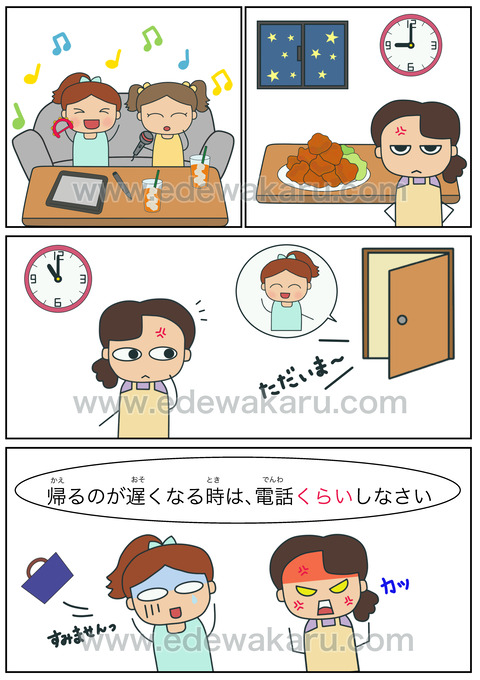
Meaning
At least ~
How to use it
Noun [dictionary form] + くらい
Explanation
“Aくらい” expresses [limitation], meaning “at least A ~.” “A” is an extreme example, and the pattern is used to mean “at least do A” or “you’d better at least do A.”
[Examples]
①If you’re going to be late getting home, at least call.
→At the very least, call.
②At least learn to use honorific language properly.
→At the very least, learn to use honorific language.
③Wife: It’s already 10! Get up!
Husband: At least let me sleep in on Sunday…
→(Since I get up early every day on weekdays) At least let me sleep in on Sunday…
④If you can’t at least cook, you can’t live alone.
→If you can’t at least cook, you can’t live alone.
⑤If you want to study abroad, you should at least be able to speak English.
→As the bare minimum, you should be able to speak English.
“〜くらい” expressing [limitation] can sometimes be understood as “〜くらい” expressing [belittling], so let’s learn that as well 😀
[Related grammar]
In context 5 examples
帰るのが遅くなる時は、電話くらいしなさい
If you’re going to be late getting home, at least call.
敬語くらいきちんと使えるようにしなさい
At least learn to use honorific language properly.
妻:もう10時よ!早く起きて!!夫:日曜日くらい寝させてくれよ…
Wife: It’s already 10! Get up! Husband: At least let me sleep in on Sunday…
料理くらいできないと、一人暮らしできないわよ
If you can’t at least cook, you can’t live alone.
留学したいなら、英語くらいは話せるようにしといたほうがいいよ
If you want to study abroad, you should at least be able to speak English.
Read the original source text
Meaning
最低限〜は
How to use it
名詞[辞書形]+くらい
Explanation
「Aくらい」は「最低限Aは〜」という意味で[限定]を表します。「A」には極端な例が入り、「最低限Aは〜しなさい」「最低限Aは〜ほうがいい」という意味で使われます。
[例]
①帰るのが遅くなる時は、電話
くらい
しなさい
→最低限、電話はしなさい
②敬語
くらい
きちんと使えるようにしなさい
→最低限、敬語は使えるようにしなさい
③妻:もう10時よ!早く起きて!!
夫:日曜日
くらい
寝させてくれよ…
→(平日は毎日早く起きているのだから)最低限、日曜日は寝させてくれよ…
④料理
くらい
できないと、一人暮らしできないわよ
→最低限料理ができないと、一人暮らしができないわよ
⑤留学したいなら、英語
くらい
は話せるようにしといたほうがいいよ
→最低限のこととして、英語は話せたほうがいいよ
[限定]を表す「〜くらい」は、[軽視]を表す「〜くらい」の意味としてとれる場合もありますので、一緒に覚えておきましょう😀
【関連文法】
Usage 2
Read this source entry ↗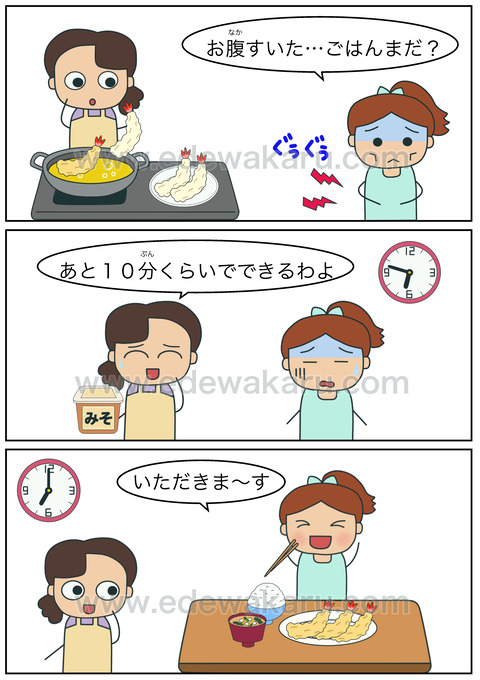
Meaning
Approximately 〜
How to use it
Quantity + くらい
Question word + くらい
Explanation
“〜くらい” means “approximately 〜.” It is used in the form “quantity + くらい” when you want to say that a quantity is close to 〜 or is roughly at a certain level. When asking about an approximate amount or degree, the form “question word + くらい” is used.
[Examples]
How long does it take to get to school?
How long does it take to get to school?
How many hours does it take to get to school?
“〜くらい” has several uses, so review them 😉
[Related articles]
[List of patterns that include “くらい”]
In context 6 examples
娘:お母さん、お腹すいた〜!ごはんまだ?母:あと10分くらいでできるよ
→あと、だいたい10分でできるよDaughter: Mom, I’m hungry! Is dinner ready yet? Mother: It’ll be ready in about 10 minutes. →It’ll be ready in approximately 10 minutes.
毎日1時間くらい運動をしている
→だいたい1時間運動をしているI exercise for about an hour every day. →I exercise for approximately an hour.
客:スマホが壊れてしまいました…店員:修理には1週間くらいかかります
→だいたい1週間かかりますCustomer: My smartphone broke… Clerk: Repairs will take about a week. →It’ll take approximately a week.
彼女には2歳くらいの息子がいるらしい
→だいたい2歳に見える息子がいるらしいApparently, she has a son who looks about two years old. →Apparently, she has a son who looks to be about two.
A:このバッグかわいい!でも高そう…B:う〜ん、2000円くらいだと思うよ
→だいたい2000円前後で買えると思うよA: This bag is cute! But it looks expensive… B: Hmm, I think it’s about 2,000 yen. →I think you can buy it for around 2,000 yen.
A:学校まで、どのくらいかかるの?B:バスで20分くらいだよ〜
→A:学校まで、だいたい何時間かかるの?B:だいたい、バスで20分だよA: How long does it take to get to school? B: About 20 minutes by bus. →A: About how many hours does it take to get to school? B: About 20 minutes by bus.
Read the original source text
Meaning
だいたい〜
How to use it
数量詞+くらい
疑問詞+くらい
Explanation
「〜くらい」は「だいたい〜」という意味です。「数量詞+くらい」の形で使われ、「数量が〜に近い」「だいたい〜の程度」と言いたい時に使用されます。だいたいの量や程度を聞く場合は「疑問詞+くらい」の形が使われます。
[例]
学校まで、
どのくらい
かかるの?
学校まで、
どれくらい
かかるの?
学校まで、
何時間くらい
かかるの?
「〜くらい」には、いくつかの用法がありますので復習しておきましょう😉
【関連記事】
【「くらい」がつく文型リスト】
Usage 3
Read this source entry ↗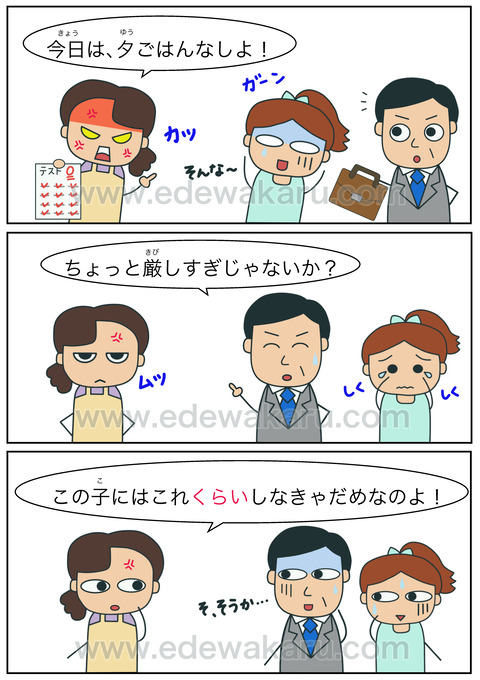
Meaning
Give an example to describe the degree of a state
How to use it
Verb [dictionary or ない-form] + くらい
Noun [dictionary form] + くらい
Explanation
“〜くらい” is a sentence pattern that describes the degree of a state by giving a concrete example. It is used when you want to say “about the same degree as ~” or “very ~,” giving an example.
[Examples]
①Husband: Isn’t that a little too strict?
Wife: I have to be this strict with this child!
→I have to be strict to the degree of “no dinner”
②I want to be able to speak English about as well as she does~
→I want to be able to speak about as well as she does
③I passed N1, and I was so happy I could cry
→I was very happy
[Concrete example] To the point of tears
④I’m tired from walking today. I’m so tired I can’t walk one more step
→I’m very tired
[Concrete example] I can’t walk one more step
⑤It was cool enough this summer that we could get by without air conditioning
→It was cool to the degree that we could “get by without air conditioning”
⑥A: It’s delicious!
B: Yeah. It’s so delicious it makes your cheeks fall off
→It’s very delicious
[Concrete example] To the point that your cheeks fall off
“〜くらい” expressing degree is often used in conversation. “〜くらい” has several usages, so let’s review them 😀
[Related patterns]
In context 6 examples
夫:ちょっと厳しすぎじゃないか?妻:この子にはこれくらいしなきゃだめなのよ!
Husband: Isn’t that a little too strict? Wife: I have to be this strict with this child!
彼女くらい英語が話せるようになりたいな〜
I want to be able to speak English about as well as she does~
N1に合格して、涙が出るくらいうれしかった
I passed N1, and I was so happy I could cry.
今日は歩き疲れた。もう1歩も歩けないくらいだ
I’m tired from walking today. I’m so tired I can’t walk one more step.
今年の夏はエアコンなしですむくらい涼しかったね
It was cool enough this summer that we could get by without air conditioning.
A:おいしいね!B:うん。ほっぺたが落ちるくらいおいしいわ
A: It’s delicious! B: Yeah. It’s so delicious it makes your cheeks fall off.
Read the original source text
Meaning
状態の程度を例をあげて言う
How to use it
動詞[辞書形・ない形]+くらい
名詞[辞書形]+くらい
Explanation
「〜くらい」は具体的な例をあげて、状態の程度を言う文型です。例をあげて「だいたい〜と同じ程度」「とても〜だ」と言いたい時に使われます。
[例]
①夫:ちょっと厳しすぎじゃないか?
妻:この子にはこれ
くらい
しなきゃだめなのよ!
→「夕ごはんなし」にする程度厳しくしないといけない
②彼女
くらい
英語が話せるようになりたいな〜
→だいたい彼女と同じ程度話せるようになりたい
③N1に合格して、涙が出る
くらい
うれしかった
→とてもうれしかった
【具体的な例】涙が出る程度
④今日は歩き疲れた。もう1歩も歩けない
くらい
だ
→とても疲れた
【具体的な例】もう1歩も歩けない
⑤今年の夏はエアコンなしですむ
くらい
涼しかったね
→「エアコンなしですむ」程度、涼しかった
⑥A:おいしいね!
B:うん。ほっぺたが落ちる
くらい
おいしいわ
→とてもおいしい
【具体的な例】ほっぺたが落ちる程度
程度を表す「〜くらい」は、会話でもよく使われます。また「〜くらい」には、いくつか用法がありますので、復習しておきましょう😀
【関連文型】
Usage 4
Read this source entry ↗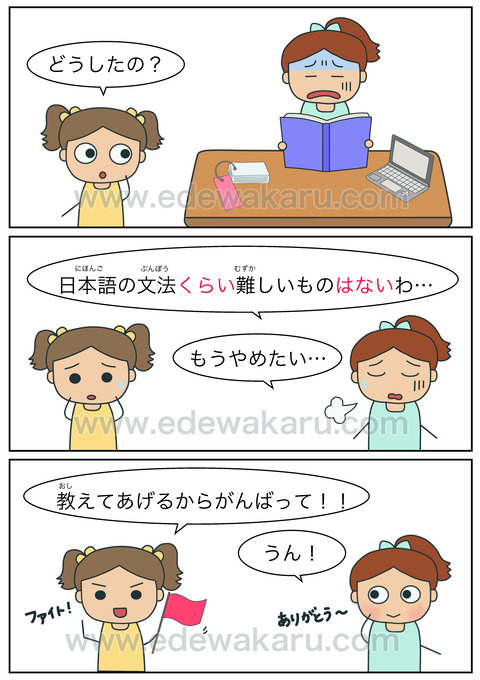
Meaning
~ is the best
How to use it
Noun [dictionary form] + くらい〜はない
Explanation
“Aくらい〜はない” is a sentence pattern meaning “A is the most ~.” It expresses the speaker’s opinion and is used to mean “I think A is the most ~.” In most cases, “〜ない” follows it, but words such as “少ない” or “めずらしい” may also follow. It can also be changed to “〜ほど〜はない,” so let’s learn that as well.
[Example]
There’s nothing as difficult as Japanese grammar…
= There’s nothing as difficult as Japanese grammar…
There are several sentence patterns that include “くらい,” so let’s review them.
In context 5 examples
A:日本語の文法くらい難しいものはないわ…B:教えてあげるからがんばって!
→日本語の文法が一番難しいわ…A: There’s nothing as difficult as Japanese grammar… B: I’ll teach you, so do your best! →Japanese grammar is the most difficult…
山田くんくらいケチな人はいない
→山田くんが一番ケチだThere’s no one as stingy as Yamada-kun. →Yamada-kun is the stingiest.
彼女くらい英語が上手な人は少ない
→彼女は英語がとても上手だThere are few people who speak English as well as she does. →She speaks English extremely well.
彼くらいかっこいい男の子はこの学校にはいないわ
→彼がこの学校で一番かっこいいThere isn’t a boy at this school as handsome as him. →He’s the most handsome at this school.
食べすぎや飲みすぎくらい体に悪いことはないよ
→食べすぎや飲みすぎが体に一番悪いNothing is worse for your health than overeating or drinking too much. →Overeating or drinking too much is the worst thing for your health.
Read the original source text
Meaning
〜が一番〜だ
How to use it
名詞[辞書形]+くらい〜はない
Explanation
「Aくらい〜はない」は「Aが一番〜だ」という意味を表す文型です。話者の考えを表す文型で、
「私はAが一番〜だと思う」
という意味で使われます。ほとんどの場合、後ろには「〜ない」がきますが、「少ない」「めずらしい」などがきたりもします。また「〜ほど〜はない」にチェンジできますので、一緒に覚えておきましょう。
[例]
日本語の文法
くらい
難しいもの
はない
わ…
=日本語の文法
ほど
難しいもの
はない
わ…
「くらい」がつく文型はいくつかありますので、復習をしておきましょう。
Usage 5
Read this source entry ↗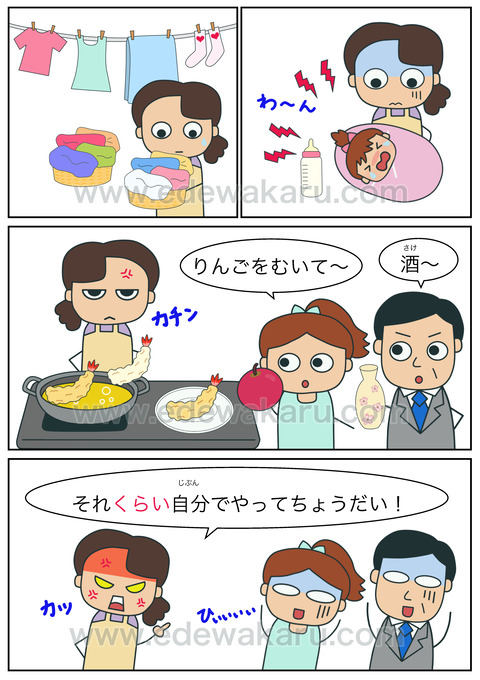
Meaning
Something as easy as ~
Something as unimportant as ~
Something as small as ~
How to use it
Verb, adjective, or noun [plain form] + くらい
Explanation
“〜くらい” is a sentence pattern expressing [belittling], and is used to mean “something as easy as ~” or “something as small as ~.” It is used when emphasizing the feeling that something is “easy,” “unimportant,” or “small.”
[For advanced learners]
“〜くらい” expressing [belittling] can also be used to convey [humility].
[Examples]
①We only have beer, but please help yourself if you like.
②Girlfriend: I could only make something like this, but please eat~
Boyfriend: Wow, it looks delicious! Thanks.
There are many sentence patterns that include “くらい,” so let’s review them 😀
In context 5 examples
娘:お母さん、りんごをむいて〜母:それくらい自分でやってちょうだい!
→そんな簡単なことは自分でやってちょうだい!Daughter: Mom, peel an apple for me. Mother: Do something that simple yourself!
A:「ありがとう」は英語で「Thank you」っていうんだよB:それくらい知ってるよ…
→そんな簡単なことは知ってるよ…A: “Thank you” is “Thank you” in English. B: I know something that simple…
1回くらい不合格だったからって、あきらめたらダメだよ!
→1回不合格することは小さなことだから、あきらめたらダメだよ!You can’t give up just because you failed once! →Failing once is a small thing, so you can’t give up!
ちょっと歩いたくらいで疲れるなんて、運動不足(うんどうぶそく)だと思うよ
→歩くことはたいしたことではないのに疲れるなんて、運動不足だよYou get tired from walking just a little? I think you’re out of shape. →Walking isn’t a big deal, but getting tired from it means you’re out of shape.
日本語ができないといっても、ひらがなくらいは読めるよ
→ひらがなのような簡単なものは読めるよEven though I say I can’t speak Japanese, I can at least read something easy like hiragana. →I can read something easy like hiragana.
Read the original source text
Meaning
〜のような簡単なこと
〜のような重要ではないこと
〜のような小さなこと
How to use it
動詞・形容詞・名詞[普通形]+くらい
Explanation
「〜くらい」は[軽視]を表す文型で、「〜のような簡単なこと」「〜のような小さなこと」という意味で使われます。
「簡単なこと」「重要ではないこと」「小さなこと」
という気持ちを強調する場合に使用されます。
【上級レベルの人へ】
[軽視]の「〜くらい」は、[謙遜]の気持ちを表す場合に使われることもあります。
[例]
①ビール
くらい
しかありませんが、よかったらどうぞ
②彼女:こんなもの
くらい
しか作れなかったけど、食べて〜
彼氏:わぁ〜おいしそう!ありがとう
「くらい」がつく文型はたくさんありますので、復習をしておきましょう😀
どんなときどう使う 日本語表現文型辞典
Usage 1
Meaning
at least
How to use it
N/V・Aの〔Plain form〕(ナAな)+くらい (about; to the extent that)
Explanation
くらい〈軽視〉
~のような軽いことや簡単なこと
1)「~くらい」の形で、「~」は大したことではないと、軽く考えているときに使う言葉。
2)基本的に、名詞につく場合は「ぐらい」、活用語につく場合は「くらい」を使うがあまり厳密ではない。
2)Generally,くらい becomes ぐらい when appended to nouns and くらい with words that conjugate, but is not ironclad rule.
1)Something is thought lightly of or unimportant.
In context 4 examples
1泊旅行だから、持ち物は下着ぐらいで大丈夫です。
It's just an overnight trip, so a change of underwear is about all you need to bring.
母:子どもじゃないんだから、自分の部屋ぐらい自分で掃除しなさい。
Mother: You're not a child, so at least clean your own room yourself.
自分一人ぐらいはルールを守らなくてもいいだろう、と思っている人が多い。
Many people think, “Surely it won't matter if just I don't follow the rules.”
1回会ったくらいで、その人のことがわかるはずはない。
There's no way you can understand someone just from meeting them once.
Read the original source text
Meaning
at least
How to use it
N/V・Aの〔普通形〕(ナAな)+くらい
Explanation
くらい〈軽視〉
~のような軽いことや簡単なこと
1)「~くらい」の形で、「~」は大したことではないと、軽く考えているときに使う言葉。
2)基本的に、名詞につく場合は「ぐらい」、活用語につく場合は「くらい」を使うがあまり厳密ではない。
2)Generally,くらい becomes ぐらい when appended to nouns and くらい with words that conjugate, but is not ironclad rule.
1)Something is thought lightly of or unimportant.
Usage 2
Meaning
almost
How to use it
〔Plain form〕(mainly the present form of イA and V)+くらい (to the extent that; so ... that)
Explanation
くらい〈程度〉
~の程度に
1)ある状態がどのくらいそうなのか、その程度を強調して言いたいときに使う。
2)話者の意志を表さない動詞や、動詞の「~たい」の形につくことが多い。
3)意味・用法は「ほど」とほとんど同じだが、「くらい」は程度が高い場合にも低い場合にも使われる。
2)Often appended to verb form ~たい, and verbs that do not express speaker’s volition.
3)Meaning and usage are similar to ほど, but くらい is used for both high and low degrees of something.
1)Extent of condition; emphasizes that extent.
In context 3 examples
山で事故にあった兄が無事に帰ってきた。大声で叫びたいくらいうれしい。
My brother, who had an accident in the mountains, came back safely. I'm so happy I could shout.
山道は子どもでも歩けるくらいの緩い坂です。
The mountain path is a gentle slope that even children can walk up.
このクイズはそんなに難しくない。ちょっと考えれば小学生でもできるくらいだ。
This quiz isn't that difficult. If you think a little, even an elementary school student could do it.
Read the original source text
Meaning
almost
How to use it
〔普通形〕(主にイAとVの現在形)+くらい
Explanation
くらい〈程度〉
~の程度に
1)ある状態がどのくらいそうなのか、その程度を強調して言いたいときに使う。
2)話者の意志を表さない動詞や、動詞の「~たい」の形につくことが多い。
3)意味・用法は「ほど」とほとんど同じだが、「くらい」は程度が高い場合にも低い場合にも使われる。
2)Often appended to verb form ~たい, and verbs that do not express speaker’s volition.
3)Meaning and usage are similar to ほど, but くらい is used for both high and low degrees of something.
1)Extent of condition; emphasizes that extent.
Usage 3
Meaning
there's nothing/no one more…
How to use it
Vる/N+くらい~はない (nothing is as ... as)
Explanation
くらい~はない
~は最高に~だ
1)主に名詞に続き「~くらい~はない」の形で、話す人が主観的に「~は最高に~だ」と感じ、強調して言うときに使う。
2)「くらい」の代わりに「ほど~はない」の言い方もある。
3)客観的な事実については使わない。
◆ × うちの課で東山さんくらい若い人はいない。
→○うちの課で東山さんが一番若い。
2)Pattern ほど~はない can be used in place of ぐらい.
1)Mainly appends to nouns. Used when speaker subjectively feels that what precedes is in superlative degree, and wishes to emphasize the fact.
3)Cannot be used for objective facts.
In context 4 examples
彼ぐらいわがままなやつはいない。
There is no one as selfish as him.
祖母の作る梅干しぐらいおいしいものはない。
Nothing is as delicious as the pickled plums my grandmother makes.
夕食後、好きな音楽を聞きながら、本を読むくらい楽しいことはない。
There is nothing as enjoyable as reading a book after dinner while listening to music I like.
若いころ、勉強しなかったことぐらい後悔することはない。
Nothing is more regretful than not having studied when I was young.
Read the original source text
Meaning
there's nothing/no one more…
How to use it
Vる/N+くらい~はない
Explanation
くらい~はない
~は最高に~だ
1)主に名詞に続き「~くらい~はない」の形で、話す人が主観的に「~は最高に~だ」と感じ、強調して言うときに使う。
2)「くらい」の代わりに「ほど~はない」の言い方もある。
3)客観的な事実については使わない。
◆ × うちの課で東山さんくらい若い人はいない。
→○うちの課で東山さんが一番若い。
2)Pattern ほど~はない can be used in place of ぐらい.
1)Mainly appends to nouns. Used when speaker subjectively feels that what precedes is in superlative degree, and wishes to emphasize the fact.
3)Cannot be used for objective facts.
日本語NET JLPT文法解説まとめ
Meaning
Something as simple as ~ / something that minor
Used with “~くらい” when the speaker takes “~” lightly, considering it not a big deal or a minor matter.
How to use it
V (plain form) + くらい / ぐらい
イA (plain form) + くらい / ぐらい
ナAな + くらい / ぐらい
N + くらい / ぐらい
Explanation
"something as simple as ~ / something that minor"
The phrase '~くらい' is used when the speaker considers '~' to be not a big deal or something minor.
In context 1 examples
今忙しいんだから、それくらい自分でやってよ。
I'm busy right now, so do something like that yourself.
Read the original source text
Meaning
~のような簡単なこと / そんな小さいこと
「~くらい」で「~」は大した問題では無い、小さいことだ、と軽く考えている時に使う言葉。
How to use it
V(普)+くらい / ぐらい
イA(普) + くらい / ぐらい
ナAな + くらい / ぐらい
N + くらい /ぐらい
Explanation
"something as simple as ~ / something that minor"
The phrase '~くらい' is used when the speaker considers '~' to be not a big deal or something minor.
毎日のんびり日本語教師
How to use it
Quantity + くらい/ぐらい
(Noun + くらい/ぐらい)
同じくらい/同じぐらい
Explanation
Expresses that an amount, size, duration, range, etc. is approximately close to that value, or almost the same.
It means the same as “about ~” or “approximately ~.”
In example (2), “息子ぐらい” is an abbreviated expression for “息子と同じ年齢ぐらい” (“about the same age as my son”).
It can be replaced with “ほど.” Using “ほど” makes the expression somewhat more formal.
Notes
There is no difference between “くらい” and “ぐらい.” They mean the same thing whichever one you use.
① In the use that expresses an approximate numerical value, you can say “同じくらい/同じぐらい,” but you cannot say “同じほど.”
The “くらい/ぐらい” series
In context 8 examples
食費は毎月3万円くらいかかる。(伙食费每月要3万日元左右。)
Food expenses are about 30,000 yen a month.
今の職場では、自分の息子ぐらいの人と一緒に働いている。
At my current workplace, I work with people about the same age as my son.
彼女は子どもが5人くらいいる。
She has about five children.
4時間くらい昼寝した。
I took a nap for about four hours.
二人の身長は同じぐらいだ。
The two of them are about the same height.
気温は15度くらいなので、過ごしやすいです。
The temperature is around 15 degrees, so it’s comfortable.
北国出身なので30度くらいの暑さでもダメだ。
I’m from the north, so even heat around 30 degrees is too much for me.
本屋さんで1時間くらい立ち読みした。②程度
I browsed books standing up for about an hour at the bookstore. ② Degree
Read the original source text
How to use it
数量+くらい/ぐらい
(名詞+くらい/ぐらい)
同じくらい/同じぐらい
Explanation
多さ、大きさ、時間、範囲等が大体その数値に近いこと、あるいはほとんど同じことを表します。
「約~」「大体~」と同じ意味です。
例文(2)の「息子ぐらい」は「息子と同じ年齢ぐらい」が省略された表現です。
「ほど」に言い換えられます。「ほど」を使うとやや硬い表現になります。
Notes
「くらい」と「ぐらい」に違いはありません。どちらを使っても意味は同じです。
①数値の近似を表す用法のとき、「同じくらい/同じぐらい」と言えますが、「同じほど」とは言えません。
「くらい/ぐらい」シリーズ
日本語文型辞典 英語版
Meaning
【くらい】ぐらい is often used as well. ほど is a very similar expression, butくらい is more for spoken language.
Attaches to a quantifier and expresses that something is around a certain amount or level (approximate figure). When a time or date is being referred to, ...くらいに is used.
(○)3時ぐらいに来てください。
Please come at around three o’clock.
(×)3時ぐらい来てください。
Please come three o’clock around.
Also, as the following example shows, when くらい is combined with question words such as どれ/どの (which), いくら (how much), 何メートル/キログラム/時間 (how many meters/kilograms/hours), it can be used to ask the approximate quantity, and when it is combined with これ, それ, or あれ (this/that), it can be used to show the actual quantity, size, etc.
(例)A:テープを切ってくれない?
Could you cut the tape?
B:どれくらい?
About how long?
A:《指を広げて大きさを示しながら》これくらい。
《showing the size by spreading two fingers》About this long.
B:あまり変わりませんよ。日本と同じくらいです。
Not so different. It’s about the same as in Japan.
B:そうだね。うちの息子ぐらいじゃないかな。
Let me see. About as old as my son is, I guess.
Used in the pattern XはY(とおなじ)くらい...だ, and means that X and Y are almost the same in terms of quantity, size, etc. ほど does not have this usage.
b. N(とおなじ)くらいのN
Used in the pattern XはYくらいのNだ and means that X and Y are almost the same in terms of some quantifiable characteristic.
The N position is filled by a noun that indicates quantity or degree, such as 大きさ (size), 重さ (weight), 高さ (height), 温度 (temperature), or 量 (amount).
c. ...くらい...Nはない
...くらい indicates that the thing it is being used to qualify has the highest degree of something. Means “such-and-such is the most....” Sometimes expressions such as すくない (few) or めずらしい (uncommon) are used instead of ない, as in
(2)
. ...くらい...Nはない can be replaced by ...ほど...Nはない.
d. Vくらいなら
Used in patterns such as XくらいならYのほうがましだ (I’d rather take Y if I had to take X), XくらいならYのほうがいい (Y is preferable to X), and XくらいならYする (If X, do Y instead). Means “Y is better than X,” with an extreme example given for Y. Used when the speaker feels very negatively about the thing indicated by ...くらい or when s/he thinks “X is not desirable and therefore Y is preferable.”
B:うん、あいつにはあれぐらい言ってやらないとわからないんだ。
Yeah, that guy never understands unless you talk to him like that.
Expresses the degree of an action or state, using a metaphor or a concrete example. Can usually be used in the same way as ほど, but くらい cannot be used when the degree of something is extreme.
(○)死ぬほど疲れた。
I am tired to death.
(×)死ぬぐらい疲れた。
I am tired around to death.
b. ...くらいだ
Used to explain the degree or extent of the thing stated previously, by giving a concrete example.
c. ...くらいだから
Indicates the degree of a certain action or condition; used when the speaker is stating the basis for a judgment or supposition. Often followed by expressions that indicate supposition or conjecture, such as のだろう, にちがいない, and はずだ.
d. ...くらいの...しか...ない
The pattern XくらいのYしか...ない gives X as an example of something with a small degree and shows that Y is not greater than X. Often followed by expressions that indicate impossibility, in which case the meaning is X以上のYは...できない (one cannot do Y to a greater extent than X).
Shows the feeling that something is viewed as unimportant or not making any difference.
Means “such a simple thing, such a trivial matter.” Often followed by expressions that mean “it doesn’t matter much” (大したことではない), “it’s easy” (容易である), or “there’s no problem” (問題はない).
B:いいじゃないか。日曜日ぐらい、ゆっくり寝かせてくれよ。
Well, so what? Let me sleep in at least on Sundays.
The form ...くらい is used to give an extreme example and indicate that something is the bare minimum that is expected.
b. ...のは...ぐらいのものだ
Used in the pattern XのはYくらいのものだ, this means that “X occurs only in the case of Y.”
How to use it
1. 数量詞+くらい〈approximation〉
2. Nくらい〈comparison〉a. N(とおなじ)くらい
3. ...くらい〈degree〉a. ...くらい
4. ...くらい〈minimization〉
5. ...くらい〈limit, restriction〉a. Nくらい
In context 57 examples
この道を5分くらい行くと、大きな川があります。
If you go along this road for about five minutes, there will be a big river.
修理には一週間ぐらいかかります。
The repairs will take about one week.
これ、いくらだろう。 3000 円ぐらいかな。
How much is this? About 3,000 yen, I suppose?
その島はこの国の3倍くらいの面積がある。
That island is about three times as large as this country.
店内のお客さまに、まいごのお子さまのご案内を申し上げます。青いシャツと黄色のズボンの、2才ぐらいのお子さまがまいごになっていらっしゃいます。
We would like to make a lost child announcement to the customers in this store. A child about two years old, wearing a blue shirt and yellow trousers, is lost.
A:物価は日本と比べてどうですか。
How is the cost of living as compared to Japan?
A:田中君って、いくつぐらいだろう。
How old do you think Tanaka-kun is?
こんどのアパートは前のと同じぐらい広くて、しかも日当たりがいい。
This next apartment is about as big as the last one, and what’s more, it gets lots of sunshine.
このボールは、ちょうどリンゴくらいの大きさだ。
This ball is just about as big as an apple.
ジルさんは、トムさんと同じぐらいの成績だ。
Jill’s grades are about the same as Tom’s.
これと同じぐらいの値段でもっといいのがありますよ。
We have another one that is better for a similar price.
タバコぐらいからだにわるいものはない。
Nothing is worse for the health than cigarettes.
山田さんくらい自分でこつこつと勉強する学生は少ない。
Few students study on their own as hard as Yamada-san does.
この車くらい若者から年輩の人にまで人気のある車は他にない。
No other car is as popular as this one among people of all ages.
国民に見はなされた政治家ぐらいみじめなものはない。
No one is as miserable as a politician who has been forsaken by the people.
いまの私にとって、まずしくて書物が自由に買えないことぐらいつらいことはない。
For me at this time, nothing is harder than having no money and not being able to buy any book I want.
あいつに助けてもらうくらいなら、死んだほうがましだ。
I would rather die than get help from him.
あんな大学に行くくらいなら、就職するほうがよほどいい。
I would much rather get a job than go to a university like that.
上から紙を貼って訂正するくらいなら、もう一度はじめから書き直したほうがいいと思うよ。
I think it would be better to rewrite it from the beginning, rather than paste a paper over it and make corrections.
銀行で借りるくらいなら、私が貸してあげるのに。
If you have to borrow from the bank, of course I’ll lend it to you.
君に迷惑をかけるくらいなら、僕が自分で行くよ。
If it’s going to be a bother for you, I’ll go myself.
その話を聞いて、息が止まりそうになるぐらい驚いた。
Listening to that story, I was so astonished that I lost my breath.
顔も見たくないくらい嫌いだ。
I hate him so much that I don’t even want to see his face.
佐藤さんぐらい英語ができるといいのにな。
I wish I were as good at English as Sato-san.
一歩も歩けないくらい疲れていた。
I was so tired that I could not walk another step.
コートがほしい(と思う)くらい寒い日だった。
It was such a cold day that I (felt like) I wanted a coat.
A:ずいぶん大きな声で怒っていたね。
You shouted at him in quite a loud voice, didn’t you?
君が困ることはないだろう。困るのは僕のほうだ。もう、泣きたいぐらいだよ。
You do not have a problem. It is me who has a problem. I could just about cry.
疲れて一歩も歩けないくらいだった。
I was so tired that I could not walk another step.
寒い日で、コートがほしいくらいだった。
It was such a cold day that I wished I had a coat.
今のぼくのうれしさがわかるかい。そこらへんの人をみんな抱きしめたいくらいだよ。
Can you see how happy I am? So much so that I could hug everyone around me.
おぼえてる? あの寒い夜ふたりでわけあって食べたラーメン。おいしくて、あたたかくて、世の中にこんなごちそうはないと思うくらいだったね。
Do you remember? The raamen the two of us shared on that cold night. It was delicious, and hot, and we thought that nothing in the world tasted better.
あの人は、会社をみっつも持ってるぐらいだから、金持ちなんだろう。
I would guess that person is rich, because she owns no fewer than three companies.
彼はいつも本さえあればほかにはなにもいらないと言っているぐらいだから、きっと家の中は本だらけなんだろう。
Since he’s always saying he wants nothing except books, I would guess that his house is full of them.
あの温厚な山田さんが怒ったくらいだから、よほどのことだったのでしょう。
I guess it must really have been something, to make even the mild-tempered Yamada-san get angry.
素人の作品でも、こんなにおもしろいくらいだから、プロが作ればもっとおもしろいものができるだろう。
If the work of an amateur is this interesting, then a professional should be able to make something even better.
燃料が少なくなっているので、あと 10 キロくらい(の距離)しか走れない。
Since we’re running out of gas, we can only drive (a distance of) about ten more kilometers.
10 年間も英語を習っているのに、挨拶くらいの会話しかできない。
Although I’ve been studying English for no less than ten years, I can only converse at the level of greetings.
体が丈夫で、風邪で数日寝込んだことくらいしかない。
Since I have a strong constitution, I’ve never been sick in bed except for a few days with a cold.
今忙しいので、ちょっとお茶を飲むくらいの時間しかありませんが、いいですか?
I’m busy right now, so I only have time for a quick cup of tea—is that all right?
学費を払うために無理をしている息子をなんとか助けてやりたいのだが、失業中の私たちには、励ましの言葉をかけてやるくらいのことしかできない。
I wish I could find some way to help my son, who is really struggling to pay his school expenses, but since we’re unemployed now, all we can do is give him words of encouragement.
そんなことくらい子供でもわかる。
Even a child can understand something like that.
山田さんは1キロメートルぐらいなら片手でも泳げるそうです。
They say that if it’s just a kilometer or so, Yamada-san can swim it using only one arm.
ちょっと足がだるいぐらい、ふろにはいればすぐになおるよ。
You can quickly cure a little tiredness in your legs by taking a bath.
すこし歩いたぐらいで疲れた疲れたって言うなよ。
Stop saying you’re tired just because you walked a little.
1回や2回試験に落ちたくらいがなんだ。このおれなんて、これまで払った受験料だけで大学がひとつ買えるぐらいだぞ。
Failing exams once or twice is nothing. In my case, I could just about buy a university with all the entrance examination fees I’ve paid so far.
ビールぐらいしか用意できませんが、会議の後で一杯やりましょう。
We can only offer you beer, but let’s have a drink after the meeting is over.
あいさつくらいの簡単な日本語しか話せない。
I can only speak very basic Japanese, like greetings.
指定された曜日にゴミを出さない人がいる。自分一人ぐらいかまわないだろうと軽く考えているのだろう。
There are people who do not put their garbage out on the specified days of the week. I guess they pass it off by thinking that just one person won't make a big difference.
子供じゃないんだから、自分のことぐらい自分で決めなさい。
You're not a child, so you need to make your own decisions.
A:もう、11 時ですよ。
It’s already eleven o’clock, you know.
帰りがおそくなるのなら、電話の一本ぐらいかけてくれてもいいじゃないか。
If you’re going to get home late, would it really be too much to ask you to give me a call?
あいさつぐらいしたらどうだ。
Can't you at least say hello?
息子が電話をよこすのは、金に困った時ぐらいのものだ。
My son gives me a call only when he needs money.
仕事が忙しくて、ゆっくりできるのは週末ぐらいのものだ。
Since I’m so busy with work, I can only relax on the weekends.
そんな高価な宝石が買えるのは、ごく一部の金持ちくらいのものだ。
Only a very few wealthy people can buy such an expensive jewel.
社長に、あんなにずけずけものを言うのは君くらいのもんだよ。
You are about the only one who can speak so frankly to our president.
AIUEO JLPT Grammar
Meaning
This sentence pattern is used to express a small degree or time, often in situations where something can be lightly considered or is minimal.
How to use it
Verb + くらい or ぐらい; adjective dictionary form + くらい or ぐらい; な-adjective + な + くらい or ぐらい; noun + くらい or ぐらい
In context 5 examples
泣きたいくらい悲しい。
I’m so sad that I feel like crying.
それくらい簡単な問題なら、すぐに解けます。
If it’s a problem as easy as that, I can solve it right away.
これぐらいの荷物なら、一人で運べます。
I can carry this much luggage by myself.
お茶ぐらい出してよ。
At least offer some tea.
今日の天気は桜が咲くくらい暖かい。
The weather today is warm enough for the cherry blossoms to bloom.
Read the original source text
Meaning
This sentence pattern is used to express a small degree or time, often in situations where something can be lightly considered or is minimal.
How to use it
動詞+くらいorぐらい形容詞辞書形+くらいorぐらい形容動詞な+くらいorぐらい名詞+くらいorぐらい
Explanation · 日本語
この文型は、程度や範囲を表します。多くの場合、相手に対して軽く考えてもよいことや、少しの程度や時間を表現するときに使われます。
文法
Meaning
Something as simple as ~ / such a small thing. 「~くらい」 is used when lightly regarding 「~」 as not a serious problem, but a small thing.
How to use it
V (plain form) + くらい / ぐらい
い-adjective (plain form) + くらい / ぐらい
な-adjective + な + くらい / ぐらい
N + くらい / ぐらい
In context 5 examples
今忙しいんだから、それくらい自分でやってよ。
I'm busy right now, so do something like that yourself.
もう大人なんだし、これから一人暮らしするんだから、料理ぐらい作れないと大変だよ。
You’re an adult now, and you’re going to live on your own, so it’ll be a problem if you can’t even cook.
外国に住むなら、英語ぐらい話せないと苦労するよ。
If you’re going to live abroad, you’ll have a hard time if you can’t at least speak English.
ちょっと階段を上がったくらいで疲れるなんて、もっと運動したほうがいいよ。
If you get tired just from going up a few stairs, you should exercise more.
ちょっと!遅れるなら連絡ぐらいしてよ。
Hey! If you’re going to be late, at least let me know.
Read the original source text
Meaning
~のような簡単なこと / そんな小さいこと「~くらい」で「~」は大した問題では無い、小さいことだ、と軽く考えている時に使う言葉。
How to use it
V(普)+くらい / ぐらい
イA(普) + くらい / ぐらい
ナAな + くらい / ぐらい
N + くらい /ぐらい
Yokubi — The Common Grammar Guide (https://yoku.bi)
Explanation
ころ is a noun that roughly means "approximate time". You run into Xのころに a lot. This can either be a conjunction "around the time of X", or a noun like "the general time when X" with the に particle attached. In some situations ころ can attach directly to nouns as the suffix ごろ.
くらい takes a measure or amount (including time) and makes it approximate. It is completely interchangeable with ぐらい and it is entirely up to speaker's preference.
It can also be used to mean "to the point where" or "to the level where" and not an inch beyond that.
When paired with the は particle it gives a nuance of "at least".
まで essentially means "up to" or "until". The limit or boundary marked by まで is included in the set.
まで is often paired with から as 〜から〜まで (from 〜 until 〜).
までに changes the meaning of まで to mean "by" (as in "do something by next Friday")
ほど essentially means "as" in terms of a comparison. Deep down the core meaning of ほど is "to the extent of".
In positive statements where ほど attaches to an "amount", it's an approximation.
すぎる is a verb and means "to exceed" or "to surpass". As an auxiliary verb, it means "too much" or indicates an excess of activity. It attaches to the ます stem.
In context 2 examples
毎日食べたいくらい美味しかったです
It was delicious to the point where I'd want to eat it every day.
名前くらいは聞いたことがあるだろう。
You must have at least heard of its name.
IMABI
The Particles ほど & くらい
Read this IMABI lesson ↗Explanation
The Particles ほど & くらい
Although very similar, ほど and くらい―also ぐらい―are not always the same.
The Adverbial Particle ほど
The first thing that you should know about the particle ほど is how it is attached to various parts of speech and what sort of particle combinations are allowed.
Class Pattern Example
名詞 N+ほど 日本ほど
形容詞 連体形+ほど できないほど
形容動詞 連体形+ほど 楽なほど
動詞 連体形+ほど 考えるほど
As far as particles are concerned, the typical order is noun + case particle + ほど. However, が・を are deleted. If they are to be used, they are used right after ほど. However, the particles such as に, で, and から are always after it.
Approximation
After a quantity, ほど shows an approximation. This usage is interchangeable with くらい・ぐらい.
1. 9年間ほど
About nine years
2. 旅は10時間ほどかかるでしょう。
The trip will probably take about ten hours.
3. そのロープは長さが六メートルほどあります。
The rope is about six meters long.
4. することが山ほどあるよ。
I have a pile of work to do.
Literally: I have a mountain of stuff to do.
5. あと1ヶ月ほどで夏休みになる。
I’ll be on summer vacation in about a month.
6. この仕事はあと2週間ほどあれば出来上がりますか。
Will this job get done in around two weeks?
7. {細石・小石}ほどの大きさの石
A stone the size of a pebble
Reading & Meaning Note: 細石 = さざれいし. This is smaller than a 小石. However, in English you use the same word.
8a. あの橋はどれ{ほど・くらい}長いんですか。(More natural)
8b. あの橋の長さはどれくらいですか。
How long is that bridge over there?
9. お(お)よそ50人(ほど)の人
Around fifty people
Word Note: お(お)よそ = Approximately
Extreme Example
It may also show an extreme example. It takes a specific situation and evaluates its extent. So, it is often translated as “to the extent that”. It may be seen after nominal or verbal expressions. Of course, idiomatic translation may very well blur this literal definition.
10. 言葉にできないほど素晴らしい。
It’s too wonderful for words.
11. 彼は歩けないほど弱ってはいなかった。
He wasn’t weak enough to not walk.
12. 彼を見てるのが気の毒なほど悄気しょげてる。(Casual)
Just seeing him makes me feel bad.
13. 彼はそれを試みるほど勇敢ゆうかんな兵士ではありません。
He isn’t a brave enough soldier to attempt that.
14. 全国民は戦争に優勝して、涙なみだが出るほど嬉しかったです。
The entire nation was happy to the point of tears from winning the war.
15. 振り解ほどけないほど彼女を確しっかりと抱き締しめた。 (叙述的な表現)
I hugged her so tightly that she couldn’t break away.
漢字 Note: しっかり(と) is usually written in ひらがな. Using the 漢字 is more old-fashioned.
When ほど is used to make a negative comparison such as in the following sentences, it cannot be replaced with くらい・ぐらい.
16. クリスマスほど待ち遠どおしいものはない。
There’s nothing I look forward to more than Christmas.
17a. 鈴木さんは外見ほど年をとっていませんね。 (Potentially rude)
17b. 鈴木さんは見た目より若く見えますね。 (More natural)
Mr. Suzuki’s not as old as he looks.18. 高橋氏は外見ほどの年齢ねんれいじゃないよ。 (失礼な言い方)
Mr. Takahashi is not as old as he looks.
19. 日本に住むほど幸せなことはありません。
There is nothing more happy than living in Japan.
20. 足はこの程度なら医者に行くほどのこともない。
If your foot is only this bad, there’s no need to go to the doctor.
21. 怒おこるほどのことではありません。
It’s not something we need to get angry about.
22. 心配するほどの怪我けがではありません。
It’s not an injury to worry about.
23. 病状は手術が必要なほどではない。
The condition of her illness is not to the point of surgery.
24. あいつは俺ほどうまく運転しねー。(Vulgar)
He doesn’t drive as good as me.
25. 私の知識ちしきなど先生のそれとは比較ひかくにならないほどお粗末そまつなものでございます。 (Humble)
My knowledge is not even comparable to that of the teacher’s.
26. 散歩ほどいいものはないね。
There’s nothing like a walk, right?
27. 今日の微分積分学びぶんせきぶんがくの試験は思ったほど難しくなかった。
Today’s calculus exam was less difficult than I thought.
28. 結果は後程ご一報ください。(Formal)
Please inform us the results later.
敬語 Note: 後程(のちほど) = あとで.
AすればAするほど
This pattern means “the more…the more…”. Without the conditional, you’d just show that there is a link between the extent of the pattern and the phrase that follows. The overall sentence can either be positive or negative depending on whether you are showing an increase or decrease in the degree of something respectively. You cannot replace ほど with くらい・ぐらい for this usage!
Verbs 泳ぐ → 泳げ → 泳げ +ば = 泳げば + 泳ぐほど = 泳げば泳ぐほど
形容詞 新しい → 新しけれ + ば = 新しければ + 新しいほど = 新しければ新しいほど
形容動詞 簡単だ → 簡単な (+ば) = 簡単なら(ば) + 簡単なほど = 簡単なら(ば)簡単なほど
Politeness Note: Using であれば instead of なら is more formal/polite.
29. 多ければ多いほどよい。
The more, the better it is.
30. 複雑ふくざつなら複雑なほど壊れやすいです。
The more complicated something is, the easier it is to break.
31. 何でも、練習すればするほど上手になります。
With anything, the more you practice, the better you become.
32. 価格かかくが高ければ高いほど、需要じゅようは減少げんしょうする。
The higher the price, the smaller the demand is.
33. 骨董品こっとうひんは古ければ古いほど価値があがる。
The older antiques are the more value it has.
34. 早ければ早いほどいいです。
The sooner, the better it is.
35. 高く登れば登るほど寒くなってくる。
The higher you climb, the colder it gets.
36. パソコンは操作が簡単であれば簡単であるほどいいです。
The easier the operation of a PC is, the better it is.
37. 田舎いなかに住むほど幸せなことはないと思う。
I think that nothing is happier than living in the country.
38. 人が多ければ多いほど楽しい。
The more the merrier.
39. 深ければ深いほど暗くなる。
The deeper you get, the darker it gets.
The Adverbial Particle くらい・ぐらい
The way くらい・ぐらい are attached to things is the same as with ほど, but its combination with other particles is slightly different.
Class Pattern Example
名詞 N+くらい・ぐらい 一円{くらい・ぐらい}
形容詞 連体形+くらい・ぐらい 見えない{くらい・ぐらい}
形容動詞 連体形+くらい・ぐらい 不思議な{くらい・ぐらい}
動詞 連体形+くらい・ぐらい 捨てる{くらい・ぐらい}
The particles が and を if used with it are after it. The particles に, へ, で, と, から can all be seen before or after it.
Approximation
Introduces something and then shows the degree or quantity almost equivalent to that. When you are saying that something is the same degree, you must use くらい・ぐらい.
40. ニューメキシコ州も同じ{〇 くらい・〇 ぐらい・X ほど}暑いですよ。
New Mexico is just as hot.
41. 8時くらいです。
It’s about eight o’clock.
42. リーチは立原の方が極端なぐらい長い。
As for reach, Tachihara’s is longer to an extreme.
From 擬態 by 北方謙三.
43. 彼は36歳ぐらいだ。
He is around thirty six years old.
44. 30分ぐらいしてから、もう一度電話をかけてみました。
I tried calling again after about thirty minutes.
45. 私の捕った魚はこれくらいの大きさでした。
The fish I caught was about this big.
46. 昼くらいに雨が止んだ。
It stopped raining around noon.
47. それくらいのことでめげるな。
Don’t be discouraged at such a thing.
48. 眉まゆが隠れるくらいに切ってください。
Please cut it so that my eyebrows are covered.
49. そして仲田が、その女を自分の妹あつかいし、馬鹿にしているのを勿体もったいないことをする奴やつだ位に感じた。
Furthermore, he felt that Nakata was this guy treating that (perfect woman for him) as his own sister, making her out to be stupid, having her do things unfit for her class.
From 友情 by 武者小路実篤むしゃのこうじさねあつ.
Grammar Note: An entire clause is modifying 位, the 漢字 spelling of くらい, and if this were written in a more modern fashion, quotations would have probably been used to reinforce a short spoken pause that aids in the grammaticality of this sentence.
Orthography Note: This sentence comes from a book originally published in 1920, which is why くらい is written in 漢字. It would be somewhat old-fashioned to do likewise today.
Belittling
Introduces something of light degree and limits it to a certain level. This can be seen in the pattern XのはYくらいだ (Y is about the only X). Thus, again, this usage creates a minimal phrase. This belittling usage is not interchangeable with ほど.
50. せめてタバコくらいやめてくださいよ。
The least you can do is stop smoking.
51. 簡単な料理ぐらい私だってできるよ。
Even I can cook a simple meal (to that extent)!
52. 子供でもそんなことくらい分かる。
Even a child would understand (to the extent of) something like that.
53. 「韓国料理は、何でも好きですか」 「いいえ、私が好きなのはキムチくらいです」
“Do you like any Korean food?”. “No, kimchi is about the only thing I like”.
54. 「このごろの子供は、本をあんまり読まんと聞いたが」「ええ、ほんとに。よく読むのマンガぐらいなんだよね」「そりゃ困ったな~」 (すごく砕けた言い方)
“I heard that kids these days don’t read books much”. “Yeah, that’s true. Manga is just about the only thing they often read”. “That’s no good”.
55. 「あの、君はスポーツは何でもできるんでしょ」「いや、実は、僕ができるのは{サッカー・卓球・野球・バドミントン・テニス}くらいだよ」
“Uh, you can play any sport, right?”. “No, actually, [soccer; table tennis; baseball; badminton; tennis] is about the only thing I can”.
56. 空一面真っ赤かになるくらいの見事みごとな夕焼けでした。
The splendid sunset was to the extent that the whole sky turned completely red.
57. 恥はずかしくて穴があったら入りたいくらいだった。
I was so embarrassed to the extent that if a hole opened up I would want to enter it.
2. Shows an extreme matter. ~くらいなら~ほうがましだ = “rather…than…”. However, it should be understood that both actions are unfavorable. It’s just you say that you’d rather do the latter.
58. 降参するぐらいなら死んだ方がましだ。
I’d rather die than surrender.
59. 君を捨てるぐらいなら死んだ方がましだ。
I would rather die than abandon you.
60. 期日きじつに遅れるくらいなら、徹夜てつやをして完成かんせいさせた方がましだ。
I would rather have it completed overnight than be late to the deadline.
Phrase Note: ましになる is used to show that something is improving, but it’s not fully good. As such, it’s not really appropriate to a lot of people to use such a phrase to refer to someone feeling better. However, there are areas like the Kansai Region where it is rather common.
61. 痛みがましになる。
The pain improved.
62. 通りから広場に出たところで、少し混雑がましになった。
As I entered into the plaza from the street, the traffic got a little better.
From 野生の風 by 村山由佳.
3. ~くらい~はない shows something being the most….
63. 彼くらい努力する人はいません。
There is no person putting effort into it than him.
64. 地震{ほど・くらい}怖いものはない。
There’s nothing as scary as an earthquake.
4. ~くらいで gives that the feeling that something is at a small amount or significance. It is often used in suggesting or belittling something.
65. テストが悪かったぐらいで、泣かないで。(Casual)
Don’t cry over a doing bad on a test.
66. スペイン語習ったことはあるけど、ちょっとしゃべれるようになったぐらいでやめてちゃったんで、本を読めるようにはならんかった。 (すごく砕けた言い方)
I’ve studied Spanish, but I quit when I became able to speak it, so I didn’t end up becoming able to read a book.
67. このレッスンはやさしいから、ちょっと練習するくらいで、終わりましょう。
Since this lesson is easy, let’s end with a little practice.
In context 71 examples
9年間ほど
About nine years
旅は10時間ほどかかるでしょう。
The trip will probably take about ten hours.
そのロープは長さが六メートルほどあります。
The rope is about six meters long.
することが山ほどあるよ。
I have a pile of work to do.
あと1ヶ月ほどで夏休みになる。
I’ll be on summer vacation in about a month.
この仕事はあと2週間ほどあれば出来上がりますか。
Will this job get done in around two weeks?
{細石・小石}ほどの大きさの石
A stone the size of a pebble
あの橋はどれ{ほど・くらい}長いんですか。(More natural)
How long is that bridge over there?
あの橋の長さはどれくらいですか。
How long is that bridge over there?
お(お)よそ50人(ほど)の人
Around fifty people
言葉にできないほど素晴らしい。
It’s too wonderful for words.
彼は歩けないほど弱ってはいなかった。
He wasn’t weak enough to not walk.
彼を見てるのが気の毒なほど悄気しょげてる。(Casual)
Just seeing him makes me feel bad.
彼はそれを試みるほど勇敢ゆうかんな兵士ではありません。
He isn’t a brave enough soldier to attempt that.
全国民は戦争に優勝して、涙なみだが出るほど嬉しかったです。
The entire nation was happy to the point of tears from winning the war.
振り解ほどけないほど彼女を確しっかりと抱き締しめた。 (叙述的な表現)
I hugged her so tightly that she couldn’t break away.
クリスマスほど待ち遠どおしいものはない。
There’s nothing I look forward to more than Christmas.
鈴木さんは外見ほど年をとっていませんね。 (Potentially rude)
Mr. Suzuki, you haven’t aged as much as your appearance suggests, have you? (Potentially rude)
鈴木さんは見た目より若く見えますね。 (More natural)
Mr. Suzuki, you look younger than you look. (More natural)
日本に住むほど幸せなことはありません。
There is nothing more happy than living in Japan.
足はこの程度なら医者に行くほどのこともない。
If your foot is only this bad, there’s no need to go to the doctor.
怒おこるほどのことではありません。
It’s not something we need to get angry about.
心配するほどの怪我けがではありません。
It’s not an injury to worry about.
病状は手術が必要なほどではない。
The condition of her illness is not to the point of surgery.
あいつは俺ほどうまく運転しねー。(Vulgar)
He doesn’t drive as good as me.
私の知識ちしきなど先生のそれとは比較ひかくにならないほどお粗末そまつなものでございます。 (Humble)
My knowledge is not even comparable to that of the teacher’s.
散歩ほどいいものはないね。
There’s nothing like a walk, right?
今日の微分積分学びぶんせきぶんがくの試験は思ったほど難しくなかった。
Today’s calculus exam was less difficult than I thought.
結果は後程ご一報ください。(Formal)
Please inform us the results later.
多ければ多いほどよい。
The more, the better it is.
複雑ふくざつなら複雑なほど壊れやすいです。
The more complicated something is, the easier it is to break.
何でも、練習すればするほど上手になります。
With anything, the more you practice, the better you become.
価格かかくが高ければ高いほど、需要じゅようは減少げんしょうする。
The higher the price, the smaller the demand is.
骨董品こっとうひんは古ければ古いほど価値があがる。
The older antiques are the more value it has.
早ければ早いほどいいです。
The sooner, the better it is.
高く登れば登るほど寒くなってくる。
The higher you climb, the colder it gets.
パソコンは操作が簡単であれば簡単であるほどいいです。
The easier the operation of a PC is, the better it is.
田舎いなかに住むほど幸せなことはないと思う。
I think that nothing is happier than living in the country.
人が多ければ多いほど楽しい。
The more the merrier.
深ければ深いほど暗くなる。
The deeper you get, the darker it gets.
ニューメキシコ州も同じ{〇 くらい・〇 ぐらい・X ほど}暑いですよ。
New Mexico is just as hot.
8時くらいです。
It’s about eight o’clock.
リーチは立原の方が極端なぐらい長い。
As for reach, Tachihara’s is longer to an extreme.
彼は36歳ぐらいだ。
He is around thirty six years old.
30分ぐらいしてから、もう一度電話をかけてみました。
I tried calling again after about thirty minutes.
私の捕った魚はこれくらいの大きさでした。
The fish I caught was about this big.
昼くらいに雨が止んだ。
It stopped raining around noon.
それくらいのことでめげるな。
Don’t be discouraged at such a thing.
眉まゆが隠れるくらいに切ってください。
Please cut it so that my eyebrows are covered.
そして仲田が、その女を自分の妹あつかいし、馬鹿にしているのを勿体もったいないことをする奴やつだ位に感じた。
Furthermore, he felt that Nakata was this guy treating that (perfect woman for him) as his own sister, making her out to be stupid, having her do things unfit for her class.
せめてタバコくらいやめてくださいよ。
The least you can do is stop smoking.
簡単な料理ぐらい私だってできるよ。
Even I can cook a simple meal (to that extent)!
子供でもそんなことくらい分かる。
Even a child would understand (to the extent of) something like that.
「韓国料理は、何でも好きですか」 「いいえ、私が好きなのはキムチくらいです」
“Do you like any Korean food?”. “No, kimchi is about the only thing I like”.
「このごろの子供は、本をあんまり読まんと聞いたが」「ええ、ほんとに。よく読むのマンガぐらいなんだよね」「そりゃ困ったな~」 (すごく砕けた言い方)
“I heard that kids these days don’t read books much”. “Yeah, that’s true. Manga is just about the only thing they often read”. “That’s no good”.
「あの、君はスポーツは何でもできるんでしょ」「いや、実は、僕ができるのは{サッカー・卓球・野球・バドミントン・テニス}くらいだよ」
“Uh, you can play any sport, right?”. “No, actually, [soccer; table tennis; baseball; badminton; tennis] is about the only thing I can”.
空一面真っ赤かになるくらいの見事みごとな夕焼けでした。
The splendid sunset was to the extent that the whole sky turned completely red.
恥はずかしくて穴があったら入りたいくらいだった。
I was so embarrassed to the extent that if a hole opened up I would want to enter it.
Shows an extreme matter. ~くらいなら~ほうがましだ = “rather…than…”. However, it should be understood that both actions are unfavorable. It’s just you say that you’d rather do the latter.
I’d rather die than surrender.
降参するぐらいなら死んだ方がましだ。
I’d rather die than surrender.
君を捨てるぐらいなら死んだ方がましだ。
I would rather die than abandon you.
期日きじつに遅れるくらいなら、徹夜てつやをして完成かんせいさせた方がましだ。
I would rather have it completed overnight than be late to the deadline.
痛みがましになる。
The pain improved.
通りから広場に出たところで、少し混雑がましになった。
As I entered into the plaza from the street, the traffic got a little better.
~くらい~はない shows something being the most….
There is no person putting effort into it than him.
彼くらい努力する人はいません。
There is no person putting effort into it than him.
地震{ほど・くらい}怖いものはない。
There’s nothing as scary as an earthquake.
~くらいで gives that the feeling that something is at a small amount or significance. It is often used in suggesting or belittling something.
Don’t cry over a doing bad on a test.
テストが悪かったぐらいで、泣かないで。(Casual)
Don’t cry over a doing bad on a test.
スペイン語習ったことはあるけど、ちょっとしゃべれるようになったぐらいでやめてちゃったんで、本を読めるようにはならんかった。 (すごく砕けた言い方)
I’ve studied Spanish, but I quit when I became able to speak it, so I didn’t end up becoming able to read a book.
このレッスンはやさしいから、ちょっと練習するくらいで、終わりましょう。
Since this lesson is easy, let’s end with a little practice.
Read the original source text
Explanation
The Particles ほど & くらい
Although very similar, ほど and くらい―also ぐらい―are not always the same.
The Adverbial Particle ほど
The first thing that you should know about the particle ほど is how it is attached to various parts of speech and what sort of particle combinations are allowed.
Class Pattern Example
名詞 N+ほど 日本ほど
形容詞 連体形+ほど できないほど
形容動詞 連体形+ほど 楽なほど
動詞 連体形+ほど 考えるほど
As far as particles are concerned, the typical order is noun + case particle + ほど. However, が・を are deleted. If they are to be used, they are used right after ほど. However, the particles such as に, で, and から are always after it.
Approximation
After a quantity, ほど shows an approximation. This usage is interchangeable with くらい・ぐらい.
1. 9年間ほど
About nine years
2. 旅は10時間ほどかかるでしょう。
The trip will probably take about ten hours.
3. そのロープは長さが六メートルほどあります。
The rope is about six meters long.
4. することが山ほどあるよ。
I have a pile of work to do.
Literally: I have a mountain of stuff to do.
5. あと1ヶ月ほどで夏休みになる。
I’ll be on summer vacation in about a month.
6. この仕事はあと2週間ほどあれば出来上がりますか。
Will this job get done in around two weeks?
7. {細石・小石}ほどの大きさの石
A stone the size of a pebble
Reading & Meaning Note: 細石 = さざれいし. This is smaller than a 小石. However, in English you use the same word.
8a. あの橋はどれ{ほど・くらい}長いんですか。(More natural)
8b. あの橋の長さはどれくらいですか。
How long is that bridge over there?
9. お(お)よそ50人(ほど)の人
Around fifty people
Word Note: お(お)よそ = Approximately
Extreme Example
It may also show an extreme example. It takes a specific situation and evaluates its extent. So, it is often translated as “to the extent that”. It may be seen after nominal or verbal expressions. Of course, idiomatic translation may very well blur this literal definition.
10. 言葉にできないほど素晴らしい。
It’s too wonderful for words.
11. 彼は歩けないほど弱ってはいなかった。
He wasn’t weak enough to not walk.
12. 彼を見てるのが気の毒なほど悄気しょげてる。(Casual)
Just seeing him makes me feel bad.
13. 彼はそれを試みるほど勇敢ゆうかんな兵士ではありません。
He isn’t a brave enough soldier to attempt that.
14. 全国民は戦争に優勝して、涙なみだが出るほど嬉しかったです。
The entire nation was happy to the point of tears from winning the war.
15. 振り解ほどけないほど彼女を確しっかりと抱き締しめた。 (叙述的な表現)
I hugged her so tightly that she couldn’t break away.
漢字 Note: しっかり(と) is usually written in ひらがな. Using the 漢字 is more old-fashioned.
When ほど is used to make a negative comparison such as in the following sentences, it cannot be replaced with くらい・ぐらい.
16. クリスマスほど待ち遠どおしいものはない。
There’s nothing I look forward to more than Christmas.
17a. 鈴木さんは外見ほど年をとっていませんね。 (Potentially rude)
17b. 鈴木さんは見た目より若く見えますね。 (More natural)
Mr. Suzuki’s not as old as he looks.18. 高橋氏は外見ほどの年齢ねんれいじゃないよ。 (失礼な言い方)
Mr. Takahashi is not as old as he looks.
19. 日本に住むほど幸せなことはありません。
There is nothing more happy than living in Japan.
20. 足はこの程度なら医者に行くほどのこともない。
If your foot is only this bad, there’s no need to go to the doctor.
21. 怒おこるほどのことではありません。
It’s not something we need to get angry about.
22. 心配するほどの怪我けがではありません。
It’s not an injury to worry about.
23. 病状は手術が必要なほどではない。
The condition of her illness is not to the point of surgery.
24. あいつは俺ほどうまく運転しねー。(Vulgar)
He doesn’t drive as good as me.
25. 私の知識ちしきなど先生のそれとは比較ひかくにならないほどお粗末そまつなものでございます。 (Humble)
My knowledge is not even comparable to that of the teacher’s.
26. 散歩ほどいいものはないね。
There’s nothing like a walk, right?
27. 今日の微分積分学びぶんせきぶんがくの試験は思ったほど難しくなかった。
Today’s calculus exam was less difficult than I thought.
28. 結果は後程ご一報ください。(Formal)
Please inform us the results later.
敬語 Note: 後程(のちほど) = あとで.
AすればAするほど
This pattern means “the more…the more…”. Without the conditional, you’d just show that there is a link between the extent of the pattern and the phrase that follows. The overall sentence can either be positive or negative depending on whether you are showing an increase or decrease in the degree of something respectively. You cannot replace ほど with くらい・ぐらい for this usage!
Verbs 泳ぐ → 泳げ → 泳げ +ば = 泳げば + 泳ぐほど = 泳げば泳ぐほど
形容詞 新しい → 新しけれ + ば = 新しければ + 新しいほど = 新しければ新しいほど
形容動詞 簡単だ → 簡単な (+ば) = 簡単なら(ば) + 簡単なほど = 簡単なら(ば)簡単なほど
Politeness Note: Using であれば instead of なら is more formal/polite.
29. 多ければ多いほどよい。
The more, the better it is.
30. 複雑ふくざつなら複雑なほど壊れやすいです。
The more complicated something is, the easier it is to break.
31. 何でも、練習すればするほど上手になります。
With anything, the more you practice, the better you become.
32. 価格かかくが高ければ高いほど、需要じゅようは減少げんしょうする。
The higher the price, the smaller the demand is.
33. 骨董品こっとうひんは古ければ古いほど価値があがる。
The older antiques are the more value it has.
34. 早ければ早いほどいいです。
The sooner, the better it is.
35. 高く登れば登るほど寒くなってくる。
The higher you climb, the colder it gets.
36. パソコンは操作が簡単であれば簡単であるほどいいです。
The easier the operation of a PC is, the better it is.
37. 田舎いなかに住むほど幸せなことはないと思う。
I think that nothing is happier than living in the country.
38. 人が多ければ多いほど楽しい。
The more the merrier.
39. 深ければ深いほど暗くなる。
The deeper you get, the darker it gets.
The Adverbial Particle くらい・ぐらい
The way くらい・ぐらい are attached to things is the same as with ほど, but its combination with other particles is slightly different.
Class Pattern Example
名詞 N+くらい・ぐらい 一円{くらい・ぐらい}
形容詞 連体形+くらい・ぐらい 見えない{くらい・ぐらい}
形容動詞 連体形+くらい・ぐらい 不思議な{くらい・ぐらい}
動詞 連体形+くらい・ぐらい 捨てる{くらい・ぐらい}
The particles が and を if used with it are after it. The particles に, へ, で, と, から can all be seen before or after it.
Approximation
Introduces something and then shows the degree or quantity almost equivalent to that. When you are saying that something is the same degree, you must use くらい・ぐらい.
40. ニューメキシコ州も同じ{〇 くらい・〇 ぐらい・X ほど}暑いですよ。
New Mexico is just as hot.
41. 8時くらいです。
It’s about eight o’clock.
42. リーチは立原の方が極端なぐらい長い。
As for reach, Tachihara’s is longer to an extreme.
From 擬態 by 北方謙三.
43. 彼は36歳ぐらいだ。
He is around thirty six years old.
44. 30分ぐらいしてから、もう一度電話をかけてみました。
I tried calling again after about thirty minutes.
45. 私の捕った魚はこれくらいの大きさでした。
The fish I caught was about this big.
46. 昼くらいに雨が止んだ。
It stopped raining around noon.
47. それくらいのことでめげるな。
Don’t be discouraged at such a thing.
48. 眉まゆが隠れるくらいに切ってください。
Please cut it so that my eyebrows are covered.
49. そして仲田が、その女を自分の妹あつかいし、馬鹿にしているのを勿体もったいないことをする奴やつだ位に感じた。
Furthermore, he felt that Nakata was this guy treating that (perfect woman for him) as his own sister, making her out to be stupid, having her do things unfit for her class.
From 友情 by 武者小路実篤むしゃのこうじさねあつ.
Grammar Note: An entire clause is modifying 位, the 漢字 spelling of くらい, and if this were written in a more modern fashion, quotations would have probably been used to reinforce a short spoken pause that aids in the grammaticality of this sentence.
Orthography Note: This sentence comes from a book originally published in 1920, which is why くらい is written in 漢字. It would be somewhat old-fashioned to do likewise today.
Belittling
Introduces something of light degree and limits it to a certain level. This can be seen in the pattern XのはYくらいだ (Y is about the only X). Thus, again, this usage creates a minimal phrase. This belittling usage is not interchangeable with ほど.
50. せめてタバコくらいやめてくださいよ。
The least you can do is stop smoking.
51. 簡単な料理ぐらい私だってできるよ。
Even I can cook a simple meal (to that extent)!
52. 子供でもそんなことくらい分かる。
Even a child would understand (to the extent of) something like that.
53. 「韓国料理は、何でも好きですか」 「いいえ、私が好きなのはキムチくらいです」
“Do you like any Korean food?”. “No, kimchi is about the only thing I like”.
54. 「このごろの子供は、本をあんまり読まんと聞いたが」「ええ、ほんとに。よく読むのマンガぐらいなんだよね」「そりゃ困ったな~」 (すごく砕けた言い方)
“I heard that kids these days don’t read books much”. “Yeah, that’s true. Manga is just about the only thing they often read”. “That’s no good”.
55. 「あの、君はスポーツは何でもできるんでしょ」「いや、実は、僕ができるのは{サッカー・卓球・野球・バドミントン・テニス}くらいだよ」
“Uh, you can play any sport, right?”. “No, actually, [soccer; table tennis; baseball; badminton; tennis] is about the only thing I can”.
56. 空一面真っ赤かになるくらいの見事みごとな夕焼けでした。
The splendid sunset was to the extent that the whole sky turned completely red.
57. 恥はずかしくて穴があったら入りたいくらいだった。
I was so embarrassed to the extent that if a hole opened up I would want to enter it.
2. Shows an extreme matter. ~くらいなら~ほうがましだ = “rather…than…”. However, it should be understood that both actions are unfavorable. It’s just you say that you’d rather do the latter.
58. 降参するぐらいなら死んだ方がましだ。
I’d rather die than surrender.
59. 君を捨てるぐらいなら死んだ方がましだ。
I would rather die than abandon you.
60. 期日きじつに遅れるくらいなら、徹夜てつやをして完成かんせいさせた方がましだ。
I would rather have it completed overnight than be late to the deadline.
Phrase Note: ましになる is used to show that something is improving, but it’s not fully good. As such, it’s not really appropriate to a lot of people to use such a phrase to refer to someone feeling better. However, there are areas like the Kansai Region where it is rather common.
61. 痛みがましになる。
The pain improved.
62. 通りから広場に出たところで、少し混雑がましになった。
As I entered into the plaza from the street, the traffic got a little better.
From 野生の風 by 村山由佳.
3. ~くらい~はない shows something being the most….
63. 彼くらい努力する人はいません。
There is no person putting effort into it than him.
64. 地震{ほど・くらい}怖いものはない。
There’s nothing as scary as an earthquake.
4. ~くらいで gives that the feeling that something is at a small amount or significance. It is often used in suggesting or belittling something.
65. テストが悪かったぐらいで、泣かないで。(Casual)
Don’t cry over a doing bad on a test.
66. スペイン語習ったことはあるけど、ちょっとしゃべれるようになったぐらいでやめてちゃったんで、本を読めるようにはならんかった。 (すごく砕けた言い方)
I’ve studied Spanish, but I quit when I became able to speak it, so I didn’t end up becoming able to read a book.
67. このレッスンはやさしいから、ちょっと練習するくらいで、終わりましょう。
Since this lesson is easy, let’s end with a little practice.
Bunpro Grammar Reference
Usage 1
Meaning
To the extent that, So…that, About the only thing that...
How to use it
Verb + くらい(1)
[い]Adjective + くらい(1)
[な]Adjective + な + くらい(1)
Noun + くらい(1)
(1) ぐらい
Nuance
A fairly casual way to express that (A) happened to the surprising extent of (B).
Explanation
Often, the noun くらい is used as an adverbial particle. This use of くらい (or ぐらい) expresses the limit of something, in a similar way to ほど. This means that it can be translated as 'about (A)', 'so (A) that (B)', or '(A) to the extent of (B)'. Let's take a look at a few examples.
今日はもう一生走りたくないくらい走った。
Today, I ran so much that I don't want to run again in my whole life.
わたしも叫びたいくらい、怖かった。
I was so scared that I wanted to scream too.
5連休が必要なぐらい疲れています。
I am tired to the extent that it is necessary for me to have 5 days off.
俺もキヨミさんくらいピアノが弾けるようになりたい。
I want to be able to play the piano to about the level of Kiyomi-san.
Despite translating in the above ways, we can see that this use of くらい is similar to the standard kanji use 位, which literally means a 'rank', or 'grade' of something. What this means is that (A) will usually be considered to be at the 'grade' of something that was required in order to cause/allow (B).
In context 16 examples
- 寝ることしか出来ないくらい、疲れている。
I am so tired that I can't do anything but sleep.
- 俺もキヨミさんくらいピアノが弾けるようになりたい。
I want to be able to play the piano to about the level of Kiyomi-san.
- わたしも叫びたいくらい、怖かった。
I was so scared that I wanted to scream too.
- 5連休が必要なぐらい疲れています。
I am tired to the extent that it is necessary for me to have 5 days off.
- 今日はもう一生走りたくないくらい走った。
Today, I ran so much that I don't want to run again in my whole life.
- あの仕事は、泣きたいくらいつらかったよ。
That job was rough to the extent that I wanted to cry.
- プロ選手ぐらい上手になりたい。
I want to be skilled to the extent that pro athletes are.
- 残っているのはやきとりくらいですが。
Yakitori is just about the only thing left...
- みんなを泣かすくらいスパイシーなチリのサラダを作った。
I made a chili salad so spicy that it made everyone cry.
- このゲームはお年寄りでもやれるくらい簡単だ。
This game is easy to the extent that even elderly can play it.
- 先輩ぐらいオシャレになりたいです。
I want to become stylish to the extent that my senior is.
- ヘリウムの風船は、飛行できるくらいすごく軽い。
Helium balloons are so amazingly light, that they can fly.
- 今日は何もかもが不思議なくらいうまくいった。
Today, just about everything went well, to the extent that it was almost strange.
- 少し日本語を話せるぐらい勉強したことがある。
I have studied to the extent that I can speak a little Japanese.
- 有名人に興味のない彼氏でも彼について知ってるの。そのくらい有名なのよ。
Even my boyfriend, that is not interested in celebrities, knows about him. He is THAT famous.
- 兄は久し振りにアメリカから帰った。兄だとわからないくらい変わってしまった。
My brother returned home for the first time in a long time from America. He changed, to the extent that I didn't recognize that it was him.
Usage 2
Meaning
About, Approximately
How to use it
Number/counter + くらい or ぐらい
Nuance
A common way to express an approximation or extent.
Explanation
くらい or ぐらい (more common in spoken language) has several different uses in Japanese, but is often translated as 'about', or 'approximately'. It comes from the kanji 位, which literally means a 'rank', or 'grade' of something. This use of くらい comes after numbers, or counter words.
後3分くらいで着く。
I'll arrive in about 3 minutes.
4個ぐらい欲しいな。
I want about 4.
どのくらいで着きますか?
About how long will it take for you to arrive?
As can be seen in the last example, くらい may also be used after question words such as どの, when asking about the extent (grade) of something.
Due to the original meaning of くらい being 'rank', or 'extent', it may not be used when referring to broad periods of time. ころ will be used in these situations. However, くらい and ころ may be used interchangeably when referring to a specific time (due to a specific time being able to be thought of as an extent).
8時くらいでもいい?
Is about 8 okay?
8時ごろでもいい?
Is about 8 okay?
子供のくらいにディズニーランドに行った。
About when I was a kid, I went to Disneyland. (Incorrect example, with unnatural English to match!)
子供のころにディズニーに行った。
I went to Disney when I was a kid.
Caution
Please see the ころ grammar point if you would like to compare these two structures further.
In context 19 examples
- 何時ぐらいに来ますか。
Approximately when will you come?
- 4個ぐらい欲しいな。
I want about 4.
- 子供のくらいにディズニーランドに行った。
About when I was a kid, I went to Disneyland. (Incorrect example, with unnatural English to match!)
- 後3分くらいで着く。
I'll arrive in about 3 minutes.
- 8時くらいでもいい?
Is about 8 okay?
- 8時ごろでもいい?
Is about 8 okay?
- どのくらいで着きますか?
About how long will it take for you to arrive?
- 子供のころにディズニーに行った。
I went to Disney when I was a kid.
- あと30分ぐらいで行きます。
I will go/leave in approximately 30 minutes.
- 毎週コーヒーはどのくらい飲む?
Approximately how much coffee do you drink per week?
- 彼は10歳くらいだろう。
He's about 10 years old.
- 一週間に、五時間ぐらいスポーツをする。
I play sports for about five hours in one week.
- 100万円ぐらいかかります。
It costs about one million yen.
- それぐらいでいいです。
About that much is good.
- 一日ぐらいでもいいです。
It is okay, even if it is about one day.
- 14歳ぐらいから、私は仕事をした。
I worked from about the age of 14.
- 毎日、一時間くらい本を読みます。
I read a book for about one hour every day.
- 秋は10月ぐらいからでしょう?
Fall starts from about October, right?
- 一日に、お茶を三杯ぐらい飲みます。
I drink about three cups of tea in one day.
Read the original source text
Meaning
About, Approximately
How to use it
Number/counter + くらい or ぐらい
Nuance
A common way to express an approximation or extent.
Explanation
くらい or ぐらい (more common in spoken language) has several different uses in Japanese, but is often translated as 'about', or 'approximately'. It comes from the kanji 位, which literally means a 'rank', or 'grade' of something. This use of くらい comes after numbers, or counter words.
後3分くらいで着く。
I'll arrive in about 3 minutes.
4個ぐらい欲しいな。
I want about 4.
どのくらいで着きますか?
About how long will it take for you to arrive?
As can be seen in the last example, くらい may also be used after question words such as どの, when asking about the extent (grade) of something.
Due to the original meaning of くらい being 'rank', or 'extent', it may not be used when referring to broad periods of time. ころ will be used in these situations. However, くらい and ころ may be used interchangeably when referring to a specific time (due to a specific time being able to be thought of as an extent).
8時くらいでもいい?
Is about 8 okay?
8時ごろでもいい?
Is about 8 okay?
子供のくらいにディズニーランドに行った。
About when I was a kid, I went to Disneyland. (Incorrect example, with unnatural English to match!)
子供のころにディズニーに行った。
I went to Disney when I was a kid.
Caution
Please see the ころ grammar point if you would like to compare these two structures further.
Nuance · 日本語
およその数や大体の範囲を表すときによく使われる言い方。
NINJAL 日本語文型データベース
Usage 1
Meaning
Expresses the speaker’s subjective evaluation that “〜” is the highest in degree.
How to use it
N1くらいN2はない・N1くらいN2はいない
Notes
When talking about people, use the form “〜くらい〜はいない.”
If “〜” is a sentence, use “こと” to turn it into a noun before connecting it.
In context 6 examples
常日頃、親くらいありがたいものはないと実感しています。
I’m constantly reminded that there’s nothing as precious as one’s parents.
今年の冬くらい雪が積もった冬はそうそうなかったでしょう。
There probably haven’t been many winters with as much snow as this year’s.
祖母は「うちの孫くらいかわいい子はいないね」ってよく言ってた。
My grandmother often used to say, “There isn’t a child as cute as my grandchild.”
家族と一緒にいられることくらい幸せなことはありません。
Nothing is as wonderful as being able to spend time with family.
週に1日も休めないことくらいつらいことはない。
Nothing is as hard as not getting even one day off a week.
バスケットボール選手として、背が高いことくらい有利なことはないだろう。
As a basketball player, nothing is probably as advantageous as being tall.
Read the original source text
Meaning
〜が最も程度が高いという話し手の主観的な評価を表します。
How to use it
N1くらいN2はない・N1くらいN2はいない
Notes
人について言うときは「〜くらい〜はいない」の形になります。
「〜」が文の場合は、「こと」を使って名詞にして接続します。
Usage 2
Meaning
Expresses the speaker’s subjective evaluation that “〜” is the highest in degree.
How to use it
N1くらいN2はない・N1くらいN2はいない
Notes
When talking about people, use the form “〜ぐらい〜はいない.”
If “〜” is a sentence, use “こと” to turn it into a noun before connecting it.
In context 7 examples
睡眠不足ぐらいつらいことはない。
Nothing is as hard as being sleep-deprived.
「山口部長ぐらい世話好きな上司はいませんよね」
“There isn’t a boss as caring as Department Manager Yamaguchi.”
「うちの弟ぐらいわがままな子はいないよ。お母さんが甘やかすからだよ」
“There’s no child as selfish as my younger brother. It’s because Mom spoils him.”
学生時代、中野さんぐらいよく勉強する人はほかにいなかった。
When we were students, there was no one else who studied as hard as Nakano.
日本語の勉強で、漢字を覚えることぐらい大変なことはないと私は思います。
In studying Japanese, I think nothing is as difficult as learning kanji.
お金がないことぐらいわびしく感じることはありません。
Nothing feels as lonely as having no money.
自分の会社の経営状況が良くないことぐらい心配なことはないでしょう。
Nothing is probably as worrying as the fact that your company’s business is not doing well.
Read the original source text
Meaning
〜が最も程度が高いという話し手の主観的な評価を表します。
How to use it
N1くらいN2はない・N1くらいN2はいない
Notes
人について言うときは「〜ぐらい〜はいない」の形になります。
「〜」が文の場合は、「こと」を使って名詞にして接続します。