くらべてわかる日本語表現文型辞典
Usage 1
Meaning
Meaning 1: Gives A as an example and expresses that since A is B, things beyond A (greater or lesser than A) are naturally B as well.
Meaning 2: Expresses that A is added to an existing state, further increasing its degree.
Meaning 3: In the form 「A さえしない」, emphasizes that there is absolutely no A or that A is not done at all.
Meaning 4: It may seem that A is not the case, but in fact it is A.
How to use it
A さえ B (A でさえ B/A とさえ B/A にさえ B/A さえしない)
Connection 1:
[Verb / verb—volitional form] + と + さえ
[Noun—∅ / particle] さえ
Connection 2:
[Noun—∅] さえ
Connection 3:
[Verb—ます form] さえ
Connection 4:
[Verb—て form] さえ
[i-adjective—く] さえ
[na-adjective—で] さえ
[Noun—∅] でさえ
Explanation
【Contrast 1】
「A も B」
「A も B」 cannot be substituted when it means adding B to A.
○スーパーへ行くなら、パンも買ってきて。 — If you go to the supermarket, pick up some bread too.
×スーパーへ行くなら、パンさえ買ってきて。 — If you go to the supermarket, pick up even some bread.
But it can be substituted when 「A も B」 is simply giving an example. 「A さえ B」 emphasizes A.
○3カ月日本語を勉強したが、ひらがなさえ覚えられない。 — I've studied Japanese for three months, but I can't even remember hiragana.
○3カ月日本語を勉強したが、ひらがなも覚えられない。 — I've studied Japanese for three months, but I can't remember hiragana either.
「A すら B」(Meaning 1, p. 109)
「A だに B」(Meaning 1, p. 123)
【Contrast 2】
「A も B」
Substitution is possible, but 「A も B」 simply means that A is added, whereas 「A さえ B」 emphasizes A by expressing that A was added on top of a situation that would have been sufficient even without A.
○朝から寒くて、昼すぎからは雨も降ってきた。 — It had been cold since morning, and it started raining in the early afternoon too.
○朝から寒くて、昼すぎからは雨さえ降ってきた。 — It had been cold since morning, and it even started raining in the early afternoon.
Notes
【Note 1】
・The particle before 「さえ」 can be 「に・から・で・と・へ」, among others, depending on the verb that follows.
【Note 4】
・When A is a verb, use 「A さえいる」; when it is a noun or adjective, use 「A さえある」.
In context 16 examples
今年は春が遅い。4月に入って雪さえ降ってきた。
Spring is late this year. It even snowed in April.
最近の若者は、電車の中で老人に席を譲ろうとさえしない。
Young people these days don't even try to give up their seats to the elderly on trains.
「久しぶりに国に帰って、楽しかったですか?」
「出張だったので、忙しくて、両親とさえ会えなかったんですよ。」“Was it fun going back to your home country after such a long time?” “I was there on a business trip, so I was busy and couldn't even see my parents.”
小学生にさえできるんだから、中学生の君もできるはずだ。
If even an elementary school student can do it, you, a middle school student, should be able to do it too.
朝から大雨で、昼すぎからは風さえ強くなってきた。
It was pouring from the morning, and from early afternoon the wind even started getting stronger.
夏休みの宿題は文法に読解、その上作文さえある。
For summer vacation homework, there's grammar and reading comprehension, and on top of that, even an essay.
山頂付近は悪天候だ。さらに雪崩さえ起きる危険がある。
The weather near the summit is bad. There is also the danger that an avalanche could occur.
おじは私に服や靴やそれに帽子さえ買ってくれた。
My uncle bought me clothes and shoes, and even a hat.
天気予報では大雨といっていたのに、一滴も降りさえしない。
The forecast said there would be heavy rain, but not even a drop fell.
この子は強情で、どんなことがあっても涙を流しさえしない。
This child is stubborn and won't even shed a tear, no matter what happens.
この辺は夜になると、人っこ一人通りさえしない。
Around here, once night falls, not a single person even passes by.
こう毎日雨が降り続いていては、洗濯物が乾きさえしない。
With rain continuing day after day like this, the laundry won't even dry.
彼と彼女は面識がないどころか、毎日会ってさえいた。
Far from being strangers, he and she were even seeing each other every day.
結婚生活は彼にとって、苦痛でさえあった。
Married life was even a source of pain for him.
彼女の死に顔は美しくさえあった。
Her face in death was even beautiful.
昼間はにぎやかなオフィス街も休日になれば静かでさえある。
Even the usually bustling office district is quiet on holidays.
Read the original source text
Meaning
意味1:Aを例としてあげ、そのAがBであるから、A以上(以下)のものも当然Bだという表現。
意味2:今までの状態にさらにAが加わって、程度が進むことを表す。
意味3:「Aさえしない」の形で。まったくAないと、Aがないことを強調する。
意味4:Aではないと思われているが、実はAだ。
How to use it
AさえB(AでさえB/AとさえB/AにさえB/Aさえしない)
接続1:
[動詞/動詞-意向形]+と+さえ
[名詞-∅/助詞]さえ
接続2:
[名詞-∅]さえ
接続3:
[動詞-ます形]さえ
接続4:
[動詞-て形]さえ
[イ形-く]さえ
[ナ形-で]さえ
[名詞-∅]でさえ
Explanation
【対比1】
「AもB」
AにBをプラスするときの「AもB」は置き換えできない。
○スーパーへ行くなら、パンも買ってきて。
×スーパーへ行くなら、パンさえ買ってきて。
だが、単なる例示としての「AもB」とは置き換えられる。「AさえB」はAを強調している表現。
○3カ月日本語を勉強したが、ひらがなさえ覚えられない。
○3カ月日本語を勉強したが、ひらがなも覚えられない。
「AすらB」(意味1 P.109)
「AだにB」(意味1 P.123)
【対比2】
「AもB」
置き換え可能だが、「AもB」は単にAが加わるという意味で、「AさえB」はAがない状態でも十分なのにその上Aが加わって、とAを強調する。
○朝から寒くて、昼すぎからは雨も降ってきた。
○朝から寒くて、昼すぎからは雨さえ降ってきた。
Notes
【注意1】
・「さえ」の前の助詞は「に・から・で・と・へ」などで、後の動詞によって変わる。
【注意4】
・Aが動詞の時は「Aさえいる」、名詞や形容詞の時は「Aさえある」になる。
Usage 2
Meaning
Meaning 1: Expresses that the condition of A being B is enough for everything to be taken care of.
Meaning 2: The condition of A being B (or not being B) would have been enough for everything, but in reality A was B (or was not B).
Meaning 3: Whenever one does A (or enters a state of A), B happens.
How to use it
A さえ Bば (A さえ Bたら)
[Verb—ます form] さえ
[i-adjective—く] さえ
[na-adjective—に/で] さえ + [Verb—ば form]
[Noun—∅ / particle] さえ
Explanation
【Contrast 1】
「A が(を・に・・・)B さえすれば」
The meaning is the same, but the speaker's point of view differs.
○この規則さえ守れば、あとは自由です。(視点は「この規則」にある) — If you just follow this rule, the rest is up to you. (The focus is on “this rule.”)
○この規則を守りさえすれば、あとは自由です。(視点は「この規則を守る」ことにある) — If you just make sure to follow this rule, the rest is up to you. (The focus is on “following this rule.”)
When B is 「~ている」, 「~てしまう」, and so on, the following forms are also possible.
○論文さえ書いてしまえば / 勉強さえしていれば — Once you have finished writing the paper / As long as you keep studying
○論文を書きさえすれば / 勉強をしさえすれば — If you just write the paper / If you just study
○論文を書いてさえしまえば / 勉強をしてさえいれば — If you just finish writing the paper / If you just keep studying
○論文を書いてしまいさえすれば / 勉強をしていさえすれば — If you just get the paper written / If you just keep studying
Notes
【Note 2】
・The speaker says this with feelings such as regret, remorse, or anger.
In context 12 examples
パソコンさえ打てたら、年齢は問いません。
As long as you can use a computer, your age doesn't matter.
若い頃は、結婚する相手がハンサムでさえあればいいと思っていた。
When I was young, I thought it would be enough as long as the person I married was handsome.
私は何も望まない。楽しくさえ生きていければ満足だ。
I don't ask for anything. I'll be satisfied as long as I can live happily.
このマニュアルを読みさえすれば、だれでも簡単に使える。
Anyone can use it easily as long as they read this manual.
あの人は酒さえ飲まなければ、いい人なんですがね…。
He's a good person as long as he doesn't drink, you know…
彼があんなことを言いさえしなければ、私は恥をかかなかったわ。
If only he hadn't said something like that, I wouldn't have been embarrassed.
私がもう少しやさしくさえしていたら、離婚せずにすんだだろう。
If only I had been a little kinder, we probably could have avoided getting divorced.
あの人のように成績が優でさえあれば、就職も楽なのに。
If only my grades were excellent like that person's, finding a job would be easy.
夫は私がやさしくさえ言えば、何でもしてくれる。
My husband will do anything as long as I just ask him nicely.
彼は暇さえあったら、ゲームをしている。
Whenever he has free time, he plays games.
彼女は紙と鉛筆さえあれば、絵を描いている子供だった。
She was the kind of child who would draw whenever she had just paper and a pencil.
父は家にいさえすれば、将棋を打っている。
Whenever my father is at home, he plays shogi.
Read the original source text
Meaning
意味1:「AがB」「AがBない」という条件だけですべてが事足りることを表す。
意味2:AがB、AがBではないという条件だけで、すべてが事足りたのに、実際はAがBであった(Bではなかった)。
意味3:Aをすれば(Aという状態になれば)いつでもB。
How to use it
AさえBば(AさえBたら)
[動詞-ます形]さえ
[イ形-く]さえ
[ナ形-に/で]さえ+[動詞-ば形]
[名詞-∅/助詞]さえ
Explanation
【対比1】
「Aが(を・に・・・)Bさえすれば」
意味の違いはないが、話し手の視点が違う。
○この規則さえ守れば、あとは自由です。(視点は「この規則」にある)
○この規則を守りさえすれば、あとは自由です。(視点は「この規則を守る」ことにある)
Bが「~ている」「~てしまう」などの場合は、次のような形もある。
○論文さえ書いてしまえば / 勉強さえしていれば
○論文を書きさえすれば / 勉強をしさえすれば
○論文を書いてさえしまえば / 勉強をしてさえいれば
○論文を書いてしまいさえすれば / 勉強をしていさえすれば
Notes
【注意2】
・話し手は残念・後悔・怒りなどの気持ちを持って発話する。
DoJG 日本語文法辞典(全集)
Meaning
Even; if ~ only; if ~ just; as long as; the only thing ~ need is
How to use it
(i) Noun | さえ | |
| 鹿さえ出る | Even deer appear |
| 刺身さえ食べる | Eat even sashimi |
(ii) Noun(Particle) | さえ | |
| アフリカ(へ/に) さえ行った | Went even to Africa |
(iii) Noun Particle | さえ | |
| こんな街にさえある | Exist even in such a town |
| 私にさえ分かる | Understandable even to me |
| 学校でさえ教える | Teach even at school |
| 犬とさえ遊ぶ | Play even with a dog |
| 中国からさえ来る | Come even from China |
(iv) Noun (Particle) | でさえ | |
| 専門家でさえ分からない | Even professionals don’t understand (literally: one doesn’t understand something even if he is a professional) |
| 果物でさえ食べない | Don’t eat even fruit (literally: don’t eat something even if it is fruit) |
| 私からでさえもらわない | Don’t accept (something) even from me (literally: don’t receive something even if it is from me) |
(v) Vて | さえ (いる/もらう/etc.) | |
| 読んでさえいない | Have not even read |
| 見てさえ分からない | Don’t understand even by looking at |
(vi) Vます | さえする | |
| 書きさえする | Even write |
(vii) Adjective い stem | くさえある | |
| 安くさえある | Be even inexpensive |
(viii) {Adjective な stem/Noun} | でさえある | |
| 便利でさえある | Be even convenient |
| 学者でさえある | Be even a scholar |
Explanation
An emphatic particle which expresses the idea of "even" in non-conditional clauses (or sentences) or the idea of "only" in conditional clauses.
In context 16 examples
彼女は現代日本語は勿論古典さえ読める。
She can read even classical Japanese, not to mention modern Japanese.
この研究所にはアメリカからさえ研究者が来る。
Researchers even from America visit this lab.
その歌は子供でさえ知っている。
Even children know this song.
ここに置いておきさえすれば後はここの人が全部やってくれます。
If you just leave it here, the people in this place will take care of the rest.
この仕事さえ片付いたら後は楽なんです。
If we can only finish (literally: If we only finish) this work, the rest will be easy.
彼はもうおかゆさえ喉を通らなかった。
He was no longer able to eat even porridge.
私はその写真を大人には勿論子供にさえ見せた。
I showed the picture even to kids, not to mention adults.
彼は私の言うことを聞こうとさえしない。
He doesn't even try to listen to me.
山田にさえ出来たんだから君にも出来るよ。
Even Yamada could do it, so you can do it, too.
先生でさえこの問題を解くのに二時間もかかった。
Even my teacher took (as much as) two hours to solve this problem.
クレジットカードさえあればいつでも入会出来ます。
You can join our club any time if you only have a credit card.
君さえ承知してくれたら今すぐこのプロジェクトを始めるつもりだ。
As long as you agree (to our plan), we are planning to begin this project right away.
まじめに勉強してさえいれば試験は大丈夫だ。
As long as you study seriously, you'll do okay on the exam (literally: the exam will be all right).
手を上げさえすればすぐ警官が飛んでくる。
If you just raise your hand, a policeman will rush to you.
高くさえなければ売れるはずだ。
It should sell as long as it's not expensive.
通勤に便利でさえあればどんなところでもいいんです。
Any location will be fine as long as it is convenient for commuting.
日本語文型辞典
Meaning
Used to say that something normally considered a given is not so, implying that this is even more true of everything else. When attached to the subject, it often becomes でさえ. It can be rephrased as …も.
Expresses the feeling that if one thing is achieved, that alone is enough; other things are minor, unnecessary, or not a problem.
⇾ただでさえ
How to use it
さえ
N(+particle)さえ(も)
interrogative …かさえ(も)
…さえ …たら/…ば
Nさえ…たら/…ば
R-さえ したら/すれば
V-てさえ…たら/…ば
interrogative …かさえ …たら/…ば
ただでさえ
In context 10 examples
あのころは授業料どころか家賃さえはらえないほどまずしかった。
Back then, I was so poor that I couldn’t pay even the rent, let alone tuition.
この本はわたしにはむずかしすぎます。何について書いてあるのかさえわかりません。
This book is much too difficult for me. I don’t even understand what it’s about.
そんなことは小学生でさえ知ってるよ。
Even elementary school students know that.
本人にさえわからないものを、どうしてあの人にわかるはずがあるんだ。
If even the person themself doesn’t understand it, how could that person possibly understand it?
その小説はあまりにもおもしろくて、食事の時間さえもったいないと思ったほどだった。
That novel was so interesting that I thought even mealtimes were a waste.
A:ぼくたち、いつ結婚するんだ。B:なに言ってるの。するかどうかさえ、私はまだ決めてないのよ。
A: When are we getting married? B: What are you talking about? I haven’t even decided whether I’ll marry you.
あなたさえそばにいてくだされば、ほかにはなにもいりません。
As long as you’re by my side, I need nothing else.
あなたがそばにいてさえくだされば、ほかにはなにもいりません。
As long as you’re by my side, I need nothing else.
あなたがそばにいてくださりさえすれば、ほかにはなにもいりません。
As long as you’re by my side, I need nothing else.
今度の試験で何が出るのかさえわかったらなあ。
If only I knew what would be on the next exam.
Read the original source text
Meaning
普通なら当然だと思われていることがそうではないと述べ、その他のものはなおさらだという含みを伝えるのに用いる。主格に付くときは「でさえ」になることが多い。「…も」に言いかえられる。
あるものごとが実現すればそれで十分で、ほかはちいさなことだ、必要ではない、問題ではない、という気持ちを表す。
⇾ただでさえ
How to use it
さえ
N(+助詞)さえ(も)
疑問詞…かさえ(も)
…さえ …たら/…ば
Nさえ…たら/…ば
R-さえ したら/すれば
V一てさえ…たら/…ば
疑問詞…かさえ …たら/…ば
ただでさえ
絵でわかる日本語
Usage 1
Read this source entry ↗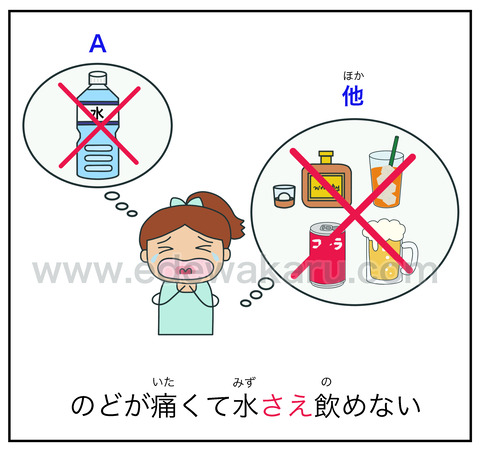
Meaning
Since even A is …, of course the others are … too
How to use it
Noun [dictionary form] + さえ
Explanation
「Aさえ〜」is a sentence pattern meaning “since even A is …, of course the others are … too.” 「さえ」is stronger than the emphatic 「も」😀 For example, example ①,
“Even water hurts my throat too much to drink” means “My throat hurts so much that I can’t even drink water, so of course I can’t drink other things (whisky, juice, cola, beer).”
When using it, put the most extreme example in A, and try to make a sentence meaning “since even A is …, of course / even more so, the others are …” 😊
「Aさえ〜」can be used for both good and bad things, and is also common in conversation 😉
In context 4 examples
のどが痛くて水さえ飲めない
→のどが痛くて水も飲めない(だから他のものはもちろん飲めない)My throat hurts so much that I can’t even drink water. →My throat hurts so much that I can’t drink water either (so of course I can’t drink anything else).
彼は長い間日本語を勉強しているのに「ひらがな」さえ読めない
→彼は長い間日本語を勉強しているのに「ひらがな」も読めない(カタカナはもちろん読めない)Even though he has studied Japanese for a long time, he can’t even read hiragana. →Even though he has studied Japanese for a long time, he can’t read hiragana either (and of course he can’t read katakana).
山田くんは5歳なのに高校レベルの漢字さえ書ける
→山田くんは5歳なのに高校レベルの漢字も書ける(小学校・中学校レベルはもちろん書ける)Even though Yamada is only five, he can even write high-school-level kanji. →Even though Yamada is only five, he can write high-school-level kanji too (and of course he can write elementary- and middle-school-level kanji).
私は料理が苦手で、みそ汁さえ作れない
→私は料理が苦手で、(簡単に作れる)みそ汁も作れない(他の料理はもちろん作れない)I’m bad at cooking and can’t even make miso soup. →I’m bad at cooking and can’t make miso soup either (though it’s easy to make; of course I can’t make other dishes).
Read the original source text
Meaning
Aも〜だから、他はもちろん〜
How to use it
名詞[辞書形]+さえ
Explanation
「Aさえ〜」は「Aも〜だから、他はもちろん〜だ」という文型です。強調の「も」よりも強いのがこの「さえ」です😀例えば、例文①は
「のどが痛くて水さえ飲めない」というのは、「
のどが痛くて水も飲めないんだから、他のもの(ウイスキー・ジュース・コーラ・ビール)が飲めないのは当然だ」
このような意味になります。
使用する場合は、「A」に1番極端な例を入れて、「Aも〜だから、他のものはもちろん/さらに〜」 というように文を作れるようにがんばってください
😊
「Aさえ〜」はいい事にも悪い事にも使え、会話でもよく使われますよ😉
Usage 2
Read this source entry ↗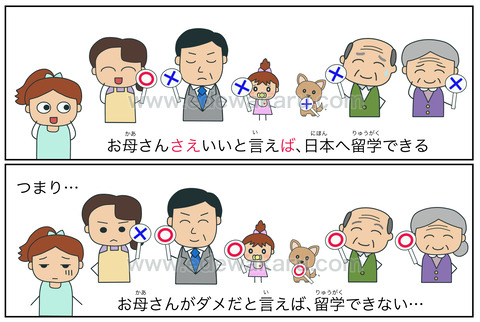
Meaning
(In the form “Aさえ〜ば”)
If A happens, that alone is enough
If A happens, nothing else is necessary
If A happens, there is no problem
If A is OK, everything is OK
How to use it
Verb [ます-form] + さえすれば
い-adjective [drop い] + くさえあれば
な-adjective [drop な] + でさえあれば
Noun [dictionary form] + さえ〜ば
Explanation
“Aさえ〜ば” is a sentence pattern meaning “If A is achieved, that is enough,” “If there is A, there is no problem,” or “If there is A, nothing else is needed.”
It means “If A is OK, everything is OK,” and emphasizes that “If A is no good, everything is no good.”
😮
[Example]
① If Mom says it’s OK, I can study abroad in Japan.
→ Even if Dad, Grandpa, Grandma, or my younger sister says it’s no good, it’s OK as long as Mom says yes.
→ Even if Dad, Grandpa, Grandma, or my younger sister says yes, it’s no good if Mom says no.
Also, the way this pattern connects to anything other than nouns is very complicated, so be sure to learn it well. 😨
[Verbs]
食べる→食べさえすれば
食べている→食べていさえすれば/食べてさえいれば
勉強する→勉強しさえすれば/勉強さえすれば
[い-adjectives]
おいしい→おいしくさえあれば
[な-adjectives]
きれいな→きれいでさえあれば
[For advanced learners]
“〜さえ〜ば” is one sentence pattern, so you cannot change “さえ” to “すら.” 😯
[Example]
⭕️ If Mom says it’s OK, I can study abroad in Japan.
❌ If even Mom says it’s OK, I can study abroad in Japan.
This is an N3 pattern, but its connections are very complicated, so do your best to learn them. 😊
In context 4 examples
お母さんさえいいと言えば、日本に留学できる
→お母さんがいいと言ったら、日本に留学することができるIf Mom says it’s OK, I can study abroad in Japan. → If Mom says it’s OK, I’ll be able to study in Japan.
ゲームさえできれば、それで十分だ
→ゲームができたら、他には何もできなくてもOKだIf I can play games, that’s enough. → If I can play games, it’s OK even if I can’t do anything else.
連絡さえすれば、休んでもいいですよ
→連絡をすれば、休んでも問題はないですよYou can take the day off as long as you let me know. → If you contact me, it’s no problem for you to take the day off.
お金さえあれば幸せだなんて、うそだ(復習:〜なんて)
→お金があれば幸せだなんて、うそだIt’s a lie that you’ll be happy as long as you have money. (Review: 〜なんて) → It’s a lie that you’ll be happy if you have money.
Read the original source text
Meaning
(「Aさえ〜ば」の形で)
Aが実現すればそれで十分だ
Aが実現すれば、他のことは必要ではない
Aが実現すれば、問題はない
AがOKなら、全部OK
How to use it
動詞[ます形]+さえすれば
い形容詞[ーい]+くさえあれば
な形容詞[ーな]+でさえあれば
名詞[辞書形]+さえ〜ば
Explanation
「Aさえ〜ば」は「Aが実現すれば、十分だ」「Aがあれば問題ない」「Aがあれば他は必要ではない」という意味を表す文型です。
「AがOKなら、全部OK」という意味を表す文型で、「Aがダメなら、全部ダメだ」という意味を強調します
😮
[例]
①お母さん
さえ
いいと言え
ば、日本に留学できる
→お父さん・おじいちゃん・おばあちゃん・妹がダメと言っても、お母さんがいいと言えばOK
→お父さん・おじいちゃん・おばあちゃん・妹がいいと言っても、お母さんがダメと言えばダメ
また、この文型は、
名詞以外の接続がとても複雑です
ので、しっかりと覚えておきましょう😨
[動詞]
食べる→食べ
さえすれば
食べている→食べ
ていさえすれば
/食べ
てさえいれば
勉強する→勉強し
さえすれば
/勉強
さえすれば
[い形容詞]
おいしい→おいし
くさえあれば
[な形容詞]
きれいな→きれい
でさえあれば
【上級レベルの人へ】
「〜さえ〜ば」は1つの文型ですので、「さえ」を「すら」にチェンジすることができません😯
[例]
⭕️お母さん
さえ
いいと言え
ば、日本へ留学できる
❌お母さん
すら
いいと言え
ば、日本へ留学できる
N3の文型ですが、接続がとても複雑ですのでがんばって覚えてくださいね😊
どんなときどう使う 日本語表現文型辞典
Usage 1
Meaning
whenever; if only
How to use it
Vます+さえすれば
Explanation
さえ~ば
~ば、それだけで
Nさえ+ Vば/イAければ/ナAなら/Nなら
イAく/ナA で+さえあれば
「~さえ~ば…」の形で、「…」が成立するのに、「~」という条件が実現すればいい、ほかには何も必要ないという意味で使う。
For the situation following the pattern to occur, conditions before the pattern must be realized. Indicates that nothing external is necessary.
In context 6 examples
これは薬を飲みさえすれば治るという病気ではない。入院が必要だ。
This is not an illness that will get better just by taking medicine. Hospitalization is necessary.
謝りさえすれば許されるというのは間違いだ。謝っても許されない罪もある。
It’s a mistake to think that you’ll be forgiven as long as you apologize. There are sins for which you won’t be forgiven even if you apologize.
うちの子は暇さえあれば、本を読んでいます。
My child reads books whenever there’s free time.
湿度さえ低ければ、東京の夏も暮らしやすい。
As long as the humidity is low, Tokyo’s summers are comfortable too.
このシャツ、もう一まわり大きくさえあれば着られるのに。残念だな。
If only this shirt were one size bigger, I could wear it. What a shame.
子どもたちの体さえ健康なら、親はそれだけでうれしい。
As long as the children are healthy, that alone makes their parents happy.
Read the original source text
Meaning
whenever; if only
How to use it
Vます+さえすれば
Explanation
さえ~ば
~ば、それだけで
Nさえ+ Vば/イAければ/ナAなら/Nなら
イAく/ナA で+さえあれば
「~さえ~ば…」の形で、「…」が成立するのに、「~」という条件が実現すればいい、ほかには何も必要ないという意味で使う。
For the situation following the pattern to occur, conditions before the pattern must be realized. Indicates that nothing external is necessary.
Usage 2
Meaning
even
How to use it
Noun(+particle)+さえ
Explanation
~も
極端なものごとを取り出して「ほかのことはもちろん」という意味に使う。 ❹ のように主格につく場合は「でさえ」となることが多い。
Cites an extreme case to express that naturally there are other factors. Often appends to the nominative as でさえ, as in sentence ❹ .
In context 5 examples
ジムは日本に長くいるので会話は上手だが、文字はひらがなさえ読めない。
Jim has been in Japan for a long time and speaks well, but he can’t even read hiragana.
彼女は親友の花子にさえ知らせずに一人で外国へ旅立った。
She left for a foreign country alone without telling even her close friend Hanako.
息子を失った彼女は生きる希望さえなくしてしまった。
After losing her son, she even lost the will to live.
この本は小学生でさえ読めるのだから、高校生のあなたは簡単に読めるでしょう。
Even elementary school students can read this book, so you, a high school student, should be able to read it easily.
山の上には夏でさえ雪が残っている。
There is still snow on the mountain even in summer.
Read the original source text
Meaning
even
How to use it
N(+助詞)+さえ
Explanation
~も
極端なものごとを取り出して「ほかのことはもちろん」という意味に使う。 ❹ のように主格につく場合は「でさえ」となることが多い。
Cites an extreme case to express that naturally there are other factors. Often appends to the nominative as でさえ, as in sentence ❹ .
日本語NET JLPT文法解説まとめ
Usage 1
Read this source entry ↗Meaning
~ too
Implies that “if this is true as well, then the same is naturally true of the others.”
How to use it
V (ます-form)ます + さえ
N + さえ
Explanation
even
It implies that "if one thing is true, then it's only natural to assume the same for others.
It conveys the speaker's surprise or exasperation.
It is almost always used with a negative meaning.
In context 16 examples
ジョンさんは1年も日本語を勉強したのに、ひらがなさえ書けない。
Even though John has studied Japanese for a whole year, he can't even write hiragana.
食事することさえ忘れてしまうほど、彼は研究に熱中していた。
He was so absorbed in his research that he even forgot to eat.
田中さんは親友にさえ知らせず、海外へ移住してしまった。
Tanaka-san moved overseas without telling even his best friend.
退職することを両親にさえ相談せずに決めた。
I decided to quit my job without even discussing it with my parents.
今年の新入社員は挨拶さえ、きちんとできなくて困っている。
I'm having trouble with this year's new employees because they can't even greet people properly.
私の妻は、卵さえ割れないほど料理が下手だ。
My wife is such a bad cook that she can't even crack an egg.
忙しすぎて、ご飯を食べる時間さえない。
I'm so busy that I don't even have time to eat.
1年も一緒に働いているのに、彼女は私の名前さえ覚えてくれない。
Even though we've worked together for a whole year, she hasn't even learned my name.
こんな私でさえ90点が取れたので、今回のテストは簡単だったのだろう。
Since even someone like me got 90 points, this test must have been easy.
ミニマリストの田中さんの部屋には机さえない。
There isn't even a desk in minimalist Tanaka-san's room.
喉が痛くて、水さえ飲めない。
My throat hurts so much that I can't even drink water.
私は彼のことが大嫌いなので、顔さえ見たくない。
I hate him so much that I don't even want to see his face.
こんな簡単な問題さえ解けないのであれば、もう1年勉強し直した方がいいよ。
If you can't even solve a problem this easy, you should study for another year.
来週、海外へ出張なのに、彼はまだホテルの予約さえしていない。
He's going on a business trip overseas next week, but he hasn't even booked a hotel yet.
トムさんは私のスマホを壊したのに、謝りさえしなかった。
Even though Tom broke my smartphone, he didn't even apologize.
お金持ちのジェームスさんは一人で電車にさえ乗ったことがないらしい。
Apparently, wealthy James has never even ridden a train by himself.
Read the original source text
Meaning
〜も
「~もそうだから、他も当然そうだ。」ということを暗示する。
How to use it
V(ます形)ます + さえ
N + さえ
Explanation
even
It implies that "if one thing is true, then it's only natural to assume the same for others.
話し手の驚きやあきれた気持ちが含まれる。
マイナスに意味で使うことがほどんど。
Usage 2
Read this source entry ↗Meaning
If ~ can be achieved, the rest is no problem.
Means that if one condition is met, the rest does not matter and will be all right.
How to use it
V (ます-form)ます + さえすれば
い-adjective stem (く) + さえあれば
な-adjective stem (で) + さえあれば
N + さえあれば
Explanation
Presupposes an only or particular condition.
This sentence pattern indicates that as long as one specific condition is met, everything else is not an issue and will be fine.
In context 19 examples
田中さんは暇さえあれば、本を読んでいます。
Whenever Tanaka-san has free time, he reads books.
薬を飲みさえすれば、病気が治るというものではありません。
It is not necessarily the case that the illness will be cured just by taking medicine.
あの時、話し合ってさえいれば、妻と別れることはなかったのに。
If only we had talked things through then, I wouldn't have separated from my wife.
お金さえあれば、他には何もいらない。
If only I had money, I wouldn't need anything else.
この子が健康でさえいてくれれば、私は幸せです。
As long as this child is healthy, I am happy.
自分さえよければ、他人がどうなってもいいの?
As long as you're fine, you don't care what happens to other people?
スマホさえあれば、テレビもパソコンもいりません。
As long as I have my smartphone, I don't need a TV or a computer.
給料さえもらえれば、どんな仕事でも構わない。
As long as I get paid, I don't care what kind of job it is.
時間さえ合えば、私も参加したいんですが。
If only the timing works, I'd like to join too.
道が込んでさえなければ、今頃、着いていたはずなのに。
If only the road hadn't been congested, we should have arrived by now.
カップラーメンはお湯さえあれば食べられるから、とても便利な食べ物だ。
Cup noodles are very convenient because all you need is hot water to eat them.
理想の相手?料理さえできれば、どんな人でもいいよ。
My ideal partner? As long as they can cook, anyone will do.
住所さえわかれば、Google mapで調べて一人で行けます。
As long as I know the address, I can look it up on Google Maps and go by myself.
あの曲の名前なんだったけ・・・。名前さえわかれば、調べられるのに。
What was the name of that song again...? If only I knew the name, I could look it up.
テストの点さえ良ければ、私は息子に何も言いません。
As long as my son's test score is good, I won't say anything to him.
結果さえ出してくれれば、何も言うことはない。
As long as you deliver results, I have nothing to say.
これさえやっておけば、テストでいい点が取れるよ。
As long as you do this, you'll get a good score on the test.
お金持ちじゃなくても、毎日ご飯さえ食べられれば、私は幸せです。
Even if I'm not rich, as long as I can eat every day, I'm happy.
定期的に、国の家族と連絡さえとれれば、ホームシックにならないと思います。
I think I won't get homesick as long as I can keep in touch regularly with my family back home.
Read the original source text
Meaning
〜が実現できれば、他は問題ない。
ある1つの条件が満たされれば、他は問題にならない、大丈夫だと言う意味。
How to use it
V(ます形)ます + さえすれば
イAく + さえあれば
ナAで + さえあれば
N + さえあれば
Explanation
Presupposes an only or particular condition.
This sentence pattern indicates that as long as one specific condition is met, everything else is not an issue and will be fine.
毎日のんびり日本語教師
Usage 1
Read this source entry ↗Meaning
~even
How to use it
Noun + さえ/さえも
Particle (に/から/で/の/と) + さえ/さえも
Noun referring to a person + (で) + さえ/さえも
Explanation
This grammar draws an inference about other things from one extreme example.
It can be rephrased as 「~も」, but 「~さえ」 emphasizes it even more strongly.
There is also the expression 「ただでさえ~のに」 (“as it is; even under normal circumstances”).
Notes
Nothing in particular.
In context 8 examples
プロでさえ失敗することもある。(即使是专业人士也有失败的时候。)
Even professionals sometimes make mistakes. (Even professionals have times when they fail.)
このまま終わらない可能性さえある。
There is even a possibility that it won't end like this.
日本人でさえも知らない言葉を、外国人が勉強する必要はない。
Foreigners don't need to study words that even Japanese people don't know.
当時は泳ぐことさえできなかったのに、今ではトライアスロンを完走するくらいにまで成長した。
Back then, I couldn't even swim, but I've grown to the point where I can now finish a triathlon.
学生の今でさえ大変なのに、卒業して社会人になったらどうなるのだろう。
It's hard even now, while I'm still a student, so I wonder what it'll be like after I graduate and start working.
上司の命令で、土日さえも出勤しなければならなくなった。
On my boss's orders, I've had to go to work even on Saturdays and Sundays.
水を飲み込むのさえ痛い。(甚至连喝水都会痛。)
Even swallowing water hurts. (Even drinking water hurts.)
大寒波で家の中さえ寒い。(在大寒潮下即使待在家里也会冷。)
It's cold even inside the house because of the severe cold wave. (Even staying indoors is cold during the severe cold wave.)
Read the original source text
Meaning
~も
How to use it
名詞+さえ/さえも
助詞(に/から/で/の/と)+さえ/さえも
人物を表す名詞+(で)+さえ/さえも
Explanation
ある一つの極端な例から、その他の物事について類推する文法です。
「~も」に言い換えることができますが、「~さえ」はこれよりも更に強調しています。
「ただでさえ~のに(本来已经,平常就,本来就)」という言い方もあります。
Notes
特になし
Usage 2
Read this source entry ↗How to use it
Verb ます-form + さえ~ば
い-adjective stem + さえ~ば
な-adjective stem + さえ~ば
Noun + さえ~ば
Explanation
This expresses that if one particular condition is met, other things will also be possible. Conversely, if that one condition is not met, everything will be ruined.
A verb's conditional form / 已然形 connects to 「~ば」.
Notes
Nothing in particular.
In context 10 examples
メールアドレスさえあれば、誰でも登録できます。
Anyone can register as long as they have an email address.
きっかけさえあれば、人はいつでも変わることができる。
As long as there is a catalyst, people can change at any time.
悲しみを分かち合える友達さえいれば、辛い事があっても乗り越えられる。
As long as you have a friend with whom you can share your sadness, you can get through difficult times.
この問題さえ分かれば満点だったのに。
If only I had understood this problem, I would have gotten a perfect score.
この仕事はやり方やコツさえ掴めれば誰にだってできる。
Anyone can do this job as long as they grasp the method and a few tricks.
辛くても生きていさえすれば人生はどうにかなるものだ。
As long as you keep living, no matter how hard things are, life will work itself out somehow.
バイトさえ無ければすぐにでも君に会いにいくつもりだった。
If I hadn't had work, I was going to come see you right away.
レポートの内容に関わらず、提出さえすれば単位がもらえる。
Regardless of the report's content, you can earn credits as long as you submit it.
暇さえあればアニメを見ている。
Whenever I have free time, I watch anime.
金欠だから、時給さえ高ければどんな仕事にでも今すぐ行きたい。
I'm short on money, so as long as the hourly wage is high, I'd take any job right now.
Read the original source text
How to use it
動ます+さえ~ば
い形容詞語幹+さえ~ば
な形容詞語幹+さえ~ば
名詞+さえ~ば
Explanation
ある一つの条件が満たされると、それ以外のことも成り立つことを表します。逆にその一つの条件が満たされなければ全てが台無しになります。
「~ば」には動詞の仮定形/已然形を接続します。
Notes
特になし
日本語文型辞典 英語版
Meaning
B:なに言ってるの。するかどうかさえ、私はまだ決めてないのよ。
What are you talking about? I haven’t decided yet whether or not we should even get married.
Used to state that something assumed as a matter of course is not true, and to imply that other conditions are even less likely to be true. When attached to the grammatical subject, it often takes the form でさえ. Can be replaced by ...も.
Expresses the feeling that it is enough if a certain thing is realized, and that other things are trivial, unnecessary, or do not pose a problem.
How to use it
1. さえ[N(+ particle)さえ(も)][question word...かさえ(も)]
2. ...さえ ...たら/...ば[Nさえ ...たら/...ば][R-さえ したら/すれば][V-てさえ ...たら/...ば][question word...かさえ ...たら/...ば]
3. ただでさえ→
In context 10 examples
あのころは授業料どころか家賃さえはらえないほどまずしかった。
In those days we were so poor that we couldn’t even afford to pay the rent, let alone the tuition fees.
この本はわたしにはむずかしすぎます。何について書いてあるのかさえわかりません。
This book is too difficult for me. I don’t even understand what it is about.
そんなことは小学生でさえ知ってるよ。
Even elementary school children know things like that.
本人にさえわからないものを、どうしてあの人にわかるはずがあるんだ。
Why would you expect her to understand it, when even the person in question doesn’t understand?
その小説はあまりにもおもしろくて、食事の時間さえもったいないと思ったほどだった。
That novel was so exciting that I felt like even time spent eating was a waste.
A:ぼくたち、いつ結婚するんだ。
When are we getting married?
あなたさえそばにいてくだされば、ほかにはなにもいりません。
If you are close to me, I don’t need anything else.
あなたがそばにいてさえくだされば、ほかにはなにもいりません。
If only you are close to me, I don’t need anything else.
あなたがそばにいてくださりさえすれば、ほかにはなにもいりません。
As long as you are close to me, I don’t need anything else.
今度の試験で何が出るのかさえわかったらなあ。
If only I could know what’s going to be on the exam this time....
Read the original source text
Meaning
B:なに言ってるの。するかどうかさえ、私はまだ決めてないのよ。
What are you talking about? I haven’t decided yet whether or not we should even get married.
Used to state that something assumed as a matter of course is not true, and to imply that other conditions are even less likely to be true. When attached to the grammatical subject, it often takes the form でさえ. Can be replaced by ...も.
Expresses the feeling that it is enough if a certain thing is realized, and that other things are trivial, unnecessary, or do not pose a problem.
How to use it
1. さえ[N(+助詞)さえ(も)][疑問詞...かさえ(も)]
2. ...さえ ...たら/...ば[Nさえ ...たら/...ば][R-さえ したら/すれば][V-てさえ ...たら/...ば][疑問詞...かさえ ...たら/...ば]
3. ただでさえ→
AIUEO JLPT Grammar
Usage 1
Meaning
「さえ」is used to emphasize by providing an extreme example, suggesting that if the minimum condition is met, everything else will fall into place.
How to use it
Noun (+ particle) + さえ
In context 5 examples
彼は漢字さえ読めない。
He can’t even read kanji.
子供でさえ、その本を読める。
Even a child can read that book.
彼の名前さえ知らない。
I don’t even know his name.
専門家でさえ、その現象を説明できない。
Even experts can’t explain that phenomenon.
先生でさえ、その答えを知らなかった。
Even the teacher didn’t know the answer.
Read the original source text
Meaning
「さえ」is used to emphasize by providing an extreme example, suggesting that if the minimum condition is met, everything else will fall into place.
How to use it
名詞 (+助詞)+さえ
Explanation · 日本語
「さえ」は、極端な例を挙げて、他のすべての事柄が含まれることを強調するために使われる助詞です。特に、最低限の条件や状況を示す場合に使われます。
Usage 2
Meaning
This sentence pattern emphasizes the minimum conditions that, if met, will ensure everything else works out.
How to use it
Noun さえ + verb ば-form; noun さえ + adjective ば-form
In context 5 examples
水さえあれば生きていける。
You can survive as long as you have water.
英語さえ点数が良ければ、合格できる。
As long as you get a good score in English, you can pass.
あなたさえいれば、何もいらない。
As long as you’re here, I don’t need anything else.
お金さえあれば、何でも買える。
If you just have money, you can buy anything.
子供さえ幸せであれば、私はそれでいい。
As long as the children are happy, I’m satisfied.
Read the original source text
Meaning
This sentence pattern emphasizes the minimum conditions that, if met, will ensure everything else works out.
How to use it
名詞さえ+動詞ば形名詞さえ+形容詞ば形
Explanation · 日本語
この文型は、最低限の条件を提示し、その条件が満たされれば、他のすべてがうまくいくことを強調するために使われる表現です。
文法
Usage 1
Meaning
~ too
Implies that “if this is true as well, then the same is naturally true of the others.”
How to use it
V (ます-form)ます + さえ
N + さえ
Notes
Conveys the speaker’s surprise or exasperation.
It is almost always used in a negative sense.
In context 15 examples
ジョンさんは1年も日本語を勉強したのに、ひらがなさえ書けない。
Even though John has studied Japanese for a whole year, he can't even write hiragana.
食事することさえ忘れてしまうほど、彼は研究に熱中していた。
He was so absorbed in his research that he even forgot to eat.
田中さんは親友にさえ知らせず、海外へ移住してしまった。
Tanaka-san moved overseas without telling even his best friend.
退職することを両親にさえ相談せずに決めた。
I decided to quit my job without even discussing it with my parents.
今年の新入社員は挨拶さえ、きちんとできなくて困っている。
I'm having trouble with this year's new employees because they can't even greet people properly.
私の妻は、卵さえ割れないほど料理が下手だ。
My wife is such a bad cook that she can't even crack an egg.
忙しすぎて、ご飯を食べる時間さえない。
I'm so busy that I don't even have time to eat.
1年も一緒に働いているのに、彼女は私の名前さえ覚えてくれない。
Even though we've worked together for a whole year, she hasn't even learned my name.
こんな私でさえ90点が取れたので、今回のテストは簡単だったのだろう。
Since even someone like me got 90 points, this test must have been easy.
ミニマリストの田中さんの部屋には机さえない。
There isn't even a desk in minimalist Tanaka-san's room.
喉が痛くて、水さえ飲めない。
My throat hurts so much that I can't even drink water.
私は彼のことが大嫌いなので、顔さえ見たくない。
I hate him so much that I don't even want to see his face.
こんな簡単な問題さえ解けないのであれば、もう1年勉強し直した方がいいよ。
If you can't even solve a problem this easy, you should study for another year.
来週、海外へ出張なのに、彼はまだホテルの予約さえしていない。
He's going on a business trip overseas next week, but he hasn't even booked a hotel yet.
トムさんは私のスマホを壊したのに、謝りさえしなかった。
Even though Tom broke my smartphone, he didn't even apologize.
Read the original source text
Meaning
〜も
「~もそうだから、他も当然そうだ。」ということを暗示する。
How to use it
V(ます形)ます + さえ
N + さえ
Notes
話し手の驚きやあきれた気持ちが含まれる。
マイナスに意味で使うことがほどんど。
Usage 2
Meaning
If ~ can be achieved, nothing else is a problem. It means that if one condition is met, nothing else matters and everything will be all right.
How to use it
V (ます-form) ます + さえあれば
いAく + さえあれば
なAで + さえあれば
N + さえあれば
In context 15 examples
田中さんは暇さえあれば、本を読んでいます。
Whenever Tanaka-san has free time, he reads books.
薬を飲みさえすれば、病気が治るというものではありません。
It is not necessarily the case that the illness will be cured just by taking medicine.
あの時、話し合ってさえいれば、妻と別れることはなかったのに。
If only we had talked things through then, I wouldn't have separated from my wife.
お金さえあれば、他には何もいらない。
If only I had money, I wouldn't need anything else.
この子が健康でさえいてくれれば、私は幸せです。
As long as this child is healthy, I am happy.
自分さえよければ、他人がどうなってもいいの?
As long as you're fine, you don't care what happens to other people?
スマホさえあれば、テレビもパソコンもいりません。
As long as I have my smartphone, I don't need a TV or a computer.
給料さえもらえれば、どんな仕事でも構わない。
As long as I get paid, I don't care what kind of job it is.
時間さえ合えば、私も参加したいんですが。
If only the timing works, I'd like to join too.
道が込んでさえなければ、今頃、着いていたはずなのに。
If only the road hadn't been congested, we should have arrived by now.
カップラーメンはお湯さえあれば食べられるから、とても便利な食べ物だ。
Cup noodles are very convenient because all you need is hot water to eat them.
理想の相手?料理さえできれば、どんな人でもいいよ。
My ideal partner? As long as they can cook, anyone will do.
住所さえわかれば、Google mapで調べて一人で行けます。
As long as I know the address, I can look it up on Google Maps and go by myself.
あの曲の名前なんだったけ・・・。名前さえわかれば、調べられるのに。
What was the name of that song again...? If only I knew the name, I could look it up.
テストの点さえ良ければ、私は息子に何も言いません。
As long as my son's test score is good, I won't say anything to him.
Read the original source text
Meaning
〜が実現できれば、他は問題ない。ある1つの条件が満たされれば、他は問題にならない、大丈夫だと言う意味。
How to use it
V(ます形)ます + さえあれば
イAく + さえあれば
ナAで + さえあれば
N + さえあれば
Bunpro Grammar Reference
Usage 1
Meaning
Even
How to use it
Noun + (で) + さえ
Noun + Particle + さえ
Verb + こと(1) + さえ + (する)
Verb[stem]+ さえ + (する)
Verb[て]+ さえ +(いる)
(1) の
Nuance
A structure that shows that the very surprising (A) can even be included in a group.
Explanation
さえ is an adverbial particle in Japanese that is used to place emphasis on something existing in certain state. It is often translated as 'even'. さえ has three primary meanings, which are as follows:
Analogical Reasoning: 類推 - Analogy, (A) is an outstanding example of something.
Limit: 限定 - Limit, (A) is all that is needed for something.
Addition: 添加 - (A) compounds something that is pre-existing.
さえ is regularly paired with other particles and is often followed by verbs in negative form, with the overall meaning usually being determined by what part (B) of the sentence is conveying. Let's look at a few examples.
上級者の彼でさえ出来ないのに、あなたが出来るわけがないでしょう。
Even someone in the advanced class level can't do it, there is no way you can do it.
彼女は親にさえ知らせずに彼氏と結婚をした。
She got married to her boyfriend, without even telling her parents.
彼はストレスのせいで、晩飯を食べることさえ出来なくなった。
Due to him being stressed, he couldn't even eat dinner.
タナカ君は酷くない?彼女を傷つけたのに、謝りさえしなかったらしいよ。
Don't you think Tanaka-kun is a jerk? He hurt his girlfriend, but I heard he didn't even apologize.
そんなの放っておいてさえいたら、すぐ直るよ。
Even if you leave it as it is, it will get well quickly.
In each of these cases, we can see how さえ is showing that (A) is an extreme example of something.
Fun Fact
は, も, でも, and さえ are all adverbial particles that can be thought of as having a relationship toward, and away from what is 'expected' in any given situation. This relationship can be seen here:
(A) は - (A) is completely expected, there is nothing unusual.
(A) も - (A) will be included as part of what is expected, but can be unusual.
(A) でも - (A) may or may not be included as part of what is expected, and can be unusual.
(A) さえ - (A) is separated completely from what is expected, and is unusual.
Due to this unexpected and unusual situation that さえ always presents, it is regularly translated as 'let alone (A)', or 'not to mention (A)'.
このレベルはプロでさえ難しいというのに、よくできたね。
I am impressed you were able to do this, let alone that it is difficult even for professionals.
トムがこんなに漢字を知っているのは凄いと思うよ。日本人でさえ漢字は難しいのに。
Tom, I think it is impressive that you know this many kanji. Not to mention that it is difficult even for Japanese people.
In context 19 examples
- 富士山の頂上は夏でさえ寒い。
It is cold on the summit of Mt. Fuji even in summer.
- 上級者の彼でさえ出来ないのに、あなたが出来るわけがないでしょう。
Even someone in the advanced class level can't do it, there is no way you can do it.
- 彼女は親にさえ知らせずに彼氏と結婚をした。
She got married to her boyfriend, without even telling her parents.
- そんなの放っておいてさえいたら、すぐ直るよ。
Even if you leave it as it is, it will get well quickly.
- 彼はストレスのせいで、晩飯を食べることさえ出来なくなった。
Due to him being stressed, he couldn't even eat dinner.
- タナカ君は酷くない?彼女を傷つけたのに、謝りさえしなかったらしいよ。
Don't you think Tanaka-kun is a jerk? He hurt his girlfriend, but I heard he didn't even apologize.
- そんな初歩的なことは、子供でさえ知っている。
Even children know things that basic.
- 小さい戦いさえ、私はしたことがない。
I've never even been in a small fight.
- あのことについてさえ知っているんです。
I even know about that thing.
- 家族さえも応援してくれないんです。
Even my family doesn't support me.
- 彼からさえプレゼントをもらったわよ!
I got a present even from him!
- 彼のいたずらがひどすぎて、同情する余地さえない。
His prank went too far, I don't even feel sorry for him.
- 妻は僕の声さえ聞こえないほど集中してテレビを見ている。
My wife is so focused on watching TV that she can't even hear my voice.
- 彼は親友の僕の意見さえ無視するほど傲慢になってしまった…
He has become so arrogant that he even ignores advice from his best friend (me).
- 「タダであげる」と言われても、こんな読む価値さえない本はいりません。
I don't need a book that is not even worth reading, even if I am told 'I'll give it to you for free'.
- このペット型ロボットは走れるだけではなく、飛びさえするそうだ。
I heard that this pet robot can not only run but even jump.
- 祖父は若い頃、戦時中に遠くまで戦闘に向かった。日本にさえ戦いに行ったことがある。
When my grandfather was young, he fought in far off lands during the war. He even went to Japan.
- このレベルはプロでさえ難しいというのに、よくできたね。
I am impressed you were able to do this, let alone that it is difficult even for professionals.
- トムがこんなに漢字を知っているのは凄いと思うよ。日本人でさえ漢字は難しいのに。
Tom, I think it is impressive that you know this many kanji. Not to mention that it is difficult even for Japanese people.
Usage 2
Meaning
If only…then, As long as..., Provided..., Only thing ... needs for ... is ...
How to use it
Verb[stem]+ さえ + すれば
Verb[て]+ さえ + いれば
Noun + さえ + Verb[ば]
[い]Adjective[く]+ さえ + あれば
Noun + さえ + [い]Adjective[ば]
[な]Adjective + (で) + さえ + あれば
Nuance
A strong, hypothetical phrase that expresses (A) as being all that is required for (B).
Explanation
As a set expression, さえ~ば is a combination of the adverbial particle さえ, and the conjunction particle ば. It is used to highlight assumption, and presents (A) as a extreme limitation that is required to achieve (B), hypothetically. This structure may be translated as 'if only (A), then (B)', 'the only thing needed for (B) is (A)', or 'as long as (A), (B)'.
さえ may be grouped with any word, but will require the conjunctive form, or て form before it when grouped with verbs. It also regularly appears after other particles, forming a dual-particle meaning.
この薬を毎日飲みさえすれば、すぐに治りますよ。
As long as you drink this medicine every day, it will heal quickly.
もっと若い頃からお金を貯めてさえいれば、今頃デカい家を買えてたかも。
If only I had saved up money since I was young, by now, I would have been able to buy a big house.
あの背が高い人さえ横にずれてくれれば、ちゃんと見えるのにな。
If only that tall person moved to the side, (then) I would be able to see.
タナカさんは若くさえあれば、あんな人でも雇う。
Tanaka-san will hire anyone, so long as they are young.
家の前の道さえ広ければSUV(エスユーブイ)が買えたのに。
I would have been able to buy an SUV, if only the street in front of my house was bigger.
僕は静かでさえあればどこでも寝れます。
As long as it is quiet, I can sleep anywhere.
This use of さえ is an example of limit, with (A) being a hypothetical limit presented by the ば particle. It is also possible to see さえ with other hypothetical indicators (such as たら), but is quite rare in modern Japanese, as さえ~ば is considered a set pattern.
バンドメンバー募集中。ギターさえ弾けたら誰でもオッケーです。
Looking for a new band member. Anyone is okay, so long as you can play the guitar.
日本で英語さえ話せたら、どこでも働けます。
As long as you can speak English in Japan, you can work anywhere.
This limitation is also sometimes referred to as a 'stipulation', or 'condition'.
In context 20 examples
- この薬を毎日飲みさえすれば、すぐに治りますよ。
As long as you drink this medicine every day, it will heal quickly.
- もっと若い頃からお金を貯めてさえいれば、今頃デカい家を買えてたかも。
If only I had saved up money since I was young, by now, I would have been able to buy a big house.
- タナカさんは若くさえあれば、あんな人でも雇う。
Tanaka-san will hire anyone, so long as they are young.
- 家の前の道さえ広ければSUV(エスユーブイ)が買えたのに。
I would have been able to buy an SUV, if only the street in front of my house was bigger.
- 僕は静かでさえあればどこでも寝れます。
As long as it is quiet, I can sleep anywhere.
- バンドメンバー募集中。ギターさえ弾けたら誰でもオッケーです。
Looking for a new band member. Anyone is okay, so long as you can play the guitar.
- 日本で英語さえ話せたら、どこでも働けます。
As long as you can speak English in Japan, you can work anywhere.
- あの背が高い人さえ横にずれてくれれば、ちゃんと見えるのにな。
If only that tall person moved to the side, (then) I would be able to see.
- 妹は暇さえあれば、運動する。
As long as my little sister has free time, she will exercise.
- 彼は自分さえ良ければ、いいと思っている。
He thinks that as long as it is good for him, it is good (for everyone). (only if)
- 天気さえ良ければテニスできるのに…
If only the weather was good, then I would be able to play tennis, but...
- 機会さえあれば、会えるのに…
If only there was a chance, then I would meet him...
- 君さえいれば、他には何もいらない。
I don't need anything else, as long as I have you. (if only you exist)
- インターネットさえあれば、だいたいのことは調べられますよ。
As long as you have an internet connection, then you can look up almost everything. (if only)
- 参加の意志さえあれば、軍隊に入ることができる。
As long as you are willing to join the army, you can get in. (if only...)
- 責任を持った生活さえできればボランティアになることができる。
As long as someone can be responsible, then that person can be a volunteer. (if only ~ then)
- 雨さえ降らなければ、あの試合は僕たちの勝ちだったのに…
If only it hadn't rained, then we would have won the match.
- 勉強さえすれば、もう少しいい点が取れますよ。
As long as you study, you will improve your score a little. (if only ~ then)
- 死体さえ発見できれば、警察が解決をする。
Provided the police can find the body (then) they will solve the case. (if only..)
- 生きてさえいれば、きっとまた出会えるさ。
As long as we are alive, we will surely see each other again. (if only ~ then)
IMABI
The Particles さえ, すら, & だに
Read this IMABI lesson ↗Explanation
The Particles さえ, すら, & だに
The particles さえ, すら, and だに are often interchangeable, but pay close attention to detail. There is some history involved, so try not to use these words anachronistically. Although they’re interchangeable with each other, there are subtle differences.
The Adverbial Particle すら
すら is the original particle for minimal example–“even…not to mention..”. Now it has evolved to show minimal expectation, which is showing an extreme (usually negative) example. So, it is equal to “(not) even”. It can be seen as ですら. すら is faded into literature and somehow survived to the present. Now, だに is ironically rarer than すら.
Using this with other particles is very tricky as there is historical and personal variation. For instance, using it with を isn’t wrong. However, many people just use すら. For when you do want to use it with を, をすら and すらを are both possible, but the latter is extremely old-fashioned. Even so, it still pops up.
1. なにしろ、警視庁みずから一般人の犯歴データを流していたことが問題になったばかりなのに、公の裁判所の正式決定すらをはねつけたんですからね。
Anyhow, although the Metropolitan Police themselves having been leaking out general people’s criminal record data has just become a problem, it’s because they even rejected a public court’s official decision.
From 明日はどっちだ! by 岡留安則.
The Adverbial Particle さえ
さえ comes from the verb 添ふ (to add), which has become 添える in Modern Japanese. So, the original meaning of this particle was “in addition to”. Eventually, さえ began to be used to show minimal example. Both usages survive today, but the latter can be alternatively expressed with でさえ, as is demonstrated in the example below. It is to note that both ですら and でさえ are only used after nouns! This is because the case particle で is in these expressions.
2. 今どき、男の子だったら、小学生でさえ知ってるよ。
These days even boys in elementary school know.
The meaning of X(で)さえY is this. Some X matter and some Y action/happening/condition are usually not connected in any one, yet when you bind them together, you emphasize a situation that is not the norm by any means. This is what minimal example means.
3. 虎でさえ彼を傷つけることはできない。
Not even a tiger can hurt him.4. 彼は食費{さえ・すら}惜しんだ。
He even begrudged taking the money for food.
It’s sometimes hard to tell which meaning is meant. Minimal example is often used in negative expressions, but when this is not the case, consider the context. “Even a kid can understand it” is minimum example. “In addition to us, even the dogs understand” shows addition. It doesn’t help that both English and Japanese are vague on this.
5. 雪どころか雨さえ降らなかった。
Not even rain fell, let alone snow.
6 初心者にさえできることだ。
It’s something even a beginner can do.
7a. 子供{(で){さえ・すら}・でも}(そのこと)知ってる(ことだ)よ。〇
7b. 子供もさえそんなこと知ってるよ。X
Even kids know that.
8. ただでさえ電車が遅れているのに、寄り道をしようだなんて。
Even under normal circumstances, hanging out along the way even when the train is late is just…
9a. ぼくは独りだから、君さえぼくの心の頼りだよ。X
9b. ぼくは独りだから、君だけがぼくの心の頼りだよ。〇
Because I’m all alone, you’re the only thing my heart relies on.
Particle Note:
1. さえ can be after other particles like に. をさえ is also possible, but を is usually dropped. In literature, however, をさえ is more common.
10. 秘密にしていたのに、三歳の子供にさえ気づかれてしまった。
Even though I was keeping it a secret, it was even found out by a three year old.
11. 自分はまだ生きているのだという実感をさえ持つことができたのだった。
I was able to have the realization that I myself was still alive.
From 光の雨 by 立松和平.
2. There is also さえも and さえもが. Both are more emphatic than さえ and show minimal example, but が implies new information and or surprise. If you understand も and が well enough, this shouldn’t be hard to visualize.
12. 死さえもが玉井にとっては安楽なのだ。
Even death was something which would be bring ease to Tamai.
From 光の雨 by 立松和平. 13. 子どもばっかりじゃなく、大人さえも悲鳴をあげたよ。
The children and even the adults screamed.
Important Patterns
Both さえ and すら can be after the 連用形 of verbs similar to は, や. etc. You can also use them after て. This creates a phrase that puts emphasis on the action rather than the noun. すら, again, is increasingly becoming rarer, so you will probably only see it with nouns. Here is a chart using the pattern さえ…ば (if only you~) to illustrate this grammar.
Noun + さえ + Verb + ば 薬さえ飲めば If you only drank this medicine (and no other)
Verb (連用形) + さえ + すれば 薬を飲みさえすれば If you only drink this medicine (and do nothing else)
Verb + て + さえ + いれば 薬を飲んでさえいれば If you are drinking this medicine (and doing nothing else)
Grammar Note: Verb+ている+さえすれば → Verb+ていさえすれば. In this case, it doesn’t matter that 連用形 of いる is left like that. Remember, this is not like ~ており、・・・.
14. 食べ((すぎ)さえし)なければ、もっとやせ(られる・るようになるよ)。
If you would only not eat, you would be able to lose more weight.
15. 幸せでありさえすればかまわないんだ。
I don’t care so long as you are happy.
16. 知ってさえいればな~。(Colloquial Spelling)
If only I had known!
17. 時間さえあれば、手伝うんだが。
If only I had time, I’d help.
18. 生きていさえすれば、何も要らない。
If you just live on, you won’t need anything.
19. 勉強さえすれば、試験はできるでしょう。
If you just study, you should be able to do the exam.
20. 一生懸命頑張りさえすれば、何でも好きなことができる。
If you just try with all your hardest, you should be able to do anything you like.
21. 分からない漢字は、調べさえすれば分かりますよ。
If you simply look up Kanji you don’t understand, you’ll understand them.
22. 日本語は、日本人と毎日話そうとしてさえいれば話せるようになります。
If you just try talking to Japanese people everyday, you’ll become able to speak in Japanese.
23. 病気は、この漢方薬さえ飲めば、よくなります。
If you drink just this herbal medicine, your sickness should become better.
24. 和書さえ読めれば、幸せです。
If I read just Japanese books, I’m happy.
25. これさえあれば、後は何も要らない。
If we only had this, we’d need nothing later.
Nuance Note: Again, these particles emphasize what they directly follow, so although there is some levity on where to place さえ in a sentence, be aware of this.
Speech Style Note: Though さえ may be used in the spoken language, it is more common in the written language.
26. しかしこの進学については、思い出すさえ忌々しい事情がある。
But, remembering about going onto university brought on annoying circumstances by just remembering.
From 金閣寺 by 三島由紀夫.
Grammar Note: さえ also rarely follows the 連体形 of verbs. This is essentially old-fashioned.
The Adverbial Particle だに
だに, not to be confused with the noun ダニ (tick), is used in both negative and positive sentences. It raises the most probable thing and negates it and anything aside from it. Originally, it showed minimal desire or want. In this sense it means “at the least”. This led to it being used to show minimal example just like さえ and すら. This is equivalent to だけで. It is the rarest of the three.
27a. 夢にだに思ったことはない。(かなり古風)
27b. 夢でさえ思ったこともない。(もっと一般的)
I have not thought of something in just a dream.
28. ネオンは錯綜し、吞み屋の大きな赤い提灯は微動だもしなかった。
The neon lights complicated things, and the bar’s big, red lantern didn’t even sway a bit.
From スタア by 三島由紀夫.
Grammar Note: だも is a contraction of だにも.
In context 30 examples
なにしろ、警視庁みずから一般人の犯歴データを流していたことが問題になったばかりなのに、公の裁判所の正式決定すらをはねつけたんですからね。
Anyhow, although the Metropolitan Police themselves having been leaking out general people’s criminal record data has just become a problem, it’s because they even rejected a public court’s official decision.
今どき、男の子だったら、小学生でさえ知ってるよ。
These days even boys in elementary school know.
虎でさえ彼を傷つけることはできない。
Even a tiger cannot hurt him.
雪どころか雨さえ降らなかった。
Not even rain fell, let alone snow.
子供{(で){さえ・すら}・でも}(そのこと)知ってる(ことだ)よ。〇
Even kids know that.
子供もさえそんなこと知ってるよ。X
Even kids know that.
ただでさえ電車が遅れているのに、寄り道をしようだなんて。
Even under normal circumstances, hanging out along the way even when the train is late is just…
ぼくは独りだから、君さえぼくの心の頼りだよ。X
Because I’m all alone, you’re the only thing my heart relies on.
ぼくは独りだから、君だけがぼくの心の頼りだよ。〇
Because I’m all alone, you’re the only thing my heart relies on.
さえ can be after other particles like に. をさえ is also possible, but を is usually dropped. In literature, however, をさえ is more common.
Even though I was keeping it a secret, it was even found out by a three year old.
秘密にしていたのに、三歳の子供にさえ気づかれてしまった。
Even though I was keeping it a secret, it was even found out by a three year old.
自分はまだ生きているのだという実感をさえ持つことができたのだった。
I was able to have the realization that I myself was still alive.
There is also さえも and さえもが. Both are more emphatic than さえ and show minimal example, but が implies new information and or surprise. If you understand も and が well enough, this shouldn’t be hard to visualize.
Even death was something which would be bring ease to Tamai.
死さえもが玉井にとっては安楽なのだ。
Even death was something which would be bring ease to Tamai.
食べ((すぎ)さえし)なければ、もっとやせ(られる・るようになるよ)。
If you would only not eat, you would be able to lose more weight.
幸せでありさえすればかまわないんだ。
I don’t care so long as you are happy.
知ってさえいればな~。(Colloquial Spelling)
If only I had known!
時間さえあれば、手伝うんだが。
If only I had time, I’d help.
生きていさえすれば、何も要らない。
If you just live on, you won’t need anything.
勉強さえすれば、試験はできるでしょう。
If you just study, you should be able to do the exam.
一生懸命頑張りさえすれば、何でも好きなことができる。
If you just try with all your hardest, you should be able to do anything you like.
分からない漢字は、調べさえすれば分かりますよ。
If you simply look up Kanji you don’t understand, you’ll understand them.
日本語は、日本人と毎日話そうとしてさえいれば話せるようになります。
If you just try talking to Japanese people everyday, you’ll become able to speak in Japanese.
病気は、この漢方薬さえ飲めば、よくなります。
If you drink just this herbal medicine, your sickness should become better.
和書さえ読めれば、幸せです。
If I read just Japanese books, I’m happy.
これさえあれば、後は何も要らない。
If we only had this, we’d need nothing later.
しかしこの進学については、思い出すさえ忌々しい事情がある。
But, remembering about going onto university brought on annoying circumstances by just remembering.
夢にだに思ったことはない。(かなり古風)
I have not thought of something in just a dream.
夢でさえ思ったこともない。(もっと一般的)
I have not thought of something in just a dream.
ネオンは錯綜し、吞み屋の大きな赤い提灯は微動だもしなかった。
The neon lights complicated things, and the bar’s big, red lantern didn’t even sway a bit.
Read the original source text
Explanation
The Particles さえ, すら, & だに
The particles さえ, すら, and だに are often interchangeable, but pay close attention to detail. There is some history involved, so try not to use these words anachronistically. Although they’re interchangeable with each other, there are subtle differences.
The Adverbial Particle すら
すら is the original particle for minimal example–“even…not to mention..”. Now it has evolved to show minimal expectation, which is showing an extreme (usually negative) example. So, it is equal to “(not) even”. It can be seen as ですら. すら is faded into literature and somehow survived to the present. Now, だに is ironically rarer than すら.
Using this with other particles is very tricky as there is historical and personal variation. For instance, using it with を isn’t wrong. However, many people just use すら. For when you do want to use it with を, をすら and すらを are both possible, but the latter is extremely old-fashioned. Even so, it still pops up.
1. なにしろ、警視庁みずから一般人の犯歴データを流していたことが問題になったばかりなのに、公の裁判所の正式決定すらをはねつけたんですからね。
Anyhow, although the Metropolitan Police themselves having been leaking out general people’s criminal record data has just become a problem, it’s because they even rejected a public court’s official decision.
From 明日はどっちだ! by 岡留安則.
The Adverbial Particle さえ
さえ comes from the verb 添ふ (to add), which has become 添える in Modern Japanese. So, the original meaning of this particle was “in addition to”. Eventually, さえ began to be used to show minimal example. Both usages survive today, but the latter can be alternatively expressed with でさえ, as is demonstrated in the example below. It is to note that both ですら and でさえ are only used after nouns! This is because the case particle で is in these expressions.
2. 今どき、男の子だったら、小学生でさえ知ってるよ。
These days even boys in elementary school know.
The meaning of X(で)さえY is this. Some X matter and some Y action/happening/condition are usually not connected in any one, yet when you bind them together, you emphasize a situation that is not the norm by any means. This is what minimal example means.
3. 虎でさえ彼を傷つけることはできない。
Not even a tiger can hurt him.4. 彼は食費{さえ・すら}惜しんだ。
He even begrudged taking the money for food.
It’s sometimes hard to tell which meaning is meant. Minimal example is often used in negative expressions, but when this is not the case, consider the context. “Even a kid can understand it” is minimum example. “In addition to us, even the dogs understand” shows addition. It doesn’t help that both English and Japanese are vague on this.
5. 雪どころか雨さえ降らなかった。
Not even rain fell, let alone snow.
6 初心者にさえできることだ。
It’s something even a beginner can do.
7a. 子供{(で){さえ・すら}・でも}(そのこと)知ってる(ことだ)よ。〇
7b. 子供もさえそんなこと知ってるよ。X
Even kids know that.
8. ただでさえ電車が遅れているのに、寄り道をしようだなんて。
Even under normal circumstances, hanging out along the way even when the train is late is just…
9a. ぼくは独りだから、君さえぼくの心の頼りだよ。X
9b. ぼくは独りだから、君だけがぼくの心の頼りだよ。〇
Because I’m all alone, you’re the only thing my heart relies on.
Particle Note:
1. さえ can be after other particles like に. をさえ is also possible, but を is usually dropped. In literature, however, をさえ is more common.
10. 秘密にしていたのに、三歳の子供にさえ気づかれてしまった。
Even though I was keeping it a secret, it was even found out by a three year old.
11. 自分はまだ生きているのだという実感をさえ持つことができたのだった。
I was able to have the realization that I myself was still alive.
From 光の雨 by 立松和平.
2. There is also さえも and さえもが. Both are more emphatic than さえ and show minimal example, but が implies new information and or surprise. If you understand も and が well enough, this shouldn’t be hard to visualize.
12. 死さえもが玉井にとっては安楽なのだ。
Even death was something which would be bring ease to Tamai.
From 光の雨 by 立松和平. 13. 子どもばっかりじゃなく、大人さえも悲鳴をあげたよ。
The children and even the adults screamed.
Important Patterns
Both さえ and すら can be after the 連用形 of verbs similar to は, や. etc. You can also use them after て. This creates a phrase that puts emphasis on the action rather than the noun. すら, again, is increasingly becoming rarer, so you will probably only see it with nouns. Here is a chart using the pattern さえ…ば (if only you~) to illustrate this grammar.
Noun + さえ + Verb + ば 薬さえ飲めば If you only drank this medicine (and no other)
Verb (連用形) + さえ + すれば 薬を飲みさえすれば If you only drink this medicine (and do nothing else)
Verb + て + さえ + いれば 薬を飲んでさえいれば If you are drinking this medicine (and doing nothing else)
Grammar Note: Verb+ている+さえすれば → Verb+ていさえすれば. In this case, it doesn’t matter that 連用形 of いる is left like that. Remember, this is not like ~ており、・・・.
14. 食べ((すぎ)さえし)なければ、もっとやせ(られる・るようになるよ)。
If you would only not eat, you would be able to lose more weight.
15. 幸せでありさえすればかまわないんだ。
I don’t care so long as you are happy.
16. 知ってさえいればな~。(Colloquial Spelling)
If only I had known!
17. 時間さえあれば、手伝うんだが。
If only I had time, I’d help.
18. 生きていさえすれば、何も要らない。
If you just live on, you won’t need anything.
19. 勉強さえすれば、試験はできるでしょう。
If you just study, you should be able to do the exam.
20. 一生懸命頑張りさえすれば、何でも好きなことができる。
If you just try with all your hardest, you should be able to do anything you like.
21. 分からない漢字は、調べさえすれば分かりますよ。
If you simply look up Kanji you don’t understand, you’ll understand them.
22. 日本語は、日本人と毎日話そうとしてさえいれば話せるようになります。
If you just try talking to Japanese people everyday, you’ll become able to speak in Japanese.
23. 病気は、この漢方薬さえ飲めば、よくなります。
If you drink just this herbal medicine, your sickness should become better.
24. 和書さえ読めれば、幸せです。
If I read just Japanese books, I’m happy.
25. これさえあれば、後は何も要らない。
If we only had this, we’d need nothing later.
Nuance Note: Again, these particles emphasize what they directly follow, so although there is some levity on where to place さえ in a sentence, be aware of this.
Speech Style Note: Though さえ may be used in the spoken language, it is more common in the written language.
26. しかしこの進学については、思い出すさえ忌々しい事情がある。
But, remembering about going onto university brought on annoying circumstances by just remembering.
From 金閣寺 by 三島由紀夫.
Grammar Note: さえ also rarely follows the 連体形 of verbs. This is essentially old-fashioned.
The Adverbial Particle だに
だに, not to be confused with the noun ダニ (tick), is used in both negative and positive sentences. It raises the most probable thing and negates it and anything aside from it. Originally, it showed minimal desire or want. In this sense it means “at the least”. This led to it being used to show minimal example just like さえ and すら. This is equivalent to だけで. It is the rarest of the three.
27a. 夢にだに思ったことはない。(かなり古風)
27b. 夢でさえ思ったこともない。(もっと一般的)
I have not thought of something in just a dream.
28. ネオンは錯綜し、吞み屋の大きな赤い提灯は微動だもしなかった。
The neon lights complicated things, and the bar’s big, red lantern didn’t even sway a bit.
From スタア by 三島由紀夫.
Grammar Note: だも is a contraction of だにも.
Adverbial Particles
Read this IMABI lesson ↗Explanation
第032課: Adverbial Particles
All of the particles that will be discussed in this lesson are those that you should already know from Modern Japanese. Essentially little has changed, which will hopefully make this an easy lesson. The particles that will be studied in this lesson are the following.
まで など し(も) ばかり
のみ だに すら さえ
The Particle まで
As you know, the particle まで created some sort of extent, and this is rather concrete, even when it is dealing with unexpected degree as opposed to other phrases like にかけて. As is the case in Modern Japanese, this particle may follow noun phrases and the 連体形. Just like in Modern Japanese it can be paired with either the particles から or より to create “from…to…”.
1. 明くるより暮るるまで、東の山ぎはを眺めて過ぐす。
From the time the sun came up till it went down, I passed the time by gazing at the edge of the eastern hills.
From the 更級日記.
2. 夜更くるまで酒飲み物語して、あるじの親王、酔ひて入りたまひなむとも。
The Prince of the household drank and talked until night and was completely drunk as he tried to enter (his bedroom).
From the 伊勢物語.
3. 武蔵の國まで惑ひ歩きけり。
He walked wandering as far as Musashi Province.
From the 伊勢物語.
4. わが宿は道もなきまで荒れにけり。
As for our house, it has been overrun to the point that the road has disappeared.
From the 古今和歌集.
5. 朝ぼらけ有明の月と見るまでに吉野の里に降れる白雪
It’s the white snow piled up in Yoshino village to the point that one mistakes it for the moon at dawn’s light shining across.
From the 古今和歌集.
The Particle など
The particle など first appeared in the 平安時代. Its primary function is to show example(s), implying similar items of such group are included as well. However, just as in Modern Japanese, it may just be used primarily to soften the sentence.
6. 雨など降るもをかし。
It is also charming when the rain and such falls.
From the 枕草子.
7. いみじううつくしきちごの、いちごなど食ひたる。
Extremely kids ate strawberries and such.
From the 枕草子.
8. いざ、いと心安き所にて、のどかに聞こえむなど語らひ給へば…
Since (Genji) said such things as “Well, let’s talk all relaxed somewhere very comfortable”,…
From the 源氏物語.
9. 閼伽棚に菊紅葉など折り散らしたる、さすがに住む人のあればなるべし。
The chrysanthemums and colored leaves bent and scattered on the water offering board is no doubt because people are living there.
From the 徒然草.
10. 大人、童、下衆なんど、かたちよし。
The adults, children, and low class people and such have beautiful appearances.
From the 宇津保物語.
11. 車の音すれば、若き者どもの覗きなどすべかめるに
It looked like the young (lady) attendants were looking for an opening of such when there was noise from a cart, but…
From the 源氏物語.
The Particle し(も)
Up until the 平安時代, the particle し was seen in all sorts of positions in a sentence, but it quickly became more commonly seen in combinations such as し…ば… or combined with bound particles. This is where the form しも comes to play, which is sometimes classified as a bound particle with there being も. The particle is quite emphatic and singles out a single item from a list of things, and thus, it is very limiting. Just like in Modern Japanese, this means it’s perfect for strengthening a negation.
12. 今し、かもめむれゐてあそぶ所あり。
Right now, there is a place where the seagulls are gathering and playing.
From the 土佐日記.
13. 折りしも雨風うしつづきて、心あわただしく散りすぎぬ。
The rain and wind unfortunately continued, and (the cherry blossoms) restlessly ended up scattering away.
From the 徒然草.
14. 飛鳥川の淵瀬常ならぬ世にしあれば
Since this is the world just like the rapids and abysses of the Asuka river ever changing
From the 徒然草.
15. 心には月見むとしも思はねどうきには空ぞながめられける。
Though in my heart, I didn’t have any thought of looking at the moon, in my sorrow I found myself gazing at the sky.
From the 後拾遺集.
The Particle ばかり
Just like in Modern Japanese, the primary usage of ばかり is to show approximation. This approximation deals with numbers, place, age, time, weight, etc. It can also show degree/extent. The use of “just”, which is also found in Modern Japanese, began in the 平安時代. This is pretty distinguishable from the other usage because it wouldn’t be used with a “counter/quantity noun”.
Now, the intense repetition usage found in things like 鳴いてばかりいる in Modern Japanese started out in the 鎌倉時代 as a final particle usage, but now it is the most important usage, with its use for “just” as a means of restriction being almost entirely given to だけ and its approximation usage fighting with くらい over minute semantics (Lesson 83).
Origin Note: The particle ばかり comes from the verb 計る. If you know that はかり・秤 means a “scale/weighing machine” even to this day, you can see the direct correlation it has with its fundamental meaning of showing approximation, which all of its other usages evolved from over time.
Sound Change Note: Starting in the 江戸時代, the particle underwent dialectical sound changes, of which some have survived into Modern Japanese as slang/colloquial variants. Those that are important include ばっかり, ばっかし, ばかし, and ばっか.
Base Note: ばかり goes after the 終止形 for approximation usages but after the 連体形 for limitation usages.
Examples
16. 廣瀬河袖衝許 淺乎也 心深目手 吾念有良武 (原文)
広瀬川袖つくばかり浅きをや 心深めて我が思へるらむ。
Just like the Hirose River being so shallow that my sleeves are wet,
I wonder why I’m taking it so deep to the heart.
From the 万葉集.
17. 如此許恋乍不有者高山之磐根四巻手死奈麻死物乎 (原文)
かくばかり恋ひつつあらずは高山の磐根し枕まきて死なましものを
Without yearning and suffering this much,
I want to end up dying upon the rocks as my pillow in that tall mountain.
From the 万葉集.
18. されど、なほ夕顔という名ばかりはをかし。
But after all, only the name of the evening face is charming.
From the 枕草子.
19. 頚もちぎるばかり引きたるに。
They pulled (his head) to the extent that his neck was almost torn off.
From the 徒然草.
20. 卯のときばかりにふねいだす。
We set out on the boat around the Hour of the Rabbit.
From the 土佐日記.
21. 人しれずおつる涙のつもりつつ數かくばかりなりにけるかな。
As my tears in secret piled up, I ended up at the point of writing down the number of tears in vain.
From the 拾遺和歌集.
22. 命あらば逢ふよもあらん世の中になど死ぬばかりおもふ心ぞ。
If I had life, I would probably have a time of being able to meet that person, but even so, why does my heart fret as if I’m going to die?
From the 金葉集.
Word Note: 世の中 in this passage has both the meaning of “male-female relationship” and “longevity”. This adds to the modern translation as referring to the speaker and the partner as well as the twist on “life”.
23. 吾屋前 芽子花咲有 見来益 今二日許 有者将落 (原文)
我が屋戸の萩が花咲けり見に来ませいま二日ばかりあらば散りなむ
The ogi flowers have bloomed at my yard. Come see them! Won’t they scatter away in two days?
From the 万葉集.
24. 有明のつれなく見えし別れより暁ほど憂きものはなし。
Nothing is better than the dawn from the day we parted as the dawn moonlight shined coldly above.
From the 古今和歌集.
25. かぞふれば年の残りもなかりけり老いぬるばかり悲しきはなし。
When you count, there is no remaining years. There is nothing more said that getting old.
From the 新古今和歌集.
26. 今来んと言ひしばかりに長月のありあけの月を待ちいでつるかな。
I wait for the moon of the dawn of the ninth month saying it will show now, but will it emerge?
From the 古今和歌集.
The Particle のみ
The particle のみ during the 奈良時代 was used far more frequently than ばかり, but ever since it has lost its steam, and even in Modern Japanese were it has survived to, it is used in a limited fashion in more literary/formal situations. Its use, just like today is to show “limitation” meaning “only”. Up until the 平安時代, it would be placed before particles like を and に, but the order switched to をのみ and にのみ respectively, as is the case to the present day.
27. ただ浪の白きのみぞ見ゆる。
The only thing that was visible was the white of the waves.
From the 土佐日記.
28. 秋の夜も名のみなりけり逢ふといへば事ぞともなく明けぬるものを。
The fall night was in name only. If I were to meet (my lover), I wish this night would end oh so soon.
From the 古今和歌集.
29. 筑波祢尓 可加奈久和之能 祢乃未乎可 奈伎和多里南牟 安布登波奈思尓 (原文)
筑波嶺に かか鳴く鷲の音のみをか 泣きわたりなむ 逢ふとはなしに。
Like the eagles crying at Tsukubane, I too shall cry for I can no longer see that child.
From the 万葉集.
30. 花は盛りに、月はくまなきをのみ見るものかは。
Should we look at the moon only when it is clear or at flowers only at their peak?
From the 徒然草.
The Particles だに, すら, & さえ
Except for some particle details, the original coverage of these particles almost completely applies here as well.
だに was used a lot in the 奈良時代 to primarily show minimal desire (せめて…でも), and then afterwards it began being used to show minimal example, eventually replacing すら. However, as we know, in Modern Japanese さえ took over all of them.
すら was used in the ancient period too, in which it showed minimal example. So, at least in the 奈良時代, the two particles weren’t really confused in function with each other. There wasn’t even any true consistency on how it was used with case particles. Combinations like をすら, すらを, すらに, にすら, etc. were all common. At one point it also appeared as そら, and managed to survive into Modern Japanese be being consistently used in writing.
さえ is slightly different in that it can mean “on top of that” and show minimal example. “Minimal example” in Modern Japanese can appear as でさえ(も) to distinguish the usages. It came from the verb “to add”, 添ふ. This shouldn’t be a surprise. It too was used in the ancient period. With the similar roles of だに, すら, and さえ, it’s not surprising that they’d be confused with each other and that one would become used more than the others as a result.
Examples
31. 今一度聲をだに聞かせ給へ。
Now let me hear your voice at least once.
From the 源氏物語.
32. かたみに打ちて、男をさへぞ打つめる。
They took turns hitting each other, and it appears that they even hit the men!
From the 枕草子.
33. 昇らんをだに見送り給へ。
At the very least, watch me ascend.
From the 竹取物語.
34. 言不問 木尚妹興兄 有云乎 直独子尓 有之苦者 (原文)
言問はぬ木すら妹いもと兄せありとふをただ独子ひとりごにあるが苦しさ。
They say that even the mute tree has sisters and brothers; oh how hard it must be as an only child!
From the 万葉集.
35. ひとつ子にさへありければ、いとかなしうし給ひけり。
In addition, since he was the only child, (the mother) was even more saddened.
From the 伊勢物語.
36. 星の光だに見えず暗きに。
It was dark and even the light of the stars wasn’t visible.
From the 更級日記.
37. 人所寝 味宿不寝 早敷八四 公目尚 欲嘆 (原文)
人の寝る 味眠は寝ずて愛はしきやし 君が目すらを欲りて嘆くも。
Having not had sweet sleep with someone, my dear, I sigh desiring at least a glimpse of you.
From the 万葉集.
In context 37 examples
明くるより暮るるまで、東の山ぎはを眺めて過ぐす。
From the time the sun came up till it went down, I passed the time by gazing at the edge of the eastern hills.
夜更くるまで酒飲み物語して、あるじの親王、酔ひて入りたまひなむとも。
The Prince of the household drank and talked until night and was completely drunk as he tried to enter (his bedroom).
武蔵の國まで惑ひ歩きけり。
He walked wandering as far as Musashi Province.
わが宿は道もなきまで荒れにけり。
As for our house, it has been overrun to the point that the road has disappeared.
朝ぼらけ有明の月と見るまでに吉野の里に降れる白雪
It’s the white snow piled up in Yoshino village to the point that one mistakes it for the moon at dawn’s light shining across.
雨など降るもをかし。
It is also charming when the rain and such falls.
いみじううつくしきちごの、いちごなど食ひたる。
Extremely kids ate strawberries and such.
いざ、いと心安き所にて、のどかに聞こえむなど語らひ給へば…
Since (Genji) said such things as “Well, let’s talk all relaxed somewhere very comfortable”,…
閼伽棚に菊紅葉など折り散らしたる、さすがに住む人のあればなるべし。
The chrysanthemums and colored leaves bent and scattered on the water offering board is no doubt because people are living there.
大人、童、下衆なんど、かたちよし。
The adults, children, and low class people and such have beautiful appearances.
車の音すれば、若き者どもの覗きなどすべかめるに
It looked like the young (lady) attendants were looking for an opening of such when there was noise from a cart, but…
今し、かもめむれゐてあそぶ所あり。
Right now, there is a place where the seagulls are gathering and playing.
折りしも雨風うしつづきて、心あわただしく散りすぎぬ。
The rain and wind unfortunately continued, and (the cherry blossoms) restlessly ended up scattering away.
飛鳥川の淵瀬常ならぬ世にしあれば
Since this is the world just like the rapids and abysses of the Asuka river ever changing
心には月見むとしも思はねどうきには空ぞながめられける。
Though in my heart, I didn’t have any thought of looking at the moon, in my sorrow I found myself gazing at the sky.
廣瀬河袖衝許 淺乎也 心深目手 吾念有良武 (原文)
廣瀬河袖衝許 淺乎也 心深目手 吾念有良武 (Original text)
如此許恋乍不有者高山之磐根四巻手死奈麻死物乎 (原文)
如此許恋乍不有者高山之磐根四巻手死奈麻死物乎 (Original text)
されど、なほ夕顔という名ばかりはをかし。
But after all, only the name of the evening face is charming.
頚もちぎるばかり引きたるに。
They pulled (his head) to the extent that his neck was almost torn off.
卯のときばかりにふねいだす。
We set out on the boat around the Hour of the Rabbit.
人しれずおつる涙のつもりつつ數かくばかりなりにけるかな。
As my tears in secret piled up, I ended up at the point of writing down the number of tears in vain.
命あらば逢ふよもあらん世の中になど死ぬばかりおもふ心ぞ。
If I had life, I would probably have a time of being able to meet that person, but even so, why does my heart fret as if I’m going to die?
吾屋前 芽子花咲有 見来益 今二日許 有者将落 (原文)
吾屋前 芽子花咲有 見来益 今二日許 有者将落 (Original text)
有明のつれなく見えし別れより暁ほど憂きものはなし。
Nothing is better than the dawn from the day we parted as the dawn moonlight shined coldly above.
かぞふれば年の残りもなかりけり老いぬるばかり悲しきはなし。
When you count, there is no remaining years. There is nothing more said that getting old.
今来んと言ひしばかりに長月のありあけの月を待ちいでつるかな。
I wait for the moon of the dawn of the ninth month saying it will show now, but will it emerge?
ただ浪の白きのみぞ見ゆる。
The only thing that was visible was the white of the waves.
秋の夜も名のみなりけり逢ふといへば事ぞともなく明けぬるものを。
The fall night was in name only. If I were to meet (my lover), I wish this night would end oh so soon.
筑波祢尓 可加奈久和之能 祢乃未乎可 奈伎和多里南牟 安布登波奈思尓 (原文)
筑波祢尓 可加奈久和之能 祢乃未乎可 奈伎和多里南牟 安布登波奈思尓 (Original text)
花は盛りに、月はくまなきをのみ見るものかは。
Should we look at the moon only when it is clear or at flowers only at their peak?
今一度聲をだに聞かせ給へ。
Now let me hear your voice at least once.
かたみに打ちて、男をさへぞ打つめる。
They took turns hitting each other, and it appears that they even hit the men!
昇らんをだに見送り給へ。
At the very least, watch me ascend.
言不問 木尚妹興兄 有云乎 直独子尓 有之苦者 (原文)
言不問 木尚妹興兄 有云乎 直独子尓 有之苦者 (Original text)
ひとつ子にさへありければ、いとかなしうし給ひけり。
In addition, since he was the only child, (the mother) was even more saddened.
星の光だに見えず暗きに。
It was dark and even the light of the stars wasn’t visible.
人所寝 味宿不寝 早敷八四 公目尚 欲嘆 (原文)
人所寝 味宿不寝 早敷八四 公目尚 欲嘆 (Original text)
Read the original source text
Explanation
第032課: Adverbial Particles
All of the particles that will be discussed in this lesson are those that you should already know from Modern Japanese. Essentially little has changed, which will hopefully make this an easy lesson. The particles that will be studied in this lesson are the following.
まで など し(も) ばかり
のみ だに すら さえ
The Particle まで
As you know, the particle まで created some sort of extent, and this is rather concrete, even when it is dealing with unexpected degree as opposed to other phrases like にかけて. As is the case in Modern Japanese, this particle may follow noun phrases and the 連体形. Just like in Modern Japanese it can be paired with either the particles から or より to create “from…to…”.
1. 明くるより暮るるまで、東の山ぎはを眺めて過ぐす。
From the time the sun came up till it went down, I passed the time by gazing at the edge of the eastern hills.
From the 更級日記.
2. 夜更くるまで酒飲み物語して、あるじの親王、酔ひて入りたまひなむとも。
The Prince of the household drank and talked until night and was completely drunk as he tried to enter (his bedroom).
From the 伊勢物語.
3. 武蔵の國まで惑ひ歩きけり。
He walked wandering as far as Musashi Province.
From the 伊勢物語.
4. わが宿は道もなきまで荒れにけり。
As for our house, it has been overrun to the point that the road has disappeared.
From the 古今和歌集.
5. 朝ぼらけ有明の月と見るまでに吉野の里に降れる白雪
It’s the white snow piled up in Yoshino village to the point that one mistakes it for the moon at dawn’s light shining across.
From the 古今和歌集.
The Particle など
The particle など first appeared in the 平安時代. Its primary function is to show example(s), implying similar items of such group are included as well. However, just as in Modern Japanese, it may just be used primarily to soften the sentence.
6. 雨など降るもをかし。
It is also charming when the rain and such falls.
From the 枕草子.
7. いみじううつくしきちごの、いちごなど食ひたる。
Extremely kids ate strawberries and such.
From the 枕草子.
8. いざ、いと心安き所にて、のどかに聞こえむなど語らひ給へば…
Since (Genji) said such things as “Well, let’s talk all relaxed somewhere very comfortable”,…
From the 源氏物語.
9. 閼伽棚に菊紅葉など折り散らしたる、さすがに住む人のあればなるべし。
The chrysanthemums and colored leaves bent and scattered on the water offering board is no doubt because people are living there.
From the 徒然草.
10. 大人、童、下衆なんど、かたちよし。
The adults, children, and low class people and such have beautiful appearances.
From the 宇津保物語.
11. 車の音すれば、若き者どもの覗きなどすべかめるに
It looked like the young (lady) attendants were looking for an opening of such when there was noise from a cart, but…
From the 源氏物語.
The Particle し(も)
Up until the 平安時代, the particle し was seen in all sorts of positions in a sentence, but it quickly became more commonly seen in combinations such as し…ば… or combined with bound particles. This is where the form しも comes to play, which is sometimes classified as a bound particle with there being も. The particle is quite emphatic and singles out a single item from a list of things, and thus, it is very limiting. Just like in Modern Japanese, this means it’s perfect for strengthening a negation.
12. 今し、かもめむれゐてあそぶ所あり。
Right now, there is a place where the seagulls are gathering and playing.
From the 土佐日記.
13. 折りしも雨風うしつづきて、心あわただしく散りすぎぬ。
The rain and wind unfortunately continued, and (the cherry blossoms) restlessly ended up scattering away.
From the 徒然草.
14. 飛鳥川の淵瀬常ならぬ世にしあれば
Since this is the world just like the rapids and abysses of the Asuka river ever changing
From the 徒然草.
15. 心には月見むとしも思はねどうきには空ぞながめられける。
Though in my heart, I didn’t have any thought of looking at the moon, in my sorrow I found myself gazing at the sky.
From the 後拾遺集.
The Particle ばかり
Just like in Modern Japanese, the primary usage of ばかり is to show approximation. This approximation deals with numbers, place, age, time, weight, etc. It can also show degree/extent. The use of “just”, which is also found in Modern Japanese, began in the 平安時代. This is pretty distinguishable from the other usage because it wouldn’t be used with a “counter/quantity noun”.
Now, the intense repetition usage found in things like 鳴いてばかりいる in Modern Japanese started out in the 鎌倉時代 as a final particle usage, but now it is the most important usage, with its use for “just” as a means of restriction being almost entirely given to だけ and its approximation usage fighting with くらい over minute semantics (Lesson 83).
Origin Note: The particle ばかり comes from the verb 計る. If you know that はかり・秤 means a “scale/weighing machine” even to this day, you can see the direct correlation it has with its fundamental meaning of showing approximation, which all of its other usages evolved from over time.
Sound Change Note: Starting in the 江戸時代, the particle underwent dialectical sound changes, of which some have survived into Modern Japanese as slang/colloquial variants. Those that are important include ばっかり, ばっかし, ばかし, and ばっか.
Base Note: ばかり goes after the 終止形 for approximation usages but after the 連体形 for limitation usages.
Examples
16. 廣瀬河袖衝許 淺乎也 心深目手 吾念有良武 (原文)
広瀬川袖つくばかり浅きをや 心深めて我が思へるらむ。
Just like the Hirose River being so shallow that my sleeves are wet,
I wonder why I’m taking it so deep to the heart.
From the 万葉集.
17. 如此許恋乍不有者高山之磐根四巻手死奈麻死物乎 (原文)
かくばかり恋ひつつあらずは高山の磐根し枕まきて死なましものを
Without yearning and suffering this much,
I want to end up dying upon the rocks as my pillow in that tall mountain.
From the 万葉集.
18. されど、なほ夕顔という名ばかりはをかし。
But after all, only the name of the evening face is charming.
From the 枕草子.
19. 頚もちぎるばかり引きたるに。
They pulled (his head) to the extent that his neck was almost torn off.
From the 徒然草.
20. 卯のときばかりにふねいだす。
We set out on the boat around the Hour of the Rabbit.
From the 土佐日記.
21. 人しれずおつる涙のつもりつつ數かくばかりなりにけるかな。
As my tears in secret piled up, I ended up at the point of writing down the number of tears in vain.
From the 拾遺和歌集.
22. 命あらば逢ふよもあらん世の中になど死ぬばかりおもふ心ぞ。
If I had life, I would probably have a time of being able to meet that person, but even so, why does my heart fret as if I’m going to die?
From the 金葉集.
Word Note: 世の中 in this passage has both the meaning of “male-female relationship” and “longevity”. This adds to the modern translation as referring to the speaker and the partner as well as the twist on “life”.
23. 吾屋前 芽子花咲有 見来益 今二日許 有者将落 (原文)
我が屋戸の萩が花咲けり見に来ませいま二日ばかりあらば散りなむ
The ogi flowers have bloomed at my yard. Come see them! Won’t they scatter away in two days?
From the 万葉集.
24. 有明のつれなく見えし別れより暁ほど憂きものはなし。
Nothing is better than the dawn from the day we parted as the dawn moonlight shined coldly above.
From the 古今和歌集.
25. かぞふれば年の残りもなかりけり老いぬるばかり悲しきはなし。
When you count, there is no remaining years. There is nothing more said that getting old.
From the 新古今和歌集.
26. 今来んと言ひしばかりに長月のありあけの月を待ちいでつるかな。
I wait for the moon of the dawn of the ninth month saying it will show now, but will it emerge?
From the 古今和歌集.
The Particle のみ
The particle のみ during the 奈良時代 was used far more frequently than ばかり, but ever since it has lost its steam, and even in Modern Japanese were it has survived to, it is used in a limited fashion in more literary/formal situations. Its use, just like today is to show “limitation” meaning “only”. Up until the 平安時代, it would be placed before particles like を and に, but the order switched to をのみ and にのみ respectively, as is the case to the present day.
27. ただ浪の白きのみぞ見ゆる。
The only thing that was visible was the white of the waves.
From the 土佐日記.
28. 秋の夜も名のみなりけり逢ふといへば事ぞともなく明けぬるものを。
The fall night was in name only. If I were to meet (my lover), I wish this night would end oh so soon.
From the 古今和歌集.
29. 筑波祢尓 可加奈久和之能 祢乃未乎可 奈伎和多里南牟 安布登波奈思尓 (原文)
筑波嶺に かか鳴く鷲の音のみをか 泣きわたりなむ 逢ふとはなしに。
Like the eagles crying at Tsukubane, I too shall cry for I can no longer see that child.
From the 万葉集.
30. 花は盛りに、月はくまなきをのみ見るものかは。
Should we look at the moon only when it is clear or at flowers only at their peak?
From the 徒然草.
The Particles だに, すら, & さえ
Except for some particle details, the original coverage of these particles almost completely applies here as well.
だに was used a lot in the 奈良時代 to primarily show minimal desire (せめて…でも), and then afterwards it began being used to show minimal example, eventually replacing すら. However, as we know, in Modern Japanese さえ took over all of them.
すら was used in the ancient period too, in which it showed minimal example. So, at least in the 奈良時代, the two particles weren’t really confused in function with each other. There wasn’t even any true consistency on how it was used with case particles. Combinations like をすら, すらを, すらに, にすら, etc. were all common. At one point it also appeared as そら, and managed to survive into Modern Japanese be being consistently used in writing.
さえ is slightly different in that it can mean “on top of that” and show minimal example. “Minimal example” in Modern Japanese can appear as でさえ(も) to distinguish the usages. It came from the verb “to add”, 添ふ. This shouldn’t be a surprise. It too was used in the ancient period. With the similar roles of だに, すら, and さえ, it’s not surprising that they’d be confused with each other and that one would become used more than the others as a result.
Examples
31. 今一度聲をだに聞かせ給へ。
Now let me hear your voice at least once.
From the 源氏物語.
32. かたみに打ちて、男をさへぞ打つめる。
They took turns hitting each other, and it appears that they even hit the men!
From the 枕草子.
33. 昇らんをだに見送り給へ。
At the very least, watch me ascend.
From the 竹取物語.
34. 言不問 木尚妹興兄 有云乎 直独子尓 有之苦者 (原文)
言問はぬ木すら妹いもと兄せありとふをただ独子ひとりごにあるが苦しさ。
They say that even the mute tree has sisters and brothers; oh how hard it must be as an only child!
From the 万葉集.
35. ひとつ子にさへありければ、いとかなしうし給ひけり。
In addition, since he was the only child, (the mother) was even more saddened.
From the 伊勢物語.
36. 星の光だに見えず暗きに。
It was dark and even the light of the stars wasn’t visible.
From the 更級日記.
37. 人所寝 味宿不寝 早敷八四 公目尚 欲嘆 (原文)
人の寝る 味眠は寝ずて愛はしきやし 君が目すらを欲りて嘆くも。
Having not had sweet sleep with someone, my dear, I sigh desiring at least a glimpse of you.
From the 万葉集.
NINJAL 日本語文型データベース
Usage 1
Meaning
Used to express the bare minimum condition necessary for a certain situation to come about.
This is the form used with nouns and na-adjectives for “〜さえ〜ば.”
How to use it
Nさえna-Aなら
N1さえN2なら
Notes
The two “〜” parts express the conditions necessary for a certain situation to come about. After “〜さえ〜なら,” a clause describing the situation that comes about follows.
In context 8 examples
何歳になっても足さえ丈夫なら、山登りを楽しむことができる。
No matter how old you get, as long as your legs are strong, you can enjoy mountain climbing.
町の発展には交通の便が欠かせない。交通さえ便利なら人が集まってくる。
Convenient transportation is essential for a town’s development. As long as transportation is convenient, people will come.
食料さえ十分なら、遭難しても数日は持ちこたえられるだろう。
As long as there is enough food, you could probably endure for several days even if you become stranded.
困難にぶつかったときでも、気持ちさえ冷静なら乗り越えていける。
Even when you face difficulties, as long as you remain calm, you can overcome them.
旅行の日さえ晴れなら、次の日からは毎日雨でもいい。
As long as it’s sunny on the day of the trip, I don’t mind if it rains every day after that.
答えさえ正解なら、スマートな解き方でなくてもいいと思う。
I think it’s fine as long as the answer is correct, even if the method isn’t elegant.
母親さえ私の味方なら、私はこの人との結婚をみんなに反対されても平気だ。
As long as my mother is on my side, I don’t mind if everyone opposes my marrying this person.
災害などが起こったとき、自分さえ安全圏内なら、被害を受けた人のことはあまり気にしない人もいるのではないだろうか。
When a disaster or something similar occurs, there may be people who don’t really care about those affected, as long as they themselves are in a safe area.
Read the original source text
Meaning
ある状況が成立するための必要最低限の条件を表すときに使います。
「~さえ~ば」の名詞とナ形容詞の場合の形です。
How to use it
Nさえna-Aなら
N1さえN2なら
Notes
2つの「〜」で、ある状況の成立に必要な条件を表します。「〜さえ〜なら」の後には、成立する状況を表す文がきます。
Usage 2
Meaning
Used to express the bare minimum condition necessary for a certain situation to come about.
How to use it
Notes
The two “〜” parts express the conditions necessary for a certain situation to come about.
After “〜さえ〜ば,” a clause describing the situation that comes about follows.
In context 25 examples
ユウ君は暇さえあれば鉄道の本を読んでいる。よほど鉄道が好きだと見える。
Whenever Yu has free time, he reads books about trains. He must really like trains.
どうも僕はあいつが苦手だ。あいつとさえうまくやれれば、何事もうまくいくんだけど……。
For some reason, I just can’t get along with that guy. If only I could get along with him, everything would go well...
テストさえなければ学校は楽しいんだけどなあ。
School would be fun if only there weren’t tests.
明日のフェスティバルは大雨さえ降らなければ予定通り行われます。
Tomorrow’s festival will go ahead as planned as long as there isn’t heavy rain.
どんなスポーツでも言えることだが、ただ試合に勝ちさえすればそれでいいというものではない。フェアプレイの精神が本当の感動を呼ぶ。
This applies to any sport, but it’s not enough just to win the game. The spirit of fair play is what truly moves people.
この健康法は簡単です。このストレッチ体操を毎日20回続けさえすればいいのです。
This health routine is simple. You just have to keep doing this stretching exercise 20 times every day.
店長にあんなにきつく怒られさえしなければ、この店でずっと働いていたかったのだが、ひどく怒られて嫌になってしまった。
If only the manager hadn’t scolded me so harshly, I would have wanted to keep working at this shop, but being yelled at so badly made me hate it.
料理は味さえよければいいというものではない。盛り付けも大切だ。
It’s not enough for a dish to taste good. The presentation is important too.
日用品は、値段さえ安ければ少々質が悪くても私は買ってしまいます。
When it comes to daily necessities, I end up buying them as long as they’re cheap, even if the quality is a little poor.
新築の家に住みたい。新しくさえあれば、間取りには多くを望まない。
I want to live in a newly built house. As long as it’s new, I don’t expect much from the layout.
実技試験はうまくできたと思う。あとは学科の試験さえ極端に悪くなければ、この美術学校に合格できそうだ。
I think I did well on the practical exam. As long as I didn’t do terribly badly on the written exam, I should be able to get into this art school.
私は辛いものは苦手です。辛くさえなければ、何でもおいしく食べられるんですが……。
I can’t handle spicy food. If only it weren’t spicy, I could enjoy eating anything...
問題が難しくさえなければ問題数が多くてもいいんだけど、あの先生の試験は難しくて、しかも、問題数も多いんだ。
I wouldn’t mind there being a lot of questions as long as they weren’t difficult, but that teacher’s exams are difficult and have a lot of questions too.
新鮮でさえあればどんな魚もおいしい。
Any fish is delicious as long as it’s fresh.
私もついに定年を迎えた。これから先も心身ともに健康でさえあれば、いろいろなことが楽しめると思っている。
I’ve finally reached retirement age. I think I’ll be able to enjoy many things from now on, as long as I stay healthy both physically and mentally.
うちの母はときどき血圧が高くなることがあります。血圧さえ不安定でなければ、安心なんですが……。
My mother’s blood pressure sometimes gets high. If only it weren’t unstable, I could relax...
この地域は自然に恵まれたいい所だ。交通さえ不便でなければ、この別荘を手放したくはないのだが。
This area is a lovely place blessed with nature. If only transportation weren’t inconvenient, I wouldn’t want to give up this vacation home.
父は時々不機嫌になる。不機嫌でさえなければ、最高の父親だと思う。
My father sometimes gets into a bad mood. As long as he isn’t in a bad mood, I think he’s the best father.
納豆は嫌いですか。嫌いでさえなければ毎日食べるようにしましょう。体にいいですよ。
Do you dislike natto? As long as you don’t dislike it, try to eat it every day. It’s good for you.
海外旅行がしたい。外国でさえあればどこでもいい。
I want to travel abroad. Anywhere is fine as long as it’s a foreign country.
私は花がたくさん咲いている所でさえあれば、すぐに行きたくなる。
As long as there are lots of flowers in bloom somewhere, I immediately want to go there.
子育て中でさえなければ、もっとあちらこちら遊び歩けるのだが……。
If only I weren’t raising a child, I could go out and have fun in more places...
父が有名人でさえなければ、私はもっと自由に生きられたかもしれない。
If only my father weren’t a famous person, I might have been able to live more freely.
昨日の試験は難しかったが、最後の問題さえ間違いでなければ、合格点を取れていると思う。
Yesterday’s exam was difficult, but as long as I didn’t get the last question wrong, I think I got a passing score.
車の運転は交通違反でさえなければいいと思っている人がいるかもしれないが、周囲への配慮、同乗者への心遣いなども大切だ。
Some people may think that driving is fine as long as they don’t violate traffic laws, but consideration for those around you and thoughtfulness toward your passengers are important too.
Read the original source text
Meaning
ある状況が成立するための必要最低限の条件を表すときに使います。
How to use it
Notes
2つの「〜」で、ある状況の成立に必要な条件を表します。
「〜さえ〜ば」の後には、成立する状況を表す文がきます。