AIUEO JLPT Grammar
Meaning
This sentence pattern is used to express a result or impression that differs from expectations or general standards. It is used when comparing a specific standard or situation and expressing a contrary result or characteristic.
How to use it
Verb に + しては; i-adjective に + しては; na-adjective に + しては; Noun に + しては
In context 5 examples
彼は初心者にしては、かなり上手に弾けますね。
Considering he’s a beginner, he plays quite well.
この家は、都心にしては家賃が安い。
For being in the city center, the rent for this house is cheap.
今日は冬にしては暖かいですね。
For winter, it’s quite warm today.
このケーキは、手作りにしてはプロ並みの出来栄えだ。
For a homemade cake, this is of professional quality.
あの人はスポーツ選手にしては、小柄だよね。
For an athlete, he is quite small.
Read the original source text
Meaning
This sentence pattern is used to express a result or impression that differs from expectations or general standards. It is used when comparing a specific standard or situation and expressing a contrary result or characteristic.
How to use it
動詞に+しては形容詞に+しては形容動詞に+しては名詞に+しては
Explanation · 日本語
この文型は、予想や一般的な基準と異なる結果や印象を表すときに使われる表現です。特定の基準や状況と比較して、それに反する結果や特徴を述べたいときに用いられます。
文法
Meaning
Unsuitable for ~ / Different from what one would expect from ~
An expression for describing something that is different from what one would naturally expect from the facts. Used when criticizing or evaluating someone else. It is hardly ever used about oneself.
How to use it
V (plain form) + にしては
N + にしては
In context 9 examples
ラグビー選手にしては、体が小さいよね。
He’s small for a rugby player, isn’t he?
彼は新入社員にしては、電話応対が上手だ。
He’s good at handling phone calls for a new employee.
有名な監督がとった映画にしては、あまりおもしろくないね。
For a movie made by a famous director, it’s not very interesting.
彼って35歳なの?35歳にしては、ちょっと服装が子供っぽくない?
Is he 35? For a 35-year-old, don’t you think he dresses a bit childishly?
彼は20年もアメリカに住んでいたにしては、英語があまり上手じゃない。
Considering he lived in America for 20 years, his English isn’t very good.
10月にしては、まだまだ暑いね。
It’s still really hot for October.
勉強しなかったにしては、いい点が取れた。
Considering I didn’t study, I got a good score.
彼、未経験にしては、上手にプログラムを組むよね。
He writes programs well for someone with no experience, doesn’t he?
A:今日で英会話スクールに通い始めて3年が経ちます。
B:えっ!それにしては、あまり英語が上手じゃないよね。A: It’s been three years since I started attending English conversation classes. B: What? For that long, your English isn’t very good.
Read the original source text
Meaning
~にふさわしくない / ~から予想される結果と違って・・・
その事実から当然考えられる姿とは違うことを表す表現。他の人を批判したり評価したりするときに使われる。自分自身のことにはほとんど使われない。
How to use it
V(普) + にしては
N + にしては
Bunpro Grammar Reference
Meaning
(Even) considering, (Even) for
How to use it
Verb + にしては
Noun + にしては
Nuance
A structure that goes off the consideration that (A) is a general truth, before elaborating that even for (A), (B).
Explanation
Like として, にして highlights an aspect of something from which another thing happens. The primary difference being that と implies that (B) results from (A), while に implies that (B) happens/exists at the same time as (A). This reflects the case marking particle に's use as a location. The adverbial particle は presents the entire (A) phrase as something that will be compared.
にしては is regularly translated as 'considering (A), (B)', or 'even for (A), (B)', and may be used with both verbs and nouns. Like として, にして is often considered as a stand-alone adverbial particle, despite stemming from several parts.
彼は毎日漢字の勉強をしているにしては全然漢字を読めない。
For someone that studies kanji every day, he can't read it at all.
始めたばかりにしては結構じょうずだね。
Considering you have just started, you are considerably good.
田舎にしてはコンビニがいっぱいあるね。
Considering that this is the countryside, there are many convenience stores.
あの人は俳優にしてはあまりイケメンじゃない。
Considering he is an actor, he is not very attractive.
Despite the 'considering (A), (B)' translation, にしては is closer in meaning to 'while (A), (B)'. This expresses that (A) and (B) share a simultaneous relation, but also that (B) is not necessarily a result of (A) at all.
中卒にしては頭がいいけど、大卒の同級生と比べるとそうでもない。
Considering that he is a middle school graduate, he is smart, but compared to a college graduate of the same age he is not that smart.
新人にしてはよく働くけど、他と比べるとあまり働いていない。
For a new worker he works a lot, but compared to others, he doesn't work that much.
In context 18 examples
- 子供にしては静かな方だ。
Considering (she) is a child, (she) is a quiet one.
- 彼は毎日漢字の勉強をしているにしては全然漢字を読めない。
For someone that studies kanji every day, he can't read it at all.
- 始めたばかりにしては結構じょうずだね。
Considering you have just started, you are considerably good.
- 田舎にしてはコンビニがいっぱいあるね。
Considering that this is the countryside, there are many convenience stores.
- 中卒にしては頭がいいけど、大卒の同級生と比べるとそうでもない。
Considering that he is a middle school graduate, he is smart, but compared to a college graduate of the same age he is not that smart.
- 新人にしてはよく働くけど、他と比べるとあまり働いていない。
For a new worker he works a lot, but compared to others, he doesn't work that much.
- あの人は俳優にしてはあまりイケメンじゃない。
Considering he is an actor, he is not very attractive.
- 力士にしては結構細いですね。
Considering he is a sumo wrestler, he is quite thin.
- 猫にしては大きすぎませんか?
(Even) for a cat, isn't it too big?
- うどんにしては随分細い麺だな。
Considering it's udon, these noodles are quite thin.
- 昔話にしては、随分現実的な話ですね。
(Even) considering it is an old folk tale, it is quite a realistic story.
- 夢にしてはかなりリアルだったから、泣いてしまいました。
It was quite realistic (even) for a dream, so I ended up crying. (even considering)
- 田舎にしてはいい方ですよ、うちの家は。
Considering it's in the countryside, my house is decent.
- (彼女は)政治家にしてはかなり若いから、少し不安ですね。
Considering (she) is a politician, (she) is quite young, so I am a bit anxious.
- 初めてにしては随分上手に仕事をするね。
Considering it is your first time, you do quite well.
- 彼は10年間日本に住んでいるにしては、全く日本語をしゃべれない。
(Even) considering he has lived in Japan for 10 years, he can't speak a word of Japanese.
- 彼が初めて絵を描いたにしてはよくできたと思うんだけど…
Considering that (this) is the first time he has drawn a picture, I think that he did a good job...
- 2月にしては暖かすぎる。こんな天気は異常だ。
Considering it is February, it's too warm. This kind of weather is out of the ordinary.
Read the original source text
Meaning
(Even) considering, (Even) for
How to use it
Verb + にしては
Noun + にしては
Nuance
A structure that goes off the consideration that (A) is a general truth, before elaborating that even for (A), (B).
Explanation
Like として, にして highlights an aspect of something from which another thing happens. The primary difference being that と implies that (B) results from (A), while に implies that (B) happens/exists at the same time as (A). This reflects the case marking particle に's use as a location. The adverbial particle は presents the entire (A) phrase as something that will be compared.
にしては is regularly translated as 'considering (A), (B)', or 'even for (A), (B)', and may be used with both verbs and nouns. Like として, にして is often considered as a stand-alone adverbial particle, despite stemming from several parts.
彼は毎日漢字の勉強をしているにしては全然漢字を読めない。
For someone that studies kanji every day, he can't read it at all.
始めたばかりにしては結構じょうずだね。
Considering you have just started, you are considerably good.
田舎にしてはコンビニがいっぱいあるね。
Considering that this is the countryside, there are many convenience stores.
あの人は俳優にしてはあまりイケメンじゃない。
Considering he is an actor, he is not very attractive.
Despite the 'considering (A), (B)' translation, にしては is closer in meaning to 'while (A), (B)'. This expresses that (A) and (B) share a simultaneous relation, but also that (B) is not necessarily a result of (A) at all.
中卒にしては頭がいいけど、大卒の同級生と比べるとそうでもない。
Considering that he is a middle school graduate, he is smart, but compared to a college graduate of the same age he is not that smart.
新人にしてはよく働くけど、他と比べるとあまり働いていない。
For a new worker he works a lot, but compared to others, he doesn't work that much.
Nuance · 日本語
(A)が一般的な常識であるとしてから、(A)であるのに(B)だ、ということを表す表現。
Explanation · 日本語
「にして」は、「として」と同じように、(A) を基準として、(B) を考えるときに使われる表現です。ただし、「と」が「(A) の結果として (B) が起こる」ことを表すのに対して、「に」は「(A) と (B) が同時に成り立つ」ことを表します。これは、格助詞「に」の場所を表す用法と少し似ています。また、副助詞の「は」は、(A) 全体が比較の対象であることを示します。
「にしては」は、動詞や名詞につながり、「(A) から考えると、(B) だ」のような意味で、(B) を評価するときに使われます。たいていの場合、(B) が (A) から予想されることとは違うときに使われます。「にしては」もいくつかの要素からできていますが、一つの副詞として扱われることが多いです。
彼は毎日漢字の勉強をしているにしては全然漢字を読めない。
For someone that studies kanji every day, he can't read it at all.
始めたばかりにしては結構じょうずだね。
Considering you have just started, you are considerably good.
田舎にしてはコンビニがいっぱいあるね。
Considering that this is the countryside, there are many convenience stores.
あの人は俳優にしてはあまりイケメンじゃない。
Considering he is an actor, he is not very attractive.
また、「にしては」には、「(A) であり、(B) でもある」というニュアンスもあります。これは、「にしては」が (A) と (B) が同時に成り立っていることを示すためです。
中卒にしては頭がいいけど、大卒の同級生と比べるとそうでもない。
Considering that he is a middle school graduate, he is smart, but compared to a college graduate of the same age he is not that smart.
新人にしてはよく働くけど、他と比べるとあまり働いていない。
For a new worker he works a lot, but compared to others, he doesn't work that much.
DoJG 日本語文法辞典(全集)
Meaning
For ~; considering that ~
How to use it
(i) Noun | (だった) にしては | |
| 先生(だった) にしては | Considering that someone is/was a teacher |
(ii) Vinformal | にしては | |
| {話す /話した} にしては | Considering that someone talks/talked |
Explanation
A phrase that indicates a generally agreed upon standard (the entire sentence that includes this phrase expresses some deviation from that standard.)
In context 6 examples
高山さんは日本人にしては大きい・大きいです。
Mr. Takayama is big for a Japanese person.
ボブは日本語をよく勉強しているにしては下手だ・下手です。
Considering that Bob is studying Japanese hard, he is poor at it.
八月にしては涼しいですね。
For August is it cool, isn't it?
これは日本の車にしては大きいですね。
For a Japanese car this is big, isn't it?
彼はレスラーだったにしては体が小さい。
Considering that he was a wrestler, he is small.
青木さんはアメリカに十年いたにしては英語があまり上手じゃない。
Considering that Mr. Aoki spent ten years in America, his English is not very good.
どんなときどう使う 日本語表現文型辞典
Meaning
for
How to use it
N / [plain form] (な-adjective + である / N + である) + にしては
Explanation
~にふさわしくなく
1)「その事実から考えると、当然とは言えない状態だ」と言いたいときに使う。
2)ほかの人を批判したり評価したりするときの言い方で、自分自身のことにはあまり使わない。
1)Something can't be considered as matter of course considering the facts.
2)For criticizing or evaluating outsiders; not often used about speaker.
In context 4 examples
あの人は新入社員にしては、客の応対がうまい。
For a new employee, that person is good at dealing with customers.
彼は力士にしては体が小さい。
For a sumo wrestler, he is small.
この作品は文学賞を取った彼が書いたにしては、おもしろくない。
For a work written by him, who won a literary prize, this piece isn’t very interesting.
このレポートは時間をかけて調査したにしては、詳しいデータが集まっていない。
Considering how much time was spent researching this report, not much detailed data has been gathered.
Read the original source text
Meaning
for
How to use it
N/〔普通形〕(ナAである/Nである)+にしては
Explanation
~にふさわしくなく
1)「その事実から考えると、当然とは言えない状態だ」と言いたいときに使う。
2)ほかの人を批判したり評価したりするときの言い方で、自分自身のことにはあまり使わない。
1)Something can't be considered as matter of course considering the facts.
2)For criticizing or evaluating outsiders; not often used about speaker.
絵でわかる日本語
Meaning
I thought ~, but in fact ~
Contrary to expectations, ~; in fact ~
How to use it
Verb or noun [plain form] + にしては
Explanation
“〜にしては” is a sentence pattern meaning “contrary to expectations, in fact ~.” It is used when the actual result differs from what one would naturally expect, and emphasizes the feeling that it is unexpected.
[Examples]
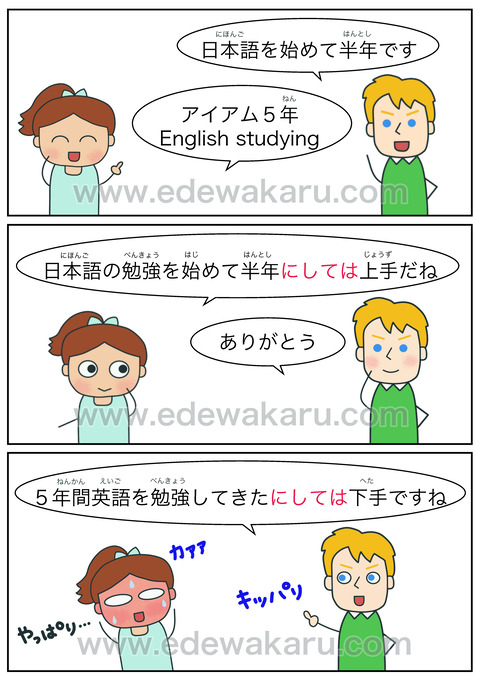
①A: You’re really good, considering you’ve only been studying Japanese for half a year.
[Expectation] After half a year, you wouldn’t be very good
[Fact] You’re really good
①B: You’re bad, considering you’ve been studying English for five years.
[Expectation] If you’ve studied for five years, you’d be good
[Fact] You’re bad
②Considering I didn’t study at all, I got a good score.
[Expectation] I didn’t study, so I probably wouldn’t get a good score
[Fact] I got a good score
③A: This cake is delicious for 100 yen!
[Expectation] It’s 100 yen, so it probably won’t taste good
[Fact] It tastes good
④It’s warm for March.
[Expectation] March still isn’t very warm
[Fact] It’s warm
⑤She’s a very mature child for an elementary school student.
[Expectation] Elementary school students are children
[Fact] She’s mature
Remember that “〜にしては” is used to convey a sense of surprise, as in “contrary to expectations, the fact is ~” 😀
[Related patterns]
In context 5 examples
A:日本語の勉強を始めて半年にしては、すごく上手だねB:5年間英語を勉強してきたにしては下手ですね
A: You’re really good, considering you’ve only been studying Japanese for half a year. B: You’re bad, considering you’ve been studying English for five years.
全然勉強しなかったにしては、いい点が取れた
Considering I didn’t study at all, I got a good score.
A:このケーキ、100円にしてはおいしいね!B:うん!
A: This cake is delicious for 100 yen! B: Yeah!
3月にしては暖かい
It’s warm for March.
小学生にしては大人っぽい子だね
She’s a very mature child for an elementary school student.
Read the original source text
Meaning
〜と思ったが、事実は〜
予想と違って〜、事実は〜
How to use it
動詞・名詞[普通形]+にしては
Explanation
「〜にしては」は「予想と違って、事実は〜」という意味の文型です。これは当然予想できる結果と事実が違っていたという時に使われる文型で、「予想とは違って、意外だ」という気持ちを強調します。
[例]
①A:日本語の勉強を始めて半年
にしては、すごく上手だね
【予想】半年だったら、あまり上手ではない
【事実】すごく上手だ
①B:5年間英語を勉強してきた
にしては
下手ですね
【予想】5年勉強したら上手だ
【事実】下手だ
②全然勉強しなかった
にしては、いい点が取れた
【予想】勉強しなかったから、いい点が取れないだろう
【事実】いい点が取れた
③A:このケーキ、100円
にしては
おいしいね!
【予想】100円だから、おいしくないだろう
【事実】おいしい
④3月
にしては
暖かい
【予想】3月は、まだあまり暖かくない
【事実】暖かい
⑤小学生
にしては
大人っぽい子だね
【予想】小学生は子供だ
【事実】大人っぽい
「〜にしては」は、「予想と違って、事実は〜だ」というように意外な気持ちを込めて使うと覚えておきましょう😀
【関連文型】
日本語文型辞典
Meaning
N/Na/V にしては
It means “for …” or “considering that.” What follows is something that differs from what would naturally be expected. It can often be rephrased as 「X(な)のに」, but 「のに」 implies that X is already an established fact, whereas 「Xにしては」 does not.
Examples:
1. For a child, he knows a lot of difficult words.
2. For a place in the city center, the rent in this apartment is low.
3. For a poor person, he lives in a remarkably fine place.
4. You have made impressive progress, considering you only just started.
5. Considering that she is getting married soon, she does not look very happy.
6. The content was inadequate, considering the amount of research that had been done.
Read the original source text
Meaning
基本情報N/Na/V にしては説明「その割に」という意味を表す。後には、そこから当然予想されることと食い違うことがらが続く。「X(な)のに」に言いかえられる場合が多いが、「のに」にはXがすでに確定した事実であるという含みがあるのに対して、「Xにしては」にはそのような含みはない。例文① 子供にしてはむずかしい言葉をよく知っている。② このアパートは都心にしては家賃が安い。③ 貧乏人にしてはずいぶん立派なところに住んでいる。④ 始めたばかりにしてはずいぶん上達したものだ。⑤ 近々結婚するにしてはあまり楽しそうな様子ではない。⑥ 下調べをしたにしては不十分な内容であった。
日本語文型辞典 英語版
Meaning
【にしては】[N/Na/V にしては]
Expresses the meaning of “it is rather; considering that.” Followed by a thing/event/state which is contradictory to what is normally expected. Can often be rephrased as X(な)のに. However, although のに implies that X is already confirmed, Xにしては does not contain such implications.
In context 6 examples
子供にしてはむずかしい言葉をよく知っている。
For her age, the child really knows a lot of difficult words.
このアパートは都心にしては家賃が安い。
The rent for this apartment is quite inexpensive for the center of the city.
貧乏人にしてはずいぶん立派なところに住んでいる。
For a poor person, he lives in a relatively nice place.
始めたばかりにしてはずいぶん上達したものだ。
Considering you’ve just started, you’ve improved a lot.
近々結婚するにしてはあまり楽しそうな様子ではない。
Even though he will get married soon, he doesn’t look very happy.
下調べをしたにしては不十分な内容であった。
Even though she had done her research, the content was insufficient.
くらべてわかる日本語表現文型辞典
Meaning
The actual degree of B does not match the standard or norm naturally expected from A. While one cannot positively say that X is B, considering the condition A, X is B.
How to use it
Explanation
【Contrast 1】
“AとしてはB” (Meaning 2, p. 176)
“(Xは) AとしてはB” limits A: X is B in that respect, but may not be B beyond the scope of A. “AにしてはB” states that X is B when judged against general standards associated with A.
○彼は医者にしては無能だ。(医者の持つ一般基準・規定概念から能力がないと判断される) — He is incompetent for a doctor. (He is judged to lack ability by the general standards or notion associated with doctors.)
○彼は医者としては無能だ。(彼の要素の中の医者の部分は無能だ) — He is incompetent as a doctor. (The doctor aspect of him is incompetent.)
“AとしてはB” (Meaning 3, p. 176)
“AとしてはB” means that B is true within A, or that it is on the B side of the scale. “AにしてはB” expresses that the speaker assumes A would naturally be a certain way, but in reality A is B beyond that expectation.
○鶏の卵としては大きい。(鶏の卵の中では大きいほうだ) — It is large for a chicken egg. (It is on the large side among chicken eggs.)
○鶏の卵にしては大きい。(鶏の卵と考えるには大きすぎる) — It is large for a chicken egg. (It is too large to be considered a chicken egg.)
“A割にB” (Meaning 1, p. 333)
This can be replaced with “AにしてはB.” However, if B is an evaluation or expectation about a specific person or thing, other people who do not know that person or thing cannot make that expectation, so it cannot be replaced with “A割にB,” which strongly conveys an evaluation or expectation.
○いつもドジな田中さんの割にはよくやった。(評価・予想が可能) — Tanaka, who is usually clumsy, did well. (An evaluation or expectation is possible.)
×田中さんの割にはよくやった。 — Tanaka did well for the circumstances.
“A割にB” allows a range in the evaluation or degree of B.
○はじめての商談にしては、成功といえる。 — For a first business negotiation, it could be called a success.
×はじめての商談の割には、成功といえる。 — For a first business negotiation, it could be called a success.
“AにしてもB” (Meaning 1, p. 236)
“AにしてもB” means that even taking A into consideration, the current state of B is unacceptable. “AにしてはB” means that B is not the natural state or result expected from A.
○今日は帰りが遅くなると言っていたにしても、遅すぎる。 — Even though he said he would be late getting home today, this is too late.
○今日は帰りが遅くなると言っていたにしては、早かった。 — Although he said he would be late getting home today, he came early.
However, depending on how the speaker views the fact A, either expression may sometimes be used.
○彼は日本に来てまだ1年ですが、それにしては日本語が上手ですね。(1年ならまだ日本語が下手なのが当然なのに、1年の割に上手だ) — He has been in Japan for only a year, but his Japanese is good for that. (Naturally, after only a year one would still expect him to be poor at Japanese, but he is good for someone who has been here a year.)
○彼は日本に来てまだ1年ですが、それにしても日本語が上手ですね。(1年でこのぐらいの程度だろうと思っていたのだが、実際はもっと程度が上だった) — He has been in Japan for only a year, and even so, his Japanese is good. (I thought his Japanese would be around this level after a year, but in reality it was even better.)
Notes
【Note 1】
・Depending on the context, A may be hypothetical or established.
○「この指輪、何かしら?ダイヤモンドかなあ?」「ダイヤモンドにしては、安いんじゃない?」(仮定) — “What’s this ring? Could it be a diamond?” “If it’s a diamond, isn’t it cheap?” (hypothetical)
○彼は英語教師にしては発音が悪い。(確定) — His pronunciation is poor for an English teacher. (established)
・“A。それにしてはB。” is a connective expression with the same meaning as “〜にしては,” but it emphasizes B. Also, when used in conversation, it often refers to the other person’s words or actions.
○「今、ダイエット中なの。」「それにしては、よく食べるわね。」 — “I’m dieting now.” “For someone who’s dieting, you sure eat a lot.”
In context 4 examples
学生の下宿にしては、部屋はこぎれいに片付いていた。
For a student’s rented room, it was quite neatly kept.
ダイエットに大金を使ったにしては、効果は薄かった。
Considering how much money I spent on dieting, the results were meager.
今日は、春にしては汗ばむぐらいの陽気だ。
It is warm enough to make you sweat today, for spring.
勉強したにしては、成績が悪い。
For someone who studied, his grades are poor.
Read the original source text
Meaning
Aから当然予想される基準や標準に現実のBの程度が合わない。XがBであるとは、積極的に言えないが、Aという条件を考え合わせればB。
How to use it
Explanation
【対比1】
「AとしてはB」(意味2 P.176)
「(Xは)AとしてはB」はAを限定し、その意味ではXはBだが、Aの範囲を超えれば、XはBとは言えないかもしれないという意味で、「AにしてはB」はAの持つ一般基準などから考えてBだと述べる。
○彼は医者にしては無能だ。(医者の持つ一般基準・規定概念から能力がないと判断される)
○彼は医者としては無能だ。(彼の要素の中の医者の部分は無能だ)
「AとしてはB」(意味3 P.176)
「AとしてはB」はAの中ではBだ、Bのほうだという意味である。「AにしてはB」は話し手にはAは当然~だという考えがあるが、実際はその考えを越えてAはBだという表現である。
○鶏の卵としては大きい。(鶏の卵の中では大きいほうだ)
○鶏の卵にしては大きい。(鶏の卵と考えるには大きすぎる)
「A割にB」(意味1 P.333)
「AにしてはB」と置き換え可能である。ただし、Bが特定のもの・人に対する評価や予想の場合は、そのことを知らないほかの人には予想が不可能なので、評価・予想の意味合いの強い「A割にB」では置き換えられない。
○いつもドジな田中さんの割にはよくやった。(評価・予想が可能)
×田中さんの割にはよくやった。
「A割にB」はBの評価・程度に幅がある。
○はじめての商談にしては、成功といえる。
×はじめての商談の割には、成功といえる。
「AにしてもB」(意味1 P.236)
「AにしてもB」はAを考慮しても現状のBは納得できないという意味で、「AにしてはB」はAから考えられる、当然の状態・結果にBはならないという意味。
○今日は帰りが遅くなると言っていたにしても、遅すぎる。
○今日は帰りが遅くなると言っていたにしては、早かった。
しかし、Aの事実を話し手がどのようにとらえているかによって、どちらの使い方でもできる場合がある。
○彼は日本に来てまだ1年ですが、それにしては日本語が上手ですね。(1年ならまだ日本語が下手なのが当然なのに、1年の割に上手だ)
○彼は日本に来てまだ1年ですが、それにしても日本語が上手ですね。(1年でこのぐらいの程度だろうと思っていたのだが、実際はもっと程度が上だった)
Notes
【注意1】
・文脈によって、Aは仮定の場合と確定の場合がある。
○「この指輪、何かしら?ダイヤモンドかなあ?」「ダイヤモンドにしては、安いんじゃない?」(仮定)
○彼は英語教師にしては発音が悪い。(確定)
・「A。それにしてはB。」は接続表現で、意味は「~にしては」と同じだが、Bが強調される。また、会話で用いる場合は相手の言動を言う場合が多い。
○「今、ダイエット中なの。」「それにしては、よく食べるわね。」
日本語NET JLPT文法解説まとめ
Meaning
Not fitting ~ / … contrary to what one would expect from ~
An expression that indicates something differs from what would naturally be expected based on the facts. It is used when criticizing or evaluating another person. It is hardly ever used about oneself.
How to use it
V (plain form) + にしては
N + にしては
Explanation
"contrary to what is expected from ~"
This expression indicates something different from what would naturally be expected based on the facts. It is used to criticize or evaluate others and is rarely used for oneself."
In context 9 examples
ラグビー選手にしては、体が小さいよね。
He’s small for a rugby player, isn’t he?
彼は新入社員にしては、電話応対が上手だ。
He’s good at handling phone calls for a new employee.
有名な監督がとった映画にしては、あまりおもしろくないね。
For a movie made by a famous director, it’s not very interesting.
彼って35歳なの?35歳にしては、ちょっと服装が子供っぽくない?
Is he 35? For a 35-year-old, don’t you think he dresses a bit childishly?
彼は20年もアメリカに住んでいたにしては、英語があまり上手じゃない。
Considering he lived in America for 20 years, his English isn’t very good.
10月にしては、まだまだ暑いね。
It’s still really hot for October.
勉強しなかったにしては、いい点が取れた。
Considering I didn’t study, I got a good score.
彼、未経験にしては、上手にプログラムを組むよね。
He writes programs well for someone with no experience, doesn’t he?
A:今日で英会話スクールに通い始めて3年が経ちます。
A: As of today, it’s been three years since I started attending an English conversation school.
Read the original source text
Meaning
~にふさわしくない / ~から予想される結果と違って・・・
その事実から当然考えられる姿とは違うことを表す表現。他の人を批判したり評価したりするときに使われる。自分自身のことにはほとんど使われない。
How to use it
V(普) + にしては
N + にしては
Explanation
"contrary to what is expected from ~"
This expression indicates something different from what would naturally be expected based on the facts. It is used to criticize or evaluate others and is rarely used for oneself."
毎日のんびり日本語教師
How to use it
Verb plain form + にしては
I-adjective plain form + にしては
Na-adjective stem + にしては
Noun + にしては
Explanation
Expresses that a result contrary to what is generally expected has occurred, or that a fact is contrary to what was expected.
Notes
Similar grammar: 「【N3 Grammar】~くせに/くせして」
Similar grammar: 「【N3 Grammar】~わりに/わりには」
Related grammar: 「【N3 Grammar】~として/としての/としても/としては」
In context 14 examples
この子は、15歳にしてはずいぶん大人っぽい。
This child is quite mature for 15.
昼寝にしては寝すぎてしまった。
I slept too long for a nap.
彼は高校生にしてはやけに落ち着いている。
He’s unusually composed for a high school student.
初めてにしてはよくできたほうだと思う。
I think I did pretty well for a first try.
予習したにしてはあまりにも不出来だ。
It’s far too poorly done, considering I prepared for it.
今日の天気、今の時期にしては冷え込んでいるほうだ。
Today’s weather is rather chilly for this time of year.
ここの家賃は、駅に近いにしてはあまり高くない。
The rent here isn’t very high, considering how close it is to the station.
小学生が作ったにしてはクオリティが高すぎる。(作为小学生制作的质量太高。)
The quality is far too high for something made by an elementary school student. (The quality is too high for something made by an elementary school student.)
セミは地上で3年から17年ほど過ごし、地上に出て羽化する。虫にしてはその一生は長い。
Cicadas spend about three to seventeen years underground, then emerge above ground and molt. That’s a long life for an insect.
新人にしては落ち着いていてこれからが楽しみだ。
He’s composed for a newcomer, and I’m looking forward to seeing what he does in the future.
気温もちょうどよく、8月のこの時期にしては過ごしやすい感じです。
The temperature is just right, and it feels comfortable for this time of August.
毎日パンやカップラーメンばかり食べている私にしては、今日のご御飯はまともな食事だ。
For someone like me who eats nothing but bread and cup noodles every day, today’s meal is a proper one.
自分で髪染めたにしてはよくできたと思う。
I think I did a good job, considering I dyed my hair myself.
はじめてにしては上出来ですね。
That’s quite good for a first try.
Read the original source text
How to use it
動詞普通形+にしては
い形容詞普通形+にしては
な形容詞語幹+にしては
名詞+にしては
Explanation
一般的に想定される結果とは相反する結果が生じたこと、事実と想定されることが相反していることを表します。
Notes
似ている文法「【N3文法】~くせに/くせして」
似ている文法「【N3文法】~わりに/わりには」
関連文法「【N3文法】~として/としての/としても/としては」
NINJAL 日本語文型データベース
Meaning
Used to say that something differs from what would ordinarily be expected or anticipated based on ~ as a standard.
How to use it
V plain form + にしては
i-A plain form + にしては
na-A plain form + にしては (however, “na-Aだ” → “na-A + にしては・na-Aである + にしては”)
N plain form + にしては (however, “Nだ” → “N + にしては・Nである + にしては”)
Notes
“~” is often a word referring to a specific thing without a range. The sentence following “~にしては” often expresses the speaker’s evaluation of the facts.
In context 22 examples
「この部屋は一人で住んでいるにしては、家具が多いですね」
“This room has a lot of furniture, considering that only one person lives here.”
「さゆりちゃん、お金がないってよく言ってるけれど、お金がないにしては、いつもきれいな格好してるよね」
“Sayuri often says she has no money, but she’s always dressed nicely for someone who has no money.”
料理が不得意な姉が作ったにしては、その料理はおいしかった。
Considering that my older sister, who is not good at cooking, made it, the food was delicious.
林君は2時間しか勉強しなかったにしては、テストの点数はよかったようだ。
Considering that Hayashi studied for only two hours, it seems he got a good score on the test.
木村さんは映画のことをよく知っているというが、映画に詳しいにしては、見ていない有名な作品もけっこうあるようだ。
Kimura says he knows a lot about movies, but for someone who is so knowledgeable about films, he seems to have missed quite a few famous ones.
会社の売り上げがよくないにしては、ボーナスはよかった。
Considering that the company’s sales are poor, the bonuses were good.
今年の夏のイベントは、準備期間が今まででいちばん長かったにしては盛り上がりがなかった。
Considering that this summer’s event had the longest preparation period ever, it didn’t generate much excitement.
「今日は油っこいものは食べたくないって言ってたよね。食べたくなかったにしては、天ぷらとか注文しているじゃないの」
“You said today that you didn’t want to eat anything greasy, right? For someone who didn’t want to eat any, you’ve ordered tempura and things like that.”
アキは自分では几帳面って言っているけど、几帳面にしてはいつも部屋が散らかっていて、やることもおおざっぱだ。
Aki says she’s meticulous, but for someone so meticulous, her room is always messy and she’s very careless about what she does.
両幹部の関係が険悪であるにしては、このプロジェクトに対する互いの協力体制はしっかりとれていた。
Considering that the relationship between the two executives was strained, they had a solid system of cooperation on this project.
弟は日ごろ勉強に熱心じゃないにしてはテストの点はいい。
My younger brother isn’t usually diligent about studying, but he gets good test scores.
犯行は計画的だったらしいが、計画的だったにしてはずさんな点が多い。
The crime seems to have been planned, but for a planned crime, there are many sloppy points.
試験の内容が簡単ではなかったにしては、クラスの平均点はよかったようだ。
Considering that the exam wasn’t easy, it seems the class average was good.
あの子は10歳にしては、大人っぽく見える。
That child looks mature for ten years old.
私たち、兄弟にしてはあまり似てないってよく言われるんです。
We’re often told that we don’t look very alike for siblings.
昨日泊まったホテルは、ビジネスホテルにしては部屋が広かった。
The hotel I stayed at yesterday had a spacious room for a business hotel.
「それ、結婚式に着ていく服にしては、ちょっと地味すぎるんじゃないの」
“Isn’t that a bit too plain for something to wear to a wedding?”
このシャツはたったの1000円だったけど、それにしては縫製がしっかりしていて、着心地もいい。
This shirt was only 1,000 yen, but for that price, it’s well made and comfortable to wear.
この墓はこの地方のかつての支配者のものだそうだが、権力者の墓であるにしては質素に見える。
I hear this tomb belongs to a former ruler of this region, but it looks modest for the tomb of a person in power.
兄はもう未成年ではないにしては親に甘えすぎだ。
My older brother relies on our parents too much, considering he is no longer a minor.
「あの二人、初対面だったにしてはよく話をしていたね。まるで古くからの友達みたいだった」
“Those two talked a lot for people meeting for the first time. They seemed just like old friends.”
美容師志望の友達に髪をカットしてもらったことがある。まだプロじゃなかったにしては、すごい技術だった。
I once had a friend who wanted to become a hairdresser cut my hair. It was impressive technique, considering they weren’t a professional yet.
Read the original source text
Meaning
~という基準から常識的に予想されること、期待されることとは違っていると言いたいときに使います。
How to use it
V普通形+にしては
i-A普通形+にしては
na-A普通形+にしては(ただし、「na-Aだ」→「na-A+にしては・na-Aである+にしては」
N普通形+にしては(ただし、「Nだ」→「N+にしては・Nである+にしては」)
Notes
「~」には幅のない特定のことを表す言葉がくることが多いです。「〜にしては」の後には、事実についての話し手の評価を表す文がくることが多いです。
IMABI
Considering…: わりに(は) & にしては
Read this IMABI lesson ↗Explanation
Considering…: わりに(は) & にしては
In this lesson, we will learn about two related expressions used when you’re encountered with unexpected situations.
わりに(は)
In the expression “A + わりに(は)+ B,” B is an unexpected outcome/judgment of A. The addition or omission of は is based on how much emphasis you wish to place on the contrast to one’s preconception.
[Formation]
This expression is used with nouns, adjectives, adjectival nouns, and verbs. This includes past tense and negative forms of said parts of speech that can conjugate.
Noun Noun + {の・である}わりに(は)
Adjectives Adj. + わりに(は)
Adjectival Nouns Adj. Noun + わりに(は)
Verbs Plain Form + わりに(は)
Grammar Note: The use of である instead of の with nouns is only seen in old-fashioned speech largely limited to the written language.
[Usage]
This pattern is frequently used in both positive and negative connotations, but it is best used with generalizations rather than with exact details. However, it is grammatical so long as the phrase it attaches to does not involve individual things/people.
Below are example sentences with the various formation patterns from the table above.
1. カルビは、安やすいわりには美味おいしい。
Considering how cheap it is, galbi is delicious.
Word Note: Galbi is a loanword from Korean meaning 肋骨ろっこつ (rib). In context of cooking, it refers to meat around the rib, which if in a non-Korean cuisine context is called ばら肉にく.
2. 勉強べんきょうしなかったわりには、よくできたなあ。
Considering how you didn’t study, you did pretty well.
3. 私わたしは、太ふとってるわりにはあんまり食たべません。
Considering how much I weigh, I hardly eat.
4. 井いノ川かわさんは、歳としのわりにはとても若わかく見みえますね。
Considering his age, Mr. Inokawa sure looks young, huh.
5. うちの彼氏かれしなんですが、何回なんかいも結婚けっこんしたくないと言いっているわりには、他愛無たわいない話はなしの中なかで、いつも子供こどもや結婚式けっこんしきの話はなしをしたりします。
Considering how many times my boyfriend says he doesn’t want to get married, he always talks about kids and having a wedding in silly talk.
6. 料金りょうきんが安やすかったわりには完璧かんぺきでしたよ。
Considering how cheap the fee/rate was, it was perfect.
7. 10じゅう年以上中国語ねんいじょうちゅうごくごを勉強べんきょうしたわりには、あまり上手じょうずになってない気きがします。
Considering how I’ve studied Chinese for over ten years, I feel like I haven’t become all that good at it.
8. 世評せひょうが高たかかったわりには、すごくつまらなすぎて2に度どと観みたくもない。
Considering how high its review was, it was so boring I don’t even want to watch it again.
9. 個人的こじんてきには比較的外食ひかくてきがいしょくの回数かいすうが多おおいわりには、体重たいじゅうが増ふえてない。
Considering how relatively frequent my eating out personally is, my weight isn’t going up.
10. この子こ、小型犬こがたけんのわりには、落ち着ついているほうです。
Considering how it’s a small-sized dog, it’s laid-back.
11. よく食たべるわりにあまり太ふとってない。
I’m not that fat considering how often I eat.
12. 農業のうぎょうは、大変たいへんなわりにあまり儲もうからない。
Agriculture doesn’t profit much considering how tough it is.
13. お金かねが無ないわりに、よく買かい物ものするね。
You sure shop often considering how you don’t have money.
14. ここは、知名度ちめいどのわりにあまり観光地化かんこうちかされていない。
This place hasn’t really become a tourist area considering its name recognition.
15. 橘たちばなさんは、四国出身しこくしゅっしんのわりに、あんまり訛なまりを感かんじませんね。
Mr. Tachibana doesn’t have much of an accident considering he’s from Shikoku, no?
16. 簡単かんたんなわりに美味しかったね。
That was delicious considering how easy it was, no?
17. 免税店めんぜいてんのわりに、為替かわせレートがいいよね。
The exchange rate is good considering it’s a duty-free shop, no?
The Noun 割(り)
わり comes from the noun 割(り). This literally means “ratio/percentage.” It can also mean 10% and other specialized meanings.
18. 3さん割引わりびきです。
It’s 30% off.
19. もっと割わりのいい仕事しごとをしてほしい。
I’d like you to do a more lucrative job.
20. おおむね1いっ週間しゅうかんに1いっ回かいの割わりで通院つういんしています。
I’m generally commuting to the hospital once a week.
21. 私わたしは焼酎しょうちゅうをお湯割ゆわりで飲のんでいます。
I drink shochu mixed with hot water.
Word Note: Shochu is a Japanese alcoholic beverage distilled from rice, barley, sweet potatoes, buckwheat, or brown sugar.
22. 本割りとは大相撲おおずもうおおずもうで発表はっぴょうされた取組表とりくみおもてとりくみひょうによって行おこなわれる正規せいきの取組とりくみである。
”Honwari” are official matches in professional sumo wrestling held according to the matches table.
割 (り){に・と}
As an adverb, 割(り)に, alternatively seen as 割(り)と, is used to mean “relatively/comparatively.”
23. 私わたしは花粉症かふんしょうです。症状しょうじょうは割わりと重おもい方ほうだと思おもいます。
I have allergies. My symptoms are relatively severe.
24. 仕事しごとは大分慣だいぶなれたので、割わりと楽らくになってきました。
I’ve gotten used to my job a lot, so it’s become relatively comfortable.
25. 作つくって売うるだけなら、割わりと簡単かんたんですよ。
If you’re just making and selling it, then it’s relatively easy.
26. 聖書学者せいしょがくしゃといわれる人ひとは、割わりに古ふるい家柄いえがらの人ひとが多おおいようです。
It seems that a lot of people who are called Bible scholars are of relatively old pedigree.
わりにゃ(あ)
In very casual speech, わりには may be contracted to わりにゃ(あ).
27. 上品じょうひんそうな顔かおのわりにゃ(あ)、やる事ことがえげつないなあ。
Considering how elegant (her) face is, what she does is pretty vulgar.
28. 店全体みせぜんたいのスペースのわりにゃ(あ)、席せきが少すくない気きがします。
It feels like there are few seats considering the store’s space as a whole.
29. 期待きたいしたわりにゃ(あ)、大たいしたことでもなかったな。
It really wasn’t all that much considering how much I was expecting it to be.
30. あいつはアホなわりにゃ(あ)、よく能書のうがき垂たれるよな。
That guy sure likes to boast considering he’s an idiot.
にしては
The pattern “A + にしては + B” is also used to describe a situation that is contrary to one’s expectation. It can be used in both positive and negative contexts. As far as tone is concerned, it typically isn’t used in harsh critiques. Any negative context is limited to disappointment/regret.
[Formation]
This pattern cannot be used with adjectives or adjectival nouns. This is due to the fact that adjectives/adjectival nouns by nature don’t have to refer to exact standards. Even when it’s used with verbs, the situation it follows is always well-defined.
Nouns Noun + にしては
Verbs Plain Form + にしては
Translation Note: This pattern is usually translated as “for…” or “considering…”
[Usage]
With concrete concepts, especially those concerning quality, degree, age, price, etc., にしては is interchangeable with わりに(は). However, one defining difference is that にしては can be used when the situation is hypothetical. However, whether the situation is concrete or hypothetical, the standard of comparison needs to be made clear. For instance, “considering…age” can be translated as 年齢ねんれいのわりに(は), but you can only use にしては if you replace 年齢 with something more specific like 60ろくじゅっ歳さい (sixty years old).
As such, にしては isn’t used with generalizations. The situation itself may be concrete or hypothetical in nature, but there is a standard of some sort that must be established in order for it to be grammatical. It’s also important to note that the phrase before it can be an individual person/thing, which is not the case with わりに(は).
Examples
31. マックのハンバーガーの値段ねだんにしては割わりに合あってるお肉にくだと思おもいますが、違ちがうんでしょうか。
For the price of a McDonald’s hamburger, the meat is considerably fitting, am I wrong?
32. この辺あたりの鰻屋うなぎやにしては割わりとうまいと思おもいます。
For an eel restaurant in this area, I think it’s relatively good.
33. 報酬ほうしゅうにしては割わりに合あわない。
For a reward, it’s not used much.
34. 夏なつにしては、よく雨あめが降ふりましたね。
It rained a lot for summer, huh.
35. 健太君けんたくんは小学生しょうがくせいにしてはよく漢字かんじを知しってるね。
Kentaro sure knows Kanji well for an elementary school student, no?
36. 泉いずみさんって、70ななじゅっ歳さいにしては若わかく見みえますね。
Mr. Izumi sure looks young for 70, doesn’t he?
37. 外国人がいこくじんにしては日本語にほんごが上手じょうずすぎてまるで日本人にほんじんのようですね。
Considering he’s a foreigner, (his) Japanese is so good it’s as if he’s Japanese, no?
38. 中国ちゅうごくにしては高価格こうかかくにもかかわらず、ほとんどの読者どくしゃが定期購読ていきこうどくをしている。
Considering it’s China, despite the high price, most readers are subscribers.
39. 中古品ちゅうこひんにしては保存状態ほぞんじょうたいが良よいですね。
Its condition is good for a secondhand good, no?
40. アライグマにしては素早すばやい!
It’s fast for a raccoon!
41. アイスクリームにしては、全然甘ぜんぜんあまくないよ。
This isn’t sweet at all for ice cream.
42. 「あんたが作つくったにしては、美味おいしいよ。」「え、どういうこと?酷ひどい言いい方かただなあ。」
“It’s delicious considering you made it.” “Huh, what? What an awful thing to say.”
43. 掃除そうじしたにしては、部屋へやがまだまだ汚きたないなあ。
The room is still dirty considering you cleaned it.
44. 外国人がいこくじんにしてはいけないことというと、外国人がいこくじんの訛なまりを真似まねすること、外国人がいこくじんが一緒いっしょにいるのに日本人にほんじんとばかり話したりすることなどが思おもい付つきます。
When talking about things that you mustn’t do to foreigners, mimicking a foreigners accident and only speaking to people who are Japanese when you’re with a foreigner come to mind.
45. 僕ぼくにしてはスペイン語ごの勉強頑張べんきょうがんばってますよ。
Considering how I am, I’m doing my best in my Spanish studies.
46. ちょっと春はるにしては暑あついんじゃないですか。
Isn’t it a little hot for spring?
47. 千円せんえんにしては質しつがいいですよ。
For a thousand yen, the quality is good.
48. ダイエットしてるにしては、よく食たべるね。
You sure eat a lot considering you’re on a diet.
49. 「英検はうまくいった?」「んん、どうだろう。4級にしては問題が難しかったよ。」
“Did you do okay on the English proficiency test?” “Mm, I’m not sure. The problems were pretty difficult for Level 4.”
50. 初はじめてにしては上手じょうずだな。
You’re pretty good for it being your first time.
にしちゃ
In casual contexts, にしては can be contracted to にしちゃ.
51. 2に年ねんしか勉強べんきょうしてないにしちゃ、英語えいごうまいっすな。
Considering you’ve only studied for two years, your English is pretty good.
52. あの値段ねだんにしちゃ美味おいしかったしね。
It was also delicious for that price.
53. 君きみにしちゃ、珍めずらしいな。
That’s pretty rare for you.
54. 人生じんせいを無駄むだにしちゃいけないよ。
You mustn’t waste your life.
Grammar Note: Do not confuse this にしちゃ with the にしちゃ seen as a contraction in the phrase にしてはいけない (mustn’t do…)
にして = であって
In semi-archaic speech, にして can be seen used with the meaning of であって.
55. 荘厳しょうごんにして華麗かれいな逸品いっぴんです。
It is a sublime, gorgeous article of rare beauty.
In context 55 examples
カルビは、安やすいわりには美味おいしい。
Considering how cheap it is, galbi is delicious.
勉強べんきょうしなかったわりには、よくできたなあ。
Considering how you didn’t study, you did pretty well.
私わたしは、太ふとってるわりにはあんまり食たべません。
Considering how much I weigh, I hardly eat.
井いノ川かわさんは、歳としのわりにはとても若わかく見みえますね。
Considering his age, Mr. Inokawa sure looks young, huh.
うちの彼氏かれしなんですが、何回なんかいも結婚けっこんしたくないと言いっているわりには、他愛無たわいない話はなしの中なかで、いつも子供こどもや結婚式けっこんしきの話はなしをしたりします。
Considering how many times my boyfriend says he doesn’t want to get married, he always talks about kids and having a wedding in silly talk.
料金りょうきんが安やすかったわりには完璧かんぺきでしたよ。
Considering how cheap the fee/rate was, it was perfect.
10じゅう年以上中国語ねんいじょうちゅうごくごを勉強べんきょうしたわりには、あまり上手じょうずになってない気きがします。
Considering how I’ve studied Chinese for over ten years, I feel like I haven’t become all that good at it.
世評せひょうが高たかかったわりには、すごくつまらなすぎて2に度どと観みたくもない。
Considering how high its review was, it was so boring I don’t even want to watch it again.
個人的こじんてきには比較的外食ひかくてきがいしょくの回数かいすうが多おおいわりには、体重たいじゅうが増ふえてない。
Considering how relatively frequent my eating out personally is, my weight isn’t going up.
この子こ、小型犬こがたけんのわりには、落ち着ついているほうです。
Considering how it’s a small-sized dog, it’s laid-back.
よく食たべるわりにあまり太ふとってない。
I’m not that fat considering how often I eat.
農業のうぎょうは、大変たいへんなわりにあまり儲もうからない。
Agriculture doesn’t profit much considering how tough it is.
お金かねが無ないわりに、よく買かい物ものするね。
You sure shop often considering how you don’t have money.
ここは、知名度ちめいどのわりにあまり観光地化かんこうちかされていない。
This place hasn’t really become a tourist area considering its name recognition.
橘たちばなさんは、四国出身しこくしゅっしんのわりに、あんまり訛なまりを感かんじませんね。
Mr. Tachibana doesn’t have much of an accident considering he’s from Shikoku, no?
簡単かんたんなわりに美味しかったね。
That was delicious considering how easy it was, no?
免税店めんぜいてんのわりに、為替かわせレートがいいよね。
The exchange rate is good considering it’s a duty-free shop, no?
3さん割引わりびきです。
It’s 30% off.
もっと割わりのいい仕事しごとをしてほしい。
I’d like you to do a more lucrative job.
おおむね1いっ週間しゅうかんに1いっ回かいの割わりで通院つういんしています。
I’m generally commuting to the hospital once a week.
私わたしは焼酎しょうちゅうをお湯割ゆわりで飲のんでいます。
I drink shochu mixed with hot water.
本割りとは大相撲おおずもうおおずもうで発表はっぴょうされた取組表とりくみおもてとりくみひょうによって行おこなわれる正規せいきの取組とりくみである。
”Honwari” are official matches in professional sumo wrestling held according to the matches table.
私わたしは花粉症かふんしょうです。症状しょうじょうは割わりと重おもい方ほうだと思おもいます。
I have allergies. My symptoms are relatively severe.
仕事しごとは大分慣だいぶなれたので、割わりと楽らくになってきました。
I’ve gotten used to my job a lot, so it’s become relatively comfortable.
作つくって売うるだけなら、割わりと簡単かんたんですよ。
If you’re just making and selling it, then it’s relatively easy.
聖書学者せいしょがくしゃといわれる人ひとは、割わりに古ふるい家柄いえがらの人ひとが多おおいようです。
It seems that a lot of people who are called Bible scholars are of relatively old pedigree.
上品じょうひんそうな顔かおのわりにゃ(あ)、やる事ことがえげつないなあ。
Considering how elegant (her) face is, what she does is pretty vulgar.
店全体みせぜんたいのスペースのわりにゃ(あ)、席せきが少すくない気きがします。
It feels like there are few seats considering the store’s space as a whole.
期待きたいしたわりにゃ(あ)、大たいしたことでもなかったな。
It really wasn’t all that much considering how much I was expecting it to be.
あいつはアホなわりにゃ(あ)、よく能書のうがき垂たれるよな。
That guy sure likes to boast considering he’s an idiot.
マックのハンバーガーの値段ねだんにしては割わりに合あってるお肉にくだと思おもいますが、違ちがうんでしょうか。
For the price of a McDonald’s hamburger, the meat is considerably fitting, am I wrong?
この辺あたりの鰻屋うなぎやにしては割わりとうまいと思おもいます。
For an eel restaurant in this area, I think it’s relatively good.
報酬ほうしゅうにしては割わりに合あわない。
For a reward, it’s not used much.
夏なつにしては、よく雨あめが降ふりましたね。
It rained a lot for summer, huh.
健太君けんたくんは小学生しょうがくせいにしてはよく漢字かんじを知しってるね。
Kentaro sure knows Kanji well for an elementary school student, no?
泉いずみさんって、70ななじゅっ歳さいにしては若わかく見みえますね。
Mr. Izumi sure looks young for 70, doesn’t he?
外国人がいこくじんにしては日本語にほんごが上手じょうずすぎてまるで日本人にほんじんのようですね。
Considering he’s a foreigner, (his) Japanese is so good it’s as if he’s Japanese, no?
中国ちゅうごくにしては高価格こうかかくにもかかわらず、ほとんどの読者どくしゃが定期購読ていきこうどくをしている。
Considering it’s China, despite the high price, most readers are subscribers.
中古品ちゅうこひんにしては保存状態ほぞんじょうたいが良よいですね。
Its condition is good for a secondhand good, no?
アライグマにしては素早すばやい!
It’s fast for a raccoon!
アイスクリームにしては、全然甘ぜんぜんあまくないよ。
This isn’t sweet at all for ice cream.
「あんたが作つくったにしては、美味おいしいよ。」「え、どういうこと?酷ひどい言いい方かただなあ。」
“It’s delicious considering you made it.” “Huh, what? What an awful thing to say.”
掃除そうじしたにしては、部屋へやがまだまだ汚きたないなあ。
The room is still dirty considering you cleaned it.
外国人がいこくじんにしてはいけないことというと、外国人がいこくじんの訛なまりを真似まねすること、外国人がいこくじんが一緒いっしょにいるのに日本人にほんじんとばかり話したりすることなどが思おもい付つきます。
When talking about things that you mustn’t do to foreigners, mimicking a foreigners accident and only speaking to people who are Japanese when you’re with a foreigner come to mind.
僕ぼくにしてはスペイン語ごの勉強頑張べんきょうがんばってますよ。
Considering how I am, I’m doing my best in my Spanish studies.
ちょっと春はるにしては暑あついんじゃないですか。
Isn’t it a little hot for spring?
千円せんえんにしては質しつがいいですよ。
For a thousand yen, the quality is good.
ダイエットしてるにしては、よく食たべるね。
You sure eat a lot considering you’re on a diet.
「英検はうまくいった?」「んん、どうだろう。4級にしては問題が難しかったよ。」
“Did you do okay on the English proficiency test?” “Mm, I’m not sure. The problems were pretty difficult for Level 4.”
初はじめてにしては上手じょうずだな。
You’re pretty good for it being your first time.
2に年ねんしか勉強べんきょうしてないにしちゃ、英語えいごうまいっすな。
Considering you’ve only studied for two years, your English is pretty good.
あの値段ねだんにしちゃ美味おいしかったしね。
It was also delicious for that price.
君きみにしちゃ、珍めずらしいな。
That’s pretty rare for you.
人生じんせいを無駄むだにしちゃいけないよ。
You mustn’t waste your life.
荘厳しょうごんにして華麗かれいな逸品いっぴんです。
It is a sublime, gorgeous article of rare beauty.