くらべてわかる日本語表現文型辞典
Meaning
Meaning 1: It indicates that the speaker has decided on the situation A themselves.
Meaning 2: A formal expression of “Aます.”
Meaning 3: A hypothetical situation A is created even though it is not actually A.
How to use it
Aことにする (Aことにしている)
Connection 1:
[Verb—dictionary form] (+ という) + ことにする
[Verb—negative form] ない (+ という) + ことにする
[Noun—∅] + という + ことにする
Connection 2:
[Verb—ル form] ことにする
Connection 3:
[Verb—た-form] (という) ことにする
[Verb—negative form] + なかった + (という) ことにする
Explanation
【Comparison 1】
“Aことになる” (Meaning 1, p. 94)
Notes
【Note 2】
・It is often used in speeches and writing.
・There is no form “Aことにしている.”
In context 12 examples
せっかく手術が成功したのだから、もう酒は飲まないことにします。
Since the surgery was successful, I’ve decided not to drink alcohol anymore.
パーティーには、家族全員で出席することにしております。
We have decided that the whole family will attend the party.
彼に会うのは、日曜ということにしました。
I’ve decided that I’ll meet him on Sunday.
私は毎朝、ジョギングすることにしている。
I make a point of jogging every morning.
始めにこの計画の概略について簡単に述べることにします。
First, I will briefly outline this plan.
便宜上、本文では敬称を省くことにします。
For convenience, I will omit honorifics in the main text.
これで会議を終えることにいたします。
I will now bring the meeting to a close.
会話文から主人公の心の動きを追っていくことにしましょう。
Let’s trace the protagonist’s inner changes through the dialogue.
参考書を買ったことにして、親から金をもらった。
I told my parents I had bought a reference book and got money from them.
この話はなかったことにしてください。
Please pretend this conversation never happened.
出張に行ったことにして出張費を自分のものにするのは犯罪だ。
Pretending I went on a business trip and pocketing the travel expenses is a crime.
これに関しては、私は何も知らなかったということにしてください。
Please let it be understood that I knew nothing about this.
Read the original source text
Meaning
意味1:話し手自身がAという事態を決めたことを表す。
意味2:「Aます」の硬い表現。
意味3:本当はAではないが、Aという仮想状況を作る。
How to use it
Aことにする(Aことにしている)
接続1:
[動詞-る形](+という)+ことにする
[動詞-ない形]ない(+という)+ことにする
[名詞-∅]+という+ことにする
接続2:
[動詞ール形]ことにする
接続3:
[動詞-た形](という)ことにする
[動詞-ない形]+なかった+(という)ことにする
Explanation
【対比1】
「Aことになる」(意味1 P.94)
Notes
【注意2】
・演説や書き言葉などで使われることが多い。
・「Aことにしている」の形はない。
DoJG 日本語文法辞典(全集)
Meaning
Decide to
How to use it
(i) Vinformal nonpast | ことに{する/した} | |
| 話すことに{する/した} | Someone decides/has decided to talk |
| 食べることに{する/した} | Someone decides/has decided to eat |
Explanation
A volitional decision to do something is made.
In context 6 examples
私は会社を辞めることにした・しました。
I decided to quit my company.
私は毎日三十分ぐらい運動をすることにしている・います。
I made it a rule to exercise for about 30 minutes every day.
今年の夏は北海道を旅行することにしました。
I've decided to make a trip to Hokkaido this summer.
京都までバスで行くことにしましょう。
Let's (lit. decide to) go as far as Kyoto by bus.
毎日漢字を十覚えることにしました。
I've decided to memorize ten kanji every day.
私は肉をあまり食べないことにしている。
I make it a rule not to eat very much meat.
日本語文型辞典
Meaning
Expresses a decision or resolve about a future action. In the form ことにした, as in ③, it conveys that the decision or resolve has already been made. こととする, which has the same meaning, is a more formal, written expression.
Attached to a clause, it means to act as if something were contrary to fact or to treat the situation that way. With a noun, use the form N(だ)ということにする, as in ②. With a verb, it attaches to the past-tense form, as in ① and ④. In this case, という may be included or omitted. こととする has the same meaning and is a more formal, written expression. For comparison with ことになる, see 【ことになる】1.
How to use it
…ことにする【decision】
Vことにする
…ことにする【treating something as】
N(だ)ということにする
Na だということにする
V-た(という)ことにする
In context 7 examples
あしたからジョギングすることにしよう。
I think I’ll start jogging tomorrow.
これからはあまりあまい物は食べないことにしよう。
From now on, I think I’ll stop eating so many sweet things.
きょうはどこへも行かないで勉強することにしたよ。
I’ve decided to stay in and study today.
その話は聞かなかった(という)ことにしましょう。
Let’s pretend we didn’t hear about that.
その件は検討中(だ)ということにして、すこしなりゆきを見まもろう。
Let’s say that matter is still under consideration and wait to see how things develop.
敵の攻撃に対する防御の時間をかせぐために、大統領はすこぶる健康だということにしておくべきだ。
To buy time to defend against an enemy attack, the president should be made out to be in excellent health.
出張に行った(という)ことにして出張費を着服したり不正流用することを、俗に「カラ出張」と言う。
Falsely claiming to have gone on a business trip in order to pocket or misappropriate the travel expenses is colloquially called a “fake business trip.”
Read the original source text
Meaning
将来の行為についての決定・決意などを表す。③のように「ことにした」の形になると、その決定・決意はすでに成立しているという意味あいをつたえる。同じ意味の「こととする」は、よりあらたまった書きことば的表現。
節に付いて、事実とは反対のこととしてふるまったり、そのように事態をあつかったりする、という意味を表す。名詞の場合は②のように「N(だ)ということにする」の形にする。動詞の場合は①④のようにタ形に付く。この場合は「という」があってもなくてもよい。おなじ意味の「…こととする」は、よりあらたまった書きことば的表現。「ことになる」との比較は【ことになる】1 を参照。
How to use it
…ことにする【決定】
Vことにする
…ことにする【扱い】
Nくだ)ということにする
Na だということにする
V-た(という)ことにする
絵でわかる日本語
Usage 1
Read this source entry ↗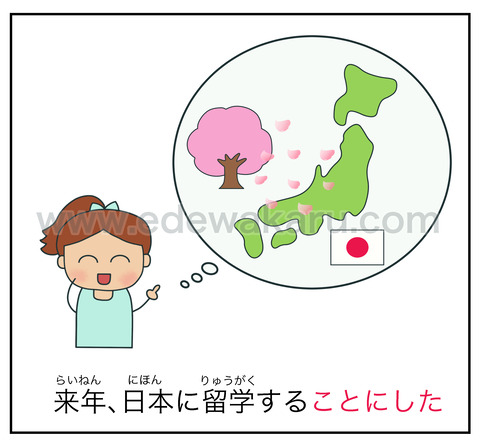
Meaning
Expresses one’s own decision or intention
Decide to …
How to use it
Verb [dictionary form] + ことにする
Explanation
「〜ことにする」is a sentence pattern that expresses a decision one has made oneself or one’s own intention 😊
It may help to remember it as meaning “decide to …” 😉
Be sure to distinguish it clearly from 「〜ことにしている」and「〜ことになっている」😀
【The「こと」series】
〜こと (command)
〜ことか
〜ことから
〜ことがある
〜ことができる (possibility)
〜ことができる (ability)
〜ことこの上ない
〜ことだ・〜ないことだ
〜ことだから
〜ことだし
〜ことで (Nのことで)
〜こととて
〜ことなしに
〜ことなく
〜ことに
〜ことにしている
〜ことにする
〜ことになっている
〜ことになる・〜こととなる
〜ことには
〜ことは〜が① (adjectives・nouns)
〜ことは〜が② (verbs)
〜ことはない
〜ことはならない
〜たことがある (experience)
〜だこと!
(〜は)〜てのこと
〜ても〜すぎることはない
〜ということだ
〜とのことだ
〜ないこともない
〜ないことには
〜なかったことがある
In context 4 examples
来年、日本に留学することにした
→来年、日本に留学することに決めたI decided to study in Japan next year. →I decided to study in Japan next year.
今日からダイエットをすることにした
→今日からダイエットすることに決定したI decided to start dieting today. →I decided to go on a diet starting today.
健康のために、早寝早起き(はやねはやおき)をすることにした
→健康のために、早寝早起きをすることに決めたFor the sake of my health, I decided to go to bed early and get up early. →For the sake of my health, I decided to go to bed early and get up early.
もうお酒は飲まないことにした
→もうお酒は飲まないと決めたI decided not to drink alcohol anymore. →I decided not to drink alcohol anymore.
Read the original source text
Meaning
自分の決定や意志を表す
〜に決める
How to use it
動詞[辞書形]+ことにする
Explanation
「〜ことにする」は自分で決めた決定や自分の意志を表す文型です😊
「〜に決める」というように覚えておくといいと思います
😉
「〜ことにしている」「〜ことになっている」との区別をしっかりとしておきましょう😀
【「こと」シリーズ】
〜こと(命令)
〜ことか
〜ことから
〜ことがある
〜ことができる(可能)
〜ことができる(能力)
〜ことこの上ない
〜ことだ・〜ないことだ
〜ことだから
〜ことだし
〜ことで(Nのことで)
〜こととて
〜ことなしに
〜ことなく
〜ことに
〜ことにしている
〜ことにする
〜ことになっている
〜ことになる・〜こととなる
〜ことには
〜ことは〜が①(形容詞・名詞)
〜ことは〜が②(動詞)
〜ことはない
〜ことはならない
〜たことがある(経験)
〜だこと!
(〜は)〜てのこと
〜ても〜すぎることはない
〜ということだ
〜とのことだ
〜ないこともない
〜ないことには
〜なかったことがある
Usage 2
Read this source entry ↗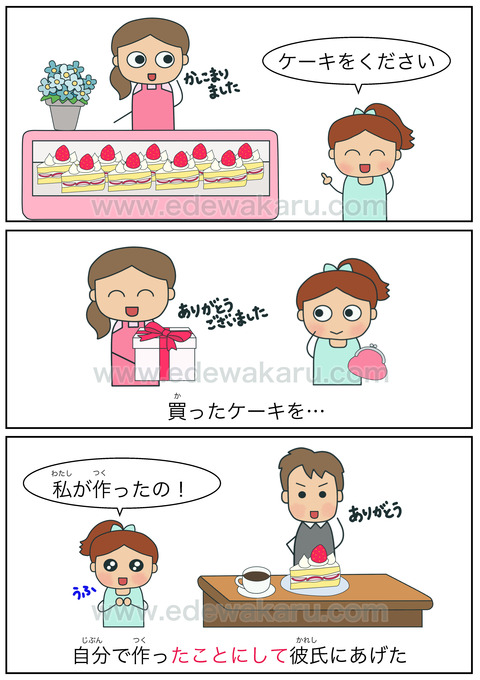
Meaning
The truth is that…, but think of it as not being so
The truth is that…, but pretend that…
How to use it
Verb [た-form] + たことにする
い-adjective [−い] + ということにする
な-adjective [−だ] + ということにする
Noun [dictionary form / −だ] + ということにする
Explanation
“〜たことにする” is a sentence pattern meaning “the truth is that…, but think of it as not being so” or “the truth is that…, but pretend that…” It is used when you want to say that someone did the opposite of what actually happened or considers something to be the opposite of what it really is.
[Examples]
① She gave her boyfriend a cake she bought, pretending she had made it herself.
→ She gave her boyfriend a cake she had actually bought, saying she had made it herself.
② I pretended to have a cold and took the day off from my part-time job.
The truth is, I didn’t have a cold, but I pretended I did and took the day off.
③ Let’s go as if you’ve done it!
The truth is, you haven’t done your homework, but let’s act as if you have!
④ I’ll pretend I didn’t hear that.
→ I did hear it, but I’ll consider it as if I didn’t.
⑤ I got sick, but let’s tell Mom that I’m fine.
→ I’m actually sick, but let’s pretend I’m fine so Mom won’t worry.
Remember “〜たことにする” as one of the “こと” patterns 😀
In context 5 examples
買ったケーキを、自分で作ったことにして彼氏にあげた
She gave her boyfriend a cake she bought, pretending she had made it herself.
かぜをひいたことにしてバイトを休んだ
I pretended to have a cold and took the day off from my part-time job.
A:カラオケに行かない?B:宿題をしないとお母さんに怒られるのA:やったことにして行こうよ!
A: Want to go to karaoke? B: I have to do my homework or Mom will get mad at me. A: Let’s pretend you’ve done it and go!
A:このことは絶対に秘密だよ!B:うん、聞かなかったことにするよ
A: This is absolutely a secret! B: Yeah, I’ll pretend I didn’t hear it.
病気になったが、お母さんには元気だということにしておこう(復習:〜ておく)
I got sick, but let’s tell Mom that I’m fine. (Review: 〜ておく)
Read the original source text
Meaning
本当は〜だが、〜ではないと考える
本当は〜だが、〜ふりをする
How to use it
動詞[た形]+たことにする
い形容詞[ーい]+ということにする
な形容詞[ーだ]+ということにする
名詞[辞書形・ーだ]+ということにする
Explanation
「〜たことにする」は「本当は〜が、〜ではないと考える」「本当は〜だが、〜ふりをする」という意味を表す文型です。事実とは反対のことをしたり、実際のこととは反対のことと考えると言いたい時に使います。
[例]
①買ったケーキを、自分で作っ
たことにして
彼氏にあげた
→本当は買ったケーキを、自分で作ったと言って彼氏にあげた
②かぜをひい
たことにして、バイトを休んだ
本当はかぜをひいていないが、かぜをひいているふりをしてバイトを休んだ
③やっ
たことにして
行こうよ!
本当は宿題をやってないが、やったと考えていこうよ!
④聞かなかっ
たことにする
よ
→本当は聞いたけど、聞かなかったと考えるよ
⑤病気になったが、お母さんには元気
だということにしておこう
→本当は病気だが、お母さんが心配しないように元気なふりをしよう
「〜たことにする」 は「ことシリーズ」の1つとして覚えておきましょう😀
日本語NET JLPT文法解説まとめ
Meaning
"decide to do 〜"
Used when saying that you have decided of your own volition to do or not to do something.
How to use it
V (dictionary form / nai-form) + ことにする
Explanation
decide to do
Used to say that you have decided to do or not to do something of your own volition.
・There is also the somewhat formal expression 「〜こととする」.
・Use 「〜ことになる」 to talk about something decided regardless of your own will.
In context 14 examples
明日から、毎日10分ジョギングをすることにしました。
I’ve decided to jog for 10 minutes every day starting tomorrow.
次の夏休みは国へ帰ることにします。
I’ll decide to return to my country during the next summer vacation.
頭が痛いので、今日は早く寝ることにします。
I have a headache, so I’ll go to bed early today.
日本語学校を卒業したら、国へ帰って働くことにしました。
I’ve decided to return to my country and work after graduating from Japanese language school.
みんなが真面目に勉強しないので、明後日テストをすることにします。
Since nobody is studying seriously, I’ve decided to give a test the day after tomorrow.
浮気ばかりするから、彼とは別れることにしました。
Because he keeps cheating on me, I’ve decided to break up with him.
自分の会社を作るために、12月で会社を辞めることにしました。
I’ve decided to quit my company in December so I can start my own.
今夜のパーティーには行かないことにしました。
I’ve decided not to go to tonight’s party.
何度教えても、覚えてくれないから、ジョンさんにはもう教えないことにしました。
Since John won’t remember no matter how many times I teach him, I’ve decided not to teach him anymore.
健康のために、タバコとお酒をやめることにしました。
I’ve decided to give up cigarettes and alcohol for my health.
ダイエットのために、お菓子をやめることにします。
I’ll give up snacks to lose weight.
わからないことがあったら、まず自分で調べることにします。
If there’s something I don’t understand, I’ll look it up myself first.
いくら調べてもわからないので、先生に聞くことにします。
I can’t figure it out no matter how much I look into it, so I’ll ask the teacher.
大学を卒業後は就職せずに、大学院に行くことにします。
I’ll go to graduate school instead of getting a job after graduating from university.
Read the original source text
Meaning
"〜すると決める"
自分の意志で〜する、〜しないと決めたことを言う時に使う。
How to use it
V(辞書形 / ナイ形)+ことにする
Explanation
decide to do
Used to say that you have decided to do or not to do something of your own volition.
・少し硬い表現に「〜こととする」という表現もある。
・自分の意志に関係なく決まったことを言う場合は「〜ことになる」を使う。
毎日のんびり日本語教師
Meaning
~decide to do
How to use it
Verb dictionary form + ことにする/こととする
Verb ない-form + ことにする/こととする
Explanation
This grammar is used for a subjective decision based on the speaker's own will or judgment.
「~ことにする」 is commonly used in speech, while 「~こととする」 is somewhat formal and is also used in writing.
It cannot be used for another person's judgment or an objective decision.
Notes
A similar pattern is 「~ことになる/こととなる」.
It is used when something is decided through another person's judgment, an objective decision, or the natural course of events.
In context 5 examples
自分へのご褒美は来月のボーナスで買うことにする。
I've decided to buy myself a reward with next month's bonus.
明日に向けて風呂に入って寝ることにする。(为了明天洗澡睡觉。)
I've decided to take a bath and go to bed so I'll be ready for tomorrow. (I'm going to bathe and sleep for tomorrow.)
気に入らないこともあるけど、せっかくだから心ゆくまで楽しむことにした。
There are things I don't like, but since I have the chance, I decided to enjoy myself to my heart's content.
拾った子猫を飼うことにした。(决定养捡到的小猫。)
I decided to keep the kitten I found. (I decided to raise the kitten I found.)
地球温暖化防止の為、化石燃料を使う代わりに自然エネルギーを利用することとした。
To prevent global warming, we decided to use renewable energy instead of fossil fuels.
Read the original source text
Meaning
~することに決める
How to use it
動詞辞書形+ことにする/こととする
動詞ない形+ことにする/こととする
Explanation
話し手自身の意志や判断による主観的な決定に用いる文法です。
「~ことにする」は口語としてよく使われ、「~こととする」はやや硬く書き言葉でも使われます。
他者の判断、客観的な決定に使うことはできません。
Notes
似た文型に「~ことになる/こととなる」があります。
こちらは他人による判断や客観的な決定、自然の成り行きなどによって物事が決まったときに用いられます。
日本語文型辞典 英語版
Meaning
Indicates a decision or resolution to perform an action in the future. When the form ことにした is used, as in
(3)
, it conveys the meaning that a decision or resolution has already been made. こととする has the same meaning as ことにする, but こととする is more formal and tends to be used in written language.
Attached to a clause describing an action or state, this expression is used to pretend something is true when it isn’t, or to signal that someone will handle a situation in a certain way. When used with a noun, it takes the form N(だ)ということにする, as in
(2)
. With verbs, it follows the ta-form, as in
(1)
and
(4)
. In that case, use of という is optional. ...こととする, which has the same meaning, is more formal and used in written language. See Usage 1 of ことになる for a comparison with that expression.
How to use it
1. ...ことにする〈decision〉[Vことにする]
2. ...ことにする〈treatment〉[N(だ)ということにする][Na だということにする][V-た(という)ことにする]
In context 7 examples
あしたからジョギングすることにしよう。
Starting tomorrow, I am going to jog.
これからはあまりあまい物は食べないことにしよう。
From now on, I'm not going to eat so many sweets.
きょうはどこへも行かないで勉強することにしたよ。
I decided not to go anywhere and just study today.
その話は聞かなかった(という)ことにしましょう。
Let’s just say that we never heard that story.
その件は検討中(だ)ということにして、すこしなりゆきを見まもろう。
Let’s put that matter under consideration and see how things go for a while.
敵の攻撃に対する防御の時間をかせぐために、大統領はすこぶる健康だということにしておくべきだ。
We’d better pretend that the president is in excellent health, in order to gain time to prepare a defense against attacks from the enemy.
出張に行った(という)ことにして出張費を着服したり不正流用することを、俗に「カラ出張」と言う。
Pretending to have been on a business trip and pocketing or misappropriating the travel expenses is commonly known as a kara-shutchoo (phoney business trip).
Read the original source text
Meaning
Indicates a decision or resolution to perform an action in the future. When the form ことにした is used, as in
(3)
, it conveys the meaning that a decision or resolution has already been made. こととする has the same meaning as ことにする, but こととする is more formal and tends to be used in written language.
Attached to a clause describing an action or state, this expression is used to pretend something is true when it isn’t, or to signal that someone will handle a situation in a certain way. When used with a noun, it takes the form N(だ)ということにする, as in
(2)
. With verbs, it follows the ta-form, as in
(1)
and
(4)
. In that case, use of という is optional. ...こととする, which has the same meaning, is more formal and used in written language. See Usage 1 of ことになる for a comparison with that expression.
How to use it
1. ...ことにする〈decision〉[Vことにする]
2. ...ことにする〈treatment〉[N(だ)ということにする][Na だということにする][V-た(という)ことにする]
AIUEO JLPT Grammar
Meaning
This sentence pattern expresses that the speaker has made a decision, showing their intention, plan, or decision.
How to use it
Verb dictionary form + ことにする; verb in ない-form + ことにする
In context 5 examples
健康のために、明日から毎日運動することにする。
For my health, I decide to exercise every day from tomorrow.
試験に合格するために、毎日勉強することにした。
To pass the exam, I decided to study every day.
良い人間関係を築くために、人に親切にすることにした。
To build good relationships, I decided to be kind to others.
貯金をするために、無駄遣いをしないことにしました。
To save money, I decided not to waste money.
自分が全部やったことにしないほうがいいよ。
It's best not to take it upon yourself to do it all.
Read the original source text
Meaning
This sentence pattern expresses that the speaker has made a decision, showing their intention, plan, or decision.
How to use it
動詞辞書形+ことにする動詞ない形+ことにする
Explanation · 日本語
この文型は、話者が何かを決定したことを表す表現で、意志や計画、決断などを示すときに使われます。
Bunpro Grammar Reference
Meaning
To decide on, Have decided to
How to use it
Verb[る]+ ことにする
Verb[ない]+ ことにする
Verb[る]+ ことにします
Verb[ない]+ ことにします
Nuance
An expression that shows that the thing which is (A) has been decided upon, or will be done.
Explanation
In a similar way to how にする means to 'decide on' something, ことにする means to decide on a situation, or course of action. This grammar point is a combination of 事 'thing' in its role as a nominalizer (a word that creates a noun-phrase), and にする 'to make it (A)'. Literally this grammar structure can be translated as 'to do (A)', or 'to make it (A)'.
ことにする may be used with verb-phrases that are either in the affirmative, or negative (using ない) forms. As こと itself is a noun, the verb (or auxiliary verb) that comes before it will need to be in its attributive form.
今日はワクチンを打ったから、明日は仕事を休むことにする。
Today I got vaccinated, so I will go with taking the day off tomorrow.
タマキさんと箱根に行くことにする。
I have decided to go to Hakone with Tamaki-san.
今日は雨が降っているから、明日行くことにしない?
It is raining today, don't you want to make it that we go tomorrow?
勝手に僕が行くという事にしないでください。
Please don't decide that I will go without asking me. (Please don't assume that I want to go)
にする is a strong expression, which tends to make the speaker sound like they are fairly resolute in their decision.
Caution
The する in にする itself may also be seen using ない, to mean that someone has decided 'against' doing something. Due to this, careful attention will need to be paid to the overall structure of the sentence.
これからは肉を食べることにする。
I have decided to eat meat from now on.
これからは肉を食べることにしない?
Let's decide not to eat meat from now on.
これからは肉を食べないことにする。
I have decided to not eat meat from now on.
これからは肉を食べないことにしない。
I have decided to not not eat meat from now on.
In context 20 examples
- 今日はエイプリルフールだからウソしか言わない事にする。
Since today is April Fool's, I've decided to only tell lies.
- 今日はワクチンを打ったから、明日は仕事を休むことにする。
Today I got vaccinated, so I will go with taking the day off tomorrow.
- タマキさんと箱根に行くことにする。
I have decided to go to Hakone with Tamaki-san.
- 今日は雨が降っているから、明日行くことにしない?
It is raining today, don't you want to make it that we go tomorrow?
- 勝手に僕が行くという事にしないでください。
Please don't decide that I will go without asking me. (Please don't assume that I want to go)
- あの場所で、記念写真を撮る事にします。
We've decided to take the commemorative photo at that place.
- 九時に終わるか分からなかったが、早めに帰る事にしました。
I didn't know if it would finish at nine but I decided to go home in advance.
- これ以上言わない事にします。もし何か言ったら彼女を怒らせるでしょう。
I have decided not to say anything else. If I say something, it would piss her off.
- この商品、無料で配る事にします。
I have decided to hand out this product for free.
- 毎日、数分文法を勉強する事にした。
I have decided to study grammar for a few minutes every day.
- 最近睡眠不足だから、今日から早く寝る事にした。
Starting from today, I have decided to sleep earlier because I have been sleep deprived lately.
- 一本早い電車に乗る事にした。その方が座れるから。
I have decided to take the earlier train. That way, I will be able to sit down.
- 友達との旅行に行かないで、僕だけ家に残る事にしました。
I have decided to stay home alone, and not to go on a trip with friends.
- あまりプロジェクトに気を使わない事にした。疲れてしまうから。
I will get completely worn out, so I have decided not to worry about the project too much.
- ビタミン不足だから、毎日野菜ジュースを飲む事にしている。
I have decided to drink vegetable juice every day because I am lacking in vitamins.
- やりすぎてしまうから、今後はテレビゲームをしない事にします。
I have decided to stop playing video games from now on, because I play too much.
- これからは肉を食べることにする。
I have decided to eat meat from now on.
- これからは肉を食べることにしない?
Let's decide not to eat meat from now on.
- これからは肉を食べないことにする。
I have decided to not eat meat from now on.
- これからは肉を食べないことにしない。
I have decided to not not eat meat from now on.
文法
Meaning
"decide to do 〜"
Used when saying that you have decided of your own volition to do or not to do something.
How to use it
V (dictionary form / nai-form) + ことにする
Notes
・There is also the somewhat formal expression 〜こととする.
・Use 〜ことになる when talking about something decided independently of your own will.
In context 14 examples
明日から、毎日10分ジョギングをすることにしました。
I’ve decided to jog for 10 minutes every day starting tomorrow.
次の夏休みは国へ帰ることにします。
I’ll decide to return to my country during the next summer vacation.
頭が痛いので、今日は早く寝ることにします。
I have a headache, so I’ll go to bed early today.
日本語学校を卒業したら、国へ帰って働くことにしました。
I’ve decided to return to my country and work after graduating from Japanese language school.
みんなが真面目に勉強しないので、明後日テストをすることにします。
Since nobody is studying seriously, I’ve decided to give a test the day after tomorrow.
浮気ばかりするから、彼とは別れることにしました。
Because he keeps cheating on me, I’ve decided to break up with him.
自分の会社を作るために、12月で会社を辞めることにしました。
I’ve decided to quit my company in December so I can start my own.
今夜のパーティーには行かないことにしました。
I’ve decided not to go to tonight’s party.
何度教えても、覚えてくれないから、ジョンさんにはもう教えないことにしました。
Since John won’t remember no matter how many times I teach him, I’ve decided not to teach him anymore.
健康のために、タバコとお酒をやめることにしました。
I’ve decided to give up cigarettes and alcohol for my health.
ダイエットのために、お菓子をやめることにします。
I’ll give up snacks to lose weight.
わからないことがあったら、まず自分で調べることにします。
If there’s something I don’t understand, I’ll look it up myself first.
いくら調べてもわからないので、先生に聞くことにします。
I can’t figure it out no matter how much I look into it, so I’ll ask the teacher.
大学を卒業後は就職せずに、大学院に行くことにします。
I’ll go to graduate school instead of getting a job after graduating from university.
Read the original source text
Meaning
"〜すると決める"
自分の意志で〜する、〜しないと決めたことを言う時に使う。
How to use it
V(辞書形 / ナイ形)+ことにする
Notes
・少し硬い表現に「〜こととする」という表現もある。
・自分の意志に関係なく決まったことを言う場合は「〜ことになる」を使う。
NINJAL 日本語文型データベース
Meaning
Used when the speaker wants to say that, by their own will, they have decided to do something. It expresses the speaker’s proactive attitude. It is also used when inviting someone to choose or decide, in forms such as 「~ことにしましょう・~ことにしませんか」.
How to use it
Vることにする/Vないことにする
Notes
The subject is usually first person. When expressing a third party’s intention, use it together with an expression of hearsay or conjecture, such as 「~らしい・~そうだ・~と言っている」.
「〜」 takes a verb expressing a deliberate action, such as 「帰る・やめる・勉強する」.
It is usually used in affirmative sentences.
In context 7 examples
頭が痛いから、薬を飲むことにする。
My head hurts, so I’ll take some medicine.
「課長、これは大切な書類なので、直接先方に届けることにします」「そうか。では、よろしく」
“Section chief, this is an important document, so I’ll deliver it directly to the other party.” “I see. Please do.”
子どもが大きくなったので、もう少し広い家に引っ越すことにした。
Now that the children have grown, we decided to move to a slightly bigger house.
「この仕事は松本さんに任せることにしませんか。彼ならきっとしっかりやってくれますよ」
“Shall we entrust this job to Mr. Matsumoto? I’m sure he’ll handle it properly.”
雨も降りそうだし、今日の作業はこの辺で切り上げることにしよう。
It looks like rain, so let’s call it a day on today’s work here.
あの代表者は何だか信用できないので、我々のNPOとしてはこの団体からの資金援助はもう受けないことにしたい。
That representative doesn’t seem trustworthy for some reason, so as an NPO we would like to stop accepting financial support from this organization.
A社のあのチョコレートを最近店頭で見かけなくなった。どうやらもう生産しないことにしたらしい。
I haven’t seen that chocolate from Company A in stores lately. Apparently, they’ve decided to stop producing it.
Read the original source text
Meaning
話し手の意志で、~することを決めると言いたいときに使います。話し手の積極的な姿勢を表します。「~ことにしましょう・~ことにしませんか」などの形で選択や決定を呼びかける場面でも使われます。
How to use it
Vることにする/Vないことにする
Notes
主語はふつう一人称です。第三者の意志を表す場合は「~らしい・~そうだ・~と言っている」などの伝聞や推測の表現を一緒に使います。
「〜」には、「帰る・やめる・勉強する」など、意志的な行為を表す動詞がきます。
ふつう肯定文で使います。
IMABI
Expressions with こと
Read this IMABI lesson ↗Explanation
Expressions with こと
The nominalizer こと appears in many grammatical structures, and in all the structures showcased in this lesson, it has no interchangeability with the nominalizer の. So, as you go through each structure, this will be a great opportunity to better internalize these two nominalizers and how they are fundamentally different.
~ことがある: Experience(S) One Has
When こと follows a verbal predicate, either in the non-past form or the past form, it indicates experiences one has. The difference tense plays determines whether said experience is one that one “(often) has” or “has had.”
Vnon-past + ~ことがあるagent (often) does/experiences doing…
Vpast + ~ことがあるagent has/have done… (before)
In practice, ~たことがある is more practically translated as “has/have…” as in having done something before—an experience that is unequivocally in the past as an experience had. Meaning, this pattern may not be used to reflect the present perfect use of “have” like in “I have done my work,” in which the speaker may be referring to actions that they have just completed. ~たことがある should also NOT be misconstrued as a wordier replacement of plain past tense, either.
i. きのう、日本語を勉強したことがある。X
Intended: Yesterday, I studied Japanese.
ii. 仕事をやったことがある。??
Intended: I have done my work.
Actual Meaning: I have done a job.
iii. 営業事務の仕事をやったことがある。
I have worked in sales administration (before).
Particle Note: Whether が, は, も, or no particle at all is used in this structure is ultimately determined by the intended nuancing of the statement. With the particle は, the experience (being) had is being contrasted with other scenarios. With the particle も, the experience (being) had is in addition to other stated experiences. No particle being used is indicative of casual speech in which case the added nuances provided by は・も are not relevant as well as が’s own exhaustive-listing nuancing being irrelevant.
While it may go without saying, this construct can be used in negative sentences, in which case ある conjugates to its respective negative forms.
iv. 北京ダックを食べたことがない。
I have not had Peking duck (before).
It must also be noted that Vnon-past before こと may also be in the negative, and it is even possible for ある to be in the negative in tandem. However, each scenario is distinctly different.
v. それほど頻繁に食べることはないかもしれませんが、高塩分の食品の摂取量が多いと、胃癌リスクが高まりますよ。
Although you may not eat them that frequently, high intake of salty foods will increase your risk of stomach cancer.
vi. 鶏肉は、食べないことはないですが、あまり好きではありませんね。
While it’s not that I don’t ever eat chicken, I don’t really care for it.
While conjugating verbs into plain/polite and affirmative/negative forms should not be problematic by this point, here are the relevant forms of ある with the structure ~ことがある.
PlainPolite
Affirmative~ことがある~ことがあります
Negative~ことがない~ことがないです
~ことがありません
Past※~ことがあった~ことがありました
Negative Past※~ことがなかった~ことがなかったです
~ことがありませんでした
※While Japanese does not exhibit tense agreement, there are instances in which the pattern ~ことがある utilizes ~た for both the verb こと attaches to and ある, or even just the past tense marker on ある itself (see Exs. 14-17).
1. 富士山に登った1こともありますか。
Have you also climbed Mt. Fuji before?
2. マシュマロ入りのホットチョコレートを飲んだことがありますか。
Have you ever had hot chocolate with marshmallows?
3. 雲が多くなる時間2もあるが、雨が降ることはない。
There are times when it gets cloudy, but it will never rain.
4. 夏場でも鍋物を食べることがある。
Even during summertime, I (often) have hotpot.
5. 映画では同じようなアイデアが何度も繰り返し使われることが多い3ので、似たようなシーンを別の映画で見かけることがあるかもしれない。
In movies, similar ideas are used over and over again a lot, so you may often encounter similar scenes (to what you have seen) in other films.
6. 久しぶりに訪れた場所で道に迷うことがあります。
I often get lost when I visit places I haven’t been in a while.
7. 基本的に引き篭もっているのですが、休日に母と買い物に行くことがある。
I basically stay at home, but sometimes I go shopping with my mother on the weekends.
8. 「香港に行ったことがあるの?」「一度行ったことがあるよ。」
“Have you been to Hong Kong before?” “I’ve been there once.”
9. 歯磨きをしないで寝たことがありますか。
Have you ever gone to sleep without brushing your teeth?
10. ラーメンを食べたことある?
Have you ever had ramen?
11. 歌舞伎を観たことはありますか。
Have you seen kabuki before?
12. 外国人に日本語を教えたことがあります。
I have taught Japanese to foreigners before.
13. あまり気にすることはないよ。
There really isn’t anything to worry about.
As for when ~たことがあった is used, an experience “that had been had, or “had not been had” in the negative, is mentioned as a retelling of the past. At times, this could be done as an attempt to confirm such event occurred, either to oneself or to whoever might be listening.
14. この場所で子供のころ、よく遊んだんだよ。あの滑り台の上から飛び降りて怪我をしたことがあったな。
I used to play here a lot as a kid. I once jumped off the top of that slide and got hurt.
15. 娘の父親は東京の江戸川区で育って幼稚園へ通ったことがあったが、母親の私のほうは、幼稚園へ行かなかった。
My daughter’s father grew up in Edogawa Ward, Tokyo, and had gone to kindergarten, but I, her mother, did not go to kindergarten.
Similarly, Vnon-past+ ~ことがあった is used when the speaker is retelling common occurrences, or lack thereof when in the negative, from the past.
16. 母だって子守唄を歌うことがあっただろうが、思い出せない。
I’m sure my mother of all people sometimes sang lullabies to me, but I can’t remember.
17. 毎年きっと1冊か2冊、ときには三冊も四冊も出版することがあった。
Ever year, I would publish one or two books, sometimes three or four.
Insofar, we have only see situations in which the verb used with ~ことがある indicates the volition of an agent (doer). However, When there is no agent, the structure ought to be interpreted as indicating what “may (often) be the case.”
18. 届出に不備などがあると加入手続きが遅れることがあるのでご注意ください。
Please note that if there are any issues in your filing, the enrollment process may be delayed.
19. 何か相手の気に入らないことがあったとしか思えませんね。
The only thing I can think of is that there must’ve been something that didn’t bode well with the other person.
~ことがある w/ Adjectival Predicates
One leap away from non-volitional verbs would be adjectival predicates. In fact, adjectives and adjectival nouns may also be used with ~ことがある for describing having (had) experiences in a certain situation, tense dynamics permitting. Arguably more care must be taken to ensure that the context is not best described with the past tense, however, as the context at had must still be understood as “experience(s) in which such a state is/was so” as opposed to simply stating that “something was so.” The latter situation would be within the domain of the past tense.
20. この先、楽しいことがあるとは思えません。
I just can’t see there being anything fun to be had in the future.
21. アボカドの熟成の見極めは難しいですねえ。私も切ってみたら、すごく硬かったことがあります。
It sure is hard to judge the ripeness of an avocado, huh. I once cut into one that was really hard.
22. ときどき大変なこともあるけど、ポジティブに考えるようにしているよ。
It can be hard at times, but I try to think positively.
23. 単品だと500円なんだけど、以前はもうちょっと安かったことがあったの。
It’s 500 yen à la carte, sure, but I had bought it a little cheaper than that in times past.
24. 怖そうな人でも優しいこともあるんだよ。
Even scary people are sometimes nice.
25. 北多摩は神奈川県だったことがある。
Kita Tama has once been (in) Kanagawa Prefecture.
NON-REMODELED CONTENT BELOW
~ことにする・こととする: To decide.
26. あいつを忘れることにしただけさ。(Very colloquial)
I’ve just decided to just forget that guy.
27. 私はお酒を飲むのをやめることとしました。 (Slightly formal)
I have decided to quit drinking liquor.
~ことにしている shows that one makes a routine of doing something or that one is determined/has a strong commitment to doing something.
28. 毎日カルピスを飲むことにしています。
I’ve made it a rule to drink Calpis every day.
29. 英語では話さないことにしています。
I’ve made it a rule not to speak in English.
~ことになる・こととなる: To be decided
30. 今年日本に行くことになりました。
It has been decided that I will go to Japan this year.
31. 新製品は5月10日に発表することになりました。
It has been decided that we will announce the new product on May 10th.
山を登る, while grammatically valid, does not mean the same thing as 山に登る. In this scenario, を functions as a transition marker, indicating that the mountain is not, per se, what is being climbed, but a point along one’s hiking journey. ↩︎
This example exemplifies are こと in this pattern may be replaced with similar yet concrete nouns like 時間・時 (time). ↩︎
This example exemplifies two things: that the pattern ~ことがある can be used with passive verbs and that ある can be replaced with similar words such as 多い (for there to be a lot of…). With this in mind, [高塩分の食品の摂取量] from v. may also be viewed as a paraphrasing of [Verb + ~こと]. ↩︎
In context 31 examples
富士山に登った1こともありますか。
Have you also climbed Mt. Fuji before?
マシュマロ入りのホットチョコレートを飲んだことがありますか。
Have you ever had hot chocolate with marshmallows?
雲が多くなる時間2もあるが、雨が降ることはない。
There are times when it gets cloudy, but it will never rain.
夏場でも鍋物を食べることがある。
Even during summertime, I (often) have hotpot.
映画では同じようなアイデアが何度も繰り返し使われることが多い3ので、似たようなシーンを別の映画で見かけることがあるかもしれない。
In movies, similar ideas are used over and over again a lot, so you may often encounter similar scenes (to what you have seen) in other films.
久しぶりに訪れた場所で道に迷うことがあります。
I often get lost when I visit places I haven’t been in a while.
基本的に引き篭もっているのですが、休日に母と買い物に行くことがある。
I basically stay at home, but sometimes I go shopping with my mother on the weekends.
「香港に行ったことがあるの?」「一度行ったことがあるよ。」
“Have you been to Hong Kong before?” “I’ve been there once.”
歯磨きをしないで寝たことがありますか。
Have you ever gone to sleep without brushing your teeth?
ラーメンを食べたことある?
Have you ever had ramen?
歌舞伎を観たことはありますか。
Have you seen kabuki before?
外国人に日本語を教えたことがあります。
I have taught Japanese to foreigners before.
あまり気にすることはないよ。
There really isn’t anything to worry about.
この場所で子供のころ、よく遊んだんだよ。あの滑り台の上から飛び降りて怪我をしたことがあったな。
I used to play here a lot as a kid. I once jumped off the top of that slide and got hurt.
娘の父親は東京の江戸川区で育って幼稚園へ通ったことがあったが、母親の私のほうは、幼稚園へ行かなかった。
My daughter’s father grew up in Edogawa Ward, Tokyo, and had gone to kindergarten, but I, her mother, did not go to kindergarten.
母だって子守唄を歌うことがあっただろうが、思い出せない。
I’m sure my mother of all people sometimes sang lullabies to me, but I can’t remember.
毎年きっと1冊か2冊、ときには三冊も四冊も出版することがあった。
Ever year, I would publish one or two books, sometimes three or four.
届出に不備などがあると加入手続きが遅れることがあるのでご注意ください。
Please note that if there are any issues in your filing, the enrollment process may be delayed.
何か相手の気に入らないことがあったとしか思えませんね。
The only thing I can think of is that there must’ve been something that didn’t bode well with the other person.
この先、楽しいことがあるとは思えません。
I just can’t see there being anything fun to be had in the future.
アボカドの熟成の見極めは難しいですねえ。私も切ってみたら、すごく硬かったことがあります。
It sure is hard to judge the ripeness of an avocado, huh. I once cut into one that was really hard.
ときどき大変なこともあるけど、ポジティブに考えるようにしているよ。
It can be hard at times, but I try to think positively.
単品だと500円なんだけど、以前はもうちょっと安かったことがあったの。
It’s 500 yen à la carte, sure, but I had bought it a little cheaper than that in times past.
怖そうな人でも優しいこともあるんだよ。
Even scary people are sometimes nice.
北多摩は神奈川県だったことがある。
Kita Tama has once been (in) Kanagawa Prefecture.
あいつを忘れることにしただけさ。(Very colloquial)
I’ve just decided to just forget that guy.
私はお酒を飲むのをやめることとしました。 (Slightly formal)
I have decided to quit drinking liquor.
毎日カルピスを飲むことにしています。
I’ve made it a rule to drink Calpis every day.
英語では話さないことにしています。
I’ve made it a rule not to speak in English.
今年日本に行くことになりました。
It has been decided that I will go to Japan this year.
新製品は5月10日に発表することになりました。
It has been decided that we will announce the new product on May 10th.
The Supplementary Verb する
Read this IMABI lesson ↗Explanation
The Supplementary Verb する
Essentially all material in this lesson should be review. What this lesson will try to do is showcase the various usages of the supplementary verb する, which by now you should be accustomed to seeing and using.
With Bound Particles
Bound particles are often placed after a base and followed by the supplementary verb する. For example, the particles は, も, and や may follow the 連用形 and are then followed by する to greatly emphasize the verb.
1. 彼女は褒めこそすれ、非難したことはない。
She does speaks highly (of others), but she never criticizes.
2. 聞きもしないで批評すんな。
Don’t criticize without listening.
3. 彼女は日本語が話せはするが、うまくはないね。
She can speak Japanese, but she’s not good.
4. 責めやしないのはいつまでも最良の決定です。
Not blaming (others) is the best decision no matter what.
5. 彼は顔の前で両手を広げ、それからぱたんとあわせる。「世の中にはいっぱい納屋があって、それらがみんな僕に焼かれるのを待っているような気がするんです。海辺にぽつんと建った納屋やら、たんぼのまん中に建った納屋やら・・・・・・とにかく、いろんな納屋です。十五分もあれば綺麗きれいに燃えつきちゃうんです。まるでそもそもの最初からそんなもの存在もしなかったみたいにね。誰も悲しみやしません。ただ―消えちゃうんです。ぷつん﹅﹅﹅ってね」
He spread out his hands in front of his face, clapped them together with a bang and then said, ”There are a lot of barns in this world, and I feel like waiting for them all to burn. Whether it is the barn standing up all alone on the seashore, the barn built in the middle of a field, just a wide variety of barns. Given fifteen minutes, one can burn down completely quite nicely. It’s as if from the very beginning like those barns had no existence. No one is saddened by this. They just disappear, with a snap.”
From 納屋を焼く by 村上春樹.
Grammar Note: Notice how は may contract in the construction ”連用形+はする”.
In Honorifics
する is a very important verb in humble speech. It is seen after the stems of verbs to show first person action.
6. ご案内します。
I will guide you.
7. ご奉納します。
I will offer (this).
8. お待ちします。
I will wait.
With the Particles たり and など
The auxiliary verb ~たり attaches to the 連用形 to primarily show back and forth action and must always be used with する. In the same fashion, など may also list actions by following the 連体形 of a verb.
9. 休日に雑誌を読むなどして過ごすのは本当につまらない。
To spend the holidays doing stuff like reading magazines is really boring.
10. 彼は泣いたり笑ったりばかりしている男だ。
He’s only a guy that cries and laughs.
11. 遊んだり働いたりしているというのが若さの意味だ。
The meaning of youth is to play and work.
12. 彼女は掃除をするなどして暮らしていた。
She lived on doing things such as cleaning.
With the Volitional Form
With the auxiliary verbs ~う, ~よう, and ~まい + と it shows volition in trying to (not) do something. Of course, the first two auxiliaries are positive and the last is negative.
13. 嘘をつこうとしたが、つけなかった。
I tried to lie, but I couldn’t.
14. 負けるまいとする。
To try not to lose.
15. 彼は歌おうとしたが、うまくなかった。
He tried to sing, but it wasn’t good.
~ようにする
This usage is translated as “to try…”. This is to try to do something for the long run, unlike above. Furthermore, the よう in this pattern is from 様: it’s not the volitional ending. The volitional ending ~よう came from a sound change when the original volitional contracted from む → ん and then → う. With some verb classes, this resulted in the birth of ~よう, most certainly because of pronunciation ease.
16. できるだけ野菜を食べるようにする。
I’ll try to eat vegetables as much as possible.
17. もう二度と会わないようにした。
I tried to not see him a second time.
18. 遅れないようにしてください。
Please try not be late.
~ことにする
In this speech pattern the speaker shows what he or she decided with his or her own will. Remember that this pattern can also be seen as ~こととする, which is deemed to be more punctual and formal.
19. 私は酒を飲むのをやめることとしました。
I have decided to quit drinking liquor.
20. 東京に引っ越すことにした。
I have decided to move to Tokyo.
21. たばこをやめることにしましたよ。
I’ve decided to quit smoking!
~としたことが
Being equivalent to ~ともあろうものが, it shows dismay and regret for someone’s abnormal misbehavior.
22. 彼女としたことが、大変なことを言ってしまった。
Of all people, she accidentally said something that bad!
~と[すると・したら・すれば]
~と[すると・したら・すれば] means “if there were.” The slightly different nuances of the conditional patterns still apply.
23. 十時に出たとすればもう着いているだろう?
If we had left at 10 o’ clock, wouldn’t we already have arrived?
24. 四次元よじげんの世界せかいがあるとすれば、どのようなものだと思いますか。
What do you think of what kind of a world it would be if we assumed that there was a 4 dimensional world?
25. 仮に戦争が起ったとしたら、何千、何百万の人々の命が失われるだろう。
Supposed that war broke out, tens, hundreds of millions of lives would be lost.
26. 温泉に行くとしたら、どこがいいのでしょうか。
If we were to go to a hot spring, where would be good?
27. 雨だとすると、中止だろう。
If there’s rain, it’ll probably be postponed.
28. 大地震が起こるとすると、どうすればいいのか。
If there were to be a big earthquake, what would we do?
29. 大学とすれば、抗議こうぎしないといけない。
Assuming it’s the university, we must protest.
In context 29 examples
彼女は褒めこそすれ、非難したことはない。
She does speaks highly (of others), but she never criticizes.
聞きもしないで批評すんな。
Don’t criticize without listening.
彼女は日本語が話せはするが、うまくはないね。
She can speak Japanese, but she’s not good.
責めやしないのはいつまでも最良の決定です。
Not blaming (others) is the best decision no matter what.
彼は顔の前で両手を広げ、それからぱたんとあわせる。「世の中にはいっぱい納屋があって、それらがみんな僕に焼かれるのを待っているような気がするんです。海辺にぽつんと建った納屋やら、たんぼのまん中に建った納屋やら・・・・・・とにかく、いろんな納屋です。十五分もあれば綺麗きれいに燃えつきちゃうんです。まるでそもそもの最初からそんなもの存在もしなかったみたいにね。誰も悲しみやしません。ただ―消えちゃうんです。ぷつん﹅﹅﹅ってね」
He spread out his hands in front of his face, clapped them together with a bang and then said, ”There are a lot of barns in this world, and I feel like waiting for them all to burn. Whether it is the barn standing up all alone on the seashore, the barn built in the middle of a field, just a wide variety of barns. Given fifteen minutes, one can burn down completely quite nicely. It’s as if from the very beginning like those barns had no existence. No one is saddened by this. They just disappear, with a snap.”
ご案内します。
I will guide you.
ご奉納します。
I will offer (this).
お待ちします。
I will wait.
休日に雑誌を読むなどして過ごすのは本当につまらない。
To spend the holidays doing stuff like reading magazines is really boring.
彼は泣いたり笑ったりばかりしている男だ。
He’s only a guy that cries and laughs.
遊んだり働いたりしているというのが若さの意味だ。
The meaning of youth is to play and work.
彼女は掃除をするなどして暮らしていた。
She lived on doing things such as cleaning.
嘘をつこうとしたが、つけなかった。
I tried to lie, but I couldn’t.
負けるまいとする。
To try not to lose.
彼は歌おうとしたが、うまくなかった。
He tried to sing, but it wasn’t good.
できるだけ野菜を食べるようにする。
I’ll try to eat vegetables as much as possible.
もう二度と会わないようにした。
I tried to not see him a second time.
遅れないようにしてください。
Please try not be late.
私は酒を飲むのをやめることとしました。
I have decided to quit drinking liquor.
東京に引っ越すことにした。
I have decided to move to Tokyo.
たばこをやめることにしましたよ。
I’ve decided to quit smoking!
彼女としたことが、大変なことを言ってしまった。
Of all people, she accidentally said something that bad!
十時に出たとすればもう着いているだろう?
If we had left at 10 o’ clock, wouldn’t we already have arrived?
四次元よじげんの世界せかいがあるとすれば、どのようなものだと思いますか。
What do you think of what kind of a world it would be if we assumed that there was a 4 dimensional world?
仮に戦争が起ったとしたら、何千、何百万の人々の命が失われるだろう。
Supposed that war broke out, tens, hundreds of millions of lives would be lost.
温泉に行くとしたら、どこがいいのでしょうか。
If we were to go to a hot spring, where would be good?
雨だとすると、中止だろう。
If there’s rain, it’ll probably be postponed.
大地震が起こるとすると、どうすればいいのか。
If there were to be a big earthquake, what would we do?
大学とすれば、抗議こうぎしないといけない。
Assuming it’s the university, we must protest.
どんなときどう使う 日本語表現文型辞典
Meaning
make up one's mind to
How to use it
Vる・Vない+ことにする (decide to; make it a rule to)
Explanation
B:そのこと、先月も聞いたよ。
自分の意志で、ある行為をする、または、しないと決めたと言いたいときに使う。「Vる/Vないことに決めた」とも言える。
Indicates whether speaker has decided to undertake a certain action. Can also say: Vる, Vないことに決めた.
In context 6 examples
桜の木の下で拾ってきたねこだから、「さくら」と呼ぶことにしよう。
Since it's a cat I found under a cherry tree, let's call it Sakura.
連休には、長野の友だちのうちへ行くことにしました。
I've decided to go to a friend's home in Nagano during the long weekend.
A:今日からたばこをやめることにした!
A: I've decided to quit smoking starting today!
社員研修が続くので、今月のボランティア活動には参加しないことにしました。
Since employee training continues, I've decided not to take part in this month's volunteer activities.
海外駐在が決まったのですが、今回は1年ぐらいなので、家族を連れて行かないことにしました。
My overseas assignment has been decided, but since it will only be for about a year this time, I've decided not to take my family with me.
3月は試験があるので、アルバイトをしないことにした。
I decided not to work part-time in March because I have exams.
Read the original source text
Meaning
make up one's mind to
How to use it
Vる・Vない+ことにする
Explanation
B:そのこと、先月も聞いたよ。
自分の意志で、ある行為をする、または、しないと決めたと言いたいときに使う。「Vる/Vないことに決めた」とも言える。
Indicates whether speaker has decided to undertake a certain action. Can also say: Vる, Vないことに決めた.