くらべてわかる日本語表現文型辞典
Meaning
Meaning 1: Assigning X the position or meaning A, one does B.
Meaning 2: B in the role, status, or state of A.
Meaning 3: In the form 「A は A として B」. An expression meaning that A is understood or settled, and setting A aside, there is also B.
Meaning 4: Assuming A, it follows that B. B is the natural result. If A, then B.
Meaning 5: In the form 「A (もの) として B」. One does B on the basis of the judgment that A; one does B considering A to be the case.
How to use it
(X を) A として B (A とする B/A とした B/A ものとして B/A は A として B)
Connections 1–3:
[Noun — ∅] として
Connections 4, 5:
[Verb] として
[Noun — ∅] として
Notes
【Note 3】
・There is also an expression in the form 「A は B として」meaning that A has been decided or agreed upon, and the next question is what follows.
○サンドイッチは頼むとして、飲み物は何にする?
In context 20 examples
我々は彼を中心として活動している。
We operate with him at the center.
大阪を震源とする地震が、今後起こる可能性は大きい。
There is a strong possibility of an earthquake with its epicenter in Osaka occurring in the future.
YWCAは平和な世界の実現を目的とした女性の団体である。
The YWCA is a women’s organization whose purpose is to realize a peaceful world.
被告を無罪とする。
The defendant is found not guilty.
お父さんは私を大人として扱ってくれません。
My father doesn’t treat me as an adult.
彼女は母親としてもすばらしいが、女性としても魅力のある人だ。
She is wonderful as a mother, but she is also an attractive woman.
専門家としてのご意見をお伺いしたいと思います。
I would like to hear your opinion as an expert.
私はあの人のことを人生の先輩として尊敬している。
I respect that person as someone senior to me in life.
「来週、映画を見にいかない?」
「いいよ。それはそれとして、テストの勉強進んでいる?」“Want to go see a movie next week?” “Sure. Putting that aside, how’s your test preparation going?”
「田中さんにお世話になったから、誕生日に何かあげましょうよ。」
「誕生日は誕生日として、世話になったお礼は別にしたほうがいいんじゃないか。」“Since Mr. Tanaka has been so helpful, let’s give him something for his birthday.” “Let’s treat his birthday as one thing, and give him something separately to thank him for his help.”
規則は規則として認めるが、これは規則違反には当たらないと思う。
I accept that rules are rules, but I don’t think this counts as a violation of the rules.
「月にいくらぐらい子供に渡しているの?」
「小遣いは小遣いとして、その他、食費やら本代やらで2万円かな。」“About how much do you give your child each month?” “Pocket money is one thing; besides that, with food and books and such, about 20,000 yen, I guess.”
今日、病院でもらった薬は1日3錠ずつ飲んだとして、1ヶ月分だ。
The medicine I got at the hospital today will last a month if I take three tablets a day.
「何時に、こっちに着く?」「今から出発したとして、6時ごろかな。」
“What time will you get here?” “If I leave now, around six, I guess.”
給料が月に30万円として、彼の年収はざっと400万円ぐらいか。
If his salary is 300,000 yen a month, his annual income is roughly 4 million yen.
今、ローンを組んだとして、全額返済するのは私が75歳の年だ。
If I take out a loan now, I’ll be 75 the year I finish paying it all back.
今後は会社からの援助はないものとして、行動してくれ。
Act on the assumption that there will be no further assistance from the company.
犯人は複数いるものとして、捜査に当たろう。
Let’s conduct the investigation on the assumption that there is more than one culprit.
大雨のおそれがあるとして、気象庁は厳重な注意を呼びかけている。
On the grounds that there is a risk of heavy rain, the Meteorological Agency is urging people to exercise extreme caution.
政府は当初の目標が達成されたとして、税率を据え置くことにした。
The government decided to keep the tax rate unchanged, considering the initial target to have been achieved.
Read the original source text
Meaning
意味1:XにAという位置づけ・意味づけをしてB。
意味2:Aという立場・身分・状態でB。
意味3:「AはAとしてB」の形で。Aは了解した、Aを別にしてほかにBという表現。
意味4:Aと仮定するとBということになる。Bは当然の結果。AとするとB。
意味5:「A(もの)としてB」の形で。Aという判断のもとにBをする。Aと考えてB。
How to use it
(Xを)AとしてB(AとするB/AとしたB/AものとしてB/AはAとしてB)
接続1~3:
[名詞-∅]として
接続4,5:
[動詞]として
[名詞-∅]として
Notes
【注意3】
・「AはBとして」の形で、Aは決定・了解した、次は~という意味の表現もある。
○サンドイッチは頼むとして、飲み物は何にする?
DoJG 日本語文法辞典(全集)
Meaning
As; in the capacity of
How to use it
Noun | として | |
| 先生として | As a teacher |
Explanation
A compound particle which indicates the capacity, role or function of someone or something.
In context 4 examples
田中さんはセールスマンとして採用された・されました。
Mr. Tanaka was hired as a salesman.
私は医者としてあなたに言います。
I'll tell you (this) as a doctor.
木村さんとは友達として付き合っているだけです。
I'm just keeping company with Mr. Kimura as a friend.
この部屋は物置として使っている。
I'm using this room as a storeroom.
Read the original source text
Meaning
As; in the capacity of
How to use it
Noun | として | |
| 先生として | As a teacher |
Explanation
A compound particle which indicates the capacity, role or function of someone or something.
日本語文型辞典
Usage 1
Meaning
Attaches to a noun to indicate a capacity, position, category, or designation.
⇾としては
Attaches to a noun referring to a person or an organization and means “also from that position or viewpoint.” It may take a polite form, as in ③. The difference from 「としては」 is that 「としても」 implies there are other people or organizations in a similar position or viewpoint.
⇾としても
A use in which 「Nとして」 modifies a noun.
How to use it
Nとして
Nとしては
Nとしても
NとしてのN
In context 16 examples
研究生として、この大学で勉強している。
I am studying at this university as a research student.
日本軍の行った行為は日本人として恥ずかしく思う。
As a Japanese person, I feel ashamed of the actions taken by the Japanese military.
子供がこんなひどい目にあわされては、親として黙っているわけにはいかない。
As a parent, I can't just keep quiet when my child is treated so terribly.
彼は大学の教授としてより、むしろ作家としての方がよく知られている。
He is better known as a writer than as a university professor.
趣味として書道を勉強している。
I am studying calligraphy as a hobby.
学長の代理として会議に出席した。
I attended the meeting as the president's representative.
大統領を国賓として待遇する。
The president is treated as a state guest.
軽井沢は古くから避暑地として人気があるところだ。
Karuizawa has long been a popular summer resort.
文学者としては高い評価を得ている彼も、家庭人としては失格である。
Although he is highly regarded as a literary figure, he is a failure as a family man.
彼の料理の腕前はプロのコックとしても十分に通用するほどのものだ。
His cooking skills are good enough to serve him well even as a professional chef.
私としても、この件に関しては当惑しております。
I, too, am perplexed by this matter.
学長としても、教授会の意向を無視するわけにはいかないだろう。
Even as president, he probably cannot ignore the wishes of the faculty council.
会社といたしましても、この度の不祥事は誠に遺憾に思っております。
As a company, we deeply regret this recent scandal.
教師としてではなく、一人の人間としての立場から発言したいと思う。
I would like to speak not as a teacher, but from the standpoint of an individual.
彼にも男としての意地があるはずです。
He must have his pride as a man, too.
日本代表としての責任を強く感じ、精一杯頑張りたいと思います。
I feel a strong sense of responsibility as a representative of Japan, and I intend to do my very best.
Read the original source text
Meaning
名詞に接続して資格・立場・部類・名目などを表す。
⇾としては
人物や絶縁を表す名詞に付いて、「その立場、観点からも」という意味を表す。③のように丁寧な形をとることもある。「としては」との違いは、「としても」は、他にも同様の立場・観点に立つ人や組織があるという含みがある点である。
⇾としても
「Nとして」が名詞を修飾する用法。
How to use it
Nとして
Nとしては
Nとしても
NとしてのN
Usage 2
Meaning
Basic information: minimum quantity + として…ない. Explanation: Takes a word with 「一」 that expresses a minimum amount, such as 「一日」「一時(いっとき)」「(だれ)一人」「(何)一つ」, followed by a negative predicate, and means “not … at all.” When accompanied by an interrogative such as 「なに」 or 「だれ」, 「として」 may be omitted. Examples: ① Since the war began, there hasn't been a single day when I could feel at ease. ② In the final exams, not a single student wrote an answer they were satisfied with. ③ They're all luxury goods, and I can't find a single item I could afford to buy. ④ Not a single person supported what I said. Example: Not a single person supported what I said. This expression is somewhat literary; in spoken language, expressions such as 「一人も…ない」 are more common.
Read the original source text
Meaning
基本情報最小限の数量+として…ない説明「一日」「一時(いっとき)」「(だれ)一人」「(何)一つ」などの最小限の量を表す「一」の付く語を受け、後に述語の否定形を伴って「全然…ない」という意味を表す。「なに」「だれ」のような疑問詞を伴う場合は「として」を省くことができる。例文① 戦争が始まって以来、一日として心の休まる日はない。② 期末試験では、一人として満足のいく答案を書いた学生はなかった。③ 高級品ばかりで、一つとして私が買えそうな品物は見当たらない。④ だれ一人として、私の発言を支持してくれる人はいなかった。例文(例) だれ一人、私の発言を支持してくれる人はいなかった。やや書きことば的な表現で、話しことばで「一人も…ない」のような言い方が普通。
絵でわかる日本語
Usage 1
Read this source entry ↗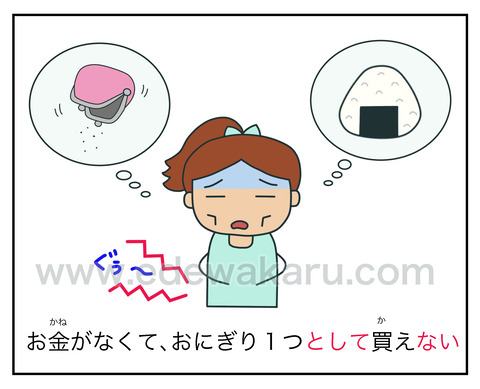
Meaning
not even one ~
not ~ at all
How to use it
1 + counter + として〜ない
Explanation
「1〜として…ない」 is a grammatical pattern that emphasizes “not even one ~” or “not ~ at all.” The 「〜として」 part can be changed to 「〜も」 for emphasis. So you can simply remember it as:
「1〜も…ない=1〜も…ない」😉
1匹
として
釣れない→1匹
も
釣れない
1つ
として
買えない→1つ
も
買えない
1人
として
いない→1人
も
いない
[Additional explanation]
This pattern is used with 「1」 in most cases, but there are also idiomatic expressions such as 「誰一人として」「何一つとして」「どれ一つとして」. 😮 In these cases, 「として」 can also be omitted. 😀
彼に賛成する人は
誰一人として
いなかった
彼に賛成する人は
誰一人
いなかった
彼に賛成する人は
誰も
いなかった
彼に賛成する人は
一人も
いなかった
All the examples above mean the same thing. 😄 「〜として…ない」 is more characteristic of written language, so 「1人も…ない」 is generally used in conversation. 😊
[For those who want to learn more]
Besides using 「〜として…ない」 with 「1」 or in idiomatic expressions, it can also be used with 「2」. 😮 This expression means “there is only one ~” or “there is no other ~.”
こんなすばらしい作品はこの世に2つとしてない
→There is only one work as wonderful as this in the world.
彼ほどケチな人は2人としていないよ…
→There’s no one as stingy as him…
This pattern may be unfamiliar, but it is similar to the N1 pattern 「〜たりとも…ない」, so be sure to learn it well. 😌 I’ll explain the difference from 「〜たりとも…ない」 next time. 😅
In context 4 examples
お金がなくて、おにぎり1つとして買えない
→お金がなくて、おにぎり1つも買えないI don’t have any money, so I can’t even buy one rice ball. →I don’t have any money, so I can’t buy even one rice ball.
1日中釣りをしているが、魚は1匹として釣れない
→1日中釣りをしているが、魚は1匹も釣れないI’ve been fishing all day, but I haven’t caught even one fish. →I’ve been fishing all day, but I haven’t caught a single fish.
明日は日本語能力試験だ。1分として無駄にはできない
→明日は日本語能力試験だ。1分も無駄にはできないThe Japanese-Language Proficiency Test is tomorrow. I can’t waste even one minute. →The Japanese-Language Proficiency Test is tomorrow. I can’t waste a single minute.
4人も子供がいると、1日としてゆっくりできる日はない
→4人も子供がいると、1日もゆっくりできる日はないWith four children, there isn’t even one day when I can relax. →With four children, there isn’t a single day when I can relax.
Read the original source text
Meaning
1〜も〜ない
全然〜ない
How to use it
1+助数詞+として〜ない
Explanation
「1〜として…ない」は「1〜も…ない」というように「全然〜ない」というのを強調する文型です。「〜として」の部分は強調の「〜も」にチェンジができます。ですから、
「1〜も…ない=1〜も…ない」
と覚えてしまってOKです😉
1匹
として
釣れない→1匹
も
釣れない
1つ
として
買えない→1つ
も
買えない
1人
として
いない→1人
も
いない
【補足説明】
この文型はほとんどの場合「1」と一緒に使用されますが、
「誰一人として」「何一つとして」「どれ一つとして」
という慣用表現もあります😮また、これらの場合は
「として」を省略することもできます
😀
彼に賛成する人は
誰一人として
いなかった
彼に賛成する人は
誰一人
いなかった
彼に賛成する人は
誰も
いなかった
彼に賛成する人は
一人も
いなかった
上の例文は全て同じ意味です😄「〜として…ない」は書き言葉的ですので、会話では「1人も…ない」を使うのが一般的です😊
【余裕のある人へ】
「〜として…ない」は「1」と使う場合・慣用表現を使う以外に「2」が使われる場合もあります😮「1〜しかない」「他には〜ない」という意味を表す表現です。
こんなすばらしい作品はこの世に2つとしてない
→こんなすばらしい作品はこの世に1つしかない
彼ほどケチな人は2人としていないよ…
→あんなにケチな人は彼1人しかいないよ…
あまり聞きなれない文型かもしれませんが、N1の「〜たりとも…ない」の類似文型ですのでしっかりと覚えておきましょう😌「〜たりとも…ない」との違いはまた次回説明します😅
Usage 2
Read this source entry ↗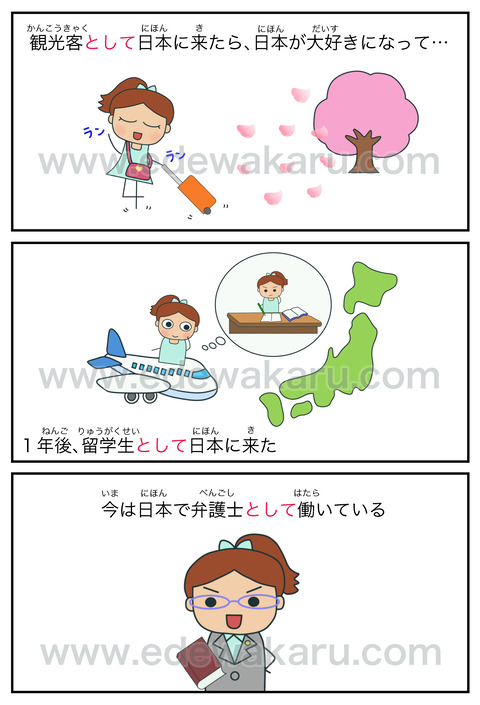
Meaning
In the position of 〜
In the role of 〜
In the capacity of 〜
Under the name of 〜
How to use it
Noun [dictionary form] + として
Noun [dictionary form] + としての + noun
Explanation
“〜として” is a sentence pattern that expresses a position, capacity, status, or pretext, as in “in the position of 〜” or “under the name of 〜.” It is used when you want to emphasize a position, qualification, or pretext. 😊 When followed by a noun, it becomes “〜としての + noun.”
[Examples]
Advice as a teacher
An opinion as a parent
[For those who want to learn more]
When “は” is added, as in “〜としては,” it means “speaking from the position of 〜” and is used to mean “judging from the position of 〜.” 😮
[Examples]
As a mother, I can’t support studying abroad...
→ Judging from the position of a mother, I can’t support studying abroad.
As a doctor, I have no choice but to tell you to quit smoking. (Review: 〜ざるを得ない)
→ Speaking from the position of a doctor, I have no choice but to tell you to quit smoking.
However, when using the contrastive “は,” it is used in the sense of “in the position of 〜.” 😓
[Example]
He is excellent as a lawyer, but as a person, he is the worst.
There are several patterns similar to “〜として” that are easy to confuse, so be sure to distinguish and learn them well. 😀
In context 5 examples
観光客(かんこうきゃく)として日本に来た[立場]
→観光客という立場で日本に来たCame to Japan as a tourist. [Position] → Came to Japan in the capacity of a tourist.
留学生(りゅうがくせい)として日本に来た[立場]
→留学生という立場で日本に来たCame to Japan as an international student. [Position] → Came to Japan in the capacity of an international student.
弁護士として働いている[地位・資格]
→弁護士という地位で働いているWorks as a lawyer. [Status/qualification] → Works in the position of a lawyer.
趣味として日本語を勉強している[名目]
→趣味という名目で日本語を勉強しているStudying Japanese as a hobby. [Pretext] → Studying Japanese under the pretext of it being a hobby.
手数料として1万円いただきます[名目]
→手数料という名目で1万円いただきますWe will charge 10,000 yen as a handling fee. [Pretext] → We will charge 10,000 yen under the name of a handling fee.
Read the original source text
Meaning
〜の立場で
〜の地位で
〜の資格で
〜の名目で
How to use it
名詞[辞書形]+として
名詞[辞書形]+としての+名詞
Explanation
「〜として」は「〜の立場で」「〜の名目で」というように【立場】【資格】【地位】【名目】などを表す文型です。立場や資格、名目を強調して言いたい時に使われます😊また、後ろに名詞がくる場合は「〜としての+名詞」になります。
[例]
教師
としての
アドバイス
親
としての
意見
【余裕がある人へ】
「〜としては」というように「は」がつくと「〜の立場に立って言えば」という意味になり、「〜の立場から判断すると〜」という意味で使われます😮
[例]
母親
としては
留学に賛成できないわ…
→母親
の立場から判断すると、留学には賛成できないわ
医者
としては、タバコはやめろと言わざるを得ませんよ(復習:〜ざるを得ない)
→医者
の立場に立って言えば、タバコはやめろと言わざるを得ない
しかし、
【対比の「は」】を使う場合は、「〜の立場で」の意味で使われます
😓
[例]
彼は弁護士
としては
すばらしいが、人
としては
最低の人間だ
「〜として」は混乱しやすい文型がいくつかありますので、しっかりと区別して覚えておいてください😀
どんなときどう使う 日本語表現文型辞典
Usage 1
Meaning
not even (one)
How to use it
1 + counter+として~ない
Explanation
として~ない
まったくない
「1助数詞+として~ない」の形で最低の単位のものを挙げて、全否定を強く言う言い方。また、 ❸ のように疑問詞を前につけて「疑問詞+1助数詞+として~ない」の形で使うことが多い。他の例「何一つとしてない」など。
Strong overall negation given by selecting some minimal unit as example. Also often used as in sentence ❸ , preceded by interrogative (interrogative + one numerical classifier + として~ない). Other examples include 何一つとしてない.
In context 3 examples
火事で焼けてしまったので、わたしの子どものころの写真は1枚として残っていない。
Since they were burned in the fire, not a single photograph from my childhood remains.
ぼくは1日として君のことを考えない日はない。愛しているよ。
There isn’t a single day when I don’t think of you. I love you.
犯人が通った出入り口の近くに人が何人かいたのだが、だれ一人として気がついた人はいなかった。
There were several people near the entrance the culprit used, but not a single person noticed.
Read the original source text
Meaning
not even (one)
How to use it
1助数詞+として~ない
Explanation
として~ない
まったくない
「1助数詞+として~ない」の形で最低の単位のものを挙げて、全否定を強く言う言い方。また、 ❸ のように疑問詞を前につけて「疑問詞+1助数詞+として~ない」の形で使うことが多い。他の例「何一つとしてない」など。
Strong overall negation given by selecting some minimal unit as example. Also often used as in sentence ❸ , preceded by interrogative (interrogative + one numerical classifier + として~ない). Other examples include 何一つとしてない.
Usage 2
Meaning
as
How to use it
N+として
Explanation
~の立場で/~の資格で/~の名目で
❶ ~ ❸ のように何かをするときや、 ❹ ~ ❻ のように何かを評価するときの立場・資格・名目を述べる。
As in ❶ ~ ❸ , states position, qualification, or name when doing something, or as in ❹ ~ ❻、 when evaluating something.
In context 6 examples
わたしは前に1度観光客として日本に来たことがある。
I once came to Japan as a tourist.
わたしは卒業論文のテーマとして資源の再利用の問題を取り上げることにした。
I decided to take up the issue of resource recycling as the subject of my graduation thesis.
今回の事故につきましては、会社側としてもできるだけのことをさせていただきます。
Regarding this accident, the company will do everything it can.
古代ギリシャで初めて学問としての数学が始まった。
In ancient Greece, mathematics first began as an academic discipline.
この問題についてわたしとしては特に意見はありません。
As far as I’m concerned, I have no particular opinion on this matter.
S氏は医者としてよりも小説家として有名だ。
Mr. S is famous more as a novelist than as a doctor.
Read the original source text
Meaning
as
How to use it
N+として
Explanation
~の立場で/~の資格で/~の名目で
❶ ~ ❸ のように何かをするときや、 ❹ ~ ❻ のように何かを評価するときの立場・資格・名目を述べる。
As in ❶ ~ ❸ , states position, qualification, or name when doing something, or as in ❹ ~ ❻、 when evaluating something.
日本語NET JLPT文法解説まとめ
Usage 1
Read this source entry ↗Meaning
Used to clearly indicate a position, qualification, or the like: “in the capacity of 〜 / as 〜 / under the title of 〜.”
How to use it
N + として
Explanation
as N
An expression used to clearly indicate a position or qualification.
In context 12 examples
私は留学生として日本にきました。
I came to Japan as an international student.
彼は歌手として有名だ。
He is famous as a singer.
ホームステイの家族は、私を家族の1人として温かく迎えてくれた。
My homestay family warmly welcomed me as one of their family.
今年から、エンジニアとして働くことになった。
Starting this year, I will be working as an engineer.
日本語の文字として、ひらなが、カタカナ、漢字が使われている。
Hiragana, katakana, and kanji are used as Japanese writing systems.
リサイクル運動の一つとして、フリーマーケットがある。
Flea markets are one form of recycling activity.
君の考えはアイデアとしてはいいが、コストや開発期間を考えると難しいと思う。
Your idea is good as an idea, but I think it would be difficult when you consider the cost and development time.
オリンピック選手として選ばれたからには恥ずかしくないような結果を残したい。
Now that I've been chosen as an Olympic athlete, I want to achieve a result I won't be ashamed of.
私は非常勤講師として、2つの学校で勤務しています。
I work at two schools as a part-time lecturer.
最近はモデルや女優としても活躍する歌手が増えてきた。
Recently, more singers have also been active as models and actresses.
息子のいじめを親として、黙っているわけにはいきません。
As a parent, I can't remain silent about my son's bullying.
東京タワーは東京の観光地として有名だ。
Tokyo Tower is famous as a tourist attraction in Tokyo.
Read the original source text
Meaning
〜という立場で / 資格で / 名目で立場や資格などをはっきりと示すときに使う表現。
How to use it
N + として
Explanation
as N
An expression used to clearly indicate a position or qualification.
Usage 2
Read this source entry ↗Meaning
“Not at all ~”
Emphasis of negation.
How to use it
1 + counter + として〜ない
Explanation
"Not at all"
Emphasis of negation.
In context 6 examples
君のことを1日として考えない日はないよ。本当に愛してる。
There's not a single day when I don't think about you. I truly love you.
ジョンさんは1日として授業をサボったことがない。
John has never skipped class, not even for one day.
今とても大事な時期だから、1秒として無駄にできない。
This is a very important time, so I can't waste even a second.
部長の提案に誰一人として賛同しなかった。
Not a single person agreed with the department head's proposal.
アルバイト募集の広告を出しているんだけど、誰一人として応募してこない。
We're running an ad for part-time workers, but not a single person is applying.
津波により家が流されてしまい、何1つとして残っていない。
The tsunami swept away our house, and not a single thing remains.
Read the original source text
Meaning
"全く〜ない"
否定の強調。
How to use it
1+助数詞 + として〜ない
Explanation
"Not at all"
Emphasis of negation.
毎日のんびり日本語教師
Usage 1
Read this source entry ↗How to use it
Noun + として~ない
Explanation
Before 「として」, the form 「1 + numeral」 is used, as in 「1日」「1人」「1秒」, to express that there is not even a little. This sentence pattern emphasizes a small quantity.
「誰一人」「何ひとつ」「どれ一つ」 are fixed expressions, and 「誰」「何」「どれ」 can each be omitted.
The number 2 can also be used to express rarity, as in 「彼みたいな人は2人としていない」.
Notes
The similar pattern 「~たりとも~ない」 can express a small quantity by attaching to the form 「1 + numeral」, but it cannot be used with 2.
✕
「彼みたいな人は2人たりともいない」
〇
「彼みたいな人は2人としていない」
(There will never be another person like him.)
In context 3 examples
一瞬として気が抜けない。(一点也不可以掉以轻心。)
I can't let my guard down even for a moment.
誰一人として欠席は許されない。
Not a single person is allowed to be absent.
彼みたいな逸材は今後2人として出てこないだろう。
A talent like him will probably never appear again.
Read the original source text
How to use it
名詞+として~ない
Explanation
「として」の前には1日、1人、1秒などの「1+数詞」の形が接続され、少しも存在しないことを表します。数量が少ないことを強調する文型です。
「誰一人」「何ひとつ」「どれ一つ」は慣用表現で、それぞれ「誰」「何」「どれ」は省略可能です。
「彼みたいな人は2人としていない」のように、稀少を表すために2を使うこともできます。
Notes
似ている文型「~たりとも~ない」は「1+数詞」の形を接続して数量が少ないことを表せますが、2の使い方はありません。
✕
彼みたいな人は2人たりともいない。
〇
彼みたいな人は2人としていない。
(他那样的人不会再有第二个。)
Usage 2
Read this source entry ↗Meaning
as …
even as …
… as a …
How to use it
Noun + として
Noun + としての + noun
Noun + としても / といたしましても
Noun + として / といたしまして
Explanation
Indicates status, position, qualification, or category.
“~といたしまして” and “~といたしましても” are humble language.
Notes
Related grammar: “【N2 Grammar】~にしては”
Related grammar: “【N2 Grammar】~として/としての/としても”
Related grammar: “【N2 Grammar】~としては”
In context 9 examples
このミスコンでは女性としての容姿の美しさを競うのではなく、内面の美しさが評価対象となっている。
In this beauty pageant, the contestants are judged not on their beauty of appearance as women, but on their inner beauty.
プレゼントされたものを売り払うなんて人としてどうかしてる。
Selling off a gift is outrageous behavior for a person.
彼は多趣味で、その1つとして釣りがある。
He has many hobbies, and fishing is one of them.
「抱く」には、男性が女性と夜の営みをすることを表す俗語としての意味がある。(“抱く”有表示男性和女性在夜晚生活的俗语的意思。)
“抱く” also has a vulgar meaning referring to a man having sexual relations with a woman.
上の者に従う。それが組織としての在り方である。
Following one’s superiors—that is how an organization should function.
A監督は現役時代、選手としても素晴らしい功績を残している。
During his playing days, Coach A also achieved outstanding results as a player.
このウイスキーは消毒液としても使用できます。
This whisky can also be used as a disinfectant.
知識としてはあるが経験がない。
I have the knowledge, but no experience.
詳しい条件といたしましては以下になります。(详细条件如下。)
The detailed conditions are as follows.
Read the original source text
Meaning
作为… (として)
作为…也… (としても)
作为…的… (としての)
How to use it
名詞+として
名詞+としての+名詞
名詞+としても/といたしましても
名詞+として/といたしまして
Explanation
身分や立場、資格、種類を表します。
「~といたしまして」「~といたしましても」は謙譲語です。
Notes
関連文法「【N2文法】~にしては」
関連文法「【N2文法】~として/としての/としても」
関連文法「【N2文法】~としては」
日本語文型辞典 英語版
Usage 1
Meaning
Attaches to nouns and expresses a qualification, position, category, or title.
Attaches to nouns denoting people or organizations and means “also from such-and-such a stance or perspective.” May also be used in the polite form, as in
(3)
. The difference between としては and としても is that the latter implies there are also other people or members of an organization who have the same stance or perspective.
→
Nとして (as a/an N) is used to modify another noun.
How to use it
1. Nとして
2. Nとしては→
3. Nとしても
4. NとしてのN
In context 16 examples
研究生としてこの大学で勉強している。
I am studying at this university as a research student.
日本軍の行った行為は日本人として恥ずかしく思う。
As a Japanese, I am ashamed of the actions of the Japanese soldiers.
子供がこんなひどい目にあわされては、親として黙っているわけにはいかない。
As a parent, I cannot sit back and say nothing while children are being treated so badly.
彼は大学の教授としてより、むしろ作家としての方がよく知られている。
He is better known as a writer than as a college professor.
趣味として書道を勉強している。
I am studying calligraphy as a hobby.
学長の代理として会議に出席した。
I attended the meeting in place of the college president.
大統領を国賓として待遇する。
We will treat the president as a state guest.
軽井沢は古くから避暑地として人気があるところだ。
Karuizawa has long been popular as a resort to get away from the summer heat.
文学者としては高い評価を得ている彼も、家庭人としては失格である。
While he has received great acclaim as a literary scholar, as a family man he is a failure.
彼の料理の腕前はプロのコックとしても十分に通用するほどのものだ。
His cooking skills are good enough for him to make it as a professional chef.
私としてもこの件に関しては当惑しております。
I, too, am at a loss with respect to this matter.
学長としても、教授会の意向を無視するわけにはいかないだろう。
Even as the university president, I can’t very well ignore the will of the faculty, can I?
会社といたしましても、この度の不祥事は誠に遺憾に思っております。
Speaking for the company, I feel that this scandal is truly regrettable.
教師としてではなく、一人の人間としての立場から発言したいと思う。
I would like to speak not as a teacher but from the standpoint of a single human being.
彼にも男としての意地があるはずです。
He too must have some male pride.
日本代表としての責任を強く感じ、精一杯頑張りたいと思います。
I feel a strong sense of responsibility as a representative of Japan, and I pledge to do my utmost.
Read the original source text
Meaning
Attaches to nouns and expresses a qualification, position, category, or title.
Attaches to nouns denoting people or organizations and means “also from such-and-such a stance or perspective.” May also be used in the polite form, as in
(3)
. The difference between としては and としても is that the latter implies there are also other people or members of an organization who have the same stance or perspective.
→
Nとして (as a/an N) is used to modify another noun.
How to use it
1. Nとして
2. Nとしては→
3. Nとしても
4. NとしてのN
Usage 2
Meaning
【を...とする】[NをNとする]
→
【とする2】2a
In context 2 examples
その中学はその生徒を退学処分とするという決定をおこなったようだ。
It seems that the junior high school has taken the decision to expel that pupil.
我々は、ここに、我々の国を本日より共和制とすることを宣言する。
We hereby declare our country to be a republic from this day forth.
Read the original source text
Meaning
【を...とする】[NをNとする]
→
【とする2】2a
Usage 3
Meaning
【として...ない】[最小限の数量+として...ない]
として attaches to words that contain the element 一 (one), which indicates a minimum quantity. Followed by a predicate in the negative form and means “not any, not at all.” Examples of words to which として attaches include 一日 (one day), 一時 (いっとき) (a short time), (だれ) 一人 ((not) one person), and (何) 一つ ((not) a single thing). With question words such as なに (what) and だれ (who), として can be dropped, as below.
(例)だれ一人、私の発言を支持してくれる人はいなかった。
Not one person supported what I said.
More commonly used in written language. In spoken language, expressions like ひとつもない (not a single one) are usually used.
In context 4 examples
戦争が始まって以来、一日として心の休まる日はない。
Since the war began, I have not had a day’s peace.
期末試験では、一人として満足のいく答案を書いた学生はなかった。
Not one single student submitted satisfactory answers to the final exam.
高級品ばかりで、一つとして私が買えそうな品物は見当たらない。
There are only luxury goods; I can't find a single thing I can afford to buy.
だれ一人として、私の発言を支持してくれる人はいなかった。
There wasn't a single person who supported what I said.
AIUEO JLPT Grammar
Usage 1
Meaning
This sentence pattern expresses the role, position, qualification, or state of someone or something as seen from a specific point of view. It shows how something is regarded or treated.
How to use it
Noun + として
In context 5 examples
彼はリーダーとしてチームを引っ張っている。
He is leading the team as a leader.
彼は医者としての責任を果たしている。
He is fulfilling his responsibilities as a doctor.
留学生として日本に来ました。
I came to Japan as an exchange student.
この本は、歴史資料としても貴重だ。
This book is valuable as a historical document.
これは彼の意見として聞いておく。
I will take this as his opinion.
Read the original source text
Meaning
This sentence pattern expresses the role, position, qualification, or state of someone or something as seen from a specific point of view. It shows how something is regarded or treated.
How to use it
名詞と+して
Explanation · 日本語
この文型は、名詞に接続して使われ、その名詞が示す役割、立場、資格、または状態を表すときに使われる表現です。個人や物がどのような存在として扱われるかを示す時に使われます。
Usage 2
Meaning
This sentence pattern expresses that something is regarded or treated in a certain way for a specific purpose or role. The expression 「〜を〜とする」 is used to designate something for a particular role or purpose.
How to use it
Noun を + noun と + する or して or した
In context 5 examples
彼は弁護士を目標として勉強を続けている。
He continues to study with the goal of becoming a lawyer.
この契約を条件として、新しいプロジェクトが始まる。
The new project will start on the condition of this contract.
彼を中心としたチームがその問題を解決した。
The team centered around him solved the problem.
この出来事を契機として、会社の方針が大きく変わった。
The company’s policy changed significantly as a result of this event.
この計画は、予算の増額を前提としています。
This plan assumes an increase in the budget.
Read the original source text
Meaning
This sentence pattern expresses that something is regarded or treated in a certain way for a specific purpose or role. The expression 「〜を〜とする」 is used to designate something for a particular role or purpose.
How to use it
名詞を+名詞と+するorしてorした
Explanation · 日本語
この文型は、何かを特定の目的や役割と見なす、または扱うことを表す表現です。「〜を〜とする」や「〜を〜として」は、あるものを特定の立場や役割に据える場合に使われ、「〜を〜とした」は、その状態が過去に決定されたことや、その状態を前提としたニュアンスがあります。
Usage 3
Meaning
This sentence pattern emphasizes that something has never occurred or has never been in a certain state. It is a strong negation, highlighting something that has never happened.
How to use it
Noun + として + negative sentence
In context 5 examples
彼は一日として休んだことがない。
He has never taken even a single day off.
彼女は一度として約束を破ったことがない。
She has never broken a promise even once.
その件については、一人として賛成する者はいなかった。
Not a single person agreed on that matter.
彼は一日として運動を欠かすことはない。
He never skips a day of exercise.
彼の提案に、一つとして問題点がないとは言えなかった。
I could not say that there isn’t a single problem with his proposal.
Read the original source text
Meaning
This sentence pattern emphasizes that something has never occurred or has never been in a certain state. It is a strong negation, highlighting something that has never happened.
How to use it
名詞と+して+否定文
Explanation · 日本語
この文型は、何かが一度も起きなかったり、一度もその状態にならなかったことを強調する否定表現で、強い否定の意味を持ちます。
文法
Usage 1
Meaning
Used to clearly indicate a position, qualification, or the like: “in the capacity of 〜 / as 〜 / under the title of 〜.”
How to use it
N + として
In context 13 examples
私は留学生として日本にきました。
I came to Japan as an international student.
彼は歌手として有名だ。
He is famous as a singer.
ホームステイの家族は、私を家族の1人として温かく迎えてくれた。
My homestay family warmly welcomed me as one of their family.
今年から、エンジニアとして働くことになった。
Starting this year, I will be working as an engineer.
日本語の文字として、ひらなが、カタカナ、漢字が使われている。
Hiragana, katakana, and kanji are used as Japanese writing systems.
リサイクル運動の一つとして、フリーマーケットがある。
Flea markets are one form of recycling activity.
君の考えはアイデアとしてはいいが、コストや開発期間を考えると難しいと思う。
Your idea is good as an idea, but I think it would be difficult when you consider the cost and development time.
オリンピック選手として選ばれたからには恥ずかしくないような結果を残したい。
Now that I've been chosen as an Olympic athlete, I want to achieve a result I won't be ashamed of.
私は非常勤講師として、2つの学校で勤務しています。
I work at two schools as a part-time lecturer.
最近はモデルや女優としても活躍する歌手が増えてきた。
Recently, more singers have also been active as models and actresses.
息子のいじめを親として、黙っているわけにはいきません。
As a parent, I can't remain silent about my son's bullying.
着れなくなった服は、掃除の時に、雑巾の代わりとして使ってます。
I use clothes I can no longer wear as rags when I clean.
東京タワーは東京の観光地として有名だ。
Tokyo Tower is famous as a tourist attraction in Tokyo.
Read the original source text
Meaning
〜という立場で / 資格で / 名目で立場や資格などをはっきりと示すときに使う表現。
How to use it
N + として
Usage 2
Meaning
An emphatic negative meaning “not at all.”
How to use it
1 + counter + として〜ない
In context 6 examples
君のことを1日として考えない日はないよ。本当に愛してる。
There's not a single day when I don't think about you. I truly love you.
ジョンさんは1日として授業をサボったことがない。
John has never skipped class, not even for one day.
今とても大事な時期だから、1秒として無駄にできない。
This is a very important time, so I can't waste even a second.
部長の提案に誰一人として賛同しなかった。
Not a single person agreed with the department head's proposal.
アルバイト募集の広告を出しているんだけど、誰一人として応募してこない。
We're running an ad for part-time workers, but not a single person is applying.
津波により家が流されてしまい、何1つとして残っていない。
The tsunami swept away our house, and not a single thing remains.
Read the original source text
Meaning
全く〜ない否定の強調。
How to use it
1+助数詞 + として〜ない
Bunpro Grammar Reference
Meaning
As (i.e. in the role of), For
How to use it
Noun + として
Noun + として + Noun
Nuance
A grammar point that expresses something, considering either the viewpoint or role of (A). Because it is (A), treat it (B).
Explanation
When the case marking particle と is used to highlight a result, it regularly translates to 'as' in English. This nuance of 'as' simply assumes that (A) is a plain or unchanging fact from which something (usually an opinion or evaluation) is based. Combining this nuance of と with して (the conjugation form of する), として will present (A) as the base point from which (B) can be determined.
Despite being a combination of several individual parts, として is often considered to be a 副助詞 (adverbial particle) by itself, meaning that it will most often be seen connected directly to nouns.
ミキは友達としては最高だ。
As a friend, Miki is awesome.
このゲーム機はDVD(ディーブイディー)プレイヤーとしても使えます。
You can use this game console as a DVD player.
As として works in the same way as a 副助詞, it may be connected directly to a second noun to express that (B) is something functioning as (A).
動物を傷つける奴は人間として失格だ。
People who hurt animals are a failure as humans.
これは会社としての目標です。
This is the goal as a company.
Fun Fact
This result use of と regularly appears when one particular aspect of something is being highlighted (while other aspects still exist). This simply means that nothing apart from (A) is being considered when expressing (B).
タナカさんは友達としてはいい人なんだけど、先輩としてはよくない。
Tanaka-san is a nice person as a friend, but not as a senpai.
In context 17 examples
- 私たちは先生としての彼を尊敬します。
We look up to him as our teacher.
- このゲーム機はDVD(ディーブイディー)プレイヤーとしても使えます。
You can use this game console as a DVD player.
- 動物を傷つける奴は人間として失格だ。
People who hurt animals are a failure as humans.
- これは会社としての目標です。
This is the goal as a company.
- ミキは友達としては最高だ。
As a friend, Miki is awesome.
- 妻としての役割をよく果たしてくれている。
She does well as a wife.
- 挨拶は礼儀として必要です。
As a courtesy, greetings are important.
- ジョチはチンギス・カンの長男として生まれた。
Jochi has been born as the first son of Genghis Khan.
- 私の嫁さんは母として、そして妻として、本当にいい人だ。
As both a mother and as a wife, my wife is really a great person.
- それは事実として受け止めるけど、感情的には納得できない。
I will accept that as a fact, but it hardly satisfies me emotionally.
- これは私の想い出の品として大切に持っていてください。
Please keep it as a memento of me.
- ここに来た証として、私たちの名前を書いておきましょう。
Let's write down our names as proof that we were here.
- このカンファレンスは日本文化を広めることを目的として行われます。
This conference will be held with the role of spreading Japanese culture.
- マルボルク城は中世で最大の城の一つとして知られている。
Castle Malbork is known as one of the biggest castles from the Middle Ages.
- 条件として悪くはないが、今はお金がないから契約できません。
For terms and conditions, they aren't bad, but because I don't have money now I can't enter the contract.
- 文法は日本語の一番難しいところとして、学ぶ方法がなかなか見つからない。
For (something that is considered to be) the most difficult aspect of Japanese, it is hard to find resources for grammar.
- タナカさんは友達としてはいい人なんだけど、先輩としてはよくない。
Tanaka-san is a nice person as a friend, but not as a senpai.
NINJAL 日本語文型データベース
Meaning
Indicates that someone or something is in a particular position, capacity, qualification, or status.
In formal speeches and documents, it may take the form “〜としまして.”
How to use it
Nとして
Notes
What follows “〜として” is a sentence describing an action, state, judgment, evaluation, and so on.
In context 10 examples
妹は今、JICA海外青年協力隊の一員としてセネガルで活動しています。
My younger sister is currently working in Senegal as a member of the JICA Japan Overseas Cooperation Volunteers.
納豆は、体にとてもいいらしい。私は納豆を一種の薬として毎日欠かさず食べている。
Apparently natto is very good for you. I eat it every day without fail as a kind of medicine.
明治時代、日本は近代化を国是として掲げ、国際社会での地位を確立するために、大規模な改革を推進した。
During the Meiji era, Japan made modernization a national policy and promoted large-scale reforms to establish its standing in the international community.
徳島県鳴門市は、ベートーベンの「第九」のアジア初演の地として知られている。
Naruto City in Tokushima Prefecture is known as the site of the first Asian performance of Beethoven’s Ninth Symphony.
今の日本は、恵まれていると思う。食料不足の国を支援することは、国として当然のことだろう。
I think Japan today is fortunate. Supporting countries facing food shortages is only natural for a nation.
いったん払い込まれた会費は原則としてお返しできません。
As a rule, membership fees that have been paid cannot be refunded.
税金を払うことは、国民としての義務だろう。
Paying taxes is a citizen’s duty.
あのコーチにはプロとしての自覚がないのではないか。練習中にスマホばかり見ていて、選手を指導しない。
That coach seems to lack a sense of responsibility as a professional. He’s always looking at his phone during practice and doesn’t coach the athletes.
「先生、この度の事件に対して、教育者としてのご意見をお願いします」
“Teacher, please share your opinion on this incident as an educator.”
政府としましては、将来に希望が持てる成長戦略を明らかにしていくことが重要であると考えております。
As the government, we believe it is important to set out a growth strategy that offers hope for the future.
Read the original source text
Meaning
~という立場・名目・資格・身分であることを表します。
改まったスピーチや文書などでは「〜としまして」の形になることもあります。
How to use it
Nとして
Notes
「〜として」の後には、行為・状態・判断・評価などを述べる文がきます。
IMABI
Standpoint: として(は) VS にとって(は)
Read this IMABI lesson ↗Explanation
Standpoint: として(は) VS にとって(は)
This lesson is about relatively similar speech modals that concern describing standpoint or point of view. Although their English translations cause great confusion to learners, don’t let this beat you.
~として(は)
1. The first uses of ~として that we will study are after nominal phrases. This is something really important to keep in mind because other usages of this will go after other things. So, don’t get things confused in your mind.
The first thing that として is most known for is when it shows “qualification/title”. In other words, it functions like the as in “to carry out one’s duty as an officer”. It can also be used to show what you have something as. This is somewhat causative in nature, but in this sense it is closer to utility. So, just as you can say, “to use a sharp stick as a knife”, you can say 鋭い枝をナイフとして使う. Notice, though, that “as” in English can be used in many more situations than what has just been defined for として.
“(Aは)B としては” is typically just a contrastive usage of として, but it can have nuances more similar to “among” in the sense of ~の場合には. It could also emphasis a side of judgment. For instance, if you were to say 私としては, you are emphasizing your side of opinion.
Particle Note: When used to modify another noun phrase, which is possible as well in English, you must use ~としての.
1. ジョン万次郎まんじろうは、日本人として始めて、アメリカで教育を受けた。
Jon Manjiro was the first person as a Japanese to receive an education in America.
2. 石炭を燃料として使う。
To use coal as fuel.
3. 私一己としては
For my own part/personally
4. 私としては、彼の意見に反対です。
As for me, I don’t agree with his opinion.
5. 最高傑作として作る。X → 最高傑作を作る。
To create as a masterpiece.
6. 最高傑作としての条件 〇
Conditions as a best work masterpiece
7. くそあいつは教師としても無能だぞ。(Vulgar)
That guy is also incompetent as a teacher.
Usage Note: This usage is deemed to be case.
2. Shows complete negation with a word showing unit.
8. 僕は、一日として彼女のことを思わない日はない。
There’s not even a single day that I don’t think about her.
9. 一人として賛成しません。
Not one person can agree.
Usage Note: This usage is deemed to be adverbial.
3. After the 終止形 it means “in assuming that” or “with the reason of”.
10. 話は後でするとして、まず食事にしましょう。
Let’s leave talking for later and eat first.
Usage Note: This usage is deemed to be conjunctive.
Grammar Note: として is a grammaticalized object that should be studied separately from とする. Though its usages derive from it, it has become its own grammar point in its own right. Thus, it should be differentiated from a として from とする used at the end of a dependent clause, in which て would still have a conjunctive function. The として is also not the same as the として found in the 連用形 of タル形容動詞.
11. 堂堂としている。
It’s magnificent. (Grand; impressive)
12. われわれはその実験の結果を基礎として、学会雑誌に発表することになりました。
We had the results of that experiment as our basis and published (the results) in a scientific journal.
In Relation to ~とする
Up to now, there have been several mentions of ~とする. How exactly does this fit with this section? Furthermore, how are you supposed to know what you’re looking at? “AをBとする” is “to make/have A be B” a certain way where と shows the content/substance of a result. ~とする can mean “to presume; to think that; etc.
13. その結果を基礎としている。
To be having the results as the basis.
14. 業としている。
To be pursuing a vocation.
15. 石炭を燃料とする。
To have coal be (used as) fuel.
16. 今は配慮を必要としている。
We need forethought now.
17. 一時として目が離せないよ。
My eyes can leave a single moment.
18. 長官として発言する。
To speak as a general.
19. 初めて会う人やよく知らない人には敬語を使うのが礼儀だとされていますよ。
It is deemed proper etiquette to use Keigo towards people such as those you first meet or don’t know well.
20. 人を殺すのが犯罪(だ)とされていない者はいるのか。
Is there a person that doesn’t deem killing a person a crime?
~としても
~としても is after nominal phrases to mean “even the position of…” or “even if…were to…”.
21. 私としても、この事柄は重要ではないとよく分かります。
As for me, too, I understand well that this matter is not important.
22. 新車を買うとしても、今度もやっぱ(り)黒いのにしよう。
Even if we were to buy a new vehicle, let’s surely get the black one this time.
23. 行けるとしても、少し遅れてしまうかも。
Even if we were able to go, we would end up being a little late.
24. 生まれ変わったとしても、またそんなことをするのか。
Even if I were born again, would such a thing happen again?
~にとって
~にとって, equivalent to “(の立場・たちば)からみて”, means “to/for” and shows someone’s perspective on something. ~にとって may be with は to make a slightly contrasting image or with の attributively. It may be ~にとりまして in polite speech and ~にとっちゃ(あ) in slang.
25. 彼にとっちゃその方がええんだよ。(砕けた)
For him, that way’s better.
26. 初心者にとってはあのクラスは難しい。
That class is difficult to beginners.
27. 人間にとっての事柄ことがら
A circumstance to humans
28. 韓国語を知っている人にとって、日本語は難しくないはずです。
For people who know Korean, Japanese isn’t supposed to be difficult.
29. 核爆弾かくばくだんは世界平和にとっての重大な脅威きょういです。
Nuclear weapons are great threats to world peace.
~として VS ~にとって
Many students often overextend the usages of these two speech modals. Common mistakes include confusing these patterns with topicalization and “although phrases”. As a quick exercise, consider the following sentences and what you should do to fix them.
30a. 彼女は学生として、学校へ行かず、遊んでばかりいるよ。X
30b. 外国人として大変なのは食べ物だと思います。X
30c. 僕にとってその色はあんまり好きじゃない。X
Hopefully you found something wrong with these sentences. The first order of business is to where these speech modals literally come from. ~として comes from the case particle と + the verb する; ~にとって comes from the case particle に + the verb 取る. Once put together, they mark their own unique case function. Thus, some people often call them “compound case particles”.
“Noun + ~として” and “Noun + ~にとって” both show position/point of view, but in the case of the former, it is often used to state an action that one does/did as qualification and/or from a position/standpoint. This may sound confusing, but consider the following.
31. クラスの代表として委員会に出席しました。(Qualification/position)
I attended the committee meeting as the class representative.
32. あなたの医者として、食事の量を減らすよう忠告します。
As your doctor, I advise you to decrease the amount you eat.
On the other hand, ~にとって shows an evaluation or value judgment from the/a standpoint (of someone).
33. 私にとりまして、出張は大変思い出深かったです。
For me, the business trip was very profoundly memorable.
Usage Note: ~にとりまして is normally used when talking to someone much older than you. So, the above sentence would most likely be 私にとって、出張は大変思い出深かったです.
34. これは私にとって忘れられない思い出です。
This is a memory to me that I can’t forget.
35. これはあたしにとってとっても大切なものなんだわ。(Feminine; Emphatic)
This is something very important to me.
With は
は is added to them when raising a circumstance as the topic, emphasis, or show a contrast.
36. 私としては、その考えには賛成いたしかねます。
As for me, I can’t agree to that idea.
37. あんたにとっちゃ朝飯前かもしれんが、俺にとっちゃ大変な仕事なんだよ。(砕けた)
To you it may be trivial, but to me it’s a big job.
Contrast
38. 人{として・にとって]大切なことは何か。
With ~として, the sentence suggests that what’s being important should be done by people whereas ~にとって simply states what’s so, or in this case simply stating a question.
39.
Aさん: A銀行がB銀行と合併がっぺいするそうですよ。
Bさん: へえ。でも、A銀行{としては・にとっては}、そう悪いことではないんじゃないですか。
Aさん: でも、B銀行としては黙って見ているわけにはいかないんじゃないですか。
40.
Aさん: 文部省もんぶしょうとしてはどう考えていますか。
Bさん: 文部省としましては、今回の処置しょちはやむを得ないものと考えております。(謙譲語)
Exercise: Translate the last two passages!
These patterns also differ greatly in what kinds of sentences they’re used in.
~として
Circumstance There is a sentence that shows that something happens, and the sentence after shows an opinion or stance concerning it.
Opinion Used to present one’s opinion and then show an opposite position.
41. 市から感謝状と記念品をいただきました。これは我が家の家宝として大切にしたいです。
I received a letter of thanks and mementos from the city. I would like to treat this as a family treasure in our home.
42. 義務教育の段階で外国語を教えた方がいい。外国語が話せるのは社会人として絶対に必要な教育である。
Foreign language should be taught at the level of mandatory education. Being able to speak a foreign language is absolutely necessary education for a person of society.
~にとって
~にとって~の/ことは~だ/である A very emphatic derivative of the basic form.
In topic sentence After introducing the topic, a concrete explanation follows.
43. 今僕にとって唯一の楽しみになっているのは日本語の勉強です。
What has now become my sole enjoyment is my Japanese studies.
44. 昔の人々の生活にとって、お寺は欠かせないものだった。
The temple was a necessary thing to the lives of the ancient.
Words Used with Them
1. XとしてY
Words that follow Y:
Verbs that describe action: 言う、許す、行動する.
Verbs/adjectives that describe condition: 恥ずかしい、有名だ、知られている.
45. 彼は弁護士としては無能です。
He is no good as a lawyer.
2. XにとってY
Words that follow Y:
Potential expressions: 可能だ、忘れられない.
Adjectives of evaluation: 大切だ、難しい、大変だ.
Adjective + Noun
46. 世界の経済にとって、金融きんゆうを引き締しめるのは好このましくない事態だ。
For the world economy, tightening the money market is not a desirable situation.
In context 50 examples
The first uses of ~として that we will study are after nominal phrases. This is something really important to keep in mind because other usages of this will go after other things. So, don’t get things confused in your mind.
The first uses of ~として that we will study follow nominal phrases. This is important to keep in mind because other uses of this expression follow other things. So, don’t get them mixed up.
ジョン万次郎まんじろうは、日本人として始めて、アメリカで教育を受けた。
Jon Manjiro was the first person as a Japanese to receive an education in America.
石炭を燃料として使う。
To use coal as fuel.
私一己としては
For my own part/personally
私としては、彼の意見に反対です。
As for me, I don’t agree with his opinion.
最高傑作として作る。X → 最高傑作を作る。
To create as a masterpiece.
最高傑作としての条件 〇
Conditions as a best work masterpiece
くそあいつは教師としても無能だぞ。(Vulgar)
That guy is also incompetent as a teacher.
僕は、一日として彼女のことを思わない日はない。
There’s not even a single day that I don’t think about her.
一人として賛成しません。
Not one person can agree.
After the 終止形 it means “in assuming that” or “with the reason of”.
Let’s leave talking for later and eat first.
話は後でするとして、まず食事にしましょう。
Let’s leave talking for later and eat first.
堂堂としている。
It’s magnificent. (Grand; impressive)
われわれはその実験の結果を基礎として、学会雑誌に発表することになりました。
We had the results of that experiment as our basis and published (the results) in a scientific journal.
その結果を基礎としている。
To be having the results as the basis.
業としている。
To be pursuing a vocation.
石炭を燃料とする。
To have coal be (used as) fuel.
今は配慮を必要としている。
We need forethought now.
一時として目が離せないよ。
My eyes can leave a single moment.
長官として発言する。
To speak as a general.
初めて会う人やよく知らない人には敬語を使うのが礼儀だとされていますよ。
It is deemed proper etiquette to use Keigo towards people such as those you first meet or don’t know well.
人を殺すのが犯罪(だ)とされていない者はいるのか。
Is there a person that doesn’t deem killing a person a crime?
私としても、この事柄は重要ではないとよく分かります。
As for me, too, I understand well that this matter is not important.
新車を買うとしても、今度もやっぱ(り)黒いのにしよう。
Even if we were to buy a new vehicle, let’s surely get the black one this time.
行けるとしても、少し遅れてしまうかも。
Even if we were able to go, we would end up being a little late.
生まれ変わったとしても、またそんなことをするのか。
Even if I were born again, would such a thing happen again?
彼にとっちゃその方がええんだよ。(砕けた)
For him, that way’s better.
初心者にとってはあのクラスは難しい。
That class is difficult to beginners.
人間にとっての事柄ことがら
A circumstance to humans
韓国語を知っている人にとって、日本語は難しくないはずです。
For people who know Korean, Japanese isn’t supposed to be difficult.
核爆弾かくばくだんは世界平和にとっての重大な脅威きょういです。
Nuclear weapons are great threats to world peace.
彼女は学生として、学校へ行かず、遊んでばかりいるよ。X
As a student, she doesn’t go to school and just keeps playing. X
外国人として大変なのは食べ物だと思います。X
As a foreigner, I think the difficult thing is food. X
僕にとってその色はあんまり好きじゃない。X
For me, I don’t like that color very much. X
クラスの代表として委員会に出席しました。(Qualification/position)
I attended the committee meeting as the class representative.
あなたの医者として、食事の量を減らすよう忠告します。
As your doctor, I advise you to decrease the amount you eat.
私にとりまして、出張は大変思い出深かったです。
For me, the business trip was very profoundly memorable.
これは私にとって忘れられない思い出です。
This is a memory to me that I can’t forget.
これはあたしにとってとっても大切なものなんだわ。(Feminine; Emphatic)
This is something very important to me.
私としては、その考えには賛成いたしかねます。
As for me, I can’t agree to that idea.
あんたにとっちゃ朝飯前かもしれんが、俺にとっちゃ大変な仕事なんだよ。(砕けた)
To you it may be trivial, but to me it’s a big job.
人{として・にとって]大切なことは何か。
What is important for a person?
市から感謝状と記念品をいただきました。これは我が家の家宝として大切にしたいです。
I received a letter of thanks and mementos from the city. I would like to treat this as a family treasure in our home.
義務教育の段階で外国語を教えた方がいい。外国語が話せるのは社会人として絶対に必要な教育である。
Foreign language should be taught at the level of mandatory education. Being able to speak a foreign language is absolutely necessary education for a person of society.
今僕にとって唯一の楽しみになっているのは日本語の勉強です。
What has now become my sole enjoyment is my Japanese studies.
昔の人々の生活にとって、お寺は欠かせないものだった。
The temple was a necessary thing to the lives of the ancient.
XとしてY
Words that follow Y:
彼は弁護士としては無能です。
He is no good as a lawyer.
XにとってY
Words that follow Y:
世界の経済にとって、金融きんゆうを引き締しめるのは好このましくない事態だ。
For the world economy, tightening the money market is not a desirable situation.
Read the original source text
Explanation
Standpoint: として(は) VS にとって(は)
This lesson is about relatively similar speech modals that concern describing standpoint or point of view. Although their English translations cause great confusion to learners, don’t let this beat you.
~として(は)
1. The first uses of ~として that we will study are after nominal phrases. This is something really important to keep in mind because other usages of this will go after other things. So, don’t get things confused in your mind.
The first thing that として is most known for is when it shows “qualification/title”. In other words, it functions like the as in “to carry out one’s duty as an officer”. It can also be used to show what you have something as. This is somewhat causative in nature, but in this sense it is closer to utility. So, just as you can say, “to use a sharp stick as a knife”, you can say 鋭い枝をナイフとして使う. Notice, though, that “as” in English can be used in many more situations than what has just been defined for として.
“(Aは)B としては” is typically just a contrastive usage of として, but it can have nuances more similar to “among” in the sense of ~の場合には. It could also emphasis a side of judgment. For instance, if you were to say 私としては, you are emphasizing your side of opinion.
Particle Note: When used to modify another noun phrase, which is possible as well in English, you must use ~としての.
1. ジョン万次郎まんじろうは、日本人として始めて、アメリカで教育を受けた。
Jon Manjiro was the first person as a Japanese to receive an education in America.
2. 石炭を燃料として使う。
To use coal as fuel.
3. 私一己としては
For my own part/personally
4. 私としては、彼の意見に反対です。
As for me, I don’t agree with his opinion.
5. 最高傑作として作る。X → 最高傑作を作る。
To create as a masterpiece.
6. 最高傑作としての条件 〇
Conditions as a best work masterpiece
7. くそあいつは教師としても無能だぞ。(Vulgar)
That guy is also incompetent as a teacher.
Usage Note: This usage is deemed to be case.
2. Shows complete negation with a word showing unit.
8. 僕は、一日として彼女のことを思わない日はない。
There’s not even a single day that I don’t think about her.
9. 一人として賛成しません。
Not one person can agree.
Usage Note: This usage is deemed to be adverbial.
3. After the 終止形 it means “in assuming that” or “with the reason of”.
10. 話は後でするとして、まず食事にしましょう。
Let’s leave talking for later and eat first.
Usage Note: This usage is deemed to be conjunctive.
Grammar Note: として is a grammaticalized object that should be studied separately from とする. Though its usages derive from it, it has become its own grammar point in its own right. Thus, it should be differentiated from a として from とする used at the end of a dependent clause, in which て would still have a conjunctive function. The として is also not the same as the として found in the 連用形 of タル形容動詞.
11. 堂堂としている。
It’s magnificent. (Grand; impressive)
12. われわれはその実験の結果を基礎として、学会雑誌に発表することになりました。
We had the results of that experiment as our basis and published (the results) in a scientific journal.
In Relation to ~とする
Up to now, there have been several mentions of ~とする. How exactly does this fit with this section? Furthermore, how are you supposed to know what you’re looking at? “AをBとする” is “to make/have A be B” a certain way where と shows the content/substance of a result. ~とする can mean “to presume; to think that; etc.
13. その結果を基礎としている。
To be having the results as the basis.
14. 業としている。
To be pursuing a vocation.
15. 石炭を燃料とする。
To have coal be (used as) fuel.
16. 今は配慮を必要としている。
We need forethought now.
17. 一時として目が離せないよ。
My eyes can leave a single moment.
18. 長官として発言する。
To speak as a general.
19. 初めて会う人やよく知らない人には敬語を使うのが礼儀だとされていますよ。
It is deemed proper etiquette to use Keigo towards people such as those you first meet or don’t know well.
20. 人を殺すのが犯罪(だ)とされていない者はいるのか。
Is there a person that doesn’t deem killing a person a crime?
~としても
~としても is after nominal phrases to mean “even the position of…” or “even if…were to…”.
21. 私としても、この事柄は重要ではないとよく分かります。
As for me, too, I understand well that this matter is not important.
22. 新車を買うとしても、今度もやっぱ(り)黒いのにしよう。
Even if we were to buy a new vehicle, let’s surely get the black one this time.
23. 行けるとしても、少し遅れてしまうかも。
Even if we were able to go, we would end up being a little late.
24. 生まれ変わったとしても、またそんなことをするのか。
Even if I were born again, would such a thing happen again?
~にとって
~にとって, equivalent to “(の立場・たちば)からみて”, means “to/for” and shows someone’s perspective on something. ~にとって may be with は to make a slightly contrasting image or with の attributively. It may be ~にとりまして in polite speech and ~にとっちゃ(あ) in slang.
25. 彼にとっちゃその方がええんだよ。(砕けた)
For him, that way’s better.
26. 初心者にとってはあのクラスは難しい。
That class is difficult to beginners.
27. 人間にとっての事柄ことがら
A circumstance to humans
28. 韓国語を知っている人にとって、日本語は難しくないはずです。
For people who know Korean, Japanese isn’t supposed to be difficult.
29. 核爆弾かくばくだんは世界平和にとっての重大な脅威きょういです。
Nuclear weapons are great threats to world peace.
~として VS ~にとって
Many students often overextend the usages of these two speech modals. Common mistakes include confusing these patterns with topicalization and “although phrases”. As a quick exercise, consider the following sentences and what you should do to fix them.
30a. 彼女は学生として、学校へ行かず、遊んでばかりいるよ。X
30b. 外国人として大変なのは食べ物だと思います。X
30c. 僕にとってその色はあんまり好きじゃない。X
Hopefully you found something wrong with these sentences. The first order of business is to where these speech modals literally come from. ~として comes from the case particle と + the verb する; ~にとって comes from the case particle に + the verb 取る. Once put together, they mark their own unique case function. Thus, some people often call them “compound case particles”.
“Noun + ~として” and “Noun + ~にとって” both show position/point of view, but in the case of the former, it is often used to state an action that one does/did as qualification and/or from a position/standpoint. This may sound confusing, but consider the following.
31. クラスの代表として委員会に出席しました。(Qualification/position)
I attended the committee meeting as the class representative.
32. あなたの医者として、食事の量を減らすよう忠告します。
As your doctor, I advise you to decrease the amount you eat.
On the other hand, ~にとって shows an evaluation or value judgment from the/a standpoint (of someone).
33. 私にとりまして、出張は大変思い出深かったです。
For me, the business trip was very profoundly memorable.
Usage Note: ~にとりまして is normally used when talking to someone much older than you. So, the above sentence would most likely be 私にとって、出張は大変思い出深かったです.
34. これは私にとって忘れられない思い出です。
This is a memory to me that I can’t forget.
35. これはあたしにとってとっても大切なものなんだわ。(Feminine; Emphatic)
This is something very important to me.
With は
は is added to them when raising a circumstance as the topic, emphasis, or show a contrast.
36. 私としては、その考えには賛成いたしかねます。
As for me, I can’t agree to that idea.
37. あんたにとっちゃ朝飯前かもしれんが、俺にとっちゃ大変な仕事なんだよ。(砕けた)
To you it may be trivial, but to me it’s a big job.
Contrast
38. 人{として・にとって]大切なことは何か。
With ~として, the sentence suggests that what’s being important should be done by people whereas ~にとって simply states what’s so, or in this case simply stating a question.
39.
Aさん: A銀行がB銀行と合併がっぺいするそうですよ。
Bさん: へえ。でも、A銀行{としては・にとっては}、そう悪いことではないんじゃないですか。
Aさん: でも、B銀行としては黙って見ているわけにはいかないんじゃないですか。
40.
Aさん: 文部省もんぶしょうとしてはどう考えていますか。
Bさん: 文部省としましては、今回の処置しょちはやむを得ないものと考えております。(謙譲語)
Exercise: Translate the last two passages!
These patterns also differ greatly in what kinds of sentences they’re used in.
~として
Circumstance There is a sentence that shows that something happens, and the sentence after shows an opinion or stance concerning it.
Opinion Used to present one’s opinion and then show an opposite position.
41. 市から感謝状と記念品をいただきました。これは我が家の家宝として大切にしたいです。
I received a letter of thanks and mementos from the city. I would like to treat this as a family treasure in our home.
42. 義務教育の段階で外国語を教えた方がいい。外国語が話せるのは社会人として絶対に必要な教育である。
Foreign language should be taught at the level of mandatory education. Being able to speak a foreign language is absolutely necessary education for a person of society.
~にとって
~にとって~の/ことは~だ/である A very emphatic derivative of the basic form.
In topic sentence After introducing the topic, a concrete explanation follows.
43. 今僕にとって唯一の楽しみになっているのは日本語の勉強です。
What has now become my sole enjoyment is my Japanese studies.
44. 昔の人々の生活にとって、お寺は欠かせないものだった。
The temple was a necessary thing to the lives of the ancient.
Words Used with Them
1. XとしてY
Words that follow Y:
Verbs that describe action: 言う、許す、行動する.
Verbs/adjectives that describe condition: 恥ずかしい、有名だ、知られている.
45. 彼は弁護士としては無能です。
He is no good as a lawyer.
2. XにとってY
Words that follow Y:
Potential expressions: 可能だ、忘れられない.
Adjectives of evaluation: 大切だ、難しい、大変だ.
Adjective + Noun
46. 世界の経済にとって、金融きんゆうを引き締しめるのは好このましくない事態だ。
For the world economy, tightening the money market is not a desirable situation.