AIUEO JLPT Grammar
Meaning
This sentence pattern is used when the speaker considers that something may happen. In casual speech, the expression is often shortened to “〜かも” by omitting the “しれない,” giving it a more casual tone, which is commonly used in conversations between friends or people with close relationships.
How to use it
動詞かも+しれない形容詞かも+しれない形容動詞かも+しれない名詞かも+しれない
Explanation · 日本語
この文型は、話者が何かが起こる可能性があると考える場合に使う表現です。口語では「しれない」を省略して「〜かも」とすることが多いです。この省略形は、よりカジュアルな感じを与え、親しい人同士の会話で多用されます。
In context 5 examples
雨が降るかもしれない。
It might rain.
プロジェクトが遅れるかもしれません。
The project might be delayed.
この薬は効かないかも。
This medicine might not work.
この服は高かったかもしれない。
This dress may have been expensive.
事前に連絡しなかったら、彼は来なかったかもしれない。
If I hadn't contacted him in advance, he might not have come.
文法
Meaning
〜の可能性がある
話し手が推測したことを言う表現。「〜でしょう / だろう」に比べ、判断の根拠が薄く、不確かな推量である。
How to use it
V(普通形) + かもしれない
イA(普通形)+かもしれない
ナA(普通形)だ + かもしれない
N(普通形)だ + かもしれない
In context 14 examples
午後から雨がやむかもしれません。
来週、大型の台風が来るかもしれない。
最近、夫の帰りが遅いし、いい匂いがするし、浮気しているかもしれない。
今日は仕事がたくさんあるので、飲み会に参加できないかもしれない。
ピーターさんは薬指に指輪をしているし、結婚しているかもしれない。
走れば終電に間に合うかもしれません。
新しい先生は顔が怖いし、厳しいかもしれない。
このカバン、値段が書いていないけど、日本製だし、高いかもしれない。
トムさんは高そうなギターを持っているし、ギターが上手かもしれない。
今夜、息子の友達のジェームス君が家に晩ご飯を食べに来るんだけど、どんな料理を作ったらいいんだろう。日本食は好きじゃないかもしれないし。
今、その国へ行くのは危険かもしれないよ。
新しく来た転校生は目が茶色いし、花も高いし、ハーフかもしれない。
あの子、学生服を着ているけど、見たことないし、この学校の生徒じゃないかもしれない。
うちのポチ、全然ご飯食べないし、病気かもしれない。
Bunpro Grammar Reference
Meaning
Might, Maybe, Probably
How to use it
Verb + かもしれない
[い]Adjective + かもしれない
[な]Adjective + かもしれない
Noun + かもしれない
Verb + かもしれません
[い]Adjective + かもしれません
[な]Adjective + かもしれません
Noun + かもしれません
Nuance
A phrase that expresses uncertainty, but is also frequently shortened.
Explanation
かもしれない is an expression in Japanese that is often treated as a single word, but is actually the combination of the particle かも, and the potential form of the う-Verb 知る (to know) with the auxiliary verb ない attached. かもしれない is regularly translated simply as 'might', or 'maybe', but the literal translation is much closer to 'even (A), we cannot know'.
To use かもしれない, attach it to the end of any verb, noun, な-Adjective or い-Adjective, in their non-polite (keigo) forms.
来年から観光客が増えるかもしれない。
From next year, the number of tourists might increase.
あの建物は教会かもしれない。
That building might be a church.
今日は無理かもしれない。
It might not be possible today.
そこの池は深いかもしれないから気を付けてね。
That lake over there might be deep, so please be careful.
As the う-Verb 知る is part of this construction, it may also be altered to its polite-potential form, creating かもしれません.
明日は休むかもしれません。
I might take the day off tomorrow.
Due to かもしれない being such a common grammar pattern in daily speech for expressing uncertainty about various things, several colloquial forms also exist. These are かも, かもしらん, and かもしれん.
明日は休みだからドライブするかも。
I have a day off tomorrow, so I might go for a drive.
財布を家に忘れてきたかもしらん。
I might have left my wallet at home.
明日は夜遅くまで仕事があるから、行かないかもしれん。
I have to work late tomorrow night, so I probably won’t go.
かも is by far the most common of these colloquial forms, with かもしらん potentially sounding a little bit rough/boyish.
Nuance · 日本語
不確実性を表す時に使われる表現で、省略して使われることが多い。
In context 21 examples
- そうかもね。
That might be right.
- 財布を家に忘れてきたかもしらん。
I might have left my wallet at home.
- そこの池は深いかもしれないから気を付けてね。
That lake over there might be deep, so please be careful.
- あの建物は教会かもしれない。
That building might be a church.
- 今日は無理かもしれない。
It might not be possible today.
- 明日は休むかもしれません。
I might take the day off tomorrow.
- 明日は休みだからドライブするかも。
I have a day off tomorrow, so I might go for a drive.
- 明日は夜遅くまで仕事があるから、行かないかもしれん。
I have to work late tomorrow night, so I probably won’t go.
- 来年から観光客が増えるかもしれない。
From next year, the number of tourists might increase.
- 彼女がまた遅れるかもしれません。
She might be late again.
- 来年アメリカに行くかもしれない。
I might go to America next year.
- このいい服を買えば、人気になるかもしれない。
If I buy these nice clothes, then I might become popular.
- そういうことを言わないほうがいいかもしれない。
It is maybe better to not say such things.
- 彼は何も調べないで、日本に行くかもしれない。
He might go to Japan without researching anything.
- この時期は晴れの日が続くから、富士山を綺麗に見られるかも。
This time of year has a surplus of clear weather days, so you might be able to see Mt. Fuji clearly.
- 彼は専門家だから、説明が分かりやすいかもしれない。
He is an expert so his explanation might be easy to understand.
- 家の近くにある寿司屋より、こっちの寿司屋のほうが美味しいかもしれない。
This sushi restaurant might be more delicious than the one close to my house.
- あの鞄は本当にあの人のものかもしれません。
That bag might actually be that person's bag.
- 最近勉強してないから、明日のテスト落ちるかもしれない。
I haven't been studying recently, so I might fail the test tomorrow.
- あの人はこんな綺麗なものを見たことがないから、面白がるかもしれない。
That person has never seen something so beautiful before, so she might feel fascinated.
- このいい服を買ったら、人気になるかもしれない。
If I buy these nice clothes, I might become popular.
DoJG 日本語文法辞典(全集)
Meaning
Might
How to use it
(i) {V/Adjective い} informal | かもしれない | |
| {話す /話した} かもしれない | Someone might talk/might have talked |
| {高い /高かった} かもしれない | Something might be high/might have been high |
(ii) {Adjective な stem/ Noun} | {Ø/だった} かもしれない | |
| {静か/静かだった} かもしれない | Something might be quiet/might have been quiet |
| {先生/先生だった} かもしれない | Someone might be a teacher/might have been a teacher |
Explanation
Can't tell if ~
In context 8 examples
午後雨が降るかもしれない・かもしれません。
It might rain in the afternoon.
あの先生の授業はつまらないかもしれない・かもしれません。
That teacher's class might be dull.
京都の桜はまだ奇麗かもしれない・かもしれません。
The cherry blossoms in Kyoto might still be beautiful.
今年の冬は大変寒くなるかもしれません。
It might be very cold this winter.
あの人は今日のパーティーのことを忘れたかもしれません。
He might have forgotten about today's party.
この映画はあなたにつまらないかもしれません。
This movie might be uninteresting for you.
中国語の文法は日本語の文法より簡単かもしれない。
Chinese grammar might be simpler than Japanese grammar.
あれは鈴木先生かもしれないよ。
That might be Professor Suzuki.
どんなときどう使う 日本語表現文型辞典
Meaning
perhaps; it may be that
How to use it
〔普通形〕(ナA/N)+かもしれない
Explanation
先生:正しいかもしれません、正しくないかもしれません。自分で調べてみてください。
その可能性があるという意味に使う。その可能性は、 ❸ のように半々の場合も、 ❹ のようにかなり高い場合も、 ❺ のように万が一という場合もある。可能性を期待したり、恐れたりするときなどにも使われる。
Possibility, whether fifty-fifty, as in sentence ❸ ; very high, as in sentence ❹ ; or quite low, as in sentence ❺ . Used when either looking forward to or dreading an event.
In context 5 examples
雪の日は、この道は危ないですよ。すべるかもしれませんよ。
今日は母が病気なので、先に失礼するかもしれません。
ヤン:わたしの答えは正しいですか。
(スポーツ番組で)あ、森田選手、速い、速い、金メダルが取れるかもしれません。
外国で病気になるかもしれないから、旅行の保険に入った方がいいですよ。
絵でわかる日本語
Meaning
〜可能性がある
How to use it
動詞・形容詞・名詞[普通形]+かもしれない
Explanation
「〜かもしれない」は「〜可能性がある」という意味の文型です。「〜でしょう・〜だろう」に比べて、確信性が低い場合に使われます。日常会話(にちじょうかいわ)では「〜かも」という形が使われることもあります。
[例]
A:今日はすごく寒いね
B:うん。雪が降る
かも
ね
「〜かもしれない」は初級で勉強する文型ですが、会話でもよく使われますので復習しておきましょう😉
In context 5 examples
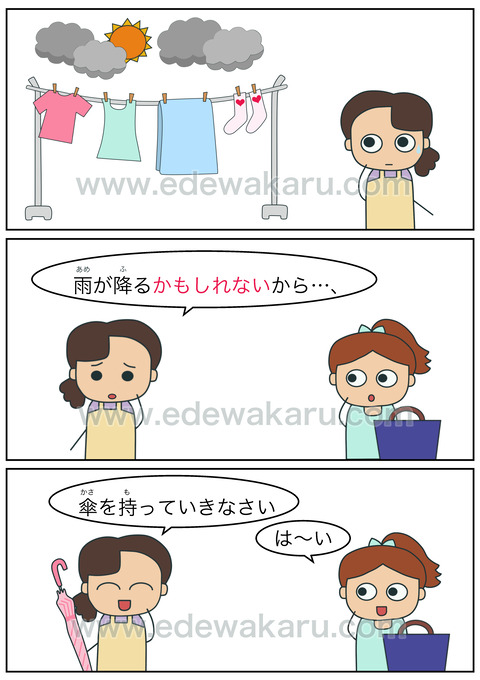
母:雨が降るかもしれないから、傘を持ってきなさい娘:は〜い
→雨が降る可能性があるから、傘を持ってきなさい毎日がんばって勉強したら、N1に合格できるかもしれない!
→N1に合格できる可能性があるA:朝から、のどが痛いの…B:かぜをひいたかもしれないね
→かぜをひいた可能性があるねA:今日はすごく寒いねB:うん。雪が降るかもしれないわね
→雪が降る可能性があるわねA:山田くんは、今日のパーティーにくるかなB:最近忙しそうだから、来ないかもしれないね
→最近忙しそうだから、来ない可能性があるね
日本語文型辞典
Meaning
基本情報N/Na/A/V かもしれない説明話しことばでは、「かもわからない」の形で使われることもある。また、くだけた会話では「かもね」「かもよ」などの形でも使われる。「かもしれぬ」「かもしれず」は書きことばとして使われるかたい表現。
話し手の発議時における推量を表す。「その可能性がある」という意味。「にちがいない」や「だろう」に比べて、「かもしれない」の表す可能性の度合いは低く、そうではない可能性もあるという気持ちを表す。「のかもしれない」は、「のだ」に「かもしれない」が付いたもの。⑧のように、話し手が断定を避けて、表現をやわらげるために使われたり、「御存知かもしれませんが」「私が間違っているかもしれませんが」などのように、話し手の主張を述べる前に前置きとして使われることもある。話しことばでは、「かもしれない」の形で使われるが、視点を自由に移動できる小説の地の文などでは、次のように「かもしれなかった」の形が使われることがある。
相手の言った内容や一般的な見解を、正しい可能性があると一応は認めた上で、それとは異なる意見を述べる場合に使う。
a. …ば/…たら V-るかもしれない
ある条件が成立することを想定して、そのときに起こる可能性についての話し手の推量を表す。
b. …ぱ/…たら V-たかもしれない
すでに起きてしまったことがらについて、「条件が違えば、違う結果になった可能性がある」という意味を表す。話し手の後悔や、悪い結果をまぬがれたことに安堵する気持ちを表すような場合に使われる。
How to use it
…かもしれない
たしかに…かもしれない
なるほと…かもしれない
…ぱ/…たら …かもしれない
In context 17 examples
A:あの偉そうにしている人、ひょっとしてここの社長かもしれないね。
B:そうかもね。ここよりもあっちの方が静かかもしれない。行ってみようか。
雨が降るかもしれないから、かさを持っていったほうがいいよ。
A:来週のパーティー、行くの?
B:まだ決めてないんだ。行くかもしれないし、行かないかもしれない。ノックをしても返事がない。彼はもう寝てしまったのかもしれない。
交渉相手が依然として強気の姿勢をくずさないということは、もしかすると何か強力な材料をもっているのかもしれない。
見合い話が壊れて、さぞがっかりしているだろうと心配していたが、それほど気にしている様子もない。当の本人は案外平気なのかもしれない。
ちょっと待って。今山田君が言ったそのアイデア、ちょっとおもしろいかもしれないよ。
(例) このままでは、達彦自身の会社も危なくなるかもしれなかった。
A:この計画は危険すぎますよ。
B:確かに、危険かもしれない。しかし、やってみるだけの価値はあると思う。A:今の時代、小さいころから受験勉強を始めなければ、いい大学には入れないんですよ。
B:なるほど君の言うとおりかもしれない。でも、いい大学に入れなくったって、いいじゃないか。女性は強くなったといわれている。確かに、昔に比べれば女性も自由になったかもしれない。しかし、就職ひとつを例にとっても、真の男女平等と言うにはほど遠いのが日本の現状だ。
ここで代打がホームランでも打てば、形勢は逆転するかもしれない。
もう少しがんばれば、志望校に合格できるかもしれない。
あの時彼女を引き留めていたら、僕たちは別れずに済んだかもしれない。
もう少し早く手術をしていれば、あるいは助かったかもしれない。
もし、あの時、救急車の到着があと5分遅かったら、私は今こうして生きていなかったかもしれない。
日本語文型辞典 英語版
Meaning
【かもしれない】[N/Na/A/V かもしれない]In spoken language, the form かもわからない can also be used. In informal conversation, かもね and かもよ may be used. かもしれぬ and かもしれず are formal expressions used in written language.
B:そうかもね。
That might be.
B:まだ決めてないんだ。行くかもしれないし、行かないかもしれない。
I haven’t decided yet. I may go, or I may not go.
Expresses a supposition on the part of the speaker at the time of utterance. Means there is a possibility of something being the case. Compared to にちがいない and だろう, the degree of probability indicated by かもしれない is low, and there is a possibility it won’t happen. Sometimes used in the form のかもしれない, which consists of かもしれない combined with のだ.
As in
(8)
, かもしれない may be used when the speaker wants to avoid an absolute declaration and soften his/her manner of expression. It may also be used by the speaker to preface an assertion, in expressions like 御存知かもしれませんが or 私が間違っているかもしれませんが.
In spoken language, かもしれない is used. In written language—including narrative passages in novels, in which different perspectives may be adopted freely—かもしれなかった can be used, as seen in the following example.
(例)このままでは、達彦自身の会社も危なくなるかもしれなかった。
At this rate, there was a possibility that Tatsuhiko’s own company would be in danger.
B:確かに、危険かもしれない。しかし、やってみるだけの価値はあると思う。
Certainly, it may be risky. However, it’s worth giving it a try.
B:なるほど君の言うとおりかもしれない。でも、いい大学に入れなくったって、いいじゃないか。
I see. That may well be the case, but would it really matter if we didn’t get into a good university?
Used by the speaker to state a differing opinion, after having first acknowledged the possibility that something the other person has said, or a general opinion, may be true.
Indicates the speaker’s conjecture regarding what might happen next, based on the assumption of a certain condition.
b. ...ば/...たら V-たかもしれない
This pattern is used to talk about something that has already happened and to express that, if the conditions had been different, the result could have been different. Used to express the speaker’s regret, or a sense of relief that a negative outcome was avoided.
How to use it
1. ...かもしれない
2. たしかに...かもしれないなるほど...かもしれない
3. ...ば/...たら ...かもしれないa. ...ば/...たら V-るかもしれない
In context 16 examples
A:あの偉そうにしている人、ひょっとしてここの社長かもしれないね。
That person acting so high and mighty might just be the president of this company.
ここよりもあっちの方が静かかもしれない。行ってみようか。
It might be quieter over there than it is here. Shall we go?
雨が降るかもしれないから、かさを持っていったほうがいいよ。
It might rain today, so you’d better take your umbrella.
A:来週のパーティー、行くの?
Are you going to the party next week?
ノックをしても返事がない。彼はもう寝てしまったのかもしれない。
There was no response when I knocked on the door. He might have gone to sleep already.
交渉相手が依然として強気の姿勢をくずさないということは、もしかすると何か強力な材料をもっているのかもしれない。
The fact that the other party continues to maintain a hard-line stance in negotiations may be because they have something very powerful to back their position....
見合い話が壊れて、さぞがっかりしているだろうと心配していたが、それほど気にしている様子もない。当の本人は案外平気なのかもしれない。
I was worried about her being disappointed over the breakdown of the marriage negotiations, but she didn’t seem to mind it that much. She might be unexpectedly unconcerned about it.
ちょっと待って。今山田君が言ったそのアイデア、ちょっとおもしろいかもしれないよ。
Wait a second, the idea that Yamada-kun just mentioned could be interesting.
A:この計画は危険すぎますよ。
This plan is too risky.
A:今の時代、小さいころから受験勉強を始めなければ、いい大学には入れないんですよ。
In this day and age, it’s impossible to get into a good university unless you start preparing for the entrance exams when you’re very young.
女性は強くなったといわれている。確かに、昔に比べれば女性も自由になったかもしれない。しかし、就職ひとつを例にとっても、真の男女平等と言うにはほど遠いのが日本の現状だ。
It is said that women have gotten stronger. It may be true that women have more freedom compared with the olden days, but if you look at employment as an example, the present situation in Japan is a long way from true gender equality.
ここで代打がホームランでも打てば、形勢は逆転するかもしれない。
If the pinch hitter hits a home run here, the momentum of the game could be reversed.
もう少しがんばれば、志望校に合格できるかもしれない。
If I try a little harder, I may be able to pass the exam for the college I want to get into.
あの時彼女を引き留めていたら、僕たちは別れずに済んだかもしれない。
If I had stopped her from leaving then, we might not have broken up.
もう少し早く手術をしていれば、あるいは助かったかもしれない。
Had he been operated on sooner, he might have been saved.
もし、あの時、救急車の到着があと5分遅かったら、私は今こうして生きていなかったかもしれない。
If the ambulance had arrived five minutes later than it did at that time, I might not be here alive.
日本語NET JLPT文法解説まとめ
Meaning
〜の可能性がある
話し手が推測したことを言う表現。「〜でしょう / だろう」に比べ、判断の根拠が薄く、不確かな推量である。
How to use it
V(普通形) + かもしれない
イA(普通形)+かもしれない
ナA(普通形)だ + かもしれない
N(普通形)だ + かもしれない
Explanation
"maybe / perhaps"
Indicates that there is a possibility.
An expression in which the speaker says what he or she guesses. It is an uncertain guess with less basis for judgment than ”〜でしょう / 〜だろう”
In context 14 examples
午後から雨がやむかもしれません。
来週、大型の台風が来るかもしれない。
最近、夫の帰りが遅いし、いい匂いがするし、浮気しているかもしれない。
今日は仕事がたくさんあるので、飲み会に参加できないかもしれない。
ピーターさんは薬指に指輪をしているし、結婚しているかもしれない。
走れば終電に間に合うかもしれません。
新しい先生は顔が怖いし、厳しいかもしれない。
このカバン、値段が書いていないけど、日本製だし、高いかもしれない。
トムさんは高そうなギターを持っているし、ギターが上手かもしれない。
今夜、息子の友達のジェームス君が家に晩ご飯を食べに来るんだけど、どんな料理を作ったらいいんだろう。日本食は好きじゃないかもしれないし。
今、その国へ行くのは危険かもしれないよ。
新しく来た転校生は目が茶色いし、鼻も高いし、ハーフかもしれない。
あの子、学生服を着ているけど、見たことないし、この学校の生徒じゃないかもしれない。
うちのポチ、全然ご飯食べないし、病気かもしれない。
毎日のんびり日本語教師
How to use it
動詞普通形+(の)かもしれない
い形容詞+(の)かもしれない
な形容詞語幹+(なの)かもしれない
名詞+(の)かもしれない
Explanation
話者の推測を表します。前には「もしかして」や「もしかすると」、「ひょっとすると」などが呼応することもあります。
「かもしれない」は、「でしょう」や「はず」よりも物事が発生する可能性が低いです。
なお、「かもしれない」の前には「の」が挿入されることがあり、この「の」は
話者の強めの推量
を表します。な形容詞に接続する場合は「なの」になります。「雨が降るかもしれない」と「雨が降るのかもしれない」では、後者の方が話者の推量・推測を強く表したものとなります。
彼は来るかもしれない。(半々)
彼は来るだろう。(~80%程度)
彼は来るはずだ。(~99%程度)
彼は来る。
Notes
特になし
In context 10 examples
せっかくお薦めしてくれた映画だけど、ホラーなら一人で見れないかもしれません。
混んでるから座れないかもしれない。
夫が不倫をしているかもしれない。(我丈夫可能在出轨。)
もしかするとこれから雪が降るかもしれない。
彼は人よりも少しだけ悲しい人生を送ってきたのかもしれない。
喉が痛いから、ひょっとしたら風邪を引いたかもしれない。
あの時ああしていれば違う結果だったかもしれないと後悔するのは虚しいことだ。
新しい出会いが私の何かを変えてくれるかもしれない。(新的邂逅可能会改变我。)
笑顔さえあれば、言葉は要らないのかもしれない。
年末年始は忙しくて休む暇さえないかもしれない。
NINJAL 日本語文型データベース
Meaning
~の可能性があるというときの推量の言い方です。その可能性を恐れたり、期待したりするときに使います。はっきり断定するのを避けて、自己主張を強くしないで言いたいときにも使うことがあります。可能性が高い場合も低い場合もあります。特に根拠がなくても可能性があれば使えます。
How to use it
V普通形+かもしれない
i-A普通形+かもしれない
na-A普通形+かもしれない(ただし、「na-Aだ」→「na-A+かもしれない」)
N普通形+かもしれない(ただし、「Nだ」→「N+かもしれない」)
その他
Notes
ふつう、過去形や否定形にはしません。
In context 25 examples
「私、今年中に結婚するかもしれないの」
今日は午後、夕立があるかもしれません。ご注意ください。
「すみません。今日はゆっくりお話しする時間が取れないかもしれません」
「ヤンさんの引越し先、調べてみますけど、わからないかもしれませんよ」
あ、窓が開いていた。私の下手な歌を誰かに聞かれたかもしれないな。
はっきり口に出して言わなかったかもしれないけど、亡くなったご両親はあなたのことを愛していたはずです。
「山の上は寒いかもしれません。厚手のセーターを持っていったほうがいいですよ」
この天気じゃ、明日のキャンプは厳しいかもしれないね。
「初めてパイを焼いてみたんです。おいしくないかもしれませんが、どうぞ」
私の言い方がよくなかったかもしれませんが、悪気はなかったんです。
試験答案はもう出してしまったけど、3番の答えは正しくなかったかもしれないと思っている。
ゆでたじゃがいもの皮をむくのは、調理器具を使うより手でやったほうが簡単かもしれない。
「このマンションはいかがですか」「うーん。ここは駅から遠いですね。通勤には不便かもしれません」
だめかもしれませんが、中井教授に講演をお願いしてみます。
この地図はあまり正確ではないかもしれません。これでは迷ってしまいます。
雨になりそうだ。今日は傘が必要だったかもしれない。
今回は日本語能力試験のN3を受けたが、N2でも無理じゃなかったかもしれないなあ。
あれ、熱がある。もしかしたらインフルエンザかもしれない。明日は大事な予定があるのに、困ったなあ。
「あそこに座っている人、知り合いかもしれません。ちょっと挨拶してきます。」
「次は私の番かもしれないから、その前にちょっとトイレに行ってくるね」
報道されていることは、はじめからすべてが本当じゃないかもしれないと思っているほうがよい。
あれ、前にDVDで見たのはこれじゃなくて、違う映画だったかもしれない。
明日の歯医者の予約は3時じゃなかったかもしれない。確認しなければ。
「世の中、お金では変えないものもあるでしょう」「それはそうかもしれないけど、お金がなければ生きていくのは大変だよ」
あの2人、ひょっとすると付き合っているのかもしれない。なんだかいい雰囲気だった。
Yokubi — The Common Grammar Guide (https://yoku.bi)
Explanation
わけ is a noun meaning "reason" (as in "why"). It can be used in many different set expressions. It is not possible to list all of them here but just a few common ones.
At the core わけ(だ) states a reason, explanation, fact, logical restatement, or conclusion. This usage can occasionally be replaced with のだ.
わけがない means "there is no way" and implies that something is not even remotely thinkable by the speaker
わけじゃない on the other hand is a roundabout way to negate a situation, circumstance, or logical conclusion.
わけにはいかない means that something is not possible according to general knowledge or social expectations.
Since わけ is a very strong statement, it is often paired with という in the form of というわけ to soften the impact of the expression.
はず expresses that the speaker expects something to factually be true or come true. It can be similar to the English "should" but it does not cover the entire same range of situations. はず also implies that the expectation is based on reasoning and is not pure conjecture.
べき states that the speaker expects a certain behaviour or state to be upheld, because not doing so would be bad, irresponsible, etc.
There are however some situations where using べき isn't always so heavy, especially in questions when asking for someone's wisdom or advice.
When in the past tense like べきだった, it says that an action or state "was" or "would have been" right, usually the latter.
べし is an archaic version of べき. Just be aware it exists.
ものだ can also express "should" with the nuance that it's a general "should" that applies to a lot of people, not just a specific person or a group. It is often used to state the nature of "how things are".
かもしれない is a compound sentence-ender. It attaches the same way as か alone does. It expresses that the speaker thinks the statement is a possibility. Sometimes people attach this to things they know are true for politeness's sake.
かもしれない is often shortened to just かも in casual conversation.
In context 1 examples
まだ寝ぼけているかもしれない。
Maybe she's still half asleep.
IMABI
Might: かもしれない
Read this IMABI lesson ↗Explanation
Might: かもしれない
To describe a 50/50 probability that “may/might” happen, ~かもしれない is used. It is composed of the particles か and も followed by the negative form of the verb 知れる, which is an intransitive verb meaning “to be known/understood.”
Orthography Note: The Kanji spelling ~かも知れない is fairly common, although the Hiragana-only spelling is most prevalent.
ConjUGATING WITH かもしれない
The particle か follows the 連体形 of predicates, but with nominal (including adjectival nouns) predicates, the copula must be deleted. It may also follow both the non-past tense and the past tense as well as the negative auxiliary ~ない. However, it does not follow polite forms as politeness is marked in it by using either ~ません or the somewhat less polite ~ないです.
Plain SpeechPolite Speech
Verbsするかもしれない
Might doするかもしれません
するかもしれないです
Might do
Adjectives古いかもしれない
Might be old古いかもしれません
古いかもしれないです
Might be old
Adjectival Nouns (だ)簡単かもしれない
Might be easy簡単かもしれません
簡単かもしれないです
Might be easy
Nouns (だ)犬かもしれない
Might be a dog犬かもしれません
犬かもしれないです
Might be a dog
~た噓だったかもしれない
Might have been a lie噓だったかもしれません
噓だったかもしれないです
Might have been a lie
~ない来ないかもしれない
Might not come来ないかもしれません
来ないかもしれないです
Might not come
Phrases like ひょっとして (by any chance) and もしかしたら・もしかすると・もしかして (perhaps/possibly) frequently accompany かもしれない.
1. 人間にんげんが全ての石油せきゆを使いきってしまう時が{訪おとずれる・来る}かもしれません。
The time may come when man will use up all oil.
2. 前の試験しけんが難しかったなら、今度こんどの試験も難しいかもしれません。
If the previous exam was difficult, the next exam may also be difficult.
3. もしかしたら彼は気が変わるかもしれません。
Perhaps his mind will change.
4. ひょっとすると雨に遭あうかもしれません。
Chances are that we’ll encounter rain.
5. セス先生は厳しすぎるかもしれない。
Seth Sensei might be too strict.
6. このレッスンは初級者には難しいかもしれません。
This lesson might be difficult to beginners.
7. ラファエル君が飲み会に行ったら、彼女に怒られるかもしれない。
If Rafael were to go to the drinking party, his girlfriend might get mad at him.
8. 円安がこの先ずっと長引くかもしれないから、今のところ、円をドルに両替しない方がいいと思いますよ。
Since the depression of the yen might last for the foreseeable future, I think it’d be best not to exchange yen for dollars for the time being.
~かもしれない vs ~だろう
Whereas ~かもしれない indicates a 50/50 probability, ~だろう・でしょう is closer to an 80% probability. It, too, is frequently used with adverbs such as ひょっとして, もしかしたら, etc.
Although the auxiliary verbs ~だろう・でしょう are derivates of the copula だ, they do not attach to things in the exact same way as だ. They instead attach to the 終止形 much like how the politeness-marker auxiliary です1 does, but they differ from です by how they do so with any inflectable word (用言).
~だろう~でしょう
Verbs雨が降るだろう
It will likely rain雨が降るでしょう
It will likely rain
Adjectives高いだろう
It will likely be expensive高いでしょう
It will likely be expensive
Adjectival Nouns新鮮だろう
It[‘s/will be] surely fresh新鮮でしょう
It[‘s/will be] surely fresh
Nouns犬だろう
It’s most likely a dog犬でしょう
It’s most likely a dog
9. 彼はひょっとしてまだ外にいるでしょう。
He might just be outside.
10. ひょっとしたら彼女はここへ来るだろう。
She will possibly come here.
~かもしれないだろう ??
~かもしれないだろう, at first glance, seems superfluous, but it is occasionally used. In this scenario, ~かもしれない refers to the probability of the situation occurring at hand, and ~だろう rhetorically questions the listener about their recognition of that probability. As such, ~だろう would be more forceful than ~じゃない ・じゃん, which has a lighter tone.
11. 最後かもしれないだろう。
This might be the last (time), you know.
You may also encounter ~だろうが after ~かもしれない to indicate frustration at what the speaker perceives to be a negative effect on a likelihood that the speaker is banking on, even though it is only a 50/50 chance.
12. もしかしたらあの女、俺達全員を殺して口封じしようとしてくるかもしれないだろうが。
Ugh, that woman could try to kill us all to keep us quiet.
From 伝説の剣士のつくりかた by 派虎衆.
Albeit old-fashioned, the auxiliary verb ~(よ)う which technically creates だろう can be conjugated normally with conjugatable parts of speech, then be followed by ~かもしれない. However, the supposition meaning of this auxiliary is hardly ever used in modern speech.
13. それだけの意味はあろうかもしれない。
It just might have that much meaning.
By 堀辰雄.
~のかもしれない
By inserting the nominalizer の, the speaker is envisioning a purely hypothetical scenario based on a given truth or the current circumstance. In doing so, the speaker highly emphasizes their opinion on how true that outcome might be, but this is more so on what they are betting on rather than suggesting a higher probability. ~のかもしれない may be used with any tense as well as positive and negative sentences.
With…
Verbs降るのかもしれない
It just might rain
Adjectives新しいのかもしれない
It might just be new
Adjectival Nouns新鮮なのかもしれない
It might just be fresh
Nouns犯人なのかもしれない
Might just be the criminal
~ない来ないのかもしれない
Might just not come
~た死んだのかもしれない
Just might have died
Grammar Notes:
By inserting の, notice that the copula in the form of な must be used with nouns and adjectival nouns in the non-past tense.
Contracting の to ん in this grammar point is not seen in standard speech.
14. まだ家へ帰っていなかったのかもしれない。
He might have not been home yet.
15. もしかしたら暑さに負けずに外に出ていたら、何か素敵なことが起きていたのかもしれない。
Perhaps if I hadn’t let the heat get to me and gone out, something fantastic might have happened.
16. 自分が本当にやりたかったことに気がついていなかったのかもしれない。
I might not have ever realized what I truly wanted to do.
17. 健太君が帰ってこないね。もしかしたら事故に遭ったのかもしれない。
Kenta hasn’t come home yet. Maybe he got into an accident.
~かも
In casual speech, ~かもしれない is frequently contracted to ~かも. What is so peculiar about this contraction is that it loses its ability to be followed by conjunctions and most final particles – with exception to ね・な.
To combat this problem, the copula だ may follow it so that it can then be followed by endings such as ~が・けど・ぞ, etc. You may even see ~かもです, which is not quite as accepted but is gaining currency among younger speakers. However, the use of だ・です after かも is still not so common, but that is likely to change in the coming decades.
18. 彼はもう帰ったかもな。
He might have already come home.
19. それ、いいかも!
That sounds good!
20. いけるかも!
That might work!
21. お金がちょっと足りねーかも。
I might be a little short on money.
22. 来週なら空いてるかも!
I might be free next week!
23. ひょっとして、俺、世界で一番かわいい猫かもにゃあ!
I might just be the cutest cat in the world!
24. 昨日はゴミ収集車が来なかったのかも。
The garbage truck might not have come yesterday.
25. スマホは不幸の原因かもだぞ!
Your smartphone might be the cause of your unhappiness!
26. あんたにとっては、些細ささいなことかもだけどな、俺には重大な問題だぞ。
For you, it may like be trivial, but to me, it’s a big deal!
27. 今なら勝ち目があるかも(だ)よ!
There might be a chance of winning now!
Grammar Note: Although ~よ may directly follow ~かも, the lack of だ causes the sentence to sound feminine.
~かもしれん
You may also encounter the casual variant ~かもしれん, which is most common in male speech or in certain regions where the contraction ~ん for ~ない is prevalent.
28. なるほど、君のいう通りかもしれんね。
Well then, you may be right.
29. 実は他の同僚も俺らの会話聞いてたかもしれんぞ。
Actually, other co-workers might’ve been listening to our conversation, too!
While です does also go after nouns, this usage of です is least problematic, simply being the polite form of the copula だ. When です follows adjectives, it does so by following the 終止形. In this capacity, it functions as an auxiliary with the sole meaning of marking politeness, losing its copular function. Similarly to this, だろう・でしょう attach to the 終止形 of conjugatable parts of speech in general as well as nouns, but when they follow conjugatable parts of speech, their “copular” functionality becomes mute, as they then only indicate supposition. ↩︎
In context 29 examples
人間にんげんが全ての石油せきゆを使いきってしまう時が{訪おとずれる・来る}かもしれません。
The time may come when man will use up all oil.
前の試験しけんが難しかったなら、今度こんどの試験も難しいかもしれません。
If the previous exam was difficult, the next exam may also be difficult.
もしかしたら彼は気が変わるかもしれません。
Perhaps his mind will change.
ひょっとすると雨に遭あうかもしれません。
Chances are that we’ll encounter rain.
セス先生は厳しすぎるかもしれない。
Seth Sensei might be too strict.
このレッスンは初級者には難しいかもしれません。
This lesson might be difficult to beginners.
ラファエル君が飲み会に行ったら、彼女に怒られるかもしれない。
If Rafael were to go to the drinking party, his girlfriend might get mad at him.
円安がこの先ずっと長引くかもしれないから、今のところ、円をドルに両替しない方がいいと思いますよ。
Since the depression of the yen might last for the foreseeable future, I think it’d be best not to exchange yen for dollars for the time being.
彼はひょっとしてまだ外にいるでしょう。
He might just be outside.
ひょっとしたら彼女はここへ来るだろう。
She will possibly come here.
最後かもしれないだろう。
This might be the last (time), you know.
もしかしたらあの女、俺達全員を殺して口封じしようとしてくるかもしれないだろうが。
Ugh, that woman could try to kill us all to keep us quiet.
それだけの意味はあろうかもしれない。
It just might have that much meaning.
まだ家へ帰っていなかったのかもしれない。
He might have not been home yet.
もしかしたら暑さに負けずに外に出ていたら、何か素敵なことが起きていたのかもしれない。
Perhaps if I hadn’t let the heat get to me and gone out, something fantastic might have happened.
自分が本当にやりたかったことに気がついていなかったのかもしれない。
I might not have ever realized what I truly wanted to do.
健太君が帰ってこないね。もしかしたら事故に遭ったのかもしれない。
Kenta hasn’t come home yet. Maybe he got into an accident.
彼はもう帰ったかもな。
He might have already come home.
それ、いいかも!
That sounds good!
いけるかも!
That might work!
お金がちょっと足りねーかも。
I might be a little short on money.
来週なら空いてるかも!
I might be free next week!
ひょっとして、俺、世界で一番かわいい猫かもにゃあ!
I might just be the cutest cat in the world!
昨日はゴミ収集車が来なかったのかも。
The garbage truck might not have come yesterday.
スマホは不幸の原因かもだぞ!
Your smartphone might be the cause of your unhappiness!
あんたにとっては、些細ささいなことかもだけどな、俺には重大な問題だぞ。
For you, it may like be trivial, but to me, it’s a big deal!
今なら勝ち目があるかも(だ)よ!
There might be a chance of winning now!
なるほど、君のいう通りかもしれんね。
Well then, you may be right.
実は他の同僚も俺らの会話聞いてたかもしれんぞ。
Actually, other co-workers might’ve been listening to our conversation, too!