AIUEO JLPT Grammar
Meaning
This sentence pattern indicates doing one action while refraining from another, or maintaining a state.
How to use it
動詞ない形+で
Explanation · 日本語
この文型は、動作や行動をしない状態で別の動作を行うこと、またはそのままの状態を保つことを示します。
In context 5 examples
朝ご飯を食べないで学校に行くのは体に良くないです。
It’s not good for your health to go to school without having breakfast.
忘れ物をしないでください。
Please don’t forget your things.
マスクを着けないで外出しないでください。
Please don’t go out without wearing a mask.
テレビを見てないで早く寝なさい。
Don't watch TV and go to bed early.
説明を聞かないで質問に答えられますか?
Can you answer the question without listening to the explanation?
Bunpro Grammar Reference
Usage 1
Meaning
Without doing, Not ~ and ~
How to use it
Verb[ない]+ で
Nuance
A common way to indicate that (B) will be done without doing (A).
Explanation
There are two primary ways in which ないで is used with verbs in Japanese. The first is to express 'without doing (A), (B)'. The second is to request that someone 'not do (A)'. We will examine the first in this write-up.
ないで is a combination of the auxiliary verb ない, and the particle で. Due to this, で keeps its standard meaning of 'with/by', in relation to 'not' doing something.
魚を焼かないで食べたから、お腹を壊した。
Since I ate fish without cooking it, I got a stomach ache. (Literally, to break one's stomach)
アミはドアのカギをかけないで寝るの?危ないよ。
Ami, you sleep without locking your doors? That's dangerous.
When ないで is used to express that '(A) has not been done before doing (B)', this is usually contrary to some kind of expectation. Because of this, ないで is often used to express something that may be surprising to the listener.
上司に伝えないで休んだの!?
You took the day off without notifying your boss!?
Caution
Be careful of the following two structures:
(A) ないで (B) - Without doing (A), (B).
(A) なくて (B) - Without doing (A), (B).
Technically, these two constructions share a similar meaning. However, in modern Japanese ないで is used more frequently when the (B) action is being highlighted as being done without (A). On the other hand, なくて is used when (A) is being given as a reason for why something else was/wasn't done.
昼ご飯を温めないで食べた。
I ate my lunch without heating it up. (Event 2 happened without event 1)
インターネットが繋がらなくて困ってる。
I am bothered because the internet isn't connecting. (Event 2 happened because of event 1)
Nuance · 日本語
(A)をせずに(B)をするということを表す一般的に使われる表現。
In context 17 examples
- 休まないで仕事をする。
To work without taking a break.
- 上司に伝えないで休んだの!?
You took the day off without notifying your boss!?
- アミはドアのカギをかけないで寝るの?危ないよ。
Ami, you sleep without locking your doors? That's dangerous.
- 魚を焼かないで食べたから、お腹を壊した。
Since I ate fish without cooking it, I got a stomach ache. (Literally, to break one's stomach)
- 「後悔しないで生きたい。」
'I want to live without regret.'
- 「あの人は便所から手を洗わないで出てきたんだよ。」
'That person left the toilet without washing their hands!'
- 夕食を食べないで、寝る。
To go to bed without eating dinner.
- 「昨日、うちの娘は頭をぶつけたけど、泣かないで『大丈夫だよ』とだけ言ったんだ。本当に驚いた。」
'Yesterday, my daughter hit her head, but without crying, she just said 'I'm fine.' I was really surprised.'
- 「遊ばないで、勉強をしてください」ってお母さんが言いました。
My mother said 'Please study without playing!'
- 「明日はどこにも行かないで家にいるつもりだ。」
'I plan to stay home tomorrow without going anywhere.'
- 「彼はいつも朝ごはんを食べないで仕事に行くんだ。」
'He always goes to work without eating breakfast.'
- 何も言わないで、出て行った。
Without saying a word, he left.
- お父さんはまだ寝ているから、大きい声を出さないで遊んでね。
Since dad is still sleeping, play without talking loudly.
- 「昨日は夜遅く家に帰ったからシャワーを浴びないで寝たんだ。」
'I came back home late at night, so I went to sleep without taking a shower.'
- 日本に行ったことがないから、勉強しないで行くのはやめたほうがいいと思う。
You have never been to Japan, so I think that you better refrain from going without studying (first).
- 昼ご飯を温めないで食べた。
I ate my lunch without heating it up. (Event 2 happened without event 1)
- インターネットが繋がらなくて困ってる。
I am bothered because the internet isn't connecting. (Event 2 happened because of event 1)
Usage 2
Meaning
(Please) do not (for me), Casual request
How to use it
Verb[ない]+ で。
Nuance
A casual, simple conjunctive form used as an abbreviated way of saying please don't do (A).
Explanation
ないでください is a polite way to express 'please don't do (A)'. However, such politeness is often not required, like in conversations between close friends. In these cases, ないで by itself may be used for the same purpose. Although grammatically the same as the ないで with the meaning of 'without doing (A), (B)', rather having a part (A) and a part (B) to the sentence, this ないで acts more like a simple statement.
ないで combines the auxiliary verb ない, with the case marking particle, で. To use this structure, simply attach it to the negative stem of the verb that you wish to request someone not to do. The sentence itself usually finishes with ないで.
先生:「そこの生徒、授業中に寝ないで!」
Teacher: 'The student there, please don't sleep during class!'
母が娘に:「知らない人についていかないで!約束よ。」
Mother to her daughter: 'Please don't go with people you don't know! That's a promise.'
妻が夫に:「貯金をしたいから、無駄な物にお金を使わないで。」
Wife to her husband: 'I want to save up, so please don't use money recklessly.'
Nuance · 日本語
(A)をしてほしくないことをカジュアルに伝えたい時に使われる短くされた活用。
In context 15 examples
- あそこの公園は危ないので、遊ばないで。
Since that park is dangerous, (please) don't play there.
- 先生:「そこの生徒、授業中に寝ないで!」
Teacher: 'The student there, please don't sleep during class!'
- 妻が夫に:「貯金をしたいから、無駄な物にお金を使わないで。」
Wife to her husband: 'I want to save up, so please don't use money recklessly.'
- 母が娘に:「知らない人についていかないで!約束よ。」
Mother to her daughter: 'Please don't go with people you don't know! That's a promise.'
- 冷蔵庫にあるケーキはまだ食べないでね。
(Please) don't eat the cake in the refrigerator yet.
- 食べてからジェットコースターに乗らないで。
(Please) don't ride a rollercoaster after eating.
- 「バカにしないでよ!はんだくん。」
'(Please) don't make a fool out of me! Handa.'
- ここは病院なので、走ったり、騒いだりしないで。
Since this is a hospital, (please) don't do things like run or be boisterous.
- 母親が子供に言う:「まだ熱いから、触らないでね。」
Mother speaking to her child: 'It is still hot, so (please) don't touch it.'
- 母親が子供に言う:「いい子だから、泣かないでね。」
Mother speaking to her child: 'You are a good child, so (please) don't cry, okay? '
- 寝る前に携帯を使ったり、おかしを食べたりしないで。
Before going to bed, (please) don't do things like use your phone or eat candy.
- 明日から旅行に行くから、風邪を引かないでね。
Since you are going on a trip tomorrow, (please) don't catch a cold.
- 姉が弟に言う:「頼むから、親には何も言わないで。」
Elder sister speaking to her younger brother: 'I am asking you, so (please) don't tell our parents.'
- 母親が子供に言う:「お父さんはまだ寝ているので、大きい声を出さないでね。」
Mother speaking to her child: 'Since dad is still sleeping, (please) don't talk loudly.'
- 子供が母親に言う:「ママ、すぐに戻ってくるよ。心配しないで。」
A child speaking to their mother: 'Mom, I will come back soon. (Please) don't worry.'
Usage 3
Meaning
Don't (please), Please do not
How to use it
Verb[な̶い̶で̶く̶だ̶さ̶い̶]+ んといてください
Verb[な̶い̶で̶]+ んといて
Exceptions:
する→せんといて(ください)
くる→こんといて(ください)
Nuance
The Kansai way to request that something not be done.
Explanation
The standard Japanese way to casually request that someone 'please not' do something is created through the use of the auxiliary verb ない, and the case marking particle で. This structure may be seen with or without ください added on the end. The 関西弁 equivalent of this structure is んといて, which conjugates in the same way as ないで.
ん itself is an abbreviation of ない, while といて is a shortened form of でおいて (the て form of おく, used for conveying that something is being done in advance). This means that んといて has the same meaning (and stems from) ないでおいて, which can literally be translated as 'to not do (for some future purpose)'.
As with the standard Japanese construction, ください may be seen with the Kansai dialect variation, but is not required.
Caution
ておく and ないでおく have roughly similar meanings, despite being opposites. ておく means to do something for the purpose of enabling a future event, while ないでおく means to do something for the purpose of preventing a future event.
Caution
する and くる will both conjugate in a unique way when linked with といて. This change affects the base form of the verbs, and will transform する into せん, while くる will become こん.
Notes
関西弁
Nuance · 日本語
関西弁で「何かをしないで」ということを示す表現。
In context 17 examples
- ちょっと今話しかけんといて。
Can you not talk to me right now?
- 商品を触らんといてください。
Please don't touch the products.
- そういう事子供の前で言わんといて。
Can you not say stuff like that in front of my kids?
- バスで行かないで。
バスでいかんといて。Can you (please) not go by bus?
- ラーメンを食べに行かないで。
ラーメンを食べにいかんといて。(Please) don't go eat ramen.
- サッカーをしないでください。
サッカーをせんといてください。Please don't play soccer.
- この本を読まないで。
この本をよまんといて。(Please) don't read this book.
- 高くしないで。
高くせんといて。(Please) don't make it expensive.
- 勝手に一人で行かないで。
勝手に一人でいかんといて。Please don't go alone without permission.
- ここは走らないで下さい。
ここははしらんといてください。Please don't run here.
- 明日の弁当を今夜作っておく。
Tonight, I am going to make lunch for tomorrow in advance.
- 正直に言ったら傷つくかもしれないから、言わないでおく。
They might get hurt if I am honest with them, so I am not going to say it (in advance).
- 余計な事せんといて。
Please don't do things that are unnecessary.
- 洗い物はせんといていいんやけど、してもらったら助かるわ。
It is fine if you don't do the dishes (for me), but if you do, that would be helpful.
- 邪魔になるからこっちにこんといてください。
You are going to get in my way, so please don't come over here.
- 勝手に友達を連れてこんといてって、前も言ったよな。
Didn't I tell you before to not bring your friends without my permission?
- 近所迷惑になるんで鳩に餌をやらんといてください。
Because it is going to inconvenience the neighbors, please don't feed the pigeons.
Usage 4
Meaning
(Please) do not, Do not, Don't (prohibitive)
How to use it
Verb[stem]+ なさんな
Nuance
The Kansai way to prohibit an action, using an old-fashioned verb.
Explanation
As a midway point between ないで 'please don't', and な 'don't!', 関西弁 uses a unique structure, なさんな. なさんな is a combination of the honorific language word なさる, and the sentence ending particle な.
なさる is a polite (slightly outdated) version of する, used to refer to the actions of others (never oneself). なさる conjugates with the conjunctive form of verbs, meaning that なさんな will also conjugate in the same way.
Fun Fact
There are many cases in Japanese where the terminal る (of verbs) will be omitted, due to the shortening of sounds within speech. While this is technically slang, it is a common feature worth memorizing. When る is omitted, it will almost always be replaced by the ん sound, as seen with なさんな. A few more examples are as follows:
するな - Will become すんな, 'don't do!'.
踊るな - Will become 踊んな, 'don't dance!'.
走る - Will become 走んな, 'don't run!'.
Notes
関西弁
Nuance · 日本語
古典的な動詞を使って、何かをするなということを表す際に関西で用いられている表現。
In context 11 examples
- 残してもいいから、無理して食べなさんな。
It's okay if you don't eat everything, don't force yourself to eat it.
- 彼も反省しとるみたいだし、そんなに怒りなさんな。
It seems like he regrets what he did, so don't yell at him.
- そんな遠慮しなさんな。
Please don't hesitate.
- 弁当はこちらで用意をするので、弁当は持ってこなさんな。
We will provide you with lunch, so please don't bring your own.
- 寿司を食べに行かないで。
寿司を食べにいきなさんな。(Please) don't go eat sushi.
- 誰にも言わないで。
誰にもいいなさんな。(Please) don't tell anyone.
- 何もしないで。
何もしなさんな。(Please) don't do anything.
- 値段を高くしないで。
値段を高くしなさんな。(Please) don't increase the price.
- 毎日テレビを見ないで。
毎日テレビをみなさんな。(Please) don't watch TV everyday.
- 机に字を書かないで。
机に字をかきなさんな。(Please) don't write words on the table.
- 未成年でお酒を呑まないで。
未成年でお酒をのみなさんな。(Please) don't drink alcohol if you are underage.
DoJG 日本語文法辞典(全集)
Meaning
Do not do something and; without doing ~
How to use it
Vnegative | ないで | |
| 話さないで | Without talking |
| 食べないで | Without eating |
Explanation
A negative て form of a verb.
In context 7 examples
ナンシーは昨日朝ご飯を食べないで学校へ行った・行きました。
Nancy went to school yesterday without eating her breakfast.
中田さんは大阪に行かないで京都に行った。
Mr. Nakada didn't go to Osaka; he went to Kyoto.
辞書を使わないで読んで下さい。
Please read it without using a dictionary.
まだ帰らないで下さい。
Please don't go home yet.
電話しないで欲しい。
I want you not to call me.
やかましくしないで貰いたい。
I want you to not make noises.
まだあるから買わないでおきました。
Because I still have it, I didn’t buy it (in advance).
どんなときどう使う 日本語表現文型辞典
Meaning
without
How to use it
Vないで
Explanation
1)動詞の否定形には「Vなくて」と「Vないで」がある。どんな状況で動作をしたかを表す場合は「Vないで」を使う。
2)「Vないで」は、 ❶ ~ ❸ では「どんな状態で動作作用が起こったか」、 ❹ では「手段・方法」、 ❺ では「代わりに」などの意味がある。
3)「Vなくて」を使うのは理由を表す場合だけである。
◆ × 兄は上着を着なくて出かけました。
1)Negations of verbs have forms Vなくて and Vないで. When expressing how some action occurs, use Vないで.
3)The form Vなくて is used only for stating rea-sons.
2)In sentences ❶ to ❸ , type of situation where action occurs is described; in sentence ❹ , means and methods are delineated; in sentence ❺ , "instead of" is meant.
In context 5 examples
昨夜は顔も洗わないで寝てしまいました。
兄は上着を着ないで出かけました。
指定席を取らないで新幹線に乗ったら、すわれなかった。
はさみを使わないで、この紙を2枚にしてください。
サンドイッチを買わないで、おにぎりを買いました。
絵でわかる日本語
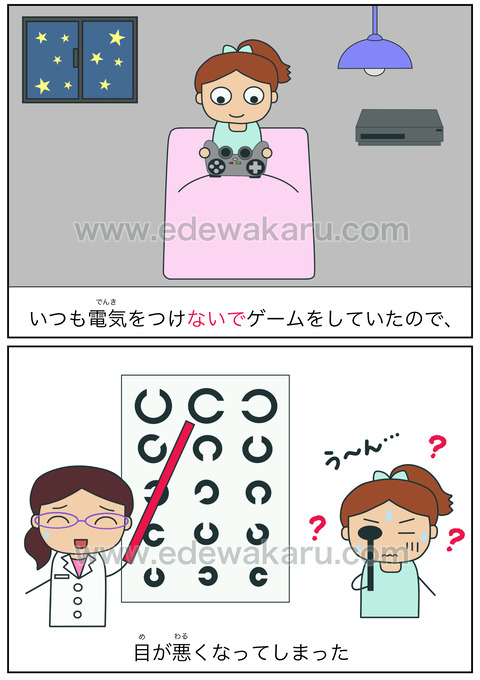
Meaning
〜しない状態で〜する
How to use it
動詞[ない形]+ないで
Explanation
「AないでB」は「Aしない状態でBする」という意味の文型です。「〜ずに」にチェンジすることができますので一緒に覚えておきましょう。
[例]
いつも電気をつけ
ないで
ゲームをしていたので、目が悪くなってしまった
=いつも電気をつけ
ずに
ゲームをしていたので、目が悪くなってしまった
「〜ないで」は、会話でもよく使う文型ですので復習しておきましょう😉
In context 6 examples
いつも電気をつけないでゲームをしていたので、目が悪くなってしまった
→電気をつけない状態でゲームをしていたので、目が悪くなってしまったショッピングに行ったが、何も買わないで帰ってきた
→何も買わない状態で帰ってきた時間がなかったので、今日は朝ごはんを食べないで学校に来た
→朝ごはんを食べない状態で学校に来た昨日は、寝ないでテスト勉強をしました
→寝ない状態でテスト勉強をしました昨日の夜は疲れていたので、お風呂に入らないで寝てしまった
→お風呂に入らない状態で寝てしまったA:コーヒーには何も入れないで飲むのが好きですB:ミルクも砂糖も入れないの?A:はい
→何も入れない状態で飲むのが好きです
日本語文型辞典
Meaning
基本情報説明動詞の否定形がテ形の形をとったもので、後に続く動作や状態がどんな様子・状況・事情のもとに成立するかを表す。
後ろに動詞の文を伴って、「…しない状態で…する」という意味を表す。書きことばでは「…ずに」も使われる。「…なくて」に言いかえることはできない。
「…ではなく、代わりに別のことを行う/別のことが起こる」という意味で、二つのことがらを対比的に述べる表現。後に続くことがらは予想・期待に反した結果だという意味を含む場合が多い。書きことばでは「…ずに」も使われる。「なくて」で置きかえられないこともないが、「なくて」の場合は「代わりに」という対比的な意味がなく、二つのことがらが前後して成立したという別の意味になる。したがって、対比的な意味を表したい場合には、「ないで」を使わなければならない。
「…しないことが原因で」という意味を表す。後に続く表現には、①②のように「困った」「助かった」などの感情や評価を表す表現や、④のように、時間的な前後関係が認められることがらのことが多い。この用法では、比較的自由に「なくて」との置きかえができる。
How to use it
V-ないで【付帯状況】
V-ないで【代わりに】
V-ないで【原因】
In context 14 examples
息子は今朝もご飯を食べないで出かけた。
彼女は一生結婚しないで独身を通した。
傘を持たないで出かけて雨に降られてしまった。
予約しないで行ったら、満席で入れなかった。
歯を磨かないで寝てはいけません。
親が来ないで子供が来た。
ロンドンには行かないで、パリとローマに行った。
運動してもちっともやせないで、かえって体重が少し増えた。
頑張っているのに、成績はちっともよくならないで、むしろ下がってきている。
子供がちっとも勉強しないで困っています。
やつが来ないで助かった。
試験にパスできないでがっかりした。
朝起きられないで授業に遅れた。
大事故にならないでよかった。
日本語文型辞典 英語版
Meaning
【ないで】ないで is the te-form of a negated verb. It indicates the manner, situation, or circumstances in which the action or state referred to after ないで is realized.
Followed by a main verb clause X, V-ないでhas the meaning of “do X without doing Y.” In written language, ...ずに is also used. Cannot be replaced by V-なくて.
V-ないで is used to make a contrastive statement about two things. Means “do such-and-such instead of doing something else,” or “such-and-such happens instead of something else.” Often implies that what follows V-ないで is a result that contradicts the speaker’s expectation or anticipation. In written language, ...ずに is also used.
It is not impossible to replace V-ないで with V-なくて. However, なくて does not convey the contrastive meaning of 代わりに (instead of). Rather, it means that two situations or states of affairs have been realized at virtually the same time. Thus, when the speaker wants to express contrastive meaning, ないで must be used.
Means “because someone does not do X” or “because something does not happen.” Often followed by expressions that indicate an emotion or evaluation, such as 困った (didn’t know what to do) in
(1)
and 助かった (was relieved) in
(2)
, or expressions that present a chronological relationship between situations or events, as in
(4)
. In this usage, ないで can be replaced relatively freely by なくて.
How to use it
1. V-ないで〈attendant circumstances〉
2. V-ないで〈instead of〉
3. V-ないで〈cause〉
In context 14 examples
息子は今朝もご飯を食べないで出かけた。
My son left the house again this morning without eating breakfast.
彼女は一生結婚しないで独身を通した。
She didn’t marry, she remained single for her entire life.
傘を持たないで出かけて雨に降られてしまった。
I went out without an umbrella and got rained on.
予約しないで行ったら、満席で入れなかった。
I went without making a reservation, so I couldn’t get in because every seat was taken.
歯を磨かないで寝てはいけません。
Don’t go to bed without brushing your teeth.
親が来ないで子供が来た。
The child came, but not the parents.
ロンドンには行かないでパリとローマに行った。
Instead of London, I went to Paris and Rome.
運動してもちっともやせないで、かえって体重が少し増えた。
Even though I’m working out, I’m not losing weight at all—instead I’ve gained a little.
頑張っているのに成績はちっともよくならないで、むしろ下がってきている。
Even though I’m trying my best, my marks aren’t getting any better—if anything, they’re getting worse.
子供がちっとも勉強しないで困っています。
I don’t know what to do, because my child isn’t studying at all.
やつが来ないで助かった。
I was relieved that the guy didn’t come.
試験にパスできないでがっかりした。
I was disappointed because I couldn’t pass the exam.
朝起きられないで授業に遅れた。
I was late for class because I couldn’t get up in the morning.
大事故にならないでよかった。
I’m glad it didn’t turn into a big accident.
日本語NET JLPT文法解説まとめ
Meaning
Aをしない状態でBをする。
How to use it
V(ない形) + ないで
のむ → のまないで
たべる → たべないで
みる → みないで
Explanation
To do B without doing A
In context 16 examples
今朝、朝ごはんを食べないで学校に来ました。
私は毎日、電気を消さないで寝ます。
最近、涼しいので、エアコンをつけないで寝ます。
傘を持たないで出かけます。
コーヒーに砂糖を入れないで飲みます。
宿題をしないで学校に行ったら怒られました。
昨日、お風呂に入らないで寝てしまった。
友達にもらった本を読まないで売ってしまった。
明日は試験なので、今晩は寝ないで勉強します。
熱があったので、お風呂に入らないで寝ました。
体調が悪いときは、無理しないで休んでください。
わからないことがあったら、遠慮しないで聞いてください。
財布を持たないで来てしまった。
辞書を使わないで、一人でやりました。
朝寝坊して急いでいたので、歯磨きをしないで学校に来ちゃった。
今日は学校に行かないで、どこに行っていたの?
毎日のんびり日本語教師
How to use it
動ない形+ないで
動ない形+ず(に)
(する→せずに)
Explanation
動作・状態の否定、付帯状況を表します。
「~ないで」は話し言葉で用いられます。それよりも少し硬い表現が「~ずに」です。
Notes
関連文法「【N1文法】~ことなく/ことなしに/こともなく」
In context 8 examples
どちらか一つを選べと言われたら、迷わずAを選ぶ。
飛んでくる矢を、手を傷つけないで掴み取る。
両親に孫の顔を見せずに死なせるわけにはいかない。(不能让父母看不到孙子的脸就死了。)
一度もモテ期が訪れずに人生を終えることになりそうだ。
ゴールデンウィークも休まず働く。(黄金周也不休息地工作。)
彼はあまりのストレスに耐え切れずに自死を選んだ。(他承受不了太大的压力选择了自杀。)
睡魔に勝てずに寝落ちした。
仕事しないでずっと本読んでたい。
NINJAL 日本語文型データベース
Meaning
相手に~しないように頼んだり、指示したり、勧めたりするときに使います。相手の意向を尋ねないで要求する言い方です。
「〜ないでください」の「ください」を省略した形です。
友達・家族など心理的に近い人や立場が下の人に言うときに使います。
How to use it
Vないで
In context 6 examples
兄「ゆり、それ、僕のケーキだよ。食べないでね」
先生「あなたたち、危ないから、廊下を走らないで!」
「良子の誕生日パーティー、いつだっけ?」「今週末だよ。忘れないで」
「お姉ちゃん、パソコン使わせて」「いいけど、データ、消さないでよ」
「あれ、髪、切ったんだね」「うーん。美容院の人にはあんまり短くしないでって言ったんだけどね」
もうすぐ試合なんだから、あんまり無理しないで。早めに寝て疲れをとったほうがいいよ。
Yokubi — The Common Grammar Guide (https://yoku.bi)
Explanation
We briefly discussed the difference between なくて and ないで in [Lesson 11](../../Section1/Part1/Lesson11.md). Let's dig a bit deeper into it.
When we make a verb or い adjective into the なくて form, this behaves like a usual て conjunctive form ("do X, and…"). It is common in this usage to imply some cause \-\> effect sequence ("I didn't do X, and that is why Y happened") although not strictly required.
We can also make the negative with ないで instead, however in contrast with なくて, this usage often implies a manner or state in which the following action is being done. You can think of the statement before ないで to become an "adverb" to the statement after it.
There is another way we can use なくて and ないで, and that is using the verb forms 〜ず and 〜ずに. ず is an archaic conjugation of the negative auxiliary verb ぬ, but you don't really need to know this. Just remember that 〜ず is almost a 1:1 replacement to なくて (or in some cases なく), and 〜ずに is a replacement of ないで. In **some** cases, 〜ず alone (without に) can also be used as ないで (Yay, Japanese!).
ず and ずに are more formal and stiff-sounding than their なくて and ないで counterparts and are mostly used in literary stuff. However you will still hear plenty of ずに in spoken language too and they show up a lot in common phrases and expressions.
In context 2 examples
もしかして、食べないで待っていたのか
Perhaps… did you wait without eating?
ノックもしないで部屋に入る。
To enter the room without even knocking.
IMABI
The Negative て形: ~なくて & ~ないで
Read this IMABI lesson ↗Explanation
The Negative て形: ~なくて & ~ないで
Previously, we learned how to make the て形 in the affirmative (positive sentences), but it is also possible to combine the conjunctive particle ~て with the auxiliary adjective ~ない to create the negative て形. Confusingly, there are two ways to go about this:
Conjugate ~ない to its ku-type continuative form (連用形れんようけい), then add ~て.
Attach ~て directly after ~ない, but it gets voiced as ~で in the process.
With the first method, you get ~なくて. With second method, you get ~ないで. These forms, although etymologically more or less the same, are used in different grammatical circumstances.
~なくて
As we already know how to use ~ない with the various parts of speech, the chart below shows how ~て looks added into the fold.
Part of Speech + ~なくて
Ichidan Verbs見みる → 見みなくて
食たべる → 食たべなくて
Godan Verbs行いく → 行いかなくて
死しぬ → 死しななくて
Sahenする → しなくて
Kahen来くる → 来こなくて
Adjectives新あたらしい → 新あたらしくなくて
Adjectival Nouns簡単かんたんだ → 簡単かんたん[では・じゃ]なくて
Noun + Copula犬いぬだ → 犬いぬ[では・じゃ]なくて
The ~なくて form is used in the following ways:
i. In listing events, characteristics, or states of being, ~なくて serves as the proper negative て形. Whether things are truly in succession with each other as opposed to holding true at the same time depends on context.
1. このピザはハラペーニョがのっていなくて、美味おいしくないんですよ。
This pizza doesn’t have jalapenos on it, and it doesn’t taste good.
2. ジムは昔むかしは行いっていたけど、結局けっきょく行いかなくてやめてしまった。
I had been going to the gym a long time ago, but I ultimately wouldn’t go and ended up stopping.
3. さっき蛇口じゃぐちを閉しめなくて、少すこし時間じかんが経たったら、なんとクモが一匹いっぴき中なかから垂たれ落おちた。
Earlier, I didn’t shut the faucet, then after a little while, wouldn’t you know, a spider dropped and fell out from inside it.
4. 猫は視力が【良くなくて・悪くて】、嗅覚が鋭い。
Cats have bad vision [and/but] have a sharp sense of smell.
5. 全然甘すぎなくて、とても美味しくて、飽きられません。
It’s not too sweet all, it’s very delicious, and I can’t get tired of it.
6. アメリカ南部式のスイートティーはねえ、品のいい甘さじゃなくて、ただ甘いんだ!
You see the thing is, American Southern “sweet tea” is not a refined tasting sweet: it’s just sweet.
“X is not Y but Z,” which is an application of this, is only expressed with ~なくて.
ii. Causal relations in which the inaction stated in the first clause is responsible for what happens in the second clause. The purpose of choosing ~なくて is to show how consequential the flow of events is.
7. セスは学生ではなくて先生だ。
Seth is not a student but a teacher.
8. バスが来なくて遅刻しました。
The bus didn’t come, and (so) I was late.
9. 友だちが来なくて、困りました。
My friend didn’t come, and (so) I was upset.
10. 過去問を一切勉強しなくて、不合格になりました。
I didn’t study past problems at all, and (so) I got a failing score.
11. お金がなくてお酒を飲みに行けない。
I don’t have money, and (so) I can’t go drinking.
An important application of this usage is ~なくてよかった (glad that X didn’t happen).
12. 雨が降らなくてよかった。
I’m glad that it didn’t rain.
13. 僕、女の子じゃなくて本当によかったと思う1。
I’m really glad that I’m not a girl.
It is from this meaning that the patterns for “must” come from. These double negative structures utilize ~なくて’s role of marking the action/state that Y relies upon to be true.
Informal ~なくてはだめ
Neutral ~なくてはいけない
Formal/Stern ~なくてはならない
~ては may contract to ~ちゃ in casual speech. This contraction may lessen the tone but not so much the severity behind the meaning of “must.” As for the use of the particle は, it highlights the negative element of the statement.
14. なぜ戦争で死ななくてはならないのか?
Why is it that you must die in war?
15. 規則を守らなくてはいけない。
You/we must follow the rules.
16. 人の一倍2、時間をかけて勉強しなく【ては・ちゃ】だめだよ。
You gotta put in twice the effort as others and take the time to study.
~ないで
The most profound difference between ~なくて and ~ないで is that ~ないで only attaches itself to verbs. Meaning, it is not allowed with adjectival or nominal predicates.
Verb Class + ~ないで
Ichidan Verbs見る → 見ないで
食べる → 食べないで
Godan Verbs行く → 行かないで
死ぬ → 死なないで
Sahenする → しないで
Kahen来る → こないで
~ないで means “without doing X” in its basic understanding. This requires that X be a volitional verb. In doing so, it can serve three different yet interrelated nuances.
i. X is the means by which you do Y, but X happens to be in the negative. Sometimes X is ancillary in nature to Y, while other times Y happens in succession of X not happening. Oftentimes, it is further implied that not doing X is against expectation.
※Nuance i is NOT shared with ~なくて.
17. 寝ないで待つ。
Wait without sleeping.
18. 歯磨きをしないで寝る癖だけは直せない。
Sleeping without brushing my teeth is the one habit I can’t break myself of.
19. きょうは電車に乗らないで、歩いてきました。
I came by walking instead of riding the train today.
20. 辞書を{使わないで・引かないで}、手紙を書いた。
I wrote a letter without using a dictionary.
21. 家の中でクーラーをつけないで過ごしています。
I’m getting by indoors without having the air conditioner on.
22. 今朝、玄関のドアを閉めないで出ていってしまった。
I ended up leaving this morning without locking the front door.
23. 長男が宿題をやらないで学校に行ってみた!
My oldest son tried going to school without doing his homework!
24. 電車の中で吊り革に掴まらないでしっかり立てなくて、転んでしまった。
I couldn’t stand firmly without grabbing the straps inside the train, and (so) I fell over.
25. うちの子は、8歳なのに自転車に補助輪を付けないで乗れないのよ。
Even though my kid is 8, (he/she) still can’t ride (his/her) bicycle without training wheels.
Nuance i gives rise to various speech modals in which auxiliary verbs such as ~ください, (polite command), ~くれ (crude command), ~ほしい (wish to the listener), ~もらう (request from the listener), ~おく (leave as) attach. In any case, ~ないで’s role is to emphasize that X does not happen. In the case of commands, the auxiliary can be dropped, leaving ~ないで by itself to serve said role.
26. 今度忘れないでくださいね。
Don’t forget next time.
27. 朝ご飯を食べないでおこう3。
I’ll go without eating breakfast.
28. 飛行機に子供を乗せないでもらいたいです。
I’d like for kids not to be put on airplanes.
29. タバコを吸わないでほしい。
I want you to not smoke.
ii. ~ないで may also mean “instead of” when action X is what you should be doing, but instead you are doing Y. X is the opposite of Y, and ~ないで contrasts them.
※Nuance ii is NOT shared with ~なくて.
30. 宿題をしないで遊んでばかりいる学生が嫌いだ。
I hate students who only have fun instead of doing their homework.
31. お酒を飲まないで、働いた。
I worked instead of drinking alcohol.
32. ローサさんは、メキシコに行かないで、カリフォルニアに行きました。
Rosa-san went to California instead of going to Mexico.
Nuance ii may be expanded to more complex sentences in which each clause has a different agent (doer). In each clause, what the agent does not do is contrary to the speaker’s expectation. If two inactions are merely being compared and placed next to each other with no implicit misgivings towards the agents, then only ~なくて becomes grammatical.
33. ローサさんは仕事に行かないでレイアンさんも仕事に行かなかった。
Rosa-san didn’t go to work, and Raeann-san also didn’t go to work.
34. レイアンさんは朝ご飯を食べなくて、ラファエル君は夕ご飯を食べなかった。
Raeann-san didn’t eat breakfast, and Rafael-kun didn’t eat dinner.
iii. ~ないで may also indicate a causal relation, but unlike ~なくて, it is paired with volitional verbs only. The result Y happens from the agent (doer) not doing X.
Nuance iii ~ないで does happen to overlap with ~なくて. If you use ~ないで, you are emphasizing the dynamic/verbal element(s) of the sentence. There is a sort of impulse about the statement – the consequence of purposeful inaction is what brings about Y. If you use ~なくて, you are emphasizing the static/adjectival element(s) of the sentence – not doing X, or X not happening, consequentially brings about Y.
35. 遊び過ぎて過去問を一切勉強【しないで・しなくて】不合格になった。
I had too much fun, didn’t study at all, and ended up failing (as a result).
36. 日本語の宿題を【しないで・しなくて】セス先生に叱られました。
I got scolded by Seth Sensei for not doing my Japanese homework.
37. 全然停止線に【気づかないで・気づかなくて】パトカーに呼び止められた。
I was stopped by a squad car for not paying any attention to the stop line.
It may seem contradictory to the notion of “volition” that 気づく can work with ~ないで as seen in Ex. 37. Indeed, it has far less “volition” involved than other verbs, but when a speaker does use 気づく, there is a hope that one may pay attention to the matter at hand. Meanwhile, we seen in Ex. 38 that a verb that truly lacks any sort of volition really is ungrammatical with ~ないで.
38. 時間が【足りないで X・足りなくて 〇】間に合わなかった。
There wasn’t enough time, and (so) I couldn’t make it.
Conversely, there still are grammar circumstances where both are plausible if the verbal predicate is more or less equal dynamic or static in nature based on individual interpretation. One such situation is ~なくて済む vs ~ないで済む. Both refer to being able to get by without doing X. In Ex. 39, the speaker did not actively seek to go shopping. So, while the verb 買う requires that the speaker be an active agent, the “active” nature is not really felt given the circumstances. This allows for ~なくて済む to be used. Meanwhile, In Ex. 40, both are still possible, but the likelihood of ~ないで済む is far higher because of how “quitting one’s job,” would likely involve some degree of the agent’s will over the situation.
39. お母さんが食料をいっぱい送ってくれているので、半年くらい買いに{行かなくて・行かないで}済んでいる。
My mother keeps sending me lots of food, so I’ve gotten by for half a year without shopping for any.
40. 会社を{辞めないで ◎・辞めなくて 〇}済むことなら、なんとかします。
If it’s something where I can get by without quitting my job at the company, I’ll figure it out.
~なくてもいい VS ~ないでもいい
Having come this far, if asked which negative て形 is used to say “it’s okay not to do X,” you might choose ~なくて but hesitate because of how ~ないで can show negative commands. In fact, there is good reason to assume that there might be overlap in this regard too. In Standard Japanese, however, only ~なくてもいい is recognized, rendering ~ないでもいい dialectal.
41. 無理にお酒を飲まなくてもいい。
It’s okay to not force yourself to drink.
42. 分からなくてもいい。
It’s okay not to understand.
43. 見ないでもええん4ちゃうか? (Kansai Dialect)
Isn’t it perfectly alright not to watch it, then?
Previous Lesson
Next Lesson
~と思う is frequently added as a sentence softener to avoid saying what would otherwise be a straightforward, declarative opinion made by the speaker. ↩︎
一倍 confusingly may also mean “twice as much,” being synonymous with 二倍, but its presence is rather limited to set phrases in practical use such as in 人(の)一倍 ↩︎
~ないでおこう is a combination of three grammatical patterns. ~ないで establishes “without doing…,” ~ておく establishes “going ahead and leaving the situation as is,” and ~う (which attaches to the 未然形 but with a vowel shift from /a/ to /o/) denotes volition (desire to commit the act). ↩︎
~ん, here, is the particle の, turning [見ないでもええ] into a nominal expression. ↩︎
In context 43 examples
このピザはハラペーニョがのっていなくて、美味おいしくないんですよ。
This pizza doesn’t have jalapenos on it, and it doesn’t taste good.
ジムは昔むかしは行いっていたけど、結局けっきょく行いかなくてやめてしまった。
I had been going to the gym a long time ago, but I ultimately wouldn’t go and ended up stopping.
さっき蛇口じゃぐちを閉しめなくて、少すこし時間じかんが経たったら、なんとクモが一匹いっぴき中なかから垂たれ落おちた。
Earlier, I didn’t shut the faucet, then after a little while, wouldn’t you know, a spider dropped and fell out from inside it.
猫は視力が【良くなくて・悪くて】、嗅覚が鋭い。
Cats have bad vision [and/but] have a sharp sense of smell.
全然甘すぎなくて、とても美味しくて、飽きられません。
It’s not too sweet all, it’s very delicious, and I can’t get tired of it.
アメリカ南部式のスイートティーはねえ、品のいい甘さじゃなくて、ただ甘いんだ!
You see the thing is, American Southern “sweet tea” is not a refined tasting sweet: it’s just sweet.
セスは学生ではなくて先生だ。
Seth is not a student but a teacher.
バスが来なくて遅刻しました。
The bus didn’t come, and (so) I was late.
友だちが来なくて、困りました。
My friend didn’t come, and (so) I was upset.
過去問を一切勉強しなくて、不合格になりました。
I didn’t study past problems at all, and (so) I got a failing score.
お金がなくてお酒を飲みに行けない。
I don’t have money, and (so) I can’t go drinking.
雨が降らなくてよかった。
I’m glad that it didn’t rain.
僕、女の子じゃなくて本当によかったと思う1。
I’m really glad that I’m not a girl.
なぜ戦争で死ななくてはならないのか?
Why is it that you must die in war?
規則を守らなくてはいけない。
You/we must follow the rules.
人の一倍2、時間をかけて勉強しなく【ては・ちゃ】だめだよ。
You gotta put in twice the effort as others and take the time to study.
寝ないで待つ。
Wait without sleeping.
歯磨きをしないで寝る癖だけは直せない。
Sleeping without brushing my teeth is the one habit I can’t break myself of.
きょうは電車に乗らないで、歩いてきました。
I came by walking instead of riding the train today.
辞書を{使わないで・引かないで}、手紙を書いた。
I wrote a letter without using a dictionary.
家の中でクーラーをつけないで過ごしています。
I’m getting by indoors without having the air conditioner on.
今朝、玄関のドアを閉めないで出ていってしまった。
I ended up leaving this morning without locking the front door.
長男が宿題をやらないで学校に行ってみた!
My oldest son tried going to school without doing his homework!
電車の中で吊り革に掴まらないでしっかり立てなくて、転んでしまった。
I couldn’t stand firmly without grabbing the straps inside the train, and (so) I fell over.
うちの子は、8歳なのに自転車に補助輪を付けないで乗れないのよ。
Even though my kid is 8, (he/she) still can’t ride (his/her) bicycle without training wheels.
今度忘れないでくださいね。
Don’t forget next time.
朝ご飯を食べないでおこう3。
I’ll go without eating breakfast.
飛行機に子供を乗せないでもらいたいです。
I’d like for kids not to be put on airplanes.
タバコを吸わないでほしい。
I want you to not smoke.
宿題をしないで遊んでばかりいる学生が嫌いだ。
I hate students who only have fun instead of doing their homework.
お酒を飲まないで、働いた。
I worked instead of drinking alcohol.
ローサさんは、メキシコに行かないで、カリフォルニアに行きました。
Rosa-san went to California instead of going to Mexico.
ローサさんは仕事に行かないでレイアンさんも仕事に行かなかった。
Rosa-san didn’t go to work, and Raeann-san also didn’t go to work.
レイアンさんは朝ご飯を食べなくて、ラファエル君は夕ご飯を食べなかった。
Raeann-san didn’t eat breakfast, and Rafael-kun didn’t eat dinner.
遊び過ぎて過去問を一切勉強【しないで・しなくて】不合格になった。
I had too much fun, didn’t study at all, and ended up failing (as a result).
日本語の宿題を【しないで・しなくて】セス先生に叱られました。
I got scolded by Seth Sensei for not doing my Japanese homework.
全然停止線に【気づかないで・気づかなくて】パトカーに呼び止められた。
I was stopped by a squad car for not paying any attention to the stop line.
時間が【足りないで X・足りなくて 〇】間に合わなかった。
There wasn’t enough time, and (so) I couldn’t make it.
お母さんが食料をいっぱい送ってくれているので、半年くらい買いに{行かなくて・行かないで}済んでいる。
My mother keeps sending me lots of food, so I’ve gotten by for half a year without shopping for any.
会社を{辞めないで ◎・辞めなくて 〇}済むことなら、なんとかします。
If it’s something where I can get by without quitting my job at the company, I’ll figure it out.
無理にお酒を飲まなくてもいい。
It’s okay to not force yourself to drink.
分からなくてもいい。
It’s okay not to understand.
見ないでもええん4ちゃうか? (Kansai Dialect)
Isn’t it perfectly alright not to watch it, then?
文法
Meaning
Aをしない状態でBをする。
How to use it
V(ない形) + ないで
のむ → のまないで
たべる → たべないで
みる → みないで
In context 15 examples
今朝、朝ごはんを食べないで学校に来ました。
私は毎日、電気を消さないで寝ます。
最近、涼しいので、エアコンをつけないで寝ます。
傘を持たないで出かけます。
コーヒーに砂糖を入れないで飲みます。
宿題をしないで学校に行ったら怒られました。
昨日、お風呂に入らないで寝てしまった。
友達にもらった本を読まないで売ってしまった。
明日は試験なので、今晩は寝ないで勉強します。
熱があったので、お風呂に入らないで寝ました。
体調が悪いときは、無理しないで休んでください。
わからないことがあったら、遠慮しないで聞いてください。
財布を持たないで来てしまった。
辞書を使わないで、一人でやりました。
朝寝坊して急いでいたので、歯磨きをしないで学校に来ちゃった。