くらべてわかる日本語表現文型辞典
Meaning
Aの側面から見てもBの側面から見てもXはYである。「XはYだ」ということを説明するために、Xを色々な角度から見る。
How to use it
(Xは)AといいBといいY
[イ形-普|ナ形-な/である/だった/ではない]+こと+といい[~]+こと+といい
[名詞-∅]といい[名詞-∅]といい
Explanation
【対比1】
「AであれBであれC」(意味1 P.140)
「AであれBであれC」はAやBで代表されるどんな場合でも同じ条件であるということを示している。依頼や忠告に使われることもある。
○公用であれ、私用であれ、電話の使用回数は制限してください。
×公用といい、私用といい、電話の使用回数は制限してください。
○このアパートは環境といい、価格といい満足できる。
○このアパートは日本人であれ、外国人であれ入居条件が厳しい。
「AといわずBといわずC」(意味1 P.162)
Notes
【注意1】
・XはYであるという事実を述べる文で、Yに希望や命令はつきにくい。
In context 4 examples
この本は、分量といい、内容といい、子どもに読み聞かせるのにちょうどいい。
今度の台風は規模といい、コースといい、10年前とそっくりだ。
授業態度といい、試験の点数といい、申し分のない学生だ。
あの先生は教え方といい、声の大きさといい、はっきりしていてよくわかる。
DoJG 日本語文法辞典(全集)
Meaning
In terms of both ~ and ~; in terms of ~ as well as ~; from the perspective of both ~ and ~
How to use it
Noun1 | といいNoun2といい | |
| 色といい形といい | In terms of both colour and shape |
Explanation
~といい~といい A structure that introduces multiple perspectives when describing a person or a thing.
In context 7 examples
このコーヒーは味といい香りといい、申し分ありません。
This coffee is perfect in terms of both flavour and aroma.
内容といい話し方といい、見事なスピーチでした。
It was a splendid speech in terms of content as well as delivery.
声といい演技力といい、彼女は最高だ。
She is the best from the perspective of both voice and acting ability.
人柄といい才能といい、米倉さんに勝る人はいない。
No one surpasses Ms. Yonekura in terms of both personality and ability.
音楽の情感といい音の豊かさといい、こんな感動的な演奏を聴いたことがない。
I've never heard such a moving performance, both in terms of the artist's emotion and the richness of the sound.
家柄といい学歴といい、彼は非の打ちどころがない。
He is just perfect, both in terms of his family and educational backgrounds.
スピードといいパワーといい、今の彼に勝てる選手はいない。
No player can beat him now in terms of either speed or power.
日本語文型辞典
Usage 1
Meaning
基本情報N/NaだといいA-いといいV-るといい説明「と1-3」と「いい」が結び付いたもの。「とよい」はそのやや改まった形。
動詞の辞書形を受け、人に対してその行為を行うように勧める意味を表す。文脈によっては、⑤のように「自分の好きなように…しなさい」といった「放任」を表す場合もある。しないように勧める場合には使えず、その場合は「V-ないほうがいい」などを使う。
類義的表現として「たらいい」「ばいい」があるが、「といい」は「一般的にそうするのが適当だ」という意味の勧めに使う。どうすべきかをたずねる疑問表現では「といい」は使えず、「たらいい」「ばいい」を使う。その答えには「たらいい/ばいい」だけでなく、「といい」も使うことができる。この場合「たらいい/ばいい」が特定の結果を得るために「それで必要十分だ」という意味を表すのに対し、「といい」は「それが一般的に適切だ」という意味を表す。
そうなってほしいという願望を表す。文末に「が/けど/のに/(のに)なあ」などを伴うことが多い。「が/けど/のに」を伴う場合は、「実現しないかもしれない」という不安や、現状が希望する状態と異なるという含みがある。「たらいい」「ばいい」もほぼ同義で、ほとんどの場合言いかえが可能。
実際には起こらなかったり、現実が期待に反するような場合に、それを残念に思ったり聞き手を非難したりする気持ちを表す。この用法では「とよかった」よりも「ばよかった」「たらよかった」の形の方がよく使われる。文末には「のに/のだが/のだけれど」などが付くことが多い。「のに」は普通自分の行動については使わない。
How to use it
V-るといい
…といい
…とよかった(のに)
In context 21 examples
この株は今買うといいですよ。
分からないときは、この辞書を使うといい。
旅行には、小さいドライヤーを持っていくといい。
疲れたようだね。仕事は急がなくてもいいから、ソファーで少し寝るといい。
私を疑いたければ存分に疑うといい。
(誤) 今買わないといい。
(正) 今買わないほうがいい。
(誤) うまくいかない時はどうするといいですか。
(正) A:うまくいかない時はどう{したら/すれば}いいですか。
B:山本さんに聞いたら/聞ければ/聞くと)いいですよ。生まれてくる子供が、女の子だといいなあ。
学生がもっと積極的だといいのだが。
勉強部屋がもっと広いといいのになあ。
旅行の間、晴天が続くといい。
彼が時間に間に合うといいんだけど。
みんながこのことを忘れていないといいが。
学生の自発的な活動が今後も継続されるといい。
A:とても楽しい旅行だったわよ。あなたも来るとよかつたのに。
B:行けるとよかったんだけど、急用ができてしまってね。本当のことを言ってくれるとよかったのに。
この部屋、もう少し日当たりがいいとよかったんだが。
(誤) 僕も行けるとよかったのに。
(正) 僕も行けるとよかったん(だけと/だが)。
Usage 2
Meaning
基本情報NといいNといい説明例としてふたつのものをとりあげるのに用いる。その二つだけでなく他のものもそうであるという意味が含まれることが多い。批判や評価の文で使い、特別な感情(あきれたという気持ち、感心、あきらめなど)が表される。例文① 社長といい、専務といい、この会社の幹部は古くさい頭の持ち主ばかりだ。② 娘といい、息子といい、遊んでばかりで、全然勉強しようとしない。③ 玄関の絵といい、この部屋の絵といい、時価一千万を越えるものばかりだ。④ これは、質といい、柄といい、申し分のない着物です。⑤ ここは、気候といい、景色といい、休暇を過ごすには、最高の場所だ。⑥ あのホテルといい、このレストランといい、観光客からできるだけしぼりとろうとしているのが明白だ。
絵でわかる日本語
Usage 1
Read this source entry ↗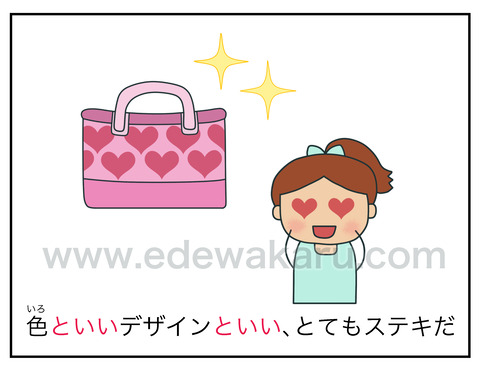
Meaning
〜も〜も全部
How to use it
名詞[辞書形]+といい+名詞[辞書形]+といい
Explanation
「AといいBといい」は2つのものをあげて「AもBも全部」という意味で使用される文型です。この文型は「AとB以外も〜だ」という意味を含んでいます😮
[例]
色
といい
デザイン
といい、とてもステキだ
→
色
も
デザイン
も
大きさ
も
柄
も、とてもステキだ
*色とデザイン以外に大きさや柄もステキだという意味を含んでいる
靴
といい
バッグ
といい、彼女が持っているものは高そうだ
→
靴
も
バッグ
も
服
も
ネックレス
も、彼女が持っているものは高そうだ
また、この文型は
話者の考えや気持ち、評価などをいう時によく使われます
😊
[例]
色
といい
デザイン
といい、とてもステキだ→
「ステキで好きだ」という肯定的評価
靴
といい
バッグ
といい、高そうだ→
「高そうですごいなぁ」「高そうでちょっと嫌な感じ」などの評価
手
といい
足
といい
泥だらけだ→
「泥だらけで汚い」という否定的評価
「〜といい〜といい」には類似文型がいくつかありますが、
・AとB2つに焦点を当てて取り上げ、「AとB以外に他も全部〜だ」という意味
・話者の評価や気持ちを表す
というように覚えておきましょう😉
In context 3 examples
色といいデザインといい、とてもステキだ
→色もデザインも全部ステキだ靴といいバッグといい、彼女が持っているものは高そうだ
→靴もバッグも彼女が持っているものは全部高そうだ息子は手といい足といい、泥だらけで帰ってきた(復習:〜だらけ)
→息子は手も足も泥だらけで帰ってきた
Usage 2
Read this source entry ↗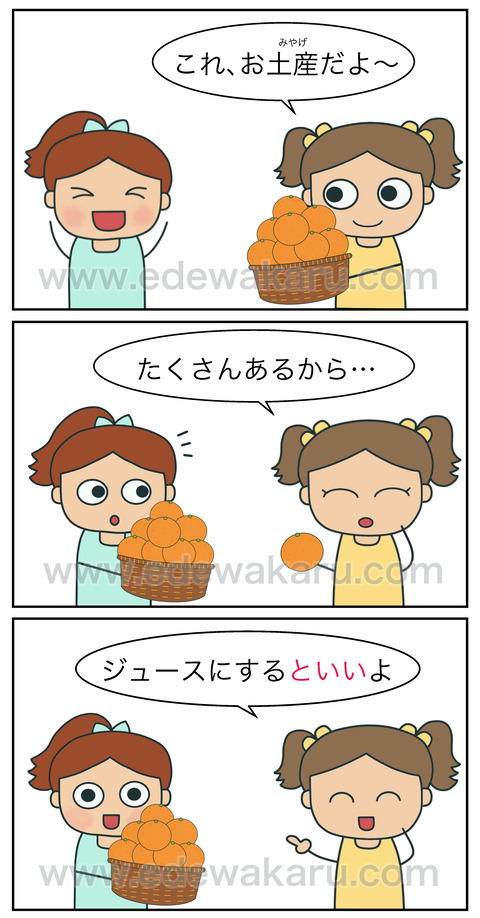
Meaning
〜たほうがいい
How to use it
動詞[辞書形]+といい
Explanation
「〜といい」は「〜たほうがいい」という意味で使われる文型です。これは
相手に〜をするように勧めたり、アドバイスをする時
に使う表現です😊
この文型は動詞の[辞書形]に使いますので、〜ないように勧める時には「〜ないほうがいい」を使わなければいけません
😨
[例]
❌ジュースにし
ないといい
よ
⭕️ジュースにし
ないほうがいい
よ
また、疑問文には使えませんので、疑問文の場合は「〜ばいい」か「〜たらいい」を使いましょう😀答えは「〜といい」「〜ばいい」「〜たらいい」どれでもOKです😉
[例]
❌お腹がすいたら何を食べる
といい?
⭕️お腹がすいたら何を食べれ
ばいい?
⭕️お腹がすいたら何を食べ
たらいい?
⭕️パンを食べる
といい
よ
⭕️パンを食べれ
ばいい
よ
⭕️パンを食べ
たらいい
よ
「〜といい」は初級で勉強する簡単な文型ですが、とてもよく使いますのでしっかりと覚えておきましょう😄
In context 5 examples
たくさんあるから、ジュースにするといいよ
→たくさんあるから、ジュースにしたほうがいいよあの店は平日に行くといいですよ
→あの店は平日に行ったほうがいいですよいつ災害が起こるかわからないから、防災グッズを買っておくといいよ
→防災グッズを買っておいたほうがいいよ(復習:防災の日)午後から雨が降るから、傘を持っていくといいよ
→午後から雨が降るから、傘を持って行ったほうがいいよわからないところは先生に聞くといいよ
→わからないところは先生に聞いたほうがいいよ
毎日のんびり日本語教師
How to use it
名詞+といい+名詞+といい
Explanation
例として2つ挙げ、それら全体について主観的な評価を述べる文型です。
挙げられた2つの例以外の存在も暗示します。
良い評価も悪い評価も可能です。
Notes
特になし
In context 10 examples
性能といい、デザインといい、この機種は素晴らしい。
部下のAといい、Bといい、私の指示を全く聞いてくれない。
政治家といい、官僚といい、最近汚職が多くてがっかりだ。
あの店員は服装といい、態度といい、接客態度が全くダメだ。
彼は食べ方といい、飲み方といい、汚すぎて一緒に食事してると気分が悪くなる。
最近はAIといい、5Gといい、技術の進歩が著しい。
私の彼女は外見といい、中身といい、文句のつけようがない。
髪型といい、髭といい、もうちょっと整えたら彼ももっとモテるようになると思う。
歌い方といい、声といい、私のタイプだ。
見た目といい性格といい全てにおいて好き。
日本語文型辞典 英語版
Usage 1
Meaning
【といい】[N/Na だといい][A-いといい][V-るといい]Formed by combining と1 (Usage 3) with いい. とよい is a slightly more formal form.
Follows the dictionary form of a verb and expresses the notion of encouraging another person to take an action. Depending on the context, it can also be used to express a hands-off attitude, as in
(5)
, which has the sense of “do as you like.” Cannot be used to dissuade someone from taking an action. In such cases, the form V-ないほうがいい is used.
(×)今買わないといい。
It’s good not to buy it now.
(○)今買わないほうがいい。
You shouldn't buy it now.
Similar expressions include たらいい and ばいい, but といい implies the encouragement that “generally speaking, doing such-and-such is appropriate.” The form といい cannot be used in interrogative expressions inquiring what one ought to do. In that case, たらいい/ばいい are used instead. When answering such questions, however, it is possible to use not only たらいい/ばいい but also といい. Then たらいい/ばいい convey the meaning that “such-and-such would be sufficient” to obtain a particular result. On the other hand, といい means that “such-and-such is generally an appropriate course of action.”
(×)うまくいかない時はどうするといいですか。
What’s good to do when things don't go well?
(◯)A:うまくいかない時はどう{したら/すれば}いいですか。
A:When things don't go well, what should I do?
B:山本さんに{聞いたら/聞ければ/聞くと}いいですよ。
It would be best to ask Yamamoto-san.
Expresses a desire for something to happen. Often used with が, けど, のに, or (のに)なあ at the end of the sentence. When accompanied by が, けど, or のに, the implication is concern that “such-and-such may not be realized,” or that the present state of affairs does not reflect what is hoped for. Has essentially the same meaning as たらいい and ばいい, and can be substituted with these in almost all cases.
B:行けるとよかったんだけど、急用ができてしまってね。
It would have been great to be able to go, but something suddenly came up.
Expresses a feeling of regret or criticism of the listener, arising from the fact that something did not actually happen or that the present reality is contrary to expectations. This usage takes the forms ばよかった or たらよかった more often than とよかった. The sentence often concludes with expressions such as のに, のだが, or のだけれど. However, のに is not usually used regarding one's own actions.
(×)僕も行けるとよかったのに。
I should have been able to go, too....
(○)僕も行けるとよかったん{だけど/だが}。
If only I had been able to go, too....
How to use it
1. V-るといい〈suggestion, recommendation〉
2. ...といい〈wish, desire〉
3. ...とよかった(のに)
In context 15 examples
この株は今買うといいですよ。
It's good to buy this stock now.
分からないときは、この辞書を使うといい。
When you don’t understand, this dictionary is helpful.
旅行には、小さいドライヤーを持っていくといい。
Taking a small blow-dryer on trips is a good idea.
疲れたようだね。仕事は急がなくてもいいから、ソファで少し寝るといい。
You seem tired. Since this work is not urgent, you should lie down on the sofa for a while.
私を疑いたければ存分に疑うといい。
If you want to doubt me, then go ahead and doubt!
生まれてくる子供が、女の子だといいなあ。
It would be nice if the baby on the way is a little girl.
学生がもっと積極的だといいのだが。
How I wish the students would take a little more initiative!
勉強部屋がもっと広いといいのになあ。
If only this study room were a little more spacious....
旅行の間、晴天が続くといい。
Let's hope that the fair weather holds during the trip.
彼が時間に間に合うといいんだけど。
I hope that he makes it in time, but....
みんながこのことを忘れていないといいが。
You would all do well never to forget this.
学生の自発的な活動が今後も継続されるといい。
It would be nice to see these voluntary activities by the students continue.
A:とても楽しい旅行だったわよ。あなたも来るとよかったのに。
It was a very enjoyable trip. It would have been nice if you had come along.
本当のことを言ってくれるとよかったのに。
If only you had told me the truth.
この部屋、もう少し日当たりがいいとよかったんだが。
I wish this room could have had a little more sunlight.
Usage 2
Meaning
【といい...といい】[NといいNといい]
Used to present two examples of something. Often implies that there are other similar examples as well. Used to make a criticism or evaluation, and conveys a particular feeling (such as shock, admiration, or resignation) regarding the topic at hand.
In context 6 examples
社長といい、専務といい、この会社の幹部は古くさい頭の持ち主ばかりだ。
Whether it’s the president or the managing director, I can say that the leadership of this company are all outmoded thinkers.
娘といい、息子といい、遊んでばかりで、全然勉強しようとしない。
Both my daughter and my son are only interested in having a good time, and neither of them makes any effort to study.
玄関の絵といい、この部屋の絵といい、時価一千万を越えるものばかりだ。
The picture in the entrance, as well as the one in this room—everything here has a market price of well over 10 million yen.
これは、質といい、柄といい、申し分のない着物です。
This kimono is perfect, in terms of both its quality and design.
ここは、気候といい、景色といい、休暇を過ごすには、最高の場所だ。
The climate as well as the scenery make this absolutely the best place for spending a vacation.
あのホテルといい、このレストランといい、観光客からできるだけしぼりとろうとしているのが明白だ。
Looking at that hotel or this restaurant, it's obvious that they're all out to exploit tourists to the absolute limit.
Bunpro Grammar Reference
Meaning
I hope, I wish, You should, It would be good
How to use it
Verb + と + いい
[い]Adjective + と + いい
[な]Adjective + だ + と + いい
Noun + だ + と + いい
Wishing for others:
(Desired Outcome) Phrase + といい + ね
Wishing for oneself:
(Desired Outcome) Phrase + といい + なぁ
(Desired Outcome) Phrase + といい+んだ(1) + けど(2)
(1) のだ
(2) けれど、けども、けれども、が
Verb + と + いい + です
[い]Adjective + と + いい + です
[な]Adjective + だ + と + いい + です
Noun + だ + と + いい + です
Wishing for others:
(Desired Outcome) Phrase + といい + です + ね
Wishing for oneself:
(Desired Outcome) Phrase + といい + です+なぁ
(Desired Outcome) Phrase + といい+んです(1) + けど(2)
(1) のです
(2) けれど、けども、けれども、が
Nuance
A fairly casual phrase to express hopes for yourself, or for others.
Explanation
One of the regular uses of the と particle is to express 'if'. However, unlike some other structures (like なら, たら, and ば), と implies that the 'if' result of と is something that will definitely happen, or is a natural consequence of (A) happening. When combined with the い-Adjective いい, it means 'if (A), it would be good'.
This construction may be used with any phrase ending in a word in its standard form.
明日は学校に行きたくないな~、雪が降るといいな。
I don't want to go to school tomorrow. It would be great if it snows.
今夜のパーティーは楽しいといいね!
I hope your party tonight is fun! (Hoping for someone else's sake)
先輩が言っていることが本当だといいね!
If what senpai is saying is true, it would be good!
「今夜の夕食は魚だといいな~」と弟が言っていました。
My little brother was saying 'I hope dinner tonight is fish'.
Because と expresses a 'certain' outcome, the 'good' in this grammar construction often sounds quite strong, leading to といい regularly being translated closer to 'I hope (A)', or 'I wish (A)'.
There are several situations in which this grammar point can be used to express that you are hoping something for yourself, or hoping something for someone else. This is primarily determined by the use of な, or んだけど (hoping for yourself), or ね (hoping for others/mutual benefit).
明日は晴れるといいな。
I hope it clears up tomorrow. (Hoping for your own benefit)
明日の試合で勝つといいんだけど相手が強いから自信がない。
I hope to win the tournament tomorrow, but since my opponent is formidable, I am not confident. (Hoping for your own benefit)
来週は彼氏が来るといいね。
I hope your boyfriend comes next week. (Hoping for another's benefit)
Caution
When this expression finishes with けど, けれども, or が, it can imply that there are some external factors that will make the desired result difficult to achieve.
明日の朝に荷物が届くといいんだけど。(今夜から雪が降るから配達が大変そう)
I hope my package arrives tomorrow morning. (However, it is going to start snowing tonight, so delivery seems like an issue)
宝くじに当たるといいんだが。(一枚しか買っていないから当たらないと思う)
I hope I win the lottery. (But since I only bought one ticket, I don't think I will)
Nuance · 日本語
自分や他人の願いなどを表すときに使われるカジュアルな表現。
In context 21 examples
- 試合で勝つといいですね。
I hope that you can win the game.
- 明日は学校に行きたくないな~、雪が降るといいな。
I don't want to go to school tomorrow. It would be great if it snows.
- 「今夜の夕食は魚だといいな~」と弟が言っていました。
My little brother was saying 'I hope dinner tonight is fish'.
- 明日は晴れるといいな。
I hope it clears up tomorrow. (Hoping for your own benefit)
- 今夜のパーティーは楽しいといいね!
I hope your party tonight is fun! (Hoping for someone else's sake)
- 来週は彼氏が来るといいね。
I hope your boyfriend comes next week. (Hoping for another's benefit)
- 先輩が言っていることが本当だといいね!
If what senpai is saying is true, it would be good!
- 明日の試合で勝つといいんだけど相手が強いから自信がない。
I hope to win the tournament tomorrow, but since my opponent is formidable, I am not confident. (Hoping for your own benefit)
- あなたはもっと果物を食べるといいです。
You should eat more fruit.
- 楽しいといいんですが。
I hope it is fun.
- あの選手が世界一になるといい。
I hope that athlete becomes the world's best.
- これからもどんどん強くなるといいね。
I hope that you can rapidly get stronger (from now).
- 明日ハイキングに行くので、晴れるといいね。
Since we are going hiking tomorrow, I hope it is clear.
- 映画に遅れそうだけど、席があるといいね。
It looks like we might be late to the movie, but I hope there are still seats.
- 今夜の花火は綺麗だといいなぁ。
I hope that tonight's fireworks are pretty.
- 来週は締め切りなので、来週までに出すといい。
Next week is the deadline, so you should submit it by then.
- 日本に来て彼女と一緒に住めるといいね。
I hope that (you) can come to Japan to live with (your) girlfriend.
- 今日あなたの好きな番組がやっているといいね。
I hope that your show is on today. (The show that you like)
- 最近は忙しいから、今週末は休みだといいのだが。
I have been busy lately, so I hope I have this weekend off.
- 明日の朝に荷物が届くといいんだけど。(今夜から雪が降るから配達が大変そう)
I hope my package arrives tomorrow morning. (However, it is going to start snowing tonight, so delivery seems like an issue)
- 宝くじに当たるといいんだが。(一枚しか買っていないから当たらないと思う)
I hope I win the lottery. (But since I only bought one ticket, I don't think I will)
NINJAL 日本語文型データベース
Usage 1
Meaning
相手に〜するように勧めるときに使います。一般的に〜することが適当だという意味になり、助言をすることができる立場の人や明らかに情報を多く持っている人が、相手に〜するように勧めるときに使います。
How to use it
Vるといい
Notes
「どうするといいですか」の形では使いません。
話し言葉では、ふつう文末に「よ」などをつけて使います。
また、上の立場から押し付ける言い方にならないように、「〜らしい・〜ようだ・〜みたい・と思う」などをつけて使うことがあります。
In context 5 examples
飛行機の予約をする前に、いろいろな会社の運賃を比べるといい。
海外旅行に行くなら、行く前に簡単な挨拶の言葉を覚えるといいでしょう。
面接で聞かれそうな質問は、前もって答えを考えておくといいですね。
「夜眠れないときは、ホットミルクを飲むといいらしいですよ」「今度やってみます」
「私、漢字がすごく苦手。なかなか覚えられなくて」「それなら、この問題集をやってみるといいと思うよ」
Usage 2
Meaning
確認できていない状況について、話し手が〜の実現を希望していることを表します。話し手の意志だけではその希望が実現しない場合に使います。
How to use it
Notes
「〜」には、話し手の意志を表さない表現(意志的な行為を表さない動詞(「晴れる・ある」など)・可能の動詞(「見える・できる」など)・話し手以外が主語になる表現など)がきます。
話し言葉では、ふつう文末に「〜な(あ)・〜ね」などをつけて使います。文末に「〜(のだ)が・〜(んだ)けど」などをつける場合は、そうなるかどうかを不安に思う気持ちがあります。
In context 23 examples
今年はクリスマスプレゼントがたくさんもらえるといいな。
「おじいちゃんの手術は無事終わったみたいだよ」「よかった。早く退院できるといいね」
「今度、私の国の料理を作ってごちそうします。気に入ってくださるといいんですが」「わあ、それはありがとう。楽しみにしています」
新しい実験装置が想定通りに動くといいのだが。
「夏休みに沖縄に行くんです。旅行中に台風が来ないといいんですけどね」
よし、3点差だ。このまま逆転されないといいなあ。頑張れ!
お父さんが散歩の帰りに牛乳を買ってくるのを忘れないといいけど。
きれいな桃を売っていたから買ってみた。おいしいといいな。
明日から新しい職場に出勤だ。働きやすいといいなあ。
「お母さん、週末、お友達とお花見でしょう? 天気がいいといいね」
「今年の夏はあまり暑くないといいんですが、この調子だと暑くなりそうですね」
「今度のミーティング、来週に変更になったって。みんなの都合が悪くないといいんだけど……」
ラブレターを書いた。山田君も私のことを好きだといいな。
鉄道事故のニュースが流れている。乗客が全員無事だといいが。
まだ彼氏もいないけど、結婚する相手が料理が得意だといいな。
今度のアルバイト、あまり大変じゃないといいなあ。
田中さんに仕事を頼もうと思っている。迷惑ではないといいんだけど。
今日の晩ご飯、カレーだといいな。
今度の誕生日のプレゼントがネックレスとピアスだといいなと思ってる。
留学先のホストファミリーが気さくな方たちだといいんですが。
英語の期末試験、難しかったな。追試じゃないといいけど。
あ、バスが来た。満員でないといいなあ。
「タクシーに財布忘れたの? それならきっとタクシー会社から連絡が来るよ」「そうだといいけど」
Usage 3
Meaning
あるものの要素のうち2つの例を〜で挙げて、どの要素もすべて同じ状態だと言いたいときに使います。全体として、その対象に対する驚き・関心・非難などの気持ちを表します。
How to use it
N1といいN2といい
In context 5 examples
企画力といい行動力といい、橋本課長の実力はすごい。
このワンピースは柄といい全体のシルエットといい、まさに私好みだと思って買ったんです。
態度といい言葉遣いといい、あの店員には客をもてなす気持ちが全く感じられなかった。
部長といい課長といい、うちの上司はいつでも利益ばかり優先して、部下の働く環境のことなど何も考慮してくれない。
このデッサンは構図といい、影の入れ方といい、とてもうまく書けている。
IMABI
Whether it be…or…: ~といい & ~といわず
Read this IMABI lesson ↗Explanation
Whether it be…or…: ~といい & ~といわず
This lesson is about two very similar expressions that translate as “whether it be…or…” Though the differences between the two are subtle, understanding the finer differences between the two will be all you’ll have to worry about.
~といい
・AといいBといいC: In addition to A and B, there are other things that become C.
At a basic understanding, the expression ~といい can be described in the above manner. Although everything else in question may not be 100% like “C,” several other related things will be implied by using this pattern. This can be used in positive and negative connotations. Typically, this expression is used primarily in the written language, but it would not be totally odd to use in the spoken language as well.
1. 香かおりといい、味あじといい、県内一けんないいちの美味おいしさだと思おもう。
Whether it be its fragrance or its taste, I think that it is No. 1 in deliciousness in the prefecture.
2. 日本にほんは、総理そうりをはじめ、政治家せいじかといい官僚かんりょうといいどうしようもないものばかりだ。
As for Japan, not only the Prime Minister, but also whether it be politicians or bureaucrats, it is full of just helpless individuals.
3. 吹雪ふぶきの様子ようすを見みに戻もどってきた夫おっとは、頭あたまといい、肩かたといい、雪ゆきまみれで、まるで雪達磨ゆきだるまのような格好かっこうでした。
My husband, who returned from checking out the status of the blizzard, is covered in snow, whether it be his head or shoulders; it’s as if he’s a snowman.
4. 頭あたまといい、性格せいかくといい、先生せんせいのご主人しゅじんは素晴すばらしいです。
Whether it be his brains or his personality, your husband, Sensei, is a wonderful person.
5. 寿司すしといい、うどんといい、和食わしょくのなんでも好すきです。
Whether it be sushi or udon, I like anything in Japanese cuisine.
Orthography Note: うどん may seldom be spelled as 饂飩.
6. 性能せいのうといい、デザインといい、このコーヒーメーカーが一番好いちばんすきです。
Whether it be its performance or its design, I like this coffee maker the best.
7. 長谷川はせがわさんは、勉強べんきょうといい、スポーツといい、いつでもトップなのよ。(Feminine)
Hasegawa, whether it be his studies or spots, is always at the top.
8. この街まちは、駅えきからのアクセスといい、便利べんりさといい、住すむにはちょうどいいところなんですね。
This town is the perfect place to live, whether it be because of its (ease of) access via
9. 言いわずもがな、その部屋へやは家具かぐといい、カーテンといい、絨毯じゅうたんといい、素敵すてきすぎるもので溢あふれていた。
It goes without saying, the room was filled with absolutely amazing things, whether it was the future, the curtains, or the carpet.
10. 顔かおの色艶いろつやといい、声こえの張はりといい、嶋村しまむらさん、本当ほんとうにお元気げんきになられましたね。
From your complexion to the spring in your voice, you’ve really gotten better, haven’t you, Shimamura-san?
11. 品質ひんしつといい、値段ねだんといい、アメリカ産さんの豚肉ぶたにくに勝まさるものはない。
Whether it be its quality or its price, there isn’t anything that beats American pork.
12. 料理りょうりは、味あじといい量りょうといい満足まんぞくでした。
The cooking, whether it be the taste or the quantity, was satisfactory.
~といわず
・AといわずBといわずC: Starting with A and B (and others), they all become C.
This pattern is almost identical to ~といい. The only difference is that it indicates that “A” and “B” are C 100%. If this absolute doesn’t hold in reality, then ~といわず becomes ungrammatical and you should use ~といい instead. This may be used in positive or negative contexts. However, it is markedly more subjective than ~といい.
13. 吹雪ふぶきの様子ようすを見みに戻もどってきた夫おっとは、頭あたまといわず、肩かたといわず、体全身からだぜんしんが雪達磨ゆきだるまのようでした。
My husband, who returned from checking out the status of the blizzard, whether it was his head or his shoulders, he looked like a snowman all over.
14. 彼は入浴中にゅうよくちゅうといわず、就寝中しゅうしんちゅうといわず、片時かたときもスマホを手放てばなさない。
Whether while bathing or sleeping, there is not even a moment he lets go over his smart phone.
15. 日本人にほんじんは、子供こどもといわず大人おとなといわず、漫画まんがやライトノベルなどをよく読よむ。
Japanese people, whether they be children or adults, frequently read stuff like manga and light novels.
16. 私わたしはアライグマに手てといわず足あしといわず矢鱈やたらに噛かまれて、病院びょういんに運はこばれました。
I was indiscriminately bitten all over, my hands, feet, etc. by a raccoon and was taken to the hospital.
17. 私わたしが通かよっていた中学校ちゅうがっこうには、校長こうちょうといわず、教頭きょうとうといわず、まともに生徒せいとのことを考かんがえて仕事しごとに取とり組くんでいる人ひとは、ひとりもいなかった。
There wasn’t a single person at the middle school I went to, whether it was the principal or the vice principal, who got the job done by earnestly considered students.
18. 私わたしは、牛肉ぎゅうにくといわず、豚肉ぶたにくといわず、お肉にくは全然食ぜんぜんたべません。
I, whether it be beef or pork, do not eat meat whatsoever.
19. 幸田こうださんは日本酒にほんしゅといわずビールといわず、酒さけであれば、何なんにでも目めがない。
Whether it be sake or beer, if it’s alcohol, he has a weakness for it.
20. 目めといい口元くちもとといい服装ふくそうといい、本当ほんとうにハンサムだと思おもわない?
Whether it be his eyes, his mouth, or his clothes, do you think he’s really handsome?
21. 髪かみといわず服ふくといわず、とても煙草臭たばこくさくなってしまい、自分じぶんは全然吸ぜんぜんすわないのに、纏まとわり付ついた臭においで気持きもち悪わるくなることもあります。
Whether it be my hair or clothes, I end up reeking of tobacco, and even though I don’t smoke at all, the odor that follows me is often revolting.
22. 子供こどもたちは顔かおといわず髪かみといわず服ふくといわず泥どろだらけで、白しろい歯はを見みせてにやにや笑わらっていた。
The children were covered in mud, whether it be their faces, hair, or clothes, and were snickering as they showed their white teeth.
23. {昼ひるといわず夜よるといわず・昼夜ちゅうやを問とわず}、為替相場かわせそうばは時々刻々じじこっこくと{動うごいている・変かわっている}。
The exchange rate moves/changes all day and all night and at every moment.
24. 手てといわず足あしといわず、体たいじゅう蚊かに刺さされた。
Not just my hands and feet, but I was bitten by mosquitoes all over my body.
25. 彼かれは、朝あさといわず、夜よるといわず、暇ひまさえあればマンガを読よんでばかりいるみたいだ。
Not just in the morning and in the evening, but he reads comics whenever he has time.
In context 25 examples
香かおりといい、味あじといい、県内一けんないいちの美味おいしさだと思おもう。
Whether it be its fragrance or its taste, I think that it is No. 1 in deliciousness in the prefecture.
日本にほんは、総理そうりをはじめ、政治家せいじかといい官僚かんりょうといいどうしようもないものばかりだ。
As for Japan, not only the Prime Minister, but also whether it be politicians or bureaucrats, it is full of just helpless individuals.
吹雪ふぶきの様子ようすを見みに戻もどってきた夫おっとは、頭あたまといい、肩かたといい、雪ゆきまみれで、まるで雪達磨ゆきだるまのような格好かっこうでした。
My husband, who returned from checking out the status of the blizzard, is covered in snow, whether it be his head or shoulders; it’s as if he’s a snowman.
頭あたまといい、性格せいかくといい、先生せんせいのご主人しゅじんは素晴すばらしいです。
Whether it be his brains or his personality, your husband, Sensei, is a wonderful person.
寿司すしといい、うどんといい、和食わしょくのなんでも好すきです。
Whether it be sushi or udon, I like anything in Japanese cuisine.
性能せいのうといい、デザインといい、このコーヒーメーカーが一番好いちばんすきです。
Whether it be its performance or its design, I like this coffee maker the best.
長谷川はせがわさんは、勉強べんきょうといい、スポーツといい、いつでもトップなのよ。(Feminine)
Hasegawa, whether it be his studies or spots, is always at the top.
この街まちは、駅えきからのアクセスといい、便利べんりさといい、住すむにはちょうどいいところなんですね。
This town is the perfect place to live, whether it be because of its (ease of) access via
言いわずもがな、その部屋へやは家具かぐといい、カーテンといい、絨毯じゅうたんといい、素敵すてきすぎるもので溢あふれていた。
It goes without saying, the room was filled with absolutely amazing things, whether it was the future, the curtains, or the carpet.
顔かおの色艶いろつやといい、声こえの張はりといい、嶋村しまむらさん、本当ほんとうにお元気げんきになられましたね。
From your complexion to the spring in your voice, you’ve really gotten better, haven’t you, Shimamura-san?
品質ひんしつといい、値段ねだんといい、アメリカ産さんの豚肉ぶたにくに勝まさるものはない。
Whether it be its quality or its price, there isn’t anything that beats American pork.
料理りょうりは、味あじといい量りょうといい満足まんぞくでした。
The cooking, whether it be the taste or the quantity, was satisfactory.
吹雪ふぶきの様子ようすを見みに戻もどってきた夫おっとは、頭あたまといわず、肩かたといわず、体全身からだぜんしんが雪達磨ゆきだるまのようでした。
My husband, who returned from checking out the status of the blizzard, whether it was his head or his shoulders, he looked like a snowman all over.
彼は入浴中にゅうよくちゅうといわず、就寝中しゅうしんちゅうといわず、片時かたときもスマホを手放てばなさない。
Whether while bathing or sleeping, there is not even a moment he lets go over his smart phone.
日本人にほんじんは、子供こどもといわず大人おとなといわず、漫画まんがやライトノベルなどをよく読よむ。
Japanese people, whether they be children or adults, frequently read stuff like manga and light novels.
私わたしはアライグマに手てといわず足あしといわず矢鱈やたらに噛かまれて、病院びょういんに運はこばれました。
I was indiscriminately bitten all over, my hands, feet, etc. by a raccoon and was taken to the hospital.
私わたしが通かよっていた中学校ちゅうがっこうには、校長こうちょうといわず、教頭きょうとうといわず、まともに生徒せいとのことを考かんがえて仕事しごとに取とり組くんでいる人ひとは、ひとりもいなかった。
There wasn’t a single person at the middle school I went to, whether it was the principal or the vice principal, who got the job done by earnestly considered students.
私わたしは、牛肉ぎゅうにくといわず、豚肉ぶたにくといわず、お肉にくは全然食ぜんぜんたべません。
I, whether it be beef or pork, do not eat meat whatsoever.
幸田こうださんは日本酒にほんしゅといわずビールといわず、酒さけであれば、何なんにでも目めがない。
Whether it be sake or beer, if it’s alcohol, he has a weakness for it.
目めといい口元くちもとといい服装ふくそうといい、本当ほんとうにハンサムだと思おもわない?
Whether it be his eyes, his mouth, or his clothes, do you think he’s really handsome?
髪かみといわず服ふくといわず、とても煙草臭たばこくさくなってしまい、自分じぶんは全然吸ぜんぜんすわないのに、纏まとわり付ついた臭においで気持きもち悪わるくなることもあります。
Whether it be my hair or clothes, I end up reeking of tobacco, and even though I don’t smoke at all, the odor that follows me is often revolting.
子供こどもたちは顔かおといわず髪かみといわず服ふくといわず泥どろだらけで、白しろい歯はを見みせてにやにや笑わらっていた。
The children were covered in mud, whether it be their faces, hair, or clothes, and were snickering as they showed their white teeth.
{昼ひるといわず夜よるといわず・昼夜ちゅうやを問とわず}、為替相場かわせそうばは時々刻々じじこっこくと{動うごいている・変かわっている}。
The exchange rate moves/changes all day and all night and at every moment.
手てといわず足あしといわず、体たいじゅう蚊かに刺さされた。
Not just my hands and feet, but I was bitten by mosquitoes all over my body.
彼かれは、朝あさといわず、夜よるといわず、暇ひまさえあればマンガを読よんでばかりいるみたいだ。
Not just in the morning and in the evening, but he reads comics whenever he has time.
AIUEO JLPT Grammar
Meaning
This sentence pattern is used to express that all the examples listed share the same evaluation or impression. It is commonly used to express general evaluations or opinions based on both positive and negative examples.
How to use it
名詞と+いい+名詞と+いい
Explanation · 日本語
この文型は、いくつかの例を挙げて、それらがすべて同じ評価や印象を持つことを表す表現です。通常、良いことや悪いことを例に挙げて、総合的に評価や意見を述べるときに使われます。
In context 5 examples
値段といい、機能といい、このスマホは本当にお買い得だ。
The price and features of this smartphone make it a real bargain.
デザインといい、使い勝手といい、このバッグは素晴らしい。
The design and usability of this bag are fantastic.
味といい、見た目といい、この料理は完璧だ。
The taste and appearance of this dish are perfect.
天気といい、景色といい、今日は最高のピクニック日和だ。
The weather and the scenery make today the perfect day for a picnic.
音質といい、デザインといい、このスピーカーは本当に優れている。
The sound quality and design of this speaker are truly outstanding.
文法
Meaning
〜も〜も / 〜だけでなく〜も目立つ点を挙げて、述べる表現で、人や物を評価するときに使われる。
How to use it
N1 + といい + N2 + といい
In context 10 examples
彼は顔といい性格といい、全てがパーフェクトだ。
デザインといい性能といい、i-Phoneは最高のスマホだ。
このホテルは部屋といいサービスといい、とても素晴らしい。
このレストランは、料理の味といい値段といい、文句のつけようがない。
田中といい山田といい、この会社の男性社員は頼りないやつばかりだ 。
トムさんは目といい鼻といい、お父さんにそっくりですね。
課長といい部長といい、この会社は古い考え方を持つ上司が多い。
息子といい娘といい、遊んでばかりで全然勉強しない。
この歌は歌詞といいメロディーといい、素晴らしいので毎日聴いています。
マレーシアは物価といい治安といい、海外移住するならここがいいな。
どんなときどう使う 日本語表現文型辞典
Usage 1
Meaning
(hope) would be good if
How to use it
〔普通形〕の現在形+といい
Explanation
といい〈希望〉
B:そうですね。いい天気になるといいですね。
B:そうだなあ。今度は女の子だといいな。
1)そうなってほしいという希望や願いを伝えるときに使う。
2)文末に詠嘆の気持ちを表す「なあ」をつけることが多い。
3)実現が難しいと感じている場合には ❸ のように文末に「けど・のに・が」などをつけることが多い。
4)「~といい」の「~」には話す人の意志を含む言葉は使わない。
◆ × 正月には国へ帰るといいなあ。
5)「たらいい・ばいい」とは互いに言い換えができる。
2)Often ends with exclamatory なあ.
3)When situation seems difficult to realize, phrases such as けど, のに, or が are appended to end of sentence, as in sentence ❸ .
4)Words expressing speaker's volition are not included before といい.
◆ × 正月には国へ帰るといいなあ。
5)Interchangeable with たらいい and ばいい.
1)Expresses hope that something will happen or conveys wishes.
In context 4 examples
(スポーツ大会の前日)A:あした、雨が降らないといいですね。
A:赤ちゃんができたんだって? おめでとう。男の子と女の子とどっちがいい?
学校がもうちょっと駅から近いといいんだけど。
正月には国へ帰れるといいなあ。
Usage 2
Meaning
(recommendation) good if (you)
How to use it
Vる+といい
Explanation
といい〈勧め〉
1)「そうするのがいい案だ」という意味を表し、ほかの人に勧めたり提案したり助言したりするときに使う。
2)同じ意味の表現に「たらいい・ばいい」がある。
3)「どうするのが適切か」と質問する場合には「どうするといいか」は使えない。「どうしたらいいか」か「どうすればいいか」を使う。
◆ × 眠れないとき、どうするといいですか。
→○眠れないとき、どうしたらいいですか。
4)しないことを勧める場合は「Vない方がいい」を使う。
◆ × しないといい。→○ しない方がいい。
2)Forms たらいい and ばいい have same meaning.
3)どうするといいか is not used when asking what would be appropriate approach to something.
◆ × 眠れないとき、どうするといいですか。→○眠れないとき、どうしたらいいですか。
4)For negative, use Vない方がいい.
1)Advises or recommends plan considered good to someone.
In context 4 examples
眠れないときは、ちょっとお酒を飲むといい。
海外旅行には、軽い電子辞書を持っていくといい。
この結婚式場は夏ならすいているから、夏に式を挙げるといいですよ。
クリーニング屋なら、A店に行くといいです。サービスがいいから。
Usage 3
Meaning
both…and
How to use it
N+といい+N+といい
Explanation
といい~といい
~も~も
ある事柄について、いくつかの例を取り上げて「どの点から見ても~だ」と話者の評価を言いたいときに使う。
Speaker gives evaluations by enumerating several examples to show that no matter what angle issue is viewed from, result is same.
In context 4 examples
デザインといい色といい、彼の作品が最優秀だと思う。
頭のよさといい気のやさしさといい、彼はリーダーとしてふさわしい人間だ。
リーさんといいラムさんといい、このクラスにはおもしろい人が多い。
額の広いところといいあごの四角いところといい、この子は父親にそっくりだ。
日本語NET JLPT文法解説まとめ
Meaning
"〜も〜も / 〜だけでなく〜も"
目立つ点を挙げて、述べる表現で、人や物を評価するときに使われる。
How to use it
N1 + といい + N2 + といい
Explanation
Used to evaluate people or things by pointing out and describing their prominent features.
In context 10 examples
彼は顔といい性格といい、全てがパーフェクトだ。
デザインといい性能といい、iPhoneは最高のスマホだ。
このホテルは部屋といいサービスといい、とても素晴らしい。
このレストランは、料理の味といい値段といい、文句のつけようがない。
田中といい山田といい、この会社の男性社員は頼りないやつばかりだ。
トムさんは目といい鼻といい、お父さんにそっくりですね。
課長といい部長といい、この会社は古い考え方を持つ上司が多い。
息子といい娘といい、遊んでばかりで全然勉強しない。
この歌は歌詞といいメロディーといい、素晴らしいので毎日聴いています。
マレーシアは物価といい治安といい、海外移住するならここがいいな。