DoJG 日本語文法辞典(全集)
Meaning
(thinking/saying) that ~; because; like; in such a way that ~
How to use it
(i) {V/Adjective(い/な)}informal | と(思って/言って) | Verb of psychology |
| 読めると(思って/言って)嬉しがっている | Someone is happy thinking/saying that s/he can read it |
| 面白いと(思って/言って)喜んでいる | Someone is happy thinking/saying that something is interesting |
| 便利だと(思って/言って)嬉しがっている | Someone is happy thinking/saying that something is convenient |
(ii) Sentence (internal monologue) | と(思って) | |
| もう会うまいと、縁を切った | Thinking that someone would not see someone else, he severed the relationship |
| 映画でも見に行こうかなと、出かけた | Wondering if I should go see a movie I left home |
(iii) Vvolitional | と(思って/して) | |
| 食べようと(思って/して) | Thinking that s/he would eat it |
(iv) {V/Adjective(い/な)}informal (conjectural) | と(思って) | |
| 来ないだろうと(思って) | Thinking that s/he might not come |
| うまらないかもしれないと(思って) | Thinking that something might be boring |
| 元気だろうと(思って) | Thinking that someone might be healthy |
(v) NounParticle Noun, …NounParticle Noun | (そして)NounParticleと(いう{よう/風}に)Verb | |
| 男は二階、女は一階と(いう{よう/風}に)部屋を分ける | Someone divides the rooms in such a way that men are placed upstairs and women in the first floor |
Explanation
A particle which makes an adverbial clause, with a verb of saying/thinking/understood after it.
In context 16 examples
幸夫は来年は家が買えると大変喜んでいる。
Yukio is very happy that he can buy a house next year.
博物館は開いているかなと、電話してみた。
(internal monologue): Wondering if the museum is open I called them.
テニスをしようと出かけたら、途中で雨が降ってきた。
With the intention of playing tennis (literally: Thinking that I will play tennis) I went out, but on my way it started to rain.
父はまだ元気なようだと安心していたが、最近急に弱ってきた。
I felt at ease, thinking that my father still looked healthy, but suddenly he began to grow weak.
外国語の能力は単語から文、文から段落、そして段落から複段落と、伸びていく。
Foreign language proficiency develops from words to sentences, from sentences to paragraphs, and then from paragraphs to complex paragraphs.
友達は長い間飼っていた猫が死んでしまったと、悲しがっていた。
My friend looked sad, saying that a cat, which she kept for a long time, had died.
彼は癌になったかもしれないと心配している。
He is worried that he may have cancer.
その学生はもうちょっとで百点が取れたのにと、悔しがった。
That student felt chagrined that he could almost get 100 points.
彼女と会うのもこれが最後かと、寂しかったのです。
Thinking that this would be the last time to see her, I felt lonely.
変な音がしたなと、外に出てみたが、何でもなかった。
Wondering what the strange noise was, I went outside, but it was nothing.
僕は今晩は酒を飲むまいと、まっすぐ家に帰った。
I came straight home, thinking that I would not drink tonight.
年内に論文を仕上げようと、懸命に努力しているところです。
Thinking that I should complete the paper before the end of the year, I am right now doing my very best.
彼にお礼を言おうとやって来たのに、ほかのことばかり話して、お礼を言うのを忘れてしまった。
I came here intending to thank him, but I just talked about something else, and forgot to thank him.
少しは体にいいだろうと、最近は散歩をしています。
I thought it would make a small improvement to my body, so I am taking walks these days.
宿題を忘れたので先生に叱られるかもしれないと、ビクビクしていた。
I forgot my homework so I feared that I might be scolded by my teacher.
日本の四季は、春は三月から五月、夏は六月から八月、秋は九月から十一月、冬は十二月から二月までと、どの季節もほぼ同じ長さになっている。
In Japan the four seasons are of approximately equal length, in such a way that spring is from March through May, summer from June through August, autumn from September through November, and winter from December through February.
日本語文型辞典
Usage 1
Meaning
基本情報N/Na だとA-いとV-ると説明述語の辞書形に付く。たいてい普通体に付くが、丁寧に言う場合は「…ですと」「…ますと」となる場合もある。前の出来事を契機にして後の出来事が成立するという関係を表す。
特定の個人やものではなく、人やものごと一般についての条件関係を述べる表現で、「Xが成立する場合に必ずYが成立する」という意味を表す。文末はいつも辞書形をとり、タ形や推量の形をとることはない。⑦のように、本来そのような性質を持っているという意味を表す「ものだ」が付くことがある。前のことがらが起こると、それに引き続き自動的・自然発生的に後のことがらが起こるというような関係を表すことが多く、自然界の法則を述べる場合などによく使われる。⑩⑪はことわざの表現。
特定の人やものの習慣や動作の反復を表す。「必ず」「いつも」「毎年」「よく」など、習慣や反復を表す副詞を伴うことが多い。1の【一般条件】と異なり、この用法は、特定の主語について述べるもので、文末には辞書形とタ形のどちらも使える。
a. …と…る
特定の人やものの現在の習慣・動作の反復を表す。文末には述語の辞書形が用いられる。
b. …と…たくものだ)
文末に述語のタ形が用いられ、特定の人やものの過去の習慣・動作の反復を表す。回想を表す「たものだ」を伴うことが多い。
a. …と+未実現のことがら
特定の人やものについて「Xが成立する場合にYが成立する」ということを述べるのに使う。Yはいつも未実現のことがらを表すが、Xは未実現のことがらの場合とすでに実現していることがらの場合がある。①~⑥は、Xが未実現の場合、⑦~⑩は、Xがすでに実現している場合である。⑥は動き出しそうな相手に銃を向けて脅す場合の表現で、この場合「動いたら撃つぞ」とも言えるが、「と」には前後の動作が間を置かずにほとんど同時に起こるという意味があり、「たら」よりも迫力のある脅しの表現となる。⑦⑧はそれぞれ食べ過ぎの人、勉強しない人に警告する時の言い方である。Yには、事実を述べ立てる表現や「だろう」「かもしれない」などの推量表現を続けることができるが、命令・依頼・勧誘など相手への働きかけの表現や、「V-よう」の形の意志表現は使えない。
「と」は、すでに実現していることや、未来にかなりの確率で実現しそうなことがらを条件とするという意味が強いため、仮定の意味をもつ「もし」は付きにくい傾向がある。
b. …と+疑問詞…か
「…するとどうなるか」のような形で、「と」の後に疑問詞を伴う疑問文が続いたもの。後ろには「どうなるか」「何があるか」など、変化や存在などを表す無意志的な行為を表す動詞が続く。「どうするか」のような意志でコントロール/できる動作の表現は習慣や習性を表す以外には使えない。
「と」は、たいてい「…するとどうなるか」のように、後半に疑問の焦点がある場合に使われ、「どうするとそうなるか」のように、前半に窺間の焦点がある文には使いにくい。この場合は、「と」ではなく「ば」や「たら」を使ったほうが自然である。
前後ともにすでに実現している特定のことがらを表す。文末はタ形をとるのが普通だが、小説などでは、歴史的現在を表す辞書形が用いられることもある。ほとんどの場合、前後とも動詞が用いられる。物語や小説でよく使われるが、会話では「たら」のほうがよく使われる。
a. …と…た【契機】
前のことがらが成立した場面で、後のことがらを話し手が新たに認識したり、前のことがらをきっかけに後のことがらが起こったりするという関係を表す。①②③は前の動作が行われたところで、後の状況を話し手が発見するといった用法。④⑤は前の動作が行われている場面に、新たな事態が出現するといった用法。⑥⑦は、前半が後続のことがらが成立する時間的状況を表す用法である。⑧⑨は、前の動作をきっかけに後の動作が起こるという関係を表す。いずれの場合も、後続のことがらは、前のことがらが成立するのと同一場面で、話し手が外から観察できるようなことがらでなければならない。次の例は、話し手の身体的な感覚を表しており、こうした関係を表さないので「と」は使えず、代わりに「たら」を使わなければならない。
ほとんどの場合、前後とも動詞が用いられるが、③のように、ある状況の発見を表す用法では後半に名詞述語や形容詞述語が使われることもある。
b. …と…た【連続】
同一の行為者が、ひとつの動作を契機にして、引き続き次の動作をしたということを表す。前後とも意志的動作を表す。文末は普通夕形を用いるが、シナリオの図書などでは次のように辞書形も使われる。
【連続】の「と」は小説や物語でよく使われる。この用法では「たら」の使用は不自然で、ほとんどの場合、言いかえは不可能である。この用法の「と」は、動詞のテ形で言いかえられるが、テ形から「と」への言いかえは、いつも可能とは限らない。例えば、テ形は三つ以上の動作の連続を表すことができるが、これを「と」で言いかえることはできない。
テ形は同一の場面で連続する動作を表すのに対し、「と」は、場面を二つに分けて、第一の場面から第二の場面に切り替わる時に起こる変化を外から描写するような場合に用いるものだからである。
条件表現の「と」と副詞「すぐ」の組み合わさったもので、前の出来事に続いてすぐに次の出来事が起こることを表す。
「言う」「見る」「考える」「比べる」など、発言や思考、比較などを表す動詞に続き、後に続くことがらがどのような観点や立場から述べられているかについて前置き的に述べる表現。この用法の「と」は、「たら」「は」「なら」で言いかえられることが多い。
⇾からいう1
⇾からする1
⇾からみる1
⇾てみる3
⇾というと
⇾となると2
⇾ともなると
⇾によると
⇾よう24
How to use it
…と【一般条件】
…と【反復・習慣】
…と【仮定条件】
…と…た【確定条件】
…とすぐ
…と【前置き】
…からいうと
…からすると
…からみると
…てみると
…というと
…となると
…ともなると
…によると
V-ようとV-まいと
In context 77 examples
あまり生活が便利だと、人は不精になる。
気温が低いと桜はなかなか咲かない。
酒を飲むと顔が赤くなる。
春が来ると花が咲く。
水は100度になると沸騰する。
気温が急に下がると霧が発生する。
だれでも年をとると昔がなつかしくなるものだ。
生活が安定すると退屈になるし、不安定すぎるとストレスがたまる。
月にかさがかかると翌日は雨になる。
来年のことを言うと鬼が笑う。
夜爪を切ると親の死に目に会えない。
おじいさんは、天気がいいと裏山に散歩にでかける。
兄は、冬になると毎年スキーに行く。
隣の犬は、私の顔を見るといつもほえる。
私は、面白いコマーシャル、を見るとすぐその製品を買いたくなるくせがある。
お酒を飲むと、いつも頭がいたくなる。
ワープロを2時間たたくと、肩がこる。
彼女は、ストレスがたまるとむやみに食べたくなるのだそうだ。
僕がデートに遅れると、彼女は必ず不機嫌になる。
彼は給料が入ると飲みに行く。
子供のころ、天気がいいと、この辺を祖母とよく散歩をしたものだ。
日曜日に一家で買い物に出ると、必ずデパートの食堂でお昼を食べた。
祖母のところに行くと、必ずおこづかいをもらったものだ。
学生のころは、試験が始まると胃が痛くなったものだ。
北海道のおじさんが遊びに来ると、娘たちはいつも大喜びをした。
あのころは一日働くと、一カ月遊んで暮らせたものだ。
ここをまっすぐ行くと、右手に大きな建物が見えます。
このボタンを押すとドアは開きます。
この小説を読むと世界観が変わるかもしれません。
雨天だと明日の試合は中止になります。
これを全部計算すると、給費用はだいたい百万円になります。
動くと撃つぞ。
そんなに食べると太るよ。
真面目に勉強しないと卒業できないよ。
生活がこんなに不安定だと落ち着いて研究ができない。
こんなにおいしいと、いくらでも食べてしまいそうだ。
(誤) 雨天だと明日の試合は中止しよう。
(正) 雨天なら明日の試合は中止しよう。
(誤) もし雨天だと試合は中止になります。
(正) もし雨天なら試合は中止になります。
A:お酒を飲むとどうなりますか。
B:顔が赤くなります。A:51を3で割ると、いくつになりますか。
B:17になります。A:この道をまっすぐ行くと、どこに出ますか。
B:国道1号線に出ます。(誤) 水は100度になるとどうしますか。
(正) 水は100度になるとどうなりますか。
(誤) どうするとドアは開きますか。
(正) どう{すれば/したら}ドアは開きますか。
教えられたとおりまっすぐ行くと、つきあたりに郵便局があった。
駅に着くと、友達が迎えに来ていた。
トンネルを出ると、そこは銀世界だった。
お風呂に入っていると、電話がかかってきた。
街を歩いていると、見知らぬ男が声をかけてきた。
夜になると急に冷え込んできた。
午後になるとだいぶ暖かくなった。
ベルを鳴らすと、女の子が出て来た。
仕事をやめるとたちまちお金がなくなった。
(誤) 昨夜この薬を飲むと、よく効いた。
(正) 昨夜この薬を飲んだら、よく効いた。
(例) 外に出ると、予想以上に寒かった。
男はめざまし時計を止めると、またベッドヘ戻った。
わたしは、東京駅へ着くとその足で会社へ向かった。
母は受講機を置くと、ためいきをついた。
(例) (シナリオ)良雄は、手をふくと、ギターを手に取る。
(誤) 父は家に帰ると、ご飯を食べると、すぐ布団に入った。
(正) 父は家に帰って、ご飯を食べて、すぐ布団に入った。
彼は、うちへ帰るとすぐテレビのスイッチを入れる。
放送局は、駅を降りて右へ曲がるとすぐです。
うちへ帰るとすぐテレビのスイッチを入れた。
彼らは土地の開発許可が降りるとすぐ工事にとりかかった。
彼女は大学を卒業するとすぐ結婚した。
スポーツをやめるとすぐ太り出した。
正直に言うと、そのことについてはあまりよく分からないのです。
母に言わせると、最近の若者は行儀が悪くなっているようだ。
本当のことを申し上げますと、手術で助かる見込みは50パーセント以下ではないかと思います。
実用的な点からみると、あまり使いやすい部屋ではない。
今となって考えてみると、彼の言うことももっともだ。
昨年に比べると、今年は桜の開花がちょっと遅いようだ。
Usage 2
Meaning
「一人、また一人」「一つ、また一つ」のように、「1」を表す数量詞を繰り返して、出来事が散発的に繰り返される様子を表す。書きことば。
少ない数と、一つ上の数を並べて、少しずつ量や回数が増る様子を表す。
短い期間や少ない量を表す数量詞を用い、後ろには否定の表現を伴って、わずかそれだけでさえ満たせないという意味を表す。
⇾にどと…ない
擬態語や擬声語に付いて、動作や作用の行われる様子を表す。「と」は省略できる場合もある。また、③~⑤のように擬態語や擬声語を繰り返すと、動作や作用が繰り返されたり少しずつゆっくりと開始されたりする様子を表す。
How to use it
数量詞+と【繰り返し】①
数量詞+と【累加】
数量詞+とV-ない
にととV-ない
擬態語+と
In context 14 examples
星が、一つ、また一つと消えていく。
白鳥が一羽、また一羽と湖に降り立った。
人々は一人、二人と集ってきた。
このコンクールも二回、三回と回を重ねるうちに、だんだんよくなってきた。
二度三度と失敗を繰り返して、ようやく成功にこぎつけた。
禁煙しようという彼の決心は三日と続かなかった。
あの人は気が短いから、5分と待っていられない。
A:これだけビールを買っておけばだいじょうぶでしょう。
B:いや、客が多いから1時間ともちませんよ。あんなに宣伝したのに、参加者は二十人と集らなかった。
器はゆっくりと立ち上がった。
雨がザーッと降ってきた。
雨がぽつり、ぽつりと降り始めた。
列車はガタンガタンと動き始めた。
傷口がずきんずきんと痛む。
絵でわかる日本語
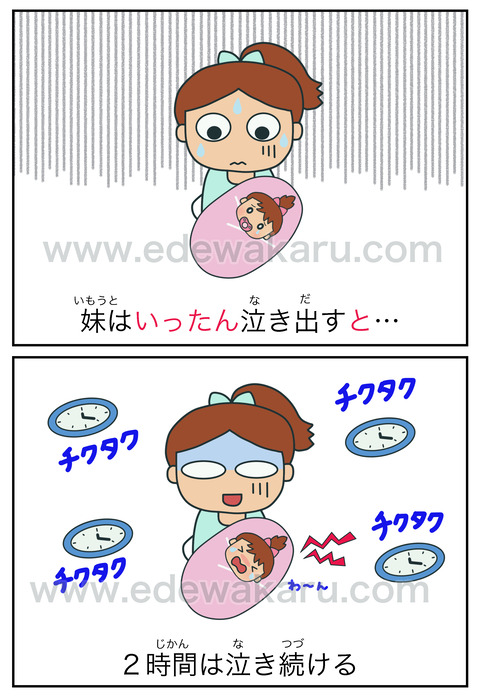
Meaning
一度〜すると、もう前の状態には戻らない
How to use it
いったん+動詞[辞書形]+と
Explanation
「いったん〜と」は「一度〜すると〜」という意味を表す文型で、「一度〜し始めると、元の状態に戻れない」と言いたい時に使用します。「もう前の状態には戻れない」というのがポイントですね😊
[例]
妹は
いったん
泣き出す
と、2時間は泣き続ける
→一度泣き始めると2時間以上、
前の状態(泣いていない状態)に戻らない
また
「いったん〜と」は「いったん〜たら」にチェンジすることもできます
😀
[例]
妹は
いったん
泣き出し
たら、2時間は泣き続ける
彼女は
いったん
怒り出し
たら、どんなに謝っても許してくれない
いったん
ゲームを始め
たら、なかなかやめられない
「いったん」は漢字で書くと
「一旦」
と書くということも覚えておきましょう😉
In context 2 examples
妹はいったん泣き出すと、2時間は泣き続ける
→妹は一度泣き出すと、2時間は泣き続ける彼女はいったん怒り出すと、どんなに謝っても許してくれない
→彼女は一度怒り出すと、どんなに謝っても許してくれない
どんなときどう使う 日本語表現文型辞典
Usage 1
Meaning
when, whenever
How to use it
Vると+~た Vたら+~た
Explanation
と~た〈発見〉
1)「Vと、~」の形で、「Vと」の行為によって、すでに起こっていたこと、あったこと、継続していたこと、などを発見した、という意味を表す。「~」は「Vていた」の形が多い。
2)「Vと」の前後の主語は違う。
3)意外なことがあったときに使われ、驚きの気持ちを表すことが多い。
4)次の二つの文の違いに注意すること。
◆ 窓を開けると、富士山が見えます。(いつものこと)/窓を開けると、富士山が見えました。(ある特定のときのこと)
1)Through V と action, one discovered what occurred or has been continuing. Often found in pattern Vていた.
2)Subjects before and after V と differ.
3)Often used for unexpected events or to express surprise.
4)Note difference in meaning between following.
In context 5 examples
ドアを開けると、大きい犬がいました。
部屋に入ると、会議はもう始まっていた。
机の上を見ると、彼女からの手紙がありました。
携帯の電源を入れたら、メールが7通も来ていました。
Mデパートへ行ったら、今日は休みでした。
Usage 2
Meaning
when…did…
How to use it
Vると+~た Vたら+~た
Explanation
と~た〈きっかけ〉
1)「V1と、V2た」の形で、「V1」の行為がきっかけとなって「V2」のことが起こった、という場合に使う。
2)「V2」に、話す人の意志のある行為を表す文は来ない。 ❸ のように「たら~た」も意味・用法は同じだが「たら~た」の方がやや口語的。
1)In form V1 と V2 た, means action of V1 is impetus for occurrence of V2.
2)No expressions of speaker's volitional actions in V2. Same meaning and usage as たら~たin sentence ❸ , but たら~た is slightly colloquial.
In context 3 examples
のり子が「タロー」と呼ぶと、その犬は走ってきました。
CDをかけると、子どもたちはおどりはじめました。
お酒を飲んだら、気分が悪くなりました。
Usage 3
Meaning
of A and B, which
How to use it
Nと+Nと+どちら
Explanation
と~とどちら
B:紅茶の方が好きです。
B:どちらでもいいですよ。
B:どちらも好きです。
B:あっちの方がきれいよ。
1)二つのものを話題として取り上げて、それを比べる聞き方。この形の比較の質問には、ふつう、「N1よりN2の方が…」の「N1より」を省略して、「N2の方が…」で答える。
2)くだけた話し言葉では「どちら」が「どっち」になる。
is usually N2 のほうが, where N1 より is contracted in the pattern N1 より N2 のほうが.
2)In informal speech, どちらbecomes どっち.
1)Comparison of two topical items. Answer to this comparative question
In context 4 examples
A:あなたは紅茶とコーヒーとどちらが好きですか。
A:土曜日と日曜日とどちらがつごうがいいですか。
A:あなたはスポーツをするのと見るのとどちらが好きですか。
A:このセーターとあのセーターとどっちがいい?
Usage 4
Meaning
says; said
How to use it
〔丁寧形〕・〔普通形〕+と 1)参照
Explanation
と〈直接話法〉
1)直接的な引用を表す。言う言葉をそのままの形で「 」に入れて「と」で受ける。 ❷ ❸ のように「言う」以外の動詞でも使う。
2)話し言葉では ❹ のように「って」を使う。
1)Direct quotations. Quoted phrase is repeated exactly as spoken, followed by to. Verbs other than 言う can be used, as in sentences ❷ and ❸ .
2)In conversation, って is used, as in sentence ❹ .
In context 4 examples
花子さんは「サッカーの試合をはじめて見ました」と言いました。
祖母は「いち、に、さん」と言わないで「ひとつ、ふたつ、みっつ」と数えます。
犬は「ワンワン」、ねこは「ニャーニャー」と鳴きます。
あの子はぼくに「こんにちは」って言ったよ。
Usage 5
Meaning
said
How to use it
〔普通形〕+と
Explanation
と〈間接話法〉
1)間接的な引用を表す。言った内容を「 」に入れないで「と」で受ける。
2)直接話法を間接話法にするとき、丁寧体で話したことや書いたことを普通形にして「と」で受ける。
3)間接話法にすると、人称の言い方や視点のある動詞「行く−来る」なども変わる。
◆ マリは「わたしは来週あなたの家に行きます」と言った。
→マリは、来週わたしの家に来ると言った。
4)話し言葉では ❺ のように「って」を使う。
1)Indirect quotations. Quotation does not precede と.
2)When converting direct discourse into indirect, polite spoken speech or written forms are put into plain form and followed by と.
3)With indirect discourse, verbs that reflect person or point of view change, e.g., 行く becomes 来る, etc.
◆ マリは「わたしは来週あなたの家に行きます」と言った。
→マリは、来週わたしの家に来ると言った。
4)In speech, って is used, as in sentence ❺ .
In context 5 examples
花子さんはサッカーの試合をはじめて見たと言いました。
英語の"Thank you."は日本語で「ありがとう」と言います。
次郎はお父さんに早く会いたいと手紙に書きました。
今日の漢字の試験は簡単だったと思う。
初めてコアラを見たとき、かわいいなって思った。
Usage 6
Meaning
(conditions) when
How to use it
Vる+と
Explanation
と〈継起〉
~てすぐ
1)「~と、…」の形で「~の動作に続いてすぐ…の動作をする様子」を表す。
2)「~と…」の主語は同じ。
3)「…」には、話す人の意志や依頼を表す文は来ない。
4) ❸ のように文末が現在形のときは、習慣的によくすることを表す。
1)Indicates that as soon as what precedes pattern is completed, second action takes place.
2)Subject of both verbs is same.
3)Speaker's volition or request does not appear in succeeding action.
4)When sentence ending is in present tense, as in sentence ❸ , indicates habitual action.
In context 3 examples
兄は上着を着ると、だまって出ていきました。
次郎は手紙を読み終わると、すぐに返事を書き始めました。
このごろ、マリはうちに帰ってくると、すぐどこかへ電話をかけます。
Usage 7
Meaning
just when
Explanation
と~た〈偶然〉
ちょうど、そのとき
Vると+~た Vたら+~た
1)「V1と、V2た」の形で、「V1」のことをしているとき、「V2」が起こった、または、何かに出合った、と言いたいときに使う。
2)「V1と/たら」のVは「~ている」の形が多い。偶然、思いがけなく、という感じがある。
3)「V2」の文はできごとなどを表す文で、状態や話者の行為を表す文は来ない。
4) ❸ ❹ のように「たら~た」も意味、用法は同じだがやや口語的。
1)In form V1 と V2 た, while one action is happening, V2 occurs, or encounters something.
2)OftenV1 verb is in form ~ている. Gives sense of coincidence or something unexpected.
3)V2 states events, and not conditions or people's actions.
4)Same meaning and usage as たら~た as in sentences ❸ and ❹ , but slightly colloquial.
In context 4 examples
本を読んでいると、窓から鳥が入ってきました。
弟の家族のことを心配しながら地震のニュースを見ていると、弟から「ぼくたちは大丈夫だよ」と電話がかかってきました。
山道を歩いていたら、林の中からさるの親子が出てきました。
スーパーで買い物をしていたら、マリさんも来ました。接続
Usage 8
Meaning
(non-actual supposition) if only
How to use it
〔普通形〕の現在形+と~(のに)
Explanation
と~(のに)〈反実仮想〉
木村:そうですか。行けなくて、残念でした。
1)「~と、…のに/けれど」の形で、「~と」で事実とは違うことを仮想して、「…」で実現しなかったことについて、残念な気持ちを述べる。
2)文末は「のに・けれど」などの表現が多い。
1)Using the form ~と、…のに/けれど, imagines something contrary to fact and expresses feelings of regret or gladness that fact was not realized.
2)Often words such as のに、orけれどoccur at end of sentence.
In context 3 examples
伊藤:きのうのパーティーは楽しかったですよ。木村さんも来られるとよかったのに。
田中さんは、もう少し友だちの意見を聞くといいのに……。
(助手をする人について)もっと経験のある人だとよかったんだけれど。
Usage 9
Meaning
once; when
How to use it
〔普通形〕の現在形+と
Explanation
と〈条件〉
B:そうですね。
1)「~と、…」の形で、「~」が成立した場合、必然的に「…」が成立する、という意味を表す。「…」の文末は現在形。
2)「…」には話す人の意志・依頼などを表す文は来ない。
◆ × 春になると、山へ遊びに行きましょう。
→○春になると、きれいな花が咲きます。
3)話す人の意志のある行動でも、❼のように習慣的な行為の場合は意志性が薄いので使える。
4)❽❾は話し言葉。このように「Vないと」は日常生活の中で相手や自分にある行動を取るように促す警告の意味でよく使われる。「Vないと」の後には「いけない・だめだ・困る」などの否定的な言葉が省略されている。
2)Speaker's volition or request does not follow と.
◆ × 春になると、山へ遊びに行きましょう。
→○春になると、きれいな花が咲きます。
4)Sentences ❽ and ❾ are spoken forms, and as is apparent, can often be used to urge speaker or others by using Vないと to take certain actions in daily life. Negatives such as いけない, だめだ, and 困る are omitted after Vないと.
1)Second action inevitably occurs after first action. Sentence ending is in present tense.
3)Speaker's volitional actions can be used for habitual actions such as in sentence ❼, since volition is muted.
In context 9 examples
暖かくなると、桜の花が咲きます。
ここを強く押さないと、電気はつきません。
となりの部屋がうるさいと、眠れません。
外国語が上手だと、いろいろな仕事ができます。
この学校は外国人でないと入れません。
この道を右に曲がると、駅が見えます。
わたしはおなかがすくと、いつもラーメンを作って食べます。
A:会議の時間が変わったことを木村さんにも知らせないと。
母:ともちゃん、早く起きないと。もう7時半ですよ。
日本語NET JLPT文法解説まとめ
Meaning
ある動作を行うと、必ず、別のことがらや作用が続いて起こることを表す。
機械の使い方や道順の説明によく使われる。
How to use it
V(辞書形 / ナイ形)+ と
イAい + と
ナAだ + と
Nだ + と
Explanation
"whenever A happens, B also happens."
① This sentence pattern describes a sequence of actions or events where one action inevitably leads to another.
② This sentence pattern is commonly used in explaining how to use machines or giving directions.
・後件に意志を表す文や依頼表現などは使えない。
・仮定条件には使うことができない。
例:もし100万円あると、何がしたいですか?
In context 13 examples
この道をまっすぐ行くと、病院があります。
このまままっすぐ行って、2つ目の角を左に曲がると、交番があります。
お金を入れて、食べたい料理のボタンを押すと、食券が出ます。
春になると桜が咲きます。
冬になると、暗くなるのが早くなります。
一日中パソコンを使うと、目が痛くなります。
私は彼の顔を見ると、いつも元気になります。
私は電気を消さないと、寝られません。
このダイアルを回すと、音が大きくなります。
このボタンを押すと、ドアが開きます。
JLPT N2に受からないと、就職は難しいですね。
アレルギーがあるので、猫に触ると体がかゆくなります。
成績が悪いと、学校を卒業できませんよ。
毎日のんびり日本語教師
Usage 1
Read this source entry ↗How to use it
数量詞+と~ない
Explanation
期間や数量を表す語について、それに少しも満たないことを表します。
Notes
特になし
In context 4 examples
配属されて1週間と経たず辞めてしまった。
集中力がなくて、10分と机に向かっていられない。
ダイエットしても三日と持たず続かない。(即使减肥也坚持不了三天。)
募集したのに、参加者は10人と集まらなかった。
Usage 2
Read this source entry ↗How to use it
-
Explanation
格助詞としての「と」の用法は並列関係、動作の同伴、異同の判断基準、引用、例示の5つあります。
文法としての用法は動作の契機(順次動作)、一般条件、仮定条件、確定条件、習慣、話の前置き、繰り返し・累加の7つあります。
格助詞の「と」については、「格助詞の用法一覧 - 格助詞「と」の用法」でもまとめてあります。
格助詞
並列関係
私と彼は学生です。
動作の同伴
彼女と結婚したい。
異同の判断基準
私は母と似ていない。
引用
彼は今日来ると言っていた。
例示
彼は野球、サッカー、バスケと、スポーツなら何でもできる。
文法
動作の契機(順次動作)
家に帰ると、すぐ倒れ込んだ。
一般条件
春になると桜が咲く。
仮定条件
そこを曲がると、銀行があります。
確定条件
右に曲がると、銀行があった。
習慣
春になると毎年花見をする。
話の前置き
正直に言うと、私は全て知っている。
繰り返し・累加
一人、また一人と辞めていった。
一般条件
とは、前件が成立すると後件が必ず成立するような一般的な事象を述べるときの条件文です。
仮定条件
とは、前件の真偽が未定である条件のことです。
確定条件
とは、前件が発生する可能性が100%である条件のことです。
習慣
の用法では、その人物の習慣となっている動作を表し、「いつも」「よく」「必ず」「毎日」「毎年」などの高い頻度を表す副詞と呼応しやすいです。
話の前置き
の用法では、「言う」「考える」「見る」などの動詞の後に接続し、後件の前置きを表します。
Notes
特になし
In context 24 examples
私と彼は学生です。(我和他是学生。)
机にスマホと本が置いてある。
彼女と結婚したい。
ペットと一緒に帰省する。(带着宠物一起回老家。)
私は母と似ていない。(我和母亲不像。)
私はあなたとは違う。(我和你不一样。)
彼は今日来ると言っていた。
今何とおっしゃいましたか?
彼は野球、サッカー、バスケと、スポーツなら何でもできる。
彼女は英語、日本語、スペイン語と、語学に長けている。
家に帰ると、すぐ倒れ込んだ。
窓を開けると、風が吹き込んできた。
春になると桜が咲く。
暗いところでスマホを見ると、目が痛くなる。
そこを曲がると、銀行があります。
このボタンを押すと、シャッターが閉まります。
右に曲がると、銀行があった。
ボタンを押すと、シャッターが閉まった。
春になると毎年花見をする。(每年一到春天就会去赏樱花。)
母はいつも天気が良いと散歩に行く。
正直に言うと、私は全て知っている。
今考えてみると、あれは間違っていたと思う。
一人、また一人と辞めていった。
1度だけじゃなく、2度、3度と失敗した。
日本語文型辞典 英語版
Meaning
【と1】[N/Na だと][A-いと][V-ると]Attaches to the dictionary form of a predicate. Although it is usually used with plain forms, in polite language it is also used in the form ですと or ますと. Expresses the relation that the second event is realized because of the condition created by the first event.
Expresses a conditional relationship that applies not to a specific person or thing, but to people or things in general. Means “if X happens, then Y is inevitable.” The end of the sentence is always in dictionary form, and ta-forms, conjectural forms, and so on are not possible. As in
(7)
, sometimes と is combined with ものだ, which signifies that a certain characteristic is intrinsic to the thing or situation at hand.
Often used to express a relationship in which the event stated in the second clause occurs automatically or spontaneously after the event in the first clause. Thus, this pattern is often used to state laws of nature. Both
(10)
and
(11)
are proverbial expressions.
a. ...と...る
Indicates the repetition of a present habit or action of a particular person or thing. The dictionary form of a predicate is used at the end of the sentence.
b. ...と...た(ものだ)
The ta-form of a predicate is used at the end of the sentence to express the repetition of a past habit or action of a particular person or thing. Often accompanied by the phrase たものだ, which expresses reminiscence.
Used to say that “if/when X occurs, then Y will occur,” with respect to a particular person or thing. The Y clause always expresses an unrealized situation, but the X clause may express either an unrealized situation or one that has already come about.
(1)
-
(6)
are cases in which X has not been realized, and
(7)
-
(10)
are cases in which X has already been realized.
(6)
is a threat directed at an addressee who is on the verge of moving. In this situation it would also be possible to say 動いたら撃つぞ (If you move, then I’ll shoot), but the use of と implies that both actions will occur virtually simultaneously, giving the threat more impact than when it is expressed with the たら form.
(7)
and
(8)
are ways to warn or admonish someone who is overeating and someone who is lax about studying, respectively.
The Y clause may be followed by expressions to emphasize a fact, or expressions of conjecture such as だろう or かもしれない. However, expressions meant to exert an effect on the other party, including commands, requests, and invitations, cannot be used. V-よう intentional forms cannot be used either.
(×)雨天だと明日の試合は中止しよう。
When it’s rainy, let’s cancel tomorrow’s match.
(○)雨天なら明日の試合は中止しよう。
If it rains, let’s cancel tomorrow’s match.
Since と conveys a strong implication that a condition has already been realized or is very likely to be realized in the future, there is a tendency to avoid combining it with the word もし, which signifies a hypothetical situation.
(×)もし雨天だと試合は中止になります。
Supposing when it rains, the match will be canceled.
(○)もし雨天なら試合は中止になります。
If it rains, the match will be canceled.
b. ...と+疑問詞...か
B:顔が赤くなります。
My face turns red.
B:17 になります。
It’s
1
7.
B:国道1号線に出ます。
It leads to National Highway No.
1.
This is like the form するとどうなるか (if such-and-such is done, what is the outcome?). と is followed by an interrogative clause such as どうなるか or 何があるか, which contains a question word and a verb that expresses some kind of unintentional action, such as change or existence. Expressions denoting actions that are consciously controllable, such as どうするか, cannot be used unless they indicate a habitual behavior or characteristic.
(×)水は 100 度になるとどうしますか。
What will you do when water reaches a temperature of 100 degrees Celsius?
(○)水は 100 度になるとどうなりますか。
What happens when water reaches a temperature of 100 degrees Celsius?
The particle と is similar to the pattern するとどうなるか in that the focus of the question is usually on the second half of the sentence. It is difficult to use in patterns like どうするとそうなるか, where the focus of the question is on the first half of the sentence. In these cases, it is more natural to use ば or たら rather than と.
(×)どうするとドアは開きますか。
What do you do then the door opens?
(○)どう{すれば/したら}ドアは開きますか。
What should be done so that the door opens?
a. ...と...た〈trigger〉
Expresses a relationship between two situations, such as when the occurrence of the first situation makes the speaker aware of the second, or the first situation is a trigger that brings about the second.
(1)
,
(2)
, and
(3)
show that as soon as the first action is carried out, the speaker “discovers” the second situation.
(4)
and
(5)
are scenarios in which a new situation arises while the first action is taking place. In
(6)
and
(7)
, the first half of the sentence expresses a time-related condition that leads to the realization of the second situation.
(8)
and
(9)
express a relation in which the first action triggers the occurrence of the second one.
In all cases, the second situation must be part of the same overall situation as the first one, and it must also be something the speaker can observe from the outside. The following example describes an internal physical sensation of the speaker. Here the particle と is not possible, and たら must be used instead.
(×)昨夜この薬を飲むと、よく効いた。
On taking this medicine last night, it worked really well.
(○)昨夜この薬を飲んだら、よく効いた。
When I took this medicine last night, it worked really well.
In almost all cases, a verb is used in both clauses. However, when this pattern is used to express the discovery of a situation, a predicate noun or adjective may conclude the second sentence, as shown in
(3)
above and the example below.
(例)外に出ると、予想以上に寒かった。
On going outside, I found it much colder than I had imagined.
b. ...と...た〈successive events〉
Expresses a situation in which the same person performs two actions in succession, the first one leading to the second. Both actions are intentional. Although the ta-form is usually used at the end of the sentence, in stage directions for things like screenplays the dictionary form may be used, as below.
(例)《シナリオ》良雄は、手をふくと、ギターを手に取る。
《script》Yoshio wipes his hands, then picks up the guitar.
The <successive events> usage of と is often found in novels or stories. With this usage, たら is unnatural, and it is almost never possible to use たら instead of と. This と can be replaced by the te-form of the verb, but it is not always possible to replace the te-form of the verb with と. For example, the te-form can be used to link three or more successive actions, but と cannot be used to do so.
(×)父は家に帰ると、ご飯を食べると、すぐ布団に入った。
When my father came home, when he ate dinner, he soon got into bed (lit. his futon).
(○)父は家に帰って、ご飯を食べて、すぐ布団に入った。
My father came home, ate dinner, and soon got into bed.
While the te-form expresses successive actions that are part of the same situation, と divides one situation into two parts. It is used to depict, from an external point of view, the change that arises as the first situation switches into the second one.
This is a combination of the conditional expression と and the adverb すぐ. It means that a first event is followed immediately by the occurrence of a second.
When と is used after verbs of utterance, thought, or comparison, such as 言う (say), 見る (see), 考える (think), or 比べる (compare), it functions as an introductory expression indicating the viewpoint or stance from which the thing that follows will be stated. In this usage, と can often be substituted with the forms たら, ば, and なら.
1
1
1
1
3
1
1
1
1
1
【よう2】4
As in 一人、また一人 (one person, then another) or 一つ、また一つ (one by one), the quantifier “one” is repeated to indicate the sporadic repetition of an event. Used in written language.
A situation of gradually increasing amount or frequency is expressed by listing a small number with the next largest one.
B:いや、客が多いから1時間ともちませんよ。
No, there are a lot of guests, so it won’t even last an hour.
This pattern uses a quantifier indicating a short time or a small amount, followed by the negative form of a verb, to express the notion that this limited number was not nearly sufficient.
と is attached to mimetic or onomatopoeic words to express the manner of an action or effect. とmay be omitted in some cases. Also, repetition of the mimetic or onomatopoeic word, as in
(3)
-
(5)
, implies that the action/effect is repeated or that the onset of the action/effect is slow and gradual.
How to use it
1. ...と〈generic condition〉
2. ...と〈repetition, habit〉Expresses repeated habits or actions of a particular person or thing. Often accompanied by adverbs such as 必ず(invariably), いつも(always), 毎年(every year), or よく(often). Unlike the generic condition expressed in Usage 1, this usage concerns a particular subject, and either the dictionary form or ta-form may be used at the end of the sentence.
3. ...と〈yet-to-be-realized condition〉a. ...と+未実現のことがら
4. ...と...た〈already-realized condition〉The situations specified before and after と are previously-realized conditions. Typically, the ta-form appears in sentence-final position, but in novels and other literary works, the dictionary form is sometimes used to express the historical present. In almost all cases, a verb is used both before and after this expression. Often used in stories and novels. In conversation, たら is more commonly used.
5. ...とすぐ
6. ...と〈introductory utterance〉
7. ...からいうと→
8. ...からすると→
9. ...からみると→
0. ...てみると→
1. ...というと→
2. ...となると→
3. ...ともなると→
4. ...によると→
5. V-ようとV-まいと→
1. 数量詞+と〈repetition〉
2. 数量詞+と〈cumulative increase〉
3. 数量詞+とV-ない
4. にどとV-ない→
5. 擬態語+と
In context 78 examples
あまり生活が便利だと人は不精になる。
People become lazy when lifestyles are too convenient.
気温が低いと桜はなかなか咲かない。
If the temperatures are low, it takes a long time for the cherry blossoms to bloom.
酒を飲むと顔が赤くなる。
His face turns red if he drinks alcohol.
春が来ると花が咲く。
When spring comes, flowers bloom.
水は 100 度になると沸騰する。
Water boils when it reaches 100 degrees Celsius.
気温が急に下がると霧が発生する。
Fog forms when the temperature drops suddenly.
だれでも年をとると昔がなつかしくなるものだ。
All people wax nostalgic over the past as they get older.
生活が安定すると退屈になるし、不安定すぎるとストレスがたまる。
When life is stable, it gets boring, and if it’s too unstable, it causes stress.
月にかさがかかると翌日は雨になる。
When the moon has a halo, it will rain the next day.
来年のことを言うと鬼が笑う。
Don’t count your chickens before they’re hatched (lit. If you talk about next year, the devil will laugh).
夜爪を切ると親の死に目に会えない。
If you cut your nails at night, you’ll never say your last goodbyes to your parents (lit. If you cut your nails at night, you won't be able to see your parents at the time of their death).
おじいさんは天気がいいと裏山に散歩にでかける。
Grandfather strolls in the hills behind our house whenever the weather is fine.
兄は冬になると毎年スキーに行く。
My older brother goes skiing every year when winter comes.
隣の犬は私の顔を見るといつもほえる。
The dog next door barks every time she sees my face.
私は面白いコマーシャルを見るとすぐその製品を買いたくなるくせがある。
Whenever I see an interesting commercial, I tend to want to buy the product right away.
お酒を飲むといつも頭がいたくなる。
I always get a headache when I drink alcohol.
キーボードを2時間たたくと肩がこる。
I get stiff shoulders whenever I type on a keyboard for two hours.
彼女はストレスがたまるとむやみに食べたくなるのだそうだ。
I heard that whenever she’s under stress, she wants to eat a lot.
僕がデートに遅れると彼女は必ず不機嫌になる。
My girlfriend always gets upset when I’m late for a date.
彼は給料が入ると飲みに行く。
He goes out drinking whenever he gets paid.
子供のころ天気がいいと、この辺を祖母とよく散歩をしたものだ。
When I was a child, if the weather was nice, I often used to take walks with my grandmother around here.
日曜日に一家で買い物に出ると、必ずデパートの食堂でお昼を食べた。
When my family went shopping together on Sundays, we always ate lunch in the department store cafeteria.
祖母のところに行くと必ずおこづかいをもらったものだ。
Whenever I went to my grandmother’s, I always got some spending money.
学生のころは、試験が始まると胃が痛くなったものだ。
When I was a student, as soon as exams started I would always get a stomach ache.
北海道のおじさんが遊びに来ると娘たちはいつも大喜びをした。
My daughters were always overjoyed whenever their uncle from Hokkaido came to visit.
あのころは一日働くと、一ヶ月遊んで暮らせたものだ。
At that time, I could goof off for a month on just one day’s work.
ここをまっすぐ行くと右手に大きな建物が見えます。
If you go straight here, you’ll see a large building on your right.
このボタンを押すとドアは開きます。
If you push this button, the door will open.
この小説を読むと世界観が変わるかもしれません。
Your view of the world may change if you read this novel.
雨天だと明日の試合は中止になります。
If it rains, then tomorrow’s match will be canceled.
これを全部計算すると、総費用はだいたい100万円になります。
If you calculate all this, the total cost is about a million yen.
動くと撃つぞ。
Move and I’ll shoot!
そんなに食べると太るよ。
You’ll gain weight if you eat that much.
真面目に勉強しないと卒業できないよ。
If you don’t study hard, you won’t graduate, you know.
生活がこんなに不安定だと落ち着いて研究ができない。
When my livelihood is this uncertain, I can’t concentrate on my research.
こんなにおいしいといくらでも食べてしまいそうだ。
When it’s this delicious, I could eat as much as there is.
A:お酒を飲むとどうなりますか。
What happens if you drink alcohol?
A:51 を3で割るといくつになりますか。
What do you get if you divide 51 by 3?
A:この道をまっすぐ行くと、どこに出ますか。
Where does this road lead to, if we follow it straight ahead?
教えられた通りまっすぐ行くと、つきあたりに郵便局があった。
When I went straight down the road I had been shown, there was a post office at the end.
駅に着くと、友達が迎えに来ていた。
When I arrived at the station, my friend was already there to meet me.
トンネルを出ると、そこは銀世界だった。
Passing through a tunnel brought us into a winter wonderland.
お風呂に入っていると、電話がかかってきた。
It was while I was sitting in the bath that the telephone rang.
街を歩いていると、見知らぬ男が声をかけてきた。
When she was walking about the town, a strange man called to her.
夜になると急に冷え込んできた。
When evening came, it suddenly turned cold.
午後になるとだいぶ暖かくなった。
When afternoon came, it became much warmer.
ベルを鳴らすと、女の子が出て来た。
When I rang the bell, a young girl came out.
仕事をやめるとたちまちお金がなくなった。
When I quit my job, my money ran out in no time.
男はめざまし時計を止めると、またベッドへ戻った。
After shutting off his alarm clock, the man climbed back into bed.
わたしは、東京駅へ着くとその足で会社へ向かった。
After reaching Tokyo Station, I continued on to the office.
母は受話機を置くと、ためいきをついた。
After putting down the receiver, Mother let out a sigh.
彼はうちへ帰るとすぐテレビのスイッチを入れる。
As soon as he gets home, he turns on the TV.
放送局は、駅を降りて右へ曲がるとすぐです。
The broadcasting station is just after you take the first right from the station.
うちへ帰るとすぐテレビのスイッチを入れた。
I turned on the TV as soon as I got home.
彼らは土地の開発許可が降りるとすぐ工事にとりかかった。
As soon as they got the land development permit, they started construction.
彼女は大学を卒業するとすぐ結婚した。
She got married right after she graduated from college.
スポーツをやめるとすぐ太り出した。
As soon as he stopped playing sports, he started to put on weight.
正直に言うと、そのことについてはあまりよく分からないのです。
To be honest, I really don’t know very much about that.
母に言わせると、最近の若者は行儀が悪くなっているようだ。
If you ask my mother, apparently young people these days have worse manners.
本当のことを申し上げますと、手術で助かる見込みは 50 パーセント以下ではないかと思います。
If I may speak frankly, I think the chances of success for this operation may be less than fifty percent.
実用的な点からみると、あまり使いやすい部屋ではない。
Looking at it from the point of view of practicality, it’s not a very easy-to-use room.
今となって考えてみると、彼の言うことももっともだ。
Looking back on it now, what he said was also on the mark.
昨年に比べると、今年は桜の開花がちょっと遅いようだ。
Compared with last year, this year the cherry blossoms seem to be coming into bloom a little later.
人々は一人、また一人とやってきた。
One person came, and then another and another.
星が、一つ、また一つと消えていく。
One by one the stars disappear.
白鳥が一羽、また一羽と湖に降り立った。
The swans alighted on the lake one by one.
人々は一人、二人と集ってきた。
The people assembled in ones and twos.
このコンクールも二回、三回と回を重ねるうちに、だんだんよくなってきた。
This contest has gradually improved, after being held on two or three occasions.
二度三度と失敗を繰り返して、ようやく成功にこぎつけた。
After two or three repeated failures, I finally managed to achieve success.
禁煙しようという彼の決心は三日と続かなかった。
His decision to quit smoking didn’t even last for three days.
あの人は気が短いから、5分と待っていられない。
That person has little patience, so she can’t wait even five minutes.
A:これだけビールを買っておけばだいじょうぶでしょう。
If we buy this much beer, it should be enough, right?
あんなに宣伝したのに、参加者は二十人と集らなかった。
After all that publicity, we didn't even get twenty participants.
彼はゆっくりと立ち上がった。
He stood up slowly.
雨がザーッと降ってきた。
The rain started to fall in buckets.
雨がぽつり、ぽつりと降り始めた。
It began to rain, a drop here, a drop there.
列車はガタンガタンと動き始めた。
The train began to move with a bump and a jerk.
傷口がずきんずきんと痛む。
The wound throbbed with pain.
AIUEO JLPT Grammar
Usage 1
Meaning
「〜と」is a particle used to link nouns in parallel. It connects two or more nouns to represent a joint action or existence. This expression is used simply to list multiple items and indicates that the parallel nouns have an equal relationship. Similar to "… and ...” in English.
How to use it
名詞1+と(+名詞2)
Explanation · 日本語
「〜と」は、名詞を並列させるために使用される助詞です。二つ以上の名詞をつなげることで、共同での行動や存在を表します。この表現は、単純に複数の項目を並べるときに使われ、並列する名詞が対等な関係にあることを示します。
In context 5 examples
友達と図書館に行きました。
I went to the library with a friend.
彼は兄と一緒に住んでいます。
He lives with his older brother.
犬と猫が好きです。
I like dogs and cats.
山と海が見えます。
You can see mountains and the sea.
歌うことと料理することが趣味です。
My hobbies are singing and cooking.
Usage 2
Meaning
「と」is a conjunction used to express a natural or inevitable result based on a certain condition or assumption. It is used when the situation fits the condition, naturally leading to the next event.
How to use it
動詞辞書形+と形容詞辞書形+と形容動詞だ+と名詞だ+と
Explanation · 日本語
「と」は、ある条件や仮定の状況に基づいて、必然的な結果や自然な流れを表す接続助詞です。状況がその条件に当てはまると、自然に次の事柄が起こる場合に使われます。
In context 5 examples
朝早く起きると、一日が長く感じる。
When you wake up early in the morning, the day feels longer.
バーゲンだと、人がたくさん集まる。
When there is a sale, a lot of people gather.
ソフトウェアを更新すると、問題が解決することが多い。
When you update the software, problems are often solved.
経済が悪化すると、失業率が上がる。
When the economy worsens, the unemployment rate rises.
家にいると、安心する。
When you are at home, you feel safe.
Bunpro Grammar Reference
Usage 1
Meaning
If, When, Whenever, And, [Conditional]
How to use it
Verb + と
[い]Adjective + と
[な]Adjective + だ + と
Noun + だ + と
Nuance
A conditional that expresses known or certain outcomes.
Explanation
In the same way as the case marking particleと means 'and', sometimes it is translated as 'if'. In these cases, it is considered to be far stronger than ば, なら, or たら (which express hypothetical outcomes). This is because one of the primary uses of と is highlighting a result. In these cases, と is actually a conjunction particle, and shows one of three things.
仮定の順接 - A result that is assumed to be true, and obvious.
確定の順接 - A result that is known to be true.
仮定の逆接 - The opposite of a result that is assumed to be true.
Due to this, the (B) part of a phrase using と as 'if', will always occur when (A) happens, as it is considered to be the result of (A).
甘いものをいっぱい食べると、太る。
If you eat a lot of sweet things, you will gain weight.
部屋が汚いと、お母さんに怒られる。
If my room is messy, my mother will yell at me.
部屋が静かだと、眠れない。
If my room is quiet, I can't sleep.
地下鉄だと、五分早く着く。
If it's the subway, you will arrive 5 minutes faster.
と may not be used in situations where the (B) result 'might' happen. It must be definite (or close to definite).
走るとけがをする。
If I run, I will injure myself. (Unnatural Japanese, unless this person always injures themselves while running for some reason)
In this particular nuance of と, despite being translated as 'if', the actual meaning is much closer to 'and', as と is expressing that (A) and (B) will always go together.
目を閉じると、何も見えない。
I close my eyes, and I can't see.
Nuance · 日本語
結果が分かっている時や決まっていることを表す仮定法。
In context 18 examples
- 勉強をすると、テストは簡単になる。
If you study, tests become easy.
- 目を閉じると、何も見えない。
I close my eyes, and I can't see.
- 甘いものをいっぱい食べると、太る。
If you eat a lot of sweet things, you will gain weight.
- 部屋が汚いと、お母さんに怒られる。
If my room is messy, my mother will yell at me.
- 部屋が静かだと、眠れない。
If my room is quiet, I can't sleep.
- 走るとけがをする。
If I run, I will injure myself. (Unnatural Japanese, unless this person always injures themselves while running for some reason)
- 地下鉄だと、五分早く着く。
If it's the subway, you will arrive 5 minutes faster.
- この石を磨くと、綺麗になる。
If you polish this rock, it will become beautiful.
- そうすると絶対に失敗するよ。
If you do it that way, you will definitely make a mistake.
- ここから見ると、富士山が全然見えない。
If you look from here, you can't see Mt. Fuji at all.
- 週に3回トレーニングをするとだんだん強くなる。
Whenever you workout three times a week, you gradually get stronger. (if...)
- この辺でスピードを出し過ぎるとスピード違反になるよ。
If you speed in this area, you will get a speeding violation.
- ガスの匂いがしているときに火を点けると、危ないです。
It is dangerous to light a fire, if you smell gas. (whenever...)
- 今行くと危険なので、行かない方がいいと思う。
If you go now it is dangerous, so I think that it is better not to go.
- 水着を持って来るのを忘れると海に入れないよ。
If you forget to bring your swimsuit, you won't be able to swim in the ocean.
- ロッククライミングをすると使ったことのない筋肉を使う。
If you go rock-climbing you use muscles that you have never used before.
- 日本の人口が減ると大変になる。
If the Japanese population diminishes then it will become a serious situation.
- 日本語で喋ってみると日本人が喜ぶよ。
If you speak Japanese, Japanese people will be happy.
Usage 2
Meaning
And
How to use it
Noun + と
Nuance
A grammar point used to show things that exist together, in some state.
Explanation
と is a particle that is often thought of as meaning 'and' in English, which is usually how it can be translated. In a broader sense, と simply shows that there is a relationship of 'compilation' between (A) and (B). That relationship could be existing together (translated as 'and'), or performing an action together (translated as 'with').
In this case, we will focus on the 'and' translation. A full description of と as 'with' can be found here.
ピーナッツとビール。
Peanuts and beer.
彼女と食べる。
I eat with my girlfriend.
と is required after every noun that it is grouped with. However, the last と in a sentence will often be omitted, if there are several.
消しゴムとペンと鉛筆もある。
There is an eraser, pen, and a pencil too.
In this example, we can see that the last noun in the group (pencil) does not require the particle と, although it is considered more correct to have it. In conversation, the last と will almost always be omitted.
Nuance · 日本語
あるものが他の何かと同じ状態で一緒に存在しているということを表す文法。
In context 15 examples
- 魚とバナナ。
Fish and bananas.
- ピーナッツとビール。
Peanuts and beer.
- 彼女と食べる。
I eat with my girlfriend.
- 消しゴムとペンと鉛筆もある。
There is an eraser, pen, and a pencil too.
- トムとジェリー。
Tom and Jerry.
- コーヒーと牛乳。
Coffee and milk.
- 川と滝。
River and waterfall.
- これとそれは私のものです。
This and that are mine.
- メアリーとたけしとロバートは大学生だ。
Mary and Takeshi and Robert are college students.
- これとこれもあなたのですよね。
This and this too are yours, right?
- 私はカタカナとひらがなを教えます。
I teach katakana and hiragana.
- レストランと映画館は楽しい。
Restaurants and cinemas are fun.
- 私はフルーツとパンも食べます。
I eat fruit and (also) bread.
- ポチとサタケは犬です。
Pochi and Satake are dogs.
- 沖縄の海とビーチは綺麗です。
Okinawa's sea and beaches are pretty.
Usage 3
Meaning
Quotation
How to use it
(Quotation) Phrase + と + Verb(*)
Verb + と + Verb(*)
[い]Adjective + と + Verb(*)
[な]Adjective + (だ) + と + Verb(*)
Noun + (だ) + と + Verb(*)
(*) Verbs like 言う、聞く、思う、考える、仮定する and the like are used
Nuance
A particle used when quoting or summarizing something that has been said.
Explanation
One of the regular functions of と in Japanese is as a quotation particle. This use is called 引用 in Japanese, which basically translates as 'reference', or 'citation'. This way of using と can appear after almost any type of word (or phrase), but requires だ when used after nouns or な-Adjectives.
先生が「危ない!」と叫んだ。
The teacher yelled, 'Watch out!'
木村さんが「3キロ歩いた」と言った。
Kimura san said, 'I walked 3 km.'
あれは猫だと思う。
I think that is a cat.
富士山は綺麗だと思う?
Do you think that Mt. Fuji is beautiful?
と as a quotation marker will almost always be followed by a verb that shows what type of 'quote' it is. This can be words like 言う, 思う, 考える, 聞く, etc. However, at the end of a sentence, the verb will often be omitted.
生徒が先生に「何で?」と。
The students asked the teacher, 'Why?'
As with other instances of the particle と being used, this use simply expresses the relationship between (A) 'what was communicated', and (B) 'how it was communicated'.
Nuance · 日本語
誰かが言ったことを引用する時や要約するときに使われる助詞。
In context 17 examples
- 彼はとても親切だと聞きました。
I heard that he is very friendly.
- あれは猫だと思う。
I think that is a cat.
- 先生が「危ない!」と叫んだ。
The teacher yelled, 'Watch out!'
- 富士山は綺麗だと思う?
Do you think that Mt. Fuji is beautiful?
- 木村さんが「3キロ歩いた」と言った。
Kimura san said, 'I walked 3 km.'
- 生徒が先生に「何で?」と。
The students asked the teacher, 'Why?'
- 「彼はここに来ますか」と聞いた。
I asked, 'Is he coming here?' (asked)
- 「晩ごはんを作った」と言った。
I said, 'I made dinner'.
- 「重いですか」と聞きました。
He asked, 'Is it heavy?'
- 先生が「危ない」と書いた。
The teacher wrote, 'It is dangerous'.
- 「綺麗じゃなかった」と言いました。
He said, 'It wasn't beautiful'.
- 「南から風が来る」と聞いた。
I heard, 'A wind will come from the south'.
- 子供が「野菜が好きです」と言いました。
The child said, 'I like vegetables'.
- 彼は「明日は雨でしょう」と言いました。
He said, 'It will probably rain tomorrow.'
- 「寿司が好きですか」と聞きました。
He asked, 'Do you like sushi?'
- 私は「ここでは遊ばない」と書いた。
I wrote, 'I don't play here'.
- メモに「私は今から学校に行きます」と書いた。
I wrote, 'I am going to school now' on a note.
Usage 4
Meaning
With
How to use it
Noun (A) + は + Noun (B) + と + Verb
Nuance
A particle which highlights actions that are happening mutually, with several things involved.
Explanation
In our second lesson about と, we will look at the common translation of 'with' that is associated with this particle. と shows that there is a relationship between (A) and (B), regardless of if that relationship is translated as 'and', or 'with'.
In either case, the nouns that are marked with と are usually all performing some mutual action (that mutual action may simply be existing).
カレーはご飯と食べるよ。
I eat curry with rice. (I eat rice 'and' curry)
コーヒーを妻と飲む。
I drink coffee with my wife. (I 'and' my wife drink coffee)
When と is used as 'with', it means that both/all people or objects are equally involved in the action. However, に highlights that one person is the target (destination) of an action, so will result in something sounding a lot more one sided.
先生と話す。
I will talk with my teacher. (Focus on both people talking)
先生に話す。
I will talk to my teacher. (Focus on only one person talking)
Here we can see that both people are talking when と is used. It is a mutual conversation. When に is used, however, the person marked by に is being talked 'to', and is usually not actively participating in the conversation.
Nuance · 日本語
複数のことが同時に起こっていることを強調するために使われる助詞。
In context 16 examples
- トムと話す。
I talk with Tom.
- 先生と話す。
I will talk with my teacher. (Focus on both people talking)
- 先生に話す。
I will talk to my teacher. (Focus on only one person talking)
- コーヒーを妻と飲む。
I drink coffee with my wife. (I 'and' my wife drink coffee)
- カレーはご飯と食べるよ。
I eat curry with rice. (I eat rice 'and' curry)
- 僕は友達とごはんを食べる。
I will eat food with my friend.
- ゆうこさんはみおさんとコーヒーを飲む。
Yuko-san drinks coffee with Mio-san.
- タキはミツハと走る。
Taki runs with Mitsuha.
- 田中さんは山田さんと話す。
Tanaka-san talks with Yamada-san.
- 私は先生と食べます。
I will eat with the teacher.
- リカと一緒ですか?
Are you together with Rika?
- 彼がうざきさんと遊びます。
He hangs out with Uzaki-san.
- 朝、私はクマと歩く。
In the morning, I will walk with Kuma.
- 「すみません、明日は友達と出かけます。」
'I am sorry, I am going out with friends tomorrow.'
- 「妹とジュースを飲む。」
'I will drink juice with my sister.'
- ななさんははなさんと友達です。
Nana-san is friends with Hana-san.
Usage 5
Meaning
Between ~ which one
How to use it
Noun (A) + と + Noun (B) + (と) + どちら(1) + が
Verb1 + こと(2) + と + Verb2 + こと(2) + (と) + どちら(1) + が
(1) どちらのほう、どっち、どっちのほう
(2) の
Nuance
An expression that presents two choices, and then asks the speaker to choose one.
Explanation
と~と、どちらが is an expression in Japanese that is made from the following parts:
と - The particle (x2) in its meaning of 'and'.
どちら - The polite speech form of 誰 'who', and a slightly newer form of どっち that basically means 'which'.
が - The case marking particle.
This structure is used when the speaker is asking a question about whether someone will choose (A) or (B). It is only used when there are no more than two possible choices.
ピザとラーメンとどちらが好きですか。
Between pizza and ramen, which do you prefer?
漢字を書くことと漢字を読むこととどちらが得意ですか。
Between writing and reading kanji, which are you more confident with?
遊園地に行くのと動物園に行くのとどちらがいいですか。
Between going to the amusement park, and going to the zoo, which is better?
As can be seen above, verbs may be used as part of this structure if they are nominalized with こと, or の. Additionally, the polite form does not specifically need to be used, and どっち may be used instead.
辛い物と甘い物とどっちが好き?
Between something spicy and something sweet, which do you like more?
The second と itself is quite often omitted, as どちら (or どっち) implies that both (A) and (B) are part of the same structure.
私と彼女どっちが好き?
Between me and her, who do you like?
Fun Fact
As どちら is the polite speech form of 誰, it is also frequently used as a polite way to ask questions about unknown people.
すみません、どちら様ですか?
I'm sorry, who are you?
Caution
どちらのほう (or どっちのほう) may also be used, but this does not really change the overall nuance. It merely puts slightly more emphasis on the 'direction' of the choice. This is similar to expressions like 'which one are you leaning towards?' in English.
ワインとビールとどちらの方が飲みたいですか?
Between wine and beer, which would you want to drink more?
Nuance · 日本語
二つの選択肢を提示し、聞き手に一つ選択させるときに使われる表現。
In context 19 examples
- コーヒーとお茶とどちらがほしいですか。
Between coffee and tea, which do you want?
- 漢字を書くことと漢字を読むこととどちらが得意ですか。
Between writing and reading kanji, which are you more confident with?
- 辛い物と甘い物とどっちが好き?
Between something spicy and something sweet, which do you like more?
- ピザとラーメンとどちらが好きですか。
Between pizza and ramen, which do you prefer?
- 遊園地に行くのと動物園に行くのとどちらがいいですか。
Between going to the amusement park, and going to the zoo, which is better?
- 私と彼女どっちが好き?
Between me and her, who do you like?
- スポーツすることと、ゲームすること、どちらが上手ですか。
Between playing sports and playing video games, which are you better at?
- ひらがなとカタカナとどちらが覚えにくいですか。
Between hiragana and katakana, which one is more difficult to remember?
- エベレストとK(ケー)2(ツー)とどちらが高い?
Between Everest and K2, which one is taller?
- 電車で行くのと車で行くのとどちらが早いんですか。
Between going by train and going by car, which one is faster?
- テニスとバスケとどちらが楽しいと思う?
Between tennis and basketball, which do you think is more enjoyable?
- マンガを読むことと、新聞を読むこと、どちらが好きですか。
Between reading manga and reading the newspaper, which do you like?
- 猫と犬とどちらが可愛いと聞かれたら、犬の方が可愛いと思う。
If I was asked which is cuter, between dogs or cats, I think I would say dogs are (cuter).
- 二階建てのマンションと普通の家とどちらに住んでみたい?
Which one would you rather live in, between a two-story apartment and a house?
- 苦いコーヒーと甘いコーヒーとどちらが好みですか。
Between bitter coffee and sweet coffee, which one do you prefer?
- 犯人は逃げるのと、警察に行くのとどちらを選ぶでしょう。
I wonder which (one) the criminal will choose, between running and going to the police.
- スーパーで売っている林檎とコンビニで売っている林檎とどちらが安い?
Between apples sold at the store and apples sold at a convenience store, which one is cheaper?
- すみません、どちら様ですか?
I'm sorry, who are you?
- ワインとビールとどちらの方が飲みたいですか?
Between wine and beer, which would you want to drink more?
文法
Meaning
ある動作を行うと、必ず、別のことがらや作用が続いて起こることを表す。
機械の使い方や道順の説明によく使われる。
How to use it
V(辞書形 / ナイ形)+ と
イAい + と
ナAだ + と
Nだ + と
Notes
・後件に意志を表す文や依頼表現などは使えない。
・仮定条件には使うことができない。
例:もし100万円あると、何がしたいですか?
In context 13 examples
この道をまっすぐ行くと、病院があります。
このまままっすぐ行って、2つ目の角を左に曲がると、交番があります。
お金を入れて、食べたい料理のボタンを押すと、食券が出ます。
春になると桜が咲きます。
冬になると、暗くなるのが早くなります。
一日中パソコンを使うと、目が痛くなります。
私は彼の顔を見ると、いつも元気になります。
私は電気を消さないと、寝られません。
このダイアルを回すと、音が大きくなります。
このボタンを押すと、ドアが開きます。
JLPT N2に受からないと、就職は難しいですね。
アレルギーがあるので、猫に触ると体がかゆくなります。
成績が悪いと、学校を卒業できませんよ。
Yokubi — The Common Grammar Guide (https://yoku.bi)
Usage 1
Explanation
も is an inclusion marker. You can think of it like "too" or "also". Sometimes "even".
も is a particle that, similar to は, goes together with other already-existing particles. When も is used to mark something that would be normally marked by が or を, the particle is dropped and only も is left. With other particles, you just attach も after the original particle.
も can be used with negative statements. Normally, it includes the given noun in the set of things that the negative statement is true for, but sometimes it does weird things because negation changes how logical inclusion/exclusion works.
The particle と is also used to provide some "inclusion", but it works very differently from も. It may look similar at an English translation level, but don't be fooled. They are nothing alike.
と normally makes a list of things.
と can also be used to mark someone the subject does an action "with". Do not confuse this with で which might seem similar: the distinction is that と is usually used for people (who you do something with), while で is used for tools and things (what you do something with).
Sometimes で and と may seem interchangeable, but the nuance is a bit different. Compare the following:
In English, the translation is effectively the same, but と in the first sentence implies the subject is playing **with** everyone as an additional group of people (so it's subject \+ everyone else). In the second sentence, however, the subject is part of the group, and they are playing **as** everyone together ("everyone" includes the subject). It's a very subtle nuance but it's good to be aware of it.
In context 3 examples
ジムとメアリーは来ない
Jim and Mary won't come.
私はヤンと勉強する
I study with Yan.
みんなと遊ぶ
To play with everyone
Usage 2
Explanation
There are two basic types of relative clause. The first is the kind that modifies a noun, which we already learned in [Lesson 14](../../Section1/Part1/Lesson14.md). The second is an embedded clause, often called a "quote", like the underlined part of "He said that the war would end soon".
って and と, called quotation markers, often assume the role of marking such embedded clauses.
In English we distinguish between direct and indirect quotes through punctuation. For example:
The same concept does not apply to Japanese where the distinction between a direct and indirect quote is more blurry. While quotation markers (like 「 」) exist and can help identify direct quotes, they aren't required and you will see both direct and indirect quote show up "freely" in text just marked by a simple って or と.
The embedded clause inside quotes needs to be a "complete" statement, so if the quote ends with a な-adjective or noun, it needs to end with だ. There are some exceptions and usages that may drop this rule, but in the majority of situations you need to make sure だ is there or the sentence will sound wrong.
When it comes to quotes, って is essentially a colloquial version of と.
As you can see from the second example, the verb ("said", "thought", etc) can be often dropped if it's obvious from context and tone.
In some usages って can also take the role of topic, similar to は. In these cases it's not really a quote. It's just an alternative topic marker.
The construction という (often slurred as っていう or even っつう) is so commonly used that it has acquired additional meanings on top of its literal "I/they said".
It can be used to "glue" together pieces of sentences in a manner that makes them flow better and feel less awkward. It is hard to provide a comprehensive explanation for all these cases, but you will see it often enough that it's better to acquire a "feel" for it via exposure instead. Sometimes the という does not add any meaning at all, so don't try to put it into English if you can't.
It can be used to provide a definition or describe a quality. This usage is similar to である but has a slightly different nuance.
It can also be used to provide emphasis by repetition in some set expressions:
In context 7 examples
いいと思う
I think it's fine.
見えると聞いた
I heard that it's visible.
怖くないと言った
I said I'm not scared
優しい人だと思う
I think he's a kind person
研究者という人間
The people that are (identified as) researchers
今日という今日
(On) this very day
木という木
Every single tree
Usage 3
Explanation
List of items in Japanese are made by tagging each item with a specific "listing" particle that defines the nature of the list. There can be both exhaustive and non-exhaustive lists. An exhaustive list is just a list that states explicitly every element it is comprised of. A non-exhaustive list is a list that provides a few examples or a description of the nature of its elements, while leaving space for ambiguity and indirectness.
"I went to the mall with Paul and Frank" is an exhaustive list, while "I went to the mall with Paul, Frank, and the rest of the crew" on the other hand is a non-exhaustive list.
Depending on the nature of the list, the final element often has its listing particle dropped and replaced with the case particle that applies to the entire list.
や makes a **non-exhaustive** list providing a few examples of elements that correlate to a general common idea of them.
と was covered as a side-note before, but here we'll cover it explicitly and compare it to や. と makes a "generic" **exhaustive** list. It counts every element in the list.
As already mentioned, the last と is optional and usually dropped.
か can be used to provide alternatives. It is closer to "or" than "and" although the distinction is sometimes blurry.
とか makes a "vague" list. It's vague, and therefore **non-exhaustive**, but each item is its own. The items aren't necessarily considered to share a common property.
It can also be used to make things vague with just one element:
To the surprise of no one, とか is basically like と + か. It can also be used to list verbs, often to provide alternative choices. This is a distinctive feature that doesn't exist for the other listing particles in this lesson.
If the list is too long (more than 2-3 elements), it's common to use commas to separate the elements in the middle without using particles.
など is not technically a listing particle, but rather some filler particle that sounds like using "etc" or "and such" in English. It implies the notion of a list of elements open to more similar stuff. Its meaning is similar to using a single や or とか to state that more examples are implied but not directly stated.
These listing particles are also commonly used together, especially with など. The pattern Xや、Y、Zなど is incredibly common, like in the following sentence:
There is another listing particle that is sometimes overlooked: に. This particle is used to list things that come together in a set, or that the speaker is listing one-by-one as some form of chain of thought or active recollection.
In context 6 examples
スプーンやフォークで食べること
To eat with spoons and forks (and stuff like that)
リンゴと魚とタイヤキ(と)を食べた
I ate taiyaki, fish, and apples.
スプーンとかフォークで食べること
To eat with a spoon or fork (or something).
例えばデスクトップパソコンとか。
For example, (something like a) desktop PC...
戦えるとか戦えないとか、そういう問題じゃないんだ。
The problem isn't whether you can fight or not.
もしかして、付き合ってるとか?
Are you perhaps dating? (or something like that)
NINJAL 日本語文型データベース
Usage 1
Meaning
[1] 聞いたり読んだりした言葉を直接引用して、1文の中に入れるときに使います。
[2] 聞いたり読んだり思ったりした内容を引用して、1文の中に入れるときに使います。
How to use it
「…」と
V普通形(命令形・禁止形も含む)+と
i-A普通形+と
na-A普通形+と(「na-Aだ」→「na-A+と」の形になることもある)
N普通形+と(「Nだ」→「N+と」の形になることもある)
Notes
[1] 聞いたり読んだりした言葉をそのまま「 」に入れて書きます。
[2] ふつう「言う・書く・思う」などの伝達や思考に関する動詞を使います。
In context 31 examples
子どもたちは先生に「おはようございます」と元気な声で挨拶した。
母の日に5歳の娘が「お母さん、いつもありがとう」と言ってくれたのがうれしかった。
友達からの年賀状に「4月からアメリカに赴任することになったよ」と書かれていた。
犬の鳴き声は日本では「ワンワン」と表現しますが、皆さんの国ではどうですか。
容疑者の男は「先週の火曜日の午後10時には、ホテルに戻って寝ていました」と言っていたが、それは事実と違っていた。
入院中に見舞客から「頑張って」と言われるのはつらいと感じる人も多い。
今朝の天気予報では、夕方から雨になると言っていました。
調査によると、6歳の子どもの86%が、サンタクロースはいると信じているそうだ。
松井(2020)は、少子高齢化は今後、世界中の課題になると述べている。
先生は忙しくて時間がないと嘆いていました。
バスの窓から手を出してはいけないと先生に叱られた。
落とし物が見つかったと駅員から連絡があった。
事故を起こした運転手は、道路を横断する歩行者はいなかったと思い込んでいたようだ。
ゲームばかりしていないで、もっと勉強しろと母によく言われています。
残業するなと言われても、残業しないと仕事が片付かないんです。
母は我が家の愛犬のラブちゃんのことを世界でいちばんかわいいと言っています。
北欧の人たちが、日本の消費税は高くないと話していた。
パリの町はとても美しかったと父の日記に書いてあった。
昔は外で遊ぶ子どもが今より多かったと思う。
香川(2020)は、当時の日本の消費者物価指数は高くなかったと述べている。
この練習問題は簡単だと先生は言っていますが、私たちには難しいです。
高校生のころの私は、ピアノソナタではベートーべンがいちばん素敵だと思っていました。
社長は今回の取引も大丈夫と言っているが、私は少し心配だ。
従業員を前に、会社の経営状況はそれほど危機的ではないと社長は力強く断言した。
祖母は自分は幸せだったと何度も繰り返して言った。
新聞には、A製薬会社のサプリメントの成分が人体には安全ではなかったと書かれていた。
私は風邪をひいたときは寝るのがいちばんだと思っている。
子どもは国の宝と言われています。
仕事が人生の全てではないと考える人が増えているようだ。
妹は、今日一緒に遊んだのはゆかりちゃんじゃなかったと言っていた。
この川は今はほとんど水がない状態だが、以前はとても水量の多い川だったと聞いている。
Usage 2
Meaning
[1] ~という条件が成立した場合には、必ずあることが成立すると言いたいときに使います。一般的な物事の関係を言う場合にも、ある場面での必然的な結果の推量を言う場合にも使います。必然的に悪い結果になるという気持ちで相手に警告する意味で使うこともあります。
[2] ~が成立する場合、決まってあることを行う、ある事態になるという繰り返しの動作、習慣や出来事を表します。過去の反復・習慣についても言うことができます。
[3] 後に続く内容(発言・判断・考えなど)を、どのような条件・立場・観点から述べるのかを前もって言ったり、注釈したりするときに使います。
How to use it
Notes
[1] 「〜と」の後には、「~」の条件で必ず起こる事柄を表す文がきます。話し手の意向を表す文や相手への働きかけの文はきません。
[3] 「〜」には、「言う・見る・考える」など、発言、思考などを表す動詞がきます。
In context 54 examples
1に2をたすと、3になる。
夜になると、気温が下がる。
地球温暖化が進むと、世界の気候が大きく変化する。
「この部屋の電気は、このスイッチを押すとつきますよ」
次の角を右に曲がって少し行くと、スーパーがあります。
褒められると、やる気が出ます。
春にならないと、桜の花は咲きません。
運動しないと、筋力が弱くなってしまう。
6時の電車に乗らないと、待ち合わせに遅刻してしまいます。
「一生懸命勉強しないと、希望の大学に入れないよ」
天気がいいと、気持ちが明るくなる。
ご飯がおいしいと、つい食べすぎてしまいます。
睡眠時間が少ないと、健康によくない。
忙しいと、友達と会って話す時間もありません。
「せっかく沖縄に来ているけど、明日天気が悪いと泳げないかもね」
ある程度手元が明るくないと、本が読めない。
家が丈夫でも、地盤が強くないと、地震の被害を受けやすい。
授業が退屈だと、眠くなります。
部屋がきれいだと、気持ちがいいです。
「そんなにわがままを言ってはいけないよ。あまりわがままだと、人に嫌われるよ」
妹は楽天的だが、あまり楽天的だとかえって心配になる。
登山道が安全でないと、事故につながる可能性があります。
子どもが好きじゃないと、保育士の仕事は続けられないと思います。
ここから東京駅まで車だと1時間かかります。
雨だと、マラソン大会は中止になるそうです。
「赤ちゃんは飛行機に乗れるのですか」「生後48時間以内だと乗れませんが、それ以上なら乗れますよ」
このけがは病院でないと処置が難しいようだ。
この店は現金じゃないと支払いができないかもしれない。
平日はとても忙しいので、休日じゃないと家事ができません。
私は冬になると、毎年、友達とスキーに行きます。
彼は酔っ払うと、いつも私に電話をかけてくる。
図書館に行くと、たいてい佐藤さんがいます。
母はお金が足りなくなると、決まって祖母に借りに行った。
独身時代は、夏休みが始まるとすぐ故郷に帰っていた。
あの子は宿題の答えがわからないと、いつも私に見せろって言うから嫌だ。
子どものころ、ご飯を全部食べないと、よく親に叱られた。
祖父は機嫌がいいと、いつもお小遣いをくれる。
以前は娘の帰りが遅いと心配になったものだが、もう慣れた。
子どものころ、姿勢が悪いといつも母に注意された。
生徒たちは先生の話が面白くないと、おしゃべりをしはじめる。
お化け屋敷に入って、中が真っ暗だと、決まって子どもは悲鳴をあげる。
昔、母は子供が邪魔だと「あっちで遊んでね」と言うのが常だった。
妹に体にいいストレッチを教えても、やり方がよほど簡単じゃないと、面倒くさがってやらない。
うちの子どもたちは、夕食がカレーだといつもお代わりをします。
昔から父はゴルフが大好きで、仕事が休みだと毎回のようにコースに出ていた。
あの人はけちなので、安いものじゃないと買いたがらない。
リーさんは、以前は漢字の少ない文章でないと読めなかったが、最近は難しい文章も頑張って読んでいる。
本当のことを言うと、私、吉田さんのことが好きなんだ。
正直に言うと、大学では経済学ではなくて心理学を学びたかったんです。
自分の人生をふり返ってみると、苦労もあったけれども楽しいこともたくさんあったように思えます。
「隣のお子さん、去年と比べると、かなり背が伸びたね」「そうね。ちょっと大人っぽくなったね」
経済的な観点からみると、企業にとってAIは救世主だ。
田中君は言いたいことをはっきり言う性格だったけれど、今考えてみると、率直でいい人だったなあ。
父に言わせると、今の子どもたちは塾通いで遊ぶ時間もなくてかわいそうだって。
Usage 3
Meaning
[1] 〜の動作や出来事をきっかけに、あることが起こったことを表します。
[2] ~の動作をすることで、その前から続いていた状態に気づいたと言いたいときに使います。話し手が新しく気づいたり、偶然に発見したりしたことを言います。
[3] ~しているときに、予期していなかった出来事が起こったことを述べるときに使います。
[4] 話し手以外の人がある動作の後にすぐ続けてほかの動作をしたことを観察して、描写するときに使います。
How to use it
Vると~た
Vていると〜た
Notes
[1] 「~と」の後には、話し手の意志的な行為を表さない文がきます。
[2] 「〜と」の前後の主語は異なります。
「〜と」の後には、少し意外感のある状態を表す文がくることが多いです。「あった・いた・~ていた・~てあった・~だった」などの形や形容詞文が多いです。話し手の意志的な行為を表す文はきません。
[3] 「と」の前の動詞は「〜ている」の形になります。
「〜と」の前後の主語はふつう異なります。
「〜と」の前の部分の主語は話し手であることが多いです。「〜と」の後には少し意外感のある出来事を表す文がくることが多いです。話し手の意志的な行為を表す文はきません。
[4] 「〜と」の前後の文の主語は同じで、ふつう話し手以外です。
In context 22 examples
薬を飲むと、たちまち眠くなった。
ブレーカーを落とすと、電気がいっせいに消えた。
玄関を開けると、うちの犬が飛びついてきた。私の帰りを待っていたのだ。
「どうしたの?」と声をかけると、その子は突然泣き出した。
ガラス戸が汚れていましたが、クリーナーを吹きかけてひと拭きすると、たちまちきれいになりました。
空を見上げると、星が輝いていた。
2週間ぶりにパソコンのメールボックスを開くと、未読メールがたくさんたまっていた。
最終バスで帰宅すると、テーブルの上に夕飯が用意してあった。
海に向かう電車がトンネルを抜けると、そこは大海原だった。
洞窟の中を突き進むと、約1000年前の仏像があった。
駅に着くと、友人が改札口で待っていました。
窓から外を眺めていると、珍しい鳥が飛んできた。
教室で旅行のガイドブックを見ていると、友達が話しかけてきた。
昼ごろ、玄関の前で近所の人と立ち話をしていると、子どもが学校から帰ってきた。
新聞を読んでいると、気になる見出しが目に入った。
テレビを見ていると、突然地震速報の画面に切り替わった。
グランドでサッカーをしていると、急に雷が鳴りはじめました。
祖父はご飯を食べ終わると、すぐ寝室に行ってしまった。
先生は教室に入ってくると、挨拶もしないですぐ授業を始めた。
彼は深くお辞儀をすると、鳴り止まない拍手の中、舞台から去って行った。
その男は立ち止まると、かばんから手帳を取り出して何か熱心にメモし始めた。
「ちょっと待ってて」と言って立ちあがると、弟は小さい箱を持って戻ってきました。
IMABI
The Parallel/Case Particle と
Read this IMABI lesson ↗Explanation
The Parallel/Case Particle と
In this lesson, you will be introduced to the particle と, which is best known for its meaning “and” as a parallel particle First, we will learn about how it means “and” and the unique restrictions it has that its English equivalent “and” does not. Then, we will learn how it is used to mean “with” as a case particle.
The Parallel Particle と:
Noun + と + Noun (+ と): “And”
To better understand how the parallel particle と means “and” right from the start, let’s first define how conjunctions like “and” work in English and how they differ from “parallel particles” in Japanese.
In English, a conjunction is a word like “and” which can either connect clauses like in i. or connect words in the same clause like in ii.
i. I walked my dog and I took out the trash.
ii. I fed my dog and my cat.
In Japanese, parallel particles also connect words in a sentence, but that is arguably the only true commonality that they share, as each one has its own grammatical restraints and implications.
Incidentally, it is the rather limited functionality of the parallel particle と that makes it both easy to learn but also hard to remember when it is not the proper choice (until the learner has the chance to learn about all the other options).
To get started, imagine that we want to say “cat and dog.” “Cat and dog” can be viewed superficially as 猫と犬, with 猫 being N1 and 犬 being N2. In the Japanese equivalent of “there are cats and dogs,” both [N1とN2] functions as X. Meaning, [N1とN2] essentially becomes a new N1 which = X. While と can link as many nouns as needed for however many entities constitute the list you are making, once linked, the whole list functions as one big noun.
Thus, lists created via と are deemed as being complete representations of what is all being referenced1.
1. テーブルの上にリンゴとブドウがあります。
There are apples and grapes on the table.
2. 日本語のクラスにはアメリカ人と、イギリス人と、カナダ人がいます。
There are Americans, English, and Canadians in (my) Japanese class.
3. 必ず鉛筆(またはシャープペン)と消しゴムを持って来てください。
Please be certain to bring a pencil (or a mechanical pen) and an eraser.
4. ノートと教科書を持ってきてください。
Please come with your notebook and textbook(s).
5. これとそれは同じです。
This and that are the same.
6. 昼はとても暖かかったが、朝と夜はちょっと寒かった。
Afternoons were really warm, but mornings and nights were a little cold.
Historically, the parallel particle と also follows the final noun in the finite list that it creates. In modern speech, this is fairly uncommon, with it most likely appearing in the written language. When it is used, the tone of the sentence become notably formal and/or emphatic. Other particles, case particles and adverbial particles alike, may follow this final と. As such, the true pattern for this particle is: [N1とN2と].
7. はじめに神は天と地とを創造された。
In the beginning, God created the heavens and the earth.
8. お前と俺とは別の人間なんだぞ?
You and I are different people, you get that?
9. 個人消費の冷え込みと震災の影響とが重なった。
The decline of consumer spending and effects of the earthquake disaster overlapped.
In some set expressions like Ex. 10, it may appear that the parallel particle と can directly attach to verbs that are not nominalized.
10. 見ると聞くとは大違い。
There is a big difference between hearing and seeing.
In reality, however, nominalization does play a role, as the verb form being used in both instances is the 連体形, which historically could function as a nominalizing grammar structure. In modern speech, however, similarly constructed phrases that are not set in stone as set phrases will utilize the nominalizing particle の so that case particles may then follow.
The Parallel Particle と Is NOT A Conjunction
Consequently, the parallel particle と cannot be used at the beginning of a sentence, at least for its function as “and.” For the sense of “and” as a conjunction at the beginning of a sentence, the word そして2 or even また would be appropriate equivalents.
11a. と、夜11時に寝ました。X
11b. そして、夜11時に寝ました。〇
And/then, I went to bed at 11 PM.
そして is a contraction of そうして, and it behaves as “and” in two specific ways. It can show the resultant action/effect from the previous course of action much like how “then” is used in “then, this happened” or “then, I ended up doing this…” Or, it can be used to build on a previous description emphatically. The former nuance retains a temporal, logical chain of events, whereas the latter nuance loses this temporal sense to simply expand upon a description.
Moreover, learning how to use そして correctly incidentally conjures up contexts in which adjectival/verbal predicates need to be conjoined. To do this, we need a conjunctive particle to link each dependent clause to the main clause. Although we have not discussed it just yet, the solution to this is the て form (Lessons 33-35). For now, just pay attention to where そして shows up in the following two examples.
12. 早起きして、朝ご飯を食べて、試験を受けて、そ(う)してクラブにたどり着きました。
I woke up early, ate breakfast, took an exam, and then… I ended up at the club.
13. 破壊は哀れで悲しくて、そ(う)して美しいものだ。
Destruction is pitiable and sad, and it is also a beautiful thing.
Omitting Consecutive と
The omission of consecutive と is technically possible, but this is not so common with just two nouns. When two nouns are conjoined without the particle と, you will often see a 中黒(・) in between. In speech, however, this punctuation mark will often still be read as と.
14. アンケート用紙に年齢・性別の項目を記入してください。(Written Language)
Please fill in the age and gender fields on the questionnaire sheet.
The omission of consecutive と does become more common when three or more things are being listed. You may see several things being listed with , (the コンマ)—usually in “AとB、C~” format —or obligatorily with ・ (中黒) if all instances of と are omitted.
In the written language, the pattern “A,BとC” is particularly treated as an English-style format as opposed to the more natural, native Japanese style in which と is, in fact, spoken in between each noun—potentially after the final noun as well. This is because it is a calque from English.
15. 住所・氏名・年齢・電話番号を記入したうえ、申し込んでください。
Please apply upon having filled in your address, name, age, and phone number.
In the written language, the omission of と in favor of ・ is done to appear concise and follow a more Western formatting. In the spoken language, coincidental dropping of と, again, is unlikely and could be written off as a slip of the tongue, and in the event of recalling many things, a subtle hint to the speaker’s mind that subsequent things being stated may not hold as much importance than if they were to actually use と each time.
と + Predicate ≠ “And”
It never hurts to remember that the most basic sentence pattern in Japanese is XはYだ3. In this most basic of patterns, the presumption is that both X and Y are nouns; however, by the very act of assigning a noun as X or Y, a lot can be said about how the nouns then behave grammatically.
The meaning of “and” only works for the parallel particle と when it occurs between nouns that all share the same role in the sentence, but it most importantly cannot conjoin multiple Y which constitute separate nominal predicates. In Ex. 16a., we see that the て form of the copula だ is used instead of と, since と is unable to combine nominal predicates together.
16a. 私は日本人と医者です X
16b. 私は日本人で医者です。〇
I am Japanese and a doctor.
“I am Japanese and a doctor” is technically a simplification of “I am Japanese and I am a doctor.” When stated this way, the phrase is revealed to be composed of two clauses, it is clear that you are actually connecting two predicate phrases, not just two simple noun phrases. If you wanted to say that “X and Y are doctors,” then the use of the parallel particle と would be valid.
This reasoning also applies to why the parallel particle と cannot be used to conjoin adjectival predicates. Regardless of what predicate type is being used, it is the て form that is used to conjoin them, not the parallel particle と.
17a. すばしっこいと茶色の狐はのろまな犬を飛び越える。 X
17b. すばしっこい茶色の狐はのろまな犬を飛び越える。〇
The quick brown fox jumps over the lazy dog.
The Case Particle と after 1 Noun = “With”
As a case particle, と indicates the partner with which the agent, which is often but not always the speaker, is carrying out an action. Both the parallel particle と meaning “and” and the case particle と meaning “with” may occur in the same clause/sentence, as their syntactic environments are distinct from each other. While the parallel particle と conjoins multiple nouns into one larger noun, the case particle と attaches itself to a noun and is then followed by the predicate and/or any other complements that the predicate may have.
18. {両親・父と母}と公園に行きます。
I’m going to the park with my father and mother.
19. 私は父と電話で話しました。
I talked with my father on the telephone.
20. 彼氏と一緒に宿題をした。
I did homework together with my boyfriend.
21. 彼は恐怖と戦って、ついに勝った。
He fought against his fears, and he finally won.
22a. 犬と散歩に出かけた。
22b. 犬の散歩に出かけた。
I went out on a walk with my dog.
Nuance Note: Both 22a and 22b are grammatical, but 22a sounds as if you are elevating the dog to the same level of importance as yourself, whereas 22b means that you are simply taking the dog out for its walk.
23. 友達と会う。
To meet with a friend.
Grammar Note: と会う shows that both sides move (to see one another) while に会う shows that only one party moves, thus leading to meeting the person. Due to this discrepancy, for “to happen to meet someone/encounter someone,” you can see X{と・に}ばったり(と)[会う・出会う].
This use of the case particle と may be used with adverbs meaning “together” to form the equivalent of “together with,” resulting in と一緒に and と共に4. Of the two, the latter is more formal. With either phrase, they must not be viewed as extended versions of と itself as is exemplified in Ex. 27.
24. 彼らは敵と一緒に戦っていた。
They fought mutually with the enemy.
25. 彼らは敵と戦っていた。
They were fighting with/against the enemy.
26. あたしは日の出とともに起きます。(Feminine)
I rise with the sun.
27a. 宏と花子は結婚する。〇
27b. 宏は花子と一緒に結婚する。X5
Intended: Hiroshi and Hanako will marry (each other).
27c. 宏と花子は同時に結婚する。〇
Hiroshi and Hanako will marry simultaneously.
Both 一緒に and 共に may be used independently of the particle と in the same way “together/jointly” can be used without “with,” but it is important to view them as adverbs to understand the surrounding grammar and, again, not as an extension of the particle と. In fact, just as “with X” is often dropped when using “together” in English, the same can be said about Xと with these adverbs in Japanese.
28. 同じ羽の鳥は一緒に集まる。
Birds of a feather flock together.
29. (私と)一緒に来ませんか。
Won’t you come with me?
30. (彼と)食事をともにした。
I had/shared dinner (with him).
31a. 誰かと悲しみを共にすることはおかしなことではない。(Lyrical/poetic)
31b. 誰かと悲しみを共有することはおかしなことではない。(Normal)
It is not strange to share sadness with someone.
Comparisons
The case particle と may also denote comparison and contrast, which stems from its meaning of “with,” with which it shares this commonality with the English word.
32. Xと比べる。
To compare with X.
33. 彼と同じ考えです。
That is the same idea as his.
This facet of the case particle と will be revisited.
Previous Lesson
Next Lesson
Incomplete lists, those in which other referents are implied, are not formed with the parallel particle と. Instead, this role is filled with the particle や. ↩︎
Incidentally, there does exist the conjunctive phrase それと, which does translate as “and then/in addition to that.”
Ex. それと、忘れてた!ジプロックもよろしく!
And then, I almost forgot! Get Ziplock bags too! ↩︎
This is in reference to the surface structure of basic sentences and should not be misconstrued for the deep sentence structure of basic sentences. Given that the use of the topic particle は by nature superimposes context as part of basic discourse, it may be tempting to confuse the two. However, topic markers by nature cause the ellipsis of the subject marker が. ↩︎
共に has a far more lyrical, formal tone than 一緒に, which explains its use in Exs. 26 and 31 but not the other surrounding examples. ↩︎
~と一緒に necessitates that the predicate take multiple agents to accomplish it, but marriage combines the agents (=doers=people getting married) into one unit, rendering 一緒に with no role but to seemingly conflict with the concept of marriage itself. ↩︎
In context 40 examples
テーブルの上にリンゴとブドウがあります。
There are apples and grapes on the table.
日本語のクラスにはアメリカ人と、イギリス人と、カナダ人がいます。
There are Americans, English, and Canadians in (my) Japanese class.
必ず鉛筆(またはシャープペン)と消しゴムを持って来てください。
Please be certain to bring a pencil (or a mechanical pen) and an eraser.
ノートと教科書を持ってきてください。
Please come with your notebook and textbook(s).
これとそれは同じです。
This and that are the same.
昼はとても暖かかったが、朝と夜はちょっと寒かった。
Afternoons were really warm, but mornings and nights were a little cold.
はじめに神は天と地とを創造された。
In the beginning, God created the heavens and the earth.
お前と俺とは別の人間なんだぞ?
You and I are different people, you get that?
個人消費の冷え込みと震災の影響とが重なった。
The decline of consumer spending and effects of the earthquake disaster overlapped.
見ると聞くとは大違い。
There is a big difference between hearing and seeing.
と、夜11時に寝ました。X
And/then, I went to bed at 11 PM.
そして、夜11時に寝ました。〇
And/then, I went to bed at 11 PM.
早起きして、朝ご飯を食べて、試験を受けて、そ(う)してクラブにたどり着きました。
I woke up early, ate breakfast, took an exam, and then… I ended up at the club.
破壊は哀れで悲しくて、そ(う)して美しいものだ。
Destruction is pitiable and sad, and it is also a beautiful thing.
アンケート用紙に年齢・性別の項目を記入してください。(Written Language)
Please fill in the age and gender fields on the questionnaire sheet.
住所・氏名・年齢・電話番号を記入したうえ、申し込んでください。
Please apply upon having filled in your address, name, age, and phone number.
私は日本人と医者です X
I am Japanese and a doctor.
私は日本人で医者です。〇
I am Japanese and a doctor.
すばしっこいと茶色の狐はのろまな犬を飛び越える。 X
The quick brown fox jumps over the lazy dog.
すばしっこい茶色の狐はのろまな犬を飛び越える。〇
The quick brown fox jumps over the lazy dog.
{両親・父と母}と公園に行きます。
I’m going to the park with my father and mother.
私は父と電話で話しました。
I talked with my father on the telephone.
彼氏と一緒に宿題をした。
I did homework together with my boyfriend.
彼は恐怖と戦って、ついに勝った。
He fought against his fears, and he finally won.
犬と散歩に出かけた。
I went out on a walk with my dog.
犬の散歩に出かけた。
I went out on a walk with my dog.
友達と会う。
To meet with a friend.
彼らは敵と一緒に戦っていた。
They fought mutually with the enemy.
彼らは敵と戦っていた。
They were fighting with/against the enemy.
あたしは日の出とともに起きます。(Feminine)
I rise with the sun.
宏と花子は結婚する。〇
Intended: Hiroshi and Hanako will marry (each other).
宏は花子と一緒に結婚する。X5
Intended: Hiroshi and Hanako will marry (each other).
宏と花子は同時に結婚する。〇
Hiroshi and Hanako will marry simultaneously.
同じ羽の鳥は一緒に集まる。
Birds of a feather flock together.
(私と)一緒に来ませんか。
Won’t you come with me?
(彼と)食事をともにした。
I had/shared dinner (with him).
誰かと悲しみを共にすることはおかしなことではない。(Lyrical/poetic)
It is not strange to share sadness with someone.
誰かと悲しみを共有することはおかしなことではない。(Normal)
It is not strange to share sadness with someone.
Xと比べる。
To compare with X.
彼と同じ考えです。
That is the same idea as his.
The Standard Markers に & と
Read this IMABI lesson ↗Explanation
The Standard Markers に & と
In this lesson, we will learn how the particle に is used in various capacities for marking the standard of comparison, and in doing so, we will compare it to other case particles such as と and から.
The Standard Marker に
The case particle に is used to mark a standard/benchmark which then describes the nature or state of being of the subject.
1. 宮古空港は羽田空港に比べると、こぢんまりとした感じを受けますが、沖縄らしい建築で散歩して楽しかったです。
Miyako Airport feels small compared to Haneda Airport, but it was fun to stroll around and see the typical Okinawan architecture.
2. 諒君はすこし叔父さんに似てますね。
Ryo-kun looks a bit like his uncle, huh.
3. あいつは禅学者にも似合わない几帳面な男だ。
He’s a meticulous man, one who doesn’t seem fitting for a Zen scholar.
4. 池田さんこそ生徒会長に相応しい人物だと思います。
I think Ikeda-san is the most suitable person to be student council president.
This grammar point, as seen with Ex. 4 and the ones that follow, is heavily used with adjectives. From this angle, に’s ability as a general object marker (separate from that of a direct object marker) is apparent.
5. 「下戸」とはお酒が飲めない人、もしくはお酒に弱い人を指す言葉だ。
“Geko” is a word used to refer to someone who cannot drink alcohol or who [has a low tolerance of alcohol/is weak to alcohol].
6. 平屋の耐震性を高めるには、地震に強い土地を見極めることも大切です。
To improve the earthquake resistance of a single-story house, it is also important to identify land that is [earthquake-resistant/sturdy against earthquakes].
7. 食後にジェットコースターは体にきついですよ。
[Going on] a roller coaster after eating is tough on the body.
8. 健三はほとんど考えの及ばないような眼付をして、極端に近い一種の個人主義の下に存在しているこの一家の経済状態を眺めた。
With an almost thoughtless gaze, Kenzo surveyed the financial of this family, which existed under a kind of individualism that bordered on the extreme.
The standard marker に also aids in showing the benchmark of knowledge, in which case it can translate as “about/on/in.” It is notably also present in the grammar pattern ~について with the definition of “about.”
9. 政治家や公務員は経済に疎い人が多いですか?
Are there many politicians and civil servants who are ignorant about economics?
10. どうしてそんなに日本史に詳しいの?
Why are you that knowledgeable in Japanese history?
11. 薬草の栽培・利用などについて詳しいです。
I’m knowledgeable about the cultivation and use of medicinal herbs.
The standard marker に’s ability to mark the standard of comparison is also important in defining the subject as being in accordance/equal to that said entity.
12. そのケーブル、規格に準じてます?
Is that cable [in accordance with/complies with] standards?
13. この動画は規約違反に当たりますか?
Does this video violate the terms and conditions?
14. 宇宙は物理法則に従っている。
The universe [is in accordance with its/follows the] laws of physics.
15. 「くさぐさ」や「うたごえ」のように一部に濁点が付くのは、連濁という規則に則っているからだ。
The reason why some words, such as “kusagusa” and “utagoe,” have a part that gets the dakuten is because they follow a set of rules known as rendaku.
At times, the standard/benchmark marked by に is an entity that the subject is up against. In such instances, に follows that “opponent” or even the entity of competition like games, battles, etc.
16.【試合・〇〇選手】に勝った。
I won [the match/against the athlete ##].
17. 後輩に負けた。
I lost to my junior.
18. 経験に勝るものはない。
There is nothing that beats experience.
19. 成績も他人に劣っている。
Even (my) grades are inferior to others.
This usage of the particle に is also related to its ability to mark the agent in a potential sentence. In this context, the agent is marked as the standard doer for which that ability is capable of being carried out, as opposed to other people.
20. 私にできることは正直決して多くありません。
Honestly, there is not much that I am capable of.
This ability of the particle に to denote the agent also appears in existential sentences in general, which also ties back to what we have seen thus far with adjectival predicates with adjectives pertaining to quantity existing (Exs. 20, 22).
21. 私には夢がある。
I have a dream.
22. ピラミッドにはまだまだ謎が多い。
There are still many, many mysteries had with the pyramids.
Comparison with と= “With”
The case particle と, in the sense of “with,” may also indicate the object of comparison much like に. The primary difference is that the comparison is felt to be an equal comparison of both references, whereas に is a stilted comparison, denoting what it marks as the basis/standard for said comparison.
23a. XをYと比べる。
23b. XをYに比べる。
23a. To compare X with Y.
23b. To compare X to Y.
24. 彼と同じ考えです。
That is the same idea as his.
25. 人間と動物との違いについて詳しく説明します。
I will describe in detail about the differences between people and animals.
In Ex. 25, the first と is the parallel particle と meaning “and,” while the second と is the case particle と meaning “with.”
As for the verb 似る meaning “to resemble,” the nature of the comparison ultimately decides whether に or と is used, and grammaticality judgments are largely based on what is deemed to be a logical relationship. Are X and Y worthy of equal comparison (→ と), or is one element being directly related to (→ に)?
In other words, whereas と marks one side of a mutual relation(ship) with no particular reason, に shows a standard of comparison which follows some logic. Although both options produce a comparison between X and Y, in the case of に, X’s state is inherently reliant on Y’s state. Consider the following.
26a その父と子は似ている。〇
That father and child resemble (each other).
26b.その子はお父さんと似ている。X/??1
26c. その子はお父さんに似ている。〇
The child resembles his father.
26d. その父は息子と似ている。◎
26e. その父は息子に似ている。X/??2
The father resembles his child.
27. お父さんにそっくりだね!
You’re just like your father!
28. 彼は親父とそっくりだね3。
He’s a carbon copy of his father.
29. その年と比べるに値するほどの売上なのですね。
That’s a sales figure worthy of comparison with that year.
In Ex. 29, the use of both と and に in their respective capacity to form a comparison is on full display, but it is important to not forget that と may simply still denote “with” which a relationship is had, which is a feature not shared with に.
30. 僕とは君は、そんなに親しい間柄ではなかった。
Literally: You, you were not in that close of a relationship with me.
You and I were not that close.
31. 私が犯人と紛らわしいとでも思ったのですかね?
Did you think I would be confused with the culprit?
Comparison “From” から
Next, we will look at how even the case particle から may be used when created a comparison, but the basis of comparison is made from the opposite direction as either に or と. First, consider the following.
32a. 駅から近い 〇
32b. 駅に近い。◎
It is close to the train station.
33a. 駅から遠い。◎
33b. 駅に遠い。X/???4
It is far from the train station.
It may come off as strange that 32a would be grammatical, but the reasoning is that the location, 駅, is not where the speaker is located. Rather, 駅 is a “starting point” separated from the speaker, and what is being compared to it, distance-wise, is close to that starting point.
Sometimes, this distinction can be quite important. Take for example the context behind Ex. 34. In 2018, a volcanic eruption occurred near a ski resort in Kusatsu. With the location of the eruption being very pertinent to the conversation, other places nearby but removed from that locale specifically are at the forefront of discussion.
34. 草津町のスキー場では、噴火した所から近いゲレンデ以外では滑ることができます。
As for the ski resort in Kusatsu Town, there are places aside from the slopes that are close to the eruption site where you can ski at.
These instances of から denote a comparison which does stilt one way or another, but the directionality is still very much the opposite of に・と. However, this does not mean that から can be used to make a comparison which states that “Y” is more Z [predicate] than “X,” which none of the comparison markers thus far can attest to. Here, it is not a matter of a basis of comparison being emphasized. One entity is actually better/worse in some regard than another.
The particle which marks “than” in such a comparison is the case particle より. Note that in contexts like in Ex. 36, より may translate to “from,” but the comparison made still involves a state that is better/worse “than” some reference point. In the context of Ex. 36, “yesterday’s” and “today’s” patient counts are being compared.
35. 患者Aさんは患者Bさんより容体が悪化している。
Patient A is in a worse condition than Patient B.
36. 患者数は昨日より12人増えた。
The number of patients rose 12 people from yesterday.
In recent years, the particle から is being seen in contexts such as Ex. 36, in which case a previous point in time or statistical data is chosen as a starting point for a directional change that is then stated, and this has actually been perpetuated most notably when reporting on rises in COVID-19 cases.
37. 今日の新規感染者数は昨日の1300人{から ?・より ◎}250人多く増加しました。
The number of new infections today is 250 more than yesterday’s 1,300. (w/ より)
Starting from yesterday’s 1300 number of cases, new infections today have increased by 250 people. (w/ から)
The Proportion Marker に
When expressing a quantitative ratio using a certain number as the base number for comparison, that base number (the denominator) is marked with に.
38. うちの子は家の中では排泄を一切しないため、一日に3回散歩につれて行っています。
My dog never defecates inside the house, so I take it on walks three times a day.
39. 自動車業界は100年に一度の大変革の時代に入った。
The automotive industry has entered a once-in-a-century period of great transformation.
40. ドイツで起業した3人に1人が移民という計算になる。
This means that one in three people who have started a business in Germany has been an immigrant.
The proportion marker に does not necessarily need to be used in a ratio, however. When used with the word 倍 (times), に marks the “x” of times, which is still the denominator as in the “total number/amount” of which a statistic is expressed.
41. 人口じんこうは過去かこ4よ年間ねんかんに3倍ばいに増加ぞうかしました。
The population has increased three times in the last four years.
参照
比較基準を表すカラ格についての一考察 by 松本曜
In a context in which a commonality is the topic of discussion, and a “son” and “that son’s father” are merely the X and Y, and the resulting comparison is not stilted in either’s favor, Ex. 26b. could be grammatical. ↩︎
In a context in which the basis of comparison is unequivocally stilted toward the son, for whatever reason, the semantic weight of に would be rationalized, thus allowing Ex. 26e to be grammatical. ↩︎
そっくりだ is not entirely synonymous with 似ている, which affects the grammaticality of its affinity to に・と alike. Because it indicates a 100% likeness, both are plausible, with に directly implying the cause of said relationship being stilted to one side of the comparison. ↩︎
In older Japanese, as early as Early Modern Japanese, ~に遠い was also acceptable. In those instances, に simply marked the location where the referent existed far away, which would, inevitably, imply a completely different sense of directionality than から, being the resulting point of a path taken. This can still be found in the proverb:
東に近ければ西に遠い。
Literally: When the east is nearest you, the west is now far away.
↩︎
In context 47 examples
宮古空港は羽田空港に比べると、こぢんまりとした感じを受けますが、沖縄らしい建築で散歩して楽しかったです。
Miyako Airport feels small compared to Haneda Airport, but it was fun to stroll around and see the typical Okinawan architecture.
諒君はすこし叔父さんに似てますね。
Ryo-kun looks a bit like his uncle, huh.
あいつは禅学者にも似合わない几帳面な男だ。
He’s a meticulous man, one who doesn’t seem fitting for a Zen scholar.
池田さんこそ生徒会長に相応しい人物だと思います。
I think Ikeda-san is the most suitable person to be student council president.
「下戸」とはお酒が飲めない人、もしくはお酒に弱い人を指す言葉だ。
“Geko” is a word used to refer to someone who cannot drink alcohol or who [has a low tolerance of alcohol/is weak to alcohol].
平屋の耐震性を高めるには、地震に強い土地を見極めることも大切です。
To improve the earthquake resistance of a single-story house, it is also important to identify land that is [earthquake-resistant/sturdy against earthquakes].
食後にジェットコースターは体にきついですよ。
[Going on] a roller coaster after eating is tough on the body.
健三はほとんど考えの及ばないような眼付をして、極端に近い一種の個人主義の下に存在しているこの一家の経済状態を眺めた。
With an almost thoughtless gaze, Kenzo surveyed the financial of this family, which existed under a kind of individualism that bordered on the extreme.
政治家や公務員は経済に疎い人が多いですか?
Are there many politicians and civil servants who are ignorant about economics?
どうしてそんなに日本史に詳しいの?
Why are you that knowledgeable in Japanese history?
薬草の栽培・利用などについて詳しいです。
I’m knowledgeable about the cultivation and use of medicinal herbs.
そのケーブル、規格に準じてます?
Is that cable [in accordance with/complies with] standards?
この動画は規約違反に当たりますか?
Does this video violate the terms and conditions?
宇宙は物理法則に従っている。
The universe [is in accordance with its/follows the] laws of physics.
「くさぐさ」や「うたごえ」のように一部に濁点が付くのは、連濁という規則に則っているからだ。
The reason why some words, such as “kusagusa” and “utagoe,” have a part that gets the dakuten is because they follow a set of rules known as rendaku.
【試合・〇〇選手】に勝った。
I won [the match/against the athlete ##].
後輩に負けた。
I lost to my junior.
経験に勝るものはない。
There is nothing that beats experience.
成績も他人に劣っている。
Even (my) grades are inferior to others.
私にできることは正直決して多くありません。
Honestly, there is not much that I am capable of.
私には夢がある。
I have a dream.
ピラミッドにはまだまだ謎が多い。
There are still many, many mysteries had with the pyramids.
XをYと比べる。
23a. To compare X with Y.
XをYに比べる。
23a. To compare X with Y.
彼と同じ考えです。
That is the same idea as his.
人間と動物との違いについて詳しく説明します。
I will describe in detail about the differences between people and animals.
その子はお父さんと似ている。X/??1
The child resembles his father.
その子はお父さんに似ている。〇
The child resembles his father.
その父は息子と似ている。◎
The father resembles his child.
その父は息子に似ている。X/??2
The father resembles his child.
お父さんにそっくりだね!
You’re just like your father!
彼は親父とそっくりだね3。
He’s a carbon copy of his father.
その年と比べるに値するほどの売上なのですね。
That’s a sales figure worthy of comparison with that year.
僕とは君は、そんなに親しい間柄ではなかった。
Literally: You, you were not in that close of a relationship with me.
私が犯人と紛らわしいとでも思ったのですかね?
Did you think I would be confused with the culprit?
駅から近い 〇
It is close to the train station.
駅に近い。◎
It is close to the train station.
駅から遠い。◎
It is far from the train station.
駅に遠い。X/???4
It is far from the train station.
草津町のスキー場では、噴火した所から近いゲレンデ以外では滑ることができます。
As for the ski resort in Kusatsu Town, there are places aside from the slopes that are close to the eruption site where you can ski at.
患者Aさんは患者Bさんより容体が悪化している。
Patient A is in a worse condition than Patient B.
患者数は昨日より12人増えた。
The number of patients rose 12 people from yesterday.
今日の新規感染者数は昨日の1300人{から ?・より ◎}250人多く増加しました。
うちの子は家の中では排泄を一切しないため、一日に3回散歩につれて行っています。
My dog never defecates inside the house, so I take it on walks three times a day.
自動車業界は100年に一度の大変革の時代に入った。
The automotive industry has entered a once-in-a-century period of great transformation.
ドイツで起業した3人に1人が移民という計算になる。
This means that one in three people who have started a business in Germany has been an immigrant.
人口じんこうは過去かこ4よ年間ねんかんに3倍ばいに増加ぞうかしました。
The population has increased three times in the last four years.
The Citation Particle と
Read this IMABI lesson ↗Explanation
The Citation Particle と
In this lesson, we will study the citation particle と, which unlike its case particle equivalent, marks a comment/quote that is then linked to the predicate through it.
Terminology Note: For this purpose, と may be classified as a “quotative particle,” as it forms a dependent clause for said function.
Direct & Indirect Quotes
The easiest application of the citation/quotative particle と is marking that the clause before it is a quote, and this quote may either be direct or indirect.
Direct Quote: A word-for-word reproduction of what someone has said, written, or thought.
Indirect Quote: A rephrasing of what someone has said, written, or thought without using their exact words.
In the case of direct quotes, you may see the punctuation marks 「」employed as quotation marks, but they are not obligatory.
The top five “citation” verbs used in tandem with the quotative と are 言う (to say), 思う (to think), 考える (to think over), 聞く (to hear/ask), and 話す (to speak). Of course, the quotative と is used with all such verbs to this effect.
1. 彼女は「雨が降ふりません」と言いました。
She said, “It won’t rain.”
2. 山田さんは「英語は難しいですよ」と言いました。
Yamada-san said, “English is hard!”
3. セスさんは諒さんが好きだと思います。
I think that Seth-san likes Ryo-san.
4. あした試験があると言っていました。
(They) were saying that there is an exam tomorrow.
5. 二人の親は二人の関係を知らないと話している。
The two’s parents are saying that they didn’t know about their relationship.
6. 昨夜、アルゼンチンで地震があったと聞いた。
I heard that there was an earthquake in Argentina last night.
7. 「日本語がわかりませんと言ったはず?」「算数だぞ」
“I thought I said, “I don’t understand Japanese” (to you)?” “This is a math problem.”
8. 今にも、激しい雨が降る恐れがあると、観光客たちに説明しました。
I explained to the tourists that there is an imminent risk of heavy rain.
9. 韓国のムアン(務安)空港で旅客機が炎上する事故があって、韓国メディアは、28人が死亡したと伝えています。
There has been an accident in which a passenger plane has burst into flames at Muang Airport in South Korea, and South Korean media is reporting that 28 people have died.
10. 花子ちゃんが、先生に英語でいいえと答こたえました。
Hanako-chan responded “no” to the teacher in English.
Grammatical Restrictions: Speech Register, Aspect, & Tense
While direct quotes can theoretically contain everything, most quoted contents (引用部) denoted by the quotative と are “indirect” in nature, and as a consequence, typical restrictions on the construction of dependent clauses apply.
No Doubling of Politeness markers
The first restriction to make mention of is that an “indirect” quote’s dependent clause must be in the plain speech register. This results in Ex. 11a being ungrammatical.
11a. 雨が降りませんと思います。X
11b. 雨が降らないと思います。〇
I think that it won’t rain.
In fact, the fact that Ex. 11 is one’s own thought is a secondary reason for why 11a is ungrammatical, as one’s thoughts would never be rendered in polite speech. You may behave as the most polite person alive, but your “speech behavior” of using polite speech is to maintain whatever social dynamic that both the speaker and listener are anticipating. Your thoughts pertain to you, first and foremost. As the 対人関係 trigger for using polite speech is not present, inner monologues must never be in polite speech.
Aspect Restriction: ~ている w/ Third-pErson Thoughts
When expressing other people’s thoughts (third person), the citation verb representing said thought must be rendered with ~ている, not so much to mark it as an ongoing action (its tense interpretation), but so as to denote those thoughts as occurring in another person’s state of mind.
12a. 彼はどう思うの? X
12b. 彼はどう思っているの? 〇
What is he thinking?
13. 妹はサンタ・クロースは来ないと思っています。
My little sister thinks that Santa Claus won’t come.
Note that this aspect restriction does not apply to literal, verbal utterances.
14. 彼の祖父そふは偉大いだいな学者がくしゃだったという。
(They) say that his grandfather was a great scholar.
No Tense Agreement
Japanese does not possess tense agreement. As a consequence of this, the extent of tense is localized to the individual clause level. In the context of the quotative と, this results in the following grammaticality judgment.
15a.「映画を見て、どう思いましたか?」「スリルがあって面白かったと思いました」X
Intended: “What did you think of the movie?” “I thought it was thrilling and (that it was) fun.”
While “that it was” is put in parentheses in the intended English translation, its presence, nonetheless, manifests as a common grammatical error when English learners try mirroring the sentence in Japanese. The correct rendition of Ex. 15 ought to reflect how the initial question was posed in terms of tense.
15b. 「映画を見て、どう思いましたか?」「スリルがあって面白いと思いました」
“What did you think of the movie?” “I thought it was thrilling and (that it was) fun.”
The thought “スリルがあって面白い” can be viewed as existing in the moment of watching the movie, and with the thought having occurred in the past, the citation verb is what gets the past tense marker ~た.
Now, this is not to say that the past tense cannot occur within an indirect quote. The consequence, however, is that a truth statement marked by ~た in an indirect quote would have to be contained within the past, causing the quote to take on a retrospective aspect, and with the retrospection taking place in the present, the citation verb itself, thus, would be stated in the non-past tense. As an example of this, consider the following.
16. 本当に見てくれたら、絶対に面白かった(だろう)と思う。
If they had actually watched (the movie), I’m sure it was definitely fun (for them).
The lack of tense agreement in Japanese does not forbid the possibility of ~た appearing both in the dependent and independent clauses of the same sentence. When ~た does appear twice, though, the aspect of said timing for those clauses cannot be the same.
17. 梅雨はもう終わったと思ったのですが、どうやらまだ続いているようですね。
I thought that the rainy season had already ended, but it appears to still be going, doesn’t it?
[梅雨はもう終わった], in the context of the thought of the agent (oneself in this case), involves a phenomenon that was believed to have already ended for some time. Meanwhile [思った] indicates the speaker has at this juncture concluded that they had been wrong.
Place of Negation Marker Changes its Scope
The negation marker ~ない negates everything that appears before it, within its sentence, of course. To make this “scope” of negation clearer, it is marked with [] in the two iterations that follow.
18a. [雨が降ら]ないと思う。
I think that it won’t rain.
18b. [雨が降ると思わ]ない。
I don’t think that it will rain.
18a is representative of most thoughts utilizing the negative, and the same can be said for both the English and the Japanese. 18b is indicative of having either been asked of one’s opinion or the speaker’s insistence on stating that they are not of the same mind.
As for what negation being present in both the quoted content dependent clause and in the independent clause (= the predicate) does, consider the following.
18c. 雨が降らないと(は)思わない。
I do not think that it will not rain.
Just as in English, this “double negation” results in an “affirmative” interpretation. As far as practicality is concerned, the motivation for a speaker to resort to using this would, just like with 18b. indicate a desire to state one is not of the same mind as the prior speaker(s).
The Full Extent of “Linguistic Output”
As is already evident with the verb 聞く (to hear), the quotative と is not limited to speech (発話) and thought (思考) by the agent of the sentence. In fact, any verb related to linguistic output can be used with the quotative と. This includes verbs like 書く (to write),
19. 「本日臨時休業」と書いてあります。
It says, “Closed today.”
20. 「色」を意味する英語の単語ですが、アメリカ英語では「C-O-L-O-R」と綴りますが、イギリス英語では「C-O-L-O-U-R」となります。
The English word for “color” is spelled “C-O-L-O-R” in American English and “C-O-L-O-U-R” in British English.
21. コーチは「何や、これ」と不満たらたらだ。
The coach is all dissatisfied, being all, “what the heck?!”
Ex. 21 is of particular interest because while 「何や、これ」is certainly something that the agent would say, the predicate is not an explicit action but a paraphrasing in its own right, showing just how versatile the relationship between the quotative と and the predicate is.
When the Quoted Content ≠ Linguistic Output
So far, we have only seen the quotative と follow quoted content that can be viewed as linguistic output: what a person says, thinks, writes, or any other realization of language. Consider, though, the following sentences.
22. 少年は、明かりの灯っている家のドアをコンコンと叩いた。(Onomatopoeia)
The young lad knocked on the door of a house where the lights were on.
23. 「CTRL+F」と押すと、ドキュメント内の文字列を検索できます。(Symbols)
Press “CTRL+F” to search for a string within a document.
In both cases, it is clear that と is defining the predicate and that both the quoted element and predicate are not based in language. Yet, their semblance to language is undeniable.
Quoted Content ≠ Direct Object
Quoted content (引用部) marked by the quotative と, regardless of the relationship between the quoted content and the predicate may be, should not be confused for a direct object.
24. はがきの表におばあさんの住所を書いた。
I wrote my grandmother’s address on the front of the postcard.
25. はがきの表に「東京都立川市高松町〇〇ー〇〇」と(住所を)書いた。
On the front of the postcard, I wrote (the address) “XX-XX, Takamatsu-cho, Tachikawa-shi, Tokyo.”
While both sentences refer to the same thing—住所 (address) in Ex. 24 = 東京都立川市高松町〇〇ー〇〇 in Ex. 25—the former is treated as a direct object, whereas the latter is treated as a quoted element. Consider, though, the next example.
26. はがきに「おばあさんの住所」と書いた。
I wrote, “grandmother’s address” in the postcard.
Here, we see the grammatical consequence of switching out を for と, resulting in a grammatically still valid yet entirely different meaning, but even without knowing precisely what the new direct object of Ex. 26 is, we know it is not the same direct object as in Ex. 24.
This begs the question as to whether the quoted element and the direct object can ever be the same entity. The answer to this is, confusingly, yes, but nothing fundamentally changes regarding how を and と function.
27. 次に、🄱を入力してください。
Next, please enter 🄱.
28. 年齢項目に「30」と入力してください。
Please enter “30” in the age field.
In both sentences, the predicate 入力する is paired with a linguistic expression (buttons which stand for letters which the person typing knows bear some meaning or function). In Ex. 27, the 🄱 key is being pressed to input “b,” and in this sense, it is clear that 🄱 must function as the direct object; thus, it is marked with を. Meanwhile, in Ex. 28, we see that the pressing of “3” and “0” stands for the agent’s age, and so we see how “30” takes on more meaning than just what number keys are pressed, as it is the message that those numbers carry that stands for the action of the predicate.
XがYをY’(だ)とZ
The knowledge gained from the understanding that the quoted content marked by と is not the same grammatical entity as the object is important to understanding the basic sentence pattern “deeming (Z) an entity (Y) as another entity (Y’).”
29. 男の言ったことを、そのまま受け取れば、警察が、山本を犯人と考えているのは、間違いだということになる。
If (we) take what the man said at face value, it would mean that the police are mistaken in thinking that Yamamoto is the culprit.
In this pattern, the dependent clause Y’ is how Y, the direct object, is being defined. The Z element can be any verb related to linguistic output. Oftentimes, due to topicalization with the particle は, as well as the most likely dropping of the agent of the sentence (X), the lines between these two patterns can be confusing, but the grammatical ramifications will be apparent once you determine whether there are two Y components, of which the latter (Y’) is defined via と. In Exs. 30-32, the Y’ is shown in [] so that you do not confuse elements within said dependent clause as parts of the overarching sentence structure.
30. これを[研究する必要がある]と見なしている。
(We) view this as something that needs to be studied.
31. [フェイクの可能性が高い]と見ている。
(We) see this as highly likely being a fake.
32. 俺が君を[綺麗だ]と言っても、君は信じないし、そうは思わないだろう。
Even if I were to tell you that you were beautiful1, you wouldn’t believe me, and you probably don’t think so.
The presence/absence of だ is a complicated matter. When Y’ stands for an adjectival-noun embedded predicate, as is the case in Ex. 32, だ is typically present provided that the quote is a reflection of the copular nature of the quote itself as well as the degree to which だ affirms a statement, in which case its level of “modality” as it pertains to affirmation is said to be high.
Without だ, modality as it pertains to affirmation is said to be low. This allows for its ellipsis so long as the predicative role of the adjectival noun involved is readily inferable—a subjective measure at best but sufficient for explaining its ellipsis in grammar structures such as ~といっても (“although… might say…).
33. ヒンバスなんて綺麗{だ 〇・∅ 〇}と言ってもかわいいとは言いません。
Even if I were to call Feebas pretty, I wouldn’t call it cute.
Now, as for nominal predicates, consider the following.
34. 自分は「猫」だと主張している。
They insist that they are a “cat.”
Here, the affirmative declaration made by “they” is [(I) am a cat]. We see that, putting aside the extra focus on the word “cat” itself, the declarative=copular role of だ is unquestionable. If this high modality is lowered such that “that… is” is more akin to “as…,” だ is not present, rendering the quotation clause more like an adverbial qualification of the citation verb.
35. 飼い主を”子供”と思っている猫がする仕草のひとつです。
That’s one mannerism cats, who think of their owner as a “kid,” do.
Another reason for why と would not necessarily coexist with だ in contexts in which と functions as “as” is that “as” is, in a way, copula-like in function2, though not as assertive in tone or implication as the copula だ proper. To demonstrate the similarity of their functions in relation to quotative statements, look no further than English.
i. The cat views their owner as a kid.
ii. The cat thinks of their owner as a kid.
iii. The cat thinks that their owner is a kid.
While these three sentences have slightly different nuances, that is precisely the point. Ultimately, they are all fairly synonymous, with the degree of certainty behind the cat=agent’s being what differs and relates back to how ~(だ)と functions in their Japanese equivalents.
Granted that there is a nuance difference based on whether だ is present or absent, it would be suffice to say that we should expect contexts in which both are probable within the same sentence for their respective effect. Lo and behold, that is very much the case.
36. 子供を子供と思っておらず1人の人間だと思って接しています。
(We) attend to children with the mindset that (each) kid is an individual human being rather than viewing them as kids.
As we have seen, the lack of affirmation=assertiveness of だ (low modality), triggers its disappearance. One environment in which this is particularly common are formal expressions in which tone-leveling is incredibly useful. By using ~ものと思われる, for instance, an objective, level-headed approach does not match well with an overbearing assertion.
37. その原因は気候変動によるものと思われます。
The cause of that is believed to be climate change.
In many dialects and among the speaker variation found within Standard Japanese proper, だ does, in fact, get frequently omitted in both environments—with adjectival-noun predicates and noun-predicates—with modality adjustment being the primary factor. As such, if you are ever corrected to reinsert だ, the most likely cause is that its absence negatively affects your statement’s effectiveness at stating your claim.
38. 上司は、部下に何でもやらせるのを当然のこと(だ)とみなしていると言っていい。
It is fair to say that the boss takes it for granted that they can make their subordinate(s) do anything.
XがYをY’とZ ≠ XがYとZ
Returning back to the pattern XがYをY’とZ, it is important to realize that this is not the same pattern as XがYとZ, which we saw in Exs. 1-10. Because both patterns may, and usually do, exhibit topicalization in which case X is marked by は in either case, it is important for us to briefly render these patterns in their deep-sentence structures3.
In this separate pattern, X is the agent/subject of the sentence and Y is the utterance/thought of the agent (Exs. 1-10).
39. 歯科医師側は、歯科衛生士の離職について、[「産休育休」の問題が原因(だ)]と考えている者が多い。
Many dentists think that the reason dental hygienists are leaving the workforce is due to issues with maternity and childcare leave.
While we do see the ellipsis of だ as a commonality between these two patterns, the reason for why the Y’ element in grey is not reinterpreted as “Y [産休育休」の問題] を Y’ [原因(だ)]” is because the Y is the commentary on X [歯科衛生士の離職] . Meaning, the following sentence is still possible, just a different statement:
40. 産休育休の問題を(離職の)原因と考えている。
(They) believe that the issues of maternity and childcare leave are the causes for their leaving the workforce.
Dropping the Citation Verb
When the predicate (citation verb) is dropped, the quotative と still serves to represent the substance of the dropped predicate. However, as a consequence of the verb being gone, と takes on the role as a final particle. This phenomenon is usually only seen in questions, accompanied with a confrontational tone at that.
41. 何だと?
WHAT did you say?
Do not, though, confuse inversion with deletion.
42. 謎の男は続けてこう予言しました、「今から二千年後に、この世界が終わる」とね。
The mysterious man continued to foretell saying that “this world will end 2,000 years from now.
~かと(思う)
All the example sentences we have seen so far have involved Y being in the affirmative, but in reality, Y can also be a doubt spoken, thought, or written by the agent of the sentence. In which case, that doubt is marked with か.
43. こんな日がくるのではないかと思っていました。
I had thought a day like this would come.
44. 私はその場で戦闘員に殺されるかと恐れていた。
I was afraid that I would be killed by the militants on the spot.
In Ex. 45, the citation verb is actually dropped altogether, rendering Y as a hanging adverbial modifier.
45. もうそんな寒さかと島村しまむらは外そとを眺ながめると、鉄道てつどうの官舎かんしゃらしいバラックが山裾やますそに寒々さむざむと散ちらばっているだけで、雪の色はそこまで行かぬうちに闇やみに呑のまれていた。
When Shimamura gazed outside, thinking it had already gotten cold, railroad residence-like barracks were desolately dispersed at the foot of the mountains, and before the snow hues could reach that far, the barracks were swallowed by darkness.
From 『雪国』 by 川端康成かわばたやすなり.
Adding Adverbial Particles to と
The quotative と itself can also be modified to provide perspective as to what extent or to what effect the content of the quote is true of the predicate.
For instance, say you want to express that someone said “such and such” but do not want to go through everything the person said. In this case, you would need to place the adverbial particle など in between the quoted content (引用部) and the quotative と.
46. 「税金が高い」「税金をとられる」などと言った親の言葉に、子供は敏感に反応する。
Children react sensitively to things their parents say such as “taxes are high” or “we’re having our money taken away from taxation.”
In the event that the quoted content (引用部) goes too far as and the agent does not want to “go so far as to say…,” the quoted content will still be marked with the quotative と, but the adverbial particle まで, which denotes “extent,” will need to follow it to make it clear that the truth statement of the predicate does not extend to said quote.
47. いまだに家主との信頼関係が破壊されたとまでは言えないからです。
This is because (we) can’t go so far as to say that the trust between (them) and the landlord has been destroyed just yet.
The particle は follows まで for the purpose of highlighting the negation of the statement=predicate.
Another adverbial particle that is often paired with the quotative と is でも. Put together, it is often combined with ~のか to create ~とでもいうのか, which is used to harshly criticize how the listener made or insinuated “such” an assertion.
48. 君は、今回の一件の責任は、わたしにあるとでもいうのか。
Are you saying that I am responsible for this incident?
Citation Predicate Complexity
Just as the quotative と can be modified, so too can the predicate itself. This is already borne out by the existence of と-expressions being tacked on in the first place, and as we have seen, the predicate need only refer to human linguistic output. Meaning, so long as the predicate refers to what a person is saying, thinking, writing, etc., that independent clause can be whatever within that framework.
49. 相手には「まだ知り合って間がないから・・・」と曖昧なことを言って返答を回避した。
I avoided replying by giving a vague reply to them saying, “Since we haven’t known each other for that long…”
50. 「僕のこと好きかい」と、諒君の耳元に密やかに囁いた。
“Do you like me?” I whispered softly in Ryo’s ear.
When the Quoted Content ≠ The Predicate
& Quoted Content = Linguistic Output
Insofar, we have seen quite a bit of variety as to what the content of a quotation marked by と can possess as well as the kinds of predicates, or even the lack there of, that follow. In all the instances thus far, the predicate is the verbal enactment of the content (内容) quoted. What if, though, the information in the quoted element (引用部) is not actually the same scenario as the predicate but an ancillary scenario that still functions to explain what is more broadly going on? To put this into context, consider the following sentences.
51. 智君は「これ、あげる!」とプレゼントを華子ちゃんに[渡した]。
Tomo-kun handed a present to Hanako-chan, saying, “Here you go!”
52. 少年は早く家に帰ろうと[近道をした]。
The young lad took a shortcut to get home quickly.
53. 見なかったことにして、引き返そうとも[考えた]。
I even considered turning back, acting as though I didn’t see a thing.
In all three sentences, the underlined quoted element (引用部), while still giving clarity to the action of the predicate in [], is not the same action as the predicate. Even so, the role that the quotative と plays is fundamentally the same, and there are even contexts (Ex. 54) in which the quoted element can be optionally interpreted as constituting the action of the predicate. Bridging contexts like these serve as further evidence of why と appears in both scenarios.
54. 鍛冶屋の作業員は、やっと修理ができたのだと喜んでいた。
The blacksmith worker rejoiced that he had finally repaired it.
“I finally repaired it!” the blacksmith worker rejoiced.
Metalanguage representations = w/o と?
Back in Ex. 20, you may have noticed that the first word in 「」was not followed by the quotative と.
20.「色」を意味する英語の単語ですが、アメリカ英語では「C-O-L-O-R」と綴りますが、イギリス英語では「C-O-L-O-U-R」となります。
The English word for “color” is spelled “C-O-L-O-R” in American English and “C-O-L-O-U-R” in British English.
Here, we see that the word 「色」itself is the direct object of the verb 意味する “to mean.” When any word, phrase, or symbolic notation is used as a representation of itself, quotation marks or some other kind of font change is to be expected, but this metalanguage representation does not necessitate the quotative と.
Metalanguage (メタ言語): The act of describing language itself as opposed to the exercise of said language.
To further demonstrate what is meant by metalanguage and how it differs with the exercise of language, which is referred to as “object language (対象言語),” consider the following.
55. 猫は動物です。
Cats are animals.
56.「猫は動物です。」は日本語の文である。
“Neko-wa dōbutsu-desu” is a Japanese sentence.
57. 〈55〉は日本語の文である。
〈55〉is a Japanese sentence.
Ex. 55 is representative of “object language,” whereas Ex. 56 and Ex. 57 are examples of metalanguage. In the case of Ex. 57, 〈55〉 stands for 「猫は動物です。」.
There are instances, though, in which metalanguage phrases are marked with the quotative と and subsequently topicalized. When ~とは is used in this manner, there is a clear intention of defining the term, and it is also implied that the listener does not know what that definition is, thus all the more reason for the speaker to define it.
58. ブラックホールとは非常に高密度で重力の強い天体で、周囲の時空が歪み、光さえ脱出できないと予想されている。
A black hole is an extremely dense celestial object with powerful gravity; it is predicated that space and time around it are distorted, and that not even light can escape it.
This same logic can be extended to the following patterns:
ということは: Used in defining a situation, often translating into English as “that is to say,” especially when it appears at the start of a new sentence with the previous sentence constituting the situation being defined in a new and/or explicit light.
というのは: At times, a toned-down version of ~とは, while at other times, indicative of some sort of reasoning, in which case it translates more so as “the reason being…” or “that being the case…”
というか: Throws out an attempt at defining a situation, it can be safely translated into English as “or perhaps I should say/how should I put it…”
Although we will investigate these patterns in further detail later on, it is important to recognize them as derivates of ~とは. All three patterns may start a sentence in which their referent, the 引用部, is the previous sentence/discussion.
59. バイクで首都高を走ってる人は怖いということを知らない。
Do people who ride on motorcycles on the Shuto Expressway even know what “scary” is?
60. ノープランというか、最初から現地に行ってから計画を立てるつもりで行きました。
It’s not that I went without a plan per se, but rather, I went with the intention of making a plan once I got there from the get-go.
61. それに、ここが旨い料理を出すというのは事実だ。
Besides, it’s just a fact that this place serves good food.
62. 周囲をくまなく探してみたが、犯人らしき姿はまったく確認できない。ということは、犯人は暗くなってから出没するアイツ(=熊)かもしれない。
I searched all over the area, but I couldn’t find anyone who looked like they would be the culprit. That might mean that the culprit could be that one thing (a bear) that makes its appearance once it’s dark.
Dropping the Quotative と
Despite everything we have seen thus far, there are, in fact, environments in which the omission of the quotative と is possible.
Narration
In novels, the quotative と is oftentimes notably absent, with the citation verb stated as a separate thought with however much embellishment the narrator wishes to attribute to the dialogue.
63. 「だけど、ちょっと嬉しいかな」(と、)彼女がいった。
“But, I guess I am a little happy (about it),” she said.
Dialect
While this entire discussion has implicitly only been about how the quotative particle と functions in Standard Modern Japanese, there are some dialects in which it is dropped entirely. For these speakers, the dependent clause forming the “quote” simply continues into the independent clause containing the predicate.
64a. 11時だ言っとった。(名古屋弁)
64b. 11時だと言っていた。(標準語)
(I)’ve been saying that it’s at 11.
参照
引用の助詞「と」の用法を再整理する by 山崎誠 (1993).
You can also view 言う as meaning “to call” in such contexts as this. That way, the translation would more simply be, “Even if I were to call you beautiful…” ↩︎
In fact, the copular nature of と in contexts such as these is how the copula verb ~たり seen in Classical Japanese came about. ↩︎
As a recap, a “deep-sentence structure” is a sentence construct that preserves all underlying grammatical processes, and through various processes a language might employ, not all elements in the deep-sentence structure are necessarily overtly present in the sentence that is ultimately produced. However, the existence of these “unspoken elements/structures” can be still proven by their information being ascertainable and identifiable to the speaker and listener. ↩︎
In context 70 examples
彼女は「雨が降ふりません」と言いました。
She said, “It won’t rain.”
山田さんは「英語は難しいですよ」と言いました。
Yamada-san said, “English is hard!”
セスさんは諒さんが好きだと思います。
I think that Seth-san likes Ryo-san.
あした試験があると言っていました。
(They) were saying that there is an exam tomorrow.
二人の親は二人の関係を知らないと話している。
The two’s parents are saying that they didn’t know about their relationship.
昨夜、アルゼンチンで地震があったと聞いた。
I heard that there was an earthquake in Argentina last night.
「日本語がわかりませんと言ったはず?」「算数だぞ」
“I thought I said, “I don’t understand Japanese” (to you)?” “This is a math problem.”
今にも、激しい雨が降る恐れがあると、観光客たちに説明しました。
I explained to the tourists that there is an imminent risk of heavy rain.
韓国のムアン(務安)空港で旅客機が炎上する事故があって、韓国メディアは、28人が死亡したと伝えています。
There has been an accident in which a passenger plane has burst into flames at Muang Airport in South Korea, and South Korean media is reporting that 28 people have died.
花子ちゃんが、先生に英語でいいえと答こたえました。
Hanako-chan responded “no” to the teacher in English.
雨が降りませんと思います。X
I think that it won’t rain.
雨が降らないと思います。〇
I think that it won’t rain.
彼はどう思うの? X
What is he thinking?
彼はどう思っているの? 〇
What is he thinking?
妹はサンタ・クロースは来ないと思っています。
My little sister thinks that Santa Claus won’t come.
彼の祖父そふは偉大いだいな学者がくしゃだったという。
(They) say that his grandfather was a great scholar.
「映画を見て、どう思いましたか?」「スリルがあって面白かったと思いました」X
Intended: “What did you think of the movie?” “I thought it was thrilling and (that it was) fun.”
「映画を見て、どう思いましたか?」「スリルがあって面白いと思いました」
“What did you think of the movie?” “I thought it was thrilling and (that it was) fun.”
本当に見てくれたら、絶対に面白かった(だろう)と思う。
If they had actually watched (the movie), I’m sure it was definitely fun (for them).
梅雨はもう終わったと思ったのですが、どうやらまだ続いているようですね。
I thought that the rainy season had already ended, but it appears to still be going, doesn’t it?
[雨が降ら]ないと思う。
I think that it won’t rain.
[雨が降ると思わ]ない。
I don’t think that it will rain.
雨が降らないと(は)思わない。
I do not think that it will not rain.
「本日臨時休業」と書いてあります。
It says, “Closed today.”
「色」を意味する英語の単語ですが、アメリカ英語では「C-O-L-O-R」と綴りますが、イギリス英語では「C-O-L-O-U-R」となります。
The English word for “color” is spelled “C-O-L-O-R” in American English and “C-O-L-O-U-R” in British English.
コーチは「何や、これ」と不満たらたらだ。
The coach is all dissatisfied, being all, “what the heck?!”
少年は、明かりの灯っている家のドアをコンコンと叩いた。(Onomatopoeia)
The young lad knocked on the door of a house where the lights were on.
「CTRL+F」と押すと、ドキュメント内の文字列を検索できます。(Symbols)
Press “CTRL+F” to search for a string within a document.
はがきの表におばあさんの住所を書いた。
I wrote my grandmother’s address on the front of the postcard.
はがきの表に「東京都立川市高松町〇〇ー〇〇」と(住所を)書いた。
On the front of the postcard, I wrote (the address) “XX-XX, Takamatsu-cho, Tachikawa-shi, Tokyo.”
はがきに「おばあさんの住所」と書いた。
I wrote, “grandmother’s address” in the postcard.
次に、🄱を入力してください。
Next, please enter 🄱.
年齢項目に「30」と入力してください。
Please enter “30” in the age field.
男の言ったことを、そのまま受け取れば、警察が、山本を犯人と考えているのは、間違いだということになる。
If (we) take what the man said at face value, it would mean that the police are mistaken in thinking that Yamamoto is the culprit.
これを[研究する必要がある]と見なしている。
(We) view this as something that needs to be studied.
[フェイクの可能性が高い]と見ている。
(We) see this as highly likely being a fake.
俺が君を[綺麗だ]と言っても、君は信じないし、そうは思わないだろう。
Even if I were to tell you that you were beautiful1, you wouldn’t believe me, and you probably don’t think so.
ヒンバスなんて綺麗{だ 〇・∅ 〇}と言ってもかわいいとは言いません。
Even if I were to call Feebas pretty, I wouldn’t call it cute.
自分は「猫」だと主張している。
They insist that they are a “cat.”
飼い主を”子供”と思っている猫がする仕草のひとつです。
That’s one mannerism cats, who think of their owner as a “kid,” do.
子供を子供と思っておらず1人の人間だと思って接しています。
(We) attend to children with the mindset that (each) kid is an individual human being rather than viewing them as kids.
その原因は気候変動によるものと思われます。
The cause of that is believed to be climate change.
上司は、部下に何でもやらせるのを当然のこと(だ)とみなしていると言っていい。
It is fair to say that the boss takes it for granted that they can make their subordinate(s) do anything.
歯科医師側は、歯科衛生士の離職について、[「産休育休」の問題が原因(だ)]と考えている者が多い。
Many dentists think that the reason dental hygienists are leaving the workforce is due to issues with maternity and childcare leave.
産休育休の問題を(離職の)原因と考えている。
(They) believe that the issues of maternity and childcare leave are the causes for their leaving the workforce.
何だと?
WHAT did you say?
謎の男は続けてこう予言しました、「今から二千年後に、この世界が終わる」とね。
The mysterious man continued to foretell saying that “this world will end 2,000 years from now.
こんな日がくるのではないかと思っていました。
I had thought a day like this would come.
私はその場で戦闘員に殺されるかと恐れていた。
I was afraid that I would be killed by the militants on the spot.
もうそんな寒さかと島村しまむらは外そとを眺ながめると、鉄道てつどうの官舎かんしゃらしいバラックが山裾やますそに寒々さむざむと散ちらばっているだけで、雪の色はそこまで行かぬうちに闇やみに呑のまれていた。
When Shimamura gazed outside, thinking it had already gotten cold, railroad residence-like barracks were desolately dispersed at the foot of the mountains, and before the snow hues could reach that far, the barracks were swallowed by darkness.
「税金が高い」「税金をとられる」などと言った親の言葉に、子供は敏感に反応する。
Children react sensitively to things their parents say such as “taxes are high” or “we’re having our money taken away from taxation.”
いまだに家主との信頼関係が破壊されたとまでは言えないからです。
This is because (we) can’t go so far as to say that the trust between (them) and the landlord has been destroyed just yet.
君は、今回の一件の責任は、わたしにあるとでもいうのか。
Are you saying that I am responsible for this incident?
相手には「まだ知り合って間がないから・・・」と曖昧なことを言って返答を回避した。
I avoided replying by giving a vague reply to them saying, “Since we haven’t known each other for that long…”
「僕のこと好きかい」と、諒君の耳元に密やかに囁いた。
“Do you like me?” I whispered softly in Ryo’s ear.
智君は「これ、あげる!」とプレゼントを華子ちゃんに[渡した]。
Tomo-kun handed a present to Hanako-chan, saying, “Here you go!”
少年は早く家に帰ろうと[近道をした]。
The young lad took a shortcut to get home quickly.
見なかったことにして、引き返そうとも[考えた]。
I even considered turning back, acting as though I didn’t see a thing.
鍛冶屋の作業員は、やっと修理ができたのだと喜んでいた。
The blacksmith worker rejoiced that he had finally repaired it.
猫は動物です。
Cats are animals.
「猫は動物です。」は日本語の文である。
“Neko-wa dōbutsu-desu” is a Japanese sentence.
〈55〉は日本語の文である。
〈55〉is a Japanese sentence.
ブラックホールとは非常に高密度で重力の強い天体で、周囲の時空が歪み、光さえ脱出できないと予想されている。
A black hole is an extremely dense celestial object with powerful gravity; it is predicated that space and time around it are distorted, and that not even light can escape it.
バイクで首都高を走ってる人は怖いということを知らない。
Do people who ride on motorcycles on the Shuto Expressway even know what “scary” is?
ノープランというか、最初から現地に行ってから計画を立てるつもりで行きました。
It’s not that I went without a plan per se, but rather, I went with the intention of making a plan once I got there from the get-go.
それに、ここが旨い料理を出すというのは事実だ。
Besides, it’s just a fact that this place serves good food.
周囲をくまなく探してみたが、犯人らしき姿はまったく確認できない。ということは、犯人は暗くなってから出没するアイツ(=熊)かもしれない。
I searched all over the area, but I couldn’t find anyone who looked like they would be the culprit. That might mean that the culprit could be that one thing (a bear) that makes its appearance once it’s dark.
「だけど、ちょっと嬉しいかな」(と、)彼女がいった。
“But, I guess I am a little happy (about it),” she said.
11時だ言っとった。(名古屋弁)
(I)’ve been saying that it’s at 11.
11時だと言っていた。(標準語)
(I)’ve been saying that it’s at 11.
語尾 II: な & と
Read this IMABI lesson ↗Explanation
語尾 II: な & と
語尾ごび, as we have learned, are interjectory particles that show all sorts of emotions.
The Final Particle な
1. な is for the most part the masculine version of ね. However, females have begun to use it as well, particularly those that are seen as being stronger than the average woman. This should not be used in polite situations.
1. 俺おれな、今度こんどな、勝つんだ。
I, uh, this time, will win.
2. あのな、こっちではな、酒はいけないんだ。(説教的な言い方)
Um, you mustn’t drink sake here, you know.
3. 懐かしいなあ。
How nostalgic.
4. いやだな。
What a pain!
5. 君が来ないと、つまらないなあ。
If you don’t come, it’ll be boring.
6. 誰だれか来たな。
Someone came, didn’t they?
7. 罪人はお前だな。
The sinner is you, isn’t it!
2. Placed after the 終止形しゅうしけい (the end form) of a verb to show a strong negative command.
8. そんなことをするな。
Don’t do such a thing!
9. 行くな!
Don’t go!
10. すんな!
Don’t do it!
Contraction Note: ~るな is often contracted to ~んな. Even if a verb doesn’t end in the sound, ん is often inserted before な. So, instances such as 話すんな are becoming more common. It must be duly noted that these contractions do not appear in polite and/or honorific speech.
3. Used as a contraction of ~なさい. Do not confuse this with Usage 2!
11. 行きな!
Go!
12. やってみな!
Try it!
13. ちょっとこっちに来な。
Come here for a moment.
The Final Particle と
There are three very different usages of the final particle と.
In a question with a high intonation, it presents a demanding question. This is used in casual or vulgar speech.
In っと it is used to declare something with a light tone. It is used in plain speech.
とさ is used with polite endings in story-telling.
14. 何だと!?(Vulgar/casual)
WHAT!?
15. いやだと?
You say no!?
16. 知らねーっと。(Vulgar; slang)
I dunno.
17. 二人で幸しあわせに暮くらしましたとさ。
And they lived happily ever after.
18. やめたいだと?
You want to quit!?
Grammar Note: だと is allowed here because it is acting as a final particle.
In context 21 examples
な is for the most part the masculine version of ね. However, females have begun to use it as well, particularly those that are seen as being stronger than the average woman. This should not be used in polite situations.
I, uh, this time, will win.
俺おれな、今度こんどな、勝つんだ。
I, uh, this time, will win.
あのな、こっちではな、酒はいけないんだ。(説教的な言い方)
Um, you mustn’t drink sake here, you know.
懐かしいなあ。
How nostalgic.
いやだな。
What a pain!
君が来ないと、つまらないなあ。
If you don’t come, it’ll be boring.
誰だれか来たな。
Someone came, didn’t they?
罪人はお前だな。
The sinner is you, isn’t it!
Placed after the 終止形しゅうしけい (the end form) of a verb to show a strong negative command.
Don’t do such a thing!
そんなことをするな。
Don’t do such a thing!
行くな!
Don’t go!
すんな!
Don’t do it!
Used as a contraction of ~なさい. Do not confuse this with Usage 2!
Go!
行きな!
Go!
やってみな!
Try it!
ちょっとこっちに来な。
Come here for a moment.
何だと!?(Vulgar/casual)
WHAT!?
いやだと?
You say no!?
知らねーっと。(Vulgar; slang)
I dunno.
二人で幸しあわせに暮くらしましたとさ。
And they lived happily ever after.
やめたいだと?
You want to quit!?
The Conditionals
Read this IMABI lesson ↗Explanation
Conditionals I: The Particles と, なら(ば), たら, & ば
Creating an “if” statement in Japanese is not easy. This lesson will showcase to you three of the most common grammar points in Japanese to make conditional phrases. By no means, though, does this mean you will be able to master them completely by reading this lesson. The differences between these patterns are highly contextual, and it will still take a lot of practice to get the hang of them. So, by all means, please take your time as you read through this lesson.
The Conjunctive Particle と
The conjunctive と can be described as being in the part of the construction of the following constructs. For all of these constructs, the particle follows the non-past tense of a verb.
When X happens, Y will happen. For example, “when you turn, there will be a bank.”
When X happens, Y happens. For example, “when I opened the door, snow came in.”
When/if…, then… (Certain)
So, “when X happens, Y happens.” Y is predictable or an unavoidable fact. This is not an “if” statement. Even when it is translated with the word “if”, Y is still something that is certain. So, this means that this pattern is not correct for requests, judgments, etc. These sorts of things don’t have a 100% degree of certainty, and they can be easily refuted.
1. 四月になると、桜さくらが咲さく。
When it becomes April, cherry blossoms will blossom.
2. 先生だと、きっと年上としうえなんじゃないですか。
If he’s a teacher, surely he has to be older, right?
3.病院びょういんに行くと藤原さんがいました。
When I went to the hospital, Mr. Fujiwara was there.
4. 今出かけないと遅おくれるよ。
If you don’t depart now, you’ll be late.
5. 窓まどを開あけると、牛が見えます。
When you open the window, you can see cows.
6. 日が昇のぼると、明るくなります。
When the sun rises, it becomes bright.
7. 日が沈しずむと、暗くなります。
When the sun sets, it becomes dark.
8. 昆布こんぶや何かで出汁だしを取るといい。
It would be good to gather soup stock withkombu or something.
9. 3に2を足たすと、5になります。
When we add 2 to 3, we get 5.
10. 雪が降ふり始めると、動物どうぶつたちは冬眠とうみんを始める。
When it begins to snow, the animals begin hibernation.
11. ワカメやヒジキを食べると髪が生える。
Your hair grows when you eat wakame and hijiki.
12. ♪さかなさかなさかな~魚を食べると~♪あたまあたまあたま~頭がよくなる~♪
Fish, fish, fish, when you eat fish, your brain gets smart, your brain gets smart, your brain gets smart.
Practice (1): Translate the following. You may use a dictionary.
1. If you warm ice, it melts.
2. 部屋に入るとカーテンを開けた。
3. ボーイフレンドと京都に行きました。
4. ドアを開けると、犬がいた。窓まどを開けると、鳥がいた。そして、ゴミ箱ばこを開けると、ねずみがいた。
Practice (8): Translate the following. You may use a dictionary.
1. If you warm ice, it melts.
2. 部屋へやに入るとカーテンを開あけた。
3. ボーイフレンドと京都に行きました。
4. ドアを開けると、犬がいた。窓まどを開けると、鳥がいた。そして、ゴミ箱ばこを開けると、ねずみがいた。
The Conjunctive Particle なら(ば)
なら may show advice. It can show things that would be realistic if something were to ever be the case. なら is called the contextual conditional because it is equivalent to “if you are talking about…, then…“. Overall, なら(ば) is used to give suggestions, speculation, or requests.
13. 中国に行くなら、万里ばんりの長城ちょうじょうを見みてください。
If you are going to China, please see the Great Wall.
14. カメラを買いたいなら、秋葉原に行った方がいいです。
If you want to buy a camera, it’s best to go to Akihabara.
15. 郵便局ゆうびんきょくに行くなら、60円の切手きってを5枚買ってきてください。
If you are going to the post office, please buy five 60 yen stamps.
16. いいえ、売り切れましたが、自由席じゆうせきならあります。
No, they are sold out, but we have unreserved seats.
17. どうしてもというなら仕方しかたがない。
If you must, you have no choice.
18. それなら話は早い。
That makes it easy.
19. 仕事を終えたのなら、帰かえっていいよ。
You may leave provided/providing that you finished your work.
20. 知っているんなら、教えてください。
Providing that you know, please tell me.
Grammar Note: なら expresses the speaker’s supposition or defines the basis of the statement. There is no required temporal ordering of the two situations presented. So, it can’t be used to show a consequence in the past or condition for the future.
Nuance Note: のなら is stronger and enforces a confirmation of the content of the condition.
Usage Note: なら can also be used as a conjunction at the front of a sentence in broken down speech for それなら.
Practice (2): Translate the following.
1. 韓国かんこくに行くなら(ば)、飛行機ひこうきの方がよいです。
2. みなが行くなら、私も行きます。
3. 電車がないなら、歩くまでだ。
4. 大阪おおさかに行くなら、新幹線しんかんせんがいいですよ。
5. その話なら何度なんども聞いているよ。
The Conjunctive Particle たら
1. Shows an unrealized event being hypothesized, not completely certain. It’s often preceded by もし. In a temporal condition, the next action is to happen after the action with たら. So, something happens once certain conditions are met.
21. 会議かいぎが終わったら、電話でんわしますね。
I’ll call you once the meeting ends, OK?
22. 金持かねもちになったら、城しろを買う!
If I were rich, I’d so buy a castle!
23. もし雨が降らなかったら、行きましょう。
If it doesn’t rain, let’s go.
24. 雨が(降り)やんだら、どこかに行くと決めた。
After it finished raining, we decided to go somewhere.
25. 日本に行けたらいいなあ。
It would be nice if I could go to Japan.
26. もし地球ちきゅうに引力いんりょくがなかったら、空中くうちゅうに浮ういているでしょう。
If there wasn’t gravity on earth, you would probably be floating in the air.
27. 地震じしんが収おさまったら、正しい情報じょうほうを聞いてください。
Once an earthquake subsides, get accurate information.
2. When you do X, Y happens. The latter part is typically unexpected.
28. ドアを開けたら、加藤かとうさんが立っていました。
When I opened the door, Mr. Kato was standing there.
29. 本を読んであげたら、弟が喜よろこびました。
When I read the book for my younger brother, he was very happy.
30. 休んだら、元気になった。
When I rested, I got better.
31. 銀行に行ったら、友人ゆうじんに会いました。
When I went to the bank, I saw a friend.
3. Shows an obvious conditional. This is a generic condition. This means that something is almost always followed by some situation. This “almost always” diction suggests that it is not as certain as と.
32. この会社かいしゃの社員しゃいんだったら、あの大学だいがくで割引わりびきがもらえる。
If you are an employee of this company, you can get a discount at that college.
33. 人を殺ころしたら、死刑しけいになります。
If you kill a person, you’ll get the death penalty.
34. 風邪かぜを引いたら、くしゃみが出でます。
If we catch a cold, we sneeze.
4. (の)だったら emphasizes a topic because of the condition of someone else.
35. やりたくないんだったらやめてくれ。(Vulgar)
If you don’t want to do it, stop!
36. お父さんだったら部屋にいるよ。
If you’re talking about dad, he’s in the room.
たら may be たらば in formal situations. In hypothetical situations, もし(も) is almost always added. Unlike と or なら, たら may be in a hypothetical yet unrealistic gesture. It’s also the most common conditional because of its wide usage. However, it’s often avoided in formal writing.
The Adverb もし
We saw that in the first usage of たら, もし was always present. もし is related to hypothetical events. If you looked in a Japanese dictionary, you would find a definition similar to the following.
37. ある事態じたいを仮定かていして述のべることを表あらわす。
It shows an event of hypothesizing and stating a certain condition.
When a clause with たら is used to show a hypothetical condition–where it may or may not happen–it is usually used with もし. もし is also used with counter-factual hypothetical statements where the event is extremely unrealistic. Even here, もし simply adds more uncertainty.
38. 毎日すしが食べられたら、私は幸せでしょう。
If I could eat sushi every day, I would be very happy.
39. もし雨が降れば私は家にいます。
If it rains tomorrow, I will stay at home.
40. もし私があなただったらすこし待つでしょう。
If I were you, I’d wait a while.
41. もし君が僕の立場たちばだったら、どうしますか?
Suppose you were in my place, what would you do?
The Conjunctive Particle ば
ば creates the provisional conditional form with the 仮定形. Never confuse this with the potential form (可能形) .
Part of SpeechExample仮定形+~ば
一段動詞食べるtabere–食べれば
五段動詞歌うutae–歌えば
サ変するsure–すれば
カ変来るkure–来れば
形容詞新しいatarashikere–新しければ
形容動詞簡単kantan.nara–
kantan.deare–簡単なら (ば)
簡単であれば
であるであるdeare–であれば
だだnara–なら(ば)
Conjugation Note: Do not confuse the potential form (可能形) with the 仮定形. All potential forms conjugate as 一段 verbs – e.g. 買えば (if… buys) vs. 買えれば (if.. can buy).
ば indicates that the previous stated condition’s establishment is the condition for the latter stated condition to occur. The subjects of both clauses should not show volition. So, although the subject may be the same in both clauses, the resultant outcome should be natural in such instance.
This particle is perfect for showing desired result, so it would sound unnatural if the latter clause had some negative/undesired result specifically stated. This, then, does not mean “negative words” used in making suggestions/commands are then ungrammatical because you are soliciting a desired outcome.
ば may also show the cue for a latter stated recognition or judgment.
42. ほかに意見がなければ、これで終わりましょう。
If you don’t have any other opinions, let’s end here.
43. まあ、無理むり{なら・であれば}、月曜日までに出してください。
Well, if it’s impossibility, turn it in by Monday.
Like たら, it can show generic, temporal, and hypothetical conditions, but it is more forceful and places emphasis on the future aspect. The main clause should not suggest with an action in the following manner.
44a. 京都へ来たら、ぜひ連絡してください。〇
44b. 京都へ来れば、ぜひ連絡してください。X
Once you come to Kyoto, please contact me.
The suggestion is to do something once the condition of reaching Kyoto is met. Both conditionals can be followed by expressions reflecting the will of the speaker, but phrases with ば tend to be stronger and directed more specifically on something.
45. 押おせば、開ひらきます。
It will open once you push it.
46. 冬になれば、雪が降る。
When it becomes winter, snow will fall.
Grammar Note: たら has a sequence requirement, but this “once” nuance of ば focuses on the conditional as the instigator for the latter to occur.
47. 都合がよければ、一緒いっしょに大阪に行きませんか。
How about going to Osaka together if it’s convenient with you?
48. 自信じしんがあれば半なかば成功せいこうしたも同然どうぜんだ。(Proverb)
Confidence is half the battle.
49. 見上げれば、星ほしが宙ちゅうをうねり、闇やみが覆おおっている。
If you look up, the stars are projected in the air, and the dark is spreading.
50. あれだけ勉強すれば、合格ごうかくするのも当然とうぜんです。
If you’ll study to that extent, passing is only natural.
51. 酒も飲めば、タバコも吸う。
If you drink sake, you also smoke.
52. 歌手かしゅになりたいのであれば、楽器がっきの弾ひき方かたも習ならった方ほうがよいのです。
If it is the case that you wish to become a singer, it is best that you also learn how to play an instrument.
Pronunciation Note: Do not pronounce 楽器 as がき because 餓鬼 = brat. So, be careful.
Practice (3): Translate the following.
1. 高ければ、買わない方がいいですよ。
2. 僕の家に来ればどう?
3. 犬と話せれば、楽しいでしょう。
4. 勉強すれば、Aがもらえますよ。
5. 安ければ、買った方がいいと思います。
Proverb Note: 一犬虚いっけんきょに吠ほゆれば万犬実ばんけんじつを云いう。This proverb means that “if a single dog barks a lie, ten thousand dogs will then speak it as the truth”. This is meant to show that once a rumor spreads, it will eventually be taken as the truth. 吠ゆれば is the Classical Japanese form 吠えれば, and in proverbs such as this, old forms of grammar are common.
Slang Note: ~ば may be turned into ~や in slang. Generally, this is seen when れ precedes ば, and then the combination becomes りゃ. For instance, どうすりゃいいの? However, you can still say things like どう言いやいいんだよ. Of course, this would be very casual and slang and is rather 乱暴.
Keys
Practice (1):
1. 氷を温あたためると、溶とける。
2. When I entered the room, I opened the curtains.
3. I went to Kyoto with my boyfriend.
4. When I opened the door, there was a dog. When I opened the window, there was a bird. And, when I opened the trash can, there was a rat.
Practice (2):
1. If you are going to Korea, it is best to go by plane.
2. If everyone’s going, I’ll go too.
3. If there’s not a train, you just got to walk.
4. If you are going to Osaka, the bullet train is good.
5. If it’s that you’re talking about, I’ve heard it numerous times.
Practice (3):
1. It’s best not to buy it if it’s expensive.
2. How about coming to my house?
3. It would probably be fun if you could talk to dogs.
4. You’ll be able to receive an A if you study.
5. If it’s cheap, I think that it’s best to buy it.
In context 71 examples
四月になると、桜さくらが咲さく。
When it becomes April, cherry blossoms will blossom.
先生だと、きっと年上としうえなんじゃないですか。
If he’s a teacher, surely he has to be older, right?
病院びょういんに行くと藤原さんがいました。
When I went to the hospital, Mr. Fujiwara was there.
今出かけないと遅おくれるよ。
If you don’t depart now, you’ll be late.
窓まどを開あけると、牛が見えます。
When you open the window, you can see cows.
日が昇のぼると、明るくなります。
When the sun rises, it becomes bright.
日が沈しずむと、暗くなります。
When the sun sets, it becomes dark.
昆布こんぶや何かで出汁だしを取るといい。
It would be good to gather soup stock withkombu or something.
3に2を足たすと、5になります。
When we add 2 to 3, we get 5.
雪が降ふり始めると、動物どうぶつたちは冬眠とうみんを始める。
When it begins to snow, the animals begin hibernation.
ワカメやヒジキを食べると髪が生える。
Your hair grows when you eat wakame and hijiki.
♪さかなさかなさかな~魚を食べると~♪あたまあたまあたま~頭がよくなる~♪
Fish, fish, fish, when you eat fish, your brain gets smart, your brain gets smart, your brain gets smart.
部屋に入るとカーテンを開けた。
Practice (8): Translate the following. You may use a dictionary.
ボーイフレンドと京都に行きました。
Practice (8): Translate the following. You may use a dictionary.
ドアを開けると、犬がいた。窓まどを開けると、鳥がいた。そして、ゴミ箱ばこを開けると、ねずみがいた。
Practice (8): Translate the following. You may use a dictionary.
部屋へやに入るとカーテンを開あけた。
中国に行くなら、万里ばんりの長城ちょうじょうを見みてください。
If you are going to China, please see the Great Wall.
カメラを買いたいなら、秋葉原に行った方がいいです。
If you want to buy a camera, it’s best to go to Akihabara.
郵便局ゆうびんきょくに行くなら、60円の切手きってを5枚買ってきてください。
If you are going to the post office, please buy five 60 yen stamps.
いいえ、売り切れましたが、自由席じゆうせきならあります。
No, they are sold out, but we have unreserved seats.
どうしてもというなら仕方しかたがない。
If you must, you have no choice.
それなら話は早い。
That makes it easy.
仕事を終えたのなら、帰かえっていいよ。
You may leave provided/providing that you finished your work.
知っているんなら、教えてください。
Providing that you know, please tell me.
韓国かんこくに行くなら(ば)、飛行機ひこうきの方がよいです。
みなが行くなら、私も行きます。
電車がないなら、歩くまでだ。
大阪おおさかに行くなら、新幹線しんかんせんがいいですよ。
その話なら何度なんども聞いているよ。
Shows an unrealized event being hypothesized, not completely certain. It’s often preceded by もし. In a temporal condition, the next action is to happen after the action with たら. So, something happens once certain conditions are met.
I’ll call you once the meeting ends, OK?
会議かいぎが終わったら、電話でんわしますね。
I’ll call you once the meeting ends, OK?
金持かねもちになったら、城しろを買う!
If I were rich, I’d so buy a castle!
もし雨が降らなかったら、行きましょう。
If it doesn’t rain, let’s go.
雨が(降り)やんだら、どこかに行くと決めた。
After it finished raining, we decided to go somewhere.
日本に行けたらいいなあ。
It would be nice if I could go to Japan.
もし地球ちきゅうに引力いんりょくがなかったら、空中くうちゅうに浮ういているでしょう。
If there wasn’t gravity on earth, you would probably be floating in the air.
地震じしんが収おさまったら、正しい情報じょうほうを聞いてください。
Once an earthquake subsides, get accurate information.
ドアを開けたら、加藤かとうさんが立っていました。
When I opened the door, Mr. Kato was standing there.
本を読んであげたら、弟が喜よろこびました。
When I read the book for my younger brother, he was very happy.
休んだら、元気になった。
When I rested, I got better.
銀行に行ったら、友人ゆうじんに会いました。
When I went to the bank, I saw a friend.
Shows an obvious conditional. This is a generic condition. This means that something is almost always followed by some situation. This “almost always” diction suggests that it is not as certain as と.
If you are an employee of this company, you can get a discount at that college.
この会社かいしゃの社員しゃいんだったら、あの大学だいがくで割引わりびきがもらえる。
If you are an employee of this company, you can get a discount at that college.
人を殺ころしたら、死刑しけいになります。
If you kill a person, you’ll get the death penalty.
風邪かぜを引いたら、くしゃみが出でます。
If we catch a cold, we sneeze.
(の)だったら emphasizes a topic because of the condition of someone else.
If you don’t want to do it, stop!
やりたくないんだったらやめてくれ。(Vulgar)
If you don’t want to do it, stop!
お父さんだったら部屋にいるよ。
If you’re talking about dad, he’s in the room.
ある事態じたいを仮定かていして述のべることを表あらわす。
It shows an event of hypothesizing and stating a certain condition.
毎日すしが食べられたら、私は幸せでしょう。
If I could eat sushi every day, I would be very happy.
もし雨が降れば私は家にいます。
If it rains tomorrow, I will stay at home.
もし私があなただったらすこし待つでしょう。
If I were you, I’d wait a while.
もし君が僕の立場たちばだったら、どうしますか?
Suppose you were in my place, what would you do?
ほかに意見がなければ、これで終わりましょう。
If you don’t have any other opinions, let’s end here.
まあ、無理むり{なら・であれば}、月曜日までに出してください。
Well, if it’s impossibility, turn it in by Monday.
京都へ来たら、ぜひ連絡してください。〇
Once you come to Kyoto, please contact me.
京都へ来れば、ぜひ連絡してください。X
Once you come to Kyoto, please contact me.
押おせば、開ひらきます。
It will open once you push it.
冬になれば、雪が降る。
When it becomes winter, snow will fall.
都合がよければ、一緒いっしょに大阪に行きませんか。
How about going to Osaka together if it’s convenient with you?
自信じしんがあれば半なかば成功せいこうしたも同然どうぜんだ。(Proverb)
Confidence is half the battle.
見上げれば、星ほしが宙ちゅうをうねり、闇やみが覆おおっている。
If you look up, the stars are projected in the air, and the dark is spreading.
あれだけ勉強すれば、合格ごうかくするのも当然とうぜんです。
If you’ll study to that extent, passing is only natural.
酒も飲めば、タバコも吸う。
If you drink sake, you also smoke.
歌手かしゅになりたいのであれば、楽器がっきの弾ひき方かたも習ならった方ほうがよいのです。
If it is the case that you wish to become a singer, it is best that you also learn how to play an instrument.
高ければ、買わない方がいいですよ。
僕の家に来ればどう?
犬と話せれば、楽しいでしょう。
勉強すれば、Aがもらえますよ。
安ければ、買った方がいいと思います。
氷を温あたためると、溶とける。
2. When I entered the room, I opened the curtains.
The Particle と III: と + …~ない
Read this IMABI lesson ↗Explanation
The Particle と III: と + …~ない
We will look at yet another use of the case particle と. This one is quite different than all the other usages we’ve looked at as it behaves more like an adverb than any of the other case particles. So, keep this in mind.
と + …~ない
と may strengthen negative expressions used with counter expressions and some other adverbs. It is especially common in the phrase 二度と. This usage stresses that things aren’t going to be so. Although this usage is classified as a case particle usage, it’s easy to view it as an adverbial particle as it is always paired with adverbial phrases (counters).
1. もう二度とあんなところへ行かない。
I’m not going to go to a place like that ever again.
2. 3分ぷんとかからない。
It won’t take more than 3 minutes.
3. 命いのちは二つとない。
Life is but once.
4. 生なまものは3日ともたない。
Raw foods won’t last three days.
5. 一分と待てない。
I can’t even wait one minute.
6. 平穏へいおんは3日ともたない。
Tranquility won’t last but three days.
7. 色んな治療ちりょうを受けても1週間ともたない。
No matter what various treatment (I) receive, it lasts but a week.
8. 時間は一秒とかからない。
Not even a second will go by.
9. この数学問題を解くのに5分とかからなかった。
It didn’t take more than five minutes to solve this math problem.
10. この食料しょくりょうでは1日ともたない。
We won’t even make it a day with this food.
11. この食料は1日ともたない。
This food won’t make it a day.
12. 同じものは二つとない。
There isn’t a same thing twice.
13. これは世界に2個もないものですね。
There is only one in the world.
14. 雲一つとない青空を見上げる。
To look up at the blue sky with not a single cloud.
15. 二ヶ月5000円とかからなかった。
It didn’t even cost more than ¥5000 for two months.
16. 下痢げりが出るまで1分と我慢がまんできない。
I can’t even hold it one minute till diarrhea comes out.
17. こんな機会はまたとない。
Such an opportunity won’t come again.
18. 大失敗は二度と繰り返しません。
Great failure won’t repeat once more.
19. だめだ、何をやっても2日と続かない。
It’s useless, I can’t keep going at something for two days no matter what I do.
20. この問題は手計算だと10分かかるが、パソコンに解かせれば1秒とかからない。
This problem by hand takes 10 minutes, but if you get get it solved by computer, it doesn’t even take a second.
も VS と
This is very similar to the particle も, but the particle も emphasizes the greatness of something and can either be used with positive or negative sentences. This is in stark difference with this usage of と which often emphasizes the smallness and often showing intolerance about things. For instance, in 22, the speaker, despite 1 hour being reasonably short for the situation, is not wanting to be patient anymore.
21. 一時間も待った。
I waited at least one hour.
22. もう一分と待たない。
I won’t even wait a minute.
23. 税金を一円と払わない!
I won’t pay even a yen in taxes!
24. 税金を10万円も払えない。
I can’t even pay ¥100,000 in taxes.
25a. 誰ひとりと知らない。
25b. 誰ひとりも知らない。
Not a single person knows.
No one knows.
25a stresses the smallness of the quantity that one/someone either doesn’t know more than essentially no one or that no one doesn’t know something. 25b is the same but makes a big deal about the situation and is consequently more common than 25a. Say no one knows your new address, if you used 25a in the dialogue, you’re just stating that no one knows, but if you say 25b, you’re making an issue out of things and emphasizing the situation as a problem.
In context 26 examples
もう二度とあんなところへ行かない。
I’m not going to go to a place like that ever again.
3分ぷんとかからない。
It won’t take more than 3 minutes.
命いのちは二つとない。
Life is but once.
生なまものは3日ともたない。
Raw foods won’t last three days.
一分と待てない。
I can’t even wait one minute.
平穏へいおんは3日ともたない。
Tranquility won’t last but three days.
色んな治療ちりょうを受けても1週間ともたない。
No matter what various treatment (I) receive, it lasts but a week.
時間は一秒とかからない。
Not even a second will go by.
この数学問題を解くのに5分とかからなかった。
It didn’t take more than five minutes to solve this math problem.
この食料しょくりょうでは1日ともたない。
We won’t even make it a day with this food.
この食料は1日ともたない。
This food won’t make it a day.
同じものは二つとない。
There isn’t a same thing twice.
これは世界に2個もないものですね。
There is only one in the world.
雲一つとない青空を見上げる。
To look up at the blue sky with not a single cloud.
二ヶ月5000円とかからなかった。
It didn’t even cost more than ¥5000 for two months.
下痢げりが出るまで1分と我慢がまんできない。
I can’t even hold it one minute till diarrhea comes out.
こんな機会はまたとない。
Such an opportunity won’t come again.
大失敗は二度と繰り返しません。
Great failure won’t repeat once more.
だめだ、何をやっても2日と続かない。
It’s useless, I can’t keep going at something for two days no matter what I do.
この問題は手計算だと10分かかるが、パソコンに解かせれば1秒とかからない。
This problem by hand takes 10 minutes, but if you get get it solved by computer, it doesn’t even take a second.
一時間も待った。
I waited at least one hour.
もう一分と待たない。
I won’t even wait a minute.
税金を一円と払わない!
I won’t pay even a yen in taxes!
税金を10万円も払えない。
I can’t even pay ¥100,000 in taxes.
誰ひとりと知らない。
Not a single person knows.
誰ひとりも知らない。
Not a single person knows.
The Particles の & と
Read this IMABI lesson ↗Explanation
第025課: The Particles の & と
This lesson will be about the particles の and と as they were used in Classical Japanese.
The Case Particle の
The case particle の has been interchangeable with が from the onset. Although this is so, it appears that が was originally limited to noun phrases with an emotional connection, particularly human nouns. This leaves everything else to の. This can explain why even today Japanese say 我が国, although 我の did exist at one point when this distinction faded away.
They were both used as attribute markers and after the subject(s) of a sentence. Differentiating between these two different usages is a matter of looking at the logical relationships found in the sentence. If the next word is the object of the sentence but の is clearly after the subject, then you wouldn’t interpret it as the attribute marker の.
Examples
1. 思ひあまり出いでにし魂たまのあるならん。
My soul must have ventured out of an excess of love…
From the 伊勢物語.
2. 山崎の橋見ゆ。
The Yamazaki Bridge appeared.
From the 土佐日記.
3. 秋芽者 可咲有良之 吾屋戸之 淺茅之花乃 散去見者 (原文)
秋萩は咲くべくあらし 吾がやどの浅茅が花の散りゆく見れば
There is no doubt that the clovers have bloomed, once you look at the cogon grass flowers that have scatter in my yard…
From the 万葉集.
4. 風のをとにぞおどろかれぬる。
It is by the sound of the wind that I find myself startled.
From the 古今和歌集.
5. 久方のひかりのどけき春の日にしづ心なく花の散るらむ。
In this spring day with the sun beaming tranquilly, why have the cherry blossoms not yet calmed?
From the 古今和歌集.
6. 山の端はに日のかかるほど、住吉の浦を過ぐ。
When the sun reached the edge of the mountain, we passed through the Sumiyoshi Bay.
From the 更級日記.
7. 女をんなの女らしからざる、男の男らしからざる、共に天然の道に背きて醜き事の頂上ちやうじやうなり。
Women not acting like women, men not acting like men, both contrary to nature, are the zenith of ugly things.
By 幸田露伴.
8. 雪のおもしろう降りたりし朝あした、人のがり言ふべき事ありて文ふみをやるとて、雪のこと何とも言はざりし返事かへりごとに、この雪いかが見ると、一筆のたまはせぬほどのひがひがしからむ人の仰おほせらるること、聞き入るべきかは。
On a morning when the snow fell elegantly, I had something to say to a certain person, and in writing the letter, I in the reply to which I mentioned nothing of the snow, how must one even comply to such a request from an unrefined, perverse person who doesn’t even ask about what one thinks of this snow!?
From the 徒然草.
Just like in Modern Japanese, の can stand in the place of another nominal. This usage remains a very important function in Japanese and can become very context dependent quickly.
9. 草の花なでしこ。唐のはさらなり、大和のもいとめでたし。
As for grass flowers, the pink (are the best). The Chinese ones go without saying.
The Japanese ones are also very splendid.
From the 枕草子.
A usage that is not seen any more is showing apposition, the indication that the subject of the preceded phrase and that of the following are the same. This is replaced in Modern Japanese with であって or (もの)で.
10. 白き鳥の、嘴はしと脚と赤き、鴫しぎの大きさなる、水みづの上うへに遊びつつ魚を食くふ。
It was a white bird, and it had a red beak and legs; this bird, which was as big as a snipe, was eating fish as it played on top of the water.
From the 伊勢物語.
Other usages that you might find is in making similes just like のような. A usage that has been limited to rarer 美化語・雅語 speech but was far more common in Classical Japanese was the usage of の after the stems of adjectives. This was far more productive. Compare the first two examples and then the rare modern examples. This grammar pattern is a relic now and was actually more common some 100 years ago in literature.
11. 露の命、はかなきものを朝夕に生きたるかぎりあひ見てしがな。
Life like dew, oh how I would like to watch and confront this vain thing till death.
From the 続後撰集.
12. 逢ふと見て ことぞともなく 明けぬなり はかなの夢の 忘れがたみや
I met the person (in a dream), and it was like the night broke oh too soon. That vain dream is a memento to make me remember that person.
From the 新古今和歌集.
13. 永の別れ
Eternal separation
14. 愛しの君へ
To you, my dear
15. 麗しの富士
Lovely Mt. Fuji
The Case Particle と
Just like in Modern Japanese, the case particle と can be used to show actions done “with” someone as well as the equivalent of “and.” As for the “and” function, it is seen in the pattern XとYと. It also serves a citation particle and a result marker in the same way as it does in Modern Japanese.
16. 魚いをと鳥とのありさまを見よ。
Look at the appearance of the fish and birds.
From the 方丈記.
17. 「よさり、このありつる人たまへ」と。
(He) said, “take this person from a while ago (into my room) once it becomes night!”.
From the 伊勢物語.
18. 唐土とこの國とは、言異なるものなれど
Although the languages of China and this country differ
From 土佐.
19. 「長き御世にもあらなん」とぞ、思ひはべる。
She thought, “May she have long life.”
From the 源氏物語.
20. 野干玉之夜者須柄尓此床乃比師跡鳴左右嘆鶴鴨 (原文)
ぬばたまの夜はすがらにこの床のひしと鳴るまで嘆きつるかも
All throughout the pitch-black night I sighed to the point that the floor rang sharply.
From the 万葉集.
21. 声絶たず鳴けや鶯ひととせに再びとだに来べき春かは。
Cry and don’t stop bush warbler! If spring went by now, there wouldn’t be another time this year!
From the 古今和歌集.
Sentence Note: Ex. 21 shows how that even way back when と could be after an adverb like 再び in a sentence with negative implications.
22. 遊士跡吾者聞流乎屋戸不借吾乎還利於曽能風流士 (原文)
遊士とわれは聞けるを屋戸貸さず吾を還せりおその風流士
Although you heard that I was a man of elegance, you didn’t lend me lodging and made me go home, saying I was a foolish, elegant man.
From the 万葉集.
Reading Note: 遊士 and 風流士 are both read as みやびを in this poem.
23. 一声にあくると聞けど郭公まだ深き夜の月に鳴くなり。
I’ve been hearing that voice since dawn broke, but even still in the deep of night, the cuckoo cried because of the moon light.
From the 続後拾遺.
Usage Note: Starting in the 鎌倉時代, と often became used after the 連体形 as in Ex. 23.
と may also be used like ~のように often with verbs like 聞こゆ. You can also see it used like として. It can also be used to show a comparison.
24. 笛の音のただ秋風と聞こゆ。
The sound of the flute sounds just like the autumn wind.
From the 更級日記.
25. 奥波 来依荒礒乎 色妙乃 枕等巻而 奈世流君香聞 (原文)
沖つ波来寄る荒磯をしきたへの枕とまきて寝せる君かも
Oh you who are sleeping making a pillow of the reef coast which the offing waves are washing over
From the 万葉集.
26. 中〃尓人跡不有者酒壺二成而師鴨酒二染甞 (原文)
なかなかに人とあらずは酒壺に成りにてしかも酒に染みなむ
I would like to turn into a sake jar without being a rash person so I can be immersed in as much sake as I want.
From the 万葉集.
Development Note: と+あり → the copula auxiliary verb たり after the 平安時代.
とて
と, often in the form of とて, with a citation verb implied with とて, can be used to show objective.
27. 牟佐々婢波 木末求跡 足日木乃 山能佐都雄尓 相尓来鴨 (原文)
むささびは 木末求むと あしひきの 山のさつ男に あひにけるかも
The giant flying squirrel was aiming to climb to the tips of big trees and got found by a hunter.
From the 万葉集.
28. からすの寝所へ行くとて、みつよつ、ふたつみつなどとびいそぐさへあはれなり。
Just the sight of the crows, three or four, two or three, and such, hurrying for a rest place, is moving.
From the 枕草子.
29. 山吹はあやなな咲きそ花見むと植ゑけむ君がこよひ来なくに。
The kerria mustn’t bloom in vain, though the one who planted and aimed to see the flowers won’t come tonight.
From the 古今和歌集.
連用形 + と
と can be seen after the 連用形 of a verb and then be followed again by that verb to give a meaning of “without exception.” This usage is still commonly seen in the phrase 生きとし生けるもの (all living things).
30. 生きと生けるものいづれかうたをよまざりける。
Out of all the living things, which does not recite poetry?
From the 古今和歌集.
31. 家の中にありとあるもの、声を調へて泣かなしむ。
All in the house, massing their voices together, bewailed.
From the 平家物語.
Origin Note: The particle と has its roots as an adverb in phrases like とある (a certain) and とかく (apt to; anyhow; this and that).
In context 31 examples
思ひあまり出いでにし魂たまのあるならん。
My soul must have ventured out of an excess of love…
山崎の橋見ゆ。
The Yamazaki Bridge appeared.
秋芽者 可咲有良之 吾屋戸之 淺茅之花乃 散去見者 (原文)
風のをとにぞおどろかれぬる。
It is by the sound of the wind that I find myself startled.
久方のひかりのどけき春の日にしづ心なく花の散るらむ。
In this spring day with the sun beaming tranquilly, why have the cherry blossoms not yet calmed?
山の端はに日のかかるほど、住吉の浦を過ぐ。
When the sun reached the edge of the mountain, we passed through the Sumiyoshi Bay.
女をんなの女らしからざる、男の男らしからざる、共に天然の道に背きて醜き事の頂上ちやうじやうなり。
Women not acting like women, men not acting like men, both contrary to nature, are the zenith of ugly things.
雪のおもしろう降りたりし朝あした、人のがり言ふべき事ありて文ふみをやるとて、雪のこと何とも言はざりし返事かへりごとに、この雪いかが見ると、一筆のたまはせぬほどのひがひがしからむ人の仰おほせらるること、聞き入るべきかは。
On a morning when the snow fell elegantly, I had something to say to a certain person, and in writing the letter, I in the reply to which I mentioned nothing of the snow, how must one even comply to such a request from an unrefined, perverse person who doesn’t even ask about what one thinks of this snow!?
草の花なでしこ。唐のはさらなり、大和のもいとめでたし。
As for grass flowers, the pink (are the best). The Chinese ones go without saying.
白き鳥の、嘴はしと脚と赤き、鴫しぎの大きさなる、水みづの上うへに遊びつつ魚を食くふ。
It was a white bird, and it had a red beak and legs; this bird, which was as big as a snipe, was eating fish as it played on top of the water.
露の命、はかなきものを朝夕に生きたるかぎりあひ見てしがな。
Life like dew, oh how I would like to watch and confront this vain thing till death.
逢ふと見て ことぞともなく 明けぬなり はかなの夢の 忘れがたみや
I met the person (in a dream), and it was like the night broke oh too soon. That vain dream is a memento to make me remember that person.
永の別れ
Eternal separation
愛しの君へ
To you, my dear
麗しの富士
Lovely Mt. Fuji
魚いをと鳥とのありさまを見よ。
Look at the appearance of the fish and birds.
「よさり、このありつる人たまへ」と。
(He) said, “take this person from a while ago (into my room) once it becomes night!”.
唐土とこの國とは、言異なるものなれど
Although the languages of China and this country differ
「長き御世にもあらなん」とぞ、思ひはべる。
She thought, “May she have long life.”
野干玉之夜者須柄尓此床乃比師跡鳴左右嘆鶴鴨 (原文)
声絶たず鳴けや鶯ひととせに再びとだに来べき春かは。
Cry and don’t stop bush warbler! If spring went by now, there wouldn’t be another time this year!
遊士跡吾者聞流乎屋戸不借吾乎還利於曽能風流士 (原文)
一声にあくると聞けど郭公まだ深き夜の月に鳴くなり。
I’ve been hearing that voice since dawn broke, but even still in the deep of night, the cuckoo cried because of the moon light.
笛の音のただ秋風と聞こゆ。
The sound of the flute sounds just like the autumn wind.
奥波 来依荒礒乎 色妙乃 枕等巻而 奈世流君香聞 (原文)
中〃尓人跡不有者酒壺二成而師鴨酒二染甞 (原文)
牟佐々婢波 木末求跡 足日木乃 山能佐都雄尓 相尓来鴨 (原文)
からすの寝所へ行くとて、みつよつ、ふたつみつなどとびいそぐさへあはれなり。
Just the sight of the crows, three or four, two or three, and such, hurrying for a rest place, is moving.
山吹はあやなな咲きそ花見むと植ゑけむ君がこよひ来なくに。
The kerria mustn’t bloom in vain, though the one who planted and aimed to see the flowers won’t come tonight.
生きと生けるものいづれかうたをよまざりける。
Out of all the living things, which does not recite poetry?
家の中にありとあるもの、声を調へて泣かなしむ。
All in the house, massing their voices together, bewailed.
The Particles と, とも, ど, & ども
Read this IMABI lesson ↗Explanation
第029課: The Particles と, とも, ど, & ども
Although the title may suggest that this lesson is going to be very complicated, it’ll actually be quite easy. You are essentially looking at only two different topics.
The Conjunctive と(も)
These are both conjunctive particles that follow the 終止形 of verbs but the 連用形 of adjectives, and the shorter version is a rarer alternative and should not be confused with the conditional conjunctive particle と in Modern Japanese. Both show hypothetical concession and equate to “though” or “even if”. The usage of this particle became quite restricted in the spoken language after the 江戸時代, but even in Modern Japanese, there are instances like 少なくとも (at the least) and 遅くとも (at the latest) where it is still quite productive. However, given that the shortened form was already uncommon in Classical Japanese, it is unlikely that you’ll ever see it in Modern Japanese.
1. 玉藻苅 海未通女等 見尓将去 船梶毛欲得 浪高友 (原文) 玉藻たまも刈る海人あまをとめども見に行かむ船楫ふなかぢもがも波高くとも
If only there were a boat or turret to go see the fishermen’s daughters harvesting seaweed.
From the 万葉集.
2. 千年ちとせを過ぐすとも、一夜の夢の心ちこそせめ。 (原文)
Even if a thousand years were to pass, it would undoubtedly feel like a dream of a single night.
From the 徒然草.
3. 消えずはありとも
Even if they’re still there and not yet disappeared…
From the 古今和歌集.
4. よろづ代経ふとも色はかはらじ。
Even if ten thousand generations passed, its color would probably not change.
From the 古今和歌集.
5. さはありとも、などか宮仕へをしたまはざらむ。
Even so, why aren’t you doing your court service?
From the 竹取物語.
6. 花の色は霞にこめて見せずとも香をだにぬすめ春の山風
Although there’s no help but hiding the flower colors with mist, at least steal their scent!
From the 古今和歌集.
7. 穂に出でたりとかひやなからん。
Even if it were to come into ear, it would probably be to no avail.
From the 蜻蛉日記.
8. さと人のことは夏ののしげくともかれ行くきみにあはざらめやは。
Even if the rumors of the villagers were to grow rampant like the summer grass, would I not be able to stand seeing you who runs away from (those rumors)?
From the 古今和歌集.
9. 尓保杼里乃 於吉奈我河波半 多延奴等母 伎美尓可多良武 己等都奇米也母 (原文)
にほ鳥の息長川は絶えぬとも君に語らむ言尽きめやも
Even if the Okinaga River were to cease, would the words I want to speak to you ever run out!?
From the 万葉集.
Noun Note: にほ鳥・鳰鳥 means “grebe” and is an epithet word.
10. わが身は女なりとも敵の手にはかかるまじ。
Though I may be a woman, I shall not fall into the hands of the enemy.
From the 平家物語.
Word Note: It was also common to see the verb 見る shortened to just 見 with と(も).
11. 徃廻 雖見将飽八 名寸隅乃 船瀬之濱尓 四寸流思良名美 (原文) 往き還り見とも飽かめやも名寸隅の船瀬の浜にしきる白波 Going and coming, no matter how much I see, will I ever get tired of seeing them, the white wave incessantly crashing into the Nakisumi Harbor’s bay? From the 万葉集.
The Conjunctive ど(も)
Although it still exists in Modern Japanese, the conjunctive ど(も), which attaches to the 已然形 of a conjugatable part of speech and is quite productive just as much in either variant, it is largely replaced in Modern Japanese with け(れ)ど(も), which is clearly けり+ど(も). This also means “although” but it creates a direct concession from existing conditions. So, it is never hypothetical.
12. 残るといへども明日に枯れぬ。
Although they say that it remains, it ends up withering in the morning sun.
From the 方丈記.
13. かくて明けゆく空の気色、昨日にかはりたりとは見えねど、ひきかへめづらしき心地ぞする。
As for the sky’s appearance such as this with the day breaking, although one can’t see that it has really changed since yesterday, one can certainly feel refreshed at heart.
From the 徒然草.
14. 鶴つるは、いとこちたきさまなれど、鳴く声の雲井くもゐまで聞こゆる、いとめでたし。
Though the crane has a very overbearing appearance, it is very admirable that its singing voice can be heard as far as the clouds.
From the 枕草子.
15. 男、血の涙を流せども、とどむるよしなし。
Though the man shed tears of blood, there was no way to keep her (alive).
From the 伊勢物語.
16. よきほどにて出で給ひぬれど、なほ事ざまの優におぼえて、物のかくれよりしばし見ゐたるに、妻戸を今少し
おしあけて、月見るけしきなり。
At the right moment, the person came out, though I was in awe of the home, I looked in cover and saw the lady of the house from the gazing at the moon with the door opened.
From the 徒然草.
Historical Note: As far as frequency is concerned, starting in the 平安時代 the particle ど became associated with women’s literature and ども became associated with 漢文-style writing. By the 鎌倉時代, ど essentially disappeared leaving only ども, which by the 室町時代 was almost completely replaced with けれども as is the case to this day.
In context 16 examples
玉藻苅 海未通女等 見尓将去 船梶毛欲得 浪高友 (原文) 玉藻たまも刈る海人あまをとめども見に行かむ船楫ふなかぢもがも波高くとも
If only there were a boat or turret to go see the fishermen’s daughters harvesting seaweed.
千年ちとせを過ぐすとも、一夜の夢の心ちこそせめ。 (原文)
Even if a thousand years were to pass, it would undoubtedly feel like a dream of a single night.
消えずはありとも
Even if they’re still there and not yet disappeared…
よろづ代経ふとも色はかはらじ。
Even if ten thousand generations passed, its color would probably not change.
さはありとも、などか宮仕へをしたまはざらむ。
Even so, why aren’t you doing your court service?
花の色は霞にこめて見せずとも香をだにぬすめ春の山風
Although there’s no help but hiding the flower colors with mist, at least steal their scent!
穂に出でたりとかひやなからん。
Even if it were to come into ear, it would probably be to no avail.
さと人のことは夏ののしげくともかれ行くきみにあはざらめやは。
Even if the rumors of the villagers were to grow rampant like the summer grass, would I not be able to stand seeing you who runs away from (those rumors)?
尓保杼里乃 於吉奈我河波半 多延奴等母 伎美尓可多良武 己等都奇米也母 (原文)
わが身は女なりとも敵の手にはかかるまじ。
Though I may be a woman, I shall not fall into the hands of the enemy.
徃廻 雖見将飽八 名寸隅乃 船瀬之濱尓 四寸流思良名美 (原文) 往き還り見とも飽かめやも名寸隅の船瀬の浜にしきる白波 Going and coming, no matter how much I see, will I ever get tired of seeing them, the white wave incessantly crashing into the Nakisumi Harbor’s bay? From the 万葉集.
残るといへども明日に枯れぬ。
Although they say that it remains, it ends up withering in the morning sun.
かくて明けゆく空の気色、昨日にかはりたりとは見えねど、ひきかへめづらしき心地ぞする。
As for the sky’s appearance such as this with the day breaking, although one can’t see that it has really changed since yesterday, one can certainly feel refreshed at heart.
鶴つるは、いとこちたきさまなれど、鳴く声の雲井くもゐまで聞こゆる、いとめでたし。
Though the crane has a very overbearing appearance, it is very admirable that its singing voice can be heard as far as the clouds.
男、血の涙を流せども、とどむるよしなし。
Though the man shed tears of blood, there was no way to keep her (alive).
よきほどにて出で給ひぬれど、なほ事ざまの優におぼえて、物のかくれよりしばし見ゐたるに、妻戸を今少し
The Result Markers に & と
Read this IMABI lesson ↗Explanation
The Result Markers に & と
Both the case particles に and と may mark the result of an action, effect, and/or change.
1. テイラー君は、大学を卒業したあと、動物園の飼育員{に・と}なった。
Taylor-kun became a zookeeper after graduating college.
2. みぞれが雪{に・と}なった。
The sleet turned into snow.
Yet, there are also contexts in which only に is deemed the correct particle despite still relating to transformation.
3. クラーク・ケントは急いでスーパーマン{に 〇・と X}変身した。
Clark Kent hurriedly transformed into Superman.
Conversely, there are contexts in which only と is deemed the correct particle.
4a. 町は廃墟と化した。
The town was turned into ruins.
End Result = End Point
The first observation that can be made as to how に functions here is that its ability to mark an “(end) result/transformation” derives from its ability to mark an end point. This becomes even more apparent when a から constituent is added to the sentence.
5. 水は蒸発すると、液体から気体に変わる。
When water evaporates, it changes from being a liquid to a gas.
The change from a “liquid” to a “gaseous” state can also be viewed as a gradual process, implying that such a transformation inherently occurs over a duration (temporal anchoring) and that the process itself can be viewed as reaching a destined state. Truly, the reason for why に may mark a result is because results are borne from its ability to mark destination and duration.
6. 世界は大混乱に陥りました。
The world fell into a state of utter chaos.
Here, we see that [utter chaos] is both the result of said change indicated by 陥る as well as the location in which [the world] has fallen.
Whereas for the particle と, the results feel instantaneous, spontaneous even. Returning back to Ex. 4, the town was once normal, but due to calamity, it is now in ruins.
4b. 町は原爆で廃墟と化した。
The town was turned to ruins by the nuclear bomb.
Such a spontaneous transformation (転化) starkly contrasts with a naturally occurring change. In turn, if a change cannot be viewed in an instantaneous light, と becomes ungrammatical.
7. その子はやがて大人{に・と X}なった。
The child, in the end, became an adult.
Birth of a New State vs Altered State of an Unchanged circumstance
Another means of differentiating に and と is truly thinking about what is changing. With the particle に, we find that X noun enters some new state of being which overrides the previous state.
8. 信号が赤になった。
The light turned red.
The light is no longer blue. Its state as being red has begun.
We find this nuancing to hold true in various transformations such as in trading/substituting one thing for another, making alterations to settings, etc. that fundamentally onset a new era/stage of sorts.
9. 表示言語を日本語{に 〇・と X}設定しました。
I set my display language to Japanese.
10a. 試験は火曜日{に 〇・と X}延期されました。
The exam was delayed to Tuesday.
11. 金{に 〇・と X}なる商売を思いつきました。
I thought of a business that will turn into money.
On the other hand, と indicates a far more discrete change, in which the entity X does not fundamentally change; rather, it metamorphizes.
12. 芋虫は蛹{に 〇・と X}なってやがて蝶{と・に}なる。
The caterpillar turns into a pupa, then finally, it becomes a butterfly.
In this sentence, と is not possible in the first instance because of how the transformation is a process, but in the second instance, we find both に and と but for different purposes. As for に, becoming a butterfly is the end result of a long process, but the butterfly’s metamorphized state also does not detract from it being the same animal. In other words, it has merely entered an altered state and has not fundamentally entered a different existence.
4a. 町は廃墟と化した。
The town was turned into ruins.
As severely altered as the town might be, it is still, in fact, a town.
13. 災い転じて福{と 〇・に X}なす。
Turning a disaster into a blessing.
Putting aside how Ex. 13 is an idiom, given that set phrases are generally not flexible grammatically, “turning a disaster into a blessing” is meant to be an action taken then and there, meaning it is not indicative of an end result per se so much as it is the result specifically brought into being on the spot.
Restrictions on interchangeability
It would appear from the last few sentences that there may be more behind the interchangeability between に and と.
It turns out that verbs like 化する and 成す are in the minority for only being grammatical with と, and that generally speaking, に holds supreme in the majority of instances. In fact, if a verbal predicate which is not typically viewed as a verb indicating change is coupled with a constituent that marks a result, we find that と is not grammatical.
14. 窓を粉々{に 〇・と X}砕いた。
I shattered the window into pieces.
The major factor which truly defines と in terms of marking result is whether Y can be viewed as X. This also gives us insight into how the result と is actually derived from its use as a citation particle.
15. XをY{と 〇・ に X}しましょう。
Let’s posit that X is Y.
The ungrammaticality of に indicates how と’s ability to mark result is actually merely a means of (re-)defining, and since defining is not within the scope of に, that also corroborates the ungrammaticality of its presence in Ex. 15.
Be that as it may, we still have sentences such as Ex. 16 which account for many of the instances in which the two particles seem completely interchangeable at the surface.
16. 岸田文雄は首相{に・と}なった。
Fumio Kishida became the prime minister.
To demonstrate how と does not inherently mark result, imagine for a second if the sentence did not contain a verb of change (変化の動詞).
16′. 岸田文雄は首相と
Fumio Kishida… with the prime minister
We see that と defaults to being interpreted as marking the person with whom an activity is jointly done. Even for it to be interpreted as the citation と, a citation verb would need to be at least discernible in context.
Yet, Ex. 16 does provide us enough context to discern に from と. に is the default marker of change/result, and so for a speaker to go out of their way to use と, the speaker does so out of a desire to define the moment. This magnanimous, discrete, defining of X as Y ends up sounding more formal in tone than に, but it also still means that と remains restricted in the nature of the change just as we have seen.
10b. 試験は火曜日となりました。
The exam is (established to be on) Tuesday.
In fact, in order for と to be used to mark a transition but in the sense of redefining, it must be accompanied with the particle へ, which also serves as a bridging context for how と is perceived as being formal but also proves that it does not inherently mark result/change – serving as a nuanced (re-)defining element.
10a. 試験は火曜日と延期されました。X
10c. 試験は火曜日へと延期されました。〇
17. 昨晩からついに雪景色{へと 〇・と X}変わりました。
It has at last switched to a snowy scenery (outside) since last evening.
18. 今{と 〇・に X}なってはもう遅い。
It is too late now.
In Ex. 18, に is ungrammatical as the speaker is defining how “now” is, in fact, too late and is not so much indicative of a transition as it stating how the situation X is forgone for it to head into a truly new direction (Y).
19. 生徒の模範{に 〇・と ◎}なる先生になりたいです。
I want to become a teacher who is a role model for my students.
In Ex. 19, we find と to be more suitable for, again, its ability to define and the power behind the speaker’s intent to define themselves.
20. いよいよ運動会の日となりました。
It is now finally field day.
21. 期末試験は二週間後と決まった。
The final exam has been set to two weeks from now.
なる vs する
Now that we have gone over how に and と differ when used with verbs of change, let’s now step back to go over two of the most fundamental verbs of change in Japanese, those being: なる (intransitive contexts) and する (transitive contexts).
The Patterns ~{に・く・と}なる
The verb なる describes a change in state. When the altered state is represented with another noun, we see that に or と is possible, but in line with what we have learned, we will label the second noun as Y (for に) and X’ (for と) based on the nature of the change involved.
22. 去年、わたしが2代目の社長{に・と}なりました。
Last year, I became the second company chairman.
23. 朝{に・と}なりました。
It is now morning.
24. 私はセス先生のよう{に 〇・と X}なりたいです。
I want to become like Seth Sensei.
Grammar Notes:
①It is not possible for X (私) to be redefined as X’ (先生のよう), for the likeness of another entity (Y) can never be misconstrued as an alteration of X itself (X’).
②The pattern ~ようになる may translate directly as “to reach the point where…”
It is also possible for the altered state to be described with adverbs derived from adjectives (形容詞) or adjectival nouns (形容動詞). In both cases, the 連用形 is used to achieve this.
形容詞・連用形(~く)+なる形容動詞・連用形(~に)+なる
新しい → 新しくなる (to become new)簡単だ → 簡単になる (to become easy)
You may notice that the 連用形 of adjectival nouns (形容動詞) is also incidentally に. In fact, this adverbial rendition of the copula – with the copula itself being etymologically tied to に – is not just coincidentally parallel in function to に marking transition but yet another example of how に’s usages are so intricately interrelated1.
25. 写真がもっとかわいくなる!
(Your) photos will become cuter!
26. 眼が赤くなった!
My eyes are red (literally: “have become red”)!
27. 日本銀行の発行する紙幣のデザインが2024年7月に新しくなる。
The designs for the paper currency issued by the Bank of Japan will become new ones in July 2024.
28. なんでも簡単になった世界が「面白い」と言えるのか?。
Can you call a world in which everything has become easy “interesting”?
29. ブランコや滑り台がとっても冷たくなっているよ。
The swings and slides have gotten really cold.
30. 辺りは静かになった。
(Our) surroundings became quiet.
Note that ~なくなる is also seen with auxiliaries that conjugate as adjectives such as ~ない for negation.
31. 説明を聞けば聞くほど分からなくなる。
The more I listen to (their) explanation, the more I don’t understand.
形容動詞[±名詞性]+~となる
In principle, the 連用形 of a 形容動詞, that being に, ought NOT be replaced by the particle と. For one, the particle と is not a conjugational base for them2, and two, adverbs modify the predicate なる, which is not the same thing as a case particle modifying a preceding noun. In other words, since there is not another noun (Y) for the particle と to redefine, it becomes ungrammatical, whereas for に, it happens to manifest in both situations, but its exact nature is, of course, not the same.
32. 元気となる。X
To become well.
Yet, in actual practice, you may encounter examples such as the following:
33. 道義に合った正しい心を持っていれば、大きな元気となる。
If you have the right heart that is in line with morals, that will become a huge (source of) vitality.
34. 特に今後重要となってくる生成AIによるサポート関連のところは、すでに日本語で詳しく纏まっています。
There are already support-related pages (generated) by generative AI, which will particularly become important moving forward, that are compiled in Japanese in great detail.
35. 問題別に必要となる情報を記載しております。
We have compiled information that will be of necessity to you by problem.
36. 顧客満足度調査を実施したところ、80%超の高評価をいただいたことが明らか{と X/△3・に 〇}なりました。
Upon carrying out a customer satisfaction survey, it became evident that we have received favorable review of 80%+.
Many 形容動詞, especially those of Sino-Japanese origin, may be perceived as pure nouns in certain contexts, which is perceivable for 元気 (vitality), 重要 (importance), and 必要 (necessity).
This noun-like behavior is referred to as 名詞性. When this feature is low or non-existent, ~となる becomes ungrammatical. Nonetheless, it does appear on occasion with some words like 明らかだ which have zero 名詞性 such as in Ex. 34. While it is clear that the formal, news/business-like language is to blame for this error, it is still grammatically flawed at best and can be viewed as hypercorrected formal speech.
The Patterns ~{に・く・と}する
As mentioned above, なる is indicative of intransitive contexts because there is no object involved. When an object is involved – to have X be Y – we see する is used.
The transitive contexts in which we find する used as a verb of change are parallel grammatically to those we have just seen with なる, but because we are still adding another element to the basic sentence structure, let’s go over each scenario.
Noun X + Noun Y + にする
When you are having one noun, which we will call Noun X, behave/become/act as/be another noun, which we will call Noun Y, this is the sentence structure involved. To simplify this, it is often translated as “to make/have X be Y.”
37. 今年こそ素晴らしい年にしたいと思います!
I want to have this year, for sure, be a wonderful year!
38. 毎週火曜日を休みにしています。
I take Tuesdays off every week.
39. 殺人事件を小説にするところから物語は幕を開ける。
The story kick-starts with turning a murder mystery into a novel.
40. またお会いできることを楽しみにしています。
Literally: I’m having being able to meet you be (what my) anticipation is.
I’m looking forward to being able to meet you again.
41. 待ち合わせ場所はどこにしますか?
Where shall we have our rendezvous point be?
42. 「何になさいますか?」「天麩羅にします」
“What will you have (your meal be)?” “I’ll have (my meal be) tempura.”
With Other する Verbs
The sentence structure “Noun X + Noun Y + にする” is also valid when する is used to create other verbs so long as said する verb can be logically perceived as turning one entity into another.
43. ポンドを円に両替してください。
Please exchange (these) pounds into yen.
44. 新しいパスワードに変更してください。
Please change (it) to a new password.
With Other Forms of する
The sentence structure also holds true when する is conjugated into other forms. As self-explanatory as that may be, some forms do take some getting used to with this structure, most notably its potential form できる and especially its causative form させる.
45. 想いが4言葉にできません。
I cannot put my feelings into words.
46. 一人にさせないでください。
Literally: Do not [make me/allow me to] be by myself.
Don’t leave me alone.
Causative forms are often translated with “let/make someone… do…” Although the word “make” is also occasionally seen when translating the basic sentence structure Noun X + Noun Y + にする, causation implies that the agent – doer of the action – has complete control over the action of the present, and in exercising that control, MAKES someone else carry through the situation/action at hand. For comparison, see how Ex. 46 contrasts with Ex. 47.
47. 一人にしておいてください。
Please, have me be alone.
~ようにする
Although the exact English phrasing will differ depending on the inflection that follows, ~ようにする is the transitive version of ~ようになる seen briefly above. Broadly speaking, it indicates what state the agent is bringing about. This, however, is only one of its applications.
48. 管理者しかアクセスできないようにしました。
I made it so only administrators can access (the website).
49. 字を大きく書いて、みんなに見えるようにした。
I write in big letters, making it so that everyone could see them.
The Purpose Marker に
Though this usage of に deserves an entire discussion in and of itself, に’s ability to mark, in other words, what something is for, derives from the meaning of “having X be Y.” In these contexts, Noun Y does not completely supplant X, nor is it redefining, per se, what Noun X is; rather, Noun Y is the reason for the action of the predicate that is being applied to Noun X.
50. 写真を趣味にする。
To do pictures for a hobby.
51. 寿司を昼ご飯にする。
To have sushi for lunch.
52. 岩を枕にして眠る。
To sleep with a rock for one’s pillow.
Sentence Note: Ex. 52, in particular, is a great example of a bridging context between these two usages of に. The purpose of the rock is “to be” a pillow, but the speaker is also “having” the rock be the pillow.
Decision Making
Yet another facet of “Noun X + Noun Y + にする” is when the verb is not する but still indicates a decision that is made, similar to how する is used in Exs. 39-40. In Ex. 53, Noun X is 仕事 and Noun Y is [やめること].
53. 仕事をやめることに決めました。
I [decided/chose] to quit my job.
Noun X + Noun X’ +とする
In light of what we have learned about the particle と and its relation to change, it would be a mistake to also blanketly label ~とする as being a formal iteration of ~にする. In fact, the two could not be more different. For the time being, however, ~とする may be simply understood as (re)defining what Noun X is. As such, viewing it as “as” is the easiest way to understand its basic function here.
54. 2億円を身代金とする。
To have 200 million yen as ransom.
55. 2億円を身代金として要求する。
To demand with 200 million yen as the ransom.
56. 状況は事実としましょう。
Literally: Let’s have the circumstance as being the truth.
Let’s posit that the circumstance is true.
Noun X + Adjective (連用形・~く)+する
Noun X + Adjective Noun (連用形・~に)+する
Just as was the case with なる, the basic pattern “Noun X + Noun Y + にする” can be adapted so that instead of there being Noun Y, Noun X is being changed in such a way that Noun X itself is not changing, just a quality of Noun X, which is denoted by an adjective turned adverb.
To do so, we are once again conjugating the adjectives in question into their 連用形(~く) to be used as adverbs. In the case of adjectival nouns (形容動詞) , the same can be done with their 連用形(~に).
形容詞・連用形(~く)+する形容動詞・連用形(~に)+する
新しい → 新しくする (to make anew)簡単だ → 簡単にする (to simplify)
57. 音楽のボリュームを高くしました。
I turned up the music’s volume.
58. セスさんは夫のためにお風呂を熱くしに行ったのよ。
Seth-san went to go make the bath warm for his husband.
59. このカレー、辛すぎます。何を入れて甘くするといいでしょうか?
This curry is too spicy. What would be good for me to add to it to make it sweeter?
60. 美容院に行って髪を短くしました。
I went to a salon and cut my hair short.
61. 和室の襖の滑りを良くしました。
I improved how the fusuma (Japanese sliding screen) in (our) washitsu (Japanese-style room) slides.
62. 今回は、幸せにしてくれる彼氏の特徴について話したいと思います。
This time, I’d like to talk about the characteristics of a boyfriend who will make you happy.
63. 静かにしてください。
Literally: Please have (yourself) be quiet.
Please be quiet.
64. 部屋を綺麗にしなさい!
Clean your room!
Many adverbial instances of に that are defined as being of its use as a case particle include its role in ~ずに as well as how it may show the manner in which a state of being manifests or how an action/effect is carried out:
Ex. 直角に交わる
To intersect perpendicularly. ↩︎
と does happen to form the 連用形 of a defunct class of adjectival nouns known as タル形容動詞, which have almost entirely lost their ability to conjugate but still utilize the adverbial function of their 連用形.
Ex. 堂々と (magnificently)
This と is related to the と found in other adverbial expressions, but it is not related to the case particle と. ↩︎
Grammaticality is ultimately determined by the eye of the beholder. Hypercorrected formal speech is still ‘naturally’ used and perceived by speakers who use it, but this, of course, does not detract from it being ungrammatical in the greatest context of Japanese grammar. ↩︎
The use of が to mark the object of the verbal predicate [言葉にできる] does not rewrite the basic sentence structure; rather, the presence of potential grammar merely inserts ergativity. ↩︎
In context 68 examples
テイラー君は、大学を卒業したあと、動物園の飼育員{に・と}なった。
Taylor-kun became a zookeeper after graduating college.
みぞれが雪{に・と}なった。
The sleet turned into snow.
クラーク・ケントは急いでスーパーマン{に 〇・と X}変身した。
Clark Kent hurriedly transformed into Superman.
町は廃墟と化した。
The town was turned into ruins.
水は蒸発すると、液体から気体に変わる。
When water evaporates, it changes from being a liquid to a gas.
世界は大混乱に陥りました。
The world fell into a state of utter chaos.
町は原爆で廃墟と化した。
The town was turned to ruins by the nuclear bomb.
その子はやがて大人{に・と X}なった。
The child, in the end, became an adult.
信号が赤になった。
The light turned red.
表示言語を日本語{に 〇・と X}設定しました。
I set my display language to Japanese.
試験は火曜日{に 〇・と X}延期されました。
The exam was delayed to Tuesday.
金{に 〇・と X}なる商売を思いつきました。
I thought of a business that will turn into money.
芋虫は蛹{に 〇・と X}なってやがて蝶{と・に}なる。
The caterpillar turns into a pupa, then finally, it becomes a butterfly.
災い転じて福{と 〇・に X}なす。
Turning a disaster into a blessing.
窓を粉々{に 〇・と X}砕いた。
I shattered the window into pieces.
XをY{と 〇・ に X}しましょう。
Let’s posit that X is Y.
岸田文雄は首相{に・と}なった。
Fumio Kishida became the prime minister.
試験は火曜日となりました。
The exam is (established to be on) Tuesday.
試験は火曜日と延期されました。X
It has at last switched to a snowy scenery (outside) since last evening.
試験は火曜日へと延期されました。〇
It has at last switched to a snowy scenery (outside) since last evening.
昨晩からついに雪景色{へと 〇・と X}変わりました。
It has at last switched to a snowy scenery (outside) since last evening.
今{と 〇・に X}なってはもう遅い。
It is too late now.
生徒の模範{に 〇・と ◎}なる先生になりたいです。
I want to become a teacher who is a role model for my students.
いよいよ運動会の日となりました。
It is now finally field day.
期末試験は二週間後と決まった。
The final exam has been set to two weeks from now.
去年、わたしが2代目の社長{に・と}なりました。
Last year, I became the second company chairman.
朝{に・と}なりました。
It is now morning.
私はセス先生のよう{に 〇・と X}なりたいです。
I want to become like Seth Sensei.
写真がもっとかわいくなる!
(Your) photos will become cuter!
眼が赤くなった!
My eyes are red (literally: “have become red”)!
日本銀行の発行する紙幣のデザインが2024年7月に新しくなる。
The designs for the paper currency issued by the Bank of Japan will become new ones in July 2024.
なんでも簡単になった世界が「面白い」と言えるのか?。
Can you call a world in which everything has become easy “interesting”?
ブランコや滑り台がとっても冷たくなっているよ。
The swings and slides have gotten really cold.
辺りは静かになった。
(Our) surroundings became quiet.
説明を聞けば聞くほど分からなくなる。
The more I listen to (their) explanation, the more I don’t understand.
元気となる。X
To become well.
道義に合った正しい心を持っていれば、大きな元気となる。
If you have the right heart that is in line with morals, that will become a huge (source of) vitality.
特に今後重要となってくる生成AIによるサポート関連のところは、すでに日本語で詳しく纏まっています。
There are already support-related pages (generated) by generative AI, which will particularly become important moving forward, that are compiled in Japanese in great detail.
問題別に必要となる情報を記載しております。
We have compiled information that will be of necessity to you by problem.
顧客満足度調査を実施したところ、80%超の高評価をいただいたことが明らか{と X/△3・に 〇}なりました。
Upon carrying out a customer satisfaction survey, it became evident that we have received favorable review of 80%+.
今年こそ素晴らしい年にしたいと思います!
I want to have this year, for sure, be a wonderful year!
毎週火曜日を休みにしています。
I take Tuesdays off every week.
殺人事件を小説にするところから物語は幕を開ける。
The story kick-starts with turning a murder mystery into a novel.
またお会いできることを楽しみにしています。
Literally: I’m having being able to meet you be (what my) anticipation is.
待ち合わせ場所はどこにしますか?
Where shall we have our rendezvous point be?
「何になさいますか?」「天麩羅にします」
“What will you have (your meal be)?” “I’ll have (my meal be) tempura.”
ポンドを円に両替してください。
Please exchange (these) pounds into yen.
新しいパスワードに変更してください。
Please change (it) to a new password.
想いが4言葉にできません。
I cannot put my feelings into words.
一人にさせないでください。
Literally: Do not [make me/allow me to] be by myself.
一人にしておいてください。
Please, have me be alone.
管理者しかアクセスできないようにしました。
I made it so only administrators can access (the website).
字を大きく書いて、みんなに見えるようにした。
I write in big letters, making it so that everyone could see them.
写真を趣味にする。
To do pictures for a hobby.
寿司を昼ご飯にする。
To have sushi for lunch.
岩を枕にして眠る。
To sleep with a rock for one’s pillow.
仕事をやめることに決めました。
I [decided/chose] to quit my job.
2億円を身代金とする。
To have 200 million yen as ransom.
2億円を身代金として要求する。
To demand with 200 million yen as the ransom.
状況は事実としましょう。
Literally: Let’s have the circumstance as being the truth.
音楽のボリュームを高くしました。
I turned up the music’s volume.
セスさんは夫のためにお風呂を熱くしに行ったのよ。
Seth-san went to go make the bath warm for his husband.
このカレー、辛すぎます。何を入れて甘くするといいでしょうか?
This curry is too spicy. What would be good for me to add to it to make it sweeter?
美容院に行って髪を短くしました。
I went to a salon and cut my hair short.
和室の襖の滑りを良くしました。
I improved how the fusuma (Japanese sliding screen) in (our) washitsu (Japanese-style room) slides.
今回は、幸せにしてくれる彼氏の特徴について話したいと思います。
This time, I’d like to talk about the characteristics of a boyfriend who will make you happy.
静かにしてください。
Literally: Please have (yourself) be quiet.
部屋を綺麗にしなさい!
Clean your room!
The Quotative Particle と III
Read this IMABI lesson ↗Explanation
The Quotative Particle と III
In this lesson, we will expand on what we learned way back in Lesson 74 and investigate instances of と that do not fit within the confines that have been discussed thus far, most notably how the quotative と may also serve not as the quote for a citation verb but as the content (内容) of some “property (属性)” being presented (提示) for various other purposes unrelated to speech and thought.
First, consider the following examples and think about how none of them are typical examples of the quotative と.
1. 高齢者への虐待 1万8000件余と 過去最多
Elder abuse cases hit record high at over 18,000
2. スコットランドの旅行で、ネッシー出現の最古の記録が残るウルクハート城に寄ったことは、前にお話ししました。あのあたりは一、二軒の別荘があるだけで、まことに荒涼として侘しく、他には何もありません。これが日本だったら、忽ち土産物店が軒を連ね、ネッシー饅頭、ネス湖羊羹、恐竜こけし、と並ぶことでしょう。
I have previously mentioned that, on my trip to Scotland, I visited Urquhart Castle, where the oldest recorded appearance of Nessie remains. There are only one or two villas in the area, and (the surroundings) are truly desolate and dreary, with nothing else at all. If this were in Japan, souvenir shops would be lining the streets, selling Nessie-themed manju, Loch Ness yokan, and dinosaur kokeshi dolls.
From 『黄昏のロンドンから』by 木村治美.
3. 超人気アーティストの曲に採用されたり、映画が注目されたりと、何かと話題の手話をイチから学ぼう。
Let’s learn sign language from scratch, which as become a hot topic, having been used in songs by hugely popular artists and featured in a movie.
4. 売り上げは過去最高となりました。
Sales have reached an all-time high.
Each of these examples represent atypical ways in which the quotative と denotes some substantive presentation of the predicate at hand, and if Ex. 4 particularly caught your attention, the grammar discussed in this lesson also bleeds in with と’s role as a result marker, which we covered back in Lesson 75.
Type 1: Presenting the Change X → (to) Y = Result Marker と
By viewing the result marker と as also being the quotative と, the presented element (Y) is both the result inherently stated by the predicate as well as the substance (change) of said result.
5. 基本的に同じ治療方法となりました。
(How they treated the patient) was basically the same treatment method.
6. 飲み物はお茶のみと限りました。
I limited (what they) drink to tea.
7. 10月から時給が上がると決まりました。
Hourly wages have been set to increase starting in October.
The と seen in the compound particle expression へと may also be viewed in this same light, as the change in direction is also the result of the predicate.
8. 日本が戦争できる国へと方向転換する事に強い危惧を感じる声が挙がっています。
Strong concerns are being raised that Japan is shifting in direction toward becoming a country capable of waging war.
It is this duality in function which allows, ironically, for と to be paraphrased to the particle に in both these situations, as their roles overlap in this semantic context.
9. 2024年は僕にとって忘れられない年{に・と}なりました。
2024 has become an unforgettable year for me.
10. 『自分には向かないな』と悟って違う路線{に・へと}方向転換すること{に・と}なった。
I realized that this wasn’t for me and decided to change direction and take a different path.
One notable difference at the syntactic level between this use of the quotative と and the other three usages to be discussed is that, when the quotative と also happens to indicate a result, the complement (補語) it is a part of in the sentence is obligatory, whereas for the other instances to be discussed, the complement it is a part of is secondary at best.
Type 2: Gauging a measurement
The quotative particle と, as seen in Ex. 1, may also denote substantive examples of measurements for the purpose of adding a bit of objective proof to what is often a subjectively stated remark as the predicate.
11. 室外機は100キロと重い。
The outdoor (air conditioner) unit weighs 100 kg.
12. おまけにガソリンタンクの容量が約19リットルと、とってもたくさん入るので、ガソリンを一回満タンにするとかなりの距離が走れます。
What’s more, the gasoline tank has a capacity of approximately 19 liters, which is quite large, so you can travel quite a ways on a single full tank of gas.
13. 登録番号は13桁と長いので、記入間違いがない様、お気を付けください。
Your registration number will be 13 digits long, so please be careful not to enter it incorrectly.
14. 部屋が四畳半と狭いため、ソファーベッドの購入を考えています。
Since my room is small (only 4.5 tatami mats = 8.1 meters2), I am thinking of buying a sofa bed.
15. ただ、ミュウは体長が40㎝と小さいんです。
However, Mew is small, with a body length of only 40 cm.
For the most part, the quotative と gauges what can be given a numerical value: length, weight, monetary amount, percentage, volume, rank, grades, etc. However, it is not entirely limited to these Y elements. Consider the following.
16. メニューはサラダだけと低カロリー。
The menu is low-calorie, consisting only of salad.
17. 選手たちは早くも折り返し点と飛ばしている。
The athletes are zooming ahead, raising to get to the halfway point as quickly as possible.
18. シャツのサイズはXXLと特大。
The size of the shirt(s) is massive (XXL).
Even so, we see that Y is still a noun that can be viewed as an entity which serves as the gauge for the following predicate, but the relationship is notably more analytical.
One mistake that often arises from learners upon being exposed to sentences like Exs. 16-18 is the recurrence of overextending と to blindly connect two predicates in the sense of “and.” This is not without reason, though. Upon close inspection of Exs. 11-18, we see that Y is a dependent clause exactly how we saw it used in Lesson 74 (also yet another reason why this usage still counts as the quotative と). First, let’s look at two incorrect sentences.
19a. ダニエルさんはノルウェー出身と色が白い。X
19b. ダニエルさんはノルウェー出身で色が白い。〇
Daniel is Norwegian and is fair-skinned.
20a. セスさんはアメリカ人と英語ができます。X
20b. セスさんはアメリカ人で、英語ができます。〇
Seth-san is American and can speak English.
The semantic reason for why these sentences are invalid is that the Y component being attributed to と cannot be attributed to a scale of some sort. There is no gradient in one’s nationality.
Syntactically, we can also see that the dependent clause attempted to be formed in Exs. 19-20 are not the same in nature as the ones found in Exs. 16-18. As Exs. 16-17 particularly show, the tacking on of other adverbial components makes it all the more evident that the dependent clauses at hand are not separate thoughts but complements to the independent clause, whereas in Exs. 19-20, the dependent clause in each could just as easily been phrased as its own sentence.
The objectivity of the quotative と and the subjectivity of the predicate, as has held true thus far in our coverage of と also has a consequence in word order that may not be otherwise evident if not for mistakes. Consider the following.
21a. 株価は反落と1000円!X
21b. 株価は1000円と反落!〇
Intended: The stock price fell to 1,000 yen!
As a core feature of the quotative と, its objective substance must be presented first.
Back in Lesson 74, we saw the following example to demonstrate how some instances of Y may or may not represent the same action as the predicate but that, at the end of the day, that detail is not so meaningful given the synonymous outcome.
52. 鍛冶屋の作業員は、やっと修理ができたのだと喜んでいた。
The blacksmith worker rejoiced that he had finally repaired it.
“I finally repaired it!” the blacksmith worker rejoiced.
It turns out, this blurred syntactic role of と bleeds into understanding the facet of と we are looking at here. First, let’s change out [やっと修理ができたのだ] to a Y that possesses a “scale” that can be gauged.
22. 鍛冶屋の作業員は、やっと10作目と、喜んでいた。
The blacksmith worker rejoiced that he was finally at his tenth piece.
“I’m finally at my tenth piece” the blacksmith worker rejoiced.
23. 鍛冶屋の作業員が10作目と、絶好調だ。
The blacksmith worker is on his tenth piece, going swimmingly.
In this light, we see that the predicate is very much directly related to the substance of Y but from different angles, and that と relates them as one of the same situation… which leads into one more detail. Much like how Exs. 19-20 are ungrammatical, if the Y marked by と and the predicate describe the same thing but not the same situation, then と is ungrammatical and ought to be replaced, likewise, with the copula.
23a. このチーズケーキは、1食あたり1200キロカロリーと、味もなかなかだ。△/X
23b. このチーズケーキは、1食あたり1200キロカロリーで、味もなかなかだ。〇
Intended: This cheesecake is 1200 kilocalories per serving, tasting quite good.
If more calories always implies that the dish will be delicious to the speaker, then 23a could be given △, but even so, it is still quite a stretch to directly link higher calories with tasting delicious together, even though they both pertain to “eating.”
Type 3: Enumerating “Things”
This time around, we do see significant bleed over from the parallel particle と’s ability to mean “and” into how the quotative と functions, but there are, of course, noticeable grammatical differences. First, compare the following two sentences.
24. [キノコと栗とキュウリ(と)]が並んでいます。
Mushrooms, chestnuts, and cucumbers are lined up.
25. キノコ、栗、キュウリと[秋の味覚]が並んでいます。
With mushrooms, chestnuts, and cucumbers, the flavors of autumn are lined up.
Here, we see several differences, the first being where と appears. As the parallel particle (meaning “and”), we see that it follows the pattern “Noun1 と Nounn(と)” but that as the quotative particle, it follows the pattern “Nominal1, Nominalnと (※)”
※The word “nominal” is used in place of “noun” to reflect how “things” can stand for other predicate types (See Ex. 30 below).
The second noticeable difference is what constitutes the subject, conveniently denoted in []. In Ex. 24, the statement is simply about the three items being lined up, but in Ex. 25, the speaker mentions [キノコ、栗、キュウリ], but what implied meaning these three examples enumerated by the terminal と collectively provide is only made clear by looking at the predicate, at which point it becomes clear that they are being mentioned to emphasize the theme of “autumn foods.”
Ex. 25 inherently has much in common with the previous applications of the quotative と, but for it to enumerate “matters at hand” hand that prop up the substantive nature of the predicate, then there MUST be more than one example mentioned. This is inherent in the idea of “enumerating.” Meaning, the following adaptation is consequently ungrammatical.
26. キノコと秋の味覚が並んでいます。X
Intended: With mushrooms, the flavors of autumn are lined up. ???
It is also worth noting that the predicate itself implies that there are multiple referents. Also, if “things” are lined up, stating that “one thing is lined up” makes no sense to begin with. Conversely, for this enumerating power of the quotative と to have its effect of emphasizing the plurality of the predicate, explicitly stating quantity for the purpose of enumeration should not occur within said predicate, for that would result in と forfeiting its role to the predicate, but the enumerated examples marked by と may be summarized with a quantity in the predicate, in which they would go hand in hand, much like all other instances of the the quotative と. To visualize this, consider the following.
27a. お洒落な人々の間では、小粋なデザインと、豊富な色柄、そして手頃な価格と三拍子揃ったブランドとして知られている。〇
Among stylish people, it is a brand known for its triad of traits: its chic designs, a wide range of colors and patterns, and its affordable prices.
27b. お洒落な人々の間では、小粋なデザインと、三拍子揃ったブランドとして知られている。X
Intended: Among stylish people, it is a brand known for its triad of traits: like its chic designs. X
Ex. 27 utilizes the expression 三拍子揃った, an idiomatic expression which can roughly translate to “triple threat/meeting all three important conditions” as the predicate for the quotative と which precedes it. Not stating what those three key things are via と defeats the purpose of the predicate, thus resulting in 27b. being ungrammatical. In fact, this also indicates that the “amount information” must be consistent throughout the sentence. Meaning, the predicate cannot indicate a different number of referents than those enumerated by と and vice versa. This also clearly delineates the quotative と from parallel particles like や・など which do not have this requirement and oppositely imply that the “real number” of referents is larger.
Speaking of the parallel particle と, we also see how in Ex. 27 that it can coexist inside the dependent clause marked by the quotative と, indicating additional overlap between the two entities, making it clear within the mind of the speaker that whatever is enumerated is specifically what is being enumerated—nothing more, nothing less.
There are still two contingencies left to look at with this use of the quotative と:
When a sequency is implied in the “things” enumerated with the quotative と.
When the “things” are not nouns but other predicate types—all of which enumerate the dynamics of a “situation.”
Sometimes, there is a natural order to the “things” enumerated by the quotative と, and the logic behind that ordering becomes apparent once the full picture is provided. As obvious as this may sound as part of the process of “listing out” things in a reasonable fashion is itself a grammatical phenomenon. Consider the following.
28. 十年後、二十年後、三十年後と、年を追うと共に黒い雨の影響が現れてきた。
Ten years, twenty years, thirty years later, the effects of the “black rain” began to appear with each passing year.
29. aikoは「花火」「カブトムシ」「ボーイフレンド」と大ヒットを記録した。
aiko had big hits with “Hanabi,” “Kabutomushi,” and “Boyfriend.”
In Exs. 28-29, there is meaning to be derived from the ordering of the enumerated “things” itself. in Ex. 28, the years are going by increments of decades, and the decades themselves are not capable of being shuffled around. In Ex. 29, the hits listed are presumed to have come out in that order. Shuffling them around, though, grammatically plausible, would change the meaning of the statement and imply the reversal of their release dates.
Of course, the “things” enumerated need not be limited to noun-predicates, but when they are verbal/adjectival, we often see them enumerated with the help of the conjunctive particle ~たり, resulting in the pattern, ~たり~たりと.
30a. 冷暖房の際は、冷気が室内の下に溜まったり、暖気が上の方だけに1、と無駄が多いものだ。
When heating and cooling, there is a lot of waste involved, as cold air accumulates at the bottom indoors and warm air only reaches the top.
Due to ~たり implying multiple scenarios linked together, the prerequisite that the “amount of information” within the overarching dependent clause marked by the quotative と and the predicate can be met without necessarily going through the effort of eliminating everything, and this can be viewed as the direct consequence of meshing these two means of enumeration together.
30b. 冷暖房の際は、冷気が室内の下に溜まったり{∅ △・など 〇}と、無駄が多いものだ。
Intended: When heating and cooling, there is a lot of waste involved, cold air accumulating at the bottom indoors, and what not.
In Ex. 30, と appearing after ~たり can be taken as a means of pausing the speaker from having to go into every little detail, but that whatever is mentioned, even with just one example mentioned but more directly involved via ~たり, enough has been said to make [冷気が室内の下に溜まったり] equal in amount to [無駄が多い]. We see, though, that it is actually more natural to qualify と with など to make it clear that both side’s worth of problems are, in fact, “innumerable.”
Let’s also briefly revisit Ex. 3 as an example of Type 3. Here, we see that no sooner than two examples are provided as to how “sign language” is the topic of discussion, those examples are actually immediately paraphrased via the phrase 何かと, which is an abbreviated form of the phrase 何やか2やと (and whatnot), making it clear that it is an example of the atypical quotative と. Why it is so important that this phrase is paraphrasing the situations enumerated beforehand is because the “information load” of the predicate—an indeterminate yet substantial amount—would exceed it, and with that indeterminate information load being inherent in the phrase 何やかやと, it reestablishes that balance. As such, it should come as no surprise that や is imbedded in this expression, for it is the go-to particle for creating indeterminate lists.
3. 超人気アーティストの曲に採用されたり、映画が注目されたりと、何かと話題の手話をイチから学ぼう。
Let’s learn sign language from scratch, which as become a hot topic, having been used in songs by hugely popular artists and featured in a movie.
Type 4: Enumerating Complements of the Predicate
At the start of this lesson, each of the first four first examples were meant to stand for one of the non-typical means in which the quotative と can be used, but in reality, Exs. 2-3 fall under the same sub-usage we just went over. This leaves a fourth type of sentences left uncovered, and it is the most specific and complicated usage seen yet.
Instead of enumerating “things” per se, the quotative と may also enumerate “complements” of the predicate. The complements of the predicate must first be all of the same type, and what と essentially allows is collapsing separate parallel thoughts into one statement, with と marking the end of the enumeration and standing for the case particle that can be clearly deduced from the listed complement. First, consider the following.
31. 全国ツアーは、北九州・札幌・広島・那覇・名古屋・大阪と公演!
The nationwide tour will include performances in Kitakyushu, Sapporo, Hiroshima, Naha, Nagoya, and Osaka!
Complement Type: [Location + で]
32. 十五、十六、十七と私の人生暗かった
At fifteen, sixteen, and seventeen, my life was dark.
Complement Type: [Age + のときに]
From 『圭子の夢は夜ひらく』by 藤圭子.
33. 町に、医者は一軒しかない。内科、外科、小児科と一人で引き受けている。
There is only one doctor in town, and (he) is responsible for internal medicine, surgery, and pediatrics, all by himself.
Complement Type: [Direct Object + を]
From 『魔女たちのたそがれ』by 赤川次郎.
34. 3月4月と中国に入出国しましたが、出国カードが置いてありましたよ。
I entered-left China in March and April, and there were disembarkation cards placed (there).
Complement Type: [Non-Deictic Time Phrase + に]
Essentially, this use of the quotative と takes the pattern “ax+bx+cx…nx,” in which x stands for the case marking in question and a stands for the noun forming the complement with it, and turns it into “(a+b+c…+n)x,” but instead of using the case marking (x), the x is replaced by と. With counter phrases, though, we see that given their adverbial nature, no case marking is necessarily being supplanted, but that the quotative と still functions the same.
35. やがて、ひとつふたつと凧が上がったかと思う間もなく、数え切れないほどの凧が風の中に翻った。
No sooner had I thought that, at last, one, two kites were beginning to fly up, countless kites were fluttering in the wind.
This use of the quotative と can also be used in conjunction with verbal/adjectival predicates via help from ~たり. In these instances, the situations enumerated by ~たり, quite unlike in Ex. 30, do not inherently imply other instances. Instead, the impression is that the quotative と is taking the place of the verb する, which would otherwise take its place, which itself is highly grammaticalized with little to no meaning. Each “complementary” verbal clause could be stated individually with no change in meaning and with nothing else implied.
36a. トラブルが発生しても、相手はソフトウェアなので、ネジが緩んだり、ヒューズが切れたりと目に見えるわけではないのだ。
Since we are dealing with software, even if problems arise, (the issues at hand) are not things that one can see—screws coming loose, fuses blowing, the sort.
Also, similarly to the previous usage of the quotative と, though plurality is not so inherent with ~たり in this application, giving one instance as an “example” and implying other instances is unnatural but certainly not unheard of. In this scenario, keeping a form of する in the position of the quotative と could make the sentence grammatically sound, as this is what it would be replacing.
36b. トラブルが発生しても、相手はソフトウェアなので、ネジが緩んだり{と △・して 〇}目に見えるわけではないのだ。
Since we are dealing with software, even if problems arise, (the issues at hand) are not things that one can see—screws coming loose, the sort.
37. 好きな人と何回も出かけたり{と △・ して 〇}いい感じです。
Going out with someone you like a bunch of times, and all, feels great.
Type 3 = Type 4?
Type 4 can be viewed as a derivate of Type 3, with the primary difference being that the predicates of Type 4 stand for multiple scenarios and thoughts tied up in one utterance, which is why the predicate itself does not necessarily indicate that multiple scenarios occur (though fully enumerating them with と is both obligatory and the whole point of the grammar pattern), whereas in Type 3 the predicate is one scenario with multiple “things” constituting it. To compare, consider the following:
38. ケーキ、お菓子とたくさん食べた一日になりました。(Type 3)
Today was a day full of eating cakes and sweets.
39. 1時間、2時間、3時間と待ったが、誰ひとり自販機に買いに来る人はいなかった。(Type 3)
I waited for an hour, two hours, three hours, but not a single person came to buy anything from the vending machine.
As mentioned earlier, the “things” enumerated for “Type 3” need not be limited to nouns and verbal predicates with ~たり. In fact, the predicate types of Type 3 mirror those possible with Type 4, but it is the relationship between what is enumerated and the predicate that differs. In Ex. 38, “the consumption of food for the day” is the scenario being painted by the predicate, and the complements enumerated by the quotative と qualify that statement.
Likewise, in Ex. 39, the agent is waiting, and waiting, and waiting for someone to appear (the scenario painted by the predicate), but even after 1 hour, 2 hours, and even 3 hours, no one shows up (enumerated counter expressions propping up the predicate).
40. 金利が下がる傾向にあるため、純金を3キロ、5キロと買う人がいます。
(Type 4)
As interest rates are on the decline, some people are buying pure gold (at increments) of 3kg or 5kg.
41. 映像クオリティーが高すぎたり普通にストーリーが面白かったりといい感じだった。(Type 3 or 4?)
(The show) was fantastic, what with the film quality being so freaking high and the story being pretty interesting.
In Ex. 40, some people are buying pure gold in the amount of 3 kg, while some are buying it in the amount of 5 kg, and while the action 買う is the commonality that links these two scenarios together, they are still separate scenarios that could have been discussed separately.
As for Ex. 41, we see that the show’s “quality being high” and the “story itself being exciting” are aspects (= “things”) which give the agent (speaker) such a good いい感じ (good feeling) about the show, but the sentence could fall under Type 3 or Type 4 depending on your reasoning. If [映像クオリティーが高すぎたり] brings about a good vibe, and if [普通にストーリーが面白かったり] brings about a good vibe, and collectively, the quotative と sums those up to provide context for the predicate [いい感じ] coming about from those circumstances, then it would be Type 4. If, in the context of what aspects about a show provide good vibes, then it would be Type 3, implying a duplicity of factors that are inherent to being in the state of [いい感じ].
Disambiguating Atypical Quotative と from its Typical Counterpart
Mentioned way back in Lesson 74, we learned how sometimes, the citation verb can be omitted with instances of the “typical” quotative と. In that lesson, examples of this occurring were only shown for when the citation verb happens to be the predicate of the main clause. The reason for this is that this omission (ellipsis) can also occur mid-sentence:
42. 息子が会社へ行くと(言って)、出かけたきり、戻りません。
My son has not returned since leaving “to go to his work.”
In such cases, the instance of the typical quotative と and its citation verb (predicate) form one large dependent clause. The consequence is that such examples make the typical quotative と look like the “atypical” version of the quotative と. The difference is, however, that even with the citation verb omitted, its presence can always be identified, whereas with the “atypical” quotative と, no verb is being omitted, per se, even for the complex sentences seen with Type 3~Type 4.
43a. 口を開け閉めするときだけと限った動作で痛むわけではないそうです。
It sounds as though the pain is not limited to when (the patient) opens/closes their mouth.
In Ex. 43a, と is actually the typical quotative と, as 限る functions as a citation verb. It is also possible to insert いう into the sentence anyway, with no true change in meaning, resulting in:
43b. 口を開け閉めするときだけという限った動作で痛むわけではないそうです。
It sounds as though the pain is not limited to when (the patient) opens/closes their mouth.
[Counter Phrase]と~ない
As an offshoot of Type 2, the atypical quotative と may agree (呼応) with the negative to indicate that the gauged quantity marked by ~と shall never be attained.
44. 多分50年と続くことのない景観に、一期一会。
This is a once-in-a-lifetime opportunity seeing this landscape that will probably not even last another 50 years.
45. あんなに宣伝したのに、応募者は30人と集まらなかった。
Despite all that advertising, not even 30 applicants showed up.
46. もう二度とあんなところへ行かない。
I’m not going to go to a place like that ever again.
47. 命いのちは二つとない。
Life is but once.
48. 生なまものは3日ともたない。
Raw foods won’t last three days.
49. 一分と待てない。
I can’t wait even one minute.
50. 色んな治療ちりょうを受けても1週間ともたない。
No matter what various treatment (I) receive, I won’t even last a week.
51. 時間は一秒とかからない。
Not even a second will go by.
52. この数学問題を解くのに5分とかからなかった。
It took no more than five minutes to solve this math problem.
52. 同じものは二つとない。
There is never two of the same thing.
53. 雲一つとない青空を見上げた。
I looked up at the blue sky, not a single cloud to be seen.
54. こんな機会はまたとない。
Such an opportunity won’t come again.
55. 大失敗は二度と繰り返しません。
Great failure doesn’t repeat twice.
While this usage of the quotative と may seem similar to the particle も, と emphasizes intolerance toward the amount being any greater than stated, which is not a nuance had with も.
55. 一時間も待った。
I waited at least one hour.
56 もう一分と待たない。
I won’t even wait a minute.
57. 税金を一円と払わない!
I won’t pay even a yen in taxes!
58. 税金を10万円も払えない。
I can’t even pay ¥100,000 in taxes.
59a. 誰ひとりと知らない。
59b. 誰ひとりも知らない。
59a. Not a single person knows.
59b. No one knows.
参照
引用の助詞「と」の用法を再整理する by 山崎誠 (1993)
In Ex. 30a, the verb of the dependent clause [暖気が上の方だけに] is ellipsed, so it does not break the overall pattern ~たり~たりと. The reason for why it is ellipsed is because it is the same as the previous dependent clause, 溜まる, and since Type 3 instances of the atypical quotative と condenses the overall sentence structure at the syntactic level, such ellipses are inherently common. ↩︎
Abbreviated or not, the か in this expression is not the particle か. Instead, it is the pronoun か, which is directly related to the pronoun かれ. ↩︎
In context 71 examples
高齢者への虐待 1万8000件余と 過去最多
Elder abuse cases hit record high at over 18,000
スコットランドの旅行で、ネッシー出現の最古の記録が残るウルクハート城に寄ったことは、前にお話ししました。あのあたりは一、二軒の別荘があるだけで、まことに荒涼として侘しく、他には何もありません。これが日本だったら、忽ち土産物店が軒を連ね、ネッシー饅頭、ネス湖羊羹、恐竜こけし、と並ぶことでしょう。
I have previously mentioned that, on my trip to Scotland, I visited Urquhart Castle, where the oldest recorded appearance of Nessie remains. There are only one or two villas in the area, and (the surroundings) are truly desolate and dreary, with nothing else at all. If this were in Japan, souvenir shops would be lining the streets, selling Nessie-themed manju, Loch Ness yokan, and dinosaur kokeshi dolls.
超人気アーティストの曲に採用されたり、映画が注目されたりと、何かと話題の手話をイチから学ぼう。
Let’s learn sign language from scratch, which as become a hot topic, having been used in songs by hugely popular artists and featured in a movie.
売り上げは過去最高となりました。
Sales have reached an all-time high.
基本的に同じ治療方法となりました。
(How they treated the patient) was basically the same treatment method.
飲み物はお茶のみと限りました。
I limited (what they) drink to tea.
10月から時給が上がると決まりました。
Hourly wages have been set to increase starting in October.
日本が戦争できる国へと方向転換する事に強い危惧を感じる声が挙がっています。
Strong concerns are being raised that Japan is shifting in direction toward becoming a country capable of waging war.
2024年は僕にとって忘れられない年{に・と}なりました。
2024 has become an unforgettable year for me.
『自分には向かないな』と悟って違う路線{に・へと}方向転換すること{に・と}なった。
I realized that this wasn’t for me and decided to change direction and take a different path.
室外機は100キロと重い。
The outdoor (air conditioner) unit weighs 100 kg.
おまけにガソリンタンクの容量が約19リットルと、とってもたくさん入るので、ガソリンを一回満タンにするとかなりの距離が走れます。
What’s more, the gasoline tank has a capacity of approximately 19 liters, which is quite large, so you can travel quite a ways on a single full tank of gas.
登録番号は13桁と長いので、記入間違いがない様、お気を付けください。
Your registration number will be 13 digits long, so please be careful not to enter it incorrectly.
部屋が四畳半と狭いため、ソファーベッドの購入を考えています。
Since my room is small (only 4.5 tatami mats = 8.1 meters2), I am thinking of buying a sofa bed.
ただ、ミュウは体長が40㎝と小さいんです。
However, Mew is small, with a body length of only 40 cm.
メニューはサラダだけと低カロリー。
The menu is low-calorie, consisting only of salad.
選手たちは早くも折り返し点と飛ばしている。
The athletes are zooming ahead, raising to get to the halfway point as quickly as possible.
シャツのサイズはXXLと特大。
The size of the shirt(s) is massive (XXL).
ダニエルさんはノルウェー出身と色が白い。X
Daniel is Norwegian and is fair-skinned.
ダニエルさんはノルウェー出身で色が白い。〇
Daniel is Norwegian and is fair-skinned.
セスさんはアメリカ人と英語ができます。X
Seth-san is American and can speak English.
セスさんはアメリカ人で、英語ができます。〇
Seth-san is American and can speak English.
株価は反落と1000円!X
Intended: The stock price fell to 1,000 yen!
株価は1000円と反落!〇
Intended: The stock price fell to 1,000 yen!
鍛冶屋の作業員は、やっと修理ができたのだと喜んでいた。
The blacksmith worker rejoiced that he had finally repaired it.
鍛冶屋の作業員は、やっと10作目と、喜んでいた。
The blacksmith worker rejoiced that he was finally at his tenth piece.
鍛冶屋の作業員が10作目と、絶好調だ。
The blacksmith worker is on his tenth piece, going swimmingly.
このチーズケーキは、1食あたり1200キロカロリーと、味もなかなかだ。△/X
Intended: This cheesecake is 1200 kilocalories per serving, tasting quite good.
このチーズケーキは、1食あたり1200キロカロリーで、味もなかなかだ。〇
Intended: This cheesecake is 1200 kilocalories per serving, tasting quite good.
[キノコと栗とキュウリ(と)]が並んでいます。
Mushrooms, chestnuts, and cucumbers are lined up.
キノコ、栗、キュウリと[秋の味覚]が並んでいます。
With mushrooms, chestnuts, and cucumbers, the flavors of autumn are lined up.
キノコと秋の味覚が並んでいます。X
Intended: With mushrooms, the flavors of autumn are lined up. ???
お洒落な人々の間では、小粋なデザインと、豊富な色柄、そして手頃な価格と三拍子揃ったブランドとして知られている。〇
Among stylish people, it is a brand known for its triad of traits: its chic designs, a wide range of colors and patterns, and its affordable prices.
お洒落な人々の間では、小粋なデザインと、三拍子揃ったブランドとして知られている。X
Intended: Among stylish people, it is a brand known for its triad of traits: like its chic designs. X
十年後、二十年後、三十年後と、年を追うと共に黒い雨の影響が現れてきた。
Ten years, twenty years, thirty years later, the effects of the “black rain” began to appear with each passing year.
aikoは「花火」「カブトムシ」「ボーイフレンド」と大ヒットを記録した。
aiko had big hits with “Hanabi,” “Kabutomushi,” and “Boyfriend.”
冷暖房の際は、冷気が室内の下に溜まったり、暖気が上の方だけに1、と無駄が多いものだ。
When heating and cooling, there is a lot of waste involved, as cold air accumulates at the bottom indoors and warm air only reaches the top.
冷暖房の際は、冷気が室内の下に溜まったり{∅ △・など 〇}と、無駄が多いものだ。
Intended: When heating and cooling, there is a lot of waste involved, cold air accumulating at the bottom indoors, and what not.
全国ツアーは、北九州・札幌・広島・那覇・名古屋・大阪と公演!
The nationwide tour will include performances in Kitakyushu, Sapporo, Hiroshima, Naha, Nagoya, and Osaka!
十五、十六、十七と私の人生暗かった
At fifteen, sixteen, and seventeen, my life was dark.
町に、医者は一軒しかない。内科、外科、小児科と一人で引き受けている。
There is only one doctor in town, and (he) is responsible for internal medicine, surgery, and pediatrics, all by himself.
3月4月と中国に入出国しましたが、出国カードが置いてありましたよ。
I entered-left China in March and April, and there were disembarkation cards placed (there).
やがて、ひとつふたつと凧が上がったかと思う間もなく、数え切れないほどの凧が風の中に翻った。
No sooner had I thought that, at last, one, two kites were beginning to fly up, countless kites were fluttering in the wind.
トラブルが発生しても、相手はソフトウェアなので、ネジが緩んだり、ヒューズが切れたりと目に見えるわけではないのだ。
Since we are dealing with software, even if problems arise, (the issues at hand) are not things that one can see—screws coming loose, fuses blowing, the sort.
トラブルが発生しても、相手はソフトウェアなので、ネジが緩んだり{と △・して 〇}目に見えるわけではないのだ。
Since we are dealing with software, even if problems arise, (the issues at hand) are not things that one can see—screws coming loose, the sort.
好きな人と何回も出かけたり{と △・ して 〇}いい感じです。
Going out with someone you like a bunch of times, and all, feels great.
ケーキ、お菓子とたくさん食べた一日になりました。(Type 3)
Today was a day full of eating cakes and sweets.
1時間、2時間、3時間と待ったが、誰ひとり自販機に買いに来る人はいなかった。(Type 3)
I waited for an hour, two hours, three hours, but not a single person came to buy anything from the vending machine.
金利が下がる傾向にあるため、純金を3キロ、5キロと買う人がいます。
(Type 4)
映像クオリティーが高すぎたり普通にストーリーが面白かったりといい感じだった。(Type 3 or 4?)
(The show) was fantastic, what with the film quality being so freaking high and the story being pretty interesting.
息子が会社へ行くと(言って)、出かけたきり、戻りません。
My son has not returned since leaving “to go to his work.”
口を開け閉めするときだけと限った動作で痛むわけではないそうです。
It sounds as though the pain is not limited to when (the patient) opens/closes their mouth.
口を開け閉めするときだけという限った動作で痛むわけではないそうです。
It sounds as though the pain is not limited to when (the patient) opens/closes their mouth.
多分50年と続くことのない景観に、一期一会。
This is a once-in-a-lifetime opportunity seeing this landscape that will probably not even last another 50 years.
あんなに宣伝したのに、応募者は30人と集まらなかった。
Despite all that advertising, not even 30 applicants showed up.
もう二度とあんなところへ行かない。
I’m not going to go to a place like that ever again.
命いのちは二つとない。
Life is but once.
生なまものは3日ともたない。
Raw foods won’t last three days.
一分と待てない。
I can’t wait even one minute.
色んな治療ちりょうを受けても1週間ともたない。
No matter what various treatment (I) receive, I won’t even last a week.
時間は一秒とかからない。
Not even a second will go by.
この数学問題を解くのに5分とかからなかった。
It took no more than five minutes to solve this math problem.
同じものは二つとない。
There is never two of the same thing.
雲一つとない青空を見上げた。
I looked up at the blue sky, not a single cloud to be seen.
こんな機会はまたとない。
Such an opportunity won’t come again.
大失敗は二度と繰り返しません。
Great failure doesn’t repeat twice.
一時間も待った。
I waited at least one hour.
税金を一円と払わない!
I won’t pay even a yen in taxes!
税金を10万円も払えない。
I can’t even pay ¥100,000 in taxes.
誰ひとりと知らない。
59a. Not a single person knows.
誰ひとりも知らない。
59a. Not a single person knows.