DoJG 日本語文法辞典(全集)
Meaning
Called; that says ~; that
Explanation
A phrase marking information which identifies or explains the noun following the phrase.
In context 7 examples
「雪国」という小説を読んだ・読みました。
I read a novel called Snow Country.
山田さんが入院したという知らせを聞いた・聞きました。
I heard the news that Mr. Yamada has been hospitalised.
もっと頑張らなくては(ならない)という気持ちがある・あります。
I have the feeling that I have to keep hanging in there.
「七人の侍」という映画を見たことがありますか。
Have you ever seen the film called Seven Samurai?
ジューンが日本へ行くという話は本当ですか。
Is the story that June is going to Japan true?
その人に会いたくないという気持ちはよく分かります。
I am well aware of your feeling that you don't want to see him.
友達が今日来るということをすっかり忘れていた。
I completely forgot the fact that my friend is coming today.
日本語文型辞典
Meaning
「N1というN2」の形でN2の名前を示すのに用いる。単に「これはプルメリアです」という場合と比べると、「という」を用いた場合は、話し手か聞き手、またはその双方がその花をあまりよく知らないという含みがある。くだけた話しことばでは、しばしば「プルメリアって花」「エベスって町」のように「Nって」という形が用いられる。
同一の名詞を使って、「全部のN」という意味を表す。すべてであることを強調するのに用いる。書きことばで文学的な表現。
Nの内容を述べるのに用いる。Nには「話」「うわさ」「評判」など発言に関わる名詞や、「規則」「記事」「情報」「事件」など内容のあるまとまりを表す名詞が用いられる。「仕事」「事件」など、できごとの内容を述べる場合は、「という」が省略されることもある。
How to use it
NというN 【名前】
NというN 【繰り返し】
…というN 【内容】
In context 16 examples
これは、プルメリアという花です。
山川登美子という歌人を知っていますか。
中野さんという人から電話があった。
飛行機が次に着いたのは、エベスという小さい町だった。
「天使の朝」という映画を見たが、友達はだれもその映画の名前を聞いたことがないと言った。
道路という道路は車であふれていた。
家という家は飾りをいっぱいつけて、独立の喜びをあらわしていた。
ビルの窓という窓に人の顔がみえた。
会場をでてくる選手の顔という顔に満足感がみちあふれていた。
この会社には、仕事は五時までだという規則がある。
山田さんは自分では画家だといっているが、本当は会社経営者だといううわさが流れている。
弟が大学に合格したという知らせを受け取った。
彼女の到着が一日遅れるという連絡が入った。
今度K製薬からでた新製品はよく効くし、それに使いやすいという評判である。
たばこの煙が体によくないという事実はだれでも知っている。
(例) 3人の高校生が中学校に放火した(という)事件は、近所の人を不安に陥れた。
絵でわかる日本語
Usage 1
Read this source entry ↗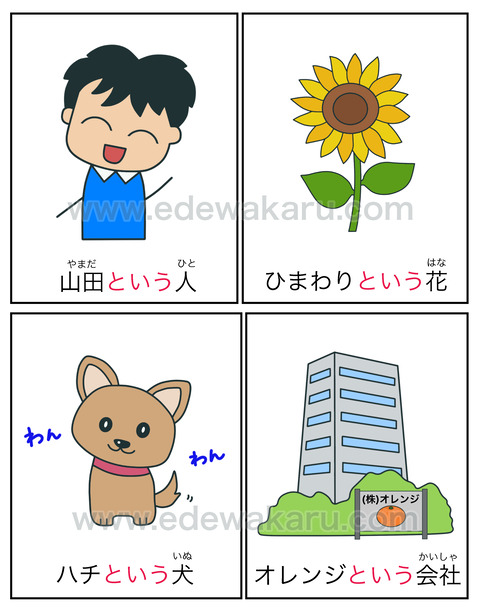
Meaning
〜という名前の〜
How to use it
名詞[辞書形]+という+名詞
Explanation
「〜という」は「〜という名前の〜」という意味を表す文型です。「人」「動物」「もの」「こと」などの名前を言いたい時に使われます😊友達や家族との間では「〜という」は「〜って」にチェンジすることができます。また「〜という」を「〜って」にすることも可能(かのうです😮(復習:口語形「〜って(引用)」)
[「〜という=〜って」「〜という=〜っていう」の例]
山田
という
人
山田
って
人
山田
っていう
人
上の3つは全部同じ意味です😊「〜という」にはたくさん意味があります😨少しずつブログに載せますのでしっかりと区別して覚えて会話で使ってみてくださいね😉
【「という」シリーズ】
〜ということだ
〜というところだ
〜というのは
〜というのも〜からだ
〜というもの(Nというもの)
〜というより
In context 5 examples
山田という人
→山田という名前の人ひまわりという花
→ひまわりという名前の花ポチという犬
→ポチという名前の犬オレンジという会社
→オレンジという名前の会社オリンピックという競技大会(きょうぎたいかい)
→オリンピックという競技大会
Usage 2
Read this source entry ↗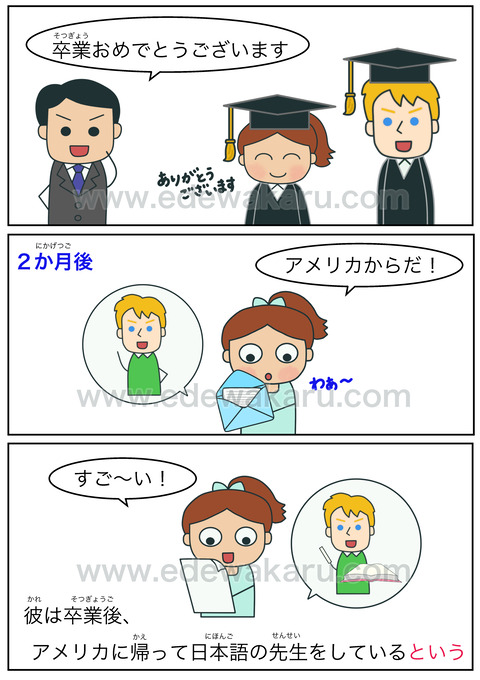
Meaning
〜そうだ
How to use it
動詞・形容詞・名詞[普通形]+という
Explanation
「〜という」は[伝聞]を表す文型で「〜そうだ」という意味です。
とてもかたい書き言葉として使われます。
日常会話(にちじょうかいわ)で伝聞を表す場合は「〜そうだ(伝聞)」や「〜らしい(推量)」がよく使用されます。伝聞の「〜という」には「〜といった」「〜といわない」「〜といわなかった」などの形がありませんので気をつけましょう。
[例]
⭕️あのお寺は、1000年前に建てられた
という
❌あのお寺は、1000年前に建てられた
といった
❌あのお寺は、1000年前に建てられた
といわない
❌あのお寺は、1000年前に建てられた
といわなかった
伝聞を表す文型はたくさんありますので、復習しておきましょう😉
【関連記事】
In context 5 examples
彼は卒業後、アメリカに帰って日本語の先生をしているという
→アメリカに帰って日本語の先生をしているそうだこの家にはおばけがいるという…
→この家にはおばけがいるそうだ…あの事件の犯人は捕まったという
→あの事件の犯人は捕まったそうだあのお寺は、1000年前に建てられたという
→あのお寺は、1000年前に建てられたそうだこの辺りは、昔は海だったという
→この辺りは、昔は海だったそうだ
日本語NET JLPT文法解説まとめ
Meaning
聞き手が知らないであろう物・人・場所などの名前を言う時に使う。
How to use it
N1 + という + N2
Explanation
"…called / …named"
Used when mentioning names of things, people, places, etc., that the listener is likely not familiar with.
・カジュアルな言い方は「〜っていう」
In context 10 examples
私はタマという猫を飼っています。
村上春樹という小説家を知っていますか?
私はインドネシアのバンドンという町から来ました。
ママルースというイタリアンレストランが美味しいらしいです。
「鬼滅の刃」という漫画が、世界中で人気があるそうです。
先ほど、木村さんという方からお電話がありましたよ。
まっすぐ行くと、「来来亭」というラーメン屋がありますから、そこを右に曲がると病院があります。
「十人十色」という言葉を知っていますか。
私は日本語を勉強する時、「日本語NET」というサイトを使っています。
フィリピンはシニガンという料理が有名らしい。
毎日のんびり日本語教師
How to use it
文の普通形+という+名詞
Explanation
話し手と聞き手のどちらか一方の理解が進んでいない場合に、その物事や人などを、定義することを表します。
口語では「って」や「っていう」が用いられます。
「XというY」のとき、Yは上位語、Xは下位語です。両者は包摂関係にあります。
Notes
関連文法「【N1文法】~という」
In context 6 examples
佐藤さんという人から電話が来ていましたよ。
来週この小説の冒頭部分を暗唱するという試験がある。
「来週試験があるってこと覚えてる?」
「この歌、何という人が歌ってるの?」
モンサンミッシェルっていうところに一度は行ってみたい。
今朝近くで女性が背後から襲われるという事件があったらしい。(今天早上附近发生了女性被人从背后袭击的事件。)
日本語文型辞典 英語版
Meaning
→
The pattern N1 という N2 is used to specify the name of N
The same noun is repeated to express the meaning “all the N.” Used to emphasize totality. A written language expression used in literature.
Used to state the content of N. N may be a noun of utterance such as 話 (talk), うわさ (rumor), or 評判 (report), or a noun that refers to a cohesive chunk of content such as 規則 (regulation), 記事 (article), 情報 (information), or 事件 (incident). When describing the content of an event, such as 仕事 (work) or 事件 (incident), the という may be dropped.
(例)3人の高校生が中学校に放火した(という)事件は、近所の人を不安に陥れた。
The incident (in which) three high school students set a junior high school ablaze has deeply worried the neighborhood.
How to use it
1. NというN〈name〉
2. Compared with simply saying これはプルメリアです (This is a frangipani), use of という implies that either the speaker or the listener, or both, are unfamiliar with the flower. In casual conversation, the form Nって is often used, as in ブルメリアって花 (a flower called frangipani) or エベスって町 (a town called Ebesu).
2. NというN〈emphasis〉
3. ...というN〈content〉
In context 18 examples
道子さんはすぐにいくと言いました。
Michiko-san said she’s coming right away.
卒業後は郷里へ帰って教師をしているという。
He says he’s going back to his hometown after graduation to be a teacher.
あの船の名前はなんといいますか。
What is that ship called?
これは、プルメリアという花です。
This flower is called a frangipani.
山川登美子という歌人を知っていますか。
Do you know the classical poet named Yamakawa Tomiko?
中野さんという人から電話があった。
There was a phone call from someone named Nakano-san.
飛行機が次に着いたのは、エベスという小さい町だった。
The next stop for the airplane was a small town called Ebesu.
「天使の朝」という映画を見たが、友達はだれもその映画の名前を聞いたことがないと言った。
I saw a movie called Tenshi no Asa, but my friend said that no one had ever heard of it.
道路という道路は車であふれていた。
Every road that could be called a road was overridden with traffic.
家という家は飾りをいっぱいつけて、独立の喜びをあらわしていた。
Anything that could be called a house was fully decorated, showing the joy of independence.
ビルの窓という窓に人の顔がみえた。
Each and every window of the building had a face in it.
会場をでてくる選手の顔という顔に満足感がみちあふれていた。
The face of each and every player leaving the venue was filled with satisfaction.
この会社には、仕事は五時までだという規則がある。
There is a regulation at this company that quitting time is five o'clock.
山田さんは自分では画家だといっているが、本当は会社経営者だといううわさが流れている。
Yamada-san says he’s an artist, but there’s a rumor going around that he’s really a company manager.
弟が大学に合格したという知らせを受け取った。
My younger brother received a notice that he had passed the university entrance examinations.
彼女の到着が一日遅れるという連絡が入った。
A message came that she would be arriving a day late.
今度K製薬からでた新製品はよく効くし、それに使いやすいという評判である。
The word is that the new product from K Pharmaceuticals works effectively and is also easy to use.
たばこの煙が体によくないという事実はだれでも知っている。
Everyone knows the fact that cigarette smoke is not good for your health.
AIUEO JLPT Grammar
Usage 1
Meaning
「〜という」is used to indicate a specific name or title when attached to a noun. This sentence pattern is used to explain or define a specific noun or thing.
How to use it
名詞と+いう+名詞
Explanation · 日本語
「〜という」は、名詞に接続して使われ、特定の名前や称号を示すときに使われる表現です。この文型は、ある特定の名詞や物事を説明したり、定義したりするときに使用されます。
In context 5 examples
これはヨガという運動です。
This is an exercise called yoga.
彼はサッカーというスポーツが好きです。
He likes a sport called soccer.
これは火災報知器という装置です。
This is a device called a fire alarm.
彼はトレーダーという仕事をしています。
He works as a trader.
これはAIという技術です。
This is a technology called AI.
Usage 2
Meaning
「〜という」is used to quote or report what someone has said or what information has been heard or written. In casual speech, it is often expressed as 「〜っていう」 or 「〜って」.
How to use it
名詞と+いう
Explanation · 日本語
「〜という」は、引用や伝聞を表すときに使われる表現です。この文型は、他の人が言ったことや、聞いた情報、書かれた内容などを引用する際に使用されます。口語では、「〜っていう」や「〜って」と表現することが多いです。
In context 5 examples
彼はパーティーに来るっていいました。
He said he would come to the party.
彼女は「今日は忙しい」って言ってた。
She was saying, “I’m busy today.”
経済アナリストは市場は回復すると言いました。
The economic analyst said, The market will recover.
作家はこの小説は最高だと言いました。
The author said that this novel is the best.
店員さんが「この商品は人気がある」って言っていました。
The store clerk was saying, “This product is popular.”
Usage 3
Meaning
This sentence pattern is used to express that all of the objects are being referred to or to emphasize a specific item, expressing that all or nothing of the noun is involved.
How to use it
名詞と+いう+名詞
Explanation · 日本語
この文型は、すべての対象を指すときや、特定のものに焦点を当てて強調したい場合に使われ、その名詞の総体や一つ残らずといったニュアンスを表現します。
In context 5 examples
家という家はすべて泥棒に入られた。
Every house was broken into by thieves.
お祭りのせいで道という道が渋滞していた。
Because of the festival, all the roads were congested.
当時、台風の影響で木という木が倒れていた。
At that time, many trees had fallen due to the typhoon.
町という町は、祭りで賑わっていた。
Every town was bustling with the festival.
国という国がこの問題について議論している。
Every country is discussing this issue.
Bunpro Grammar Reference
Usage 1
Meaning
Called, Named, Known as, As much as
How to use it
Noun (A) + という + Noun (B)
Nuance
A grammar point that establishes what something is called, or commonly known as.
Explanation
という is a combination of the case marking particle と, and the う - Verb 言う. It is a set expression that primarily uses only hiragana. という connects two nouns, and means 'the (B) that is called (A)', or 'the (B) known as (A)'.
ローラというモデルさんを知っていますか?
Do you know the model called Rola?
本山という駅で降りてください。
Please get off at a station named Motoyama.
タナカタロウという少年を見つけたら、ここにお電話をください。
If you find a child named Tanaka Tarou, please call us.
Fun Fact
という (and the verb 言う itself) is often quite misunderstood, as the closest translation in English is 'to say'. In Japanese, 言う actually refers to the information about something that cannot be discovered by simply 'looking at' it. For example, if you look at a man, you cannot know that his name is Bob, or that he works in an office, but you can know whether he is 'short', 'tall', etc. Due to this, という should only be used to express information that requires intimate knowledge, and not simple observations.
ここにボブという名前の男の人が来ませんでしたか。
Did a man called Bob come here? (Natural)
ここに小さいという男の人が来ませんでしたか。
Did a man known as small come here? (Unnatural)
It is possible to see (A) という (B) in sentences where (A) is describing something that seems 'obvious'. However, in these cases, the speaker is usually implying that something about (A) is not exactly as it seems, or that their opinion/knowledge differs.
あの人は強いというんだけど、ステロイドを使っているんじゃない?
That person is known as strong, but don't you think he uses steroids? (He looks strong, but isn't)
This particular nuance is not limited to nouns, and may be seen with almost any word type.
Nuance · 日本語
あるものの名称や、一般的になんと知られているかを示す時に使われる文法。
Explanation · 日本語
「という」は、格助詞の「と」と五段動詞「言う」からできた表現です。たいていはひらがなで書かれます。「という」は、「(A) という (B)」の形で二つの名詞をつなぎます。そして、「(A) と呼ばれる (B)」や「(A) の名前で知ら(し)れている (B)」のような意味を表します。
ローラというモデルさんを知っていますか?
Do you know the model called Rola?
本山という駅で降りてください。
Please get off at a station named Motoyama.
タナカタロウという少年を見つけたら、ここにお電話をください。
If you find a child named Tanaka Tarou, please call us.
豆知識
「という」(や動詞の「言う」自体)は、ただ見ただけではわからない情報を伝えるときに使います。例えば、ある人を見たとき、その人の名前や仕事はわかりません。しかし、身長や体型などはわかります。「という」は、名前や仕事などの情報を伝えるときに使われます。
ここにボブという名前の男の人が来ませんでしたか。
Did a man called Bob come here? (Natural)
ここに小さいという男の人が来ませんでしたか。
Did a man known as small come here? (Unnatural)
「(A) という (B)」の形が、明らかな物事に使われているように見える場合もあります。しかし、その場合、話し手が「(A) はそうだとは言われてるけど、実はちょっと違う」とか「(A) が見たままだとは思わない」などと言いたい場合が多いです。
あの人は強いというんだけど、ステロイドを使っているんじゃない?
That person is known as strong, but don't you think he uses steroids? (He looks strong, but isn't)
このような「という」の使い方は、名詞だけでなく、いろいろな品詞で見られます。
In context 18 examples
- ポケモンと言うゲームを知っている?
Do you know the game called 'Pokemon?'
- ローラというモデルさんを知っていますか?
Do you know the model called Rola?
- タナカタロウという少年を見つけたら、ここにお電話をください。
If you find a child named Tanaka Tarou, please call us.
- 本山という駅で降りてください。
Please get off at a station named Motoyama.
- 今は梅雨と言う時期です。
We are now in the time of year called 'Tsuyu' (rainy season).
- スマホと言うものは便利なものだね。
The things known as smartphones are very convenient.
- 秋と言う季節が大好きだ。
I love the season (known as) 'Autumn.'
- 佐藤浩一と言う人を知っていますか?
Do you know a man named 'Sato Koichi'?
- 「何も見なかった」と言う話は嘘です。
The story that you 'didn't see anything' is a lie. (a story called/known as)
- 先生と言う職業は、けっこう大変な仕事だ。
The job (known as a) teacher is quite hard.
- 涙と言うものはどうしてこんなに綺麗なんだろう。
Why are things known as tears so beautiful?
- 一人暮しと言う生活は結構寂しいです。
The lifestyle known as 'hitori gurashi' is quite sad.
- 夢と言うものは簡単には叶わないですよ。
Dreams don't come true easily. (Things known as dreams don't come true easily)
- 「機会があれば会いましょう」と言う言い方は大抵社交辞令だ。
The words (known as) 'Let's meet each other again, if we have a chance' is mostly just a courteous saying.
- リンと言う焼き肉屋に行ったことはありますか。
Have you ever gone to a yakiniku restaurant named 'Rin?'
- ここにボブという名前の男の人が来ませんでしたか。
Did a man called Bob come here? (Natural)
- ここに小さいという男の人が来ませんでしたか。
Did a man known as small come here? (Unnatural)
- あの人は強いというんだけど、ステロイドを使っているんじゃない?
That person is known as strong, but don't you think he uses steroids? (He looks strong, but isn't)
Usage 2
Meaning
Every single, Each and every, Emphasis, Everything that could be called
How to use it
Noun (A) + という + Noun (A)
Nuance
A grammar point implying each and every (A). All (A)'s that can be called (A).
Explanation
One of the uses of the extremely common という structure in Japanese is the pairing of identical nouns in order to convey the meaning of 'every single (A)'. In many cases, this expression will simply be used for emphasis, but the literal meaning is 'every (B) that could be called an (A)'.
という will be used between the same noun repeating itself.
空き家に入ったら床という床が全てゴミに覆われていたのでびっくりした。
When I entered the vacant house, I was surprised because the entire floor was covered in garbage.
この街の電柱という電柱に広告の張り紙が沢山貼られてあったので、街の人たちが張り紙を全て撤去した。
There were so many advertising posters on every single telephone pole in this city that the people of the city removed all the posters.
世界各国の偉い人たちが来るということで、サミットの近くの道という道は閉鎖されている。
Every single road near the summit was closed due to the fact that important people from all over the world are coming.
Caution
When this structure is seen with abstract expressions like 今日 'today', it will generally mean '(A) of all (A)'s'. This just implies that 'of anything that can be called (A), this particular one has something special about it'. What that special thing is will usually follow immediately after in the sentence.
今日という今日は絶対あいつを許さない!
I will not forgive him today of all days!
今度という今度は優勝してみせる!
I will win THIS TIME!
Nuance · 日本語
全ての(A)を指す文法。(A)と呼ぶことができる全ての(A)。
Explanation · 日本語
「という」は、日本語でとてもよく使われる表現の一つですが、この前後に同じ名詞を並べると「全ての (A)」や「あらゆる (A)」といった意味を表すことができます。主に強調を加えるために使われる表現です。
「という」は、同じ名詞の間に挟んで使われます。
空き家に入ったら床という床が全てゴミに覆われていたのでびっくりした。
When I entered the vacant house, I was surprised because the entire floor was covered in garbage.
この街の電柱という電柱に広告の張り紙が沢山貼られてあったので、街の人たちが張り紙を全て撤去した。
There were so many advertising posters on every single telephone pole in this city that the people of the city removed all the posters.
世界各国の偉い人たちが来るということで、サミットの近くの道という道は閉鎖されている。
Every single road near the summit was closed due to the fact that important people from all over the world are coming.
注意点
この表現が抽象的な言葉と一緒に使われるとき、「全ての (A) の中でも、これこそが特別だ」という意味を表すことがあります。たとえば「今日という今日は」という表現は、数ある「今日」の中でもその日が特別であることを強調し、「今日こそ」といった意味で使われます。
今日という今日は絶対あいつを許さない!
I will not forgive him today of all days!
今度という今度は優勝してみせる!
I will win THIS TIME!
In context 17 examples
- 「今日という今日は許さん。」
'I absolutely will not allow it TODAY.' (emphasis)
- 空き家に入ったら床という床が全てゴミに覆われていたのでびっくりした。
When I entered the vacant house, I was surprised because the entire floor was covered in garbage.
- この街の電柱という電柱に広告の張り紙が沢山貼られてあったので、街の人たちが張り紙を全て撤去した。
There were so many advertising posters on every single telephone pole in this city that the people of the city removed all the posters.
- 世界各国の偉い人たちが来るということで、サミットの近くの道という道は閉鎖されている。
Every single road near the summit was closed due to the fact that important people from all over the world are coming.
- 政治家という政治家はみんな口ばっかりだ。
Every single politician is nothing but talk.
- それを聞いて、人という人が一斉に頷いた。
Every single person nodded in unison when they heard that.
- 山々に生えた木という木は地すべりのため根こそぎ倒れていた。
Every single tree that was growing on the mountain collapsed due to the landslide.
- 名古屋に生まれて名古屋で育った。だから、町中の道という道、家という家を、すっかり知っている。
(They were) born and raised in Nagoya. Therefore, (they) know every single street and each and every house in the city.
- この間の大地震で学校の壁という壁にヒビが入ってしまい、校舎の建て直しが決まった。
Cracks appeared in every single wall with the recent large earthquake, and the school building's reconstruction was decided.
- 教授は生徒の顔という顔が曇っている事に気づき、同じ説明をもう一度繰り返しました。
Noticing that each and every student's face was gloomy, the teacher repeated the same explanation one more time.
- 先生:「ウイルスが部屋に溜まらないように、窓という窓を開けて換気をしましょう!」
Sensei: 'In order to prevent accumulation of the virus, let's open every single window.'
- ゴールデンウィークの最終日は帰宅ラッシュのせいで道路という道路が混んでいました。
Due to the homecoming rush on the last day of Golden Week, each and every road was congested.
- 僕がセナの部屋に入ると、壁という壁にヨゾラの写真があるのを見てショックを受けた。
When I went into Sena's room, I was shocked to see that every single wall was decorated with photos of Yozora.
- ある調査によると、若者という若者がこの国の将来には希望が無いと思っているそうだ。
According to a certain study, it is thought that every single young person has no hope for this country's immediate future.
- 有名人になってから通りですれ違う人という人が私にサインを求めてくるので、もはや気軽に外を出歩く事は出来ません。
Due to each and every person I pass on the street wanting my signature since becoming famous, I am no longer able to heedlessly go for a walk outside.
- 今日という今日は絶対あいつを許さない!
I will not forgive him today of all days!
- 今度という今度は優勝してみせる!
I will win THIS TIME!
文法
Meaning
聞き手が知らないであろう物・人・場所などの名前を言う時に使う。
How to use it
N1 + という + N2
Notes
カジュアルな言い方は「〜っていう」
In context 10 examples
私はタマという猫を飼っています。
村上春樹という小説家を知っていますか?
私はインドネシアのバンドンという町から来ました。
ママルースというイタリアンレストランが美味しいらしいです。
「鬼滅の刃」という漫画が、世界中で人気があるそうです。
先ほど、木村さんという方からお電話がありましたよ。
まっすぐ行くと、「来来亭」というラーメン屋がありますから、そこを右に曲がると病院があります。
「十人十色」という言葉を知っていますか。
私は日本語を勉強する時、「日本語NET」というサイトを使っています。
フィリピンはシニガンという料理が有名らしい。
Yokubi — The Common Grammar Guide (https://yoku.bi)
Explanation
There are two basic types of relative clause. The first is the kind that modifies a noun, which we already learned in [Lesson 14](../../Section1/Part1/Lesson14.md). The second is an embedded clause, often called a "quote", like the underlined part of "He said that the war would end soon".
って and と, called quotation markers, often assume the role of marking such embedded clauses.
In English we distinguish between direct and indirect quotes through punctuation. For example:
The same concept does not apply to Japanese where the distinction between a direct and indirect quote is more blurry. While quotation markers (like 「 」) exist and can help identify direct quotes, they aren't required and you will see both direct and indirect quote show up "freely" in text just marked by a simple って or と.
The embedded clause inside quotes needs to be a "complete" statement, so if the quote ends with a な-adjective or noun, it needs to end with だ. There are some exceptions and usages that may drop this rule, but in the majority of situations you need to make sure だ is there or the sentence will sound wrong.
When it comes to quotes, って is essentially a colloquial version of と.
As you can see from the second example, the verb ("said", "thought", etc) can be often dropped if it's obvious from context and tone.
In some usages って can also take the role of topic, similar to は. In these cases it's not really a quote. It's just an alternative topic marker.
The construction という (often slurred as っていう or even っつう) is so commonly used that it has acquired additional meanings on top of its literal "I/they said".
It can be used to "glue" together pieces of sentences in a manner that makes them flow better and feel less awkward. It is hard to provide a comprehensive explanation for all these cases, but you will see it often enough that it's better to acquire a "feel" for it via exposure instead. Sometimes the という does not add any meaning at all, so don't try to put it into English if you can't.
It can be used to provide a definition or describe a quality. This usage is similar to である but has a slightly different nuance.
It can also be used to provide emphasis by repetition in some set expressions:
In context 3 examples
研究者という人間
The people that are (identified as) researchers
今日という今日
(On) this very day
木という木
Every single tree
IMABI
~という, ~ということ, & ~というもの
Read this IMABI lesson ↗Explanation
~という, ~ということ, & ~というもの
In this lesson, we will learn about how という is used to facilitate the modification of one noun, which we will denote as Noun A’, by another noun, which we will denote as Noun A, for the purpose of defining.
という is a phrase even natives have difficulties with. At times may seem as if it is just a filler word, but when we study its use which all natives agree on to be correct, we do find details on how to use it most effectively.
Spelling Note: The 漢字 for 言う is usually used when the verb is used literally for “to say”. However, it is extremely common in casual texts to see it written out as いう or even ゆう. In other usages, the ひらがな spellings are more common. Also note that this verb may be spelled as 云う in older spelling when quoting others.
Casual Note: For all usages mentioned in this lesson, the particle と may be replaced with って in casual contexts. If it follows ん, て is usually used instead of って. Do not confuse this with the conjunctive particle て! The grammars are completely different.
という
First, let’s remember what という is composed of and why it matters. と is the citation case particle of Japanese. The phrase it attaches gets grammatically quoted, and it’s always a signal that a citation verb of some sort should follow, and if it doesn’t, that verb is implied. When conjoined with the verb 言う, literally meaning “to say”, we see that it is used to help make phrases able to modify other phrases when otherwise the grammar wouldn’t allow for it. Before we get to far ahead of ourselves, remember that this phrase is used to say “to say…”.
1. 僕はセス先生に似ていると、たまに言われます。
I’m occasionally told that I resemble Seth-sensei.
The next logical leap from this literal usage is to be used to mean “to be called/said/named.”
2. さっき買った植物がなんという植物なのか気になっています。
It’s getting to me what plant it was that I bought a while ago.
3. 先月の台風で沈んだのは何という船でしたっけ。
Oh, what was the name of that boat that sunk in last month’s typhoon.
4. 私はセスと申します。
I’m Seth. (I call myself Seth)
5. imabi.orgという学習サイトで日本語を勉強したことがありますか?
If you ever studied Japanese on a site called imabi.org?
6. 「関心」は英語で「Interest」と言います。
“Kanshin” in English is “interest.”
7. 人というものはわからないものだ。
One can never understand how people are.
8. 人生というものは辛いものだ。
Life is tough.
Grammar Note: Remember that もの refers to a more concrete thing. ~ということ would show a circumstance of some sort.
9. 希望という名の光
A light called hope
Nuance Note: ~という名の is a common figure of speech frequently seen in titles and song lyrics embodying a sense of reputation/name with something.
という‘s function in making complex relative clauses is incredibly important. Although complete sentences may easily modify nominal phrases at times, there are a few situations where not using という just doesn’t work or just doesn’t make sense. It’s also important to note that Japanese speakers internalize this usage as the same thing as above. So, try to think why that is.
10. 日本に住みたいという動機があるので、日本語の勉強が楽しい。
Because I have a motive of wanting to live in Japan, studying Japanese is fun.
If you want to use a phrase that ends in だ as a complex relative clause, という is necessary. This is also true for onomatopoeic phrases.
11. 何をやってもダメだという気持ちを忘れよう。
Forget those feelings that whatever you do is bad.
12. せっかくの独立記念日だというのに、一日中家に引きこもっていた。
Although it was Independence Day (a great opportunity), I stayed inside my home all day.
Speech Style Note: ~だというのに is slightly more formal than ~なのに. This is because のに is already rather empathic. So, making it more emphatic would be slightly abnormal in the spoken language.
〇という+名詞 is used to introduce something to the listener or reader as new information. So, although it is reasonable to say something like ジブチという国, インドという国 would be unnecessary even for kids. This lack of necessity often leads to sentences being deemed ungrammatical when this common sense principle is not implemented. This point largely determines whether という makes the most sense or not with (complex) relative clauses.
13. 仕事で妥協を許さないのは、上司から何をされるか分からないという恐怖からでしょうか。
Is your behavior of not allowing compromise at work from a fear of not knowing what your boss will do to you?
14. 反乱軍の兵士たちは、国の軍隊にいつ拘束され、処刑されるかわからない(という)恐怖におびえながら、町々の住民を守り続けた。
The rebel soldiers continued to protect the citizens of the villages amid the fear of not knowing when they would be seized by the country’s army and be put to death.
Sentence Note: The use of という in Ex. 14 would likely only be used in conversation in which という would function more so as a filler word. This is because the objective stance that the sentence takes in conveying the information makes という unnecessary at best.
Of course, this is not grammatically different at all from ~というの+Particle as we’ve already seen. Why? The particle の here functions as a dummy noun, making everything above apply.
15. 政治家たちさえ何が起こるかわからないというのはなぜでしょう?
Why is it that not even the politicians know what will happen?
16. 男でもいけるというのは本当なの?
Is it true that you even go out with guys?
17. 多くの中国人や韓国人が日本人を毛嫌いするのに日本語を勉強するというのはどうしてなのでしょうか。
Why is it that many Chinese and Koreans study Japanese even though they despise Japanese people?
18. 90% というのは信じられない数字でした。
90% was a truly impossible to believe figure.
19. アプリはアップデートしろというのに、Google Playストアにアップデート情報がきていない。
Although the app told me to update, there isn’t any update information coming into the Google Play Store.
Phrase Note: Remember that the particle のに is technically just a combination of の and に.
~ということ & ~というもの
~ということ is perfect in showing something that is abstract in nature. Essentially anything that can be deemed as an analysis of something, summarizing, determination etc. fits under this definition. This ‘something’ is never a physical thing but an abstract thing.
20. 夏にテキサス州のオースティン市に行ってみればどんなに暑いかということがわかるでしょう。
If you were to try and come to the city of Austin in the state of Texas in the summer, you would find out just how hot it is.
21. 分かるということはどういうことでしょうか。
What does understanding really mean?
22. 「バグが発覚したという報告がありました」「ということは、そろそろメンテに入るでしょう」
“We got a report that a bug surfaced” “So, that means we’ll be entering maintenance shortly.
~というもの, on the other hand, is used with not-so-abstract noun phrases. The addition of it brings an “as a matter of fact…” nuance to the phrase in question.
23. 日本語というものがこんなに美しいと感じたことはなかった。
I had never felt Japanese to be so beautiful like this before.
24. 予知夢というものを見てしまったかもしれない。
I may have had a prophetic dream.
~ということ is also frequently inserted in places it is not necessary in formal speech to lessen the tone and to be more indirect. This should make sense because こと refers to the situation, so you’re referring to things in a broader sense.
25. セス先生は、特に仕事が忙しいということなので、仕事頑張ってという応援メールを送りました。
I heard that Seth-sensei’s job is particularly busy, so I sent him a support message telling him to “keep working hard.”
Remember the difference between ~ということ and ~というもの? という invokes the vaguer meaning of こと which is to mean “matter” as in the matter of things. This is why we can say things like 映画のこと but not 映画ということ. ~ということ would work, though, if the noun is related to any event/action.
26a. ユーザーがモンスターを売却してしまった件ということですが、….。X
26b. ユーザーがモンスターを売却してしまったとのことですが、….。〇
About the users accidentally having sold their monsters…
It’s also important to note that ~ということだ or ~とのことだ can refer to hearsay. For instance, the sentence above may very well be hearsay depending on the context. The word hearsay here isn’t that far removed from summarizing things. It would only be context that determines how certain that is.
27. 新聞によると、〇〇も自殺を図ったということだ。
XX also committed suicide according to the newspaper.
28. 禁断の恋ということですが、〇〇。
About forbidden love,….
という: Emphasis Marker
という can also be used as an emphatic marker at times. This also applies to the phrases above. In the first two phrases below as well, it is not grammatically necessary, but it strengthens the emotional sense of the statements. With counter phrases, it shows that the degree is high, and at times excessive.
29. 今日という日を記念日にするよ!
We make this day a commemoration.
30. 今日という日は二度と来ない。
Today will never come again.
31. なぜ数億円という突拍子もない数字が出てくるのか説明しろよ。
Explain how such a preposterous figure of several hundred millions of yen came about.
32. ウミガメは毎年、何百キロまたは何千キロという長距離を移動する。
Sea turtles move great distances of hundreds and thousands of miles every year.
33. その後、投資家たちが医療業界に数千万ドルという資金を投入した。
After that, investors invested several tens of millions into the medical industry.
34. 何千枚なんぜんまいという宝たからくじが、一日で売り切れました。
Lottery tickets totaling thousands were sold in a day.
Note that this point actually encompasses a general pattern of repeating the very same word using という. This pattern is more frequently used in the written language, but it is still possible to hear it in conversation.
35. クリスマスの日は、店という店は基本的には営業休止にすればいい。
All shops as a principle should close business on Christmas Day.
36. 今は今しかない。だから、今という今は本当に貴重なのだ。
Now we only have now. So, the now truly is precious.
In context 37 examples
僕はセス先生に似ていると、たまに言われます。
I’m occasionally told that I resemble Seth-sensei.
さっき買った植物がなんという植物なのか気になっています。
It’s getting to me what plant it was that I bought a while ago.
先月の台風で沈んだのは何という船でしたっけ。
Oh, what was the name of that boat that sunk in last month’s typhoon.
私はセスと申します。
I’m Seth. (I call myself Seth)
imabi.orgという学習サイトで日本語を勉強したことがありますか?
If you ever studied Japanese on a site called imabi.org?
「関心」は英語で「Interest」と言います。
“Kanshin” in English is “interest.”
人というものはわからないものだ。
One can never understand how people are.
人生というものは辛いものだ。
Life is tough.
希望という名の光
A light called hope
日本に住みたいという動機があるので、日本語の勉強が楽しい。
Because I have a motive of wanting to live in Japan, studying Japanese is fun.
何をやってもダメだという気持ちを忘れよう。
Forget those feelings that whatever you do is bad.
せっかくの独立記念日だというのに、一日中家に引きこもっていた。
Although it was Independence Day (a great opportunity), I stayed inside my home all day.
仕事で妥協を許さないのは、上司から何をされるか分からないという恐怖からでしょうか。
Is your behavior of not allowing compromise at work from a fear of not knowing what your boss will do to you?
反乱軍の兵士たちは、国の軍隊にいつ拘束され、処刑されるかわからない(という)恐怖におびえながら、町々の住民を守り続けた。
The rebel soldiers continued to protect the citizens of the villages amid the fear of not knowing when they would be seized by the country’s army and be put to death.
政治家たちさえ何が起こるかわからないというのはなぜでしょう?
Why is it that not even the politicians know what will happen?
男でもいけるというのは本当なの?
Is it true that you even go out with guys?
多くの中国人や韓国人が日本人を毛嫌いするのに日本語を勉強するというのはどうしてなのでしょうか。
Why is it that many Chinese and Koreans study Japanese even though they despise Japanese people?
90% というのは信じられない数字でした。
90% was a truly impossible to believe figure.
アプリはアップデートしろというのに、Google Playストアにアップデート情報がきていない。
Although the app told me to update, there isn’t any update information coming into the Google Play Store.
夏にテキサス州のオースティン市に行ってみればどんなに暑いかということがわかるでしょう。
If you were to try and come to the city of Austin in the state of Texas in the summer, you would find out just how hot it is.
分かるということはどういうことでしょうか。
What does understanding really mean?
「バグが発覚したという報告がありました」「ということは、そろそろメンテに入るでしょう」
“We got a report that a bug surfaced” “So, that means we’ll be entering maintenance shortly.
日本語というものがこんなに美しいと感じたことはなかった。
I had never felt Japanese to be so beautiful like this before.
予知夢というものを見てしまったかもしれない。
I may have had a prophetic dream.
セス先生は、特に仕事が忙しいということなので、仕事頑張ってという応援メールを送りました。
I heard that Seth-sensei’s job is particularly busy, so I sent him a support message telling him to “keep working hard.”
ユーザーがモンスターを売却してしまった件ということですが、….。X
About the users accidentally having sold their monsters…
ユーザーがモンスターを売却してしまったとのことですが、….。〇
About the users accidentally having sold their monsters…
新聞によると、〇〇も自殺を図ったということだ。
XX also committed suicide according to the newspaper.
禁断の恋ということですが、〇〇。
About forbidden love,….
今日という日を記念日にするよ!
We make this day a commemoration.
今日という日は二度と来ない。
Today will never come again.
なぜ数億円という突拍子もない数字が出てくるのか説明しろよ。
Explain how such a preposterous figure of several hundred millions of yen came about.
ウミガメは毎年、何百キロまたは何千キロという長距離を移動する。
Sea turtles move great distances of hundreds and thousands of miles every year.
その後、投資家たちが医療業界に数千万ドルという資金を投入した。
After that, investors invested several tens of millions into the medical industry.
何千枚なんぜんまいという宝たからくじが、一日で売り切れました。
Lottery tickets totaling thousands were sold in a day.
クリスマスの日は、店という店は基本的には営業休止にすればいい。
All shops as a principle should close business on Christmas Day.
今は今しかない。だから、今という今は本当に貴重なのだ。
Now we only have now. So, the now truly is precious.
どんなときどう使う 日本語表現文型辞典
Usage 1
Meaning
is called
How to use it
N+という
Explanation
という〈名前の紹介〉
1)人や物の名を言うときの言い方。
2) ❸ の「と申します」は「という」の謙譲の言い方。
3) ❹ のように、話し言葉では「っていう」を使う。
2)と申します in sentence ❸ is humble form of という.
3)In conversation, っていう is used, as in sentence ❹ .
1)Gives names of people or things.
In context 4 examples
この花の名前は「スミレ」といいます。
A:会長さんは何というお名前ですか?B:会長は木村といいます。
はじめまして。前田と申します。
わたし「ちあき」っていうの。どうぞ、よろしく。
Usage 2
Meaning
N called N
How to use it
N+という
Explanation
という〈名前〉
1)「~というN」の形で、よく知らない人や物や場所の名を言うときに使う。
2)話し言葉では ❹ のように、「っていう」となる。くだけた話し方では「ってN」と言う。
2)In conversation っていう is used, as in sentence ❹ . In informal speech, って N is used.
1)Gives names of someone,… something, or somewhere that is not well known.
In context 4 examples
むかしむかし、桃太郎という男の子がいました。
山口県の萩という所へ行ってきました。
わたしは小林というものですが、ラヒムさんという方はいらっしゃいませんか。
ニュージーランドの「キウイ」っていう鳥はとてもかわいいです。
Usage 3
Meaning
explaining that
How to use it
〔普通形〕+という
Explanation
という〈内容説明〉
1)「~というN」の形で、Nの内容を説明する言い方。Nは電話・知らせ・記事などの情報関係のもののほか、規則・意見・事件などの内容を説明する場合にも使う。
2)話し言葉では、 ❹ のように「っていう」や「って」を使う。
2)In conversation, っていう or って is used, as in sentence ❹ .
1)Describes nominal, which represents telephone calls, notices, articles, other information, as well as rules, opinions, incidents, etc.
In context 4 examples
母から来月日本へ来るという手紙が来ました。
兄から結婚するという知らせが来た。
日本では少子化がもっと進むだろうという記事を読んだ。
この学校には、生徒は髪を染めてはいけないっていう規則があるんだ。
NINJAL 日本語文型データベース
Meaning
[1] 話し手または聞き手がよく知らない人・もの・場所などの名前を言うときに使います。
[2] Nの情報内容を表すときに使います。
How to use it
N1というN2
V普通形(命令形・禁止形を含む)+というN
i-A普通形+というN
na-A普通形+というN(「na-Aだ」→「na-A+というN」の形になることもある)
N1普通形+というN2(「Nだ」→「N1+というN2」の形になることもある)
その他
Notes
[2] Nには、「話・うわさ・報告・回答・伝言・メール・知らせ・手紙・考え・意味」など、伝達や思考に関係がある意味の名詞がきます。
In context 33 examples
「私、守屋という者ですが、林部長はいらっしゃいますか」
最近『夜と霧』という本を読んで、とても感動しました。
「スベスベマンジュウガニというカニがいるんですが、ご存じですか」「いえ、知りません。それはどんなカニですか」
「この文章に出てきた『つばぜり合い』という言葉、初めて聞きました」
「わあ、おいしそう。これ、何という料理ですか」「サムゲタンという韓国の伝統料理です」
158人に同窓会の案内を送った。そのうち56人から出席するという返事が来た。
新商品の売り上げが伸びているという報告を受けた。とてもうれしかった。
なんとなく気が進まないという理由で、その仕事は引き受けなかった。
ドイツに行った娘から無事に着いたというメールが届き、まずはほっとしている。
今朝の新聞で、大臣は今回の不祥事が起きた原因を明らかにしていないという論説を読んだ。
息子から国家試験に合格できなかったという知らせを受けて、私の方が落ち込んでしまった。
歴史的には、主君のために喜んで命を投げ出せという考えに何の疑問も持たない時代もあった。
来年の大学受験は絶対に失敗するなという親からの無言の圧力を感じている。
最近、留学したいという気持ちが大きくなってきた。
先に出発した部隊から、現地は想像以上に寒いという知らせが入った。さらに防寒の準備をしなくては。
「すみません。妻から体調がよくないという電話が来たので、今日は早退させていただけませんか」
原田先生の試験、去年はかなり難しかったという話だが、今年はどうだろうか。
アンケートの回答には、今日の講演はそれほど面白くなかったという感想があった。
リンさんは非常にまじめだという評判を私は信じている。
災害時は、自分だけは大丈夫という思い込みを持たないほうがいい。
「馬鹿正直だという言い方はいい評価ですか、悪い評価ですか」「それは正直すぎるという意味ですから、ふつうはマイナスの評価ですね」
課長から、交通渋滞で到着が遅れそうだという連絡がありました。
「お昼の休憩時間が十分ではないという意見が出ていますが、皆さんはどう思いますか」
会社が倒産したときの社長の態度がとても立派だったという記憶が、その後の私を支えてくれている。
子どもの頃から運動が得意ではなかったという父の話を聞いて、大きくうなずいてしまった。
子どもの体力不足は親の責任だという考えに、私は賛成できない。
大型台風が接近中という情報が入った。
お菓子などのパッケージに入っている乾燥剤には、食べられるものではないという注意をもっと大きく書いてほしい。
この辺りは昔貧しい漁村だったというガイドさんの説明に、みんなびっくりしていた。
アインシュタインは個性豊かな人物だったという記事に、私はとても感動した。
兄だと思っていた人が本当の兄ではなかったという役所の記録に、私は大きなショックを受けた。
仲間とのグループ旅行は25日までではなく26日までという訂正のメッセージが来た。
戦争をしてはいけないという考えに反対する人はいないはずだ。