AIUEO JLPT Grammar
Meaning
「〜っぽい」is used to describe a characteristic or tendency of something, often used casually in speech.
How to use it
動詞ます形+っぽい形容詞語幹+っぽい名詞+っぽい
Explanation · 日本語
「〜っぽい」は、ある物事の特徴や傾向を表す形容詞的な表現です。軽い意味合いで話し言葉によく使われす。
In context 5 examples
このカバン、安っぽいけど意外と丈夫だね。
This bag looks cheap, but it’s surprisingly durable.
彼女は子供っぽかった。
She was childish.
この料理は油っぽくて、ちょっと苦手です。
This dish is a bit too greasy for me.
彼女は忘れっぽいから、注意した方がいい。
She tends to forget things easily, so it’s better to remind her.
この布は最初からシワっぽかった。
This cloth was wrinkled from the beginning.
文法
Meaning
①名詞 / い形容詞 + っぽい:~のように感じる / ~のように見える
②名詞 + っぽい:〜が多いと感じる
③動詞 + っぽい:〜しやすい / よく〜する
③メモ
性格について述べる時によく使います。
How to use it
N + っぽい
いAい + っぽい (例:やすい + っぽい → やすっぽい)
Vます + っぽい
In context 10 examples
昨日彼が買ったテーブルは高いらしいが、安っぽく見える。
あの白っぽいシャツを着ている人は誰ですか。
あの子はまだ小学生なのに、とても大人っぽい。
彼女は髪をバッサリ切って、少し男っぽくなった。
なんだか熱っぽいわ。風邪でも引いたのかしら。
まだまだ仕事が終わらないので、飲み会に参加するのは無理っぽいです。
海外に住み始めて1年が経ったが、この国の料理は油っぽいものが多く、ちょっと健康が心配だ。
私の母はもう年のせいか、最近忘れっぽい。
彼は怒りっぽいから、みんなから嫌われている。
私は飽きっぽい性格なので、何をしてもすぐにやめてしまう。
Bunpro Grammar Reference
Meaning
-ish, -like, Characteristic of, Typical of, Tendency to
How to use it
Verb[stem]+ っぽい
[い]Adjective[い̶]+ っぽい
[な]Adjective + っぽい
Noun + っぽい
Verb[stem]+ っぽい + です
[い]Adjective[い̶]+ っぽい + です
[な]Adjective + っぽい + です
Noun + っぽいです
Nuance
A casual expression that shows that something appears or is acting in a way that is like (A), but not.
Explanation
っぽい (occasionally also seen as ぽい) is a suffix that may be attached to many different types of words, in order to create new い-Adjectives. In all cases, っぽい indicates something that is 'exhibiting characteristics of (A)'. This is most often in reference to the way (A) is acting, or the way (A) looks. In English, っぽい may be translated as '(A)ish', '(A)like', or 'tendency to (A)'. っぽい quite often carries a negative connotation.
As っぽい creates い-Adjectives from other words, it may be used with the conjunctive form of verbs, or the 語幹 (stem form) of any other word.
私は飽きっぽいから、何も続かない。
Because I have a tendency to get sick of things, I can't continue with anything.
白っぽいやつをください。
Please give me the whiteish one.
タナカ君はファッション業界では有名っぽいよ!
Apparently Tanaka-kun is popular in the fashion industry!
今の話は嘘っぽいけど本当の話なの。
The story I just told you sounds like a lie, but it is actually true.
Caution
As っぽい creates new い-Adjectives, っぽい itself may be conjugated in exactly the same way as regular い-Adjectives.
昔は紫っぽかったのに今はなぜか赤っぽい。
Back in the day, it was purpleish, but now for some reason it is reddish.
この靴なんか安っぽくない?
Don't these shoes look cheapish?
Caution
The fundamental meaning of っぽい will change depending on what type of word it is being used with. The general rules are as follows:
Verb + っぽい - To have a tendency to do (A).
Adjective + っぽい - To exhibit all the signs of being (A).
Noun + っぽい - To obviously not be (A), although show signs of being (A).
From this, we can see that っぽい is generally based on the opinion of the speaker, rather than the innate qualities of what is being observed. Thus, with verbs, adjectives, and nouns, the speaker feels like (A) is in excess, compared to what would be expected. This 'being in excess of what is normal' in the opinion of the speaker is what creates the negative connotation.
Nuance · 日本語
何かが(A)のような姿や行動を表現しているが、実際には(A)ではないということをカジュアルに表す表現。
Explanation · 日本語
「っぽい」または「ぽい」は、語のあとに付いてイ形容詞を作る接尾語です。どの「っぽい」にも「(A) の特徴が感じられる」という意味があります。具体的には「(A) しがち」「(A) らしい」「(A) に見える」のような意味で使われます。また、多くの場合、「っぽい」は否定的なニュアンスで使われます。
「っぽい」は、動詞の連用形や、そのほかの品詞の語幹につながります。
私は飽きっぽいから、何も続かない。
Because I have a tendency to get sick of things, I can't continue with anything.
白っぽいやつをください。
Please give me the whiteish one.
タナカ君はファッション業界では有名っぽいよ!
Apparently Tanaka-kun is popular in the fashion industry!
今の話は嘘っぽいけど本当の話なの。
The story I just told you sounds like a lie, but it is actually true.
注意点
「っぽい」が付いた語は、イ形容詞になるため、「っぽい」はふつうのイ形容詞と同じように活用します。
昔は紫っぽかったのに今はなぜか赤っぽい。
Back in the day, it was purpleish, but now for some reason it is reddish.
この靴なんか安っぽくない?
Don't these shoes look cheapish?
注意点
「っぽい」の意味は、それが付く語によって変わります。基本的な決まりを見てみましょう。
ここからわかるように、「っぽい」は実際の性質ではなく、話し手の感覚を表します。動詞・形容詞・名詞のどの場合でも、話し手が「(A) の特徴が強く出すぎている」と感じるときに使われます。そのため、しばしば否定的なニュアンスを持つことがあります。
In context 18 examples
- 寅さんは惚れっぽく、飽きっぽい。
Tora-san has the tendency to fall in love, and also has the tendency to lose interest. (~ish)
- タナカ君はファッション業界では有名っぽいよ!
Apparently Tanaka-kun is popular in the fashion industry!
- 今の話は嘘っぽいけど本当の話なの。
The story I just told you sounds like a lie, but it is actually true.
- 私は飽きっぽいから、何も続かない。
Because I have a tendency to get sick of things, I can't continue with anything.
- 白っぽいやつをください。
Please give me the whiteish one.
- なんかこの牛乳は水っぽいな。
This milk is somewhat watery… (~ish)
- 怒りっぽい人はあまり好かれない。
People that have a tendency to get angry are not liked much. (~ish)
- トムは記憶力がいいどころか、忘れっぽいよ。
Far from having a good memory, Tom is actually pretty forgetful. (~ish)
- こういう時は黒っぽいスーツを着るべきか?
Should I wear a blackish suit for this occasion?
- 熱っぽいな。インフルエンザじゃなければいいんだけど…。
I feel feverish. I hope I do not have the flu.
- 彼女は子供っぽい顔をしていますが、もうすぐ30歳です。
She has a childish face, even though she is almost 30.
- このカバンは安っぽいけど、タグを見たら高かった。
This bag looks cheap, but I looked at the tag and it was expensive. (~ish)
- 唐揚げは油っぽくて、食べたいと思わない。
I don't even think about wanting to eat deep-fried chicken because it looks too greasy. (~ish)
- 彼は飽きっぽいから、趣味を始めてもすぐにやめてしまう。
Because he has tendency to lose interest and give up, he quits soon after starting a new hobby. (~ish)
- 試合中、荒っぽくプレーして、審判に注意された。
I had been playing roughly in the match, and was given a warning by the referee. (~ish)
- 彼の話は理屈っぽいから、あまり話をしたくはない。
Because he is argumentative, I don't really like talking with him. (~ish)
- 昔は紫っぽかったのに今はなぜか赤っぽい。
Back in the day, it was purpleish, but now for some reason it is reddish.
- この靴なんか安っぽくない?
Don't these shoes look cheapish?
DoJG 日本語文法辞典(全集)
Meaning
Apt to; easy to; -ish; -like
How to use it
(i) Noun | っぽい | |
| 子供っぽい | Childish |
(ii) Adjective い stem | っぽい | |
| 安っぽい | Cheapish |
(iii) Adjective な stem | っぽい | |
| 哀れっぽい | Pitiful |
(iv) Vます | っぽい | |
| 忘れっぽい | Easy to forget, forgetful |
Explanation
A suffix that indicates someone/something has some distinctive characteristic or an attribute identified by a noun, an adjective, or a verb to which the suffix is attached.
In context 11 examples
サングラスをかけたやくざっぽい男が街角に立っていた。
A yakuza-like man wearing sunglasses was standing at the comer of the street.
その女の人は確か黒っぽいセーターを着ていたと思います。
If I remember correctly, I believe she was wearing a blackish sweater.
彼はほれっぽい性格で、どの女の人も好きになってしまう。
He is apt to fall for women, and falls in love with practically any woman.
昼食時にはこのレストランはサラリーマンっぽい人達で一杯になる。
During the lunch hour, this restaurant becomes crowded with men who look like salaried workers.
あの女優は実に女っぽいから好きだ。
I like the actress, because she is so womanish.
こんな水っぽい酒、飲めないぞ。
Who can drink such watery sake?
あなた、こんな安っぽいソファを買ってきてどうするの?
What are you going to do with this cheapish sofa that you bought?
公園のベンチに座って、きざっぽい男とあだっぱい女が話している。
Sitting on a bench at the park a foppish man is talking with a coquettish woman.
うちの息子は飽きっぽいんで、次から次へと新しいことをするんですが、一つとして、ものにならないんですよ。
Our son gets bored easily, and he tries new things one after another, but doesn't get anywhere with any of them.
うたぐりっぽい人って、嫌ですね。
I don't like a person who is distrustful.
じゅうたんは汚れっぽいから、私は使っていません。
Carpets get dirty easily, so I'm not using it.
どんなときどう使う 日本語表現文型辞典
Meaning
-ish; somewhat
How to use it
Vます/N+っぽい
Explanation
その感じがする/よくそうする
1)回数の多さではなく、ものの性質について言う。よくないことに使うことが多い。
2)ほかに「男っぽい・うそっぽい・色っぽい・黒っぽい・疲れっぽい」などの例がある。
2)Other expressions: 男っぽい (masculine), うそっぽい (seems like a lie), 色っぽい (sexy), 黒っぽい (blackish), 疲れっぽい (easily fatigued), etc.
1)Used not for frequency, but for quality of something. Often used for adverse things.
In context 5 examples
きみ子はもう20歳なのに話すことが子どもっぽい。
花子は飽きっぽくて何をやってもすぐやめてしまう。
母は年のせいかこのごろ忘れっぽくなって、いつも物を探している。
あの白っぽいセーターを着ている人が田中さんです。
この部屋は日当たりが悪いので、いつもなんとなく湿っぽい。
絵でわかる日本語
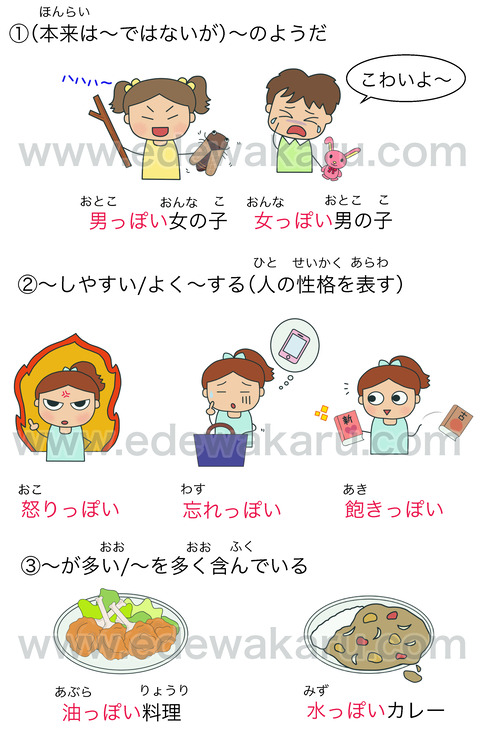
Meaning
①(本来は〜ではないが)
〜のようだ
②
〜しやすい
/
よく〜する
(人の性格を表す)
③
〜が多い
/
〜を多く含んでいる
How to use it
動詞[ます形]+っぽい
名詞+っぽい
Explanation
①「本来は〜ではないがまるで〜のようだ」という意味で使われます。ほとんどの場合、
マイナスの意味
を含んで使用します。初級文法(N4)「
〜らしい(「〜の性質を典型的に表している」という意味)」とは反対の意味
で使われる文法ですね。
男っぽい
女
(N3)
男らしい
男
(N4)
男のような
女
(N4)
このように覚えるといいですね😉
②「よく〜する人」「〜しやすい人」という意味で、人の性質を表します。
マイナスの意味
で使われます。
決まった単語にしか使われません
ので「
怒りぽい」「
忘れっぽい」「
飽きっぽい」この3つを覚えていたら十分です😄
③「〜(の要素)を多く含んでいる」という意味で使われます。
決まった単語にしか使われず、「
油っぽい」「
水っぽい」は1つの単語として覚えるといいですね😊
「油っぽい」も「水っぽい」もマイナスの意味を含んでいます
😖季節(春・夏・秋・冬)や色(黒・白・赤・青など)につく場合は「〜の要素が多い」という意味で、マイナスの意味は入りません😉
In context 7 examples
-a 男っぽい女の子
→(本来は男の子ではないが)男の子のような女の子-b 女っぽい男の子
→(本来は女の子ではないが)女の子のような男の子-a 怒りっぽい人
→よく怒る人 /怒りやすい人-b 忘れっぽい人
→よく忘れる人 /忘れることが多い人-c 飽きっぽい人
→すぐに飽きる人 /飽きやすい人-a 油っぽい料理
→油が多い(のでおいしくない)料理 /油を多く含んでいる料理-b 水っぽいカレー
→水が多すぎる(のでおいしくない)カレー
日本語文型辞典
Meaning
a. っぽい
b. っぽい
名詞や動詞の連用形に付いて、「その感じがする・傾向がある」などの意味を表すイ形容詞を作る。
①のように「赤・白・黒・黄色・茶色」など色を表す名詞と共に用いられて、「その色をおびている・その色に近い」という意味を表す。②のように「怒る・ひがむ・ぐちる・忘れる」などの動詞の連用形に付いて、「すぐに…する・よく…する」という人の性質を表す。また、③のように「子供・女・男・やくざ」等に付いて、「子供/やくざのようだ」「いかにも女/男という感じがする」という意味を表す。そのほか「水っぽい(水の量が多くて薄い)」「湿っぼい(湿っている感じがする、陰気な)」「熱っぽい(熱がある感じがする)」などがある。「子供っぽい・水っぽい」は話し手のマイナス評価を含む。プラス評価を表すときには「子供らしい・みずみずしい」が用いられる。
In context 5 examples
男は白っぽい服を着ていた。
あの人は忘れっぽくて困る。
30にもなって、そんなことで怒るなんて子供っぽいね。
この牛乳水っぽくてまずいよ。
死ぬだとか葬式だとか、湿っぽい話はもうやめよう。
日本語文型辞典 英語版
Meaning
【っぽい】[Nっぽい][Rっぽい]
Used with a noun or verb stem to form i-adjectives to express the meaning “feels that way” or “has the tendency to.”
Used with nouns that express colors, such as 赤(red), 白(white), 黒(black), 黄色(yellow), 茶色(brown), to express the meaning “has that color/characteristic” or “close to that color/characteristic,” as in
(1)
. Also used with verb stems such as 怒る(get angry)/ひがむ(have an inferiority complex) /ぐちる(grumble) /忘れる(forget) to express the characteristics of someone who “always does ...” or “often does ...,” as in
(2)
. Also used with 子供(child) /女(woman) /男(man) /やくざ(the Japanese mafia) and so on, to express the meaning “like a child/yakuza” or “very manly (man-like)/womanly (woman-like),” as in
(3)
.
In addition, there are usages like 水っぽい (too watery and thin), 湿っぽい (seems damp, gloomy), and 熱っぽい (seems to have a temperature/feverish). 子供っぽい/水っぽいhave negative connotations. When expressing a positive feeling, 子供らしい/みずみずしい are used.
In context 5 examples
男は白っぽい服を着ていた。
The man was wearing whitish clothes.
あの人は忘れっぽくて困る。
It’s a problem because he can be forgetful.
30にもなって、そんなことで怒るなんて子供っぽいね。
To be already thirty years old and get angry over something like that is really childish, isn’t it?
この牛乳水っぽくてまずいよ。
This milk is watery and tastes awful.
死ぬだとか葬式だとか、湿っぽい話はもうやめよう。
Let’s quit talking about such depressing things like death and funerals.
くらべてわかる日本語表現文型辞典
Meaning
意味1:XにはAという傾向や状態がよく現れていて、Xの性質となっている。
意味2:Xに接したときの話し手のXに対する感覚がA。Aの傾向・要素が強い。
How to use it
(Xは)Aっぽい(AっぽくB)
接続1:
[動詞-ます形]っぽい
接続2:
[名詞-∅]っぽい
Explanation
【対比1】
「Aがちだ」(意味2 P.58)
「Aがちだ」は現在はAではないが、Aというマイナス方向へ変わりやすいという意味であり、それが性格のようになってしまったのが「Aっぽい」である。
○年をとると、忘れっぽくなった。
×年をとると、忘れがちになった。
【対比2】
「Aらしい」
「Aらしい」は本当にAだという感じがする、Aを代表するような事態・状態だという意味であり、Aをプラスのイメージでとらえるが、「Aっぽい」は本当はAではない場合にも使う。
○彼女は男っぽい性格だ。 ×彼女は男らしい性格だ。
○彼は男っぽくて好青年だ。 ○彼は男らしくて好青年だ。
「Aくさい」(意味1 P.78)
「Aくさい」は(好ましくない)Aという感じがするという意味であり、Aには明らかに話し手のマイナスの気持ちが含まれる。一方「Aらしい」はAをプラスと感じている場合であり、「Aっぽい」はプラス・マイナス両方に使う。
○おばあさんらしい服(おばあさんにふさわしい服)
○おばあさんくさい服(地味すぎる服)
○おばあさんっぽい服(おばあさんがよく着るような服)
In context 8 examples
私は忘れっぽいから、ノートに書いておきましょう。
あの子は飽きっぽくて、すぐに新しいおもちゃを欲しがる。
父は怒りっぽいが、酒を飲むと機嫌がよくなる。
彼女の話はいつも湿っぽくていけない。
あの俳優は男っぽいから好きだ。(男らしい)
花子さんは子どもっぽいしゃべり方をする。(子どものような)
朝から熱っぽいわ。風邪を引いたのかしら?(熱があるようだ)
彼女は黒っぽい服がよく似合う。(黒に近い)
日本語NET JLPT文法解説まとめ
Meaning
①名詞 / い形容詞 + っぽい:~のように感じる / ~のように見える
②名詞 + っぽい:〜が多いと感じる
③動詞 + っぽい:〜しやすい / よく〜する
How to use it
N + っぽい
いAい + っぽい (例:やすい + っぽい → やすっぽい)
Vます + っぽい
Explanation
seems like / somewhat
In context 10 examples
昨日彼が買ったテーブルは高いらしいが、安っぽく見える。
あの白っぽいシャツを着ている人は誰ですか。
あの子はまだ小学生なのに、とても大人っぽい。
彼女は髪をバッサリ切って、少し男っぽくなった。
なんだか熱っぽいわ。風邪でも引いたのかしら。
まだまだ仕事が終わらないので、飲み会に参加するのは無理っぽいです。
海外に住み始めて1年が経ったが、この国の料理は油っぽいものが多く、ちょっと健康が心配だ。
私の母はもう年のせいか、最近忘れっぽい。
彼は怒りっぽいから、みんなから嫌われている。
私は飽きっぽい性格なので、何をしてもすぐにやめてしまう。
毎日のんびり日本語教師
How to use it
名詞+っぽい
動ます形+っぽい
イ形容詞語幹+っぽい
動詞普通形+っぽい
Explanation
「~の感じがする」「~の傾向がある」という意味を表します。普通はマイナスのイメージを持っている対象に対して使います。
「イ形容詞語幹+っぽい」に接続できるイ形容詞は、「安っぽい」などかなり限定的です。
(1) あの服は安い (客観的)
(2) あの服は安っぽい (主観的+悪い印象)
「っぽい」を使うとあまり良い印象を持っていないことを表します。「安っぽい」というと、安くて悪いものだというような意味です。
「騙されたっぽい」「遅れたっぽい」「寂しがっているっぽい」など、動詞普通形にも接続できます。
このとき推測の「ようだ」、伝聞の「そうだ」とほぼ同じ意味になります。
「っぽい」自体はイ形容詞の活用が適用されます。
Notes
特になし
In context 10 examples
彼は子供っぽい顔をしている。
今日の月は写真で撮ると白っぽいが、目で見ると赤色だ。
水を入れ過ぎたのか、ご飯が水っぽい。
今朝からどうも熱っぽい。
湿っぽい話はもう聞きたくない。
安っぽい味だけど癖になる。
歳を取ったからか、最近忘れっぽくて困っている。
彼女は怒りっぽい人だ。
飽きっぽい性格なので、一つのことが長く続かない。
彼の話は表情から見てもどうも嘘っぽい。
NINJAL 日本語文型データベース
Meaning
~を感じるような状態・様子であることを表します。また、性格として、よく~する傾向があることを表します。
How to use it
Notes
状態・様子の意味では、「〜」には「水・熱・理屈・子ども」などの名詞、「白い・安い・荒い」「いたずらな・おしゃれな」などの形容詞がきます。~する傾向があるという意味では、「〜」には「怒る・飽きる・忘れる」などのよくない意味の限られた動詞がきます。
「~っぽくない、~っぽかった、~っぽくて」などのように、イ形容詞と同じ形に変化します。
In context 18 examples
「あのゲーム、もう飽きたの? 本当に飽きっぽいなあ」
姉は怒りっぽい性格で、小さなことでも何かと怒ってばかりいる。
私は若い頃ひがみっぽかったと思うが、今ではもうそんなことはない。
最近、忘れっぽくなってしまったのは、年のせいだろうか。
このセーター、すごく安かったからつい買っちゃったけど、やっぱり安っぽいなあ。買わなければよかった。
山口さんは、口のきき方は荒っぽいが、心は優しい人だ。
今日は何かのセレモニーがあるのか、黒っぽい服を着ている人が何人もうちの前を通る。
シンプルなセーターでも、アクセサリーを工夫するとおしゃれっぽいです。
出かけようとしたら、飼い犬が追いかけてきた。その鳴き声がいつになく哀れっぽく感じられた。
うちの祖父は、こんな俗っぽいバラエティ番組は見ないだろう。
公園で大勢の子どもたちが遊ぶのを見ていたら、いたずらっぽい顔をした子が声をかけてきた。
なんだかちょっと熱っぽい。風邪を引いたかな。
今日のスープ、少し水っぽかったなあ。
今日は日の出山に登ってきた。駅から登山口までほこりっぽい道を1時間も歩いた。
「アルバイトの面接に行くんでしょう。そんな子どもっぽい服はだめだよ」
初めてドーナツを作ってみたが、油っぽくて、あまりおいしくなかった。
課長は頼りになるいい人だけど、理屈っぽいし、それに、言うとおりにしないと不機嫌になるんだ。
幼稚園の子どもたちは粘土で思い思いの動物を作っている。色を塗って仕上げると、いかにもそれっぽくなって、子どもたちは大喜びだった。
IMABI
The Suffix ~っぽい
Read this IMABI lesson ↗Explanation
The Suffix ~っぽい
Among the many ways to express likeness, the adjectival suffix ~っぽい presents itself as the up-and-coming modal auxiliary in Japanese, exhibiting as we shall see a major expansion in utility in the 2000s.
Presumably deriving from the adjective 多い but with its first use being dated back to the Edo Period, in its broadest understanding, it has two primary functions, both of which are normally translated into English as “-ish” or “-like”:
i. Indicating that something seems to contain a lot of something else, or in other words a strong affinity for said quality – though in context, whether the item in question has a lot of said thing is up to interpretation.
ii. Following the 連用形 of adjectives or verbs, it may indicate that something has a strong tendency to be or act a certain way.
Below are two sentences taken from 夏目漱石’s work 『吾輩は猫である』which was published in 1906, both being great examples of how the ending has traditionally been understood up until the present day.
1. あなたはほんとに厭(あ)きっぽい。(Usage ii)
You really are fickle.
2. この男がどういう訳か、よく主人の所へ遊びに来る。来ると自分を恋(おも)っている女が有りそうな、無さそうな、世の中が面白そうな、つまらなそうな、凄いような艶(つや)っぽいような文句ばかり並べては帰る。(Usage i)
For whatever reason, this man often comes to our place to chat with my master. Whenever he does, he babbles on, with a dreadful sort of coquettishness, about there being a woman in love with him or what not; about how much he enjoys the world or how desperately he is tired of it; then, he leaves.
The verb 飽きる, alternatively written as 厭きる in Ex. 1, means “to get tired of/lose interest,” and when used with ~っぽい, it creates the adjective 飽きっぽい meaning “to be fickle.” In Ex. 2, we see 艶っぽい meaning “to be coquettish,” which is a combination of the noun 艶 meaning “luster/(sexual) appeal” and ~っぽい.
Possible affinities/tendencies portrayed may pertain to physical appearance, outlook, aspect, mentality, physiology, mood, or may even be figurative. The more abstract the affinity/tendency, however, the more likely ~っぽい gives off an “-ish”-like interpretation – which is not necessarily negative – as opposed to being strongly indicative of or heavily containing something. This unique nuancing can be defined as Usage iii as follows:
iii. To give off the impression of something somehow or another. Whether that impression is positive or negative will depend on how that vague affinity is presented.
3. 卵白が水っぽくても味には問題がないことはお分かり頂けたかと思います。(Usage i)
I believe I’ve gotten you to understand that there is no problem as far as taste is concerned with egg whites even if they are watery.
4. 自分のどんなところがアホっぽいのかは分からないが、とりあえず、話し方には気を遣うようにします。 (Usage ii)
I don’t know exactly what it is about me that seems so idiotic, but for now, I’ll try to pay attention to how I’m talking.
5. なーんとなくフランス語っぽい言語なんだが、時々英語が混ざるようだ。
(Usage iii)
Though the language does have a French-like ring to it, somehow or another, it seems that English gets mixed into it from time to time.
As indicative by these examples, the use of ~っぽい is often negative, and the commentary itself is spot on albeit highly subjective1.
Noun + ~っぽい
The adjectival suffix ~っぽい may follow any noun, including proper nouns, pronouns, and even the 準体助詞 use of の.
6. 全然英語っぽくない響きだね。
It doesn’t have an English-like ring to it at all, huh.
7. まだ許容範囲っぽい。
It’s still in the acceptable-ish zone.
8. 体温計を見て熱っぽいのは気のせいだとは考えないでください。
Do not look at your thermometer and think your feverish state is just your imagination.
9. これは想定外の機能っぽいね。
This looks a feature that sorta seems unanticipated.
10. 畳のある部屋は本当に日本(っ)2ぽい雰囲気を出すね。
Rooms with tatami mats really give off a Japanese-like ambiance, huh.
11. そういうのっぽいよね。
It’s sorta like that line of thing, huh.
12. ちょっと茶色っぽい炒飯みたいなイメージがあるよね。
It has this image of being somewhat brownish-looking fried rice, huh.
13. 女子の気持ちもわかる女っぽい男性は、意外とモテます!
Men who are womanly in the sense they also know how women feel are surprisingly popular.
14. あたしっぽいスキン3きたぁ!
Finally, a skin that yells “me”!
15. 私は昔から日本茶を飲むと塩っぽい4味を感じます。
Since way back when, I taste this salty-like flavor whenever I drink Japanese tea.
16. 生地が粉っぽい。
The dough is powdery.
Because ~っぽい is an adjectival ending, that means it may also be rendered in its 連用形 to function adverbially.
17. 最近色っぽくなったな。
You’ve gotten sexier as of late.
18. お金持ちっぽく見えるでしょう?
I look like a rich person, right?
Adjective/Adjective Noun Stem
+ ~っぽい
Although the adjectival suffix ~っぽい both evidently derives from an adjective and is observed being used with a handful of adjectives first, compared to its utility with nouns or even verbs, there are far fewer examples5 of it attaching to adjectives or adjectival nouns.
Most examples pertain to attitude descriptions, which inherently accompany actions that go along with them – bad tendencies. For instance, with 荒っぽい (violent/rough-mannered), the description is rendered adjectivally, but it is also understood that the person in question is conducting themselves violently.
Meanwhile, there are examples like 安っぽい (cheap-looking/tawdry), which although do not inherently refer to conduct, the description is so overly negative in connotation, that it is more appropriate to define these examples as pertaining to particularly bad tendencies and/or affinities.
19. あいつは表面だけ素直っぽい振りをしている。
That guy feigns to be sincere purely on the surface.
20. 悪っぽい人だけどあなたがすきだったわ。
You gave off bad-boy vibes, but I liked you.
21. 幼っぽい見た目とは裏腹に中身はすごくきちんとした大人で、頭の回転も速いと思いました。
I thought that, completely contrary to her childish looks, inside I saw a proper adult who was also quick-witted.
22. {遠慮っぽい・遠慮がちな ◎}人は、逆に日本人と付き合ったほうが、うまくいくと思います。
I think people prone to being reserved would conversely be better off dating a Japanese person.
23. わたしって、愚痴っぽい人間かも!?
I might actually be a petulant person?!
24. 常日頃から皮肉っぽい人に向かって皮肉を言うのは危険ですか?
Is it dangerous to say something sarcastic to someone who’s always sarcastic?
25. 人間というのは俗っぽいんです。
That’s because people are vulgar.
26. たしかに学生時代には不良っぽい男子がモテていたし、社会人になってもちょっとワルっぽくてカッコいい大人はいますよね。
Boys who had that delinquent-like vibe were definitely popular back when I was a student, but even now as a full-fledged memory of society, there are adults out there who are baddish and cool, you know.
27. 父は少し頑固っぽい所がありますが記憶に残る限り、あれが嫌だったとかは無いです。
My dad had a little stubborn streak to him, but as far as I can remember, that wasn’t anything that I hated.
28. 英語の句動詞を使いこなすとネイティブっぽく話せる!
If you use master phrasal verbs in English, you’ll be able to talk like a native!
As the stems of color adjectives may also be viewed as nouns, those combinations tend to be viewed as harmless “Noun + ~っぽい,” which is corroborated by the lack of inherent negativity in such examples.
29. 犯人は黒っぽい帽子を被っていた。
The criminal wore a blackish cap.
30. 赤いとまではいきませんが、赤っぽい痰が出るようになりました。
I wouldn’t go so far as to label the phlegm that’s started to come out as red, but it is reddish.
Verb 連用形 +~っぽい
While ~っぽい does usually indicate strong tendency when attached to the 連用形 of verbs, if the verb itself is instantaneous in nature, then the resulting compound instead pertains to the effect having happened in a very pertinent way. To visualize this, compare the following:
31. (うちの)五歳女児がとても怒りっぽいです。
My five-year-old girl is really prone to losing her temper.
32. そのまま湿っぽい服を着ることで体温が下がり、体温が下がることで免疫力が低下し、風邪をひきやすくなります。
If you wear clothes while they’re still damp, your immunity will drop from your body temperature dropping, and it’ll make it easier for you to catch a cold.
While 怒りっぽい means “to be easily angered,” 湿っぽい means “to be damp.” For something to be “damp,” the thing in question must contain a lot of moisture.
33. 惚れっぽい性格とは、相手を深く知らずとも異性を好きになることを指します。
Having the disposition of easily being smitten is when you end up liking someone of the opposite sex without even knowing the other person at a deep level.
34. 咽せっぽい感じがします。
It feels like I’m choking.
35. あの子ってそんなに弄(いじ)られっぽいだろうか?
Is that kid that prone to getting teased?
~っぽい ‘s Expanding Usage
At the beginning, from the Edo Period to the Meiji Period, ~っぽい’s usage was largely limited to Usage i, with certain combinations such as 哀れっぽい bringing on Usage ii, which is often paraphrased in Japanese as いかにも・・・な状態.
36. 哀れっぽい声を出したって駄目だよ。
There’s no point in whining6.
Then, from the Meiji Period to the Taishо̄ Period, the seemingly opposite definition of having a certain liking but not actually being said thing (Usage iii) developed. This is also when it began to be used with demonstratives like in それっぽい as well as other kinds of nominal(ized) expressions.
Through its expanded role with nominal expressions of all kinds, it quickly gained yet another meaning, which is to define its expansion for future generations.
iv: A modality auxiliary which indicates that something seems to be the case, much in the same way ~らしい does but in a very casual tone.
37. どうやら明日は雨っぽい。
I guess it seems it gonna rain tomorrow.
Here, we see that although ~っぽい is after a noun, the noun is being used to describe rainfall and not the physical entity of rain. Yet, more so than ~らしい, the visual aspect feels far more relevant yet ironically less concrete. One can imagine the speaker hearing about it going to rain tomorrow, looking up at the sky, and thinking, “hm, I guess so,” and possibly even perplexed about it.
38. 駄目っぽいな、こりゃ。
This don’t seem good, huh.
39. 犯人(っ)ぽいやつを追跡して自宅を特定して現行逮捕してやるわ。
I’ll guy who looks like the criminal and figure out where (his) house is and arrest (him) on the spot!
Usage iv is not restricted to nouns. As seen in Ex. 38, it may even be used with adjectival nouns. Note that in either case, ~っぽい does not take the copula.
ADJECTIVE/Verb 終止形 + ~っぽい
Perhaps the most important utilization of Usage iv is its ability to follow adjectives and verbs in the 終止形. This was first observed in 2000, and since then it has steadily gained acceptance with an acceptance rate of about 40% as of the 2010s. What is so intriguing about this adaptation is how the various implications that ~っぽい has as a suffix add nuancing to ~っぽい as a modal auxiliary that established endings such as ~らしい・ようだ do not have.
■”Seem” w/ Negative-ish Implication
40. なにか知ってたっぽい。
It seems like (he/she) did know something.
41. チャット機能もなく、交流方法は掲示板に書き込むくらいしかないっぽい。
It doesn’t even have a chat function, and its means for interacting (with others) seems like it’s just posting onto a message board.
■”Seem” w/ Indifferent-ish Implication
42. こういうちゃんとしてるっぽい蕎麦とかうどんとかが売っているのはさすがにっていうかこれだってちゃんとした十割蕎麦だからね。
Leave it to this place to be selling legitimate-looking soba and udon like this, but I mean, this right here really is proper soba that’s 100% buckwheat flower.
The “-ish” factor combined with the syntactic function of establishing supposition leads to an array of possible emotional states the speaker could be getting at, but the extent at to which ~っぽい may be used.
It is also possible to see ~っぽい affixed after a quote in the same manner as ~というような, but with a vaguer and more casual tone, possibly also clueing the listener in on how the speaker might be thinking about the situation.
43. 負けたら終わりじゃなくてやめたら終わりなんだよねっぽい歌詞がある。
The song has lyrics that go like “it’s not over if you look; it’s over when you quit.”
~っぽい in Isolation = X~っぽい
It is even possible for ~っぽい to stand alone in isolation. In this scenario, the reference point is understood in context and left unstated. How ~っぽい is interpreted is context-dependent with any of its four usages possible depending on what the perceived dropped entity, which we shall call X, is.
44. しかも、っぽくない?
Moreover, doesn’t it seem like it?
45.「え、男同士がホームでいちゃついてたってこと?」「っぽいね」
“What? So, two guys were making out with each other on the platform?” “Seems like it, yeah.”
参照
日本国語大辞典
現代語における 接尾辞「ぽい」の用法 by 久保有佐.
接尾辞「ぽい」の用法の拡大について by 中村真子.
The subjective nature behind ~っぽい is borne of its emotional tone and its implications, but it could also be viewed as being quasi-objective in the sense that the commentary is meant to be hard to deny. ↩︎
Gemination of a stop consonant after /N/ is rarely heard in natural speech, and to reflect this, っ is often not written, but because of the lexicalized nature of ~っぽい itself, it is not uncommon for it to be written anyway. ↩︎
“Skin” as in graphical customization. ↩︎
The difference between using 塩っぽい here as opposed to 塩っぱい is quite significant. The speaker is implying that their tasting of saltiness is abnormal or even a misconception, and so the use of ~っぽい makes it clear that the flavor profile at hand is “as if it were salty” as opposed to truly having a high salt content. ↩︎
Examples of ~っぽい attaching itself to adjectives/adjectival nouns are far fewer in number than with nouns, and such examples are often lexicalized to the point that they are listed in dictionaries, which may give off the impression that they are more numerous than with nouns due to said reference bias. ↩︎
哀れっぽい may be more literally translated as “piteous/doleful.” ↩︎
In context 45 examples
あなたはほんとに厭(あ)きっぽい。(Usage ii)
You really are fickle.
この男がどういう訳か、よく主人の所へ遊びに来る。来ると自分を恋(おも)っている女が有りそうな、無さそうな、世の中が面白そうな、つまらなそうな、凄いような艶(つや)っぽいような文句ばかり並べては帰る。(Usage i)
For whatever reason, this man often comes to our place to chat with my master. Whenever he does, he babbles on, with a dreadful sort of coquettishness, about there being a woman in love with him or what not; about how much he enjoys the world or how desperately he is tired of it; then, he leaves.
卵白が水っぽくても味には問題がないことはお分かり頂けたかと思います。(Usage i)
I believe I’ve gotten you to understand that there is no problem as far as taste is concerned with egg whites even if they are watery.
自分のどんなところがアホっぽいのかは分からないが、とりあえず、話し方には気を遣うようにします。 (Usage ii)
I don’t know exactly what it is about me that seems so idiotic, but for now, I’ll try to pay attention to how I’m talking.
なーんとなくフランス語っぽい言語なんだが、時々英語が混ざるようだ。
(Usage iii)
全然英語っぽくない響きだね。
It doesn’t have an English-like ring to it at all, huh.
まだ許容範囲っぽい。
It’s still in the acceptable-ish zone.
体温計を見て熱っぽいのは気のせいだとは考えないでください。
Do not look at your thermometer and think your feverish state is just your imagination.
これは想定外の機能っぽいね。
This looks a feature that sorta seems unanticipated.
畳のある部屋は本当に日本(っ)2ぽい雰囲気を出すね。
Rooms with tatami mats really give off a Japanese-like ambiance, huh.
そういうのっぽいよね。
It’s sorta like that line of thing, huh.
ちょっと茶色っぽい炒飯みたいなイメージがあるよね。
It has this image of being somewhat brownish-looking fried rice, huh.
女子の気持ちもわかる女っぽい男性は、意外とモテます!
Men who are womanly in the sense they also know how women feel are surprisingly popular.
あたしっぽいスキン3きたぁ!
Finally, a skin that yells “me”!
私は昔から日本茶を飲むと塩っぽい4味を感じます。
Since way back when, I taste this salty-like flavor whenever I drink Japanese tea.
生地が粉っぽい。
The dough is powdery.
最近色っぽくなったな。
You’ve gotten sexier as of late.
お金持ちっぽく見えるでしょう?
I look like a rich person, right?
あいつは表面だけ素直っぽい振りをしている。
That guy feigns to be sincere purely on the surface.
悪っぽい人だけどあなたがすきだったわ。
You gave off bad-boy vibes, but I liked you.
幼っぽい見た目とは裏腹に中身はすごくきちんとした大人で、頭の回転も速いと思いました。
I thought that, completely contrary to her childish looks, inside I saw a proper adult who was also quick-witted.
{遠慮っぽい・遠慮がちな ◎}人は、逆に日本人と付き合ったほうが、うまくいくと思います。
I think people prone to being reserved would conversely be better off dating a Japanese person.
わたしって、愚痴っぽい人間かも!?
I might actually be a petulant person?!
常日頃から皮肉っぽい人に向かって皮肉を言うのは危険ですか?
Is it dangerous to say something sarcastic to someone who’s always sarcastic?
人間というのは俗っぽいんです。
That’s because people are vulgar.
たしかに学生時代には不良っぽい男子がモテていたし、社会人になってもちょっとワルっぽくてカッコいい大人はいますよね。
Boys who had that delinquent-like vibe were definitely popular back when I was a student, but even now as a full-fledged memory of society, there are adults out there who are baddish and cool, you know.
父は少し頑固っぽい所がありますが記憶に残る限り、あれが嫌だったとかは無いです。
My dad had a little stubborn streak to him, but as far as I can remember, that wasn’t anything that I hated.
英語の句動詞を使いこなすとネイティブっぽく話せる!
If you use master phrasal verbs in English, you’ll be able to talk like a native!
犯人は黒っぽい帽子を被っていた。
The criminal wore a blackish cap.
赤いとまではいきませんが、赤っぽい痰が出るようになりました。
I wouldn’t go so far as to label the phlegm that’s started to come out as red, but it is reddish.
(うちの)五歳女児がとても怒りっぽいです。
My five-year-old girl is really prone to losing her temper.
そのまま湿っぽい服を着ることで体温が下がり、体温が下がることで免疫力が低下し、風邪をひきやすくなります。
If you wear clothes while they’re still damp, your immunity will drop from your body temperature dropping, and it’ll make it easier for you to catch a cold.
惚れっぽい性格とは、相手を深く知らずとも異性を好きになることを指します。
Having the disposition of easily being smitten is when you end up liking someone of the opposite sex without even knowing the other person at a deep level.
咽せっぽい感じがします。
It feels like I’m choking.
あの子ってそんなに弄(いじ)られっぽいだろうか?
Is that kid that prone to getting teased?
哀れっぽい声を出したって駄目だよ。
There’s no point in whining6.
どうやら明日は雨っぽい。
I guess it seems it gonna rain tomorrow.
駄目っぽいな、こりゃ。
This don’t seem good, huh.
犯人(っ)ぽいやつを追跡して自宅を特定して現行逮捕してやるわ。
I’ll guy who looks like the criminal and figure out where (his) house is and arrest (him) on the spot!
なにか知ってたっぽい。
It seems like (he/she) did know something.
チャット機能もなく、交流方法は掲示板に書き込むくらいしかないっぽい。
It doesn’t even have a chat function, and its means for interacting (with others) seems like it’s just posting onto a message board.
こういうちゃんとしてるっぽい蕎麦とかうどんとかが売っているのはさすがにっていうかこれだってちゃんとした十割蕎麦だからね。
Leave it to this place to be selling legitimate-looking soba and udon like this, but I mean, this right here really is proper soba that’s 100% buckwheat flower.
負けたら終わりじゃなくてやめたら終わりなんだよねっぽい歌詞がある。
The song has lyrics that go like “it’s not over if you look; it’s over when you quit.”
しかも、っぽくない?
Moreover, doesn’t it seem like it?
「え、男同士がホームでいちゃついてたってこと?」「っぽいね」
“What? So, two guys were making out with each other on the platform?” “Seems like it, yeah.”