くらべてわかる日本語表現文型辞典
Meaning
意味1:Aという事態・状態は考えられないと話し手が思っている。
意味2:Aする必要はない。Aしなくてもいい。
意味3:「Aたことは(が)ない」の形で。Aという経験がないことを述べる。
意味4:今までで一番Aだ。
How to use it
Aことはない(Aこともない/Aことはある)
接続1,2:
[動詞-る形]ことはない
接続3:
[動詞-た形]ことはない
接続4:
[イ形-普]ことはない
[ナ形-な/である/だった/ではない]ことはない
Explanation
【対比1】
「Aないことはない」(意味1 P.191)
【対比2】
「Aまでもない」(意味1 P.294)
Notes
【注意1】
・「Aない」という否定を強調した表現である。
【注意3】
・「タ形ことがある」は、過去にAという経験があることを表し、「ル形ことがある」は、時々Aということをすることを表す。
○私はハワイへ行ったことがある。(ハワイへ行ったという経験がある)
○私はハワイへ行くことがある。(時々ハワイへ行く)
In context 16 examples
がんばれ!やってやれないことはない。
彼女は何を言われても、心を動かすことはなかった。
どんなに科学が進歩しても、男が子どもを産むことはない。
A社は倒産することはないだろうから融資しても大丈夫だ。
どうせ遅刻だ。走ることはない。
彼女が謝ることはない。悪いのはあいつだ。
何もわざわざ社長が行くことはない。電話で十分だ。
いくら変だからといって、そんなに笑うことはないだろう。
私は南の島へ行ったことはない。
今まで、私は100点を取ったことがない。
そんな話、聞いたことがない。うそに決まっている。
富士山は見たことはありますが、登ったことはありません。
一人暮らしをしていたときほど、不健康だったことはない。
きれいな景色とおいしい料理、こんなに幸せなことはない。
寝室に泥棒が入ってきたんだから、あんなに怖いことはなかったよ。
学生時代はみんなからいじめられ、毎日泣いていた。あんなにつらかったことはなかった。
DoJG 日本語文法辞典(全集)
Meaning
There is no need to; not necessary; there is no possibility that; there is no chance to
How to use it
Vinformal nonpast | ことはない | Affirmation |
| 行くことはない | There’s no need to go/there is no possibility that someone will go |
Explanation
A phrase which expresses the idea that there is no need to do something or that there is no possibility of doing something.
In context 8 examples
あんな男の言うことを聞くことはない。
There's no need to listen to a man like that.
彼女が今日の会議を忘れることはないと思います。
I think that there is no possibility that she will forget today's meeting.
あんな奴に親切にしてやることはない。
There is no need to be kind to a guy like that.
何もそんなに慌てることはない。
There is no need at all to be in such a hurry.
君が来ることはないと思います。
1. I don't think it will be necessary for you to come here. 2. I think that there is no possibility that you will come here.
彼がわざわざ出て行くことはないでしょう。
1. There will probably be no need for him to take the trouble to go out there. 2. There is no possibility that he will go out there.
もうお目にかかることはないかもしれませんね。
I might not have a chance to see you again.
多分私が教えることはないと思います。
I don't think there is a possibility that I will teach.
日本語文型辞典
Meaning
基本情報V-ることはない説明ある行為について、その必要がない、しなくてもよい、という意味。人をはげましたり忠告するときによく使う。例文① 心配することはないよ。ぼくもてつだうからがんばろう。② こまったことがあったらいつでも私に言ってね。ひとりでなやむことはないのよ。③ そのことでは彼にも責任があるんだから、君だけが責任をとることはないよ。
絵でわかる日本語
Usage 1
Read this source entry ↗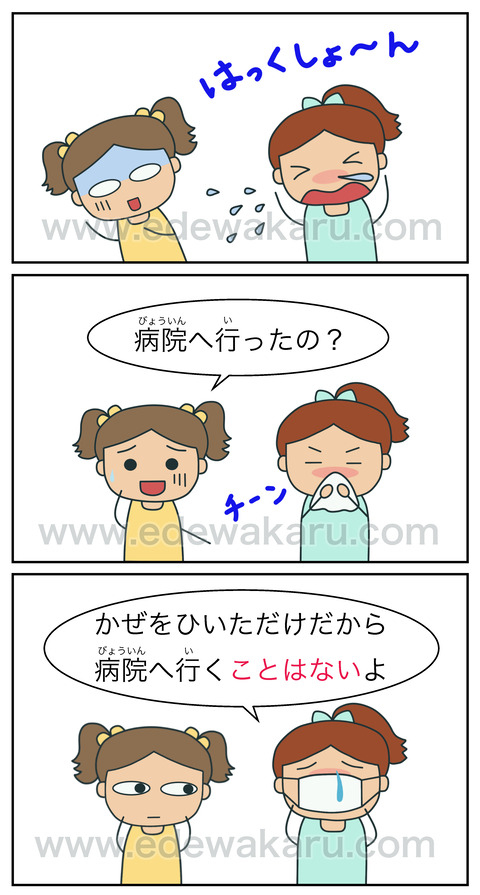
Meaning
〜する必要がない
How to use it
動詞[辞書形]+ことはない
Explanation
「〜ことがない」は「〜する必要がない」という意味を表す文型です。「〜ことはない」は動詞の辞書形につく場合は
【不必要】、た形につく場合は
【過去の経験】
を表します😀
[例]
病院へ
行くことはない
【必要がない】
病院へ行った
ことはない
【経験がない】
「こと」がつく文型もたくさんありますので、しっかりと復習をしておきましょう😊
【「こと」シリーズ】
〜こと(命令)
〜ことか
〜ことから
〜ことがある
〜ことができる(可能)
〜ことができる(能力)
〜ことこの上ない
〜ことだ・〜ないことだ
〜ことだから
〜ことだし
〜ことで(Nのことで)
〜こととて
〜ことなしに
〜ことなく
〜ことに
〜ことにしている
〜ことにする
〜ことになっている
〜ことになる・〜こととなる
〜ことには
〜ことは〜が①(形容詞・名詞)
〜ことは〜が②(動詞)
〜ことはない
〜ことはならない
〜たことがある(経験)
〜だこと!
(〜は)〜てのこと
〜ても〜すぎることはない
〜ということだ
〜とのことだ
〜ないこともない
〜ないことには
〜なかったことがある
In context 4 examples
かぜをひいただけだから、病院へ行くことはないよ
→かぜをひいただけだから、病院へ行く必要はないよそんなに心配することはないよ
→そんなに心配する必要はないよまだ時間があるから急ぐことはない
→まだ時間があるから急ぐ必要がないプリンを食べたくらいで、そんなに怒ることはないでしょ
→プリンを食べたくらいで、そんなに怒る必要がないでしょ(復習:口語形「〜でしょ・〜だろ」)
Usage 2
Read this source entry ↗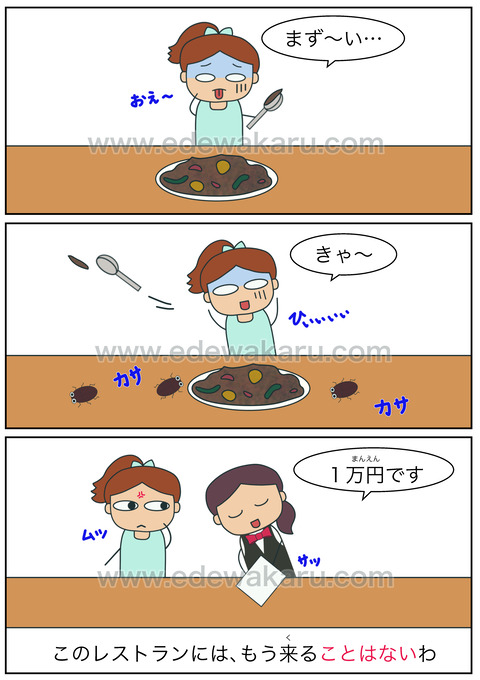
Meaning
〜は絶対にない
How to use it
動詞[辞書形]+ことはない
Explanation
「〜ことはない」は「〜は絶対にない」という意味で、とても強い否定を表す文型です。上級レベルの人は
「〜ことはあっても〜ことはない」
という形も覚えておくといいと思います😊
[例]
彼は傷付けられる
ことはあっても、人を傷つける
ことはない
(復習:傷付く・傷付ける(説明))
(復習:傷付く・傷付ける(練習))
「〜ことはない」には「〜する必要がない」という意味もありますので一緒に覚えておきましょう😀
In context 5 examples
このレストランには、もう来ることはないわ
→このレストランには、もう絶対に来ないわ彼女がうそをつくことはないよ
→彼女は絶対にうそをつかないあの会社のスマホは簡単に壊れることはない
→あの会社のスマホは絶対に簡単には壊れない田中さんは時間に厳しい。彼女が遅刻することはないはずだ
→彼女は絶対に遅刻をしないはずだ(復習:〜はずだ)真面目な彼女が仕事をサボることはないと思うよ
→彼女は絶対に仕事をサボらない(復習:サボる)
Usage 3
Read this source entry ↗Meaning
〜する必要がない
How to use it
動詞[辞書形]+ことはない
Explanation
「〜ことがない」は「〜する必要がない」という意味を表す文型です。「〜ことはない」は動詞の辞書形につく場合は
【不必要】、た形につく場合は
【過去の経験】
を表します😀
[例]
病院へ
行くことはない
【必要がない】
病院へ行った
ことはない
【経験がない】
「こと」がつく文型もたくさんありますので、しっかりと復習をしておきましょう😊
【「こと」シリーズ】
〜こと(命令)
〜ことか
〜ことから
〜ことがある
〜ことができる(可能)
〜ことができる(能力)
〜ことこの上ない
〜ことだ・〜ないことだ
〜ことだから
〜ことだし
〜ことで(Nのことで)
〜こととて
〜ことなしに
〜ことなく
〜ことに
〜ことにしている
〜ことにする
〜ことになっている
〜ことになる・〜こととなる
〜ことには
〜ことは〜が①(形容詞・名詞)
〜ことは〜が②(動詞)
〜ことはない
〜ことはならない
〜たことがある(経験)
〜だこと!
(〜は)〜てのこと
〜ても〜すぎることはない
〜ということだ
〜とのことだ
〜ないこともない
〜ないことには
〜なかったことがある
日本語NET JLPT文法解説まとめ
Meaning
~する必要はない / ~しないほうがいい
① 悩んでいる人に「その必要はないよ」と助言や忠告をする時に使う。
②「そんなに強く言うことは無いだろ」と非難として使うこともある。
How to use it
V(辞書形)+ことはない
Explanation
no need
① It is used to advise or warn someone who is troubled, saying, "There's no need for that."
② It can also be used as criticism, as in, "There's no need to say it so harshly."
毎日のんびり日本語教師
Meaning
~する必要はない
~しなくてもいい
How to use it
動詞辞書形+ことはない
動詞辞書形+こともない
Explanation
必要がないことを表します。
話し手の相手に対するアドバイスや励まし等の意味で用います。
「わざわざ」と呼応することもあります。
Notes
特になし
In context 12 examples
まだ時間があるので急ぐこともない。
気にすることはないよ。
気軽に何でもおっしゃってください。 遠慮することはありません。
自分に嘘をついてまで無理することはない。
『悩んでも悩まない、そういうように感じることができれば、人生は決して心配することはない』
人生、悪いことばかりでないから悲観することはない。(人生不全是坏事所以不必悲观。)
人事を尽くしたなら、なにも心配することはない。
断られても気にすることはない。きっとどこかで、別の人が待ってくれている。
泣きたいなら我慢することはないんだよ。
人生、悪いことばかりでないから悲観することはありません。
自分の価値観は大切にすべきで、誰かのために無理することもない。
夢がないからって自分を卑下することはないんじゃないかな。
日本語文型辞典 英語版
Meaning
【ことはない】[V-ることはない]
Used with respect to a certain action, to say that there is no necessity for it or no need to do it. Often used to encourage someone or to give advice.
In context 3 examples
心配することはないよ。ぼくもてつだうからがんばろう。
There’s nothing to worry about. I’ll help you too, so let’s do it.
こまったことがあったらいつでも私に言ってね。ひとりでなやむことはないのよ。
Please let me know if you have any problems. There’s no need to agonize on your own.
そのことでは彼にも責任があるんだから、君だけが責任をとることはないよ。
He’s to blame for it too, so you really don’t have to take all the responsibility yourself.
AIUEO JLPT Grammar
Meaning
This sentence pattern expresses that something is not necessary or that something does not need to be done.
How to use it
動詞辞書形+ことは+ない動詞辞書形+ことも+ない
Explanation · 日本語
この文型は、必要がない、あるいはしなくても良いことを示す表現です。
In context 5 examples
そんなに心配することないよ。
There is no need to worry so much.
締め切りは来週だから、そんなに急ぐことはないですよ。
The deadline is next week, so there is no need to rush.
全部暗記することはないです。
There's no need to memorize everything.
彼はもうすぐ戻ってくるから、わざわざ迎えに行くことはない。
He will be back soon, so you don’t have to go see him.
出発は午後だから、朝から急いで準備することもないでしょう。
The departure is in the afternoon, so there is no need to rush preparations in the morning.
文法
Meaning
~する必要はない / ~しないほうがいい
① 悩んでいる人に「その必要はないよ」と助言や忠告をする時に使う。
②「そんなに強く言うことは無いだろ」と非難として使うこともある。
How to use it
V(辞書形)+ことはない
In context 4 examples
たくさん頑張ったんだから、できなくてもがっかりすることはないよ。
彼は顔は怖いけど、とても優しいから怖がることはないよ。
コンビニまで歩いて3分だし、人も少ないし、わざわざ化粧していくことはないんじゃない。
来週、また帰って来るんだから、わざわざ空港まで見送りに来ることはないよ。
Bunpro Grammar Reference
Meaning
There is no need to, Never happens
How to use it
Verb + ことはない
Verb + ことはありません
Nuance
An expression that shows that (A) is a thing that either never occurs, or is not called for.
Explanation
ことはない is an expression that has two primary purposes in Japanese. To convey that there is 'no need for (A)', or that '(A) never happens'. In these cases, (A) is a verb that will appear directly before こと. ことはない is often used to reassure someone that something will not come to pass.
In this expression, the adverbial particle は is working to present (A) as the extent (a regular role of adverbial particles), while the 形容詞 ない negates that extent. This negation is up to interpretation, with the literal meaning simply being 'There is no (A)'.
そんなに慌てることはない。まだ時間がいっぱいあるからゆっくりやればいいよ。
There is no need to rush that much. We still have a lot of time, so it is okay if you pace yourself.
10年前に親と喧嘩をしてから、親と話すことはない。
Ever since I fought with my parents 10 years ago, I have not talked to them.
Caution
This structure is very different to たことがない, which presents a single instance of something not having happened. As opposed to the case marking particle が, は presents the verb/verb-phrase as a topic itself in non-past form, highlighting its non-existence. Due to this, ことはない can imply that (A) is unthinkable, or even impossible.
そんなに心配した事が無い。
There has never been a time where I worried that much.
そんなに心配することはないよ。
There is no need to worry that much.
Nuance · 日本語
(A)は絶対に起こらない、又は求められていないということを表す表現。
Explanation · 日本語
「ことはない」には、主に二つの意味があります。「(A) の必要はない」という意味と、「(A) は絶対に起こらない」という意味です。(A) には過去形ではない動詞が入り、そのあとに「こと」が続きます。この表現は、相手に「それはしなくても大丈夫だよ」とか「それは起こらないよ」と伝えて安心させたいときによく使われます。
この表現では、副助詞の「は」が (A) の程度や範囲を示していて(副助詞のよくある使い方です)、形容詞の「ない」がそれを否定しています。この「ない」が必要性を否定しているのか、可能性を否定しているのかは、文脈によって変わります。
そんなに慌てることはない。まだ時間がいっぱいあるからゆっくりやればいいよ。
There is no need to rush that much. We still have a lot of time, so it is okay if you pace yourself.
10年前に親と喧嘩をしてから、親と話すことはない。
Ever since I fought with my parents 10 years ago, I have not talked to them.
注意点
「ことはない」は、過去形の動詞などと使われる「たことがない」とは意味が異なります。「たことはない」は、それが過去に一度も起きていないことを表しますが、「ことはない」は、その対象が存在しないことを表します。また、「ことはない」は、(A) が考えられないことや、起こるはずがないという意味を表すこともあります。
そんなに心配した事が無い。
There has never been a time where I worried that much.
そんなに心配することはないよ。
There is no need to worry that much.
In context 16 examples
- そんな急ぐ事はない。ぼちぼちやればいい。
There is no need to hurry. You should take your time.
- 10年前に親と喧嘩をしてから、親と話すことはない。
Ever since I fought with my parents 10 years ago, I have not talked to them.
- そんなに慌てることはない。まだ時間がいっぱいあるからゆっくりやればいいよ。
There is no need to rush that much. We still have a lot of time, so it is okay if you pace yourself.
- もうあの家に帰る事はないだろう。
We will never return to that house, right?
- もう彼に教える事はありません。
There is no need to teach him anymore.
- これ以上何も言う事はない。
There is no need to say more.
- この抽選で車が当たる事はないと思う。
I think that winning a car in this lottery never happens.
- その怪我は擦り傷だから、心配する事はないよ。
That injury is just a flesh wound, so you don't need to worry.
- よくできた作品だ。何も言う事はないな。
This is a well done piece. I have nothing to say. (There is no need to say anything)
- 沖縄に住んだら、雪を見る事はない。
If you live in Okinawa, you never see snow.
- 君がそんなに責任を感じる事はないよ。
There is no need to feel so responsible.
- 泣く事はない。君のせいじゃないんだから。
There is no need to cry. It's not your fault.
- 落とした鍵を見つけたから、もう心配する事はない。
Since we found the keys that were dropped, there is no need to worry anymore.
- 恐れる事はない。思い切ってやってみるんだ!
There is no need to be scared. Give it all of your might!
- そんなに心配した事が無い。
There has never been a time where I worried that much.
- そんなに心配することはないよ。
There is no need to worry that much.
NINJAL 日本語文型データベース
Usage 1
Meaning
聞き手が心配していることや気にしていることを否定する言い方です。〜する必要はないという話し手の判断を表し、聞き手を励ましたり忠告したりするときに使います。話し手自身に対しても使います。また、不快だと思っていることを聞き手がするのを非難するときにも使います。
How to use it
Vることはない
Notes
立場が上の人に対しては使いません。
In context 5 examples
「この大学の入試不合格は残念だったけど、そんなに嘆くことはないよ。まだまだチャンスは残っているよ。頑張れ」
「明日のプレゼンテーションが心配で……」「そんなに心配することはありませんよ。なんとかなりますよ」
うーん、この報告書の提出期限は8月末か。でも、焦ることはない。時間はまだ十分ある。
あ、トイレが壊れた。水が止まらない。大丈夫、大丈夫。慌てることはない。こんな時こそ落ち着いて。
「なにも監督が責任をとって辞めることはないと思います。誰に責任があるというわけでもないし……」
Usage 2
Meaning
これまで経験がないことを表します。話し手が発話の時点で自覚している動作、出来事の経験を言うときに使います。
「~ことがない」よりも少し否定の意味が強いです。
How to use it
Notes
ふつう「よく・いつも」など日常的にしていることを表す言葉や、「昨日・先月」など近い過去を表す言葉とは一緒に使いません。また、「2010年3月」のような過去のある時点を表す言葉とは一緒に使いませんが、「昔・子どもの頃」のような幅のある期間を表す言葉には使えます。
In context 20 examples
日本に来て5年になるが、国へ帰りたいと思ったことはない。
私は子どもを叱るときにも、たたいたことは全くありません。
刑事「しっかり思い出して答えなさい。本当にあいつに会ったことはないのか」
「一度もうそをついたことはない」と本当に言える人はいないだろう。
私は体が丈夫で、風邪を引いても1日で治らなかったことはありません。
妹は、高校生のときから彼氏がいなかったことはない。
彼は数学の天才だ。先生がどんなに難しい問題を出しても解けなかったことはない。
この業者は頼んだ仕事が期日に間に合わなかったことはない。信頼していいだろう。
私が病気のとき、中学生の子どもが家事をやってくれた。自分の子があんなに頼もしいと思ったことはなかった。
人前で話すのが恥ずかしかったことは一度もない。
留学して、同じ国から来たクラスメートがいなくても、新しい友達がたくさんできたので寂しかったことは全くない。
あの子の言うことが正しくなかったことは一度もない。
私は勉強するのが嫌だったことは一度もありません。
いつも不真面目な息子ですが、言うことがでたらめだったことはありません。
これまでの人生を振り返って、私が幸せではなかったことはない。
私は一度も正社員だったことはない。ずっとアルバイトをして生活費を稼いできた。
「佐藤さんは昔、新聞記者をされていたと伺っていますが」「いえいえ、私が新聞記者だったことは一度もありません」
山本先輩は2年生になってから、レギュラー選手でなかったことはない。
健康診断を毎年受けていて、健康に問題なしという結果でなかったことは一度もない。
課長はストライプ柄のネクタイがお好きみたいです。毎日見てますけど、ストライプ柄でなかったことはありません。
Usage 3
Meaning
ある動作や出来事が全く起こらないことを表します。
How to use it
In context 18 examples
この地方は夏でも30度以上になることは絶対にない。
私は毎日ピアノの練習をしています。隣の人に迷惑になるといけないので、夜ピアノを弾くことはありません。
あの人は正直すぎるほど正直だ。うそをつくことは全くない。
リンさんは決して遅刻することはありません。いつも早めに来る人なのに、今日はどうしたんでしょう。
私は眠れなくても薬を飲むことはありません。眠くなるまで本を読んでいます。
健はお酒が好きだから、誘えば必ず来る。来ないことはない。
一人暮らしでも、友達が多いので寂しいことはない。
寝起きの子どもの機嫌が悪くて困るという話を聞くが、うちの子は機嫌が悪いことは全くない。
病院の薬が効いて、このごろは肩が痛いことはありません。
この食堂は、何を頼んでも量が多くないことはない。何でも大盛りだ。
妹の部屋がきれいなことはない。いつも散らかっている。掃除が苦手なのだ。
ここは商店街とはいっても、人通りが少なく、一年中いつでもにぎやかなことはありません。
林課長の言うことが不明瞭であることはない。いつも論理的だ。
田中さんの指摘が的確でないことはない。本当に頭のいい人だ。
母は服のセンスが抜群だ。どんなときもおしゃれでないことはない。
出かけるとき私は必ずパンツスタイルだ。スカートのことはない。
夕暮れ時の空は、一瞬も同じ色であることはない。
この作家の作品は、大変人気がある。この作家の書くものが、ベストセラーでないことはない。
IMABI
Expressions with こと
Read this IMABI lesson ↗Explanation
Expressions with こと
The nominalizer こと appears in many grammatical structures, and in all the structures showcased in this lesson, it has no interchangeability with the nominalizer の. So, as you go through each structure, this will be a great opportunity to better internalize these two nominalizers and how they are fundamentally different.
~ことがある: Experience(S) One Has
When こと follows a verbal predicate, either in the non-past form or the past form, it indicates experiences one has. The difference tense plays determines whether said experience is one that one “(often) has” or “has had.”
Vnon-past + ~ことがあるagent (often) does/experiences doing…
Vpast + ~ことがあるagent has/have done… (before)
In practice, ~たことがある is more practically translated as “has/have…” as in having done something before—an experience that is unequivocally in the past as an experience had. Meaning, this pattern may not be used to reflect the present perfect use of “have” like in “I have done my work,” in which the speaker may be referring to actions that they have just completed. ~たことがある should also NOT be misconstrued as a wordier replacement of plain past tense, either.
i. きのう、日本語を勉強したことがある。X
Intended: Yesterday, I studied Japanese.
ii. 仕事をやったことがある。??
Intended: I have done my work.
Actual Meaning: I have done a job.
iii. 営業事務の仕事をやったことがある。
I have worked in sales administration (before).
Particle Note: Whether が, は, も, or no particle at all is used in this structure is ultimately determined by the intended nuancing of the statement. With the particle は, the experience (being) had is being contrasted with other scenarios. With the particle も, the experience (being) had is in addition to other stated experiences. No particle being used is indicative of casual speech in which case the added nuances provided by は・も are not relevant as well as が’s own exhaustive-listing nuancing being irrelevant.
While it may go without saying, this construct can be used in negative sentences, in which case ある conjugates to its respective negative forms.
iv. 北京ダックを食べたことがない。
I have not had Peking duck (before).
It must also be noted that Vnon-past before こと may also be in the negative, and it is even possible for ある to be in the negative in tandem. However, each scenario is distinctly different.
v. それほど頻繁に食べることはないかもしれませんが、高塩分の食品の摂取量が多いと、胃癌リスクが高まりますよ。
Although you may not eat them that frequently, high intake of salty foods will increase your risk of stomach cancer.
vi. 鶏肉は、食べないことはないですが、あまり好きではありませんね。
While it’s not that I don’t ever eat chicken, I don’t really care for it.
While conjugating verbs into plain/polite and affirmative/negative forms should not be problematic by this point, here are the relevant forms of ある with the structure ~ことがある.
PlainPolite
Affirmative~ことがある~ことがあります
Negative~ことがない~ことがないです
~ことがありません
Past※~ことがあった~ことがありました
Negative Past※~ことがなかった~ことがなかったです
~ことがありませんでした
※While Japanese does not exhibit tense agreement, there are instances in which the pattern ~ことがある utilizes ~た for both the verb こと attaches to and ある, or even just the past tense marker on ある itself (see Exs. 14-17).
1. 富士山に登った1こともありますか。
Have you also climbed Mt. Fuji before?
2. マシュマロ入りのホットチョコレートを飲んだことがありますか。
Have you ever had hot chocolate with marshmallows?
3. 雲が多くなる時間2もあるが、雨が降ることはない。
There are times when it gets cloudy, but it will never rain.
4. 夏場でも鍋物を食べることがある。
Even during summertime, I (often) have hotpot.
5. 映画では同じようなアイデアが何度も繰り返し使われることが多い3ので、似たようなシーンを別の映画で見かけることがあるかもしれない。
In movies, similar ideas are used over and over again a lot, so you may often encounter similar scenes (to what you have seen) in other films.
6. 久しぶりに訪れた場所で道に迷うことがあります。
I often get lost when I visit places I haven’t been in a while.
7. 基本的に引き篭もっているのですが、休日に母と買い物に行くことがある。
I basically stay at home, but sometimes I go shopping with my mother on the weekends.
8. 「香港に行ったことがあるの?」「一度行ったことがあるよ。」
“Have you been to Hong Kong before?” “I’ve been there once.”
9. 歯磨きをしないで寝たことがありますか。
Have you ever gone to sleep without brushing your teeth?
10. ラーメンを食べたことある?
Have you ever had ramen?
11. 歌舞伎を観たことはありますか。
Have you seen kabuki before?
12. 外国人に日本語を教えたことがあります。
I have taught Japanese to foreigners before.
13. あまり気にすることはないよ。
There really isn’t anything to worry about.
As for when ~たことがあった is used, an experience “that had been had, or “had not been had” in the negative, is mentioned as a retelling of the past. At times, this could be done as an attempt to confirm such event occurred, either to oneself or to whoever might be listening.
14. この場所で子供のころ、よく遊んだんだよ。あの滑り台の上から飛び降りて怪我をしたことがあったな。
I used to play here a lot as a kid. I once jumped off the top of that slide and got hurt.
15. 娘の父親は東京の江戸川区で育って幼稚園へ通ったことがあったが、母親の私のほうは、幼稚園へ行かなかった。
My daughter’s father grew up in Edogawa Ward, Tokyo, and had gone to kindergarten, but I, her mother, did not go to kindergarten.
Similarly, Vnon-past+ ~ことがあった is used when the speaker is retelling common occurrences, or lack thereof when in the negative, from the past.
16. 母だって子守唄を歌うことがあっただろうが、思い出せない。
I’m sure my mother of all people sometimes sang lullabies to me, but I can’t remember.
17. 毎年きっと1冊か2冊、ときには三冊も四冊も出版することがあった。
Ever year, I would publish one or two books, sometimes three or four.
Insofar, we have only see situations in which the verb used with ~ことがある indicates the volition of an agent (doer). However, When there is no agent, the structure ought to be interpreted as indicating what “may (often) be the case.”
18. 届出に不備などがあると加入手続きが遅れることがあるのでご注意ください。
Please note that if there are any issues in your filing, the enrollment process may be delayed.
19. 何か相手の気に入らないことがあったとしか思えませんね。
The only thing I can think of is that there must’ve been something that didn’t bode well with the other person.
~ことがある w/ Adjectival Predicates
One leap away from non-volitional verbs would be adjectival predicates. In fact, adjectives and adjectival nouns may also be used with ~ことがある for describing having (had) experiences in a certain situation, tense dynamics permitting. Arguably more care must be taken to ensure that the context is not best described with the past tense, however, as the context at had must still be understood as “experience(s) in which such a state is/was so” as opposed to simply stating that “something was so.” The latter situation would be within the domain of the past tense.
20. この先、楽しいことがあるとは思えません。
I just can’t see there being anything fun to be had in the future.
21. アボカドの熟成の見極めは難しいですねえ。私も切ってみたら、すごく硬かったことがあります。
It sure is hard to judge the ripeness of an avocado, huh. I once cut into one that was really hard.
22. ときどき大変なこともあるけど、ポジティブに考えるようにしているよ。
It can be hard at times, but I try to think positively.
23. 単品だと500円なんだけど、以前はもうちょっと安かったことがあったの。
It’s 500 yen à la carte, sure, but I had bought it a little cheaper than that in times past.
24. 怖そうな人でも優しいこともあるんだよ。
Even scary people are sometimes nice.
25. 北多摩は神奈川県だったことがある。
Kita Tama has once been (in) Kanagawa Prefecture.
NON-REMODELED CONTENT BELOW
~ことにする・こととする: To decide.
26. あいつを忘れることにしただけさ。(Very colloquial)
I’ve just decided to just forget that guy.
27. 私はお酒を飲むのをやめることとしました。 (Slightly formal)
I have decided to quit drinking liquor.
~ことにしている shows that one makes a routine of doing something or that one is determined/has a strong commitment to doing something.
28. 毎日カルピスを飲むことにしています。
I’ve made it a rule to drink Calpis every day.
29. 英語では話さないことにしています。
I’ve made it a rule not to speak in English.
~ことになる・こととなる: To be decided
30. 今年日本に行くことになりました。
It has been decided that I will go to Japan this year.
31. 新製品は5月10日に発表することになりました。
It has been decided that we will announce the new product on May 10th.
山を登る, while grammatically valid, does not mean the same thing as 山に登る. In this scenario, を functions as a transition marker, indicating that the mountain is not, per se, what is being climbed, but a point along one’s hiking journey. ↩︎
This example exemplifies are こと in this pattern may be replaced with similar yet concrete nouns like 時間・時 (time). ↩︎
This example exemplifies two things: that the pattern ~ことがある can be used with passive verbs and that ある can be replaced with similar words such as 多い (for there to be a lot of…). With this in mind, [高塩分の食品の摂取量] from v. may also be viewed as a paraphrasing of [Verb + ~こと]. ↩︎
In context 31 examples
富士山に登った1こともありますか。
Have you also climbed Mt. Fuji before?
マシュマロ入りのホットチョコレートを飲んだことがありますか。
Have you ever had hot chocolate with marshmallows?
雲が多くなる時間2もあるが、雨が降ることはない。
There are times when it gets cloudy, but it will never rain.
夏場でも鍋物を食べることがある。
Even during summertime, I (often) have hotpot.
映画では同じようなアイデアが何度も繰り返し使われることが多い3ので、似たようなシーンを別の映画で見かけることがあるかもしれない。
In movies, similar ideas are used over and over again a lot, so you may often encounter similar scenes (to what you have seen) in other films.
久しぶりに訪れた場所で道に迷うことがあります。
I often get lost when I visit places I haven’t been in a while.
基本的に引き篭もっているのですが、休日に母と買い物に行くことがある。
I basically stay at home, but sometimes I go shopping with my mother on the weekends.
「香港に行ったことがあるの?」「一度行ったことがあるよ。」
“Have you been to Hong Kong before?” “I’ve been there once.”
歯磨きをしないで寝たことがありますか。
Have you ever gone to sleep without brushing your teeth?
ラーメンを食べたことある?
Have you ever had ramen?
歌舞伎を観たことはありますか。
Have you seen kabuki before?
外国人に日本語を教えたことがあります。
I have taught Japanese to foreigners before.
あまり気にすることはないよ。
There really isn’t anything to worry about.
この場所で子供のころ、よく遊んだんだよ。あの滑り台の上から飛び降りて怪我をしたことがあったな。
I used to play here a lot as a kid. I once jumped off the top of that slide and got hurt.
娘の父親は東京の江戸川区で育って幼稚園へ通ったことがあったが、母親の私のほうは、幼稚園へ行かなかった。
My daughter’s father grew up in Edogawa Ward, Tokyo, and had gone to kindergarten, but I, her mother, did not go to kindergarten.
母だって子守唄を歌うことがあっただろうが、思い出せない。
I’m sure my mother of all people sometimes sang lullabies to me, but I can’t remember.
毎年きっと1冊か2冊、ときには三冊も四冊も出版することがあった。
Ever year, I would publish one or two books, sometimes three or four.
届出に不備などがあると加入手続きが遅れることがあるのでご注意ください。
Please note that if there are any issues in your filing, the enrollment process may be delayed.
何か相手の気に入らないことがあったとしか思えませんね。
The only thing I can think of is that there must’ve been something that didn’t bode well with the other person.
この先、楽しいことがあるとは思えません。
I just can’t see there being anything fun to be had in the future.
アボカドの熟成の見極めは難しいですねえ。私も切ってみたら、すごく硬かったことがあります。
It sure is hard to judge the ripeness of an avocado, huh. I once cut into one that was really hard.
ときどき大変なこともあるけど、ポジティブに考えるようにしているよ。
It can be hard at times, but I try to think positively.
単品だと500円なんだけど、以前はもうちょっと安かったことがあったの。
It’s 500 yen à la carte, sure, but I had bought it a little cheaper than that in times past.
怖そうな人でも優しいこともあるんだよ。
Even scary people are sometimes nice.
北多摩は神奈川県だったことがある。
Kita Tama has once been (in) Kanagawa Prefecture.
あいつを忘れることにしただけさ。(Very colloquial)
I’ve just decided to just forget that guy.
私はお酒を飲むのをやめることとしました。 (Slightly formal)
I have decided to quit drinking liquor.
毎日カルピスを飲むことにしています。
I’ve made it a rule to drink Calpis every day.
英語では話さないことにしています。
I’ve made it a rule not to speak in English.
今年日本に行くことになりました。
It has been decided that I will go to Japan this year.
新製品は5月10日に発表することになりました。
It has been decided that we will announce the new product on May 10th.
どんなときどう使う 日本語表現文型辞典
Meaning
no need to; shouldn't
How to use it
Vる+ことはない
Explanation
~する必要はない/~しない方がいい
1)「そうする必要があるのではないか」と心配している人に「その必要はない」「そんなに心配しなくてもいい」と助言をしたり、忠告をしたりする言い方である。
2)「なにも~ことはない・わざわざ~ことはない」の形でよく使う。
3) ❺ ❻ のように「必要はない」の意味から転じて、非難する意味に使うこともある。
2)Often used in patterns なにも~ことはない (certainly no need to…) or わざわざ~ことはない (no need to go to the trouble of).
1)Response to someone's concern that something must be done. Response constitutes advice that there is no reason for action to be taken.
3)Response of "no need to…" can shift into a criticism when used as in sentences ❺ and ❻ .
In context 6 examples
簡単な手術だから、心配することはありません。すぐに退院できますよ。
怖がることはないよ。あの犬は、体は大きいけれど性質はおとなしいから。
パーティーといっても、親しい友だちが集まるだけなんだから、わざわざ着替えて行くことはないよ。
すぐ帰ってくるんだから、空港まで見送りに来ることはない。
たしかに彼の話し方はほかの人と違うが、なにも笑うことはない。
あなたの気持ちもわかるけど、皆の前であんなに怒ることはないでしょう。