AIUEO JLPT Grammar
Meaning
This sentence pattern is used when expressing that the latter content is more appropriate than the former, especially when making a judgment about which content or situation is more suitable.
How to use it
普通文と+いうより(+も)形容動詞と+いうより(+も)名詞と+いうより(+も)
Explanation · 日本語
この文型は、ある表現や状況について、前に述べた内容よりも後の内容のほうが適切であると判断するときに使われる表現です。
In context 5 examples
彼は疲れているというより、むしろ飽きているようだ。
Rather than being tired, he seems more like he’s bored.
これは料理というより、芸術作品だ。
This is more of a work of art than a dish.
彼女は賢いというより、ずる賢いと言った方がいい。
Rather than saying she’s smart, it would be more accurate to say she’s cunning.
彼の言い方は厳しいというよりも、冷たい。
His way of speaking is more cold than harsh.
彼は怒っているというより、ショックを受けているようだ。
He seems more shocked than angry.
文法
Meaning
〜という言い方よりも、むしろ〜
前件と後件を比較して前件よりも後件のほうが近い、当たっていると言いたい時に使う。
How to use it
V(普)+ というより
イA(普)+ というより
ナA(普)+ というより
N(普)+ というより
In context 6 examples
今日は涼しいというよりも寒いぐらいだ。
クラスで人気者のジェシカさんは綺麗というよりもかわいいって感じだね。
カクテルなんてお酒というよりもジュースだよね。
トムさんってかっこいいというよりもオシャレだよね。
たくさん失敗して悔しいというよりも色々な人に迷惑をかけて申し訳ない気持ちだった。
今はラーメンというよりもうどんが食べたい気分だ。
Bunpro Grammar Reference
Meaning
...is more of a... than a..., Rather than saying that...
How to use it
Verb + というより
[い]Adjective + というより
[な]Adjective + (だ) + というより
Noun + (だ) + というより
Nuance
A grammar point that presents (A) and then makes another more correct statement. Rather than saying (A), (B).
Explanation
When combining the quotation use of the case marking particle と with the う - Verb 言う 'to say', and the case marking particle より 'comparing', というより presents a phrase that is being compared through further evaluation/reconsideration. This may be thought of as similar to 'rather than saying (A), (B)' in English.
というより may be used after any type of word. However, due to phrase that comes before it 'determining' something that will then be compared, nouns and な-Adjectives will require だ (despite being omitted in casual speech). だ may also be omitted if the sentence finishes with a だ that is describing the same thing in a different light.
あの人は仕事をしているというより、仕事をさせられている感じがする。
Rather than saying that he is working, it seems like he is being made to work.
日本の天井が低いというより、あなたの身長が高いだけだと思う。
Rather than Japanese ceilings being low, I think you are just tall.
僕は暇だというより、なにをすればいいか分からないだけだ。
Rather than having nothing to do, I just don't know what I should be doing.
ここは公園というより、小さい広場みたいな物だ。
Rather than calling this a park, it is something more like a small field. (だ used at the end rather than following 'park', as 'field' is the actual state that the speaker considers true)
Caution
It should be remembered that より (in all of its uses) will highlight something that is 'less'. This means that the (B) part of というより sentences will always describe something that is 'more', 'closer', 'more accurate', etc.
マサミさんは綺麗というより、かわいい。
Masami is more cute than beautiful.
その話がつまらないというより、興味がないだけ。
It's not that the story is boring, it's just more that I have no interest in it.
Nuance · 日本語
(A)を提示し、それよりもさらに正しいことを述べる時に使われる表現。(A)ではなく、(B)の方が正しい。
Explanation · 日本語
「というより」は、引用を表す格助詞の「と」と、五段動詞の「言う」、そして比較を表す格助詞の「より」からできている表現です。あることをもう一度評価したり、検討したりして、もっと良い・適切な・正しいと思われることを述べるときの表現です。これは「(A) よりも (B) と言う方が適切だ」のような意味で使われます。
「というより」は、いろいろな品詞に使うことができます。文の前半で、名詞やナ形容詞を使う場合は「だ」が付きます(ただし、くだけた会話では、省略されることもあります)。また、同じ物事を別の角度から述べる文が「だ」で終わるときは、「というより」の前の「だ」を省略することができます。
あの人は仕事をしているというより、仕事をさせられている感じがする。
Rather than saying that he is working, it seems like he is being made to work.
日本の天井が低いというより、あなたの身長が高いだけだと思う。
Rather than Japanese ceilings being low, I think you are just tall.
僕は暇だというより、なにをすればいいか分からないだけだ。
Rather than having nothing to do, I just don't know what I should be doing.
ここは公園というより、小さい広場みたいな物だ。
Rather than calling this a park, it is something more like a small field. (だ used at the end rather than following 'park', as 'field' is the actual state that the speaker considers true)
注意点
「より」の (A) には「少ない方」や「小さい方」のような比較的程度が低い方が入ることが多いです。「というより」の文でも、後半の (B) の部分に (A) よりも「多い方」「大きい方」「正しい方」が入ります。
マサミさんは綺麗というより、かわいい。
Masami is more cute than beautiful.
その話がつまらないというより、興味がないだけ。
It's not that the story is boring, it's just more that I have no interest in it.
In context 18 examples
- 今日は暖かいと言うより暑い。
It is hot rather than warm today.
- 日本の天井が低いというより、あなたの身長が高いだけだと思う。
Rather than Japanese ceilings being low, I think you are just tall.
- あの人は仕事をしているというより、仕事をさせられている感じがする。
Rather than saying that he is working, it seems like he is being made to work.
- 僕は暇だというより、なにをすればいいか分からないだけだ。
Rather than having nothing to do, I just don't know what I should be doing.
- ここは公園というより、小さい広場みたいな物だ。
Rather than calling this a park, it is something more like a small field. (だ used at the end rather than following 'park', as 'field' is the actual state that the speaker considers true)
- あの人はかわいいと言うより綺麗。
That person is beautiful rather than cute.
- 彼は聡明と言うよりずる賢い人です。
Rather than saying that he is wise, he is cunning.
- 彼は技術者と言うより芸術家だ。
He is more of an artist than an engineer.
- これは悲しさと言うより後悔に近い。
Rather than saying that this is sorrow, it is closer to regret.
- それは理由と言うより言い訳ですよね?
Rather than calling it a reason, it's an excuse, right?
- これはサッカーと言うよりフットサルのコートみたいだ。
This appears to be more of a futsal court than a soccer pitch.
- 「嫌い」と言うより「好きではない」と言った方が正確だ。
Rather than saying 'I hate it', it is more accurate to say 'I don't like it'.
- これは草と言うより、竹みたいだ。
Rather than saying that this is grass/weeds, it looks like bamboo.
- 来月と言うより来年と言った方がいいかな。
Rather than saying next month, maybe it is better to say next year.
- オニズカさんは先生と言うより友達だと思っています。
I think of you (Onizuka-san) as more of a friend than a teacher.
- 毎日と言うより、一週間に五回運動をすると言った方が正しい。
Rather than saying every day, I would say it's more correct to say that I exercise 5 days a week.
- マサミさんは綺麗というより、かわいい。
Masami is more cute than beautiful.
- その話がつまらないというより、興味がないだけ。
It's not that the story is boring, it's just more that I have no interest in it.
DoJG 日本語文法辞典(全集)
Meaning
Rather than; more ~ than ~
How to use it
(i) Adjective い informal | というより(は)、(むしろ)Adjective い/な | |
| 涼しいというより(は)、(むしろ)寒い | Cold rather than cool |
(ii) Adjective な stem | というより(は)、(むしろ)Adjective い/な | |
| 奇麗というより(は)、(むしろ)可愛い | Cute rather than pretty |
(iii) Noun | というより(は)、(むしろ)Noun | |
| 青いというより(は)、(むしろ)紫 | Purple rather than blue |
(iv) Vinformal | というより(は)、(むしろ)Verb | |
| 食べるというより(は)、(むしろ)飲み込んでいる | Someone is swallowing rather than eating |
Explanation
というより(は)A phrase that is used to indicate more accurate characterisation of someone or something.
In context 13 examples
今年の夏は涼しいというよりは寒かった。
This summer was cold rather than cool.
カーラは臆病というより(は)むしろ用心深い。
Kara is cautious rather than timid.
本田さんは教育者というより(は)むしろ学者に近い。
Mr. Honda is more of a scholar than an educator.
あの人は酒を飲むというより(は)むしろ酒に飲まれていると言った方がいい。
One should say that sake drinks him rather than he drinks sake.
私にはこの音楽は楽しいというよりは、むしろやかましい。
To me this music is noisy rather than enjoyable.
あの人は丁寧というよりは、慇懃無礼だ。
He is politely insolent rather than polite.
彼の説明は簡潔というよりは、むしろ不十分だと言うべきだ。
We should say that his explanation is insufficient rather than concise.
父は、父親というよりは、むしろいい友達という感じでした。
I felt that my father was a good friend rather than a father.
彼は大学教授というよりは、ビジネスマンだ。
He is a businessman rather than a college professor.
私は教師ですが、教えているというよりは、勉強させてもらっています。
I'm a teacher, but I am learning (literally: I have the privilege of being allowed to study) rather than teaching.
あの母親は子供を愛しているというよりは、むしろ、甘やかしている。
That mother is pampering her child rather than loving him.
彼と話していると、会話をしているというよりは、一方的に話を聞かされているといった感じだ。
When I talk with him I feel that unilaterally I am forced to listen to his talk rather than being engaged in conversation.
私が呼んだというより、むしろ彼女の方が押しかけて来たんです。
It's more of a case of her having invited herself than me having invited her.
絵でわかる日本語
Meaning
Aとい言ってもいいが、Bと言ったほうが適切だ
Aという言い方でもいいが、Bと言う方が合っている言い方だ
How to use it
動詞・形容詞・名詞[普通形]+というより
Explanation
「AというよりB」は「Aと言うことができるが、Bと言った方が適切な言い方だ」という意味で使用されます。この文型のポイントは
「A」という言い方を否定しているのではない
というところです😮「A」でもいいが「B」という言い方が合っていると言いたい時に使う文型ですね😉 また、この文型は「Aというより、むしろB」というように「むしろ」と一緒に使われる場合もあります😊(「むしろ」があってもなくても意味は同じです)
[例]
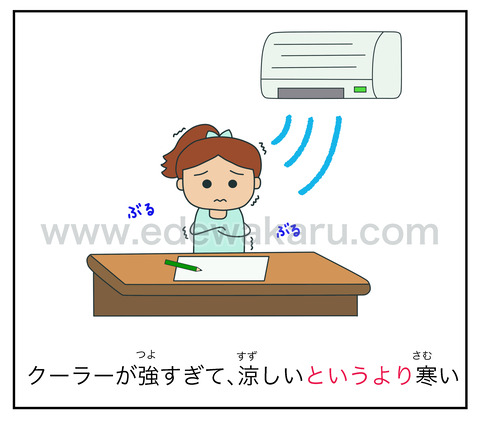
クーラーが強すぎて涼しい
というより、
むしろ
寒い
会話でもよく使われる文型ですのでしっかりと覚えましょう😄
【「という」シリーズ】
〜ということだ
〜というところだ
〜というのは
〜というのも〜からだ
〜というもの(Nというもの)
〜というより
In context 4 examples
クーラーが強すぎて、涼しいというより寒い
→クーラーが強すぎて、涼しいと言ってもいいけれど、どちらかというと寒い彼女は節約家というよりケチだよ
→彼女は節約家だと言ってもいいけれど、ケチだという言い方の方が合っているよこのアニメは子供向けというより大人向けだ
→このアニメは子供向けということもできるが、どちらかというと大人向けだ山田君はかっこいいというよりおしゃれだ
→山田君はかっこいいと言ってもいいが、おしゃれだと言った方が適切だ
日本語文型辞典
Meaning
基本情報説明あることがらについての表現や判断の仕方を比較するのに用いる。「Xという言い方もできるが、比較すればYという言い方の方が妥当だ」という意味。例文① 野村さんは、学校の先生というより、銀行員のようだ。② この絵本は、子供向けというより、むしろ、大人のために書かれたような作品だ。③ あの人は、失礼というより、無神経なのだ。④ 彼は、論争を静めるためというより、自分の力を見せつけるために発言したにすぎない。
日本語文型辞典 英語版
Meaning
Used to compare two ways of expressing or evaluating something. Means “it’s possible to say X, but in comparison to X, statement Y is more fitting.”
In context 4 examples
野村さんは、学校の先生というより、銀行員のようだ。
Apparently Nomura-san is more a bank clerk than a school teacher.
この絵本は、子供向けというより、むしろ、大人のために書かれたような作品だ。
I would say that this picture book is written not so much for children as for adults.
あの人は、失礼というより、無神経なのだ。
That person is more insensitive than rude.
彼は、論争を静めるためというより、自分の力を見せつけるために発言したにすぎない。
He spoke up merely to show off his own power, rather than to defuse the argument.
くらべてわかる日本語表現文型辞典
Meaning
Xに対しAという評価・認識があるが、話し手はBのほうが的確だと思っている。
How to use it
In context 4 examples
彼の酒の飲み方は、味わうというより溺れているといった感じだ。
彼女のしていることは親切というよりお節介だ。
今日は暖かいというより暑いぐらいだ、
あのピアニストは天才というより、むしろ努力家だろう。
日本語NET JLPT文法解説まとめ
Meaning
"〜という言い方よりも、むしろ・・・"
前件と後件を比較して前件よりも後件のほうが近い、当たっていると言いたい時に使う。
How to use it
V(普)+ というより
イA(普)+ というより
ナA(普)+ というより
N(普)+ というより
Explanation
rather than
Used when comparing the previous clause to the following clause, and indicating that the latter is closer or more accurate.
In context 6 examples
今日は涼しいというよりも寒いぐらいだ。
クラスで人気者のジェシカさんは綺麗というよりもかわいいって感じだね。
カクテルなんてお酒というよりもジュースだよね。
トムさんってかっこいいというよりもオシャレだよね。
たくさん失敗して悔しいというよりも色々な人に迷惑をかけて申し訳ない気持ちだった。
今はラーメンというよりもうどんが食べたい気分だ。
毎日のんびり日本語教師
How to use it
名詞+というよりむしろ~
動詞普通形+というよりむしろ~
い形容詞普通形+というよりむしろ~
な形容詞+(だ/である)というよりむしろ
Explanation
二つの判断や見方を比較し、後件の方が比較的妥当であることを表します。
「むしろ」は省略可能ですが、「むしろ」がつくとより強調された表現となります。
「というより」「というよりは」「というよりか」「というよりも」「というよりかは」などと様々な言い方がありますが全て同じ意味です。
Notes
「むしろ」シリーズ
In context 13 examples
声が聞こえないのはマイクが壊れているというより、パソコンの設定の方の問題だと思う。
今回の件は悲しいというより残念だ。
これからはプログラミングを趣味としてというより、仕事として頑張って行くつもりだ。
日本の満員電車は乗っているというよりは、むしろ詰め込まれているという感じだ。
金銭面の問題というよりかは、むしろ親の賛成が得られないことが留学できない大きな理由だ。
猫派か犬派かというよりも、まず動物を触ることができない。
人間の運命は、ルール通りに行われるチェスというよりむしろ宝くじを思い起こさせる。
家から出たくないというよりむしろ布団から出たくない。
彼女は可愛いというよりむしろ美しいと言った方が正しい。
毎日コツコツ繰り返し練習するのは、周り道というよりはむしろ王道だ。
彼女の新しい髪型は似合ってるというよりむしろ好き。
練習の成果を出すことができず、悔しいというよりむしろ無力感。
息子の大学入試合格は、嬉しいというよりむしろ安心したという気持ちのほうが強い。
NINJAL 日本語文型データベース
Meaning
〜という表現よりも、別の表現の方が適切だと言いたいときに使います。また、〜という判断よりも、別の判断のほうが適切だと言いたいときにも使います。
How to use it
V普通形+というより
i-A普通形+というより
na-A普通形+というより(ただし、「na-Aだ」→「na-A+というより」の形になることが多い。「na-Aである+というより」の形になることもある)
N普通形+というより(ただし、「Nだ」→「N+というより」の形になることが多い。「Nである+というより」の形になることもある)
その他
Notes
「〜というより」の後には、話し手がより適切だと考えている表現や判断がきます。
In context 23 examples
弟は学校に勉強しに行っているというより遊びに行っているみたいだ。
「夏休みはご実家に帰ってゆっくりされるのですか」「ゆっくりするというより、高齢の両親の代わりに用事をしに帰るようなものですよ」
非行を繰り返す彼は、両親からは期待されていないというより、諦められているのかもしれない。
両親は私の留学に賛成してくれたというより、むしろ無理やり賛成させられたという感じだった。
今日の1限目の講義は、内容を聴いていたというよりただ座っていただけといった方がよいかもしれない。眠くて頭に入らなかった。
「昨日の国会議員の謝罪会見、見ました?」「ええ、見ましたよ。謝ったというより、なんだかごまかしているようにしか見えませんでしたよね」
うちの子は勉強ができなかったというより、勉強の仕方がわかっていなかったのだと思います。
税金をごまかすのは、賢いというよりずるいことです。
「あそこの店の激辛ラーメン、すごく辛いんだって?」「ただ辛いというより、もう舌が痛いって感じだったよ」
「留学生活は楽しくないんですか」「いや、楽しくないというより、勉強とアルバイトの両立が大変で、楽しむ暇がないんですよ」
昨日は暖かかったというより、むしろ汗ばむくらいだった。
ジョンソン選手の優勝です。田中選手は2位に終わりましたが、田中選手の調子がよくなかったというより、ジョンソン選手の作戦勝ちといったところでしょうか。
この家のクリスマスのイルミネーションは、きれいというより派手な感じです。
その建築家の作品は斬新だというより、あまりにも奇抜すぎて、情緒ある古い町並みに溶け込むものではなかった。
妻は子どもとは少し距離を置いて接している。子どもに対して無関心であるというより、自立心を育むためだ。
政府はそのプロジェクトに積極的ではないというより、むしろ反対の意向を示している。
子どものころの妹は、神経質だったというより、感受性が豊かで繊細な心の持ち主だった。
国民の多くは彼のことを、優れたリーダーというより独裁者だと考えているだろう。
今度行くレストランは、フランス料理というより、フランス風創作料理の店です。
社長の江川は、この事件の関係者だというより、むしろ首謀者だ。
山田を部長に抜擢することは、最善の人事であるというより最悪の人事だ。
留学を諦めた理由は、金銭面の問題だったというより、むしろ健康上の問題が大きかった。
母がこのゲームを買ったのは、子どもを喜ばせたいからというより、自分がやりたいからのようだった。
IMABI
Rather
Read this IMABI lesson ↗Explanation
Rather: むしろ, かえって, ~ましだ
If you would rather not read this lesson, at least once you are finished reading it, you will have learned how to say that in Japanese.
~よりむしろ~・むしろ~
The pattern (Xより)むしろ compares two situations to come to the conclusion that the second situation (Situation Y) is more ideal/fitting than the first situation (Situation X).
接続 (X + よりむしろ + Y)
Noun + よりむしろ~
Verb 連体形 (affirmative/negative) + よりむしろ~
(Sentence Start) むしろ~
Depending on the surrounding structures, it may be more natural to translate (より)むしろ as “more so than” or something comparable. This, though, does not detract from its purpose of demonstrating a more ideal situation.
What’s more, the particle より may be emphasized with various adverbial particles to add more nuance to the comparison between Situation X and Situation Y.
よりは: The particle は’s functions of topicalizing Situation X highlights how it is not so much a desirable situation as Situation Y.
よりも: The particle も indicates that Situation Y is far more desirable than Situation X.
よりか: The particle か adds uncertainty to the comparison between Situation X and Situation Y by making it seem Situation X might not be the best reference point to bolster Situation Y as being ideal. In casual speech, it may be contracted to よか.
よりかは: With the addition of は after か, Situation X isn’t necessarily so bad or perhaps not even a point to be had given how Situation Y is better.
1. 図書館で勉強するより、むしろカフェのほうが集中できる。
More so than studying at a library, I can concentrate better at a café.
2. 何もしないよりは、むしろ一日中働いていたほうがいい。
It’s better to work all day than doing nothing.
3. コロナ禍前よりむしろ外食増えてる。
Rather, I’ve been eating out more than I was before COVID.
4. 寿司よりむしろこのお味噌汁を食べに来てる。
I come here to have the miso soup more so than the sushi.
5. 焼肉はタレをたくさんつけてしょっぱいと感じるほどなので、寿司よりむしろ塩分量は多いと思います。
The yakiniku tastes super salty when you add a lot of glaze to it, and so I think it has more sodium more so than sushi.
6. あの子はメイクもケバいよりかはむしろアイシャドウとかもかなり薄めにしてる。
That girl, even when it comes to her makeup, rather than having it be thick, she keeps her eyeshadow and everything on the light side.
7. 地獄よりかむしろ天国でした!
It was heaven more so than it was hell!
8. 雨よかむしろ強風の方がヤバいんだよね。
Strong wind is way worse than rain, huh.
9. アメリカよりもむしろカナダに滞在したいと思っています。
I would much rather stay in Canada than the US.
10. 僕はビールよりもむしろテキーラの方が好きだ。
I like tequila far more than I do beer.
11. 外車よりもむしろ日本製の車を買うんだ。
I buy Japanese-made cars far more than I do foreign cars.
12. パーティーに行くよりむしろ家にいたい。
I’d rather stay inside than go to the party.
13. むしろこちらのほうがいいと思います。
Rather, I believe that this would be better.
14. 海岸へ行くよりむしろ遊園地へ行きたい。
I’d rather go to the amusement park rather than the beach.
Orthography Note: The adverb むしろ may seldom be spelled in Kanji as 寧ろ.
~というより(むしろ)~
The pattern というよりむしろ is synonymous withよりむしろ, and as far as how they differs, the inclusion of という indicates that it can attach to a lot more things with the help of the citation particle と. When という is included, the overall phrase may be translated as, “more so/rather than saying…”
接続 (X + というよりむしろ + Y)
Noun + というよりむしろ~
Verb 終止形 + というよりむしろ~
Adjective 終止形 + というよりむしろ
Adjectival Noun 終止形 (だ・である) + というよりむしろ
Final Particle 終助詞 (Ex. か) + というよりむしろ
Conjugation Note: The verb, adjective, or adjective noun may either be in the affirmative or negative depending on the situations being compared.
The emphatic forms of より mentioned above apply to this grammar point as well. Meaning, you may see というより rendered as というよりは, というよりも, or というよりかは.
というよりは translates to “not so much as X than Y” and というよりも translates to “more so Y than X would ever be.” Using the particle か adds vagueness to X being the true object of comparison, whereas using the compound-particle かは allows Y to stand out even more as the ideal situation in light of a not so well-defined situation X.
It is actually possible to take out むしろ in these structures without a change in meaning as its purpose is to emphasize just how much Situation Y is more fitting. For instance, in Ex. 15, むしろ is dropped so that another adverb can be used instead to describe Situation Y in a different light.
15. 猫派か犬派かというよりも、まずアレルギーのため動物に触れあうことすらできない。
It’s not a matter of me being a cat person or a dog person. First of all, I can’t even interact with animals because I’m allergic to them.
16. 可愛いというよりむしろ怖い。
It’s scary more so than cute.
17. 彼女は歌手というよりもむしろ女優です。
She is an actress rather than a singer.
18. 歯の痛みというよりかは歯茎に違和感があったので受診することにした。
I decided to be seen by a doctor because my gums felt strange more so than feeling any sort of pain in my teeth.
19. 映画を観に行くというよりかは映画館という空間が好きで、ひと月に5つの映画館に行ってるんですよ。
More so than going to see movies, per say, I like movie theatres for the spaces they are, and so I go to five of them in a month.
20. 彼はDVの加害者というよりも妻からのDVの被害者だったのではないかと思われる事実が色々出てきているのだ。
All sorts of facts have been surfacing which indicate that he might very well be the victim of domestic abuse from his wife far more than being the perpetrator of domestic abuse.
21. ええ、あの子供は利口というか、いや、むしろ天才というべきだ。
Agreed, that kid is bright, no, a genius.
22. 好きじゃないというよりは(むしろ)好きになれないって感じかな?
More so than not liking (him), rather, I feel as if I can’t get myself to like (him), or something like that?
23. 実際に行動に移すかどうかはわからないというより、行動に移さない確率のほうがはるかに高い。
More so than not knowing whether (the person) is actually going to (put words) into action, the likelihood that (the person) will not take action is far higher.
~くらい・ぐらいなら(むしろ)~
~くらい・ぐらいなら(むしろ)~ is most similar in meaning to ~よりもむしろ~, but its usage is very restricted in both what it can be used with syntactically and in nuance. Firstly, this expression can only follow nouns or verbs, and depending on which of these part of speech it follows, its interpretation is different.
With Verbs
When used with verbs (in the 連体形) in either the affirmative or the negative, the speaker is stating that if the subject is going to (not) do X, then that person ought to rather do Y.
This usage is highly emotional in tone and is generally not appropriate in formal writing unless the writer is purposely sounding bombastic. The impression that the speaker gives is that Situation X is so annoying/unbearable that whether Situation Y even happens or not comes to question just because of how fed up the speaker is.
When this pattern is used, the sentence often ends in ~ほうがいい or ~ほうがましだ, with the latter pattern sounding far more exaggerated.
24. 君を捨てるぐらいなら死んだ方がましだ。
I would rather die than abandon you.
25. 嫌々やるぐらいならはじめからやらないほうがいいよ。
If you just going to complain while doing it, it’d be best that you just not do it from the get-go.
26. セスってやつに日本語の文法なんか教えられるくらいなら、まじで死んだほうがましなんだよ。
If I’m gonna be taught Japanese grammar by that guy Seth, I’d seriously much rather die.
27. 信じられない友達を持つくらいなら、むしろ一人もいないほうがいい。
If you’re going to have friends whom you can’t trust, it’d rather be best that you not have a single one.
28. 期日に遅れるくらいなら、徹夜して完成させた方がましだ。
I’d rather have it completed overnight than not make the deadline.
Nuance Note: Although doing an all-nighter isn’t unheard of, the implication of the speaker wording their statement this way suggests that as short tempered as they might sound, it is also just as unrealistic for that to actually happen. Meaning, the speaker would rather have Situation Y not happen at all.
With Nouns
When ~くらい・ぐらいなら follows nouns – usually with counter expressions – くらい・ぐらい can be more literally interpretated as denoting an approximation. As such, “Noun + ~くらい・ぐらいなら(むしろ)” is akin to “if X is going to be that much, then that’s (rather)…”
29. この品質で百ドルくらいならむしろ安いほうだと思わない?
If it’s $100 in this condition, then it’s rather on the cheap side, don’t you think?
30. もし10億円くらいなら当たったらなんとかなりそうだろ?
If it really is going to be around a billion yen, then if you were to hit (that lottery), then you’d really be getting somewhere, right?
Variation Note: Traditionally, ぐらい has been the preferred form when attached to both conjugatable and non-conjugatable parts of speech with exception to the adnominal forms of Kosoado (この, その, etc.) for which くらい had been the dominant form. Nowadays, no distinction is made between くらい and ぐらい and are completely interchangeable.
かえって
The adverb かえって indicates that Situation Y is the opposite of what one expected, which in this case is Situation X. In comparisons in which Situation Y is being emphasized as being “rather…” more so than Situation X, it is interchangeable with the adverb むしろ showcased earlier.
However, whenever Situation Y doesn’t go as planned in a way that is unpleasant to the speaker, むしろ cannot be used as it is most appropriate when the speaker favors Situation Y. That’s not to say that むしろ can’t be used with Situation Y statements that are in the negative. In such a situation, the inaction is what is favorable.
Translation Note: かえって may translated as “on the contrary,” “instead,” “rather,” or even as “all the more.”
Orthography Note: かえって may be spelled in Kanji as 却って or 反って. Although the adverb originates from the verb 返る, the two aforementioned Kanji are preferred to prevent it from being interpreted with a verbal meaning.
31. 忙しい時のほうが【かえって・むしろ】捗る。
Rather, I make the most progress when I’m busy.
32. 儲けようとして【かえって 〇・むしろ X】損をした。
I tried to make a profit but lost money instead.
33. あの人に勧められたら、かえって 行く気がしなくなかった。
When I was offered (to go) by that person, I felt like not going all the more.
34. 人を束縛することは意味のないことで、無理強いするとかえって逃げられる。
Restraining people is meaningless, and when you coerce them (to do something), they run away from you on the contrary.
35. 誰にでも欠点はあってその欠点があるからこそかえって魅力的なものになったりするものだ。
Everyone has faults, but it is exactly those faults, that are all the more attractive.
~ましだ
まし is an adjectival noun which describes that something is the least-worst situation (Situation Y), which we saw heavily used in ~ほうがましだ earlier. There is no need to have a preceding clause to use ~ほうがましだ. In fact, it can be used to mean “rather prefer Y” with a wind range of parts of speech.
接続
Noun + のほうがましだ
Adjective 連体形 + ほうがましだ
Adjectival Noun 連体形 (な・の) + ほうがましだ
Verb in the Affirmative (Non-Past or ~た※) + ほうがましだ
Verb in the Negative (~ない) + ほうがましだ
※The use of ~た before ほうが is overwhelmingly favored over using the non-past form of the verb, but it would be mistaken to view this use of ~た as literally marking the past tense. Instead, it is being used to affirm the speaker’s feelings in much the same way it does in other expressions like 良かった.
~ほうがましだ is very dramatic in tone and is ideal for when telling the listener just how awful their suggestion or some current circumstance is.
36. 本当に謝るつもりがないのなら謝らないほうがましだ。
If you really have no intent on apologizing, it’d be better if you didn’t apologize at all.
37. あいつよりも俺のほうがまだましだ。
I’m still way better than that guy.
38. 誰かを見殺しにするくらいなら、一緒に死んだほうがずっとマシだ!
If you’re going to let others die without helping, we might as well just die together!
39. 不細工なほうがまし・・・
Being ugly is far better……
40. 戦って死ぬほうがましだ。
Battling and then dying (as such) would be far better.
In Conclusion 最後に聞こう・・・
Having studied the grammar points introduced in this lesson, you now know to express “rather” when comparing two different situations.
In English, “rather” may also be synonymous with “fairly/pretty,” but that meaning is easily expressed with basic adverbs such as かなり or いっそう in Japanese and fall out of the scope of this lesson.
Now, how exactly would you go about saying, “I would have rather not read this lesson?” In English, it is common to say “I’d rather not (do that).” If this were directly translated into Japanese, you might get むしろしないでおく, but in a basic context like that, 結構です or 遠慮しておきます would be sufficient most of the time.
On the contrary, when providing a contrast with Situation X of not having done it with Situation Y of having done it anyway, it is reasonable to use a pattern such as ~なければよかった in conjunction with かえって to emphasize the unwanted outcome. When the situation has already happened, though, むしろ does become unnatural as it is favored when Situation Y is more ideal.
それでは、このレッスンを読んで、(かえって)読まなければよかったとでも思っているのでしょうか?
In context 40 examples
図書館で勉強するより、むしろカフェのほうが集中できる。
More so than studying at a library, I can concentrate better at a café.
何もしないよりは、むしろ一日中働いていたほうがいい。
It’s better to work all day than doing nothing.
コロナ禍前よりむしろ外食増えてる。
Rather, I’ve been eating out more than I was before COVID.
寿司よりむしろこのお味噌汁を食べに来てる。
I come here to have the miso soup more so than the sushi.
焼肉はタレをたくさんつけてしょっぱいと感じるほどなので、寿司よりむしろ塩分量は多いと思います。
The yakiniku tastes super salty when you add a lot of glaze to it, and so I think it has more sodium more so than sushi.
あの子はメイクもケバいよりかはむしろアイシャドウとかもかなり薄めにしてる。
That girl, even when it comes to her makeup, rather than having it be thick, she keeps her eyeshadow and everything on the light side.
地獄よりかむしろ天国でした!
It was heaven more so than it was hell!
雨よかむしろ強風の方がヤバいんだよね。
Strong wind is way worse than rain, huh.
アメリカよりもむしろカナダに滞在したいと思っています。
I would much rather stay in Canada than the US.
僕はビールよりもむしろテキーラの方が好きだ。
I like tequila far more than I do beer.
外車よりもむしろ日本製の車を買うんだ。
I buy Japanese-made cars far more than I do foreign cars.
パーティーに行くよりむしろ家にいたい。
I’d rather stay inside than go to the party.
むしろこちらのほうがいいと思います。
Rather, I believe that this would be better.
海岸へ行くよりむしろ遊園地へ行きたい。
I’d rather go to the amusement park rather than the beach.
猫派か犬派かというよりも、まずアレルギーのため動物に触れあうことすらできない。
It’s not a matter of me being a cat person or a dog person. First of all, I can’t even interact with animals because I’m allergic to them.
可愛いというよりむしろ怖い。
It’s scary more so than cute.
彼女は歌手というよりもむしろ女優です。
She is an actress rather than a singer.
歯の痛みというよりかは歯茎に違和感があったので受診することにした。
I decided to be seen by a doctor because my gums felt strange more so than feeling any sort of pain in my teeth.
映画を観に行くというよりかは映画館という空間が好きで、ひと月に5つの映画館に行ってるんですよ。
More so than going to see movies, per say, I like movie theatres for the spaces they are, and so I go to five of them in a month.
彼はDVの加害者というよりも妻からのDVの被害者だったのではないかと思われる事実が色々出てきているのだ。
All sorts of facts have been surfacing which indicate that he might very well be the victim of domestic abuse from his wife far more than being the perpetrator of domestic abuse.
ええ、あの子供は利口というか、いや、むしろ天才というべきだ。
Agreed, that kid is bright, no, a genius.
好きじゃないというよりは(むしろ)好きになれないって感じかな?
More so than not liking (him), rather, I feel as if I can’t get myself to like (him), or something like that?
実際に行動に移すかどうかはわからないというより、行動に移さない確率のほうがはるかに高い。
More so than not knowing whether (the person) is actually going to (put words) into action, the likelihood that (the person) will not take action is far higher.
君を捨てるぐらいなら死んだ方がましだ。
I would rather die than abandon you.
嫌々やるぐらいならはじめからやらないほうがいいよ。
If you just going to complain while doing it, it’d be best that you just not do it from the get-go.
セスってやつに日本語の文法なんか教えられるくらいなら、まじで死んだほうがましなんだよ。
If I’m gonna be taught Japanese grammar by that guy Seth, I’d seriously much rather die.
信じられない友達を持つくらいなら、むしろ一人もいないほうがいい。
If you’re going to have friends whom you can’t trust, it’d rather be best that you not have a single one.
期日に遅れるくらいなら、徹夜して完成させた方がましだ。
I’d rather have it completed overnight than not make the deadline.
この品質で百ドルくらいならむしろ安いほうだと思わない?
If it’s $100 in this condition, then it’s rather on the cheap side, don’t you think?
もし10億円くらいなら当たったらなんとかなりそうだろ?
If it really is going to be around a billion yen, then if you were to hit (that lottery), then you’d really be getting somewhere, right?
忙しい時のほうが【かえって・むしろ】捗る。
Rather, I make the most progress when I’m busy.
儲けようとして【かえって 〇・むしろ X】損をした。
I tried to make a profit but lost money instead.
あの人に勧められたら、かえって 行く気がしなくなかった。
When I was offered (to go) by that person, I felt like not going all the more.
人を束縛することは意味のないことで、無理強いするとかえって逃げられる。
Restraining people is meaningless, and when you coerce them (to do something), they run away from you on the contrary.
誰にでも欠点はあってその欠点があるからこそかえって魅力的なものになったりするものだ。
Everyone has faults, but it is exactly those faults, that are all the more attractive.
本当に謝るつもりがないのなら謝らないほうがましだ。
If you really have no intent on apologizing, it’d be better if you didn’t apologize at all.
あいつよりも俺のほうがまだましだ。
I’m still way better than that guy.
誰かを見殺しにするくらいなら、一緒に死んだほうがずっとマシだ!
If you’re going to let others die without helping, we might as well just die together!
不細工なほうがまし・・・
Being ugly is far better……
戦って死ぬほうがましだ。
Battling and then dying (as such) would be far better.
どんなときどう使う 日本語表現文型辞典
Meaning
more than calling it…; rather than calling it…
How to use it
2)参照
Explanation
~という言い方をするより、むしろ
B:にぎやかというより、人通りや車の音でうるさいくらいなんです。
父親:義務というよりむしろ権利なんだよ。
課長:というより、行かなければならないでしょうね。
1)あることについて表現したり判断したりするとき、「~と言うより、(言葉を変えて)~と言った方が当たっている」と言いたいときに使う。
2)接続は、取り上げようとする言葉にそのまま続ける場合が多い。 ❹ は、取り上げようとする内容を省略して、接続詞的に使った例文。
1)Rather than express something or judge something to be one way, might be better to call it something else.
2)Often appends directly to phrase it describes. Sentence ❹ is example of case in which subject is omitted, and pattern is used as conjunction.
In context 4 examples
コンピューターゲームは子どものおもちゃというより、今や大人向けの一大産業となっている。
A:この辺はにぎやかですね。
子ども:選挙で投票するというのは、国民の義務なんでしょう。
部下:やはり田中さんにあいさつに行った方がいいでしょうか。