日本語文型辞典
Usage 1
Meaning
a. Nから
さまざまな動作・現象の起点・始まり・由来などを表す。
b. NからNまで
起点と終点を明示して、距離や時間などの範囲を表す。
c. NからNにいたるまで
起点と終点を示し、その範囲が大きい様子を表す。書きことば的。
⇾からいう
⇾にしてからが
⇾からして
⇾からする
⇾からみる
根拠や由来を表す。①②のように名前の由来を述べるときは「ところ」のほうが比較的よく使われる。かたい、書きことば的表現。
⇾にしてからが
a. 数量詞+からのN
「ある数量より以上」という意味で、数量が多いという含みがある。ややかたい表現。
b. 数量詞+ からある/からする
「だいたいそれくらいか、それ以上」という意味を表す。重さ、長さ、大きさには「からある」、値段には「からする」が用いられるのが普通。
⇾てから
How to use it
Nから
Nからいうと
Nからが
Nからして
Nからすると
Nからみると
…こと/…ところ から
Nである こと/ところ から
Naである こと/ところ から
Naな こと/ところ から
A/V こと/ところ から
Nにしてからが
数量詞+から
10 V-てから
In context 23 examples
この町には、国じゅうからたくさんの人があつまってくる。
あのクラスでは、試験の成績と出席率から成績が決められるそうだよ。
窓からひざしがさしこんでいて、その部屋はとてもあたたかかった。
父からはこっぴどくしかられるし、母からはいやみを言われるし、さんざんな失敗だった。
成績不振から解雇されたそのチームの監督はいまテレビの解説者をしている。
日本は衆議院・参議院からなる二院制を取っている。
ここから目的地までは10キロほどあります。
10日から15日まで休みます。
子どもから大人まで楽しめる番組です。
あの会社はヒラ社員から社長にいたるまで全員が制服を着ている。
この番組は、北海道から九州、沖縄に至るまで、全国ネットでお送りしています。
当社は、設計・施工からアフタ-サービスに至るまで、みなさまの大切な住宅をお世話させていただきます。
一日の過ごし方から政治思想に至るまで:私があの思想家の影響を受けなかったものはない。
この魚は、ヘビそっくりなところから、ウミヘビという名前をもつ。
カボチャは、カンボジアからやってきたと言われているところからその名がついたそうだ。
車のバンパーから被害者の衣服の繊維が検出されたことから、その車の所有者にひき逃げの容疑がかかっている。
その人物が殺害されたことを記録した文書が全く存在しないところから、実はその人物は生き延びて大陸に渡ったのだという伝説が生まれたらしい。
彼女は父親が中国人であるところから、中国人の知り合いも多い。
その説明会には 1000 人からの人々がつめかけたと言う。
あの人は 3000 万からの借金をかかえているそうだ。
その遺跡からは、20キロからある金塊が出土した。
自動車産業は好調で300万からする車が飛ぶように売れている。
その種の陶器は今では貴重で、小皿1枚が10万からしている。
Usage 2
Meaning
基本情報N/Na だからA/V から
普通体にも丁寧体にも付く。話し手が主体的な立場でおこなう依頼・命令・推量・意志・主張などの理由を述べる時に使う。そのため「ので」と比べて主観性が強い。
文末に用いて、警告や慰めなどの気持ちを表す。相手に対する様々な働きかけを、言葉で表さないで含みとして表す用法。「いつかしかえししてやるから、覚えてろ」「いいから、早く手を洗いなさい」などの下線部が省略されたり倒置されたりしたもの。話しことばで用いられる。
⇾からいい
⇾からこそ
a. …のは…からだ
理由を表す「XからY」を転倒させて「YのはXからだ」の形になったもの。この文型の「から」は「ので」に言いかえられない。
b. …からだ
「YのはXからだ」の「Yのは」の部分が文脈であきらかなため省略された場合の言い方。
⇾からって
⇾からといって
⇾から(に)は
How to use it
…から
…から【文末用法】
…からいい
…からこそ
…からだ
…からって
…からといって
…からには
In context 13 examples
今日は土曜日だから、銀行は休みですよ。
それは私が持ちますから、あれを持って行っていただけますか。
星が出ているから、あしたもきっといい天気だろう。
この辞書じゃーよくわからないから先生に聞こう。
いつか、しかえししてやるからな。
おとなしく待ってろよ。おみやげ買ってきてやるからな。
A:たまご、買って来るの忘れちゃった。
B:いいから、いいから。それより、はやく手をあらいなさい。試験に落ちたのは勉強しなかつたからだ。
今日こんなに波が高いのは台風が近づいているからだ。
君はまだ気がついていないのか。彼女が君につめたいのは、君がいつもからかうようなことを言うからだよ。
(誤) 試験に落ちたのは勉強しなかったのでだ。
試験に落ちたんだってね。勉強しなかったからだよ。
A:今日は二日酔いだ。
B:きのうあんなに飲んだからだよ。
絵でわかる日本語
Meaning
〜から〜までの間のある時に〜
〜から〜までの場所のある場所で〜
〜から〜まで、ずっと〜
How to use it
名詞[辞書形]+から+名詞[辞書形]にかけて
Explanation
「〜から〜にかけて」は時間や場所の範囲を表す文型で、「〜から〜までの間のある時に〜」「〜から〜までの場所のある場所で〜」という意味で使われます。また、例文④⑤のように「〜から〜までの間ずっと〜」という意味でも使われます。「〜から〜にかけて」は、「その範囲の間、ずっと〜の状態が続く」というように、【継続していること】を強調します😮
この文型は【始まり】と【終わり】をはっきり表さない場合に使われることがほとんどです。
[例]
今日の夜
から
明日の朝
にかけて
雨が降るらしい
→夜
から
明日の朝
のある間に
雨が降り
続ける
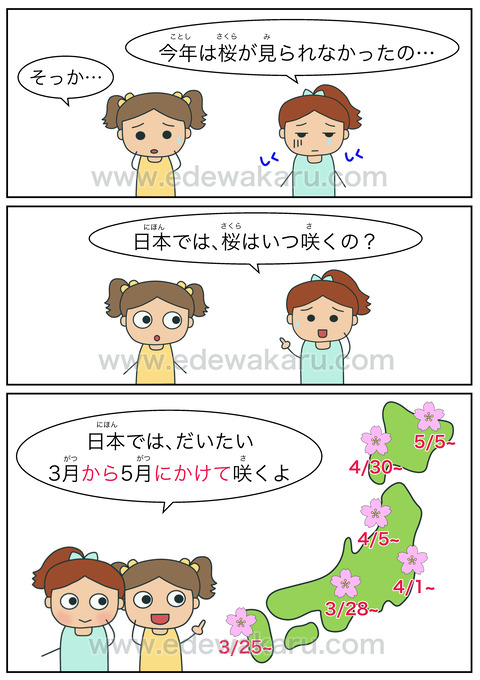
日本では、桜は3月
から
5月
にかけて
咲きます
→3月
から
5月
の間のある時に
咲き
続ける
「〜から〜にかけて」に似ている文型はいくつかありますので、しっかりと区別をして覚えておきましょう😉
【「から」シリーズ】
〜から〜にかけて
〜からする・〜からある・〜からの
〜からといって・〜からって
〜からなる
〜からには
〜てからでないと〜ない
〜てからというもの
In context 6 examples
日本では、桜は3月から5月にかけて咲きます
→日本では、桜は3月から5月の間のある期間に咲きます今日の夜から明日の朝にかけて雨が降るらしい
→今日の夜から明日の朝の間のある時間に雨が降るらしい(復習:〜らしい(推量))台風は、夏から秋にかけて発生しやすい
→台風は、夏から秋の間に発生しやすい(復習:〜やすい)(復習:「〜やすい」と「〜にくい」を使う時の注意)明日は昼から夜にかけて暑くなるそうだよ
→明日は昼から夜までずっと暑くなるそうだよ(復習:〜そうだ(伝聞))うちのお店は、金曜日から週末にかけてお客さんが多くなります
→うちのお店は、金曜日から週末までずっとお客さんが多くなります東京から大阪にかけて強い雨が降るでしょう
→東京から大阪までの間の場所で強い雨が降るでしょう
どんなときどう使う 日本語表現文型辞典
Usage 1
Meaning
so; since
How to use it
〔普通形〕・〔丁寧形〕+から
Explanation
から〈原因・理由〉
はな子:スキーができるからよ。
1)原因、理由を言いたいときに使う。文末には、話す人の意志を表す文(「たい」など)や、働きかけの文(なさい・てください、など)が来ることが多い。
2)依頼や断りを言うときには強く聞こえるので「から」は使わない方がいい。
◆ △辞書を忘れたから、ちょっと見せてくださいませんか。
→○辞書を忘れたんですが、ちょっと見せてくださいませんか。
1)Cause or reason. Often clauses expressing speaker's volition (たい, etc.) or exhortation(なさい, てください, etc.) come at end of sentence.
2)Best not to use から in requests or refusals because sounds too strong.
In context 5 examples
スープが熱いから、気をつけて持っていきなさい。
納豆はきらいですから、食べたくないんです。
ちょっと空気が悪いから、窓を開けてもいいですか。
一郎:どうして冬が好きなの。
この箱、捨てないでね。後で使うから。
Usage 2
Meaning
from; on account of
How to use it
N+から
Explanation
から〈原因〉
~が原因で
「~から、…」の形で、「~が原因で、…の結果となった」と言うときに用いる。
Shows something is a cause of a result.
In context 3 examples
たばこの消し忘れから火事になった。
一瞬の不注意から事故が起こる。運転中に携帯電話を使ってはいけない。
友人の無責任な言葉から、彼女は会社にいられなくなり、辞めてしまった。
Usage 3
Meaning
from…till
How to use it
N+から+Nに+かけて
Explanation
から~にかけて
~から~までの間
1)始まりと終わりがそれほどはっきりしていない範囲を表し、その範囲内で連続的に、または断続的にあることが続いていると言いたいときに使う。「~から~まで」と似ているが「~から~まで」は始まりと終わりがはっきりしていて、その間ずっと同じ状態が続いていることを表す。
2)後の文は1回だけのことではなく、連続的なこと。
◆ × A駅からB駅にかけて、わたしのアパートがあります。
→○A駅からB駅にかけてアパートがたくさん並んでいる。/
× 夜中から明け方にかけて、チンさんが訪ねてきました。
→○夜中から明け方にかけて雨が降りました。
1)Range with a vague beginning and end. Successive state of either continuity or intermittency within a range. Similar to~から~まで, although latter has definite beginning and ending and expresses continuation of certain condition throughout temporal or physical range.
2)Clauses following also indicate continuation rather than one-time discrete events.
In context 4 examples
このスタイルは1970年代から1980年代にかけて流行したものだ。
朝、7時半から8時にかけて、電車がとても込む。
(天気予報)明日は東北から関東にかけて、小雨が降りやすい天気になるでしょう。
(交通情報)首都高速道路は銀座から羽田にかけて、ところどころ渋滞となっております。
日本語NET JLPT文法解説まとめ
Meaning
理由・原因を言う時に使う。
How to use it
文1 + から + 文2
Explanation
"because"
Used to say the reason or cause.
In context 11 examples
今日は息子の誕生日ですから、早く帰ります。
日本の会社で働きたいですから、日本語を勉強しています。
明日はテストがあるから、遊べません。
コーヒーを飲んだから、今は全然眠くないです。
昨日、彼女のプレゼントを買ったから、もうお金がありません。
この問題は難しいですから、私にはわかりません。
牛乳がありませんから、コンビニへ買いに行きます。
野菜が嫌いですから、食べたくないです。
映画が好きですから、よくパソコンで見ています。
この本、面白いから、ぜひ読んでみて。
A:どうして昨日、来なかったの?
毎日のんびり日本語教師
Meaning
②-
How to use it
動詞普通形+から
い形容詞普通形+から
な形容詞語幹+だ/である+から
名詞+だ/である+から
Explanation
3つの用法があります。
①主観的な理由、原因
「頭が痛いから寝ます」のように、「寝る」原因を表します。
「だから」は単独で接続詞として用いることもできます。
②直接的な理由を表さない「から」
お願い、命令、勧誘などの表現を伴うとき、直接的な理由を表しません。
「ここに置いておくから、良かったら使って」など。
③警告、慰め
句末で終助詞的に用いて、相手に対する警告や慰めのニュアンスを出します。
「~から」には格助詞としての用法もあります。格助詞としての用法は以下にまとめてあります。
→「格助詞「から」の用法」
文法
主観的な理由、原因
頭が痛いから寝ます。
直接的な理由を表さないもの
天気が良いから散歩しましょう。
警告、慰め
絶対許さないんだから。
格助詞
範囲の起点
会社から家まで1時間かかる。(从公司到家要花1个小时。)
材料
醤油は大豆から作る。(酱油由大豆制成。)
動作の出どころ
彼から本を貸してもらった。(他借给我了一本书。)
受身文の動作主
両親から心配されている。(父母很担心。)
物事の原因
睡眠不足からくる倦怠感。(睡眠不足引起的倦怠感。)
根拠
このことから彼の無実は証明された。(由此证明了他的无辜。)
Notes
理由、原因の文法
特徴
【N4文法】~から
主観的
【N4文法】~ので/んで
客観的
【N3文法】~ため/ために(為に)
書き言葉的
In context 14 examples
暖かくなってきたから何か運動したい。
眠いから寝ます。(因为困所以睡觉。)
料理できないから毎日外食している。
喉が渇いたから水を飲む。(因为口渴了所以喝水。)
一人で帰るのは寂しいから、友達が来るのを待とう。
飛行機には初めて乗るから緊張する。
明日用事あるから早く寝ないと。
まだ間に合うから急がなくてもいいよ。
ここに置いておくから、必要だったら使ってね。
私がなんとかするから、君はここに居てくれる?
あいつ、絶対許さないんだから。
いつか絶対後悔させてやるからな。(总有一天我会让你后悔的。)
ちょっと待ってて。大好きなケーキ、買ってきてあげるから。
泣かないで、泣かないで。いい子だから。
日本語文型辞典 英語版
Meaning
Nから expresses the starting point, beginning, or origin of various actions and phenomena.
b. NからNまで
When a starting point and endpoint are specified, から expresses a range of distance or time.
c. NからNにいたるまで
This pattern specifies a starting point and an endpoint and expresses that the range between them is large. Has the feel of written language.
こと/ところ から expresses basis or origin. When the origin of a name is expressed, as in
(1)
and
(2)
, ところ is generally used more often. A formal expression used in written language.
Expresses “more than a certain amount,” with the implication that the amount is large. A rather formal expression.
b. 数量詞+からある/からする
Expresses that something is approximately a certain amount, or even more. Usually からある is used for weight, length, or size, and からする is used for price.
1
【から2】[N/Na だから][A/V から]
から attaches to both plain forms and polite forms. It is used to express the speaker’s reason for making a request, order, supposition, intention, or assertion. More subjective than ので.
B:いいから、いいから。それより、はやく手をあらいなさい。
Never mind, that’s all right. Just go and quickly wash your hands.
から is used at the end of a sentence and conveys a sense of warning or comforting. This is a usage that expresses various messages to the listener by implication, without explicit verbalization. The underlined parts in いつかしかえししてやるから、覚えてろ and いいから、早く手を洗いなさい are omitted or inverted. Used in spoken language.
YのはXからだ is the reverse form of XからY, which expresses a reason. In this pattern, から cannot be replaced with ので.
(×)試験に落ちたのは勉強しなかったのでだ。
My not studying was why I failed the exam.
b. ...からだ
B:きのうあんなに飲んだからだよ。
That’s because you drank so much yesterday.
In this form, Yのは is omitted from the pattern YのはXからだ because it is clear from the context.
How to use it
1. Nからa. Nから
2. Nからいうと→
3. Nからが→
4. Nからして→
5. Nからすると→
6. Nからみると→
7. ...こと/...ところ から[N である こと/ところ から][Na である こと/ところ から][Na な こと/ところ から][A/V こと/ところ から]
8. Nにしてからが→
9. 数量詞+からa. 数量詞+からのN
0. V-てから→
1. ...から
2. ...から〈sentence-final usage〉
3. ...からいい→
4. ...からこそ→
5. ...からだa. ...のは...からだ
6. ...からって→
7. ...からといって→
8. ...からには→
In context 35 examples
この町には、国じゅうからたくさんの人があつまってくる。
This town draws many people from all over the country.
あのクラスでは、試験の成績と出席率から成績が決められるそうだよ。
I hear that in that class, grades are determined from the test scores and attendance.
窓からひざしがさしこんでいて、その部屋はとてもあたたかかった。
The room was very warm, with the sunshine streaming in from the windows.
父からはこっぴどくしかられるし、母からはいやみを言われるし、さんざんな失敗だった。
I was severely scolded by my father and spoken to sarcastically by my mother, and it was a terrible failure.
成績不振から解雇されたそのチームの監督はいまテレビの解説者をしている。
The manager of that team, who was dismissed because of a bad record, is now a commentator on television.
日本は衆議院・参議院からなる二院制を取っている。
Japan has a bicameral system comprised of the House of Representatives and the House of Councilors.
ここから目的地までは 10 キロほどあります。
It is about ten kilometers from here to our destination.
10 日から 15 日まで休みます。
This store will be closed from the 10th through the 15th.
子どもから大人まで楽しめる番組です。
Everyone—from children to adults—can enjoy this program.
あの会社はヒラ社員から社長にいたるまで全員が制服を着ている。
In that company, everyone from the president down to ordinary employees wears a uniform.
この番組は、北海道から九州、沖縄に至るまで、全国ネットでお送りしています。
This program is broadcast nationwide, from Hokkaido all the way to Kyushu and Okinawa.
当社は、設計・施工からアフターサービスに至るまで、みなさまの大切な住宅をお世話させていただきます。
Our company is pleased to take care of everything—from the design and construction down to the follow-up care necessary for your homes.
一日の過ごし方から政治思想に至るまで、私があの思想家の影響を受けなかったものはない。
From the way I spend each day down to my political convictions, there is nothing in which I am not influenced by that thinker.
この魚は、ヘビそっくりなところから、ウミヘビという名前をもつ。
The name of this fish is “sea snake,” because it looks just like a snake.
カボチャは、カンボジアからやってきたと言われているところからその名がついたそうだ。
I heard that the name kabocha (squash) is from Cambodia, where squash are said to have come from.
車のバンパーから被害者の衣服の繊維が検出されたことから、その車の所有者にひき逃げの容疑がかかっている。
Because a fiber of the victim’s clothes was detected on the fender, the owner of the car is a suspect in a hit-and-run accident.
その人物が殺害されたことを記録した文書が全く存在しないところから、実はその人物は生き延びて大陸に渡ったのだという伝説が生まれたらしい。
From the absence of any documentation of his murder, the legend arose that he survived and crossed over to the continent.
彼女は父親が中国人であるところから、中国人の知り合いも多い。
Because her father is Chinese, she has many Chinese friends.
その説明会には 1000 人からの人々がつめかけたと言う。
They say that more than a thousand people crowded in for the explanatory meeting.
あの人は 3000 万からの借金をかかえているそうだ。
I hear he has a debt of more than thirty million yen.
その遺跡からは、 20 キロからある金塊が出土した。
A nugget of gold weighing twenty kilograms or more was excavated from those ruins.
自動車産業は好調で 300 万からする車が飛ぶように売れている。
The automobile industry is doing well, and sales of cars priced at three million yen or more are skyrocketing.
その種の陶器は今では貴重で、小皿1枚が 10 万からしている。
That kind of pottery is now highly prized, and a small dish starts at about 100,000 yen.
今日は土曜日だから、銀行は休みですよ。
Because today is Saturday, the bank is closed.
それは私が持ちますから、あれを持って行っていただけますか。
I’ll carry that, so could I ask you to bring that one over there?
星が出ているから、あしたもきっといい天気だろう。
Since the stars are out, the weather should be good tomorrow, too.
この辞書じゃよくわからないから先生に聞こう。
I don’t really understand what this dictionary says, so I’ll ask the teacher.
いつか、しかえししてやるからな。
I’ll get back at you someday!
おとなしく待ってろよ。おみやげ買ってきてやるからな。
Behave yourself while I’m away, and I’ll bring you a present.
A:たまご、買って来るの忘れちゃった。
I forgot to buy eggs.
試験に落ちたのは勉強しなかったからだ。
It was because I didn’t study that I failed the exam.
今日こんなに波が高いのは台風が近づいているからだ。
The surf is high today because there’s a typhoon coming.
君はまだ気がついていないのか。彼女が君につめたいのは、君がいつもからかうようなことを言うからだよ。
Haven’t you caught on yet that she’s cool to you because you’re always teasing her?
試験に落ちたんだってね。勉強しなかったからだよ。
I heard that you failed the exam. It’s because you didn’t study.
A:今日は二日酔いだ。
I have a hangover today.
AIUEO JLPT Grammar
Usage 1
Meaning
「から」is a particle used to explain reasons or causes. In formal contexts,「ので」is more commonly used. Similar to "beacuse ...” in English.
How to use it
動詞+から形容詞+から形容動詞だ+から名詞だ+から
Explanation · 日本語
「から」は、理由や原因を説明するときに使われる助詞です。フォーマルな場合では「ので」のほうがよく使われます。
In context 5 examples
今日は忙しいから、映画を見に行けません。
I can’t go to the movies today because I’m busy.
この商品は高品質だから、おすすめします。
I recommend this product because it is of high quality.
分からないことがあれば、質問してください。理解することが大切ですから。
If you don’t understand something, please ask questions because understanding is important.
お腹が空いたから、何か食べたい。
I want to eat something because I’m hungry.
詳細な情報が必要ですから、教えてください。
Please provide the details because we need detailed information.
Usage 2
Meaning
This sentence pattern is used to express the range from the start to the end of an action, time, place, or sequence.「〜から」indicates the starting point, and「〜まで」indicates the ending point. These can be used independently as well. Similar to "from ... to ...” in English.
Explanation · 日本語
この文型は、始まりと終わりの範囲を示す表現で、時間や場所、順序などを表すときに使われます。「〜から」は開始点、「〜まで」は終了点を示します。これらは単独でも使用することができます。
In context 5 examples
会議は10時から始まります。
The meeting starts at 10 o’clock.
このレポートの提出は明日までです。
This report is due by tomorrow.
夏休みは7月1日から8月31日までです。
Summer vacation is from July 1st to August 31st.
台風は沖縄から九州まで影響を及ぼしました。
The typhoon affected from Okinawa to Kyushu.
この契約は来年の12月まで有効です。
This contract is valid until December next year.
文法
Meaning
理由・原因を言う時に使う。
How to use it
文1 + から + 文2
In context 11 examples
今日は息子の誕生日ですから、早く帰ります。
日本の会社で働きたいですから、日本語を勉強しています。
明日はテストがあるから、遊べません。
コーヒーを飲んだから、今は全然眠くないです。
昨日、彼女のプレゼントを買ったから、もうお金がありません。
この問題は難しいですから、私にはわかりません。
牛乳がありませんから、コンビニへ買いに行きます。
野菜が嫌いですから、食べたくないです。
映画が好きですから、よくパソコンで見ています。
この本、面白いから、ぜひ読んでみて。
A:どうして昨日、来なかったの?
B:ごめん、忙しかったから。
Bunpro Grammar Reference
Usage 1
Meaning
Because, Since
How to use it
Verb + から
[い]Adjective + から
[な]Adjective + だから
Noun + だ + から
Nuance
A semi-casual expression which shows the stem reason for something.
Explanation
から can have several different meanings in Japanese, depending on which part of the sentence it is in, and what comes before/after it. It is often translated as 'because', or 'since'. In these cases, it just means 'Because of (A), (B)'.
昨日、アイスクリームを沢山食べたから、お腹が痛いです。
Since I ate so much ice cream yesterday, my stomach hurts. (From that I ate so much ice cream)
彼女は優しいから、好きです。
Because she is nice, I like her. (From that she is nice)
から may be used with almost any type of word, but when the nuance is 'because', it will require だ before it when following a noun or な-Adjective.
大きい会社だから、人が沢山いる。
Because it is a big company, there are a lot of workers. (From that it is a big company)
スマホは便利だから、人気がある。
Since smartphones are useful, they are popular. (From that they are useful)
Despite having several different nuances, it may be easier to think of から as meaning 'from' in all situations, as that is the base nuance.
From (A as a reason), (B) = Because/Since.
From (A as a location), (B) = From.
Fun Fact
から is a special type of particle in Japanese called a case marking particle. These are particles that describe the relationship that (A) and (B) exist in. We will learn more about these soon!
Nuance · 日本語
何かの原因を示すために使われる、少しカジュアルな表現。
In context 16 examples
- 私は犬が好きですから。
Because I like dogs.
- 彼女は優しいから、好きです。
Because she is nice, I like her. (From that she is nice)
- 大きい会社だから、人が沢山いる。
Because it is a big company, there are a lot of workers. (From that it is a big company)
- 昨日、アイスクリームを沢山食べたから、お腹が痛いです。
Since I ate so much ice cream yesterday, my stomach hurts. (From that I ate so much ice cream)
- スマホは便利だから、人気がある。
Since smartphones are useful, they are popular. (From that they are useful)
- お菓子だから、甘い。
Because it is candy, it is sweet.
- 辛いから、カレーが好き。
Because it's spicy, I like curry.
- 楽しいから、スポーツを見る。
Because it is fun, I watch sports.
- 学生がいるから、学校があるだろう。
Because there are students, there is a school, right?
- スポーツをしたから、暑いです。
Because I played sports, I am hot.
- 冬だから、寒いんです。
Because it is winter, it is cold.
- 自転車で行くから、遅いでしょう。
Because you go by bicycle, you will be late, right?
- このケーキは美味しいから、食べています。
Because this cake is delicious, I am eating it.
- 歌うのが好きだから、カラオケに行きます。
Because I like singing, I go to karaoke.
- 私は毎日勉強したから、昨日のテストは簡単でした。
Because I studied every day, yesterday's test was easy.
- 明日は月曜日だから、仕事に行く。
Because tomorrow is Monday, I will go to work.
Usage 2
Meaning
From
How to use it
Starting Point + から
Nuance
A common expression which shows the origin of an action.
Explanation
から can have several different meanings in Japanese, depending on which part of the sentence it is in, and what comes before/after it. It is often translated as 'from'. In these cases, it just means 'with (A) as a starting location, (B)'. In this grammar construction, から comes directly after the place that is considered the starting point.
彼女はモロッコから来ました。
She came from Morocco.
空港から車で来ました。
I came from the airport by car.
This form of から is the closest to the 'base' meaning of the word in Japanese, as the nuance of から can almost always be thought of as meaning 'from' in some way.
Caution
This form of から does not require だ when used after nouns or な-Adjectives, as that would change the meaning to 'because'.
Nuance · 日本語
ある動作の原点を示す一般的な表現。
In context 14 examples
- 駅からバスで来た。
I came from the station by bus.
- 彼女はモロッコから来ました。
She came from Morocco.
- 空港から車で来ました。
I came from the airport by car.
- アメリカから来ました。
I came from America.
- この靴はお母さんからです。
These shoes are from my mom.
- 学校から、パーティに行く。
To go to the party from school.
- 仕事から帰る。
To return home from work.
- 2時から始まります。
It starts from two o'clock.
- 部屋から出た。
They left from the room.
- レストランから帰った。
To have returned from the restaurant.
- 友達の家から、買い物に行く。
To go shopping from a friend's house.
- 西からの風。
A wind from the west.
- 東京から、京都へ行く。
To go from Tokyo to Kyoto.
- この服は、友達から借りた。
I borrowed these clothes from a friend.
Yokubi — The Common Grammar Guide (https://yoku.bi)
Usage 1
Explanation
から is not just the case particle "from". It also shows up as a conjunction, used to connect two sentences, where the thing after から is the outcome or result of the thing before から.
You can differentiate the conjuction から from the case particle から because the particle only comes after nouns and the conjunction after completed clauses. This means to attach the "because of" から to nouns and な adjectives, you must add だ (or です). It also can go directly after verbs and い adjectives (which the particle から cannot do).
A(だ)からB roughly means "It is B, because of A".
から can come at the beginning of a sentence in the form of だから. In this usage it can either be emphasis, or give an explanation for a previous statement.
ので acts like から. After nouns and な adjectives it becomes なので or ですので.
There are some nuance differences between から and ので but the gist is that から sounds more like a subjective opinion and ので feels more objective. For this reason, in polite contexts から can come across as pushy and ので is often preferred.
で can be used as a conjunction similar to "so". It establishes a weak cause \-\> effect relationship. で goes after nouns and な adjectives. For verbs and い adjectives they get conjugated in て form to achieve the same result.
This usage of で can also show up at the beginning of a statement to continue a previous statement, sometimes as それで:
そして is an interjection that essentially gives a sense of finality as the last element in a list of sequential statements (like "and in the end...") or a conclusive reason ("and so..."). It can sound formal.
In context 4 examples
暑いからプールに行きたいです
It's hot, so I want to go to the pool
みんないい人だから、きっと気にいる
They are all good people, so I'm sure you'll like them.
だから、そんなこと言わないでください。
I'm telling you, please don't say that!
それで、これからどうするの?
So, what are you going to do next?
Usage 2
Explanation
These particles mainly deal with location. から indicates the starting point of an action, and へ and に indicate the ending point or direction of an action.
から is the same general "from" you see in English, even when it is abstract.
The English translation doesn't even have any marking all the nouns. Particles make things easier, at least for a language learner.
The subject can be dropped in Japanese if it's understood or not important. A lot of example sentences will have a lack of a clear pronoun, so our translations will just add a random one for the sake of making them readable. Remember that just because an example translation may say "he" instead of "she" it doesn't mean that it is clear in Japanese.
へ translates well as "to" or "toward" in most situations, including abstract ones. In the previous example it also works as "on". Translations can be fairly loose.
In many sentences, へ and に can be interchangeable with very minimal difference in meaning. へ can sometimes sound a bit more formal or literary.
に can mark a location of existence or target of direction. The latter use overlaps with へ a little, but へ cares more about motion and "towardsness", and に cares more about the end objective. It can also mark a point in time when an action takes place.
Be aware that these are all loose rules. In reality, the kind of particle that is the most appropriate to use depends on the specific verb used in the sentence. General rules or explanations can help you remember these situations, but the only real way to know for sure is through experience. You'll have to remember which verb goes with which particle as it often will feel rather arbitrary.
に also has many other uses that don't mark location, direction, or time. It can act as an indirect object or target of an action. An indirect object is something relevant to or affected by a verb, but not part of the verb's core meaning
Sometimes に can also replace direct objects in verbs that are considered transitive in English, but not in Japanese.
All the particles in this lesson can be used in many other ways too. You should learn them as you come across them as we won't list all of them.
This is a good time to take notice that particles can attach to phrases as well, not just words. This applies to every particle we've learned so far.
Here から attaches to 私の家 which can be considered a single phrase ("my house").
In context 2 examples
誰かが外から俺の部屋へノックをした。
Someone knocked on my door from outside.
私の家から来る
It comes from my house
NINJAL 日本語文型データベース
Usage 1
Meaning
[1] 物事の原因・理由・根拠を表します。
「(〜のは)〜からだ。」の形でも使います。
話し言葉では、後の文のない「〜から。」の形で使うこともあります。
[2] 依頼・命令・勧誘・要望などの文で、その実行を可能にしたり、促したりするような条件や譲歩を言うときに使います。
話し言葉では、後の文のない「〜から。」の形で使うこともあります。
[3] 〜が発端・原因で、ある状態になると言いたいとき、また、〜を根拠に、ある判断・決定をすると言いたいときに使います。
How to use it
V普通形+から・V丁寧形+から
i-A普通形+から・i-A丁寧形+から
na-A普通形+から・na-A丁寧形+から
N普通形+から・N丁寧形+から
Nから
Notes
[3] 「〜から」の後には、話し手の希望・意向を表す文や相手への働きかけの文はきません。
In context 43 examples
仕事でよくカメラを使うから、もっと性能がいいのがほしい。
このラーメン屋は行列ができているから、人気があるのだろう。
「あーあ。どうしてピアノがなかなか上手にならないのかなあ」「練習しないから上手にならないんだよ」
彼は不快そうな顔をしていた。多分、僕が失礼なことを言ったからだろう。
子どもは興味のあることならあっという間に覚えてしまうから驚くなあ。
「どうして遅れたの?」「目覚ましが鳴らなかったから」
前回は出席できませんでしたから、今回は必ずミーティングに出ようと思います。
「冷房、切ろうか」「暑いから切らないで」
台風が来るらしいから、家の周りを点検しておこう。
危ないですから工事現場に近寄らないでください。
「今日は天気がよくないから、川遊びはやめたほうがいいよね」
「あれ、朝、コーヒーだけ?」「うん、今朝はあんまり食べたくないから」
アルバイトを休んだのは体の具合が悪かったからだ。行きたくなかったからではない。
このスキャナーの使い方は簡単ですからすぐ覚えられますよ。
「ここにあるごみ、分別しないと出せないね」「あ、分別はそれほど面倒じゃないから私がやります」
階段を上るのは大変だから、エレベーターで行こう。
「あなたたち、ここで大声を出すのはやめなさい。周りの人に迷惑だから」
先生の質問に返事をしなかったのは、先生の聞き方が嫌だったからだ。
私は昔テレビに出ていたんですが、あまり有名じゃなかったから覚えている人は少ないと思います。
図書館の大切な本ですから、ページを折らないでください。
「そのお店って、駅前の道をまっすぐ行けばいいの? わかるかな」「大きい看板が出ているお店だからすぐわかると思うよ」
「僕は科学者じゃないから、宇宙がどんな形をしているかなんて難しいことわからないよ」
「ママ、今日どこかのおばさんに『名前は?』って聞かれたんだけど、知らない人だったから答えなかったよ」
今ではこの町にも会社が増えましたが、昔は大きい町ではありませんでしたから、就職口も少なかったんです。
「私はちょっと出かけてくるから、あとはよろしく」
「この原稿を読み上げますから、入力が正しいかどうかチェックしてもらえますか」
「早くトイレに行ってきて。ここで待っているから」
「お伝えしたいことがあります。何時でも構いませんから、お電話くださいませんか」
子「えーん。お兄ちゃんが僕のお菓子を取ったー」父「わかったから、もう泣くな。お父さんが別のお菓子を買ってやるから」
「部屋のクーラーつけておきましたから、どうぞごゆっくり」「ありがとうございます」
「おなかがすいたよ。何でもいいから食べるものない?」
「終電が出てしまいますよ! ここの片付けはいいですから、急いで!」
明日の役員会の集まりは、少し遅れても大丈夫ですから、必ず来てください。
「ちゃんと時間守ってよ。遅刻したらだめだからね」
先生「今日の講義について、どんなことでも結構ですから、コメントを書いて提出してください」
「お借りしたお金、必ずお返しします。お願いですからもう少し待ってください」
「ユミちゃん、いい子だから、もうお休みね」
「遠慮しないで。これ、私のほんの気持ちだから、どうぞ」
小さな書類上のミスからトラブルに発展し、大きな損失が出た。
目の疲れから、首や肩のこり、頭痛など体の不調が起こることがある。
食に対する問題意識の芽生えから、会社勤めを辞めて農業を志すことにした。
Aさんは、子どものころいじめにあった経験から、人と接することが怖くなったのだという。
アンケートの結果から、近年災害に対する人々の不安が高まっていることがわかった。
Usage 2
Meaning
[1] ある状態や継続的な動作・出来事の時間的な起点を表すときに使います。
終点を「~まで」で示すことがあります。
[2] ある空間的範囲の起点や動作・出来事の空間的起点を表します。
終点を「~まで・〜に・〜へ」で示すことがあります。
[3] ある範囲の起点を表します。
終点を「~まで」で示すことがあります。
[4] ある変化の起点を表します。
終点を「~に」で示すことが多いです。
How to use it
Nから
Notes
[1] 「〜」には、時間を表す言葉がきます。「〜から」の後には、状態や動作・出来事の継続のほか、変化、時間の経過を表す文もきます。
In context 23 examples
弟は朝からずっと部屋でゲームをしている。
うちの子は1歳から3歳ごろまでずっとこのおもちゃで遊んでいました。
私の夏休みは8月下旬から9月中旬までです。
来日から5年たった。今では日本語にも不自由しない。
あの人は昔からの友人で、何でも話し合える人なんです。
宇宙を飛びたいという子どものころからの夢を今も見続けている。
「いつごろからこの町に住んでいるんですか」「10年前からです」
今年のマラソン大会は、校門前からスタートします。
駅前から公園までずっと桜並木です。春は本当にきれいです。
1階から事務所のある5階まで、私はエレベーターを使わないで歩いて上る。
車がないので、この荷物を家からイベント会場に運ぶのは大変だ。
ボートは川上から川下へゆっくりと下っていった。
大きい家だなあ。門から玄関までの距離も40メートルぐらいありそうだ。
あの人は、コートから靴下まで、全部このブランドでそろえている。
この俳優は20代から40代ぐらいの女性に人気があるようだ。
購入から設定まで、パソコンのことなら何でもご相談ください。
昔勉強した英語はすっかり忘れてしまった。基礎からもう一度やり直したほうがいいかもしれない。
そろそろ就職活動の準備をしなければならないが、何から始めたらいいのだろうか。
消費税が5%から8%に上がったのは、2014年のことだった。
多くの物質は、温度が上がると、個体から液体に、液体から気体に変わる。
息子の身長は140㎝から148cmになっていた。1年で8㎝も伸びている。
「ここ、本屋さんからパン屋さんに変わったんだよ」「本屋さん、なくなっちゃったんだ。残念」
木曜日のピアノのレッスンの開始時間は、5時から5時半に変更になりました。
IMABI
The Starting Point Marker から
Read this IMABI lesson ↗Explanation
The Starting Point Marker から
In this lesson, we will learn about the case particle から and how it marks starting points, translating as “from” into English.
The Starting Point Marker から
起点を表す「から」
The primary usage of the case particle から is to mark a starting point in all sorts of capacities. For starters, we will examine sentences in which it denotes the “starting point” in the following environments. While this list is not all inclusive, you will quickly see just how versatile から is just like its English equivalent “from.”
Place of Departure
Starting Point in Time/Space
In Order Of/Starting With…
Starting Direction
Starting Price
Starting Point of a Range
Starting State Before Change
Starting Materials → Means
In most of these environments, から can be safely translated as “from,” but there are times in which other prepositions such as “at” may be more appropriate, particularly when denoting a starting point in time without mentioning the corresponding end point in time.
Place of DeparturE (Spatial Starting Point)
To simplify things, starting points in space (location) marked by から will be denoted by the letter E. This starting point (E) can represent several interrelated things: a place of departure, a starting point in time, a starting direction, and even the source of a phenomenon. In the following examples, notice also what other complements (elements) of the sentence appear.
Sentence Structure: Eから[V = Intransitive Verb]
1. 上野駅から電車で向かいます。
I’m heading (there) by train from Ueno Station.
2. うちの猫がソファの下から出てきた。
My cat came out from under the sofa.
Sentence Structure: E1から(E2に・へ)[V=Intransitive Verb]
Whether E2 is stated or not, から marks the starting point for intransitive verbs which pertain to moving between to points in space.
3. 太陽は東から昇のぼります。
The sun rises in1 the east.
4. 壁と床の隙間から水が漏れている。
Water is leaking from cracks in the walls and floor.
5. ヨーロッパからブラジルへ船で行きました。
I went to Brazil from Europe by boat.
6. ここから先立入禁止!
Literally: Entry forbidden from this point onward!
Do not enter.
Sentence Structure: Eから・を[V = Intransitive Verb]
When the intransitive verb predicate paired with から pertains to the grammatical subject separated/separating from a locale, there is interchangeability between から and the transition marker を (see below). First off, we will see how から is used in this sense to denote that the subject is removed from location E.
7. 震源しんげんは仙台せんだいから数キロ離はなれています。
The epicenter is a couple kilometers from Sendai.
8. ロバから降りました。
I got off the donkey.
9. ロンドンのヒースロー空港へ向けて成田から発ちました。
We left from Narita headed to London’s Heathrow Airport.
Sentence Structure: Eから[V = Intransitive Verb]
In this sentence structure, E (location) happens to be the direction from which the intransitive predicate occurs. These predicates are non-volitional, which means the speaker, nor the subject in question, has any control over the phenomenon occurring, even if they are still involved (Exs. 11-12).
10. 初日の出が水平線から現れた。
The first sunrise of the year appeared over2 the horizon.
11. ここから子供たちの様子が見えます。
I can see how the children are doing from here.
12. 踏切の音が外から聞こえます。
I can hear the sound of the railroad crossing (from) outside.
Sentence Structure: E1から(E2まで)V
In a broader context, the exact opposite of the starting point marker から is the particle まで, which is the “to/until” in the pattern “from E1 to E2.” For this far broader sentence structure, all sorts of verbal predicates (intransitive, transitive, copular, even adjectival) can be conceptualized as having an effect which covers a range. First, we will look at ranges which pertain to distance, but in reality, the two points of said range are not limited to distance, as we will see next.
13. この川からあの山まで走れ!
Run from this river to the mountain over there!
14. 東京から大阪まで何キロですか?
How many kilometers is it from Tokyo to Osaka?
15. 10ページから35ページまで読んできてください。
Please come having read from Pgs. 10-35.
16. 一階から最上階までゆったり見て回りました。
I took my time looking around from the first to the top floor.
sTARTING pOINT OF Any rANGE (E1~E2 = Points in Time/sEQUENCE/oRDER…)
Now that we have seen から used to indicate the start of a range between two locations, it is now time to look at examples in which E1 and E2 are not necessarily locations. The reference points could pertain to things, time periods, rank, etc.
Sentence Structure: E1から(E2まで)V
17. 社殿からホース格納箱までが新しくなっていました。
(Everything), from the shrine building(s) to the hose storage box(es) had been renovated.
18. その記事きじを隅すみから隅まで読みました。
I read that article from beginning to the end.
19. 二歳にさいから六歳ろくさいまでの子供こどもがいました。
There were children from two to six years old.
20. カナダは紫外線が強いので日焼け止めは必須で、準備ができた子供から3順番に外に出ていきます。
The UV rays are strong in Canada, so sunscreen is essential; children who are ready go outside in orderly fashion.
21. カバンの値段は1万円からです。
Bags start at 10,000 yen.
22. 市場は午前10時から午後10まで開いています。
The market is open from 10 AM to 10 PM.
23. 来年から開始かいしします。
We will start4 next year.
24. きょうからお仲間だ!
We’re buds starting today!
25. 端直美さんはアルバイトのウェイトレスから支配人しはいにんになりました。
Naomi Hashi went from being a part-time waitress to being the manager.
26. ハーバート・フーヴァーは商務長官しょうむちょうかんから大統領だいとうりょうになりました。
Herbert Hoover went from being the Secretary of Commerce to being the president.
27. シェパードは子犬から育そだてて躾けるのは大変ですか。
Is raising and training a (German) shepherd from a puppy difficult?
While we have already seen instances in which the translation “from” does not necessarily match up well with から, “from” is usually not the correct translation for it when only the first part of a temporal range is stated. In this situation, “at” or “since” may be more appropriate.
28. 日本語の授業じゅぎょうは朝9時から始まります。
Japanese class begins at 9 o’clock in the morning.
29. 会議かいぎは3時から始まります。
The meeting will begin at 3 o’ clock.
30. 生後間せいごまもなく5から 、赤ちゃんは泣くことで「気持ちわるい!」「お腹すいた!」と知らせてくれます。
Not long after birth birth, babies will cry to let (us) know, “I don’t feel well,” “I’m hungry!”
Starting State
Much like changing rank, starting as one thing then becoming another involves an initial (starting) state, which is marked by から. This original point may not always be accompanied with “from” when translating the sentence back into English, but the idea behind から is the same as we have seen.
31. 水から氷に姿が変わる間、水の温度は〇℃のまま変わらない。
While water is turning into ice, the temperature of the water remains constant at 0℃.
32. 土曜日の天気予報が曇りから雨に変わりました。
Saturday’s weather forecast changed from “cloudy” to “rain.”
33. 子供から社会人になっても人を見下して馬鹿にする人が必ずいました。
Even as I went from being a child to a working adult, there were always people who looked down and made fun of others.
34. オタマジャクシからカエルに成長したのですが、一日で死んでしまいました。
It grew from a tadpole to a frog, but it ended up dying in a day.
Starting Materials → Means
The case particle から may even represent “from” as in marking the means of establishing something. This broad understanding of “establishment” can be pragmatically applied to making things, what something consists of, etc. Common verbs that this usage is seen with include 作る (to make) and 成る (to be made up of).
35a. スパゲッティは小麦粉から作られます。
Spaghetti is made from flour.
36. ピザを生地から作りました。
I made pizza from scratch (dough).
37. 日本は北海道、本州、九州、四国という4つの大きい島からなっています。
Japan consists of four large islands Hokkaido, Honshu, Kyushu, and Shikoku.
This usage of the case particle から is interchangeable6 with the case particle で for indicating method, but the emphasis placed on the role of the noun(s) involved differs between the two, with から focusing on “from” which something comes about, whereas で marks the noun(s) as the instruments/tools used to bring about the result.
38. 一般的に、パンは小麦粉{から・で}出来ています。
Generally, bread is made [from/of] flour.
Source of…
Much like how we saw in Exs. 10-12, the case particle から may indicate from where a phenomenon can be perceived. In reality, this logic can be extended to various other predicates. Three important sentence structures which we have yet to see include:
B (agent) から + A (subject) + V [Intransitive Verb]
B (agent) から・に + A (subject) + V [Transitive Verb (Giving Verb)]
Indirect Object から + Direct Object を + V [Transitive Verb]
※As is still the general rule in Japanese grammar, while the predicate of the main clause inevitably appears at the end of the sentence, the other complements (elements) of the sentence may float around depending on their perceived importance to the speaker.
Sentence Structure: B (agent) から + A (subject) + V [Intransitive Verb]
When an agent (B) extends an action that affects the listener (subject = A), we see that から is used to mark the agent as the source from which said extension occurs.
A very practical application of this logic is describing the origin of phone calls.
39. 鈴木さんから電話です。
(Incoming) call from Suzuki-san.
40. 注文していない商品が中国から届きました。
Merchandise I hadn’t even ordered arrived from China.
41. 全く身に覚えのない携帯番号から電話がかかりました。
I got a call from a mobile number I have no recollection of whatsoever.
Sentence Structure: B (agent) から・に + A (subject) + V [Transitive Verb (Giving Verb)]
In this sentence structure, the transitive verb serving as the predicate indicates that something, whether it be a physical item, information, etc., can be perceived as being transferred to another person. When emphasizing that the agent is the ultimate source of that transfer, the case particle から is chosen.
42. その話は先生から聞きました。
I heard about that from (our) teacher.
However, the typical indirect object=agent marker in a transitive sentence in Japanese grammar is the case particle に. This results in interchangeability between the two particles in this context. Typically, unless emphasis is intended on the “source” of the matter, に is preferred. This becomes problematic with the verb for “to receive” in Japanese, as in English, “from” is the go-to preposition, which imposes emphasis on who the giver is upon receiving something.
43. 彼氏{から・に}プレゼントをもらった。
I received a gift from my boyfriend.
Various factors affect which particle is ultimately most natural in this environment, and so we will revisit the topic later.
Source = Cause/Judgment Calls
Another application of the case particle から is indicating the “source” (cause) of some result or judgment call. In this sense, から may translate as “from” or “due to.”
44. 不注意ふちゅういからくる失敗は責任が大きい。
You are greatly responsible for failure from carelessness.
45. 仕事に対しての責任感から辞職できない人もいます。
There are also people who can’t resign due to a sense of responsibility toward their job.
Departure: を vs から
Earlier in this lesson, we learned that there is interchangeability between the case particles から and を with intransitive verb predicates which pertain to the agent separating themselves from a locale E.
The angle from which we will view their interchangeability in this lesson will be based on the notion that から expresses the speaker’s consciousness of the agent being physically removed from the locale, whereas を expresses the speaker’s consciousness of the locale being the point of departure in the process of transitioning elsewhere.
First, let’s look at a sentence in which only から is the appropriate particle.
46. そんな友達とはこちら{から 〇・を X}手を切りましょう。
Be the one to cut ties with that sort of friend from your end.
Here, the agent, represented by the pronoun こちら, also stands for the locale of the separation involved; once the tie between the friend is severed from “your” end, that physical removal is palpable.
Now, let’s look at a sentence in which only を is the appropriate particle.
47. 最近はどこの焼肉店も和牛{を 〇・から X}敬遠していますね。
Recently, all yakiniku restaurants are avoiding Wagyu beef.
The verb 敬遠する can be literally translated as “to respect x while in fact staying distant). As the object is not quite a starting point of separation for the agent, and because the agent is not necessarily even physically removed from the object, から is not the appropriate particle.
Now, let’s look at some sentences in which を・から are more or less interchangeable.
48. 先ほど羽田空港{を・から}発ちました。
I departed (from) Haneda Airport shortly ago.
49. スペイン留学以来、兄はしばらく家族{を・から }離れて暮らしていました。
Since studying abroad in Spain, my older brother has been living away from our family for a while.
In Ex. 48, the use of から indicates that the agent’s departure on a journey began at the airport, while the use of を simply indicates the airport as a point of departure. In this circumstance, the nuancing is negligible. Meanwhile, in Ex. 49, what is meant by “family” can have a significant effect on the emotional take from the sentence. By using から, the physical distance separating the family from the brother is heightened, but by using を, the image of “family” becomes abstract and loaded with emotion as an effect, as the separation is felt as a consequence of “leaving the family” being a transition point in the brother’s life.
In English, the preposition “in” is used instead of “from” because the sun is not moving. Conversely, in Japanese, because the sun is not actually moving toward another point in space, the case particle に cannot be used. Thus, から marks the point from where the action of “rising” originates, just like how “in” is being used in the English in this context. ↩︎
In English, the sun is “over” the horizon at any point beyond where the earth and the sky meet, but as for the Japanese phrasing, から focuses on the phenomenon starting “from” that point. ↩︎
Of the students in the class, they go outside in the order of who has finished putting on their sunscreen, and that sequence is marked by から. ↩︎
In English, “from” does not have to accompany the verb “to start” when it is followed by the starting period of time, but the same cannot be said for Japanese, which requires that the starting point in time be marked by から. ↩︎
So far, all instances of the case particle から have been after nouns, and in Ex. 30, we see that it is after the phrase 間もなく (shortly after), but in this context, it behaves as an adverbial noun, thus not violating the need for the case particle から to appear after a noun. ↩︎
While largely interchangeable, certain predicates may exhibit their own restrictions. For instance, 成る (to be made up of) is only used with から, while 出来る (to be made/formed), may be paired with either から or で. ↩︎
In context 49 examples
上野駅から電車で向かいます。
I’m heading (there) by train from Ueno Station.
うちの猫がソファの下から出てきた。
My cat came out from under the sofa.
太陽は東から昇のぼります。
The sun rises in1 the east.
壁と床の隙間から水が漏れている。
Water is leaking from cracks in the walls and floor.
ヨーロッパからブラジルへ船で行きました。
I went to Brazil from Europe by boat.
ここから先立入禁止!
Literally: Entry forbidden from this point onward!
震源しんげんは仙台せんだいから数キロ離はなれています。
The epicenter is a couple kilometers from Sendai.
ロバから降りました。
I got off the donkey.
ロンドンのヒースロー空港へ向けて成田から発ちました。
We left from Narita headed to London’s Heathrow Airport.
初日の出が水平線から現れた。
The first sunrise of the year appeared over2 the horizon.
ここから子供たちの様子が見えます。
I can see how the children are doing from here.
踏切の音が外から聞こえます。
I can hear the sound of the railroad crossing (from) outside.
この川からあの山まで走れ!
Run from this river to the mountain over there!
東京から大阪まで何キロですか?
How many kilometers is it from Tokyo to Osaka?
10ページから35ページまで読んできてください。
Please come having read from Pgs. 10-35.
一階から最上階までゆったり見て回りました。
I took my time looking around from the first to the top floor.
社殿からホース格納箱までが新しくなっていました。
(Everything), from the shrine building(s) to the hose storage box(es) had been renovated.
その記事きじを隅すみから隅まで読みました。
I read that article from beginning to the end.
二歳にさいから六歳ろくさいまでの子供こどもがいました。
There were children from two to six years old.
カナダは紫外線が強いので日焼け止めは必須で、準備ができた子供から3順番に外に出ていきます。
The UV rays are strong in Canada, so sunscreen is essential; children who are ready go outside in orderly fashion.
カバンの値段は1万円からです。
Bags start at 10,000 yen.
市場は午前10時から午後10まで開いています。
The market is open from 10 AM to 10 PM.
来年から開始かいしします。
We will start4 next year.
きょうからお仲間だ!
We’re buds starting today!
端直美さんはアルバイトのウェイトレスから支配人しはいにんになりました。
Naomi Hashi went from being a part-time waitress to being the manager.
ハーバート・フーヴァーは商務長官しょうむちょうかんから大統領だいとうりょうになりました。
Herbert Hoover went from being the Secretary of Commerce to being the president.
シェパードは子犬から育そだてて躾けるのは大変ですか。
Is raising and training a (German) shepherd from a puppy difficult?
日本語の授業じゅぎょうは朝9時から始まります。
Japanese class begins at 9 o’clock in the morning.
会議かいぎは3時から始まります。
The meeting will begin at 3 o’ clock.
生後間せいごまもなく5から 、赤ちゃんは泣くことで「気持ちわるい!」「お腹すいた!」と知らせてくれます。
Not long after birth birth, babies will cry to let (us) know, “I don’t feel well,” “I’m hungry!”
水から氷に姿が変わる間、水の温度は〇℃のまま変わらない。
While water is turning into ice, the temperature of the water remains constant at 0℃.
土曜日の天気予報が曇りから雨に変わりました。
Saturday’s weather forecast changed from “cloudy” to “rain.”
子供から社会人になっても人を見下して馬鹿にする人が必ずいました。
Even as I went from being a child to a working adult, there were always people who looked down and made fun of others.
オタマジャクシからカエルに成長したのですが、一日で死んでしまいました。
It grew from a tadpole to a frog, but it ended up dying in a day.
スパゲッティは小麦粉から作られます。
Spaghetti is made from flour.
ピザを生地から作りました。
I made pizza from scratch (dough).
日本は北海道、本州、九州、四国という4つの大きい島からなっています。
Japan consists of four large islands Hokkaido, Honshu, Kyushu, and Shikoku.
一般的に、パンは小麦粉{から・で}出来ています。
Generally, bread is made [from/of] flour.
鈴木さんから電話です。
(Incoming) call from Suzuki-san.
注文していない商品が中国から届きました。
Merchandise I hadn’t even ordered arrived from China.
全く身に覚えのない携帯番号から電話がかかりました。
I got a call from a mobile number I have no recollection of whatsoever.
その話は先生から聞きました。
I heard about that from (our) teacher.
彼氏{から・に}プレゼントをもらった。
I received a gift from my boyfriend.
不注意ふちゅういからくる失敗は責任が大きい。
You are greatly responsible for failure from carelessness.
仕事に対しての責任感から辞職できない人もいます。
There are also people who can’t resign due to a sense of responsibility toward their job.
そんな友達とはこちら{から 〇・を X}手を切りましょう。
Be the one to cut ties with that sort of friend from your end.
最近はどこの焼肉店も和牛{を 〇・から X}敬遠していますね。
Recently, all yakiniku restaurants are avoiding Wagyu beef.
先ほど羽田空港{を・から}発ちました。
I departed (from) Haneda Airport shortly ago.
スペイン留学以来、兄はしばらく家族{を・から }離れて暮らしていました。
Since studying abroad in Spain, my older brother has been living away from our family for a while.
The Conjunctive Particles から & ので
Read this IMABI lesson ↗Explanation
The Conjunctive Particles から & ので
※改訂中
Both the conjunctive particle から and the conjunctive particle ので are used to indicate reason (理由). The basic sentence structure which both particles share is as follows:
Clause One (Dependent Clause = The Condition) + {から・ので}Clause Two (Indicate Clause = The Result/Effect of Said Condition)
As a simple example in which both particles are possible to demonstrate this point, consider the following:
i. きょうは寒い{から・ので}、窓を閉めた。
Since it’s cold today, I closed the window.
Traditionally, the conjunctive particles から and ので are both introduced early to students, with the former taught as indicating “subjective” reasoning and the latter taught as indicating “objective” reasoning.
しばらく雨が降らないので、ほこりがひどくなっている。
雨が降るから、やめた。
The Conjunctive Particle から
Of the two particles showcased in this lesson, the conjunctive particle から is more versatile syntactically and in the kinds of that it can create.
Before delving into the semantics, we will need to know how から connects to the various predicates in Japanese. The conjunctive particle から follows the 終止形, and even when combined with nominal and adjectival-noun predicates, the copula must intervene in its 終止形 to allow for the connection. Because politeness can also be marked in Clause One marked by から, the chart below will illustrate how it connects to the various predicate types in plain speech and polite speech respectively.
Predicate TypePlain Speech
終止形+~からPolite Speech
終止形+~から
Nominal (名詞)人だから人ですから
Adjectival (形容詞)赤いから赤いですから
Adjectival Noun (形容動詞)簡単だから簡単ですから
Verbal (動詞)するからしますから
The kinds of conditions and the implications=reasonings which may follow when utilizing the conjunctive particle から are both quite varied, but it is safe to say that the English words “because” and “since” serve as proper translations for it.
First, we will look at the various relations that can be established with から when found in sentence-medial position.
①Affirmation ⇒ Affirmation
②Affirmation ⇒ Request
③Desire ⇒ Desire
④Affirmation ⇒ Volitional Statement
⑤Affirmation ⇒ Course of Action
⑥Supposition ⇒ Suggestion
A common theme that defines the conjunctive particle から in all these environments is the presumption that the conditional clause which it marks has been derived subjectively by the speaker. Even if the reasoning is ultimately not substantiated in the context that follows, the use of から itself would not be viewed ungrammatical or unwarranted.
①Affirmation ⇒ Affirmation
Affirmation (断定) can be defined as a definitive judgment on some matter. When applied to “because” statements made with the conjunctive particle から, the point being expressed is that “because X” is the case, Y is the case.
日が長いから、助かる。
②Affirmation ⇒ Request
Of course, the “Y” clause which follows an affirmative X clause need not be limited to another affirmative statement. It may be the case that X necessitates that a request (Y) be done by the listener. Sentences following this pattern also need not be overly complicated. In fact, they can be as easy as “because (of) X, please do Y.” Now, as the use of the word “necessitates” implies, clause X can be worded to explicitly mention “must/have to.” So as not to showcase too much grammar not yet formally introduced, however, only one such example will be shown (Ex. ).
わたしもすぐ行きますから、ちょっと待っていてください。
③Desire ⇒ Desire
So far, we have seen X pertain to affirmative statements and Y pertain to both affirmative statements and requests. Of course, requests are definitively affirmed by the speaker, indicating how different facets of grammar are so intricately related to each other.
Building on the notion of how different applications are so closely tied to one another, expressing desire takes us one step further on what is meant by a request as well as on what can be defined as the speaker’s affirmation.
When the speaker wishes to do something (X) and that desire/wish constitutes the reason for why they would like the speaker to do something (Y), we see that the resulting statement is a less direct means of telling the speaker what to do – but from the point of the speaker’s wishes.
早く帰りたいから、急いでもらいたい。
④Affirmation ⇒ Volitional Statement
Volition in grammar pertains to all the ways one can indicate whether the agent (doer) of an action is consciously and/or willingly performing the action. Phrasing in Japanese is very sensitive to this factor, with verbs and grammar points alike possessing default levels of volition (0~100%).
Similarly to how “will” and “shall” both indicate intent of action but differ minutely in implications (degree of volition), the choice between using the non-past form or a volitional form creates similar differences. To simplify things, we will only look at the polite volitional form ending ~ましょう in relation to statements made with から.
First, consider the following.
きょうは寒いから、窓を閉めました。
きょうは寒いから、窓を閉めましょう。
In both examples, the speaker is the agent of shutting the window(s) in question. In Ex. a, the speaker=agent has performed the action (⑤Affirmation ⇒ Course of Action), whereas in Ex. b the agent is stating either that they shall perform the action or calling themselves and those listening to action, with that subtle difference left to intonation and body language cues (←footnote?).
By using X ~から Y ~ましょう, the speaker expresses both the reason for the action (Y) and their clear intent to do Y. The ending ~ましょう may be translated into English as “will/shall” or “let’s” depending on whether it is just the speaker or the speaker and listener(s) will be the one(s) performing Y.
⑤今日は寒いから、窓を閉めた。
⑥すぐ来るでしょうから、しばらくお待ちになっては?
Inversion
Tense
===============
<Content Below is old content that has not been incorporated to the rewrite above which is in progress but left available for public access>
The most important usage of the conjunctive particle から is to connect clauses to mean “because”. It shows reason and may solicit a response, suggest something, or any means that appeals to the listener. If the sentence is polite, the clause it modifies should be too.
から doesn’t have to be used after a dependent clause to show reason. It may also be at the end of a sentence. When at the end of the sentence and followed by だ, you can make a strong assertion. Without a copula, though, you show reason with more emotional appeal. Regardless, if から is used with nouns or 形容動詞, it must be preceded by the copula!
1. 時間じかんがあるから、休憩きゅうけいをしない?
Since we have time, how about taking a break?
2. 機械きかいが壊こわれたからです。
It’s because the machine broke.
3. 明日、試験しけんがあるからです。
It’s because I have an exam tomorrow.
4. 簡単かんたんだからだ。
It’s because it’s easy.
5. あいつが馬鹿だからだな。 (Masculine)
It’s because he’s an idiot, you know.
The Conjunctive Particle ので
The particle ので, んで in casual speech, is used to show reason or cause. Unlike から, it must only be used in this way. So, you should not use it with an imperative of any sort. Also unlike から, ので is used to show reason of present circumstance where there is no control in the matter on your part. It is objective in nature, and so it’s also weaker. Appropriate translations include “since”, and “because”.
Unlike から, ので follows the 連体形 of adjectives, verbs, and copula phrases.
だ なので です ですので* 形容詞 よいので 形容動詞 静かなので 動詞 するので
Grammar Notes:
*1: ですので is technically incorrect Japanese, but it is has become frequently used to the point that is now correct Japanese.
*2: Although improper in Standard Japanese, だので is actually seen, but it’s dialectical.
This rule, though, is relatively new in Japanese, and it really has no bearing over ので. In fact, you can also find ~ますので. This, however, will be considered ungrammatical by more speakers than ですので. Why this is the case is not clear, but it probably has to deal with part of speech and the formal nature of ので. If someone doesn’t like ~ますので, the person is probably from West Japan.
Examples
6. 今日は暖かいので、桜も満開になるでしょう。
Since it is warm today, the cherry blossoms will likely be in full bloom.
7. 宿題をし終わったので、外へ遊びに行った。
Since I finished my homework, I went to play outside.
8. その料理は思ったよりおいしくなかったので、一口ひとくちしか食べませんでした。
Since that dish wasn’t as a good as I thought it would be, I didn’t eat more than a bite.
9. 彼が美術館びじゅつかんに行きたいというので、案内あんないしてあげた。
Because he said he wanted to go to an art museum, I took him around.
10. あまりに寒いので、ストーブをつけた。
Since it was so cold, I turned on the heater.
11. 日本語がうまくしゃべれるようになりたいので、一生懸命勉強いっしょうけんめいべんきょうします。
As I want to become good at Japanese, I’ll study with all my might.
12.「包つつみは航空便こうくうびんでいくらですか」「600グラムですので、1500円になります」
“How much will it cost (to send) for the package?” “Since it is 600 grams, it will be 1500 yen.”
When at the end of a sentence, ので is essentially a softer version of のだ.
13. すまない、もう先約があるんで。
Sorry, I’ve got a commitment.
14. 終電に乗りたいので。
I need to catch the last train, so…
In context 14 examples
時間じかんがあるから、休憩きゅうけいをしない?
Since we have time, how about taking a break?
機械きかいが壊こわれたからです。
It’s because the machine broke.
明日、試験しけんがあるからです。
It’s because I have an exam tomorrow.
簡単かんたんだからだ。
It’s because it’s easy.
あいつが馬鹿だからだな。 (Masculine)
It’s because he’s an idiot, you know.
今日は暖かいので、桜も満開になるでしょう。
Since it is warm today, the cherry blossoms will likely be in full bloom.
宿題をし終わったので、外へ遊びに行った。
Since I finished my homework, I went to play outside.
その料理は思ったよりおいしくなかったので、一口ひとくちしか食べませんでした。
Since that dish wasn’t as a good as I thought it would be, I didn’t eat more than a bite.
彼が美術館びじゅつかんに行きたいというので、案内あんないしてあげた。
Because he said he wanted to go to an art museum, I took him around.
あまりに寒いので、ストーブをつけた。
Since it was so cold, I turned on the heater.
日本語がうまくしゃべれるようになりたいので、一生懸命勉強いっしょうけんめいべんきょうします。
As I want to become good at Japanese, I’ll study with all my might.
「包つつみは航空便こうくうびんでいくらですか」「600グラムですので、1500円になります」
“How much will it cost (to send) for the package?” “Since it is 600 grams, it will be 1500 yen.”
すまない、もう先約があるんで。
Sorry, I’ve got a commitment.
終電に乗りたいので。
I need to catch the last train, so…
ニ格 VS カラ格
Read this IMABI lesson ↗Explanation
ニ格 VS カラ格
格 refers to grammatical case. Case marking is used to state the role of individual phrases (arguments) in the sentence. Many different particles overlap each other, and に and から are no different. In this lesson, we’ll learn when they are interchangeable with each other and how they differ in those situations.
に VS から
There are three kinds of expressions in which we find に and から interchangeable.
1. ~てもらう
2. Passive phrases
3. 借りる, もらう, 教える, 聞く, etc.
Differentiating between に and から can be done several ways, but it’s best to keep all factors in mind.
Starting Point
The first thing to consider is whether the agent (doer) of the action is the same thing as the starting point of a transfer of some kind. For physical borrowing or exchange of something via favor, that makes sense because the giver is where the transaction begins.
1. 友里はセス{に・から}英語を教えてもらった。
Yuri had Seth teach her English.
2. 智哉がセス{に・から}科学の教科書を借りた。
Tomoya borrowed a/the science textbook from Seth.
In these sentences, we can see how the agent of the action is the same as the starting point of a transfer. In Ex. 1, the person giving knowledge of English is Seth, and the receiver is Yuri. In Example 2, Seth is the one actually giving the book and Tomoya is the end point of the physical transfer. Not all “transfers” are physical, however.
3. 百華は上司から褒められたよ。
Momoka was praised by her boss.
Only に
Let’s assume, then, that the actual motivation for when you can use both has to deal with the kind of recipient. The agent would still be the person doing the action and then we would have direct and indirect recipients possible. We see that if there is only an indirect recipient in the sentence, から cannot be used.
4. 秀晃は光太郎{に 〇・から X}パーティーに来てもらった。
Hidemitsu had Kotaro come to the party.
5. 有紀子は時計屋{に 〇・から X}時計を直してもらった。
Yukiko had a watch fixed by a watch shop.
Furthermore, if there is only a direct recipient, に can only be used if that recipient has a change in its condition. The recipient in this case also happens to be the subject.
6. 私はきのう、医者{に 〇・から X}診てもらった。
I had the doctor see me yesterday.
7. 私は去年、愛犬{に 〇・から X}死なれました。
Literally: I was died on by my beloved dog last year.
When Interchangeable
When the subject is receiving a direct effect from an agent but no condition change occurs, both particles may be used.
8. 私は親切な人{に・から}席を譲ってもらいました。
I got a nice person to lend me his/her seat/I had a seat given to me from a nice person.
9. 喜久子は潤子{に・から}お金を出してもらった。
Kikuko had Junko give her money/Kikuko had money given to her by Junko.
So long as the direct recipient doesn’t undergo a state change, there could be an indirect recipient in the sentence. Another dynamic that makes から more likely is if the agent and the direct recipient are both marked by に, then から would appear more frequently to prevent the doubling of the same particle. This does not mean not doing so is grammatically incorrect.
10. 藤川さんは担任教師{に・から}息子を叱ってもらった。
Fujikawa had his son scolded by the homeroom teacher.
11. 悠子は級友{から・に}代表に選ばれました。
Yuuko was elected as representative by her classmates.
12. リーさんは友達{に・から}笑われた。
Lee-san was laughed at by his friend(s).
13. 謙太は俊太朗{から・に}小田原先生にそのメッセージを伝えてもらった。
Kenta had the message sent to Odawara-Sensei by Shuntaro.
Only から?
If there are situations when you can only use に, there must also be situations when you can only use から. An agent of a transfer can always be marked with に. If no agent is even used at all, then に would not be possible.
14. セスは図書館から本を借りてもらった。
Seth had a book borrowed for him from the library.
The only known giving-receiving verb pair that does not take に is 預かる. In this case, you must use から. However, this appears to be the only case in which から must be used.
15. 有希から荷物を預かった。
My luggage was entrusted with Yuki.
If we look at the meaning of this verb pair more closely, we see that the action is only a one-way deal. In other words, when you are entrusted with something, you don’t have any way of definitively making that be the case (for the sake of the use of these words). In a few of the sentences earlier, we saw how this sort of nuance splitting could be done with に vs. から (though for many utterances no difference is typically felt when interchangeable).
Putting Verb and Particle Meaning Together
Nevertheless, it is certain that から is the only particle that can imply receiving something or an action without personal want. With this in mind, the meanings of these verbs involving giving and receiving combined with what you know about these particles now determine which one you use.
16. 誰から聞いたの?
Who did you hear that from?
17. 誰に聞いたの?
Who did you ask?
18. 智哉はセス{に 〇・ から X}古典の辞書を貸した。
Tomoya lent Seth a classics’ dictionary.
19. 花束が先生に贈られました。
A bouquet was presented to the teacher.
20. 先生からプレゼントを贈っていただきました。
I received a present from the teacher.
21. そのメダルは藤原から杉村に贈られました。
The medal was presented to Sugimura by Fujiwara.
22. セスは智哉{に 〇・から X}古典の辞書を借りた。
Seth borrowed a classics’ dictionary from Tomoya.
Particle Note: For physical borrowing, we don’t see much nuance splitting at all, and it is not possible to say that speaker want is not present in borrowing when you use から. So the pairing of it and 借りる essentially overrides から’s possible role of inferring non-volitional receiving. It is important to note, over all, though, that when both particles are possible, に is typically the most common.
参照: http://ir.nul.nagoya-u.ac.jp/jspui/bitstream/2237/5645/1/BZ001907107.pdf
In context 24 examples
~てもらう
2. Passive phrases
借りる, もらう, 教える, 聞く, etc.
友里はセス{に・から}英語を教えてもらった。
Yuri had Seth teach her English.
智哉がセス{に・から}科学の教科書を借りた。
Tomoya borrowed a/the science textbook from Seth.
百華は上司から褒められたよ。
Momoka was praised by her boss.
秀晃は光太郎{に 〇・から X}パーティーに来てもらった。
Hidemitsu had Kotaro come to the party.
有紀子は時計屋{に 〇・から X}時計を直してもらった。
Yukiko had a watch fixed by a watch shop.
私はきのう、医者{に 〇・から X}診てもらった。
I had the doctor see me yesterday.
私は去年、愛犬{に 〇・から X}死なれました。
Literally: I was died on by my beloved dog last year.
私は親切な人{に・から}席を譲ってもらいました。
I got a nice person to lend me his/her seat/I had a seat given to me from a nice person.
喜久子は潤子{に・から}お金を出してもらった。
Kikuko had Junko give her money/Kikuko had money given to her by Junko.
藤川さんは担任教師{に・から}息子を叱ってもらった。
Fujikawa had his son scolded by the homeroom teacher.
悠子は級友{から・に}代表に選ばれました。
Yuuko was elected as representative by her classmates.
リーさんは友達{に・から}笑われた。
Lee-san was laughed at by his friend(s).
謙太は俊太朗{から・に}小田原先生にそのメッセージを伝えてもらった。
Kenta had the message sent to Odawara-Sensei by Shuntaro.
セスは図書館から本を借りてもらった。
Seth had a book borrowed for him from the library.
有希から荷物を預かった。
My luggage was entrusted with Yuki.
誰から聞いたの?
Who did you hear that from?
誰に聞いたの?
Who did you ask?
智哉はセス{に 〇・ から X}古典の辞書を貸した。
Tomoya lent Seth a classics’ dictionary.
花束が先生に贈られました。
A bouquet was presented to the teacher.
先生からプレゼントを贈っていただきました。
I received a present from the teacher.
そのメダルは藤原から杉村に贈られました。
The medal was presented to Sugimura by Fujiwara.
セスは智哉{に 〇・から X}古典の辞書を借りた。
Seth borrowed a classics’ dictionary from Tomoya.
Yori & Kara
Read this IMABI lesson ↗Explanation
第024課: The Particles より & から
There should be little surprise about these particles. Not much has changed. Both follow the same kinds of words: nominal and things in the 連体形. They even share most usages with each other. より came first, and から was once a noun. We will begin by looking at より first.
The Case Particle より
より can mean “than”. However, it can also be used just like から to show point of origin—“from”. This can also be used to show point of transit. This usage today is quite formal, but it was far more commonplace in classical times.
1. みそかなる所なれば、門よりもえ入いらで、童わらはべの踏みあけたる築地ついひぢのくづれより通ひけり。
In order to not be seen and not being able to enter from the gate, he went back and forth through a tumbled part of an earthen wall that children had tread upon and opened.
From the 伊勢物語.
2. 大津おほつより浦戸うらどをさして漕こぎいづ。
From the 土佐日記.
3. その人、かたちよりは心なむまさりたりける。
As for that person, her heart was superior to her looks.
From the 伊勢物語.
4. 前まへより行ゆく水みづをば、初瀬川といふなりけり。
The water that passes through the front is called the Hatsuse River.
From the 源氏物語.
5. もとより友とする人ひとりふたりしていきけり。
He went out together with one, two people that were his friends from the beginning.
From the 伊勢物語.
6. いづくより来つる猫ぞと見るに
While I was looked and thinking where the cat turned up from,
From the 更級日記.
7. 東路あづまぢの道みちの果はてよりも、なほ奥おくつ方かたに生おひ出いでたる人
A person who has grown in a more remote place than the end of the road of Azuma.
Word Note: Azuma is an old name for the 関東地方.
Method
It used to also be used just like で to show method.
8. ただ一人、徒歩かちよりまうでけり。
(He) made a pilgrimage alone by foot.
From the 徒然草.
よりほかに
よりほかに is also still used to mean “except for” or “aside from”.
9. ひぐらしの鳴く山里の夕暮ゆふぐれは風よりほかに訪とふ人もなし。
Except for the wind, no one visits on evenings when the cicadas sing in the mountain villages.
From the 古今和歌集.
Phrasing Note: As you can see, 人もなし was quite acceptable in Classical Japanese.
Reason
You can also see より showing reason. Some people think that this is a conjunctive usage.
つはものどもあまた具して山へ登りけるよりなむ、その山をふじの山とは名付けける。
The mountain was named “the mountain rich in soldiers” due to many being sent and having climbed it.
From the 竹取物語.
As Soon As
より can also mean “as soon as”, which is a usage that is not used today. It is just like やいなや.
10. 名を聞くより、やがて面影は推しはからるる心地するを。
As soon as one hears the name, one immediately imagines the face.
From the 徒然草.
Historical Note: より was extensively used in the 平安時代. It most certainly shares origin with other particles from the ancient period which include よ, ゆ, and ゆり.
The Case Particle から
Like より, から can also follow nominals and the 連体形. They share many functions. から can be used to show point of origin, means, passage, rapid sequence, and show reason. This reason function would eventually expand into the conjunctive particle we know and use all the time today in the medieval period.
One other grammar point that is special about it was the combination からに, which was truly the predecessor of the conjunctive particle as this could show cause as a result of something, just like today, and also show the meaning of “even if” and rapid sequence. Today, the grammar point からには, which means “so long as”.
Examples
11. 浪の花沖から咲きて散り来めり。
The flowers of the waves appear to bloom offshore and then come shatter on the shore.
From the 古今和歌集.
12. 月夜好三 妹二相跡 直道柄 吾者雖來 夜其深去來 (原文)
月夜良み妹に逢はむと直道から我は来れども夜そ更けにける。
A moonlit night is good. Down a straight path I came to meet my wife though night had fallen.
From the 万葉集.
13. 浪の音の今朝からことに聞こゆるは春の調べやあらたまるらむ
I wonder if the waves heard this morning have put in order the start of spring and its new tune?
From the 古今和歌集.
14. 惜しむから恋しき物を 白雲の立ちなむ後はなに心ちせむ
As soon as I regret something, I longing for it. Right after the white clouds depart, what kind of feeling does one have?
From the 古今和歌集.
15. 吹くからに秋の草木のしをるればむべ山風邪をあらしといふらむ。
As soon as the wind blows, the grasses and autumn trees wither; consequentially, one can indeed say that the mountain wind is a storm.
From the 古今和歌集.
Historical Note: から actually has its roots as a nominal phrase, and examples can be found occasionally used as such in the 万葉集.
In context 15 examples
みそかなる所なれば、門よりもえ入いらで、童わらはべの踏みあけたる築地ついひぢのくづれより通ひけり。
In order to not be seen and not being able to enter from the gate, he went back and forth through a tumbled part of an earthen wall that children had tread upon and opened.
大津おほつより浦戸うらどをさして漕こぎいづ。
その人、かたちよりは心なむまさりたりける。
As for that person, her heart was superior to her looks.
前まへより行ゆく水みづをば、初瀬川といふなりけり。
The water that passes through the front is called the Hatsuse River.
もとより友とする人ひとりふたりしていきけり。
He went out together with one, two people that were his friends from the beginning.
いづくより来つる猫ぞと見るに
While I was looked and thinking where the cat turned up from,
東路あづまぢの道みちの果はてよりも、なほ奥おくつ方かたに生おひ出いでたる人
A person who has grown in a more remote place than the end of the road of Azuma.
ただ一人、徒歩かちよりまうでけり。
(He) made a pilgrimage alone by foot.
ひぐらしの鳴く山里の夕暮ゆふぐれは風よりほかに訪とふ人もなし。
Except for the wind, no one visits on evenings when the cicadas sing in the mountain villages.
名を聞くより、やがて面影は推しはからるる心地するを。
As soon as one hears the name, one immediately imagines the face.
浪の花沖から咲きて散り来めり。
The flowers of the waves appear to bloom offshore and then come shatter on the shore.
月夜好三 妹二相跡 直道柄 吾者雖來 夜其深去來 (原文)
浪の音の今朝からことに聞こゆるは春の調べやあらたまるらむ
I wonder if the waves heard this morning have put in order the start of spring and its new tune?
惜しむから恋しき物を 白雲の立ちなむ後はなに心ちせむ
As soon as I regret something, I longing for it. Right after the white clouds depart, what kind of feeling does one have?
吹くからに秋の草木のしをるればむべ山風邪をあらしといふらむ。
As soon as the wind blows, the grasses and autumn trees wither; consequentially, one can indeed say that the mountain wind is a storm.
くらべてわかる日本語表現文型辞典
Meaning
意味1:Aを出発点として、帰着点がBというはっきりした範囲を表す。
意味2:Aを出発点として終点Bの範囲ですべて。Aを基本とし、Aから発展したBの範囲ですべて。
How to use it
AからBまで
[名詞-∅]から[名詞-∅]まで
Explanation
【対比1】
「AからBにかけて」(意味1 P.64)
Notes
【注意2】
・「何から何まで」「一から十まで」「隅から隅まで」は慣用的な表現。
○何から何までお世話になってありがとうございました。
○彼は物分かりが悪いから、一から十まで説明しなければならない。
In context 8 examples
勤務時間は朝9時から夕方5時までです。
ここからあの木まで何メートルありますか。
去年の9月から今年の8月まで日本に住んでいました。
あの人は北海道から九州まで、自転車で走ったそうだ。
ご妊娠からご出産まできめ細かなケアでご満足いただいております。
このスタジオは録音からCD製作まで行える。
泥棒に入られ、お金から靴下までとられてしまった。
通勤から行楽まで、私たちは普段、交通機関には世話になっている。