AIUEO JLPT Grammar
Meaning
This sentence pattern is used when two events or situations change simultaneously, indicating that the two are closely related and affect each other.
How to use it
動詞辞書形に+つれて名詞に+つれて
Explanation · 日本語
この文型は、動詞辞書形や名詞に接続して使われ、一方が変化すると同時に、他方も連動して変化することを表す表現で、二つの出来事や状態が密接に関連しながら変化する様子を示します。
In context 5 examples
夏が近づくにつれて、日が長くなってきた。
As summer approaches, the days have become longer.
年を取るにつれて、体力が衰えてきた。
As I get older, my physical strength has declined.
技術の進歩につれて、私たちの生活は便利になっている。
As technology advances, our lives are becoming more convenient.
都市化が進むにつれて、緑地が少なくなっている。
As urbanization progresses, green spaces are decreasing.
時間が経つにつれて、あの出来事の記憶が薄れていく。
As time goes by, the memory of that event fades away.
文法
Meaning
〜すると、少しずつ
How to use it
V(辞) + につれて
Notes
前件、後件ともに変化を表現する言葉が使われる。
In context 13 examples
日が経つにつれて、涼しくなってきた。
日本語が上手になるにつれて、日本での生活が楽しくなってきた。
卒業の日が近くにつれて、もうすぐ友達とお別れなので、寂しくなってきた。
年をとるにつれて、白髪が増えてきた。
年をとるにつれて、好みが変わっていくものだ。
大人になるにつれて、家族みんなで出かける機会も減った。
大人になるにつれて、嫌いだったものでも食べられるようになった。
時間が経つにつれて、嫌なことも自然と忘れるだろう。
時間が経つにつれて、手の痛みも引いてきた。
試験の日が近づくにつれて、不安でいっぱいになる。
試合が終わりに近づくにつれて、観客の興奮も高まっていった。
冬が近づくにつれて、街はだんだんクリスマスムードになってきた。
仕事が忙しくなるにつれて、彼女と電話する時間も減ってきた。
Bunpro Grammar Reference
Meaning
As…then, In proportion to, (Along) with
How to use it
Verb[る]+ につれ(て)
Noun + につれ(て)
Nuance
A phrase that shows that (B) will be taken along with (A), and act in proportion or equivalence to it.
Explanation
につれて, or に連れて when using kanji, is an expression that may be translated as 'as (A), then (B)', or 'in proportion to (A), (B)'. It is formed through the use of the case marking particle に, the る - Verb 連れる 'to take along', and the conjunction particle て. Literally, the translation is similar to 'being taken along with (A), (B)', or 'in tow with (A), (B)'.
につれて will be used after the plain, non-past form of verbs, or nouns.
毎日運転をするにつれて、どんどん運転が嫌いになってきた。
As I drove everyday, I came to dislike driving more and more.
夏になるにつれて、日が昇るのが早くなってきた。
Along with it becoming summer, the time the sun comes up is getting earlier.
犬の成長につれて、食欲が変わる。
As the dog grows, how much he eats changes (in proportion).
時代の変化につれて、食文化も変わる。
As the times change, food culture also changes.
As 連れる is a transitive verb, (A) につれて (B) implies that (A) is causing (B) to happen simultaneously. This does not have to be something that (A) is purposely doing (although it may be), just a 'domino' type effect, where (A) is considered the instigator.
冬になるにつれて、太陽が沈む時間が早くなる。
Along with it becoming winter, the time the sun sets gets earlier. (Natural, as winter directly affects the time the sun sets)
冬になるにつれて、犬が成長していく。
In tow with it becoming winter, the dog grows more. (Unnatural, as there is no relationship)
Nuance · 日本語
(B)が(A)と一緒に行われ、それと比例、又は同等に作用することを表す表現。
Explanation · 日本語
「につれて」、漢字で「に連れて」は、「(A) が変わると、(B) も変わる」という意味で使われる表現です。これは、格助詞の「に」と五段動詞の「連れる」(意味:一緒に来させる)、そして接続助詞の「て」からできています。
「につれて」は、動詞の辞書形、または名詞のあとで使われます。
毎日運転をするにつれて、どんどん運転が嫌いになってきた。
As I drove everyday, I came to dislike driving more and more.
夏になるにつれて、日が昇るのが早くなってきた。
Along with it becoming summer, the time the sun comes up is getting earlier.
犬の成長につれて、食欲が変わる。
As the dog grows, how much he eats changes (in proportion).
時代の変化につれて、食文化も変わる。
As the times change, food culture also changes.
「連れる」は他動詞なので、「(A) につれて (B)」は、「(A) が起こるのに合わせて、(自然と) (B) も起こる」という関係を表します。このとき、(A) はわざと行われる行為の場合もあれば、自然に起こる出来事である場合もあります。
冬になるにつれて、太陽が沈む時間が早くなる。
Along with it becoming winter, the time the sun sets gets earlier. (Natural, as winter directly affects the time the sun sets)
冬になるにつれて、犬が成長していく。
In tow with it becoming winter, the dog grows more. (Unnatural, as there is no relationship)
In context 18 examples
- 日がたつに連れて、怪我が悪化してきた。
As the days go by, my injury gets worse and worse.
- 犬の成長につれて、食欲が変わる。
As the dog grows, how much he eats changes (in proportion).
- 時代の変化につれて、食文化も変わる。
As the times change, food culture also changes.
- 冬になるにつれて、太陽が沈む時間が早くなる。
Along with it becoming winter, the time the sun sets gets earlier. (Natural, as winter directly affects the time the sun sets)
- 夏になるにつれて、日が昇るのが早くなってきた。
Along with it becoming summer, the time the sun comes up is getting earlier.
- 冬になるにつれて、犬が成長していく。
In tow with it becoming winter, the dog grows more. (Unnatural, as there is no relationship)
- 毎日運転をするにつれて、どんどん運転が嫌いになってきた。
As I drove everyday, I came to dislike driving more and more.
- こちらの木が大きくなるに連れて、影が広がります。
As these trees grow tall, their shade spreads.
- 子供は、成長するに連れて、性格が変わる。
Along with their growth, the personality of children changes.
- 進むに連れて道がどんどん狭くなるから心配になってきた。
As I continued on, the road grew increasingly more narrow, so I started to feel anxious.
- 経済の発展に連れて一般市民の日常生活は良くなっていく。
As the economy develops, the daily life of citizens improves.
- 冬の間は、日が沈むに連れてどんどん温度が下がっていく。
During winter, the temperature rapidly decreases as the sun goes down.
- 子供が大きくなるに連れて、一緒に出かける機会が少なくなってきた。
As your children grow older, you have fewer and fewer chances to go out and do things with them.
- 商品が売れるに連れて、品質が落ちることもあるようです。
As sales increase, the quality of the product could sometimes get worse.
- 大人になるに連れて、いい人も悪い人もいるということが分かってきた。
As I grow older, I am beginning to realize that there are good and bad people.
- 仕事が忙しくなるに連れて、睡眠時間が少なくなっています。
As I get busier with my job, I have less and less time for sleep.
- 結婚式を挙げる日が近づくに連れて、色々と不安になってきた。
(Along) with our wedding day drawing nearer, I am starting to feel anxious about various things.
- パソコンを使う機会が増えるに連れて、だんだん漢字が書けなくなっている。
As the opportunity to use computers increases, people gradually lose their ability to write kanji.
DoJG 日本語文法辞典(全集)
Meaning
As; in proportion to; with
How to use it
(i) Vinformal nonpast | につれて | |
| 読むにつれて | As one reads something |
(ii) Noun | につれて | |
| 気温の変化につれて | With the change of temperature |
Explanation
につれて/つれ A phrase used to indicate that a change occurs in accordance with another simultaneous change.
In context 10 examples
日本語が上達するにつれて日本人の友達が増えた。
As my Japanese became more proficient, the number of my Japanese friends increased.
時代の変化につれて、文化も変わっていく。
Culture also changes with the change of the times.
病気が治ってくるにつれて、食欲が出てきた。
As I recovered from my illness, I regained my appetite.
年を取るにつれて、体力がなくなる。
As people grow older, they lose their physical strength.
日本の生活が長くなるにつれて、日本のよさ、悪さがよく分かってきた。
As I've spent more time in Japan, I have come to understand the good and bad parts of Japan better.
日本の経済力が伸びるにつれて、日本語の学生が増えてきた。
As Japan's economic strength has grown, Japanese language students have increased.
秋が深くなるにつれて、紅葉が綺麗になってきた。
As we've moved further into autumn, the coloured leaves have become more beautiful.
子供は成長するにつれて、親から離れていく。
As children grow up, they become independent of their parents.
季節の変化につれて、風景も変わる。
The scenery also changes with season changes.
産業の発展につれて、公害も増えていく。
With industrial development, pollution also increases.
どんなときどう使う 日本語表現文型辞典
Meaning
as; in proportion to
How to use it
Vる/する動詞のN+につれて
Explanation
~すると、だんだん
1)「~につれて、…」の形で、「~の程度が変化すると、そのことが理由となって、…の程度も変化する」という表現。
2)「~」にも「…」にも変化を表す言葉が来る。
◆ × 20歳になるにつれて、将来の志望を決めた。
→○20歳に近づくにつれて、将来の志望がはっきりしてきた。
3)「…」には話者の意向を表す文(例「つもり」)や働きかけのある文(例「Vましょう」)は使わない。
◆ × 20歳になるにつれて、将来の志望を決めた。→○20歳に近づくにつれて、将来の志望がはっきりしてきた。
3)Phrases expressing speaker's intentions (つもり) or appeals to others (Vましょう, let's V) do not follow.
1)As level expressed before pattern changes, becomes reason for change arising after pattern.
2)Words expressing change come before and after pattern.
In context 4 examples
時間がたつにつれてあのときのことを忘れてしまうから、今のうちに書いておこう。
日本語が上手になるにつれて、友達が増え、日本での生活が楽しくなってきた。
温度が上がるにつれて、水の分子の動きが活発になってくる。
調査が進むにつれ、地震の被害のひどさが明らかになってきた。
絵でわかる日本語
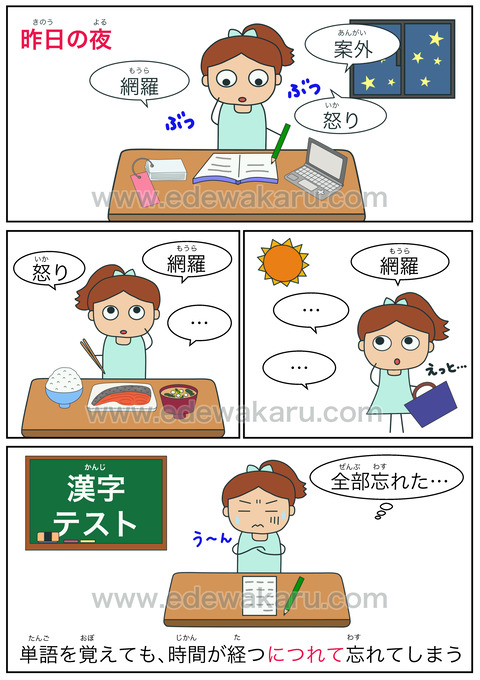
Meaning
〜すると、だんだん〜になる
〜が変化すると〜も変化する
How to use it
動詞[辞書形]+につれて・につれ
名詞[辞書形]+につれて・につれ
Explanation
「AにつれてB」は 「Aすると、だんだんBになる」「Aが変化するとBも変化する」という意味を表す文型です。この文型は「A」にも「B」にも
変化を表す言葉
が入ると覚えておきましょう😀また「〜につれて」は「〜につれ」にチェンジすることができます。
[例]
台風が近づく
につれて、風が強くなってきた
=台風が近づく
につれ、風が強くなってきた
年末に近づく
につれて、仕事は忙しくなるものだ
=年末に近づく
につれ、仕事は忙しくなるものだ
「〜につれ」は「〜につれて」よりもかたい言い方で【書き言葉】として使われると覚えておきましょう😉
In context 6 examples
単語を覚えても、時間が経つにつれて忘れてしまう
→時間が経つと、だんだん忘れてしまう台風が近づくにつれて、風が強くなってきた
→台風が近づくと、風が強くなってきた骨が折れてしまったが、日が経つにつれて痛くなくなってきた
→日が経つと、だんだん痛くなくなってきた年末に近づくにつれて、仕事は忙しくなるものだ
→年末に近づくと、だんだん仕事は忙しくなるものだ毎年、クリスマスが近づくにつれてクリスマスケーキを予約する人が増える
→クリスマスが近づくと、ケーキを予約する人がだんだん増える年をとるにつれて、すごく忘れっぽくなった
→年をとると、すごく忘れっぽくなった
日本語文型辞典
Meaning
基本情報NにつれてV-るにつれて説明ある事態の進展とともに、ほかの事態も進展するという、おおまかな比例関係を表す。書きことばの場合は「…につれ」とも言う。例文① 町の発展につれて、前になかった新しい問題が生まれて来た。② 時間がたつにつれて、悲しみは薄らいできた。③ 設備が古くなるにつれて、故障の箇所が増えて来た。④ 試合が進むにつれて、観衆も興奮してきて大騒ぎとなった。⑤ 成長するにつれて、娘は無口になってきた。
日本語文型辞典 英語版
Meaning
【につれて】[Nにつれて][V-るにつれて]
Expresses an approximate proportionate relation in which as a matter or situation develops, another also develops. Can be につれ in formal, written Japanese.
In context 5 examples
町の発展につれて、前になかった新しい問題が生まれて来た。
With the development of the town, new problems we had never encountered have emerged.
時間がたつにつれて、悲しみは薄らいできた。
As time passed, my sadness has faded.
設備が古くなるにつれて、故障の箇所が増えて来た。
As the facilities got older, more things have broken down.
試合が進むにつれて、観衆も興奮してきて大騒ぎとなった。
As the match went on, the gallery got excited and burst into cheers.
成長するにつれて、娘は無口になってきた。
As she grew up, my daughter turned quiet.
くらべてわかる日本語表現文型辞典
Meaning
Aの動詞の変化によって、Bの変化が生じる。Aは進行的である。Aの状況変化と並行的にBの事態も一定方向に変わっていく。
How to use it
AにつれてB
[動詞-る形]につれて
[名詞-∅]につれて
Explanation
【対比1】
「AとともにB」(意味2 P.181)
「AほどにB」(意味1 P.291)
「AにしたがってB」(意味1 P.231)
「AにともなってB」(意味1 P.252)
Notes
【注意1】
・Aの動詞は変化や進行を表すものである。
In context 4 examples
日が経つにつれて、さびしい気持ちも薄れてきた。
雨足が強くなるにつれて、道を歩く人々の姿もまばらになっていった。
円高が進むにつれて、海外旅行客の数は増大した。
医療技術の進歩につれて、平均寿命が延びてきた。
日本語NET JLPT文法解説まとめ
Meaning
〜すると、少しずつ
How to use it
V(辞) + につれて
Explanation
as, in proportion to
前件、後件ともに変化を表現する言葉が使われる。
In context 13 examples
日が経つにつれて、涼しくなってきた。
日本語が上手になるにつれて、日本での生活が楽しくなってきた。
卒業の日が近くにつれて、もうすぐ友達とお別れなので、寂しくなってきた。
年をとるにつれて、白髪が増えてきた。
年をとるにつれて、好みが変わっていくものだ。
大人になるにつれて、家族みんなで出かける機会も減った。
大人になるにつれて、嫌いだったものでも食べられるようになった。
時間が経つにつれて、嫌なことも自然と忘れるだろう。
時間が経つにつれて、手の痛みも引いてきた。
試験の日が近づくにつれて、不安でいっぱいになる。
試合が終わりに近づくにつれて、観客の興奮も高まっていった。
冬が近づくにつれて、街はだんだんクリスマスムードになってきた。
仕事が忙しくなるにつれて、彼女と電話する時間も減ってきた。
毎日のんびり日本語教師
How to use it
名詞+につれて/につれ
動辞形+につれて/につれ
Explanation
前件の変化に伴って後件も変化すること表す表現です。
「~につれ」のほうがやや硬い言い方です。
Notes
前件と後件が連動して変化する文法
【N3文法】~につれて/につれ
【N2文法】~に伴って/に伴い/に伴う
【N2文法】~にしたがって(従って)/にしたがい(従い)
In context 12 examples
大人になるにつれて謝るのが難しくなる。
時間が経つにつれて筋肉痛がどんどん痛くなってきた。
年を重ねるにつれて甘い物が苦手になってきた。
回数が増えていくにつれて慣れてきた。
後半になるにつれてスピードが落ちてくる。(随着后半段速度下降。)
ストーリーが進むにつれて、その世界観に引き込まれていく。
自分の発表が近づくにつれて緊張感が増してくる。
テストが近づくにつれて焦りと不安で心がいっぱいになる。
物語後半に行くにつれて面白くなってきた。
クリスマスが近づくにつれて寂しさや虚しさも増してきた。
試験日が近づくにつれて不安はどんどん大きくなっていきました。
会社規模の拡大につれて、より規模の大きな工場が必要になった。
NINJAL 日本語文型データベース
Meaning
~の程度が進むと・~という進展があると、それに比例して他のことの程度も次第に進む、または、進展すると言いたいときに使います。
How to use it
Vるにつれて
Nにつれて
Notes
「~」にも「〜につれて」の後の文にも、一方向の変化や進展を表す言葉がきます。「〜につれて」の後には、話し手の希望・意向を表す文や相手への働きかけの文はきません。
In context 11 examples
太陽が高く昇るにつれて、気温も急速に上昇する。
記憶力は年をとるにつれて衰えると言われる。
結婚前は、新生活に不安を感じる人もいるだろう。しかし、時がたつにつれて慣れていくものだ。
はじめは冷静だったが、国家試験の日が近づくにつれて落ち着かなくなった。
父の他界後,帰郷する回数が次第に減るにつれて、親族と疎遠になってきた。
私はNPOの職員として経験を積むにつれて、理想と現実との折り合いのつけ方がわかってきた。
古民家は味わいがあるが、老朽化につれて修復が難しくなる。
子どもの成長につれて、当然、親の方も成長していくのだろう。
科学技術の進歩につれて私たちの暮らしは楽になってきたはずだ。
保育園数の増加につれて、保育園に子どもを預けやすくなる。その結果、親は社会的活動をしやすくなる。
この村では、職を求めて大都市へ移り住む若者が多くなった。それにつれて村の税収は減少した。
IMABI
As (change)
Read this IMABI lesson ↗Explanation
As (change): ~につれて, ~に従って, ~に伴って, ~とともに, ~に応じて, & ~に応えて
~につれて, ~に従って, ~に伴って, and ~とともに all have meanings of showing the transition/change of one situation as another transition/change is under way. We will also see how ~に応じて・応えてrelate to them.
~につれて
~につれて is either after a noun or a verb in the 連体形 to express “as one thing changes, another thing changes as well”. These changes are simultaneous. Although it can be after nouns or verbs, it is after verbs more often. ~につれて is often used in situations where there is a proportional relationship with the two events in the respective clauses.
As such, the first clause acts as the trigger, proportionately raising the degree of the change/transition of the latter clause. Common translations include “as”, “together with”, and “in accordance to/with”.
Variant Note: It can be seen in more formal/written language as ~につれ.
Examples
1. 歌は世につれ世は歌につれ。
Song changes by generation, and generations change by song.
2. 昭和から平成へと時代が変わるにつれて軍歌ぐんかは歌われなくなりました。
With the changing of periods from the Showa to the Heisei, military songs became unsung.
3. 時間が経つにつれて忘れっぽくなる。
As time passes, I become forgetful.
4. 都心化(が進む)につれて自分の地域への関心が薄うすれる。
As urbanization progresses, the concern towards one’s region fades.
5. 夜が更ふけるにつれて嵐あらしは激しくなった。
The storm became fierce as the night grew late.
6. 季節の変化につれて気温が変わる。
The temperatures change in accordance to the seasons. 7. 冬になるにつれて、山が白くなってくる。
The mountains become white as winter depends.
8. イナゴは稲に付く害虫なので駆除しなくてはなりません。昔の人はそこからイナゴを食べることを思いつきました。当時は、食べることを前提に捕まえていたので、殺虫剤は使っていませんでした。しかし戦後、 農薬が普及し、それにつれてイナゴは激減してしまいました。現在では、殺虫剤を使ったイナゴの駆除も行われていますが、安全な無農薬栽培やオーガニック栽培をしている農家では一匹ずつ捕まえているそうです。大変な作業ですね。
Locusts are harmful insects which stick to rice plants and have to be exterminated. People in the past thought of eating locusts from this. At the time, they wouldn’t use pesticides with eating them as a premise. However, after the war, agrochemicals spread, and with this locusts were decreased in number. Presently, there is extermination involving pesticides, but at farms which use safe non-agriculture chemical and organic cultivation, locusts are caught by hand one by one. That’s definitely a tough job.
~に従って
~に従って can be used in a hierarchical sense to mean “according to”. As should be expected, ~に従い is more formal and indicative of the written language. Both に従っての and に従った are appropriate attribute forms.
9. 命令に従って、行動しろ。
Act according to the command.
10. 私の合図に従って行動してください。
Please act in according to my signals.
It may also be used like ~につれて. In the first usage above, it attaches to nouns. As for this usage, it attaches primarily to verbs. It, however, simply states that the two actions described in the respective clauses are happening in parallel.
11. 南に行くに従い、気温がどんどん高くなる。(Somewhat literary)
The temperature gets higher as you go south.
12. 人口が増えるにしたがって、住宅問題が起こってくる。
As the population increases, housing problems will come to occur.
13. 人口が増えるにしたがって、犯罪が多発する。
As the population increases, crime will frequently occur.
The contrast in nuance between ~につれて and ~にしたがって can definitely be seen in the following example.
14. スタジアムで場内の歓声が高まる{につれて・にしたがって}。実況アナウンサーの声も大きくなっていった。
As the cheers in the stadium intensified, the commentator’s voice got ever louder.
With ~につれて, the suspense is captured with the first clause being the trigger for the events of the second. With ~にしたがって, the sentence doesn’t become ungrammatical, but it loses the emotive drive and merely states that the two events described in the respective clauses are happening in parallel.
~に伴って
伴う means “to accompany” and ~に伴って means “associated/accompanied with” or “as”. Just like ~につれて, it may show that something is happening together with a change/transition of a certain situation. There is a temporal context of “taking A as the opportunity, therefore…B”. It is also often the case that it infers that the thing in the second clause continues.
What precedes it is either a noun or verb. In the case of a verb, unlike the other options, the particle の may be optionally used after the verb for nominalization. To be clear, this is not required and is not done in the first place for the other options. Lastly, ~に伴って is more literary.
Variant Note: It may also be seen in writing as ~に伴い.
15. 汚染おせんに伴う問題について話しましょう。
Let’s talk about the problems accompanied with pollution.
16. 人口の増加に伴って、たくさんの住宅が建てられる。
Many houses are constructed in association to the increase in population.
Particle Note: 伴う is used with を when used transitively.
~とともに
~とともに also behaves like ~につれて to show that something happens together with a change/transition of a certain situation. However, unlike ~につれて, the entire sentence doesn’t necessarily have to show a state of progress. In other cases it can have meanings equivalent to 同時に and 一緒に. As for its usage similar to ~につれて, it’s also the case that the words it follows must show change in situation. It cannot be words pertaining to action, which ~につれ and ~にしたがって can be.
17. 人口の増加とともに、犯罪が多発する。
Along with the increase in population, crimes will frequently occur.
18. 子供が卒業するとともに、父母会ふぼかいも解散かいさんしました。
The parents’ association also dissolved at the same time the kids graduated.
19. 皆さんとともに快適かいてきな道づくりを進めます。
With everyone we will go forward with a pleasant road construction.
漢字 Note: This pattern may also be written in 漢字 as ~と共に.
~に応じて
~に応じて means “accordingly” or “as to”. The first meaning is important in this lesson as it ties with the other patterns. When it is used with a verb that shows change, it describes the corresponding/dealing with a certain change. In this instance, it is possible to switch it out with ~につれて, ~にしたがって, ~にともなって, and ~とともに.
In its other meaning, it is equivalent to ~に応えて (as to/to satisfy). Although this, too, sounds like it is of the vein of the other phrases, it’s not. Although in such situations it may seem that ~に従って is possible, it would be considerably more negative.
20a. 住民の要求に応じて、説明会を開くことになりました。〇
20b. 住民の要求に従って、説明会を開くことになりました。△
20c. 住民の要求{にともなって・とともに}、説明会を開くことになりました。?
20d. 住民の要求につれて、説明会を開くことになりました。X
In meeting the wants of the citizens, it has been decided that we open an information seminar.
It has the attribute forms ~に応じての and ~に応じた. When に応じて comes before a noun, の is necessary after 応じて. Or, you can use に応じた. The 一段 conjugating verb 応じる either means “reply” or “to comply”.
21. 質問に応じて、彼女は問題の解答を詳くわしく説明しました。
As to answer the question, she explained the answer to the problem well.
22. 命令に応じた服従。
Obedience in accordance to command.
23. 料金が距離きょりと時間に応じて決まります。
The fee is determined according to distance and time.
24. 「うん」と応じる。
To respond with a “yes”.
25. 相手の依頼いらいに応じましたか。
Have you responded to your partner’s request?
26. 車の速さに応じてガソリンの消費量が変わる。
Fuel use will change depending upon the car’s speed.
~に応えて
The 一段 verb 応える may be used to mean “to come through/satisfy/answer” or “to tell/go to one’s heart”. The latter usage shows some sort of burden.
27. 要求に応こたえて、社員の給料が上がりました。
To meet demand, the employee’s salaries went up.
28. 国民に応えて、法律は廃止はいしされました。
The law was repealed in response to the citizens.
29. 期待に応える。
To come through with expectations.
30. 深酒ふかざけは身体に応えるのです。
Hard drinking takes its toll on the body.
31. その当時供給は需要に{応えて・満たして}いなかった。
In those days, the supply didn’t meet the demand.
In context 33 examples
歌は世につれ世は歌につれ。
Song changes by generation, and generations change by song.
昭和から平成へと時代が変わるにつれて軍歌ぐんかは歌われなくなりました。
With the changing of periods from the Showa to the Heisei, military songs became unsung.
時間が経つにつれて忘れっぽくなる。
As time passes, I become forgetful.
都心化(が進む)につれて自分の地域への関心が薄うすれる。
As urbanization progresses, the concern towards one’s region fades.
夜が更ふけるにつれて嵐あらしは激しくなった。
The storm became fierce as the night grew late.
季節の変化につれて気温が変わる。
イナゴは稲に付く害虫なので駆除しなくてはなりません。昔の人はそこからイナゴを食べることを思いつきました。当時は、食べることを前提に捕まえていたので、殺虫剤は使っていませんでした。しかし戦後、 農薬が普及し、それにつれてイナゴは激減してしまいました。現在では、殺虫剤を使ったイナゴの駆除も行われていますが、安全な無農薬栽培やオーガニック栽培をしている農家では一匹ずつ捕まえているそうです。大変な作業ですね。
Locusts are harmful insects which stick to rice plants and have to be exterminated. People in the past thought of eating locusts from this. At the time, they wouldn’t use pesticides with eating them as a premise. However, after the war, agrochemicals spread, and with this locusts were decreased in number. Presently, there is extermination involving pesticides, but at farms which use safe non-agriculture chemical and organic cultivation, locusts are caught by hand one by one. That’s definitely a tough job.
命令に従って、行動しろ。
Act according to the command.
私の合図に従って行動してください。
Please act in according to my signals.
南に行くに従い、気温がどんどん高くなる。(Somewhat literary)
The temperature gets higher as you go south.
人口が増えるにしたがって、住宅問題が起こってくる。
As the population increases, housing problems will come to occur.
人口が増えるにしたがって、犯罪が多発する。
As the population increases, crime will frequently occur.
スタジアムで場内の歓声が高まる{につれて・にしたがって}。実況アナウンサーの声も大きくなっていった。
As the cheers in the stadium intensified, the commentator’s voice got ever louder.
汚染おせんに伴う問題について話しましょう。
Let’s talk about the problems accompanied with pollution.
人口の増加に伴って、たくさんの住宅が建てられる。
Many houses are constructed in association to the increase in population.
人口の増加とともに、犯罪が多発する。
Along with the increase in population, crimes will frequently occur.
子供が卒業するとともに、父母会ふぼかいも解散かいさんしました。
The parents’ association also dissolved at the same time the kids graduated.
皆さんとともに快適かいてきな道づくりを進めます。
With everyone we will go forward with a pleasant road construction.
住民の要求に応じて、説明会を開くことになりました。〇
In meeting the wants of the citizens, it has been decided that we open an information seminar.
住民の要求に従って、説明会を開くことになりました。△
In meeting the wants of the citizens, it has been decided that we open an information seminar.
住民の要求{にともなって・とともに}、説明会を開くことになりました。?
In meeting the wants of the citizens, it has been decided that we open an information seminar.
住民の要求につれて、説明会を開くことになりました。X
In meeting the wants of the citizens, it has been decided that we open an information seminar.
質問に応じて、彼女は問題の解答を詳くわしく説明しました。
As to answer the question, she explained the answer to the problem well.
命令に応じた服従。
Obedience in accordance to command.
料金が距離きょりと時間に応じて決まります。
The fee is determined according to distance and time.
「うん」と応じる。
To respond with a “yes”.
相手の依頼いらいに応じましたか。
Have you responded to your partner’s request?
車の速さに応じてガソリンの消費量が変わる。
Fuel use will change depending upon the car’s speed.
要求に応こたえて、社員の給料が上がりました。
To meet demand, the employee’s salaries went up.
国民に応えて、法律は廃止はいしされました。
The law was repealed in response to the citizens.
期待に応える。
To come through with expectations.
深酒ふかざけは身体に応えるのです。
Hard drinking takes its toll on the body.
その当時供給は需要に{応えて・満たして}いなかった。
In those days, the supply didn’t meet the demand.