くらべてわかる日本語表現文型辞典
Meaning
意味1:Aを例として示す。たとえばA。AでなくてもAと同類ならよい。
意味2:直接Aのことを言っているのだが、婉曲的な表現で断言を避ける。Aを軽んじて述べることもある。
意味3:だいたいA。Aというようなこと。「Aなどと~」の形でも使われる。
How to use it
Aなど(AなどのB)
接続1,2:
[動詞]など
[名詞-∅]など
接続3:
[文]など
Explanation
【対比1,2】
「AなんかB」(意味2 P.207)
「AなんてB」(意味3 P.208)
【対比3】
「AなんてB」(意味2 P.208)
In context 12 examples
夏休みのご旅行でしたら、沖縄などいかがですか。
台風のときは瓦や看板が飛んでくるなど危険ですから、外へは出ないでください。
海岸で花火をあげる、大声で騒ぐ、ごみを持ち帰らないなど、他人の迷惑になる行為をしてはいけない。
東京などの大都市では、1票の格差が選挙のたびに話題になっている。
今日は雨など降って寒うございますから、お風邪を召しませんように。
推理小説の結末を言うなど、ルール違反だ。
読書など暇な人間のすることだ。
あいつなど、ぼくの敵じゃない。
父は定年後、田舎で母と暮らすなどと言い出した。
日銀は金利引き下げはしないなどといっているが、本当だろうか。
留学している娘が、まだ帰国したくないなど、言ってくる。
友達に「もう来るな、帰れ」など、ひどいことを言われた。
DoJG 日本語文法辞典(全集)
Meaning
And so on; and the like; for example; things like ~
Explanation
A marker that indicates exemplification.
In context 6 examples
日本の食べ物の中では寿司や天ぷらなどが好きだ・好きです。
Among Japanese foods I like things like sushi and tempura.
A:冬休みはどこに行きましょうか。 B:ハワイなどどうですか。
A: Where shall we go during the winter vacation? B: How about Hawaii, for example?
大学ではフランス語やドイツ語などを勉強した。
In college I studied French and German and the like.
この大学には中国や韓国などから学生が大勢来ます。
A lot of students from China, Korea and so on come to this college.
A:経済学を専攻するつもりですか。 B:いいえ、経済学など専攻するつもりはありません。
A: Are you going to major in economics? B: No, I have no intention of majoring in things like economics.
A:この翻訳をして下さいませんか。 B:こんな難しいもの、私などには出来ません。
A: Could you kindly translate this for me? B: A person like me cannot translate such a difficult thing.
日本語文型辞典
Meaning
基本情報説明くだけた言い方では「なんか」が用いられる。
a. Nなど
いろいろある中から主なものを取り上げて、例として示すのに用いる。ほかにも似たものがあるという含みがある。
b. V-るなどする
いろいろあることの中から主なものを取り上げて例として示すのに用いる。ほかにも似たことをするという含みがある。
後ろに「言う」などの発言を表す動詞を従えて、その発言のおおよその内容を表すのに使う。発言の引用をする用法だが、ほかにも似たようなことをいっているという含みがある。
名詞や動詞、名詞+助詞などのさまざまな成分に付き、その後に否定を表す表現を従えて、あることがらに対する否定を表すと同時に、「など」によって取り立てたものごとに対する軽蔑の気持ちや謙遜の気持ち、あるいは意外な気持ちなどを表す。例えば⑦は「こんな難しい問題は私には解けるはずがない」ということと同時に、自分自身を低く評価して謙遜する気持ちも表している。
名詞や動詞、名詞+助詞などのさまざまな成分に付き、否定の意を強めると同時に「など」によって取り立てたものごとを、取るに足りないくだらないものだと、軽視する気持ちを表す。
How to use it
…など
…などと
…など…ない
…など …V-るものか
In context 21 examples
ウエイトレスや皿洗いなどのアルバイトをして学費を貯めた。
A:このスーツに合うブラウスを探しているんですけどB:これなどいかがでしょうか。お似合いだと思いますよ。
デパートやスーパーなどの大きな店ができたために、小さな店は経営が苦しくなった。
ひげをそるなどして、もうすこし身だしなみに気を付けてほしい。
時には呼びつけて注意するなどしたのですが、あまり効き目はなかったようです。
学校をやめるなどと言って、みんなを困らせている。
来年になれば景気が持ち直すから大丈夫などと、のんきなことを言っている。
東京で仕事を探すなどと言って、家を出たきり帰ってこない。
あなたの顔など見たくない。
私は嘘などつきませんよ。
賛成するなどと言っていない。
あんな男となどいっしょに働きたくない。
そんなことで驚いたりなどしないさ。
別にあなたを非難してなどいませんよ。
こんな難しい問題が私のようなものになど解けるはずがありません。
こんな結果になるなどとは考えてもみませんでした。
そんな馬鹿げた話など、だれが信じるものか。
お前になど教えてやるものか。
あんなやつを助けてなどやるものか。
これくらいの怪我で、だれが死になどするものか。
私の気持ちが、あなたなどに分かるものですか。
絵でわかる日本語
Usage 1
Read this source entry ↗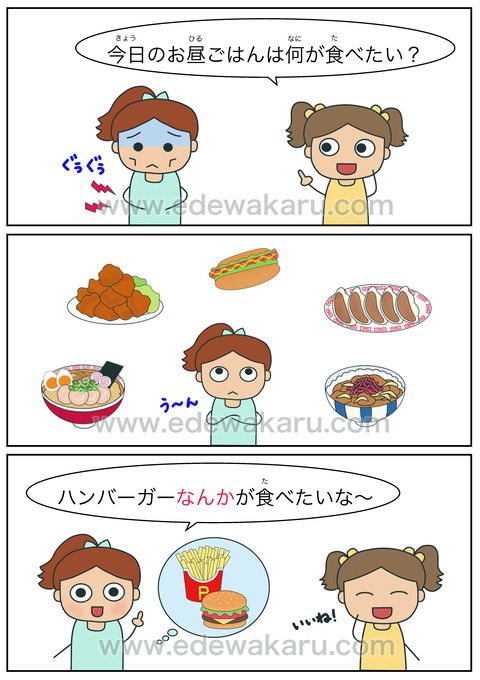
Meaning
例をあげる
How to use it
名詞[辞書形]+など・なんか・なんて
Explanation
「〜など・〜なんか・〜なんて」は、いろいろある中から【例をあげて言う】場合に使われる文型です。「〜なんか・〜なんて」は「〜など」の口語形です。
「〜など・〜なんか・〜なんて」には【軽視・軽蔑】【謙遜】を表す用法もありますので、一緒に覚えておきましょう。また【感情を表す】「〜なんて」は別の文型ですので区別をしておきましょう。
【関連文型】
In context 5 examples
A:今日のお昼ごはんは何が食べたい?B:う〜ん…ハンバーガーなんかが食べたいな〜
→(いろいろ食べたいものがあるが)例えばハンバーガーが食べたい小さい頃は、ピアノや水泳などを習っていました
→(いろいろ習っていたが)例をあげるとピアノや水泳を習っていたA:彼女の誕生日プレゼントは何をあげようかな…B:きれいな花なんかがいいと思うよ
→例えば花がいいと思うよ彼女はケーキやクッキーなどのスイーツが大好きだ
→ケーキやクッキーのようなスイーツが大好きだ店員:いらっしゃいませ。何かお探しですか?客:彼女のプレゼントを…店員:こちらのネックレスなどいかがですか?
→例えば、こちらのネックレスはいかがですか?
Usage 2
Read this source entry ↗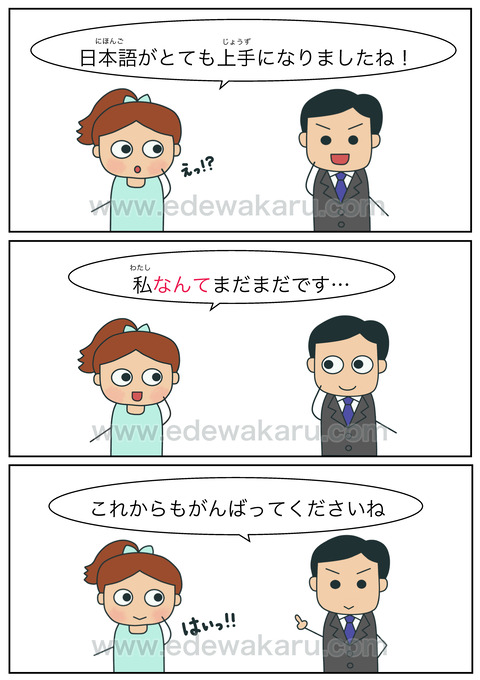
Meaning
謙遜の気持ちを表す
How to use it
名詞[辞書形]+など・なんか・なんて
Explanation
「〜など・〜なんか・〜なんて」を自分や自分に近い人に使うと謙遜していることを表します😊「〜なんか・〜なんて」は「〜など」の口語形です😀
[例]
①A:日本語がとても上手になりましたね
B:私なんてまだまだです
→「私はまだまだ上手ではない」と謙遜している
②彼氏:君は本当に美人だね
彼女:私
なんて
…田中さんの方が美人だと思うわ
→「私は美人ではない」と謙遜している
③A:料理が本当にうまいね!
B:私
なんか
全然上手じゃないよ
→「私は上手ではない」と謙遜している
④上司:今月からリーダーとしてがんばってくれ
部下:私
など
にきちんとできるかわかりませんが、がんばります
→「私にできるかわからない」と謙遜の気持ちを表している
⑤うちの息子
なんて、全然イケメンじゃないわよ〜
→「うちの息子はイケメンじゃない」と、謙遜している
「〜など・〜なんか・〜なんて」には【例をあげる】【軽視・軽蔑を表す】用法もありますので、一緒に覚えておきましょう。また【感情を表す】「〜なんて」は全然違う文型ですので区別しておきましょう😀
【関連文型】
In context 5 examples
A:日本語がとても上手になりましたねB:私なんてまだまだです
彼氏:君は本当に美人だね彼女:私なんて…田中さんの方が美人だと思うわ
A:おいしい〜!料理がうまいね!B:私なんか全然上手じゃないよ
上司:今月からリーダーとしてがんばってくれ部下:私などにきちんとできるかわかりませんが、がんばります
うちの息子なんて、全然イケメンじゃないわよ〜
Usage 3
Read this source entry ↗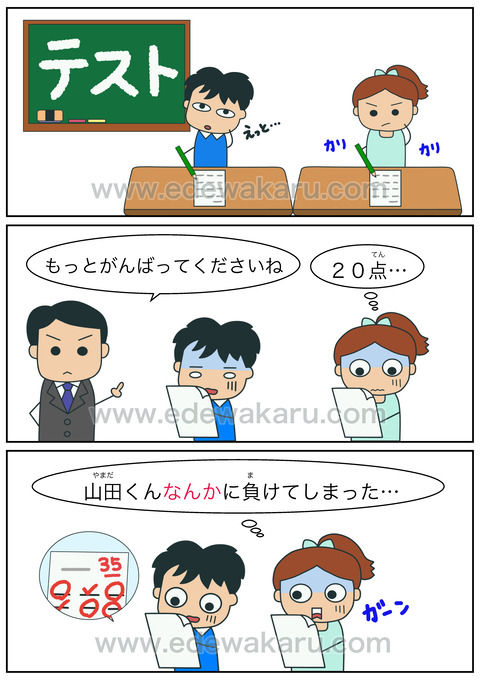
Meaning
軽視・軽蔑を表す
How to use it
名詞[辞書形]+など・なんか・なんて
Explanation
「〜など・〜なんか・〜なんて」を相手(人)や対象(もの・こと・動物)に使うと【軽視・軽蔑】の気持ちを表します。
[比較]
・山田くん
なんか
に負けた
→「自分よりバカな山田くんに負けた」「嫌いな山田くんに負けた」という気持ちを表す。相手の「山田くん」にはいい感情はない
・山田くんに負けた
→ただ「山田くんに負けた」と言っているだけ
軽視・軽蔑を表す「〜など・〜なんか・〜なんて」は相手・対象に使うと、とても失礼になりますので使い方に気をつけなければいけません😣 また「〜など・〜なんか・〜なんて」には【例をあげる】【謙遜】を表す用法もありますので復習しておきましょう。
【関連文型】
In context 6 examples
山田くんなんかに負けてしまった…[軽視する相手]山田くん
A:日本語は難しいな…B:日本語なんて簡単だよ〜[軽視する対象]日本語
あなたなどに私の気持ちはわからないわ![軽視する相手]あなた
A:山田くんはオバケと話したことがあるそうよ!B:そんなバカな話なんか信じたらだめだよ〜[軽視する対象](オバケと話したという)バカな話
母:明日テストがあるんでしょ?遊んでいる時間なんてないはずよ!娘:は〜い[軽視する対象]遊んでいる時間
こんなケガなんて全然痛くないよ[軽視する対象]少しのケガ
どんなときどう使う 日本語表現文型辞典
Meaning
something like, someone like
How to use it
N(+助詞)+など
Explanation
~のようなものは
1)「~など」の形で、「~」をいやだと思う気持ち、軽視する気持ちを表す。文末では否定的な言い方をする。
2) ❹ のように、自分のことに使うと謙遜の意味になる。
3)「なんか・なんて」はくだけた会話的な言い方。
1)Feelings of dislike or contempt precede など. Takes negative sentence ending.
3)Informal forms are なんか and なんて.
2)When used about speaker, shows humility, as in sentence ❹ .
In context 4 examples
部屋のそうじなどめんどうだなあ。
人の悪口など言うものではない。
税金を無駄使いするような大臣など、辞職して当然です。
わたしなどはみなさんのように立派な話はできません。
日本語NET JLPT文法解説まとめ
Meaning
"〜にようなものは / 〜なようなことは"
①例を挙げる時に使う
②謙遜する時に使う
③相手を軽視する時に使う。
How to use it
N + など
Explanation
"like"
① Used when giving examples.
② Used when being humble.
③ Used to belittle someone.
In context 12 examples
試験も近いし、ゲームなどしている暇はない。
中国語やインドネシア語など、仕事で役に立ちそうな外国語を勉強したいです。
学生時代は引っ越しや工場などのでアルバイトをしていました。
A:もうすぐ母の誕生日なんだけど、何がいいかな。
私など、まだまだ部長になるに早すぎますよ。
A:Bさん、綺麗になったね。
僕が君なんかに試合で負けるあり得ないよ。
なんで私が彼なんかに謝らなきゃいけないのよ。
キムさんなんかに今の僕の気持ちがわかるわけないだろう。
あんなやつとなんか一緒に働きたくない。
お前の話なんか誰が信じるもんか。
お前になんか教えてやるもんか。
毎日のんびり日本語教師
How to use it
動詞普通形+など/なんて
イ形容詞普通形+など/なんて
ナ形容詞普通形+など/なんて
名詞+など/なんて
Explanation
3つの意味があります。
①列挙
ある類似した物事の中から最も代表的なものを挙げる表現です。挙げられた物事以外の存在も暗示します。
②軽蔑・軽視・謙遜
他人や対象に対する軽蔑を表します。自分に対して用いると謙遜の意味合いになります。
この用法の時は、以下のような文型を取ります。
名詞+など/なんか/なんて(+助詞)
名詞(+助詞)+など/なんか/なんて
名詞+なんて+名詞
③驚き・意外
話者の驚きの感情を表します。
「~だなんて」「動ます形+など/なんて」の文型がよく現れます。この意味の時は「など」「なんて」が使われ、「なんか」は使いにくいです。
また、この意味のときは「~とは」に言い換えられます。
「等(など)」の口語形が「なんか」「なんて」です。
Notes
「など/なんか/なんて」シリーズ
In context 22 examples
ギターやベースなどの楽器収集が趣味です。
大雨になる所もありますので、土砂災害などに気をつけてください。
飲み会やカラオケなんかの大人数が参加するような集まりは好きじゃない。(我不喜欢酒会、卡拉OK等很多人参加的聚会。)
週末には掃除なんかするつもりだ。
「好きだよ」なんて言われて抱きしめられたい。
風邪など引かぬようにお身体大切になさってください。
うちの会社は年末なんかは特に忙しくなる。
16日7時20分頃、愛知県などで最大震度3を観測する地震がありました。
あいつなんかに負けてたまるか。
難しすぎて、私なんかにできません。
運命なんて自分の力で変えていけばいいだろう。
お前癌なんかに負けるなよ。
私は差別などしていませんよ。
お前とはもう約束なんかしない。どうせ守らないだろ。
田中なんて人、俺は知らない。
自分より辛い思いをしている人なんて世の中にたくさんいる。(世界上有很多人比自己更痛苦。)
止まない雨などない。
彼が合格したなんて信じられない。(我不相信他竟然合格了。)
こんなことになるなんて予想外です。
まさか彼が合格するなど、誰が予想できただろうか。
可愛いだなんて言ってくれて、嬉しいです。
20代という若さで脳出血だなんて、無事に回復することを祈っています。
日本語文型辞典 英語版
Meaning
【など】In casual speech, なんか is used instead of など.
B:これなどいかがでしょうか。お似合いだと思いますよ。
How about something like this? I think it’ll look good on you.
Used to present a few main examples out of a larger range of items. Implies that there are other similar items as well.
b. V-るなどする
Used to present a few main examples out of a larger range of actions. Implies that there are other similar actions as well.
などと, followed by a verb of utterance such as 言う, is used to express the gist of something that someone has said. This pattern is used for quotation, but it implies that other similar things may also have been said.
など attaches to a variety of constituents, including nouns, verbs, and noun + particle combinations, and is followed by a negative expression. This pattern expresses not only the negation of a certain thing, situation, or event but also the speaker’s feeling of contempt, modesty, surprise, etc. with respect to whatever is marked by など.
For instance,
(7)
simultaneously conveys the meaning that there is no way the speaker could ever answer such a difficult question and the sense that the speaker is humble and does not hold too high an opinion of him/herself.
May be preceded by a variety of constituents, including nouns, verbs, and noun + particle combinations. Expresses a strong negation, as well as the speaker’s feeling that the person, thing, or situation marked by など is trivial and worthy only of contempt.
How to use it
1. ...などa. Nなど
2. ...などと
3. ...など...ない
4. ...など...V-るものか
In context 21 examples
ウェイトレスや皿洗いなどのアルバイトをして学費を貯めた。
I did part-time jobs like waitressing and dishwashing to save money for my school expenses.
A:このスーツに合うブラウスを探しているんですけど...。
I’m looking for a blouse that goes with this suit, but....
デパートやスーパーなどの大きな店ができたために、小さな店は経営が苦しくなった。
Since large retailers like the department store and the supermarket were built, the small shops have found it hard to stay in business.
ひげをそるなどして、もうすこし身だしなみに気を付けてほしい。
I wish you’d pay a little more attention to your personal appearance, including things like shaving.
時には呼びつけて注意するなどしたのですが、あまり効き目はなかったようです。
Sometimes I did call her in and give her advice and whatever, but it doesn't seem to have been very effective.
学校をやめるなどと言って、みんなを困らせている。
It’s a big headache for all of us because he’s saying things like he’s going to leave school.
来年になれば景気が持ち直すから大丈夫などとのんきなことを言っている。
She’s making these casual comments, like everything will be all right next year since the economy is going to improve.
東京で仕事を探すなどと言って、家を出たきり帰ってこない。
After he said he was going to find a job in Tokyo or whatever, he left home and hasn’t been back.
あなたの顔など見たくない。
I don’t even want to look at you.
私は嘘などつきませんよ。
I would never tell a lie.
賛成するなどと言っていない。
I never said I would agree.
あんな男となどいっしょに働きたくない。
I don’t want to work with a guy like that.
そんなことで驚いたりなどしないさ。
I just wouldn’t be surprised by such a thing.
別にあなたを非難してなどいませんよ。
I’m not blaming you or anything, you know.
こんな難しい問題が私のようなものになど解けるはずがありません。
I’m not at all the person to be able to answer such a difficult question.
こんな結果になるなどとは考えてもみませんでした。
I never thought it would come to something like this.
そんな馬鹿げた話などだれが信じるものか。
Who would ever swallow such a ridiculous story?
お前になど教えてやるものか。
Why would I ever tell someone like you?
あんなやつを助けてなどやるものか。
He’s the last guy I’d ever help!
これくらいの怪我でだれが死になどするものか。
No one ever died from such a minor injury!
私の気持ちがあなたなどに分かるものですか。
How on earth would someone like you ever understand my feelings?
AIUEO JLPT Grammar
Usage 1
Meaning
「〜など」is a particle used to provide examples or list items. It is used when listing several nouns and indicates that there are more examples beyond those listed.
How to use it
名詞+など
Explanation · 日本語
「〜など」は、例示や列挙を示すために使用される助詞です。複数の名詞を列挙するときに使われ、例として挙げたものが他にもあることを示します。
In context 5 examples
りんごやバナナなどの果物を食べます。
I eat fruits such as apples and bananas.
犬や猫などの動物が好きです。
I like animals such as dogs and cats.
映画や音楽などが好きです。
I like movies, music, and so on.
赤やオレンジなどの暖かい色が好きです。
I like warm colors like red and orange.
大阪や福岡などに行きたい。
I want to go to Osaka or Fukuoka.
Usage 2
Meaning
This sentence pattern is used to enumerate or downplay certain things, or to express surprise.
How to use it
名詞+など名詞+なんか名詞+なんて
Explanation · 日本語
この文型は、名詞に接続して使われ、それらを列挙したり、軽視したり、驚きを表すために使われます。
In context 5 examples
私は寿司や天ぷらなどの日本料理が好きです。
I like Japanese foods such as sushi and tempura.
ケーキなんか食べたくない。
I don’t want to eat something like cake.
君はまだいいよ、あいつなんて試験に来なかったんだから。
You're fine, that guy didn't even show up for the exam.
こんな傷なんか、大したことない。
This injury is nothing.
こんな大事な書類を忘れるなんて、信じられない。
I can’t believe you forgot such an important document.
文法
Meaning
〜にようなものは / 〜なようなことは
①例を挙げる時に使う
②謙遜する時に使う
③相手を軽視する時に使う。
How to use it
N + など
In context 12 examples
試験も近いし、ゲームなどしている暇はない。
中国語やインドネシア語など、仕事で役に立ちそうな外国語を勉強したいです。
学生時代は引っ越しや工場などのでアルバイトをしていました。
A:もうすぐ母の誕生日なんだけど、何がいいかな。
B:うーん、花なんかいいんじゃない?・私など、まだまだ部長になるに早すぎますよ。
A:Bさん、綺麗になったね。
B:いやいや、Aさんに比べたら私なんて全然だよ。僕が君なんかに試合で負けるあり得ないよ。
なんで私が彼なんかに謝らなきゃいけないのよ。
キムさんなんかに今の僕の気持ちがわかるわけないだろう。
あんなやつとなんか一緒に働きたくない。
お前の話なんか誰が信じるもんか。
お前になんか教えてやるもんか。
Bunpro Grammar Reference
Meaning
Such as, Things like, Etc., And so on
How to use it
Noun + など
Noun + など + の + Noun
Nuance
A word that expresses (A), and things in the same category as (A).
Explanation
など is an adverbial particle that is used to express that something is being presented as an example, but that other things in the same category also exist. In this way, it is regularly translated as 'such as', 'things like', or 'and so on'.
など may be used after nouns, to describe that (A) is being presented as an example from within a group. Alternatively, など can be followed by の (B), to show that (A) is only one example from within a broader category related to (B).
この公園では石などを投げないでください。
Do not throw rocks and so on in this park.
彼はいつもルームメイトなどの悪口を言っています。
He is always badmouthing people, like his roommates.
など is regularly seen in its kanji form, 等. This kanji itself has a similar meaning to 'etc' in English. Fun FactThe kanji for 等 is also used in the pluralizing suffix, ら. Due to this, we can see that this kanji is regularly utilized to highlight something that exists as part of a larger group.
鞄や靴等を川に捨ててはならない。
You mustn't discard things such as bags and shoes into the river.
あいつ等本当にうるさいね。
Those people are very noisy, don't you think.
In the first sentence, など presents (A) as being part of a larger group of similar things. This is exactly the same thing that happens in the second sentence with ら.
Fun Fact
など is also sometimes written as なんか, and has an interchangeable meaning in many situations. However, なんか will never use the kanji form of 等.
Nuance · 日本語
(A)と、(A)と同じカテゴリーにあるものを表す表現。
In context 16 examples
- イタリアやアメリカなどに行きたい。
I want to go to places such as America and Italy. (etc. / and so on)
- この公園では石などを投げないでください。
Do not throw rocks and so on in this park.
- 彼はいつもルームメイトなどの悪口を言っています。
He is always badmouthing people, like his roommates.
- フルーツはぶどうなどが好きです。
As for fruits, I like grapes and such. (etc. / and so on)
- 趣味などを教えてください。
Please tell me things like your hobbies. (etc. / and so on)
- 明日から、準備などをするつもりです。
From tomorrow, I plan on doing things like preparing. (etc. / and so on)
- 数学などを勉強します。
I study things like math. (etc. / and so on)
- 腰や背中などが痛い。
Things like my hips and back hurt. (etc. / and so on)
- 大学生などが行きます。
People such as college students go. (etc. / and so on)
- お客さんはバスなどで来ます。
Customers come by things like the bus. (etc. / and so on)
- お土産などを買いました。
I bought things like souvenirs. (etc. / and so on)
- カレーなどの辛いものが好きです。
I like spicy things such as curry. (etc. / and so on)
- 小説などを読むのが好き。
I enjoy reading things such as novels. (etc. / and so on)
- 宿題をしてから、ゲームなどをゆっくりする。
After doing my homework, I relax with things like video games. (etc. / and so on)
- 鞄や靴等を川に捨ててはならない。
You mustn't discard things such as bags and shoes into the river.
- あいつ等本当にうるさいね。
Those people are very noisy, don't you think.
Yokubi — The Common Grammar Guide (https://yoku.bi)
Explanation
List of items in Japanese are made by tagging each item with a specific "listing" particle that defines the nature of the list. There can be both exhaustive and non-exhaustive lists. An exhaustive list is just a list that states explicitly every element it is comprised of. A non-exhaustive list is a list that provides a few examples or a description of the nature of its elements, while leaving space for ambiguity and indirectness.
"I went to the mall with Paul and Frank" is an exhaustive list, while "I went to the mall with Paul, Frank, and the rest of the crew" on the other hand is a non-exhaustive list.
Depending on the nature of the list, the final element often has its listing particle dropped and replaced with the case particle that applies to the entire list.
や makes a **non-exhaustive** list providing a few examples of elements that correlate to a general common idea of them.
と was covered as a side-note before, but here we'll cover it explicitly and compare it to や. と makes a "generic" **exhaustive** list. It counts every element in the list.
As already mentioned, the last と is optional and usually dropped.
か can be used to provide alternatives. It is closer to "or" than "and" although the distinction is sometimes blurry.
とか makes a "vague" list. It's vague, and therefore **non-exhaustive**, but each item is its own. The items aren't necessarily considered to share a common property.
It can also be used to make things vague with just one element:
To the surprise of no one, とか is basically like と + か. It can also be used to list verbs, often to provide alternative choices. This is a distinctive feature that doesn't exist for the other listing particles in this lesson.
If the list is too long (more than 2-3 elements), it's common to use commas to separate the elements in the middle without using particles.
など is not technically a listing particle, but rather some filler particle that sounds like using "etc" or "and such" in English. It implies the notion of a list of elements open to more similar stuff. Its meaning is similar to using a single や or とか to state that more examples are implied but not directly stated.
These listing particles are also commonly used together, especially with など. The pattern Xや、Y、Zなど is incredibly common, like in the following sentence:
There is another listing particle that is sometimes overlooked: に. This particle is used to list things that come together in a set, or that the speaker is listing one-by-one as some form of chain of thought or active recollection.
In context 2 examples
完璧な人間など、存在しない。
Things such as a perfect human don't exist.
剣や斧、槍、弓など、様々な武器が置かれている。
Swords, axes, spears, bows, and such a multitude of weapons were on display.
IMABI
The Particle など・なんか
Read this IMABI lesson ↗Explanation
The Particle など・なんか
In this lesson, we will learn about the adverbial particles など and なんか.
The Adverbial Particle など1
The adverbial particle など is used to give related examples, appearing after nouns as well as verbal predicates, translating into English as “etc.,” which also indicates how など itself does not necessarily create the list but concludes a list. When the need arises the glue that forms the list is handled by the particle や.
1. 私は休日は雑誌ざっしを読むなどして過すごしました。
I spent the holidays doing stuff like reading magazines.
2. 東京やニューヨーク市などの大都市には大勢たいせいの人が住んでいます。
A lot of people live in metropolises such as Tokyo and New York City.
3. 音楽やビデオゲームなどが若者に愛用されている。
Things such as music and video game are cherished by young people.
4. お茶・砂糖さとう・塩など
Tea, sugar, salt and so on
5. レモンやミカンやタンジェリンなどの果物くだものを買い集めた。
I bought up fruits such as lemons, mandarin oranges, and tangerines.
6. 彼など適任者てきにんしゃだね。
Someone like him is suitable, right?
7. このパソコンなどお買かい得どくです。
Something like this personal computer is a bargain.
8. ヨーロッパの信用しんよう不安で海外経済が減速げんそくしていることなどが影響えいきょうしている。
Events such as overseas economies decelerating due to uneasiness of confidence in Europe are taking an effect.
9. 私はテレビでアニメなどは見ません。
I don’t watch things like anime on TV.
10. 休暇中に洗濯や掃除などしなくてもいい。
It’s alright to not do laundry, cleaning, and such during vacation.
11. 泣いてなどいられない。
I can’t just be crying or the like.
12. 今さら行くなどと2言ってももう遅おそいよ。
Even if you say you’re going to go now, you’re already late.
13. 甲冑かっちゅうなども精巧せいこうに出来できている。
Things like the armor are also exquisitely made.
The Adverbial particle なんか
A colloquial variant of など, the adverbial particle なんか mostly appears after individual complements of a sentence.
As far as coexistence with other particles is concerned, when など・なんか appear after subjects and direct objects, the case particles が・を that would respectively be present do not appear in the surface structure of the sentence. For other case particles, however, do coexist and appear before など・なんか, as the emphatic role these adverbial particles play encompasses the phrase + the information encoded by those case particles.
14. こりゃなんかええじゃん? (Casual)
Isn’t something like this OK?
15. 彼女になんか会わなければよかった。
If I had somehow not met her, it would have been good.
16. 表彰ひょうしょうなんか受けたくもねーし。
I don’t want any public acknowledgement.
17. 「ああ、佐伯あさっちゃんのところに行ったの。あんなヤツの言うことなんか、嘘っぱちだよ」
“Ahh, Sahaku went to Satchan’s place? What that guy says is a downright lie.
From 『冷たい誘惑』 by 乃南アサ.
Dialectical Variants: なんど・なぞ・なんぞ
Other variants of the particle など include なんぞ3, なぞ4, due to how voiced consonants were once always accompanied with pre-nasalization. This also explains the presence of the dialectal variant なんど5.
18. ガキ同士のなつき合いなぞ、退屈ではないか。
Two brats gettin’ all affectionate with each other would be uninteresting, no?
19. 病気なぞしてたまるか。
There is absolutely no way I’m going to get ill!
20. それを釣瓶なんどに植えて。
Plant it in a well bucket or the like.
From 『魔法修行者』by 露伴.
The particle など may seldom be seen spelled in kanji as 等, and even more rarely as 抔. ↩︎
Interestingly enough, because the quotative particle と is actually built into the particle など, などと is technically grammatical redundant. However, because native speakers no longer perceive it as its etymological breakdown, the quotative particle と does not get ellipsed when a citation verb immediately follows など. ↩︎
The combination of the interrogative pronoun なに and the adverbial particle ぞ, when utilized in Standard Modern Japanese discourse, it tends to sound more masculine and colloquial despite its longstanding history in the language. However, examples of it from the early 1900s shows that its colloquial tone is a relatively new feel of the variant as it fades out of use. ↩︎
なぞ is the direct descendent of なんぞ, losing the nasalization provided by ん. ↩︎
なんど is the combination of the interrogative pronoun なに and the quotative particle と, and its direct descendent is など, losing the nasalization provided by ん. ↩︎
In context 20 examples
私は休日は雑誌ざっしを読むなどして過すごしました。
I spent the holidays doing stuff like reading magazines.
東京やニューヨーク市などの大都市には大勢たいせいの人が住んでいます。
A lot of people live in metropolises such as Tokyo and New York City.
音楽やビデオゲームなどが若者に愛用されている。
Things such as music and video game are cherished by young people.
お茶・砂糖さとう・塩など
Tea, sugar, salt and so on
レモンやミカンやタンジェリンなどの果物くだものを買い集めた。
I bought up fruits such as lemons, mandarin oranges, and tangerines.
彼など適任者てきにんしゃだね。
Someone like him is suitable, right?
このパソコンなどお買かい得どくです。
Something like this personal computer is a bargain.
ヨーロッパの信用しんよう不安で海外経済が減速げんそくしていることなどが影響えいきょうしている。
Events such as overseas economies decelerating due to uneasiness of confidence in Europe are taking an effect.
私はテレビでアニメなどは見ません。
I don’t watch things like anime on TV.
休暇中に洗濯や掃除などしなくてもいい。
It’s alright to not do laundry, cleaning, and such during vacation.
泣いてなどいられない。
I can’t just be crying or the like.
今さら行くなどと2言ってももう遅おそいよ。
Even if you say you’re going to go now, you’re already late.
甲冑かっちゅうなども精巧せいこうに出来できている。
Things like the armor are also exquisitely made.
こりゃなんかええじゃん? (Casual)
Isn’t something like this OK?
彼女になんか会わなければよかった。
If I had somehow not met her, it would have been good.
表彰ひょうしょうなんか受けたくもねーし。
I don’t want any public acknowledgement.
「ああ、佐伯あさっちゃんのところに行ったの。あんなヤツの言うことなんか、嘘っぱちだよ」
“Ahh, Sahaku went to Satchan’s place? What that guy says is a downright lie.
ガキ同士のなつき合いなぞ、退屈ではないか。
Two brats gettin’ all affectionate with each other would be uninteresting, no?
病気なぞしてたまるか。
There is absolutely no way I’m going to get ill!
それを釣瓶なんどに植えて。
Plant it in a well bucket or the like.
Adverbial Particles
Read this IMABI lesson ↗Explanation
第032課: Adverbial Particles
All of the particles that will be discussed in this lesson are those that you should already know from Modern Japanese. Essentially little has changed, which will hopefully make this an easy lesson. The particles that will be studied in this lesson are the following.
まで など し(も) ばかり
のみ だに すら さえ
The Particle まで
As you know, the particle まで created some sort of extent, and this is rather concrete, even when it is dealing with unexpected degree as opposed to other phrases like にかけて. As is the case in Modern Japanese, this particle may follow noun phrases and the 連体形. Just like in Modern Japanese it can be paired with either the particles から or より to create “from…to…”.
1. 明くるより暮るるまで、東の山ぎはを眺めて過ぐす。
From the time the sun came up till it went down, I passed the time by gazing at the edge of the eastern hills.
From the 更級日記.
2. 夜更くるまで酒飲み物語して、あるじの親王、酔ひて入りたまひなむとも。
The Prince of the household drank and talked until night and was completely drunk as he tried to enter (his bedroom).
From the 伊勢物語.
3. 武蔵の國まで惑ひ歩きけり。
He walked wandering as far as Musashi Province.
From the 伊勢物語.
4. わが宿は道もなきまで荒れにけり。
As for our house, it has been overrun to the point that the road has disappeared.
From the 古今和歌集.
5. 朝ぼらけ有明の月と見るまでに吉野の里に降れる白雪
It’s the white snow piled up in Yoshino village to the point that one mistakes it for the moon at dawn’s light shining across.
From the 古今和歌集.
The Particle など
The particle など first appeared in the 平安時代. Its primary function is to show example(s), implying similar items of such group are included as well. However, just as in Modern Japanese, it may just be used primarily to soften the sentence.
6. 雨など降るもをかし。
It is also charming when the rain and such falls.
From the 枕草子.
7. いみじううつくしきちごの、いちごなど食ひたる。
Extremely kids ate strawberries and such.
From the 枕草子.
8. いざ、いと心安き所にて、のどかに聞こえむなど語らひ給へば…
Since (Genji) said such things as “Well, let’s talk all relaxed somewhere very comfortable”,…
From the 源氏物語.
9. 閼伽棚に菊紅葉など折り散らしたる、さすがに住む人のあればなるべし。
The chrysanthemums and colored leaves bent and scattered on the water offering board is no doubt because people are living there.
From the 徒然草.
10. 大人、童、下衆なんど、かたちよし。
The adults, children, and low class people and such have beautiful appearances.
From the 宇津保物語.
11. 車の音すれば、若き者どもの覗きなどすべかめるに
It looked like the young (lady) attendants were looking for an opening of such when there was noise from a cart, but…
From the 源氏物語.
The Particle し(も)
Up until the 平安時代, the particle し was seen in all sorts of positions in a sentence, but it quickly became more commonly seen in combinations such as し…ば… or combined with bound particles. This is where the form しも comes to play, which is sometimes classified as a bound particle with there being も. The particle is quite emphatic and singles out a single item from a list of things, and thus, it is very limiting. Just like in Modern Japanese, this means it’s perfect for strengthening a negation.
12. 今し、かもめむれゐてあそぶ所あり。
Right now, there is a place where the seagulls are gathering and playing.
From the 土佐日記.
13. 折りしも雨風うしつづきて、心あわただしく散りすぎぬ。
The rain and wind unfortunately continued, and (the cherry blossoms) restlessly ended up scattering away.
From the 徒然草.
14. 飛鳥川の淵瀬常ならぬ世にしあれば
Since this is the world just like the rapids and abysses of the Asuka river ever changing
From the 徒然草.
15. 心には月見むとしも思はねどうきには空ぞながめられける。
Though in my heart, I didn’t have any thought of looking at the moon, in my sorrow I found myself gazing at the sky.
From the 後拾遺集.
The Particle ばかり
Just like in Modern Japanese, the primary usage of ばかり is to show approximation. This approximation deals with numbers, place, age, time, weight, etc. It can also show degree/extent. The use of “just”, which is also found in Modern Japanese, began in the 平安時代. This is pretty distinguishable from the other usage because it wouldn’t be used with a “counter/quantity noun”.
Now, the intense repetition usage found in things like 鳴いてばかりいる in Modern Japanese started out in the 鎌倉時代 as a final particle usage, but now it is the most important usage, with its use for “just” as a means of restriction being almost entirely given to だけ and its approximation usage fighting with くらい over minute semantics (Lesson 83).
Origin Note: The particle ばかり comes from the verb 計る. If you know that はかり・秤 means a “scale/weighing machine” even to this day, you can see the direct correlation it has with its fundamental meaning of showing approximation, which all of its other usages evolved from over time.
Sound Change Note: Starting in the 江戸時代, the particle underwent dialectical sound changes, of which some have survived into Modern Japanese as slang/colloquial variants. Those that are important include ばっかり, ばっかし, ばかし, and ばっか.
Base Note: ばかり goes after the 終止形 for approximation usages but after the 連体形 for limitation usages.
Examples
16. 廣瀬河袖衝許 淺乎也 心深目手 吾念有良武 (原文)
広瀬川袖つくばかり浅きをや 心深めて我が思へるらむ。
Just like the Hirose River being so shallow that my sleeves are wet,
I wonder why I’m taking it so deep to the heart.
From the 万葉集.
17. 如此許恋乍不有者高山之磐根四巻手死奈麻死物乎 (原文)
かくばかり恋ひつつあらずは高山の磐根し枕まきて死なましものを
Without yearning and suffering this much,
I want to end up dying upon the rocks as my pillow in that tall mountain.
From the 万葉集.
18. されど、なほ夕顔という名ばかりはをかし。
But after all, only the name of the evening face is charming.
From the 枕草子.
19. 頚もちぎるばかり引きたるに。
They pulled (his head) to the extent that his neck was almost torn off.
From the 徒然草.
20. 卯のときばかりにふねいだす。
We set out on the boat around the Hour of the Rabbit.
From the 土佐日記.
21. 人しれずおつる涙のつもりつつ數かくばかりなりにけるかな。
As my tears in secret piled up, I ended up at the point of writing down the number of tears in vain.
From the 拾遺和歌集.
22. 命あらば逢ふよもあらん世の中になど死ぬばかりおもふ心ぞ。
If I had life, I would probably have a time of being able to meet that person, but even so, why does my heart fret as if I’m going to die?
From the 金葉集.
Word Note: 世の中 in this passage has both the meaning of “male-female relationship” and “longevity”. This adds to the modern translation as referring to the speaker and the partner as well as the twist on “life”.
23. 吾屋前 芽子花咲有 見来益 今二日許 有者将落 (原文)
我が屋戸の萩が花咲けり見に来ませいま二日ばかりあらば散りなむ
The ogi flowers have bloomed at my yard. Come see them! Won’t they scatter away in two days?
From the 万葉集.
24. 有明のつれなく見えし別れより暁ほど憂きものはなし。
Nothing is better than the dawn from the day we parted as the dawn moonlight shined coldly above.
From the 古今和歌集.
25. かぞふれば年の残りもなかりけり老いぬるばかり悲しきはなし。
When you count, there is no remaining years. There is nothing more said that getting old.
From the 新古今和歌集.
26. 今来んと言ひしばかりに長月のありあけの月を待ちいでつるかな。
I wait for the moon of the dawn of the ninth month saying it will show now, but will it emerge?
From the 古今和歌集.
The Particle のみ
The particle のみ during the 奈良時代 was used far more frequently than ばかり, but ever since it has lost its steam, and even in Modern Japanese were it has survived to, it is used in a limited fashion in more literary/formal situations. Its use, just like today is to show “limitation” meaning “only”. Up until the 平安時代, it would be placed before particles like を and に, but the order switched to をのみ and にのみ respectively, as is the case to the present day.
27. ただ浪の白きのみぞ見ゆる。
The only thing that was visible was the white of the waves.
From the 土佐日記.
28. 秋の夜も名のみなりけり逢ふといへば事ぞともなく明けぬるものを。
The fall night was in name only. If I were to meet (my lover), I wish this night would end oh so soon.
From the 古今和歌集.
29. 筑波祢尓 可加奈久和之能 祢乃未乎可 奈伎和多里南牟 安布登波奈思尓 (原文)
筑波嶺に かか鳴く鷲の音のみをか 泣きわたりなむ 逢ふとはなしに。
Like the eagles crying at Tsukubane, I too shall cry for I can no longer see that child.
From the 万葉集.
30. 花は盛りに、月はくまなきをのみ見るものかは。
Should we look at the moon only when it is clear or at flowers only at their peak?
From the 徒然草.
The Particles だに, すら, & さえ
Except for some particle details, the original coverage of these particles almost completely applies here as well.
だに was used a lot in the 奈良時代 to primarily show minimal desire (せめて…でも), and then afterwards it began being used to show minimal example, eventually replacing すら. However, as we know, in Modern Japanese さえ took over all of them.
すら was used in the ancient period too, in which it showed minimal example. So, at least in the 奈良時代, the two particles weren’t really confused in function with each other. There wasn’t even any true consistency on how it was used with case particles. Combinations like をすら, すらを, すらに, にすら, etc. were all common. At one point it also appeared as そら, and managed to survive into Modern Japanese be being consistently used in writing.
さえ is slightly different in that it can mean “on top of that” and show minimal example. “Minimal example” in Modern Japanese can appear as でさえ(も) to distinguish the usages. It came from the verb “to add”, 添ふ. This shouldn’t be a surprise. It too was used in the ancient period. With the similar roles of だに, すら, and さえ, it’s not surprising that they’d be confused with each other and that one would become used more than the others as a result.
Examples
31. 今一度聲をだに聞かせ給へ。
Now let me hear your voice at least once.
From the 源氏物語.
32. かたみに打ちて、男をさへぞ打つめる。
They took turns hitting each other, and it appears that they even hit the men!
From the 枕草子.
33. 昇らんをだに見送り給へ。
At the very least, watch me ascend.
From the 竹取物語.
34. 言不問 木尚妹興兄 有云乎 直独子尓 有之苦者 (原文)
言問はぬ木すら妹いもと兄せありとふをただ独子ひとりごにあるが苦しさ。
They say that even the mute tree has sisters and brothers; oh how hard it must be as an only child!
From the 万葉集.
35. ひとつ子にさへありければ、いとかなしうし給ひけり。
In addition, since he was the only child, (the mother) was even more saddened.
From the 伊勢物語.
36. 星の光だに見えず暗きに。
It was dark and even the light of the stars wasn’t visible.
From the 更級日記.
37. 人所寝 味宿不寝 早敷八四 公目尚 欲嘆 (原文)
人の寝る 味眠は寝ずて愛はしきやし 君が目すらを欲りて嘆くも。
Having not had sweet sleep with someone, my dear, I sigh desiring at least a glimpse of you.
From the 万葉集.
In context 37 examples
明くるより暮るるまで、東の山ぎはを眺めて過ぐす。
From the time the sun came up till it went down, I passed the time by gazing at the edge of the eastern hills.
夜更くるまで酒飲み物語して、あるじの親王、酔ひて入りたまひなむとも。
The Prince of the household drank and talked until night and was completely drunk as he tried to enter (his bedroom).
武蔵の國まで惑ひ歩きけり。
He walked wandering as far as Musashi Province.
わが宿は道もなきまで荒れにけり。
As for our house, it has been overrun to the point that the road has disappeared.
朝ぼらけ有明の月と見るまでに吉野の里に降れる白雪
It’s the white snow piled up in Yoshino village to the point that one mistakes it for the moon at dawn’s light shining across.
雨など降るもをかし。
It is also charming when the rain and such falls.
いみじううつくしきちごの、いちごなど食ひたる。
Extremely kids ate strawberries and such.
いざ、いと心安き所にて、のどかに聞こえむなど語らひ給へば…
Since (Genji) said such things as “Well, let’s talk all relaxed somewhere very comfortable”,…
閼伽棚に菊紅葉など折り散らしたる、さすがに住む人のあればなるべし。
The chrysanthemums and colored leaves bent and scattered on the water offering board is no doubt because people are living there.
大人、童、下衆なんど、かたちよし。
The adults, children, and low class people and such have beautiful appearances.
車の音すれば、若き者どもの覗きなどすべかめるに
It looked like the young (lady) attendants were looking for an opening of such when there was noise from a cart, but…
今し、かもめむれゐてあそぶ所あり。
Right now, there is a place where the seagulls are gathering and playing.
折りしも雨風うしつづきて、心あわただしく散りすぎぬ。
The rain and wind unfortunately continued, and (the cherry blossoms) restlessly ended up scattering away.
飛鳥川の淵瀬常ならぬ世にしあれば
Since this is the world just like the rapids and abysses of the Asuka river ever changing
心には月見むとしも思はねどうきには空ぞながめられける。
Though in my heart, I didn’t have any thought of looking at the moon, in my sorrow I found myself gazing at the sky.
廣瀬河袖衝許 淺乎也 心深目手 吾念有良武 (原文)
如此許恋乍不有者高山之磐根四巻手死奈麻死物乎 (原文)
されど、なほ夕顔という名ばかりはをかし。
But after all, only the name of the evening face is charming.
頚もちぎるばかり引きたるに。
They pulled (his head) to the extent that his neck was almost torn off.
卯のときばかりにふねいだす。
We set out on the boat around the Hour of the Rabbit.
人しれずおつる涙のつもりつつ數かくばかりなりにけるかな。
As my tears in secret piled up, I ended up at the point of writing down the number of tears in vain.
命あらば逢ふよもあらん世の中になど死ぬばかりおもふ心ぞ。
If I had life, I would probably have a time of being able to meet that person, but even so, why does my heart fret as if I’m going to die?
吾屋前 芽子花咲有 見来益 今二日許 有者将落 (原文)
有明のつれなく見えし別れより暁ほど憂きものはなし。
Nothing is better than the dawn from the day we parted as the dawn moonlight shined coldly above.
かぞふれば年の残りもなかりけり老いぬるばかり悲しきはなし。
When you count, there is no remaining years. There is nothing more said that getting old.
今来んと言ひしばかりに長月のありあけの月を待ちいでつるかな。
I wait for the moon of the dawn of the ninth month saying it will show now, but will it emerge?
ただ浪の白きのみぞ見ゆる。
The only thing that was visible was the white of the waves.
秋の夜も名のみなりけり逢ふといへば事ぞともなく明けぬるものを。
The fall night was in name only. If I were to meet (my lover), I wish this night would end oh so soon.
筑波祢尓 可加奈久和之能 祢乃未乎可 奈伎和多里南牟 安布登波奈思尓 (原文)
花は盛りに、月はくまなきをのみ見るものかは。
Should we look at the moon only when it is clear or at flowers only at their peak?
今一度聲をだに聞かせ給へ。
Now let me hear your voice at least once.
かたみに打ちて、男をさへぞ打つめる。
They took turns hitting each other, and it appears that they even hit the men!
昇らんをだに見送り給へ。
At the very least, watch me ascend.
言不問 木尚妹興兄 有云乎 直独子尓 有之苦者 (原文)
ひとつ子にさへありければ、いとかなしうし給ひけり。
In addition, since he was the only child, (the mother) was even more saddened.
星の光だに見えず暗きに。
It was dark and even the light of the stars wasn’t visible.
人所寝 味宿不寝 早敷八四 公目尚 欲嘆 (原文)