くらべてわかる日本語表現文型辞典
Meaning
意味1:Aの状態が極限に達した次の状態がBにくる。Aには感覚•感情を表す名詞がくることが多い。
意味2:Aの程度が強すぎ、好ましくない結果や状態Bを招く。
How to use it
AあまりB(AあまりにB/AたあまりB/AのあまりB)
接続1:
[名詞-の]あまり
接続2:
[動詞-る形/た形]あまり
Explanation
【対比2】
「AあげくB」(意味1 P.26)
「AあまりB(AあまりにB)」はAに程度を伴う言葉が来る。またBに主体的判断で行うものは来ない。
○彼女は悩んだあげくに、とうとう病気になってしまった。
○彼女は悩んだあまりに、とうとう病気になってしまった。
○いろいろ迷ったあげく、大学を中退することにした。
×いろいろ迷ったあまりに、大学を中退することにした。
Notes
【注意2】
・Aが単なる動作を表す動詞の場合は「~すぎる」をつける。
In context 8 examples
彼は新人賞の授賞式で、感激のあまり、泣きだしてしまった。
息子の死を知り、老母は悲しみのあまり、その場に倒れた。
人々は喜びのあまりに、歌いだした。
痛みのあまり、ついに失神してしまった。
利益を追求するあまり、安全性が軽視されている。
彼女は酒を飲みすぎたあまりに、動けなくなってしまった。
親がかわいがるあまりに、子どもがわがままになるケースが多い。
勉強しすぎたあまりに、病気になってしまった。
DoJG 日本語文法辞典(全集)
Usage 1
Meaning
(not) very much; (not) very
Explanation
The degree of something is not great.
In context 3 examples
この本はあまりよくない・よくありません。
This book is not very good.
鈴木さんはあまり食べない。
Miss Suzuki does not eat much.
私はあまり速く走れません。
I cannot run very fast.
Usage 2
Meaning
Because of too much ~; because ~ too much; so ~ that ~
Explanation
A conjunction which marks a cause that involves excessive action.
In context 6 examples
私はその晩興奮のあまり寝られなかった。
I was so excited that I couldn't sleep that night.
この教科書は文法を重視するあまり面白くないものになってしまった。
This textbook has turned out to be an uninteresting one because it stressed grammar too much.
秋子は恐怖のあまり声も出なかった。
Akiko was so frightened that she couldn't even make a sound.
私は喜びのあまり思わず隣の人に抱きついてしまった。
I was so happy that I hugged the person beside me without thinking.
日本の英語教育は文法が強調されるあまり会話力の養成が疎かになっているようだ。
As for English education in Japan, it seems that because grammar is emphasized too much, the development of conversational skills is neglected.
今度の会合は形式を重んずるあまり内容が乏しくなってしまった。
The last meeting ended up having little content because it focused too much on formalities.
日本語文型辞典
Meaning
基本情報説明話しことばで強めるときには「あんまり」となる。
後ろに否定の表現を伴って、程度が高くないことを表す。動詞に付く場合は、頻度が高くないことや量が多くないことを表す。
a. あまりに(も)
形容詞に付くのがふつうだが⑤のように動詞に付くこともある。形容詞や動詞の表す程度が常識から考えて激しすぎることを表す。非難・マイナスの気持ちを表すことが多い。「…すぎる」が続くことも多い。また、後ろに「…て/ので/から」を伴って、程度が高すぎることから必然的に起こることがらや、そこから引き出される判断・結果などを述べることも多い。
b. あまりのN に/で
程度の意味を含む名詞に付いて、「その程度が高すぎるために」という意味を表す。後半にはそれが原因で必然的に起こる結果を述べる表現が続く。
c. あまりに(も)…と
程度が高すぎることを述べる。後半にはそこから必然的に起こる結果を述べる表現が続く。
d. …あまり(に)
感情や状態を表す名詞や動詞に付いて、その程度が極端であることを表し、後半ではそのために起こってしまった良くない結果を述べる。
その数よりもいくらか多いことを表す。厳密な数には付かない。書きことば的。
⇾あんまり3
How to use it
あまり/あんまり…ない
あまりNaではない
あまりA-くない
あまりV-ない
あまり/あんまり
あんまり(にも)
あんまり(にも)…と
Nのあまり(に)
V-るあまり(に)
数量詞+あまり
…なんてあんまりだ
In context 30 examples
今はあまりおなかがすいていないので、ケーキはいりません。
弟はあまり背が高くないので、女の子にもてない。
このごろあんまり映画を見ていない。
けさはあまりごはんを食べなかった。
今日はあんまりお金がないので、CDを買うのは今度にしよう。
あまりにおかしくて涙が出た。
ゆったりしたシャツは好きだが、これはあまりにも大きすぎる。
ここのカレーはあまりにまずくて、とても食べられたものではない。
その人の申し出はあまりにも急な話だったので、すぐにOKするのはためらわれた。
彼があまりに僕の失敗を笑うから、だんだん腹が立ってきてなぐってしまった。
あまりの驚きに声も出なかった。
海水浴に行ったが、あまりの人出でぐったり疲れてしまった。
あまりの問題の複雑さに、解決策を考える気力もわかない。
あまりの忙しさに、とうとう彼は体をこわして入院するはめになってしまった。
(誤) あまりの宿題に頭が痛くなった。
(正) あまりの宿題の多さに頭が痛くなった。
あまりボリュームを上げると隣の人が文句を言いに来るから気をつけてね。
あまりに安いとかえって心配だ。
大きいバッグは便利だけど、あまりにも大きいと、中身をたくさん入れすぎて重くなって持ち歩くのがいやになるから、適当な大きさにした方がいいだろう。
母は悲しみのあまり、病の床に就いてしまった。
彼は驚きのあまりに、手に持っていたカップを落としてしまった。
忙しさのあまり、友達に電話をしなければならないのをすっかり忘れていた。
子供のことを心配するあまり、つい下宿に電話しては嫌がられてしまう。
何とか逆転しようと焦るあまり、かえってミスをたくさん犯してしまった。
彼女は彼のことを想うあまりに自分のことを犠牲にしてしまっている。
その会の出席者は100名あまりだった。
そこから5キロあまりの道のりを歩くだけの元気は残っていなかった。
事故発生から2カ月あまりが経って、ようやく原因が突き止められた。
(誤) ベーコンを235グラムあまり買った。
(正) ベーコンを200グラムあまり買った。
絵でわかる日本語
Usage 1
Read this source entry ↗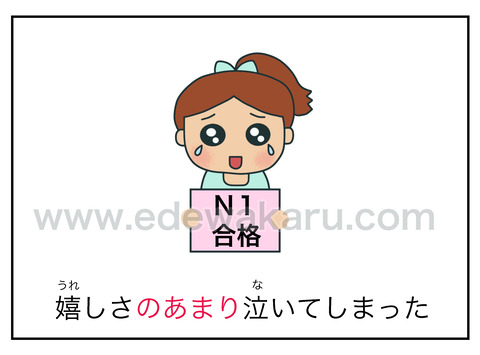
Meaning
とても〜ので
How to use it
動詞[辞書形・た形]+あまり
な形容詞[辞書形]+なあまり
い形容詞名詞化+のあまり(
例:嬉しい→嬉しさ 痛い→痛さ・痛み)
名詞[辞書形]+のあまり
Explanation
「〜あまり」は「とても〜ので」というように、「程度がとてもすごいので〜だ」と原因を表す文型です
😊また、名詞・い形容詞につく場合は次のように書き換えることも可能です。
嬉しさ
のあまり
泣いてしまった→「に」は省略可能
あまりに
嬉しい
ので
泣いてしまった →「に」は省略不可
とても
嬉しかった
ので
泣いてしまった
「〜のあまりに」の「に」は省略可能ですが、「あまりに〜ので」の「に」は省略できませんので気をつけて下さい
😨
よくこの文型を「とても〜」と覚えている人がいますが、これは「原因・理由」のグループに入る文型です。必ず「とても〜ので/から」というように覚えるようにしましょう😉
In context 3 examples
嬉しさのあまり泣いてしまった
→とても嬉しいので泣いてしまった急いだあまり、スマホを忘れてしまった
→とても急いだので、スマホを忘れてしまったきれいなあまり感動してしまった
→とてもきれいだったので感動してしまった
Usage 2
Read this source entry ↗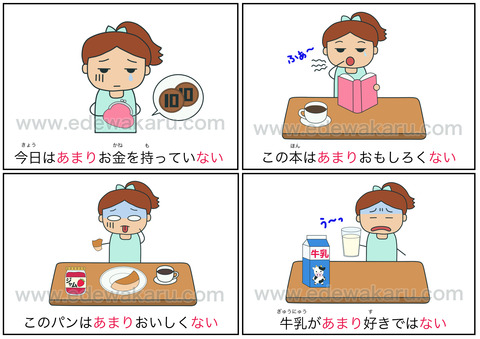
Meaning
程度が高くない
頻度が高くない
量が多くない
How to use it
あまり+動詞[ない形]
あまり+い形容詞[ーくない]
あまり+な形容詞[ーではない]
Explanation
「あまり〜ない」は「程度や頻度が高くない」「量が多くない」という意味を表す文型です。後ろには
否定形
がきます。形容詞に使う場合は「程度が高くない」という意味で、動詞に使うと「程度が高くない・量が多くない」という意味になります😮
[例]
①今日は
あまり
お金を持ってい
ない
→持っているお金の
量が多くない
【「持つ」は動詞】
②この本は
あまり
おもしろく
ない
→「おもしろい」の
程度が高くない
【「おもしろい」は形容詞】
③このパンは
あまり
おいしく
ない
→「おいしい」の
程度が高くない
【「おいしい」は形容詞】
④牛乳が
あまり
好きでは
ない
→「好き」の程度が高くない
【「好き」は形容詞】
⑤最近忙しいので、
あまり
テレビを
見なくなった
→テレビを見る
頻度が高くない
【「見る」は動詞】
⑥このカレーは
あまり
辛く
ない
→「辛い」の
程度が高くない
【「辛い」は形容詞】
⑦お酒が
あまり
飲め
ない
→飲める
量が多くない
【「飲む」は動詞】
「あまり〜ない」はN5の文型ですが、日常会話(にちじょうかいわ)でも、とてもよく使われます😊N2の文型「〜あまり」とは区別して覚えておきましょう。
(復習:〜あまり)
In context 7 examples
今日はあまりお金を持っていない(復習:〜ている(結果の状態))
この本はあまりおもしろくない
このパンはあまりおいしくない
牛乳があまり好きではない
最近忙しいので、あまりテレビを見なくなった
このカレーはあまり辛くない
お酒があまり飲めない
どんなときどう使う 日本語表現文型辞典
Meaning
so… that
How to use it
Nの/V・Aの〔普通形〕(肯定形だけ)(ナAな)+あまり
Explanation
~すぎるので、~すぎるために
「~あまり」の形で、「~の程度が極端なので、普通でない状態やよくない結果になる」と言いたいときの表現。 ❸ ❹ のように「~」には感情を表す言葉が来ることが多い。
Certain limits are extreme so result will be either abnormal or negative. Often expressions of emotion precede あまり, as in sentences ❸ and ❹ .
In context 5 examples
今のオリンピックは勝ち負けを気にするあまり、スポーツマンシップという大切なものをなくしているのではないか。
試験の問題は易しかったのに、考えすぎたあまり、間違えてしまった。
合格の知らせを聞いて、彼女はうれしさのあまり泣き出した。
夫が突然の事故で亡くなった。彼女は悲しみのあまり心の病になってしまった。
K市は開発を優先するあまり、市民の生活の安全を軽視しているのではないか。
日本語NET JLPT文法解説まとめ
Usage 1
Read this source entry ↗Meaning
〜すぎて
程度がすごいことを表す。
How to use it
V(普通形 - 肯定形) + あまり
イA(普通形 - 肯定形) + あまり
ナAな + あまり
Nの + あまり
Explanation
It expresses an extreme degree.
In context 10 examples
田舎に引っ越したばかりのころは、寂しさのあまり友達に毎日のように電話したものだ。
緊張のあまり、上手にプレゼンテーションができなかった。
綺麗なあまり、見惚れてしまった。
大学の入学試験では考えすぎたあまり時間が足りず、最後まで解けなかった。
ジョンさんはJLPT N1に合格し、嬉しさのあまり泣いてしまった。
急いでいたあまりに、大事な書類を家に忘れて来てしまった。
田中さんは残業しすぎたあまり、体を壊し入院することになった。
彼女に振られた悲しみのあまり、食事も喉を通らない。
驚きのあまり、何も言葉が出てこなかった。
母は一人暮らしの私を心配するあまり、毎日のように電話をかけてくる。
Usage 2
Read this source entry ↗Meaning
程度が高くないことを表す文型
How to use it
あまり + V(否定形)
あまり + イA(否定形)
あまり + ナA(否定形)
※必ず否定の形をとる
Explanation
"not very"
Indicates a degree that’s not very high.
When this is used, the adjective is always used with a negative form.
In context 13 examples
あまりFacebookは使いません。
すみません。あまりテレビは見ないので、その話はわかりません。
ホラー映画は苦手ですから、あまり見ません。
昨日はあまり勉強しませんでした。
休みの日はあまり外に出ません。
この映画はあまり面白くないです。
ここの料理はあまり美味しくないですが、とても安いです。
ひらがなはあまり難しくないですが、カタカナは難しいです。
A:テストはどうでしたか?
私の国の電車はあまり便利じゃありません。
お酒はあまり好きじゃありません。
このあたりはあまり静かじゃありませんね。
日本語があまり上手じゃありませんから、英語で話してもいいですか。
毎日のんびり日本語教師
Usage 1
Read this source entry ↗How to use it
名詞+のあまり(に)
動詞+あまり(に)
(ナ形容詞語幹+なあまり)
Explanation
感情、感覚、状態を表す名詞や動詞に接続し、その程度が極端にひどいことを表します。
後件では、前件の程度がひどいために生じた良くない結果が述べられます。
Notes
「あまり」シリーズ
In context 8 examples
激務のあまり、疲れて仕事が捗らない。
高さのあまり足がすくむ。(站的地方太高了吓得我两腿发抖。)
美しさのあまり、彼女ばかりに目が行ってしまう。
痛みのあまり気を失ってしまった。
このゲームは戦略性を追求するあまり、操作が複雑になっている。
恐怖のあまり冷静に物事を考えられなくなっている。
眩しさのあまり彼女を直視できない。
動揺のあまり手が震える。
Usage 2
Read this source entry ↗How to use it
あまりにも+イ形容詞+と
あまりにも+ナ形容詞+だと
あまりにも+動詞+と
Explanation
原因・理由・条件を表します。
後件では、前件の程度がひどいために生じた必然的な結果が述べられます。
「あんまり」は口語における強調です。
Notes
「あまり」シリーズ
In context 3 examples
体に良いからってあんまり飲み過ぎると、逆に健康に良くないよ。
相手があまりに綺麗だと緊張して話せなくなる。
夢があまりにも大きいと実現するのが難しくなる。
Usage 3
Read this source entry ↗How to use it
数字+助数詞+あまり
Explanation
数字につき、その数よりも少し多いことを表します。
正確で細かい数字に接続することはできません。
〇100人
あまり
✕138人
あまり
Notes
「あまり」シリーズ
In context 8 examples
A社は今期5000万円あまりの赤字となる見通しを示した。(A公司表示预计本期将出现5000万日元以上的赤字。)
国連には190か国あまりの国が加盟している。
2週間で2キロあまり痩せた。(两周瘦了两公斤多。)
今日は雪20センチあまり積もった。(今天积了20多厘米的雪。)
10個あまりのりんごが腐って無駄になった。
50匹あまりのミミズを飼っている。(养了50多只蚯蚓。)
首脳会談の警備に警察官3000人あまりが動員された。
このジャングルでは40種類あまりの新種の生物が発見された。
Usage 4
Read this source entry ↗How to use it
あまり/あんまり+ナ形容詞+ではない
あまり/あんまり+イ形容詞語幹+くない
あまり+動ない形
Explanation
形容詞に接続するときはその程度がそれほど高くないことを、動詞に接続するときはその動作の頻度がそれほど多くないことを表します。
「あんまり」は口語における強調です。
後件には必ず否定形が呼応します。
Notes
「あまり」シリーズ
In context 7 examples
最近の曲は正直あまり好きじゃない。
スマホゲームはあまり遊んだことがない。
下品な言葉は私はあまり使わないようにしている。
今あまりお金のない状況だから満足に買い物もできない。
猫パンチはあまり痛くない。
パソコンの性能があまり良くないのですぐ重くなる。
なんか体調があまり良くない。(总觉得身体不太好。)
日本語文型辞典 英語版
Meaning
【あまり】あんまり can be used in spoken language for emphasis.
あまり is followed by a negative expression and indicates that the degree of something is not high. When used with a verb, it indicates that the frequency or quantity is not high.
あまり andあんまり are usually used with adjectives, but in some cases they are used with verbs, as in
(5)
. Both express that the degree of the adjective or verb is excessive. In many cases, あまり expresses a critical or negative feeling, and すぎる often follows it. There are also many cases in whichあまり is followed byて, ので, or から and indicates an inevitable matter caused by an extremely high degree, or a judgment or result that is drawn from it.
b. あまりのN に/で
With nouns that indicate a degree, あまりに expresses “because the degree is too high.” In the latter half of the sentence, an expression of an inevitable result follows.
(×)あまりの宿題に頭が痛くなった。
There was too much homework that I had a headache.
(○)あまりの宿題の多さに頭が痛くなった。
There was so much homework that I got a headache.
c. あまりに(も)...とあんまり(にも)...と
In these cases, あまり indicates an excessive degree of something, and the expression of an inevitable result follows in the latter half of the sentence.
d. ...あまり(に)[Nのあまり(に)][V-るあまり(に)]
When あまりfollows a noun or verb that expresses an emotion or a state, it indicates an extreme degree. The latter half of the sentence describes an unfavorable result that then occurs.
Means “a little more than the number indicated by あまり." It is not used with exact numbers, but with round numbers. It is used in written language.
(×)ベーコンを 235 グラムあまり買った。
I bought a little more than 235 grams of bacon.
(○)ベーコンを 200 グラムあまり買った。
I bought a little more than 200 grams of bacon.
【あんまり】3
How to use it
1. あまり/あんまり ...ない[あまりNa ではない][あまりA-くない][あまりV-ない]
2. あまり/あんまりa. あまりに(も)あんまり(にも)
3. 数量詞+あまり
4. ...なんてあんまりだ→
In context 26 examples
今はあまりおなかがすいていないので、ケーキはいりません。
I am not very hungry, so I don’t need any cake.
弟はあまり背が高くないので、女の子にもてない。
My younger brother is not so tall, so he is not popular with girls.
このごろあんまり映画を見ていない。
I haven’t seen very many movies recently.
けさはあまりごはんを食べなかった。
I didn’t have much for breakfast this morning.
今日はあんまりお金がないので、CDを買うのは今度にしよう。
I don’t have enough money today, so I’ll buy a CD next time.
あまりにおかしくて涙が出た。
It was so funny that tears came to my eyes.
ゆったりしたシャツは好きだが、これはあまりにも大きすぎる。
I like loose-fitting shirts, but this is too big for me.
ここのカレーはあまりにまずくて、とても食べられたものではない。
The curry in this shop is so bad that I just can’t eat it.
その人の申し出はあまりにも急な話だったので、すぐにOKするのはためらわれた。
This person’s offer came all of a sudden, so I hesitated to accept it immediately.
彼があまりに僕の失敗を笑うから、だんだん腹が立ってきてなぐってしまった。
Because he laughed so much at my mistake, I gradually lost my temper and hit him.
あまりの驚きに声も出なかった。
I was so surprised that I couldn’t say a word.
海水浴に行ったが、あまりの人出でぐったり疲れてしまった。
I went bathing in the sea, but it was so crowded that I got exhausted.
あまりの問題の複雑さに、解決策を考える気力もわかない。
This problem is too complicated, so I have no motivation to seek a solution.
あまりの忙しさに、とうとう彼は体をこわして入院するはめになってしまった。
He was so busy that he finally got sick, ending up in the hospital.
あまりボリュームを上げると隣の人が文句を言いに来るから気をつけてね。
Please be careful not to turn the volume up too loud; otherwise, the neighbors will come and complain about it.
あまりに安いとかえって心配だ。
I feel rather uneasy if it is too cheap.
大きいバッグは便利だけど、あまりにも大きいと、中身をたくさん入れすぎて重くなって持ち歩くのがいやになるから、適当な大きさにした方がいいだろう。
A big bag is convenient, but if it’s too big, it’s easy to fill it too full and it’s a headache to carry, so it’s better to have a suitable size.
母は悲しみのあまり、病の床に就いてしまった。
My mother has been sick in bed because of her great sorrow.
彼は驚きのあまりに、手に持っていたカップを落としてしまった。
He was so surprised that he dropped the cup he had in his hand.
忙しさのあまり、友達に電話をしなければならないのをすっかり忘れていた。
I was so busy that I completely forgot to call my friend.
子供のことを心配するあまり、つい下宿に電話しては嫌がられてしまう。
I worry so much about my son that I’m always calling his boarding house, which annoys him.
何とか逆転しようと焦るあまり、かえってミスをたくさん犯してしまった。
I was so impatient to turn the tables by any means possible that I ended up making even more errors than usual.
彼女は彼のことを想うあまりに自分のことを犠牲にしてしまっている。
She is caring for him so much that she is sacrificing herself.
その会の出席者は 100 名あまりだった。
More than one hundred people attended the meeting.
そこから5キロあまりの道のりを歩くだけの元気は残っていなかった。
I had no power left to walk the more than five kilometers from there.
事故発生から2カ月あまりが経って、ようやく原因が突き止められた。
More than two months after the accident, the cause was finally identified.
AIUEO JLPT Grammar
Usage 1
Meaning
「あまり」is an adverb indicating a low degree, often used in negative sentences. In spoken language, it is commonly used as「あんまり」. Similar to "not much” in English.
How to use it
あまり+否定文
Explanation · 日本語
「あまり」は、程度がそれほど高くないことを表す副詞で、主に否定文とともに使用されます。口語では「あんまり」として使われることも多いです。
In context 5 examples
この商品はあまり人気がありません。
This product is not very popular.
今日はあまり暑くありません。
It is not very hot today.
この提案はあまり賛成できません。
We cannot agree with this proposal very much.
この条件はあまり有利ではありません。
These terms are not very advantageous.
ここはあまり賑やかじゃないですね。
It’s not very lively here, is it?
Usage 2
Meaning
This sentence pattern expresses that a certain emotion or action is excessive and causes an unusual result or impact. It is used when emotions or states are extreme.
How to use it
動詞辞書形+あまり (+に)形容動詞な+あまり (+に)名詞の+あまり (+に)
Explanation · 日本語
この文型は、感情や行動、状況が過剰であるために、通常とは異なる結果や影響が生じることを表す表現です。特定の感情や状態が極端である場合に使われます。
In context 5 examples
緊張のあまり、言葉が出なくなった。
I was so nervous that I couldn’t speak.
嬉しさのあまり、涙がこぼれた。
I was so happy that tears fell from my eyes.
怒りのあまり、彼は机を叩いた。
He was so angry that he hit the desk.
悲しみのあまりに、食事も喉を通らなかった。
I was so sad that I couldn’t even eat.
彼は働きすぎたあまりに、体を壊してしまった。
He worked so hard that he ended up damaging his health.
Bunpro Grammar Reference
Usage 1
Meaning
So much...that
How to use it
Verb + あまり + (Negative Result) Phrase
[い]Adjective[さ]+ の + あまり + (Negative Result) Phrase
[い]Adjective[み]+ の + あまり + (Negative Result) Phrase
[な]Adjective + な + あまり + (Negative Result) Phrase
Noun + の + あまり + (Negative Result) Phrase
Nuance
A structure that often highlights an excessive amount of (A) that causes a negative result.
Explanation
As a noun, あまり means 'excess', and refers to an amount of something that is in surplus. This noun is quite often used after many different types of words, to indicate that something happened/exists to an excessive degree (which then resulted in something negative occurring). By itself, 余り is not negative. However, this grammar point can be thought of as a set phrase that is generally used in negative situations.
To use あまり, you will need to attach it to the end of the following structures. A verb, an い-Adjective (that has been turned into a noun through the use of さ or み) followed by の, a な-Adjective followed by な, or a noun followed by の. Then, after あまり, a (B) phrase will highlight what the negative result was.
彼は仕事を終わらせることに集中するあまり、終電を逃しました。
He was so concentrated on finishing his work that he missed the last train.
トムは暑さのあまり、気を失った。
It was so hot that Tom fainted.
彼女は彼と別れて、悲しみのあまりボーっとしている。
She broke up with her boyfriend and is so sad that she is spacing out a lot.
彼は音楽が好きなあまり、仕事を辞めてバンドを作った。
He likes music so much that he quit his job and started a band.
ヤスエは初めてのライブで、緊張のあまり上手く歌えなかった。
Yasue had her first concert, and she was so nervous that she couldn't sing well.
Caution
The tense of the overall sentence will be dependent on the main clause. Therefore, it is common to see the verb before あまり being used in several different tenses.
先輩は飲み会でお酒を沢山飲んだあまり、一人で帰ることができなかった。
Senpai drank so much at the party that he couldn't get home by himself.
最近彼女と別れた友達を心配するあまり、友達の話しを聞きに行った。
I was so worried about my friend, who has broken up with his girlfriend recently, that I went to his place to listen to him vent.
社長は社員全員に恐れられているあまり、誰も社長の提案を否定しない。
The CEO of our company is so feared by all of the workers that no one will criticize his decisions.
Nuance · 日本語
(A)がありすぎて、それにより何か悪いことが起きることを示す表現。
Explanation · 日本語
名詞の「あまり」は、「多すぎて残った物」を意味します。この「あまり」は、さまざまな品詞に付いて、多すぎたり、程度が大きすぎたりすることが原因で、良くないことが起こったことを表すときによく使われます。「余り」自体にマイナスの意味はありませんが、この文法は良くないことに使われることが多いです。
「あまり」は、動詞や「さ」や「み」を使って名詞化したイ形容詞、「な」を付けたナ形容詞の語幹、または「の」を付けた名詞のあとに続けて使います。「あまり」のあとには主に、悪い出来事を表す内容が続きます。
彼は仕事を終わらせることに集中するあまり、終電を逃しました。
He was so concentrated on finishing his work that he missed the last train.
トムは暑さのあまり、気を失った。
It was so hot that Tom fainted.
彼女は彼と別れて、悲しみのあまりボーっとしている。
She broke up with her boyfriend and is so sad that she is spacing out a lot.
彼は音楽が好きなあまり、仕事を辞めてバンドを作った。
He likes music so much that he quit his job and started a band.
ヤスエは初めてのライブで、緊張のあまり上手く歌えなかった。
Yasue had her first concert, and she was so nervous that she couldn't sing well.
注意点
文全体の時制は、主節にある動詞や形容詞の時制で決まるので、「あまり」の前の形は、現在形になったり、過去形になったりします。
先輩は飲み会でお酒を沢山飲んだあまり、一人で帰ることができなかった。
Senpai drank so much at the party that he couldn't get home by himself.
最近彼女と別れた友達を心配するあまり、友達の話しを聞きに行った。
I was so worried about my friend, who has broken up with his girlfriend recently, that I went to his place to listen to him vent.
社長は社員全員に恐れられているあまり、誰も社長の提案を否定しない。
The CEO of our company is so feared by all of the workers that no one will criticize his decisions.
In context 20 examples
- トムは驚きの余り、何も言えなかった。
Tom was so surprised that he was speechless.
- 彼は音楽が好きなあまり、仕事を辞めてバンドを作った。
He likes music so much that he quit his job and started a band.
- 彼は仕事を終わらせることに集中するあまり、終電を逃しました。
He was so concentrated on finishing his work that he missed the last train.
- トムは暑さのあまり、気を失った。
It was so hot that Tom fainted.
- 彼女は彼と別れて、悲しみのあまりボーっとしている。
She broke up with her boyfriend and is so sad that she is spacing out a lot.
- ヤスエは初めてのライブで、緊張のあまり上手く歌えなかった。
Yasue had her first concert, and she was so nervous that she couldn't sing well.
- 美味しさの余り、食べ飽きることはない。
It is so delicious that I can never get tired of eating it.
- 悲しさの余り、言葉を失った。
I was so distraught that I was at a loss for words.
- 苦しさの余り、大きな声を出してしまった。
The pain was so unbearable that I shouted out loud.
- 喜びの余り、涙がとまらない。
I am so overjoyed that I cannot stop crying.
- 感動の余り、鳥肌が立った。
I was so touched that I got goosebumps.
- 旅行が楽しみな余り、今日は寝れなさそう。
I am so excited for my trip that it seems like I won't be able to sleep tonight.
- 怒りの余り、暴言を吐いてしまった。
I was so angry that I said something rash.(so much)
- ある日、王様は食べすぎた余り、立ち上がることができなかった。
One day, the king ate so much that he wasn't able to stand up.
- 金融危機の間、インフレが深刻化する余り、政府は価格を設定し始めた。
During the financial crisis, the inflation was becoming so intense that the government started to regulate the prices. (so much)
- お化け屋敷に入ったけど、怖さの余り、座り込んでしまった。
I went into the haunted house but I was so afraid that I huddled in fear.
- 若い頃、試験のため一生懸命、勉強した余り、とても疲れて、集中できなかった日があった。
When I was young, I studied so hard for an exam that there was a day when I was completely exhausted and I couldn't concentrate.(so much)
- 先輩は飲み会でお酒を沢山飲んだあまり、一人で帰ることができなかった。
Senpai drank so much at the party that he couldn't get home by himself.
- 最近彼女と別れた友達を心配するあまり、友達の話しを聞きに行った。
I was so worried about my friend, who has broken up with his girlfriend recently, that I went to his place to listen to him vent.
- 社長は社員全員に恐れられているあまり、誰も社長の提案を否定しない。
The CEO of our company is so feared by all of the workers that no one will criticize his decisions.
Usage 2
Meaning
Not very, Not much, Not really, Hardly
How to use it
あまり(1) + Verb[ない]
あまり(1) + [い]Adjective[ない]
あまり(1) + Noun + ではない(2)
あまり + [な]Adjective + ではない(2)
(1) あんまり
(2) じゃない
Nuance
A structure indicating that (A) is not an excessive amount, or being done excessively.
Explanation
あまり is a very flexible word in Japanese, that is used in several different grammar points. When paired with the ない form of a word, it translates to 'not very (A)', or 'hardly (A)'. To pair あまり (or the casual form, あんまり) with another word, we just need to place it at the beginning of a phrase, or directly before the ない statement.
今の時間だったらあまり並ばないと思うよ。
At this time, I think we would not have to stand in line for very long.
私には犬がいるからあまり寂しくない。
I have a dog, so I don't feel lonely very much.
最近はどこもあまり平和ではない。
Recently, nowhere has been very peaceful.
そこの肉屋の肉はあまりいい肉ではない。
Meat from that butcher over there is hardly good.
Fun Fact
Although あまり~ない is regularly translated as 'not very' the literal translation is closer to 'not excessively (A)'. This is due to 余り (the kanji which this word comes from), meaning 'excessive', or 'to be in excess'.
あまり has this meaning of 'excessive' in all of its grammar points, and the nuance will only change based on whether the sentence itself is positive (does not use ない), or negative (uses ない).
Nuance · 日本語
(A)が多すぎない、又はやりすぎではないことを表す表現。
In context 16 examples
- このケーキはあまり美味しくない。
This cake isn't very delicious.
- 今の時間だったらあまり並ばないと思うよ。
At this time, I think we would not have to stand in line for very long.
- 私には犬がいるからあまり寂しくない。
I have a dog, so I don't feel lonely very much.
- 最近はどこもあまり平和ではない。
Recently, nowhere has been very peaceful.
- そこの肉屋の肉はあまりいい肉ではない。
Meat from that butcher over there is hardly good.
- あまり肉を食べない。
I don't eat very much meat.
- あまり大変なことではないから、心配いらないよ。
It is not really a big deal, so you don't have to worry. (isn't that)
- 寿司をあまり食べたいと思わない。
I don't really think I want to eat sushi.
- この漢字の意味があまり分かりません。
I don't really understand the meaning of this kanji.
- 彼と時間を過ごすのはあまり好きではない。
I don't enjoy spending time with him very much.
- 彼女は私の気持ちをあまり理解していないと思う。
I think that she doesn't really understand how I feel.
- 最近は彼の事をあまり考えていない。
I haven't been thinking about him very much recently.
- あまりいい車ではないけど、走れるからいいんじゃない?
This car is hardly great, but it runs so that's good enough, right? (not that great)
- あまり好きじゃない食べ物もたまに食べなくてはいけない。
Sometimes you also have to eat food that you don't really enjoy.
- 説明してくれたけど、あまり意味が分からない。
You provided an explanation, but I don't really understand.
- 先生の授業がとても分かりやすかったけど、テストの点数があまり良くなかった。
The teacher's class was really easy to understand, but my test scores were not very good.
文法
Usage 1
Meaning
〜すぎて
程度がすごいことを表す。
How to use it
V(普通形 - 肯定形) + あまり
イA(普通形 - 肯定形) + あまり
ナAな + あまり
Nの + あまり
In context 10 examples
田舎に引っ越したばかりのころは、寂しさのあまり友達に毎日のように電話したものだ。
緊張のあまり、上手にプレゼンテーションができなかった。
綺麗なあまり、見惚れてしまった。
センター試験では考えすぎたあまり時間が足りず、最後まで解けなかった。
ジョンさんはJLPT N1に合格し、嬉しさのあまり泣いてしまった。
急いでいたあまりに、大事な書類を家に忘れて来てしまった。
田中さんは残業しすぎたあまり、体を壊し入院することになった。
彼女に振られた悲しみのあまり、食事も喉を通らない。
驚きのあまり、何も言葉が出てこなかった。
母は一人暮らしの私を心配するあまり、毎日のように電話をかけてくる。
Usage 2
Meaning
程度が高くないことを表す文型
How to use it
あまり + V(否定形)
あまり + イA(否定形)
あまり + ナA(否定形)
※必ず否定の形をとる
In context 13 examples
あまりFacebookは使いません。
すみません。あまりテレビは見ないので、その話はわかりません。
ホラー映画は苦手ですから、あまり見ません。
昨日はあまり勉強しませんでした。
休みの日はあまり外に出ません。
この映画はあまり面白くないです。
ここの料理はあまり美味しくないですが、とても安いです。
ひらがなはあまり難しくないですが、カタカナは難しいです。
A:テストはどうでしたか?
B:あまりよくなかったです。私の国の電車はあまり便利じゃありません。
お酒はあまり好きじゃありません。
このあたりはあまり静かじゃありませんね。
日本語があまり上手じゃありませんから、英語で話してもいいですか。
NINJAL 日本語文型データベース
Meaning
〜の程度が普通ではないことが原因で、ある結果になると言いたいときに使います。結果が予想外だという話し手の気持ちを表します。悪い結果を表すことが多いです。
How to use it
Notes
「〜」には、主に感情・感覚・心理的状態を表す言葉がきます。「~あまり」の後には、結果を表す文がきます。「〜てしまう」をよく使います。話し手の希望・意向を表す文や相手への働きかけの文はきません。
In context 14 examples
結婚を焦るあまり、相性のよくない人を選んでしまって後悔した。
コミュニケーション能力が重視されるあまり、内気な人が人格を否定されるようなことがあってはいけない。
ゲームに熱中しすぎたあまり、徹夜してしまった。
職場の人間関係に疲れたあまり、うつ病になってしまった。
両親の期待が大きいあまり、子どもがストレスに押しつぶされてしまうこともある。
部活の練習がきついあまり、音をあげる部員が続出した。
お金がほしかったあまり、危ない仕事にも手を出してしまった。
部長の言葉が腹立たしかったあまり、椅子を蹴って部屋を飛び出してきた。
子どもが心配なあまり世話を焼きすぎてしまうのは、よくないことだ。
整理整頓が面倒なあまり、ほとんどの物を捨ててしまった。
学生のころは、音楽活動に夢中だったあまり、勉強をおろそかにしてしまった。
面接試験はだめでした。緊張のあまり、質問されたことに対して変な答えを言ってしまったんです。
山道を歩いていたら突然目の前に鹿が現れた。驚きのあまり声も出なかった。
林君がやった先生の口真似は本当によく似ていて、おかしさのあまりみんな吹き出した。
IMABI
Adverbs III
Read this IMABI lesson ↗Explanation
Adverbs III: Syntax Agreement I
呼応の副詞 ※改訂中
There is a subset of adverbs in Japanese whose meanings are discerned by the form of the predicate that follows as part of a set. These adverbs are knowing as syntax-agreeing adverbs (呼応の副詞1). The most common sub-type consists of adverbs which appear with negative predicates (否定文). There are also those within this sub-type which appear in both affirmative predicates (肯定文) and negative predicates, but the interpretation of the sentence, as well as how to translate the adverb into English, will be the exact opposite.
While the negative predicate–agreeing sub-type is incredibly prolific, it is, of course, not the only kind of syntax-agreeing adverbs. In fact, there are eight sub-types, each corresponding to a specific kind of predicate.
Sub-TypePredicate TypeExample
1Negative全然~ない (not at all)
2Declarative必ず~する (certainly do)
3Suppositional多分~だろう (probably)
4Conditionalもし~したら (if… were to)
5Interrogativeなぜ~のか (why?)
6Desireぜひ~ほしい (by all means)
7Metaphoricまるで~ようだ (almost as if)
8Negative Suppositionalまさか~まい (couldn’t possibly)
Up to this point in いまび, we have actually seen quite a few adverbs which fall under sub-types 1-6. To ease the information load of this lesson, we will look at the sub-types 1-4, then we will return to sub-types 5-8 once we have learned more pertinent grammar.
Negative Predicate Agreement
The first sub-type of syntax-agreeing adverbs, negative predicate–agreeing adverbs, as we have learned, are most numerous among all the sub-types, and most of them
AdverbPositiveNegative
全然totally△not at all
絶対にabsolutely/definitelynever
あまりtoo muchnot quite/very/much
とても verysimply cannot
決して never
もはやalreadyno more
少しも not a bit
ちょっとa littlenot readily
1. 絶対に許ゆるさない。
(I) will never allow (this).
(I) will never forgive (you)(for this).
2. 絶対に違ちがう!
Absolutely not, for sure!
Point 3: あまり is more common in negative contexts. あんまり is a colloquial variant due to ん insertion. In positive contexts, it implies that a limit has been passed, making it similar to 非常に (very/greatly/much/quite).
3. あまりうまくない。
I’m not really good.
4. あんまり分かんない。(Colloquial; 東京弁)
I don’t quite understand.
5. あんまり運動うんどうしません。(More spoken)
I don’t exercise much.
6. とても真似できない。
I simply cannot mimic.
7. とても疲れた。
I’m very tired.
8. 中国語はとっても難しい!
Chinese is very difficult!
9. 全然分からない。
I don’t understand at all.
10. このドアは閉しまらないよ。
This door won’t shut.
11. わたしは一切テレビを見ません。
I don’t watch television at all.
12. その日はちょっと…2
That day won’t be feasibly……
あまり vs あんまり vs あまりに(も)
まだ VS 全然/全く
The adverb まだ means “still,” but when it is used with negative predicates, it can also be translated as “yet,” as the action “still” has not occurred. Consequently, many learners confuse まだ with the syntax-agreeing adverbs 全然/全く meaning “not at all.” However, as similar as “not doing X at all” and “having not done X yet” may be, they are not interchangeable concepts, as the examples below demonstrate.
13. まだ雨が降っています。
It’s still raining.
14. 「もう書きましたか」「いいえ、まだ書いていません」
“Have you written it?” “No, I haven’t written it yet.”
15a. まだ寝ねていません。
15b. まだぜんぜん寝ていません。
15a. I still haven’t slept (at all).
15b. I still haven’t slept any. (Have slept but not enough)
16a. まだ寝ない。
16b. 全然寝ない。
16a. I still won’t sleep.
16b. I won’t sleep at all.
17. もう朝なの?まだ全然寝てない。
It’s already morning? But, I still haven’t slept much at all.
While 全く and 全然 are synonymous, the former is taken far more literally in practice. The implication of this is that, at times, 全然 may not, ironically, deny that an action occurred “at all.”
18. きのうは全く寝なかった。 (0 Sleep)
I didn’t sleep at all last night.
19a. きのうは全然寝なかった。 (More Than 0 Sleep?)
19b. きのうは全然寝られなかった。(More Than 0 Sleep?)
19a. I didn’t sleep at all last night.
19b. I couldn’t sleep at all last night.
20. 「はぁー、きのうは全然寝(ら)れなかったよ」「本当に一睡いっすいもしてないの?」「いやー、寝たには寝たけど30分おきに起きちゃってさ」
“Ugh, I didn’t sleep at all last night” “Really? You didn’t sleep a bit?” “Well, I did sleep if that’s what you mean, but I would wake up every thirty minutes”
全然 w/ Affirmative Predicates
When 全然 first began to be used in Japanese as a recent loan from Chinese three centuries ago, it roughly equated to “completely,” and it could be seen in both affirmative and negative sentences. However, upon language reform attempts to standardize the language, it became restricted to negative sentences as a syntax-agreeing adverb. This prescriptive restriction on the use of 全然 has never caught on despite textbooks for natives and second language learners alike refraining from accepting its use with affirmative predications.
While the use of 全然 outside of negative predicates is still frowned upon in formal language, you will encounter many instances of 全然+肯定文 (affirmative predicate) in casual speech.
21. 全然大丈夫!気にもしてないから!
I’m completely okay! It doesn’t bother me at all!
22. 途中参加、途中退室も全然OKなんで、いつでもおこしやす3!
Joining in and/or leaving midway is A-OK, so you’re welcome whenever!
伊達に・・・~ない
Another great of example of syntax agreement can be found with the adverb 伊達に, which by itself means, “ostentatiously/for show,” but in actual practice, it is usually paired with the negative to indicate that the predicate is NOT just for show and that the agent has what it takes. Oftentimes, learners misinterpret the use of ~ない as a tag-question for the affirmative in conjunction with this adverb, which would produce the opposite intended nuance.
23. 伊達に経験豊富ではないということか。
Which would mean, (you) don’t have all that experience just for show!
Implication: The speaker is telling the agent that they do in fact truly have the experience to prove themselves and that it is not all just for show.
These adverbs are also known as 陳述の副詞 (declarative adverb). ↩︎
When people want to decline an invitation, ~はちょっと is often used and accompanied with a reluctant tone. ↩︎
おこしやす is a commonly known dialect phrase used to welcome guests. ↩︎
In context 26 examples
絶対に許ゆるさない。
(I) will never allow (this).
絶対に違ちがう!
Absolutely not, for sure!
あまりうまくない。
I’m not really good.
あんまり分かんない。(Colloquial; 東京弁)
I don’t quite understand.
あんまり運動うんどうしません。(More spoken)
I don’t exercise much.
とても真似できない。
I simply cannot mimic.
とても疲れた。
I’m very tired.
中国語はとっても難しい!
Chinese is very difficult!
全然分からない。
I don’t understand at all.
このドアは閉しまらないよ。
This door won’t shut.
わたしは一切テレビを見ません。
I don’t watch television at all.
その日はちょっと…2
That day won’t be feasibly……
まだ雨が降っています。
It’s still raining.
「もう書きましたか」「いいえ、まだ書いていません」
“Have you written it?” “No, I haven’t written it yet.”
まだ寝ねていません。
15a. I still haven’t slept (at all).
まだぜんぜん寝ていません。
15a. I still haven’t slept (at all).
まだ寝ない。
16a. I still won’t sleep.
全然寝ない。
16a. I still won’t sleep.
もう朝なの?まだ全然寝てない。
It’s already morning? But, I still haven’t slept much at all.
きのうは全く寝なかった。 (0 Sleep)
I didn’t sleep at all last night.
きのうは全然寝なかった。 (More Than 0 Sleep?)
19a. I didn’t sleep at all last night.
きのうは全然寝られなかった。(More Than 0 Sleep?)
19a. I didn’t sleep at all last night.
「はぁー、きのうは全然寝(ら)れなかったよ」「本当に一睡いっすいもしてないの?」「いやー、寝たには寝たけど30分おきに起きちゃってさ」
“Ugh, I didn’t sleep at all last night” “Really? You didn’t sleep a bit?” “Well, I did sleep if that’s what you mean, but I would wake up every thirty minutes”
全然大丈夫!気にもしてないから!
I’m completely okay! It doesn’t bother me at all!
途中参加、途中退室も全然OKなんで、いつでもおこしやす3!
Joining in and/or leaving midway is A-OK, so you’re welcome whenever!
伊達に経験豊富ではないということか。
Which would mean, (you) don’t have all that experience just for show!